

By Ride TypeGCC (Economy Rides, Premium Rides, Luxury Rides, Ride Pooling, Scheduled Rides, Corporate Rides, Airport Transfers), By Booking ChannelGCC (App-Based Booking, Web-Based...... Booking, Corporate Booking, Call Center Booking), By Commute TypeGCC (Intracity, Intercity, Airport Commute, Tourism Commute, Corporate Commute), By Vehicle TypeGCC (Sedans, SUVs, Vans, Electric Vehicles, Hybrid Vehicles, Shuttle Vehicles), By End UserGCC (Individual Users, Corporate Clients, Tourists, Government Clients, Hotel and Hospitality Clients), By Payment MethodGCC (Credit Cards, Debit Cards, Mobile Wallets, Cash Payments, In-App Payments, Corporate Billing), By Revenue ModelGCC (Pay-Per-Ride, Subscription Pass, Corporate Contracts, Commission-Based Platform Model, Fleet Partnership Model), By Service AreaGCC (Urban Areas, Suburban Areas, Airport Zones, Tourist Destinations, Business Districts), and others Read more
- Automotive
- May 2026
- 205
- PDF, Excel, PPT
GCC Ride-Hailing Service Market Report Key Takeaways
- The GCC Ride-Hailing Service Market was valued at approximately USD 2.9 billion in 2025 and is projected to grow from USD 3.3 billion in 2026 to USD 7.1 billion by 2032, registering a CAGR of 13.65% during 2026–2032.
- Saudi Arabia dominates the market with an estimated share of around 50%, driven by rising urban mobility demand, rapid transport digitalization, and increasing adoption of app-based ride-hailing services.
- By ride type, the Economy Rides segment accounts for a significant market share of approximately 52%.
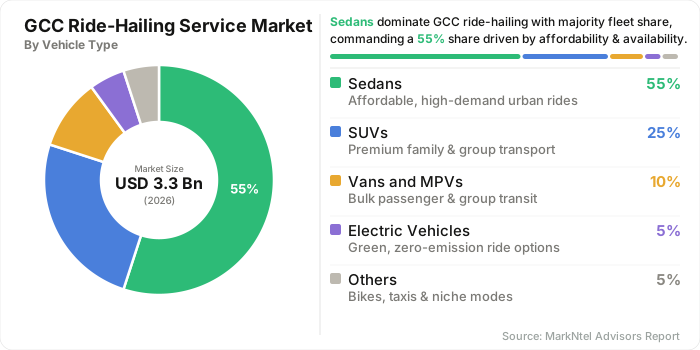
- By vehicle type, the Sedans segment holds a dominant share of nearly 55%.
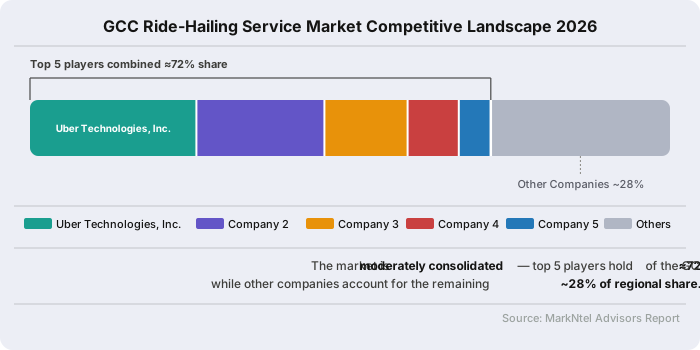
- The market is moderately consolidated, with the top five companies collectively accounting for around 72% of the market share, reflecting the strong presence of leading regional platforms, licensed fleet operators, and digital mobility aggregators.
GCC Ride-Hailing Service Market Size & Outlook
The GCC Ride-Hailing Service Market is expected to register a CAGR of 13.65% during 2026–2032, driven by rising digital booking penetration, increasing urban mobility demand, growing airport-linked travel, expanding corporate computing requirements, and government-led smart transport initiatives across the region. Additionally, the demand is concentrated across urban commuters, business travelers, tourists, airport passengers, hotel and hospitality users, and institutional clients requiring reliable short-distance and point-to-point transport.
According to Saudi Arabia’s Transport General Authority, ride-hailing trips exceeded 32 million in the first quarter of 2026, rising 15.77% year-on-year. This supports the regional expansion case by showing that regulated app-based mobility is moving from convenience-led usage toward high-frequency urban transport adoption in one of the GCC’s largest mobility markets.
Policy direction is strengthening digital booking adoption across ride-hailing services. According to Dubai Taxi Company, its 2025-2029 strategy references the Roads and Transport Authority’s directive to transition 80% of taxi trips to e-booking in the coming years. This directly supports ride-hailing platforms by shifting booking behavior toward digital channels and increasing the value of dispatch technology, fleet integration, and customer-facing applications.
Regional operating scale is becoming a stronger differentiator in ride-hailing competition. According to Careem, rides can be booked 24/7 across 80 cities in 9 countries, including the UAE, KSA, Kuwait, and Bahrain. This reinforces the importance of regional platform scale, cross-border operating familiarity, and category breadth in regional ride-hailing competition.
The GCC ride-hailing service industry outlook remains positive, with the market projected to grow from USD 3.3 billion in 2026 to USD 7.1 billion by 2032, as ride-hailing services become increasingly integrated into regulated taxi ecosystems, airport mobility, tourism corridors, and corporate transportation networks. Future market performance will depend on fleet availability, driver supply, pricing discipline, platform reliability, regulatory compliance, and the ability of operators to integrate electric, hybrid, and autonomous vehicle technologies without compromising service quality.
GCC Ride-Hailing Service Market Key Indicators
- According to Dubai Media Office, Dubai’s taxi sector reached 59.5 million trips in the first half of 2025, compared with 55.7 million in the first half of 2024 . This indicates strong utilization growth in one of the GCC’s most developed taxi and e-hailing markets, supporting higher platform booking density and fleet productivity.
- As per Saudi Arabia’s Ministry of Tourism, the Kingdom welcomed approximately 116 million domestic and inbound tourists in 2024, including nearly 29.7 million international visitors, reflecting an 8.4% increase compared with 2023. Religious tourism accounted for around 41.5% of inbound travel, while leisure tourism contributed 25.2%. The sharp rise in tourist arrivals across pilgrimage destinations, airports, hotels, shopping districts, and entertainment hubs is significantly increasing demand for app-based urban mobility services.
- According to Saudi Arabia’s Communications, Space, and Technology Commission, 5G coverage exceeded 80% nationwide in 2024, while Riyadh recorded over 95% 5G coverage, supporting faster ride-booking, real-time navigation, and seamless driver-passenger connectivity. Moreover, the smartphone penetration in the Kingdom surpassed 97%, enabling widespread adoption of ride-hailing applications and digital mobility platforms.
- Additionally, Saudi Arabia recorded nearly 1.13 billion e-commerce and digital payment transactions in 2024, while over 85% of residents actively used mobile wallets and cashless payment systems such as Mada, STC Pay, and Apple Pay. The rapid expansion of digital infrastructure, mobile internet usage, and cashless transactions is significantly accelerating ride-hailing adoption across major urban centers, including Riyadh, Jeddah, and Dammam.
GCC Ride-Hailing Service Market Scope
| Category | Segments |
|---|---|
| By Ride Type | Economy Rides, Premium Rides, Luxury Rides, Ride Pooling, Scheduled Rides, Corporate Rides, Airport Transfers |
| By Booking Channel | App-Based Booking, Web-Based Booking, Corporate Booking, Call Center Booking |
| By Commute Type | Intracity, Intercity, Airport Commute, Tourism Commute, Corporate Commute |
| By Vehicle Type | Sedans, SUVs, Vans, Electric Vehicles, Hybrid Vehicles, Shuttle Vehicles |
| By End User | Individual Users, Corporate Clients, Tourists, Government Clients, Hotel and Hospitality Clients |
| By Payment Method | Credit Cards, Debit Cards, Mobile Wallets, Cash Payments, In-App Payments, Corporate Billing |
| By Revenue Model | Pay-Per-Ride, Subscription Pass, Corporate Contracts, Commission-Based Platform Model, Fleet Partnership Mode, |
| By Service Area | Urban Areas, Suburban Areas, Airport Zones, Tourist Destinations, Business Districts |
GCC Ride-Hailing Service Market Growth Drivers
Tourism and Air-Linked Mobility Demand Is Strengthening Ride-Hailing Adoption
Tourism growth, aviation connectivity, and expanding business travel activity remain major demand-side drivers for the GCC ride-hailing service industry. These platforms benefit directly from rising visitor inflows, as tourists and corporate travelers increasingly prefer convenient, app-based transportation for travel between airports, hotels, business districts, shopping centers, entertainment venues, and leisure destinations. The growing preference for digitally enabled mobility solutions is strengthening the role of ride-hailing services within the broader urban transportation ecosystem across GCC countries.
According to the Dubai Department of Economy and Tourism, Dubai welcomed approximately 29.7 million international overnight visitors in 2024. The continued rise in international tourism is significantly increasing demand for instantly accessible transportation services, particularly around airports, hospitality hubs, and commercial corridors. This trend is also increasing the importance of multilingual ride-hailing applications, transparent pricing systems, real-time vehicle tracking, and reliable fleet availability to support the mobility expectations of international travelers.
The sharp increase in tourism and business arrivals is further contributing to stronger peak-period mobility demand across GCC cities. Higher passenger traffic during airport arrival windows, large-scale events, exhibitions, religious tourism seasons, and corporate travel periods is driving higher ride volumes and improving driver utilization rates for ride-hailing operators. As a result, platform operators are increasingly focusing on fleet optimization, dynamic pricing strategies, and service reliability to efficiently manage fluctuating urban mobility demand.
The growth in visitor-driven transportation demand is also encouraging stronger partnerships between ride-hailing platforms, taxi operators, hospitality providers, airports, and travel service companies. As GCC economies continue positioning cities such as Dubai, Riyadh, and Doha as global tourism, business, and transit hubs, ride-hailing services are evolving into an essential component of integrated urban mobility infrastructure rather than functioning solely as standalone digital transportation platforms.
Recent Trends
Autonomous Ride-Hailing Is Moving from Pilot Positioning to Commercial Deployment
A major trend shaping the GCC ride-hailing service industry is the growing transition toward autonomous ride-hailing and advanced vehicle automation technologies. Governments across the region are increasingly integrating autonomous mobility into broader smart city and digital transportation strategies, positioning ride-hailing platforms as key enablers of next-generation urban mobility systems. Among GCC countries, Dubai is emerging as a major testing ground for autonomous transportation due to strong regulatory support, smart mobility initiatives, and active collaboration between technology companies and mobility operators.
In February 2026, Uber Technologies and Baidu announced plans to introduce autonomous ride-hailing services in Dubai, initially across selected areas within Jumeirah, with future expansion dependent on operational performance and regulatory approvals. The planned deployment highlights the increasing integration of autonomous vehicle technology within app-based passenger transportation networks in one of the GCC’s most important mobility markets. The initiative also reflects the region’s broader focus on adopting AI-driven transportation systems to enhance urban mobility efficiency and reduce long-term transportation costs.
The emergence of autonomous ride-hailing is gradually reshaping competitive dynamics across the regional mobility ecosystem. Ride-hailing operators are no longer competing solely on pricing strategies, driver availability, and user experience. Competitive differentiation is increasingly influenced by access to autonomous vehicle technology partnerships, regulatory approvals, safety management systems, data capabilities, and the ability to integrate driverless mobility services into existing ride categories. As a result, strategic collaborations between ride-hailing companies, automotive manufacturers, AI developers, and government agencies are becoming increasingly important across the GCC market.
Autonomous ride-hailing adoption across the GCC is expected to progress gradually rather than transform the market immediately. Early deployment phases will likely remain concentrated within approved operational zones, premium mobility corridors, airports, tourism districts, and smart city projects where infrastructure readiness and regulatory oversight are stronger. Over the long term, autonomous mobility solutions are expected to improve fleet operating efficiency, support sustainability and smart-city objectives, and create new technology-enabled transportation segments. However, broader commercialization will continue to depend on regulatory confidence, insurance frameworks, infrastructure readiness, cybersecurity standards, and public acceptance of driverless transportation services.
GCC Ride-Hailing Service Market Opportunities & Challenges
Regulatory Complexity Creates Opportunity for Compliant Mobility Platforms
A key challenge in the market is regulatory complexity. Ride-hailing platforms must comply with licensing rules, driver requirements, passenger safety standards, fare oversight, data governance, airport access rules, and city-level transport policies. As new models such as shared app-based rides, autonomous vehicles, and electric fleets expand, compliance requirements become more demanding.
This challenge creates an opportunity within the GCC ride-hailing service Industry for licensed platforms, fleet operators, and mobility technology providers that can work directly with regulators. Companies with stronger compliance systems, verified driver networks, transparent pricing, safety controls, and government-aligned operating models can differentiate themselves from informal or weakly regulated transport providers.
According to Saudi Arabia’s Transport General Authority, it operates a regulatory sandbox that allows innovation-driven companies to test transport technologies, products, services, and methodologies in a controlled real-life environment. The sandbox allows companies to test new transport models, collaborate with regulators, and test business models for up to 12 months before graduation, supporting compliant innovation in app-based mobility.
Segmentation Insights
Economy Ride Services Dominating Owing to Strong Mass-Market Urban Commuting Demand
Economy ride services lead the GCC ride-hailing service industry, accounting for approximately 52% of the overall market share, primarily due to their strong alignment with high-frequency urban mobility requirements. These services are widely used for daily commuting, short-distance intra-city travel, airport connectivity, and cost-sensitive app-based transportation, making them the preferred ride category for a large portion of the population. In highly competitive urban markets, economy ride segments play a critical role in sustaining trip volumes, improving driver utilization rates, and supporting consistent platform engagement.
The dominance of economy ride categories is further supported by improvements in operational efficiency and faster pickup performance across regional mobility platforms. According to the Dubai Media Office, approximately 74% of Hala Taxi trips in H1 2025 recorded estimated vehicle arrival times of under 3.5 minutes, compared with nearly 70% of trips arriving within four minutes during H1 2024. Reduced waiting times significantly enhance user convenience and platform reliability, particularly for routine mobility requirements where affordability and quick access remain key decision-making factors.
Economy ride categories are also strengthening platform scalability by anchoring demand around affordable and dependable daily transportation services. Their lower fare structure enables ride-hailing operators to attract a broader consumer base, including students, office commuters, tourists, and middle-income urban residents. High trip frequency within economy segments supports stronger app engagement, better fleet utilization, and increased driver activity across densely populated cities.
As a result, economy ride services remain central to market expansion strategies across the GCC Ride-Hailing ecosystem. Operators continue prioritizing fleet availability, route optimization, and pricing efficiency within economy segments to strengthen market penetration and maintain competitiveness across major urban centers. Based on Ride Type, the market is segmented into:
- Economy Rides
- Premium Rides
- Luxury Rides
- Ride Pooling
- Scheduled Rides
- Corporate Rides
- Airport Transfers
Sedan Vehicles Leading Due to Higher Preference for Cost-Efficient and Everyday Mobility Services
Sedan vehicles lead the GCC ride-hailing service market, accounting for approximately 55% of the total market share, primarily due to their strong suitability for core ride-hailing operations. Sedans offer an optimal balance between passenger comfort, operational efficiency, urban maneuverability, and cost-effectiveness, making them highly preferred across economy, comfort, airport transfer, and corporate ride categories. Their moderate seating capacity and lower operating costs compared with larger vehicle formats enable ride-hailing operators to maintain efficient fleet utilization while supporting high-frequency urban transportation demand.
The dominance of sedan vehicles is further supported by the growing transition toward electric mobility within regional taxi and ride-hailing fleets. According to Dubai Taxi Company, its partnership with Al-Futtaim Electric Mobility in April 2025 included the deployment of 200 all-electric BYD SEAL taxis across Dubai’s transportation network. The BYD SEAL sedan offers an estimated driving range of up to 600 kilometers per charge, making it highly suitable for high-utilization ride-hailing and taxi operations where energy efficiency, operational range, passenger comfort, and fleet productivity are critical considerations.
Sedans also provide fleet operators with greater operational flexibility across multiple mobility applications, including app-based ride-hailing services, traditional taxi operations, airport transfers, and scheduled corporate transportation. Their adaptability enables operators to efficiently allocate vehicles across different pricing categories and trip requirements without significantly increasing fleet complexity or operating costs.
As the GCC Ride-Hailing industry continues to expand, sedan vehicles are expected to remain the preferred fleet category due to their compatibility with evolving mobility trends, including electric vehicle adoption, smart fleet management systems, and sustainability-focused transportation policies. Fleet procurement strategies are increasingly prioritizing factors such as fuel efficiency, EV readiness, maintenance optimization, passenger comfort, and seamless integration with digital ride-hailing platforms, further reinforcing the long-term dominance of sedans within the regional mobility ecosystem. Based on Vehicle Type, the market is segmented into:
- Sedans
- SUVs
- Vans and MPVs
- Electric Vehicles
- Hybrid Vehicles
- Shuttle and Mini-Bus Vehicles
GCC Ride-Hailing Service Market Geographical Outlook
Saudi Arabia leads the GCC ride-hailing service industry with about 50% share, supported by large urban centers, strong app-based mobility demand, aviation expansion, and active regulatory oversight of passenger transport. Riyadh, Jeddah, Makkah, Madinah, and the Eastern Province generate dense trip corridors across commuting, airport access, religious travel, business mobility, and urban leisure movement.
According to the Transport General Authority, Saudi Arabia’s ride-hailing sector reached 39.04 million trips in Q3 2025, rising 78% year-on-year. Riyadh accounted for 43.9% of these trips, followed by Makkah at 22.13% and the Eastern Province at 14.5%, showing how major urban and religious mobility centers drive platform usage.
The country’s aviation base also supports ride-hailing demand. According to Saudi Arabia’s General Authority of Civil Aviation, Saudi airports handled more than 128 million passengers in 2024, including 59 million domestic and 69 million international passengers. Higher passenger throughout increases demand for regulated airport rides, app-based pickup coordination, and reliable mobility between airports, hotels, event venues, and city centers.
GCC Ride-Hailing Service Market Competitive Analysis
The GCC ride-hailing service industry is moderately consolidated, with the top five companies accounting for about 72% combined share. Large platforms and licensed fleet operators hold structural advantages because they can scale app usage, secure vehicle availability, build airport and city partnerships, maintain driver networks, and invest in service quality across multiple ride categories.
Key Companies in the GCC Ride-Hailing Service Market
- Uber Technologies Inc.
- Careem Networks FZ-LLC
- Dubai Taxi Company PJSC
- Electronic Speed Trading Company LLC
- Bolt Technology OÜ
- Yango Group
- Suol Innovations Ltd
- Kaiian Co.
- Ego
- Mowasalat (Karwa) Q.P.S.C.
- Zed Mobility
- Blacklane GmbH
GCC Ride-Hailing Service Market Industry News and Recent Developments
May 2026: Dubai Taxi Company and Bolt Launch Bolt School in Dubai
Dubai Taxi Company, in collaboration with Bolt, launched Bolt School in Dubai as a dedicated ride category for safer and more structured school commutes. The service initially covers 90% of school areas across Dubai and allows scheduled rides through the Bolt app, supporting the recurring, safety-focused mobility demand.
Impact Analysis:The launch expands ride-hailing beyond standard point-to-point transport into recurring scheduled mobility use cases. It strengthens platform engagement, improves fleet utilization during school commute windows, and creates a differentiated service category within Dubai’s app-based mobility ecosystem.
April 2026: Dubai Taxi Company Expands Fleet with 600 New Taxi Plates
Dubai Taxi Company acquired 600 new taxi plates through the latest RTA auction, increasing its taxi fleet from 6,217 to 6,817 vehicles. The phased rollout is scheduled to begin in July 2026 and is designed to meet rising mobility demand across Dubai, directly strengthening fleet supply for app-based and taxi-linked ride-hailing services.
Impact Analysis:This expansion increases supply capacity and supports shorter wait times in a high-demand urban market. It also strengthens DTC’s competitive position in app-linked taxi services and gives platform partners deeper fleet availability for e-hailing integration.
September 2025: Dubai Taxi Company, Kabi, Bolt, and Zed Form E-Hailing Alliance
Dubai Taxi Company, together with Bolt, entered into a strategic alliance with Kabi by Al Ghurair and Zed to expand e-hailing services in Dubai. Under the agreement, 6,200 DTC taxi vehicles and 3,680 Kabi taxi vehicles were integrated into Bolt and Zed platforms, increasing digitally bookable taxi capacity in the GCC Ride-Hailing Service Market.
Impact Analysis: The alliance directly increases digitally bookable taxi capacity and improves ride availability across Dubai. It intensifies competition among app-based platforms while supporting a more integrated taxi and ride-hailing ecosystem.
- Market Segmentation
- Introduction
- Product Definition
- Research Process
- Assumptions
- Executive Summary
- GCC Ride-Hailing Market Policies, Regulations, and Product Standards
- GCC Ride-Hailing Market Trends & Developments
- GCC Ride-Hailing Market Dynamics
- Growth Factors
- Challenges
- GCC Ride-Hailing Market Hotspot & Opportunities
- GCC Ride-Hailing Market Outlook, 2022-2032F
- Market Size & Outlook
- By Revenues (USD Million)
- Market Share & Outlook
- By Ride Type- Market Size & Forecast 2022-2032, USD Million
- Economy Rides
- Premium Rides
- Luxury Rides
- Ride Pooling
- Scheduled Rides
- Corporate Rides
- Airport Transfers
- By Booking Channel- Market Size & Forecast 2022-2032, USD Million
- App-Based Booking
- Web-Based Booking
- Corporate Booking
- Call Center Booking
- By Commute Type- Market Size & Forecast 2022-2032, USD Million
- Intracity
- Intercity
- Airport Commute
- Tourism Commute
- Corporate Commute
- By Vehicle Type- Market Size & Forecast 2022-2032, USD Million
- Sedans
- SUVs
- Vans
- Electric Vehicles
- Hybrid Vehicles
- Shuttle Vehicles
- By End User- Market Size & Forecast 2022-2032, USD Million
- Individual Users
- Corporate Clients
- Tourists
- Government Clients
- Hotel and Hospitality Clients
- By Payment Method- Market Size & Forecast 2022-2032, USD Million
- Credit Cards
- Debit Cards
- Mobile Wallets
- Cash Payments
- In-App Payments
- Corporate Billing
- By Revenue Model- Market Size & Forecast 2022-2032, USD Million
- Pay-Per-Ride
- Subscription Pass
- Corporate Contracts
- Commission-Based Platform Model
- Fleet Partnership Model
- By Service Area- Market Size & Forecast 2022-2032, USD Million
- Urban Areas
- Suburban Areas
- Airport Zones
- Tourist Destinations
- Business Districts
- By Country- Market Size & Forecast 2022-2032, USD Million
- Saudi Arabia
- United Arab Emirates
- Qatar
- Kuwait
- Oman
- Bahrain
- By Company
- Competition Characteristics
- Market Share & Analysis
- By Ride Type- Market Size & Forecast 2022-2032, USD Million
- Market Size & Outlook
- GCC Economy Rides Market Outlook, 2022-2032
- Market Size & Outlook
- By Revenues (USD Million)
- Market Share & Outlook
- By Booking Channel- Market Size & Forecast 2022-2032, USD Million
- By Commute Type- Market Size & Forecast 2022-2032, USD Million
- By Vehicle Type- Market Size & Forecast 2022-2032, USD Million
- By End User- Market Size & Forecast 2022-2032, USD Million
- By Payment Method- Market Size & Forecast 2022-2032, USD Million
- By Revenue Model- Market Size & Forecast 2022-2032, USD Million
- By Service Area- Market Size & Forecast 2022-2032, USD Million
- By Country- Market Size & Forecast 2022-2032, USD Million
- Market Size & Outlook
- GCC Premium Rides Market Outlook, 2022-2032
- Market Size & Outlook
- By Revenues (USD Million)
- Market Share & Outlook
- By Booking Channel- Market Size & Forecast 2022-2032, USD Million
- By Commute Type- Market Size & Forecast 2022-2032, USD Million
- By Vehicle Type- Market Size & Forecast 2022-2032, USD Million
- By End User- Market Size & Forecast 2022-2032, USD Million
- By Payment Method- Market Size & Forecast 2022-2032, USD Million
- By Revenue Model- Market Size & Forecast 2022-2032, USD Million
- By Service Area- Market Size & Forecast 2022-2032, USD Million
- By Country- Market Size & Forecast 2022-2032, USD Million
- Market Size & Outlook
- GCC Luxury Rides Market Outlook, 2022-2032
- Market Size & Outlook
- By Revenues (USD Million)
- Market Share & Outlook
- By Booking Channel- Market Size & Forecast 2022-2032, USD Million
- By Commute Type- Market Size & Forecast 2022-2032, USD Million
- By Vehicle Type- Market Size & Forecast 2022-2032, USD Million
- By End User- Market Size & Forecast 2022-2032, USD Million
- By Payment Method- Market Size & Forecast 2022-2032, USD Million
- By Revenue Model- Market Size & Forecast 2022-2032, USD Million
- By Service Area- Market Size & Forecast 2022-2032, USD Million
- By Country- Market Size & Forecast 2022-2032, USD Million
- Market Size & Outlook
- GCC Ride Pooling Market Outlook, 2022-2032
- Market Size & Outlook
- By Revenues (USD Million)
- Market Share & Outlook
- By Booking Channel- Market Size & Forecast 2022-2032, USD Million
- By Commute Type- Market Size & Forecast 2022-2032, USD Million
- By Vehicle Type- Market Size & Forecast 2022-2032, USD Million
- By End User- Market Size & Forecast 2022-2032, USD Million
- By Payment Method- Market Size & Forecast 2022-2032, USD Million
- By Revenue Model- Market Size & Forecast 2022-2032, USD Million
- By Service Area- Market Size & Forecast 2022-2032, USD Million
- By Country- Market Size & Forecast 2022-2032, USD Million
- Market Size & Outlook
- GCC Scheduled Rides Market Outlook, 2022-2032
- Market Size & Outlook
- By Revenues (USD Million)
- Market Share & Outlook
- By Booking Channel- Market Size & Forecast 2022-2032, USD Million
- By Commute Type- Market Size & Forecast 2022-2032, USD Million
- By Vehicle Type- Market Size & Forecast 2022-2032, USD Million
- By End User- Market Size & Forecast 2022-2032, USD Million
- By Payment Method- Market Size & Forecast 2022-2032, USD Million
- By Revenue Model- Market Size & Forecast 2022-2032, USD Million
- By Service Area- Market Size & Forecast 2022-2032, USD Million
- By Country- Market Size & Forecast 2022-2032, USD Million
- Market Size & Outlook
- GCC Corporate Rides Market Outlook, 2022-2032
- Market Size & Outlook
- By Revenues (USD Million)
- Market Share & Outlook
- By Booking Channel- Market Size & Forecast 2022-2032, USD Million
- By Commute Type- Market Size & Forecast 2022-2032, USD Million
- By Vehicle Type- Market Size & Forecast 2022-2032, USD Million
- By End User- Market Size & Forecast 2022-2032, USD Million
- By Payment Method- Market Size & Forecast 2022-2032, USD Million
- By Revenue Model- Market Size & Forecast 2022-2032, USD Million
- By Service Area- Market Size & Forecast 2022-2032, USD Million
- By Country- Market Size & Forecast 2022-2032, USD Million
- Market Size & Outlook
- GCC Airport Transfers Market Outlook, 2022-2032
- Market Size & Outlook
- By Revenues (USD Million)
- Market Share & Outlook
- By Booking Channel- Market Size & Forecast 2022-2032, USD Million
- By Commute Type- Market Size & Forecast 2022-2032, USD Million
- By Vehicle Type- Market Size & Forecast 2022-2032, USD Million
- By End User- Market Size & Forecast 2022-2032, USD Million
- By Payment Method- Market Size & Forecast 2022-2032, USD Million
- By Revenue Model- Market Size & Forecast 2022-2032, USD Million
- By Service Area- Market Size & Forecast 2022-2032, USD Million
- By Country- Market Size & Forecast 2022-2032, USD Million
- Market Size & Outlook
- GCC Ride-Hailing Market Key Strategic Imperatives for Success & Growth
- Competitive Outlook
- Company Profiles
- Uber Technologies Inc.
- Business Description
- Product Portfolio
- Collaborations & Alliances
- Recent Developments
- Financial Details
- Others
- Careem Networks FZ-LLC
- Business Description
- Product Portfolio
- Collaborations & Alliances
- Recent Developments
- Financial Details
- Others
- Dubai Taxi Company PJSC
- Business Description
- Product Portfolio
- Collaborations & Alliances
- Recent Developments
- Financial Details
- Others
- Electronic Speed Trading Company LLC
- Business Description
- Product Portfolio
- Collaborations & Alliances
- Recent Developments
- Financial Details
- Others
- Bolt Technology OÜ
- Business Description
- Product Portfolio
- Collaborations & Alliances
- Recent Developments
- Financial Details
- Others
- Yango Group
- Business Description
- Product Portfolio
- Collaborations & Alliances
- Recent Developments
- Financial Details
- Others
- Suol Innovations Ltd
- Business Description
- Product Portfolio
- Collaborations & Alliances
- Recent Developments
- Financial Details
- Others
- Kaiian Co.
- Business Description
- Product Portfolio
- Collaborations & Alliances
- Recent Developments
- Financial Details
- Others
- Ego
- Business Description
- Product Portfolio
- Collaborations & Alliances
- Recent Developments
- Financial Details
- Others
- Mowasalat (Karwa) Q.P.S.C.
- Business Description
- Product Portfolio
- Collaborations & Alliances
- Recent Developments
- Financial Details
- Others
- Zed Mobility
- Business Description
- Product Portfolio
- Collaborations & Alliances
- Recent Developments
- Financial Details
- Others
- Blacklane GmbH
- Business Description
- Product Portfolio
- Collaborations & Alliances
- Recent Developments
- Financial Details
- Others
- Uber Technologies Inc.
- Company Profiles
- Disclaimer

MarkNtel Advisors follows a robust and iterative research methodology designed to ensure maximum accuracy and minimize deviation in market estimates and forecasts. Our approach combines both bottom-up and top-down techniques to effectively segment and quantify various aspects of the market. A consistent feature across all our research reports is data triangulation, which examines the market from three distinct perspectives to validate findings. Key components of our research process include:
1. Scope & Research Design At the outset, MarkNtel Advisors define the research objectives and formulate pertinent questions. This phase involves determining the type of research—qualitative or quantitative—and designing a methodology that outlines data collection methods, target demographics, and analytical tools. They also establish timelines and budgets to ensure the research aligns with client goals.
2. Sample Selection and Data Collection In this stage, the firm identifies the target audience and determines the appropriate sample size to ensure representativeness. They employ various sampling methods, such as random or stratified sampling, based on the research objectives. Data collection is carried out using tools like surveys, interviews, and observations, ensuring the gathered data is reliable and relevant.
3. Data Analysis and Validation Once data is collected, MarkNtel Advisors undertake a rigorous analysis process. This includes cleaning the data to remove inconsistencies, employing statistical software for quantitative analysis, and thematic analysis for qualitative data. Validation steps are taken to ensure the accuracy and reliability of the findings, minimizing biases and errors.

4. Data Forecast and FinalizationThe final phase involves forecasting future market trends based on the analyzed data. MarkNtel Advisors utilize predictive modeling and time series analysis to anticipate market behaviors. The insights are then compiled into comprehensive reports, featuring visual aids like charts and graphs, and include strategic recommendations to inform client decision-making
FILL THE FORM TO GET THE FREE SAMPLE PAGES
We offer flexible licensing options to cater to varying organizational needs. Choose the pricing pack that best suits your requirements:
Buy Now Inquire Before Buying
 Talk to our Consultant
 Request Customization