

By Product Type (Natural Flavors, Synthetic Flavors), By Form (Liquid, Dry), By Flavor Profile (Fruit Flavors, Brown and Sweet Flavors, Dairy and Cream Flavors, Savory Flavors, Her......bs, Spices and Botanical Flavors, Mint, Cooling and Refreshing Flavors, Other Flavor Profiles), By Application (Beverages, Dairy and Frozen Desserts, Bakery, Confectionery, Savory Foods and Snacks, Meat, Seafood and Alternative Proteins, Nutrition Products and Food Supplements, Other Applications), and others Read more
- Food & Beverages
- Aug 2026
- 245
- PDF, Excel, PPT
GCC Flavor Ingredients Market Key Takeaways
- The GCC flavor ingredients market is expected to rise from USD 430 million in 2025 to USD 453 million in 2026, and is further projected to reach USD 618 million by 2032.
- The industry is projected to witness steady growth at a 5.31% CAGR.
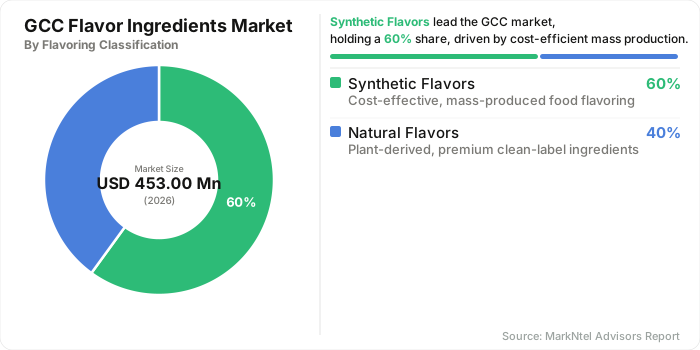
- Synthetic flavors represent the leading flavoring classification, accounting for an estimated 60% market share in 2026.
- Beverages lead by application, accounting for an estimated 33% market share in 2026.
- Saudi Arabia is the leading regional market, with an estimated 44% market share in 2026.
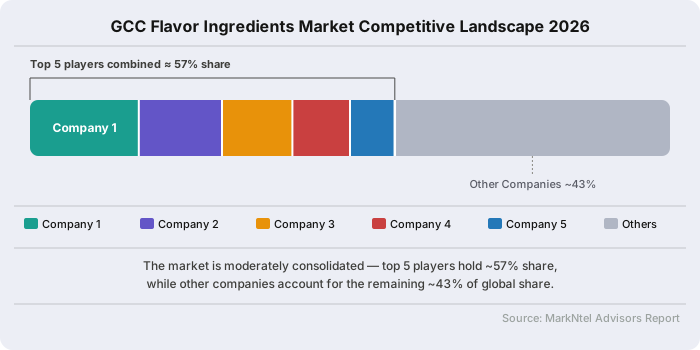
- The market is moderately concentrated, with the top five companies collectively accounting for an estimated 57% market share.
GCC Flavor Ingredients Market Size and Outlook
The flavor ingredients market in the GCC was valued at an estimated USD 430 million in 2025 and is projected to reach approximately USD 453 million in 2026. It is forecast to expand at a CAGR of around 5.31% during 2026–2032, reaching nearly USD 618 million by 2032.
Market expansion is supported by a growing food-processing base that generates recurring demand across beverages, dairy products, bakery, confectionery, savory foods, and processed proteins. Saudi Arabia had more than 1,900 food factories in 2025, backed by investments exceeding approximately USD 23.47 billion, according to the Ministry of Industry and Mineral Resources. The UAE provides a complementary manufacturing and regional-distribution base: more than 570 food and beverage processors produced approximately 5.96 million metric tons in 2025 while relying substantially on imported commodities and ingredients. Together, these processing ecosystems increase the number of commercial recipes requiring liquid and dry flavors, reaction systems, application testing, and consistent flavor performance across industrial production runs.
Through 2032, demand is expected to shift gradually toward natural profiles, locally relevant fruit, nut, botanical and savory flavors, and systems that preserve taste in reduced-sugar, reduced-salt or fortified products. Imported aroma chemicals, extracts and proprietary compounds will keep companies exposed to freight, agricultural-price and lead-time volatility, while different national registration and labeling requirements can extend qualification cycles. Market growth should therefore combine rising flavor volumes with moderate price realization and increasing value migration toward customized, encapsulated and application-specific systems.
GCC Flavor Ingredients Market Key Indicators
- GCC Statistical Centre (GCC-Stat) reported the region’s population at 61.2 million in 2024, up 2.1 million from 2023. The larger, highly urbanized consumer base expands repeat demand across packaged beverages, dairy, bakery and savory foods, increasing the number of formulations and flavor variants required by regional manufacturers.
- The GCC General Secretariat, citing GCC-Stat, recorded more than 72 million tourists and nearly USD 120 billion in tourism receipts during 2024. This visitor throughput enlarges hotel, restaurant, catering and travel-retail volumes, supporting demand for differentiated beverage, dessert, bakery and savory flavor systems.
- Saudi food exports increased approximately 60% from SAR 13 billion (USD 3.47 billion) in 2021 to SAR 22 billion (USD 5.87 billion) in 2025, according to the National Industrial Development Center. Export growth raises requirements for scalable, shelf-stable flavors meeting multiple destination preferences and regulations.
- Qatar’s Ministry of Municipality reported approximately 98% self-sufficiency in fresh dairy and derivatives through 2024, according to the Qatar News Agency. A stable domestic processing base supports recurring demand for dairy, fruit, vanilla, chocolate and indulgent profiles across milk drinks, yogurts, ice cream and adjacent products.
- Oman’s National Centre for Statistics and Information recorded a 1.8% year-on-year increase in producer prices for food products, beverages and textiles in the first quarter of 2026. Rising cost pressure heightens manufacturers’ focus on dosage efficiency and reformulation, favoring technically supported flavor systems that preserve sensory performance.
GCC Flavor Ingredients Market Downstream Industry Analysis
Localized Multi-Category Processing Expands the Addressable Formulation Base
Food manufacturing across the GCC is shifting from trading-led supply toward localized, export-capable processing, particularly in the UAE and Saudi Arabia. Jebel Ali Free Zone (Jafza) reported in March 2025 that its Dubai ecosystem accommodated more than 760 food and beverage companies and that the zone’s food trade had expanded by 12% annually over the preceding five years. This concentration supports shorter development cycles between processors, ingredient suppliers and application laboratories. It also increases the number of regionally tailored formulations required across beverages, dairy, bakery, sauces, snacks, processed proteins and foodservice products.
Investment is broadening this downstream base from production capacity to product innovation. In January 2026, Solico Group opened its approximately USD 35.4 million SoFood facility in Jafza with initial capacity of 40 tons per day. The first phase covers meat and protein products, while later phases are planned for cheese, dairy, premixes, sauces and co-packed hotel, airline and foodservice solutions. Each additional category creates separate flavor briefs, stability requirements and taste-localization needs. Through 2032, multi-category plants serving several GCC markets should favor flavor suppliers offering rapid prototyping, halal-compliant documentation, application support and liquid, dry or encapsulated systems adapted to regional distribution conditions.
GCC Flavor Ingredients Market Scope
| Category | Segments |
|---|---|
| By Product Type | Natural Flavors, Synthetic Flavors |
| By Form | Liquid, Dry |
| By Flavor Profile | Fruit Flavors, Brown and Sweet Flavors, Dairy and Cream Flavors, Savory Flavors, Herbs, Spices and Botanical Flavors, Mint, Cooling and Refreshing Flavors, Other Flavor Profiles |
| By Application | Beverages, Dairy and Frozen Desserts, Bakery, Confectionery, Savory Foods and Snacks, Meat, Seafood and Alternative Proteins, Nutrition Products and Food Supplements, Other Applications |
GCC Flavor Ingredients Market Growth Drivers
Expanding Processed-Food Capacity Broadens Cross-Category Flavor Demand
Expansion of GCC food manufacturing increases flavor demand through higher production volumes and a larger number of commercial recipes. Saudi Arabia plans to attract USD 20 billion in food-industry investment by 2035, with poultry, dairy, bakery, confectionery, beverages and juices identified as principal beneficiaries. The government expects the domestic food sector to rise from USD 41 billion in 2019 to USD 57 billion by 2030. As processors add product lines and serving formats, they require character flavors, masking or taste modulation, and repeatable sensory performance across locally sold and exported products.
Capacity additions demonstrate how this mechanism reaches ingredient procurement. In January 2026, leading global meatpacker JBS announced that it would double output at its new Jeddah chicken-processing plant by year-end; the facility had already quadrupled the company’s Saudi capacity and was exporting to Kuwait, Oman and the UAE. Higher output and wider regional distribution create recurring requirements for marinades, seasoning profiles, smoke and grilled notes, umami systems and country-specific variants. It illustrates broader capacity expansion across the identified downstream categories. Through 2032, flavor suppliers combining scalable production, application support and consistent batch performance should capture more development briefs from expanding GCC processors.
Recent Trends
Heritage Flavors Are Moving into Contemporary Cross-Category Formats
Flavor innovation in the GCC increasingly combines cultural familiarity with novelty rather than replacing traditional profiles. PwC’s 2025 survey of 2,624 consumers across Saudi Arabia, the UAE, Qatar and Egypt found that more than 30% mostly consumed traditional food, compared with 19% globally; over 40% were also open to dishes from other cultures. This dual preference encourages manufacturers to reinterpret regional profiles in convenient or premium formats. Kerry’s 2026 Taste Charts place date among dominant sweet and snack profiles, while za’atar and sumac are emerging in snacks and sauces.
Commercial launches demonstrate that heritage-led concepts can scale rapidly. In May 2025, Mars Gulf introduced Galaxy Pistachio Kunafa exclusively in the UAE and Qatar, combining milk chocolate, pistachio and a crisp kunafa center. The product moved from development to sale in four months, becoming Mars Gulf’s first fast-tracked Middle Eastern innovation. A retail-media campaign sold 17,122 units to 8,745 shoppers and generated fourteen-times return on advertising expenditure. The response shows that regional cues can support premium pricing, limited editions and faster concept-to-shelf cycles. Through 2032, suppliers able to translate heritage profiles across confectionery, dairy, beverages, bakery and savory applications should gain more customization work and defend stronger value per formulation.
GCC Flavor Ingredients Market Opportunities and Challenges
Import Dependence Constrains Supply Resilience While Driving Regional Formulation Support
Dependence on imported specialty flavor mixtures exposes GCC processors to freight disruption, currency movements and concentrated overseas sourcing. In 2025, Saudi Arabia imported USD 128 million and 8,400 tons of mixtures for food and drink; Germany, Denmark, UK, and Netherlands supplied 50+% of import value. Oman imported USD 35 million and 1,800 tons, with Ireland contributing nearly 63% of value. A disruption affecting a qualified formulation can delay production, require expensive airfreight, and trigger reformulation, stability work and regulatory-document updates, pressuring margins and service levels for processors operating short innovation cycles.
Suppliers are responding by placing creation and application capabilities nearer customers. In February 2026, Robertet inaugurated its regional headquarters at Dubai Science Park with laboratories, evaluation rooms and a ‘Flavour Hub’ tailoring solutions for beverage, dairy, sweet and savory applications. Such facilities cannot remove dependence on imported aroma chemicals, but can shorten brief-to-sample cycles, validate performance in local products and coordinate regional stock. The commercial opportunity is therefore broader than selling flavor compounds: suppliers can monetize safety-stock programs, dual-sourced formulations, application testing, halal and regulatory documentation, and rapid reformulation services. Through 2032, providers combining global sourcing with GCC-based technical teams and inventory should win higher retention and service value than exporters offering finished formulations alone.
Segmentation Insights
Synthetic Flavors Maintain Leadership Through Cost and Batch Consistency, Accounting for an Estimated 60% Market Share in 2026
Synthetic flavors remain central to mass-produced foods because they provide repeatable sensory profiles, strong heat and storage stability, dependable availability and lower formulation costs. These advantages are important across bakery, confectionery, beverages, dairy products, powdered mixes and savory foods, where manufacturers must reproduce the same taste over large batches and shelf lives. Synthetic systems also permit precise intensity adjustment and can restore notes weakened by baking, drying, pasteurization or reduced-sugar formulation, widening their use beyond low-cost products.
The operating scale and launch cadence of GCC F&B manufacturers reinforce these requirements. UAE-based Agthia recorded approx. USD 1.31 billion in revenue during 2025, while revenue from innovation increased 31% to approx. USD 56.6 million through new launches across water, snacking, protein and agri categories. Supporting multiple launches at scale favors consistent, processing-stable and cost-controlled flavor systems. Natural flavors should nevertheless grow faster through 2032 as clean-label positioning expands. Their higher input costs, agricultural variability and stability challenges should prevent them from overtaking synthetic flavors during the forecast period, while encouraging hybrid formulations that balance label appeal with cost and performance. Based on flavoring classification, the GCC flavor ingredients market is segmented into:
- Natural Flavors
- Synthetic Flavors
Beverages Lead Through Broad Formulation Demand and Frequent Reformulation, Accounting for an Estimated 33% Market Share in 2026
Flavor ingredients are used across carbonated drinks, juices and nectars, energy and sports drinks, flavored waters, dairy beverages, and plant-based alternatives. This breadth creates more formulation briefs than most individual food applications. Liquid products also expose small sensory inconsistencies immediately, requiring precise solubility, stability and batch-to-batch flavor performance. Sugar reduction, vitamin or protein fortification and the use of botanical actives can introduce bitterness or aftertaste, generating additional demand for masking, modulation and mouthfeel-supporting systems.
Regional F&B giant Almarai’s 2025 results illustrate the scale of this addressable base in Saudi Arabia. Its Juice and Beverage business generated SAR 1.79 billion (USD 476 million), achieved a 46.6% share of the Saudi juice category and reached 82.9% household penetration with a purchase frequency of eight times annually. This supports recurring requirements for fruit, citrus, dairy and botanical profiles across established products and portfolio extensions. Dairy and frozen desserts remain the second-largest application, but beverages should retain leadership through 2032 as tiered sugar taxes, functional positioning, and premium juice demand increase the frequency and technical complexity of reformulation. Based on application, the GCC flavor ingredients market is segmented into:
- Beverages
- Dairy and Frozen Desserts
- Bakery
- Confectionery
- Savory Foods and Snacks
- Meat, Seafood and Alternative Proteins
- Nutrition Products and Food Supplements
- Other Applications
GCC Flavor Ingredients Market Geographical Outlook
Saudi Arabia is estimated to account for 44% market share in 2026, supported by the GCC’s largest domestic food-processing and consumer base. Demand extends across beverages, dairy products, bakery, confectionery, snacks, culinary foods, meat products, and nutrition formulations, allowing suppliers to serve multiple application cycles. Leading food and dairy manufacturer SADAFCO’s 2025 performance illustrates this scale: it generated approx. USD 800 million in sales, launched 32 new SKUs and held category shares of 58.4% in UHT milk, 51.3% in tomato paste and 30.5% in ice cream. These categories require dairy, fruit, vanilla, sweet and savory profiles alongside masking and processing-stable systems. Saudi Arabia should therefore retain leadership through 2032 as large processors expand portfolios and local production.
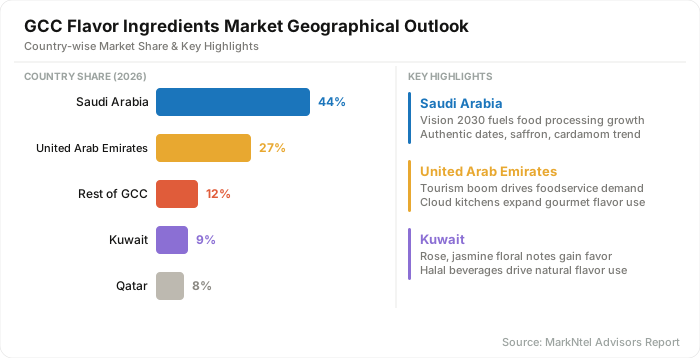
The UAE should record the fastest growth in GCC flavor ingredients industry due to its concentration of manufacturers, regional distribution infrastructure and product-development capabilities. Dubai Industrial City attracted more than AED 350 million (USD 95.3 million) in food and beverage investment during 2024, including over 25 customers leasing 1.7 million square feet. Associated projects include a dairy-products facility designed for more than 100,000 tons of annual output and an ice-cream plant commissioned in May 2025 scheduled to raise annual capacity to 50 million liters in 2026. These investments create direct requirements for dairy, chocolate, vanilla, fruit, nut and locally adapted flavor systems. The UAE should consequently gain share through export-oriented production and rapid commercialization, although Saudi Arabia’s larger demand base should preserve its regional lead.
GCC Flavor Ingredients Market Competitive Analysis
GCC flavor ingredients market is moderately concentrated, with the top five companies holding an estimated 57% market share. The top five players in the market are Givaudan SA, dsm-firmenich AG, International Flavors & Fragrances Inc., Symrise AG, and Kerry Group plc.
Key Companies in the GCC Flavor Ingredients Market
- Givaudan SA
- dsm-firmenich AG
- International Flavors & Fragrances Inc. (IFF)
- Symrise AG
- Kerry Group plc
- Dohler GmbH
- MANE Group
- Sensient Technologies Corporation
- Archer-Daniels-Midland Company (ADM)
- Takasago International Corporation
- Robertet SA
- Bell Flavors & Fragrances, Inc.
- Aromatech SAS
- Gulf Flavours & Fragrances FZCO
- Jean Niel SAS
- Others
GCC Flavor Ingredients Industry News and Recent Developments
-
December 2025 | Kerry Signs Agreement for Regional Customer Co-Creation Centre in Dubai
Kerry signed a long-term lease agreement with Expo City Dubai to establish a Regional Customer Co-Creation Centre. The planned facility will serve as a regional research, development and applications hub, supporting food and beverage manufacturers from initial concepts through commercialization. It will showcase Kerry capabilities across taste, proactive health, enzymes, food protection and preservation.
Impact analysis: Locating co-creation capabilities in the GCC should shorten sampling and reformulation cycles, improve access to application support and allow solutions to be validated against regional taste, nutrition and processing requirements before scale-up.
-
November 2025 | Givaudan Introduces Myromi Digital Aroma Device at Gulfood Manufacturing
At Gulfood Manufacturing 2025 in Dubai, Givaudan unveiled Myromi for the first time at the event. The handheld digital aroma device can blend as many as eight aromas immediately and collect instant feedback through its interface. Designed for use in laboratories, offices or mobile settings, the technology supports direct co-creation with customers and consumers.
Impact analysis: Real-time testing can reduce communication gaps among flavorists, manufacturers and consumers, enabling faster screening of locally relevant profiles and shortening the route from customer brief to validated formulation.
-
October 2025 | Symrise Announces Regionally Validated Digital Flavor-Development Program
Symrise announced that its Gulfood Manufacturing 2025 program in Dubai would combine Symvision AI, the Open Innovation Persona App and Symlife taste-balancing solutions. The portfolio covered snacks, culinary products, beverages, sweet goods and dairy, with concepts tailored to five locally inspired consumer personas and supported by regional research and local validation.
Impact analysis: Integrating prediction, taste balancing and local validation can help manufacturers narrow flavor and claim options before scale-up, reduce unsuccessful formulation iterations and accelerate market entry. It also raises competition around data-supported development rather than flavor supply alone.
-
October 2025 | Dohler Introduces Region-Specific Sugar-Reduction and Functional Concepts
Dohler announced a Dubai showcase of sugar-reduced and functional food and beverage concepts built around its natural taste, flavor and taste-modulation portfolio. The program included next-generation reduced-sugar beverages, savory labneh, energy yoghurt, synbiotic bars and pre- and postbiotic soft drinks, with the beverage concepts specifically framed around regional sugar-tax changes.
Impact analysis: These application-ready prototypes demonstrate how flavor ingredients can compensate for sweetness and sensory losses during reformulation. They can help GCC manufacturers shorten product-development cycles and respond to health, taxation and functional-nutrition requirements across several categories.
- Market Segmentation
- Introduction
- Product Definition
- Research Process
- Assumptions
- Executive Summary
- GCC Flavor Ingredients Market Downstream Industry Analysis
- GCC Flavor Ingredients Market Policies, Regulations, and Product Standards
- GCC Flavor Ingredients Market Trends & Developments
- GCC Flavor Ingredients Market Dynamics
- Growth Factors
- Challenges
- GCC Flavor Ingredients Market Hotspot & Opportunities
- GCC Flavor Ingredients Market Outlook, 2022-2032
- Market Size & Outlook
- By Revenues (USD Million)
- By Quantity Sold (Thousand Tons)
- Market Segmentation & Outlook
- By Product Type- Market Size & Forecast 2022-2032, USD Million & Thousand Tons
- Natural Flavors
- Synthetic Flavors
- By Form- Market Size & Forecast 2022-2032, USD Million & Thousand Tons
- Liquid
- Dry
- By Flavor Profile- Market Size & Forecast 2022-2032, USD Million & Thousand Tons
- Fruit Flavors
- Brown and Sweet Flavors
- Dairy and Cream Flavors
- Savory Flavors
- Herbs, Spices and Botanical Flavors
- Mint, Cooling and Refreshing Flavors
- Other Flavor Profiles
- By Application- Market Size & Forecast 2022-2032, USD Million & Thousand Tons
- Beverages
- Dairy and Frozen Desserts
- Bakery
- Confectionery
- Savory Foods and Snacks
- Meat, Seafood and Alternative Proteins
- Nutrition Products and Food Supplements
- Other Applications
- By Country
- Saudi Arabia
- United Arab Emirates
- Kuwait
- Qatar
- Oman
- Bahrain
- By Company
- Competition Characteristics
- Market Share & Analysis
- By Product Type- Market Size & Forecast 2022-2032, USD Million & Thousand Tons
- Market Size & Outlook
- Saudi Arabia Flavor Ingredients Market Outlook, 2022-2032
- Market Size & Outlook
- By Revenues (USD Million)
- By Quantity Sold (Thousand Tons)
- Market Segmentation & Outlook
- By Product Type- Market Size & Forecast 2022-2032, USD Million & Thousand Tons
- By Form- Market Size & Forecast 2022-2032, USD Million & Thousand Tons
- By Flavor Profile- Market Size & Forecast 2022-2032, USD Million & Thousand Tons
- By Application- Market Size & Forecast 2022-2032, USD Million & Thousand Tons
- Market Size & Outlook
- United Arab Emirates Flavor Ingredients Market Outlook, 2022-2032
- Market Size & Outlook
- By Revenues (USD Million)
- By Quantity Sold (Thousand Tons)
- Market Segmentation & Outlook
- By Product Type- Market Size & Forecast 2022-2032, USD Million & Thousand Tons
- By Form- Market Size & Forecast 2022-2032, USD Million & Thousand Tons
- By Flavor Profile- Market Size & Forecast 2022-2032, USD Million & Thousand Tons
- By Application- Market Size & Forecast 2022-2032, USD Million & Thousand Tons
- Market Size & Outlook
- Kuwait Flavor Ingredients Market Outlook, 2022-2032
- Market Size & Outlook
- By Revenues (USD Million)
- By Quantity Sold (Thousand Tons)
- Market Segmentation & Outlook
- By Product Type- Market Size & Forecast 2022-2032, USD Million & Thousand Tons
- By Form- Market Size & Forecast 2022-2032, USD Million & Thousand Tons
- By Flavor Profile- Market Size & Forecast 2022-2032, USD Million & Thousand Tons
- By Application- Market Size & Forecast 2022-2032, USD Million & Thousand Tons
- Market Size & Outlook
- Qatar Flavor Ingredients Market Outlook, 2022-2032
- Market Size & Outlook
- By Revenues (USD Million)
- By Quantity Sold (Thousand Tons)
- Market Segmentation & Outlook
- By Product Type- Market Size & Forecast 2022-2032, USD Million & Thousand Tons
- By Form- Market Size & Forecast 2022-2032, USD Million & Thousand Tons
- By Flavor Profile- Market Size & Forecast 2022-2032, USD Million & Thousand Tons
- By Application- Market Size & Forecast 2022-2032, USD Million & Thousand Tons
- Market Size & Outlook
- Oman Flavor Ingredients Market Outlook, 2022-2032
- Market Size & Outlook
- By Revenues (USD Million)
- By Quantity Sold (Thousand Tons)
- Market Segmentation & Outlook
- By Product Type- Market Size & Forecast 2022-2032, USD Million & Thousand Tons
- By Form- Market Size & Forecast 2022-2032, USD Million & Thousand Tons
- By Flavor Profile- Market Size & Forecast 2022-2032, USD Million & Thousand Tons
- By Application- Market Size & Forecast 2022-2032, USD Million & Thousand Tons
- Market Size & Outlook
- Bahrain Flavor Ingredients Market Outlook, 2022-2032
- Market Size & Outlook
- By Revenues (USD Million)
- By Quantity Sold (Thousand Tons)
- Market Segmentation & Outlook
- By Product Type- Market Size & Forecast 2022-2032, USD Million & Thousand Tons
- By Form- Market Size & Forecast 2022-2032, USD Million & Thousand Tons
- By Flavor Profile- Market Size & Forecast 2022-2032, USD Million & Thousand Tons
- By Application- Market Size & Forecast 2022-2032, USD Million & Thousand Tons
- Market Size & Outlook
- GCC Flavor Ingredients Market Key Strategic Imperatives for Success & Growth
- Competitive Outlook
- Company Profiles
- Givaudan SA
- Business Description
- Product Portfolio
- Collaborations & Alliances
- Recent Developments
- Financial Details
- Others
- dsm-firmenich AG
- Business Description
- Product Portfolio
- Collaborations & Alliances
- Recent Developments
- Financial Details
- Others
- International Flavors & Fragrances Inc. (IFF)
- Business Description
- Product Portfolio
- Collaborations & Alliances
- Recent Developments
- Financial Details
- Others
- Symrise AG
- Business Description
- Product Portfolio
- Collaborations & Alliances
- Recent Developments
- Financial Details
- Others
- Kerry Group plc
- Business Description
- Product Portfolio
- Collaborations & Alliances
- Recent Developments
- Financial Details
- Others
- Dohler GmbH
- Business Description
- Product Portfolio
- Collaborations & Alliances
- Recent Developments
- Financial Details
- Others
- MANE Group
- Business Description
- Product Portfolio
- Collaborations & Alliances
- Recent Developments
- Financial Details
- Others
- Sensient Technologies Corporation
- Business Description
- Product Portfolio
- Collaborations & Alliances
- Recent Developments
- Financial Details
- Others
- Archer-Daniels-Midland Company (ADM)
- Business Description
- Product Portfolio
- Collaborations & Alliances
- Recent Developments
- Financial Details
- Others
- Takasago International Corporation
- Business Description
- Product Portfolio
- Collaborations & Alliances
- Recent Developments
- Financial Details
- Others
- Robertet SA
- Business Description
- Product Portfolio
- Collaborations & Alliances
- Recent Developments
- Financial Details
- Others
- Bell Flavors & Fragrances, Inc.
- Business Description
- Product Portfolio
- Collaborations & Alliances
- Recent Developments
- Financial Details
- Others
- Aromatech SAS
- Business Description
- Product Portfolio
- Collaborations & Alliances
- Recent Developments
- Financial Details
- Others
- Gulf Flavours & Fragrances FZCO
- Business Description
- Product Portfolio
- Collaborations & Alliances
- Recent Developments
- Financial Details
- Others
- Jean Niel SAS
- Business Description
- Product Portfolio
- Collaborations & Alliances
- Recent Developments
- Financial Details
- Others
- Others
- Givaudan SA
- Company Profiles
- Disclaimer

MarkNtel Advisors follows a robust and iterative research methodology designed to ensure maximum accuracy and minimize deviation in market estimates and forecasts. Our approach combines both bottom-up and top-down techniques to effectively segment and quantify various aspects of the market. A consistent feature across all our research reports is data triangulation, which examines the market from three distinct perspectives to validate findings. Key components of our research process include:
1. Scope & Research Design At the outset, MarkNtel Advisors define the research objectives and formulate pertinent questions. This phase involves determining the type of research—qualitative or quantitative—and designing a methodology that outlines data collection methods, target demographics, and analytical tools. They also establish timelines and budgets to ensure the research aligns with client goals.
2. Sample Selection and Data Collection In this stage, the firm identifies the target audience and determines the appropriate sample size to ensure representativeness. They employ various sampling methods, such as random or stratified sampling, based on the research objectives. Data collection is carried out using tools like surveys, interviews, and observations, ensuring the gathered data is reliable and relevant.
3. Data Analysis and Validation Once data is collected, MarkNtel Advisors undertake a rigorous analysis process. This includes cleaning the data to remove inconsistencies, employing statistical software for quantitative analysis, and thematic analysis for qualitative data. Validation steps are taken to ensure the accuracy and reliability of the findings, minimizing biases and errors.

4. Data Forecast and FinalizationThe final phase involves forecasting future market trends based on the analyzed data. MarkNtel Advisors utilize predictive modeling and time series analysis to anticipate market behaviors. The insights are then compiled into comprehensive reports, featuring visual aids like charts and graphs, and include strategic recommendations to inform client decision-making
FILL THE FORM TO GET THE FREE SAMPLE PAGES
We offer flexible licensing options to cater to varying organizational needs. Choose the pricing pack that best suits your requirements:
Buy Now Inquire Before Buying
 Talk to our Consultant
 Request Customization