

GCC Juice Market Research Report: Forecast (2026-2032)
GCC Juice Market - By Product Type Fruit Juice (Fresh Juice Fortified Juice Fruit Nectars) Vegetable Juice Fruit and Vegetable Blends By Source Not from Concentrate (NFC) From Co ... ncentrate (FC) By Packaging Cartons (Tetra Pak) (Single-Serve Packs Family Packs) PET Bottles (Small-Size Bottles Large-Size Bottles) Glass Bottles Cans Others By Distribution Channel Off-Trade (Retail) (Supermarkets & Hypermarkets Convenience Stores Traditional Grocery) On-Trade (HoReCa) (Hotels Restaurants & Cafes) Online Retail By End User (Household, Hotels, Restaurants, and Cafes (HoReCa), Institutional, Industrial), and others Read more
- Food & Beverages
- Mar 2026
- Pages 165
- Report Format: PDF, Excel, PPT
GCC Juice Market
Projected 6.72% CAGR from 2026 to 2032
Study Period
2026-2032
Market Size (2026)
USD 5.47 Billion
Market Size (2032)
USD 8.08 Billion
Base Year
2025
Projected CAGR
6.72%
Leading Segments
By Packaging: Carton (Tetra Pak)
GCC Juice Market Report Key Takeaways:
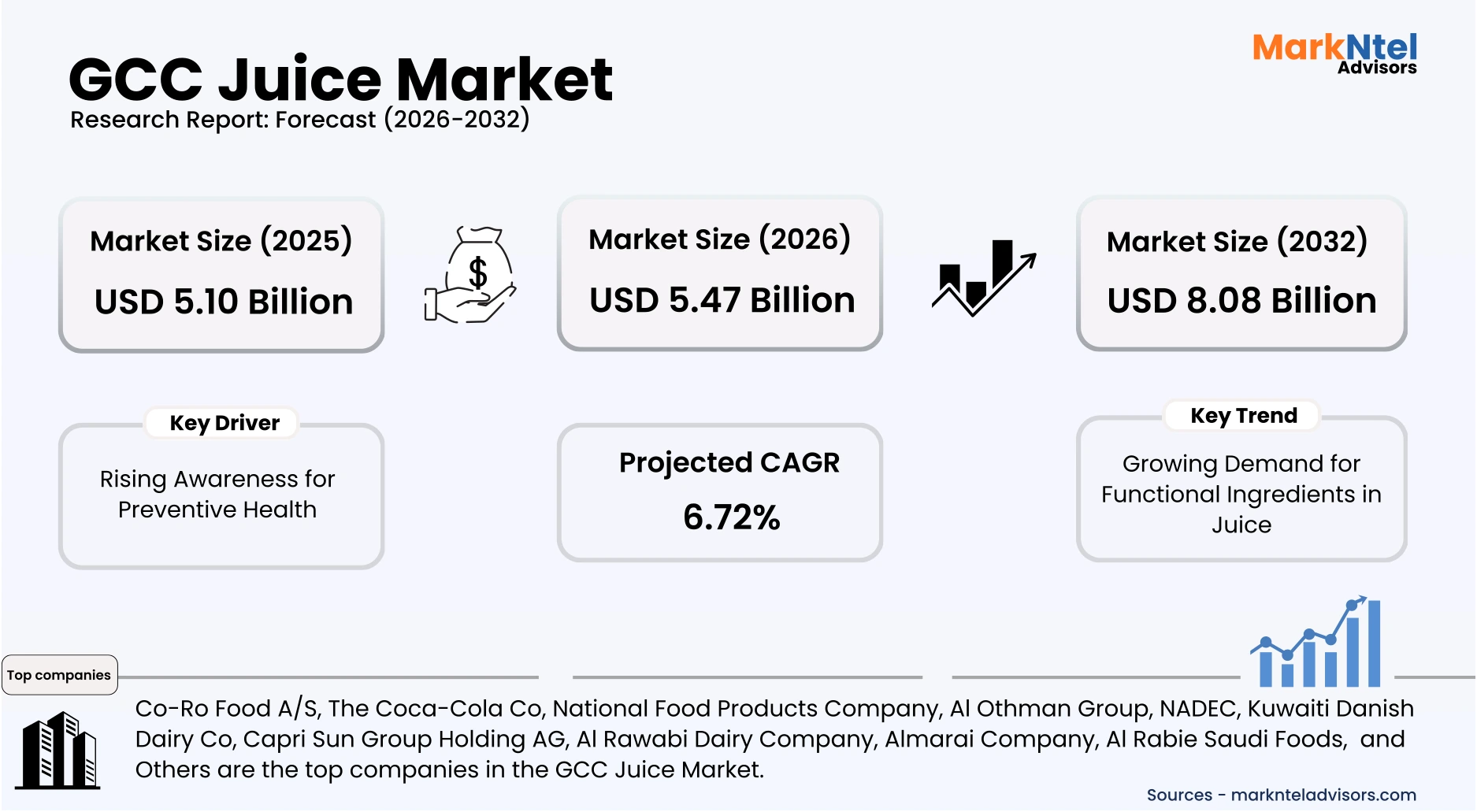
- Market size was valued at around USD 5.10 billion in 2025 and is projected grow from USD 5.47 billion in 2026 to USD 8.08 billion by 2032. The estimated CAGR by revenue from 2026 to 2032 is around 6.72%, and the CAGR by Volume is about 2.87%, indicating strong growth.
- Saudi Arabia dominates the GCC juice market, accounting for more than 48% of the regional market share in 2026 and is projected to grow at a steady CAGR of around 2.11% in the coming years.
- By Product Type, Fruit Juice represented a significant share of about 74% in the GCC Juice Market in 2026. Meanwhile, the Nectar segment is also growing at a CAGR of approximately 8.89% in Saudi Arabia.
- By Packaging, the Cartons (Tetra Packs) segment represented a major share of nearly 48% of the GCC Juice Market in 2026.
- Leading Juice companies in GCC are Co-Ro Food A/S, The Coca-Cola Co, National Food Products Company, Al Othman Group, NADEC, Kuwaiti Danish Dairy Co, Capri Sun Group Holding AG, Al Rawabi Dairy Company, Almarai Company, Al Rabie Saudi Foods, National Agricultural Development Company, Al Ain Dairy Co, Gulf Union Foods, Arrow Juice Factory, Barakat Vegetables & Fruits, and Others.
Market Insights & Analysis: GCC Juice Market (2026-32):
The GCC Juice Market size was valued at around USD 5.10 billion in 2025 and is projected grow from USD 5.47 billion in 2026 to USD 8.08 billion by 2032. Along with this, the market is estimated to grow at a CAGR of around 6.72% during the forecast period, i.e., 2026-32.
The GCC Juice Market remains positive, supported by a combination of climatic, demographic, regulatory, and structural factors that collectively sustain long-term demand. For instance, persistently high temperatures across the region drive year-round consumption of non-carbonated beverages, while rapid urbanization and long working hours encourage reliance on packaged juices for convenience and hydration. This is reinforced by expanding cold-chain infrastructure and modern retail penetration, which ensure wider availability of chilled and fresh juice formats across urban and semi-urban areas.
Additionally, health awareness and regulatory intervention are reshaping consumption patterns. For reference, calorie-labelling requirements and sugar-reduction initiatives in Saudi Arabia are encouraging consumers to shift toward reduced-sugar, fortified, and functional juices. Larger manufacturers are better positioned to respond due to stronger R&D capabilities and reformulation capacity. This advantage contributes to market concentration. The Saudi juice market is highly consolidated, with the top five companies accounting for around 60% of market value and nearly 64% of market volume. Leading players such as Almarai, Al Rabie Saudi Foods, Nada Dairy, Saudia Dairy, and Foodstuff Company (SADAFCO), and Nadec continue to strengthen their positions through distribution scale and portfolio diversification.
Moreover, supply-side constraints further support the outlook. Limited domestic fruit cultivation keeps Saudi Arabia reliant on imports. For instance, fruit juice imports were valued at millions of dollars. These are the contributing factors for the market growth.
GCC Juice Market Recent Developments:
- 2025: Tetra Pak Arabia announced a major partnership with Al Rabie Saudi Foods Co. during Gulfood, following an agreement signed in November 2024. The three-year collaboration aims to modernize and digitize Al Rabie’s production facilities in Saudi Arabia, supporting efficiency improvements in the juices, nectars, and still drinks (JNSD) segment.
- 2024: Barakat introduced a range of ready-to-drink mocktails made from real fruit with no added sugary syrups in the UAE market, including Green Appletini, Peach Bellini, Raspberry Margarita, and Lime Blue Lagoon, expanding clean-label beverage offerings.
GCC Juice Market Scope:
| Category | Segments |
|---|---|
| By Product Type | Fruit Juice (Fresh Juice Fortified Juice Fruit Nectars) Vegetable Juice Fruit and Vegetable Blends |
| By Source | Not from Concentrate (NFC) From Concentrate (FC) By Packaging Cartons (Tetra Pak) (Single-Serve Packs Family Packs) PET Bottles (Small-Size Bottles Large-Size Bottles) Glass Bottles Cans Others |
| By Distribution Channel | Off-Trade (Retail) (Supermarkets & Hypermarkets Convenience Stores Traditional Grocery) On-Trade (HoReCa) (Hotels Restaurants & Cafes) Online Retail |
| By End User | (Household, Hotels, Restaurants, and Cafes (HoReCa), Institutional, Industrial), and others |
GCC Juice Market Driver:
Rising Awareness for Preventive Health
Preventive health awareness drives GCC juice demand most strongly when it is supported by consistent fruit availability and measurable consumption patterns, turning policy intent into everyday purchasing behavior. For instance, Saudi Arabia produces over 3 million tonnes of fruit annually, ensuring a steady raw material supply for domestic juice manufacturing and reducing dependence on imports. This production base enables regular juice availability at affordable price points. For instance, FAOSTAT food balance sheets show high per-capita fruit and fruit-juice availability across GCC countries, reflecting routine intake through households, institutional catering, and foodservice rather than occasional consumption.
In parallel, the UAE’s high fruit import capacity and modern retail penetration ensure year-round fruit and juice access, supporting frequent consumption in urban, convenience-driven lifestyles. For instance, Kuwait and Qatar also report elevated fruit availability per person, reinforced by high incomes, centralized food imports, and widespread institutional catering in schools, workplaces, and hospitals.
These supply conditions align with WHO and national health guidance, which encourages fruit intake while reducing added sugar amid adult diabetes prevalence of roughly 15–20% across the GCC . As consumers respond, demand increasingly shifts toward 100% juice and no-added-sugar variants rather than sweetened soft drinks. As a result, health awareness translates directly into volume demand because production capacity, availability, and consumption habits already support juice as a daily nutrition source, making this driver structurally embedded in the GCC juice market.
GCC Juice Market Trend:
Growing Demand for Functional Ingredients in Juice
The increasing demand for functional ingredients in the GCC Juice Market is being shaped by a convergence of health regulation, institutional wellness standards, and evolving consumer preferences, prompting manufacturers to reposition juice as a nutritional beverage rather than a sugary refreshment. Governments in Saudi Arabia and the UAE are actively promoting sugar reduction and healthier diets, reinforcing demand for juices that deliver added functional value, such as vitamins, minerals, and natural fruit compounds.
In response, companies are reformulating and launching products that combine lower sugar content with enhanced nutritional benefits. This shift is evident in recent product introductions focused on functional hydration and health-oriented beverage formulations. For instance, in 2024, iPRO launched its healthy hydration beverages in Saudi Arabia through a partnership with Al Rabie Saudi Foods Company, introducing functional drinks enriched with vitamins and electrolytes to support active lifestyles and wellness-focused consumers.
Similarly, iPRO introduced its Healthy Juice Drink range in the UAE in 2024, formulated with real fruit and functional hydration benefits, bringing three exciting flavors, Orange & Mango Twist, Berry Mix, and Tropical Burst, before expanding functional beverage distribution in Saudi Arabia through local partnerships in 2025. Such launches are reinforced by demand from airlines, hospitality, and modern retail, which increasingly prioritize health-aligned beverage offerings.
GCC Juice Market Challenges:
Regulatory Pressure Linked to Sugar Reduction
Regulatory pressure linked to sugar reduction has become a central structural challenge for the GCC juice market because it affects every stage of the value chain simultaneously. Governments in Saudi Arabia and the UAE have announced a shift from flat excise duties to tiered, sugar-content-based taxation effective from January 1, 2026, under which beverages are taxed per liter based on grams of sugar per 100 ml . This policy change directly links product formulation to tax liability, making sugar levels a decisive cost factor rather than a purely nutritional consideration. As a result, juice manufacturers are compelled to reformulate existing products to fall into lower tax brackets.
Lowering sugar often requires higher fruit content, premium concentrates, or alternative ingredients, which increases raw-material costs and sourcing complexity. At the same time, reformulated products must undergo new laboratory testing, shelf-life validation, and regulatory label approvals, adding compliance costs and extending development timelines. These pressures are further amplified by the need to rationalize SKUs and redesign packaging, disrupting production planning and inventory efficiency.
GCC Juice Market (2026-32) Segmentation Analysis:
The GCC Juice Market Report and Forecast 2026-2032 offers a detailed analysis of the market based on the following segments:
Based on Product Type:
- Fruit Juice
- Fresh Juice
- Fortified Juice
- Fruit Nectars
- High Concentration (40%–50% fruit content)
- Medium Concentration (30%–39% fruit content)
- Low Concentration (25%–29% fruit content)
- Vegetable Juice
- Fruit and Vegetable Blends
Fruit juice dominates other product types in this market with a market share of about 74% because it aligns most closely with regional consumption needs, retail structure, and regulatory direction. Extreme climatic conditions across the GCC make daily hydration essential, and fruit juices are widely perceived as a healthier, more natural option compared with powdered mixes, syrups, or flavored RTD beverages. This perception is reinforced by strong availability: modern grocery formats and advanced cold-chain systems across Saudi Arabia, the United Arab Emirates, and neighboring states allow chilled and aseptic fruit juices to reach consumers year-round, something alternative formats cannot match at scale.
Additionally, regulatory pressure has strengthened fruit juice positioning. Front-of-pack calorie labeling and sugar-reduction initiatives in Saudi Arabia have encouraged consumers to move away from high-sugar concentrates and powdered drinks toward 100% or reduced-sugar fruit juices. Large manufacturers are better equipped to respond to these changes. For instance, Almarai reported a 10% increase in revenue from its fresh and long-life juice segment in 2024, with fresh juice accounting for nearly 50% of its juice volume in the domestic market, clearly signaling fruit juice preference over other formats.
Based on Packaging:
- Cartons (Tetra Pak)
- Single-Serve Packs
- Family Packs
- PET Bottles
- Small-Size Bottles
- Large-Size Bottles
- Glass Bottles
- Cans
- Others
Carton (Tetra Pak) packaging dominates the GCC juice industry with 48% market share because it directly addresses the region’s climatic, logistical, and trade realities. For instance, aseptic carton technology allows fruit juice to be stored safely for 6–12 months without refrigeration before opening, a critical advantage in GCC countries where ambient temperatures frequently exceed 40°C. This shelf stability enables nationwide distribution without reliance on continuous cold chains, unlike PET or glass bottles.
Moreover, sustainability data support cartons’ position. For reference, Tetra Pak reports that paperboard, derived from renewable sources, accounts for about 70% of a typical carton , aligning with GCC sustainability and waste-reduction goals. Together, long shelf life, lower logistics cost, import suitability, production scale, and sustainability credentials explain the clear dominance of carton packaging in the GCC juice market.
GCC Juice Market (2026-32): Regional Projection
Saudi Arabia’s dominance in the GCC Juice Market, with a market share of about 48%, is primarily shaped by its industrial scale, upstream agricultural availability, and export-oriented processing strength, which together create a self-reinforcing market structure. For instance, Saudi Arabia has emerged as a major regional juice processing and export hub, with international trade statistics showing fruit-juice exports valued at about USD281 million in 2023 , reflecting large-scale bottling, aseptic packaging, and cold-chain infrastructure that serves both domestic and GCC demand.
Additionally, this processing advantage is supported by strong domestic fruit output, the country’s annual fruit production exceeding 3 million tonnes, enabling juice manufacturers to secure raw material supply locally and reduce import dependence . Likewise, industry concentration further strengthens market leadership. For instance, large integrated food companies such as Almarai command a substantial share of Saudi Arabia’s fresh-juice volumes, allowing efficiencies in sourcing, pricing, distribution, and nationwide retail penetration.
Moreover, Saudi Arabia’s announced tiered excise tax on sugar-sweetened beverages, effective from 2026, is accelerating reformulation toward lower-sugar and fruit-based juices, structurally supporting juice demand relative to carbonated drinks.
Gain a Competitive Edge with Our GCC Juice Market Report:
- GCC Juice Market Report by MarkNtel Advisors provides a detailed & thorough analysis of market size & share, growth rate, competitive landscape, and key players. This comprehensive analysis helps businesses gain a holistic understanding of the market dynamics & make informed decisions.
- This report also highlights current market trends & future projections, allowing businesses to identify emerging opportunities & potential challenges. By understanding market forecasts, companies can align their strategies & stay ahead of the competition.
- GCC Juice Market Report aids in assessing & mitigating risks associated with entering or operating in the market. By understanding market dynamics, regulatory frameworks, and potential challenges, businesses can develop strategies to minimize risks & optimize their operations.
*Reports Delivery Format - Market research studies from MarkNtel Advisors are offered in PDF, Excel and PowerPoint formats. Within 24 hours of the payment being successfully received, the report will be sent to your email address.
Frequently Asked Questions
- Market Segmentation
- Introduction
- Product Definition
- Research Process
- Assumptions
- Executive Summary
- GCC Juice Market Trends & Developments
- GCC Juice Market Supply Chain Analysis
- GCC Juice Market Import/Export
- GCC Juice Market Pricing Analysis
- GCC Juice Market Dynamics
- Growth Drivers
- Challenges
- GCC Juice Market Hotspots & Opportunities
- GCC Juice Market Outlook, 2022-2032F
- Market Size & Analysis
- By Revenue (USD Million)
- By Volume (Million Liters)
- Market Share & Analysis
- By Product Type- (USD Million & Million Liters)
- Fruit Juice
- Fresh Juice
- Fortified Juice
- Fruit Nectars
- High Concentration (40%–50% fruit content)
- Medium Concentration (30%–39% fruit content)
- Low Concentration (25%–29% fruit content)
- Vegetable Juice
- Fruit and Vegetable Blends
- Fruit Juice
- By Source- (USD Million & Million Liters)
- Not from Concentrate (NFC)
- From Concentrate (FC)
- By Packaging- (USD Million & Million Liters)
- Cartons (Tetra Pak)
- Single-Serve Packs
- Family Packs
- PET Bottles
- Small-Size Bottles
- Large-Size Bottles
- Glass Bottles
- Cans
- Others
- Cartons (Tetra Pak)
- By Distribution Channel- (USD Million & Million Liters)
- Off-Trade (Retail)
- Supermarkets & Hypermarkets
- Convenience Stores
- Traditional Grocery
- On-Trade (HoReCa)
- Hotels
- Restaurants & Cafes
- Online Retail
- Off-Trade (Retail)
- By End User- (USD Million & Million Liters)
- Household
- Hotels, Restaurants, and Cafes (HoReCa)
- Institutional
- Industrial
- By Region
- UAE
- Saudi Arabia
- Oman
- Qatar
- Kuwait
- Bahrain
- By Competitors
- Competition Characteristics
- Market Share & Analysis
- By Product Type- (USD Million & Million Liters)
- Market Size & Analysis
- The UAE Juice Market Outlook, 2022-2032F
- Market Size & Analysis
- By Revenue (USD Million)
- By Volume (Million Liters)
- Market Share & Analysis
- By Product Type- (USD Million & Million Liters)
- By Source- (USD Million & Million Liters)
- By Packaging- (USD Million & Million Liters)
- By Distribution Channel- (USD Million & Million Liters)
- By End-User- (USD Million & Million Liters)
- Market Size & Analysis
- Saudi Arabia Juice Market Outlook, 2022-2032F
- Market Size & Analysis
- By Revenue (USD Million)
- By Volume (Million Liters)
- Market Share & Analysis
- By Product Type- (USD Million & Million Liters)
- By Source- (USD Million & Million Liters)
- By Packaging- (USD Million & Million Liters)
- By Distribution Channel- (USD Million & Million Liters)
- By End-User- (USD Million & Million Liters)
- Market Size & Analysis
- Oman Juice Market Outlook, 2022-2032F
- Market Size & Analysis
- By Revenue (USD Million)
- By Volume (Million Liters)
- Market Share & Analysis
- By Product Type- (USD Million & Million Liters)
- By Source- (USD Million & Million Liters)
- By Packaging- (USD Million & Million Liters)
- By Distribution Channel- (USD Million & Million Liters)
- By End-User- (USD Million & Million Liters)
- Market Size & Analysis
- Qatar Juice Market Outlook, 2022-2032F
- Market Size & Analysis
- By Revenue (USD Million)
- By Volume (Million Liters)
- Market Share & Analysis
- By Product Type- (USD Million & Million Liters)
- By Source- (USD Million & Million Liters)
- By Packaging- (USD Million & Million Liters)
- By Distribution Channel- (USD Million & Million Liters)
- By End-User- (USD Million & Million Liters)
- Market Size & Analysis
- Kuwait Juice Market Outlook, 2022-2032F
- Market Size & Analysis
- By Revenue (USD Million)
- By Volume (Million Liters)
- Market Share & Analysis
- By Product Type- (USD Million & Million Liters)
- By Source- (USD Million & Million Liters)
- By Packaging- (USD Million & Million Liters)
- By Distribution Channel- (USD Million & Million Liters)
- By End-User- (USD Million & Million Liters)
- Market Size & Analysis
- Bahrain Juice Market Outlook, 2022-2032F
- Market Size & Analysis
- By Revenue (USD Million)
- By Volume (Million Liters)
- Market Share & Analysis
- By Product Type- (USD Million & Million Liters)
- By Source- (USD Million & Million Liters)
- By Packaging- (USD Million & Million Liters)
- By Distribution Channel- (USD Million & Million Liters)
- By End-User- (USD Million & Million Liters)
- Market Size & Analysis
- GCC Juice Market Key Strategic Imperatives for Growth & Success
- Competitive Outlook
- Company Profiles
- Co-Ro Food A/S
- Business Description
- Product Portfolio
- Strategic Alliances or Partnerships
- Recent Developments
- Financial Details
- Others
- The Coca-Cola Co
- Business Description
- Product Portfolio
- Strategic Alliances or Partnerships
- Recent Developments
- Financial Details
- Others
- National Food Products Company
- Business Description
- Product Portfolio
- Strategic Alliances or Partnerships
- Recent Developments
- Financial Details
- Others
- Al Othman Group
- Business Description
- Product Portfolio
- Strategic Alliances or Partnerships
- Recent Developments
- Financial Details
- Others
- NADEC
- Business Description
- Product Portfolio
- Strategic Alliances or Partnerships
- Recent Developments
- Financial Details
- Others
- Kuwaiti Danish Dairy Co
- Business Description
- Product Portfolio
- Strategic Alliances or Partnerships
- Recent Developments
- Financial Details
- Others
- Capri Sun Group Holding AG
- Business Description
- Product Portfolio
- Strategic Alliances or Partnerships
- Recent Developments
- Financial Details
- Others
- Al Rawabi Dairy Company
- Business Description
- Product Portfolio
- Strategic Alliances or Partnerships
- Recent Developments
- Financial Details
- Others
- Almarai Company
- Business Description
- Product Portfolio
- Strategic Alliances or Partnerships
- Recent Developments
- Financial Details
- Others
- Al Rabie Saudi Foods
- Business Description
- Product Portfolio
- Strategic Alliances or Partnerships
- Recent Developments
- Financial Details
- Others
- National Agricultural Development Company
- Business Description
- Product Portfolio
- Strategic Alliances or Partnerships
- Recent Developments
- Financial Details
- Others
- Al Ain Dairy Co
- Business Description
- Product Portfolio
- Strategic Alliances or Partnerships
- Recent Developments
- Financial Details
- Others
- Gulf Union Foods
- Business Description
- Product Portfolio
- Strategic Alliances or Partnerships
- Recent Developments
- Financial Details
- Others
- Arrow Juice Factory
- Business Description
- Product Portfolio
- Strategic Alliances or Partnerships
- Recent Developments
- Financial Details
- Others
- Barakat Vegetables & Fruits
- Business Description
- Product Portfolio
- Strategic Alliances or Partnerships
- Recent Developments
- Financial Details
- Others
- Others
- Co-Ro Food A/S
- Company Profiles
- Disclaimer
MarkNtel Advisors follows a robust and iterative research methodology designed to ensure maximum accuracy and minimize deviation in market estimates and forecasts. Our approach combines both bottom-up and top-down techniques to effectively segment and quantify various aspects of the market. A consistent feature across all our research reports is data triangulation, which examines the market from three distinct perspectives to validate findings. Key components of our research process include:
1. Scope & Research Design At the outset, MarkNtel Advisors define the research objectives and formulate pertinent questions. This phase involves determining the type of research—qualitative or quantitative—and designing a methodology that outlines data collection methods, target demographics, and analytical tools. They also establish timelines and budgets to ensure the research aligns with client goals.
2. Sample Selection and Data Collection In this stage, the firm identifies the target audience and determines the appropriate sample size to ensure representativeness. They employ various sampling methods, such as random or stratified sampling, based on the research objectives. Data collection is carried out using tools like surveys, interviews, and observations, ensuring the gathered data is reliable and relevant.
3. Data Analysis and Validation Once data is collected, MarkNtel Advisors undertake a rigorous analysis process. This includes cleaning the data to remove inconsistencies, employing statistical software for quantitative analysis, and thematic analysis for qualitative data. Validation steps are taken to ensure the accuracy and reliability of the findings, minimizing biases and errors.

4. Data Forecast and FinalizationThe final phase involves forecasting future market trends based on the analyzed data. MarkNtel Advisors utilize predictive modeling and time series analysis to anticipate market behaviors. The insights are then compiled into comprehensive reports, featuring visual aids like charts and graphs, and include strategic recommendations to inform client decision-making
We offer flexible licensing options to cater to varying organizational needs. Choose the pricing pack that best suits your requirements:
Buy Now Inquire Before Buying
 Request Customization
 Talk to our Consultant







