

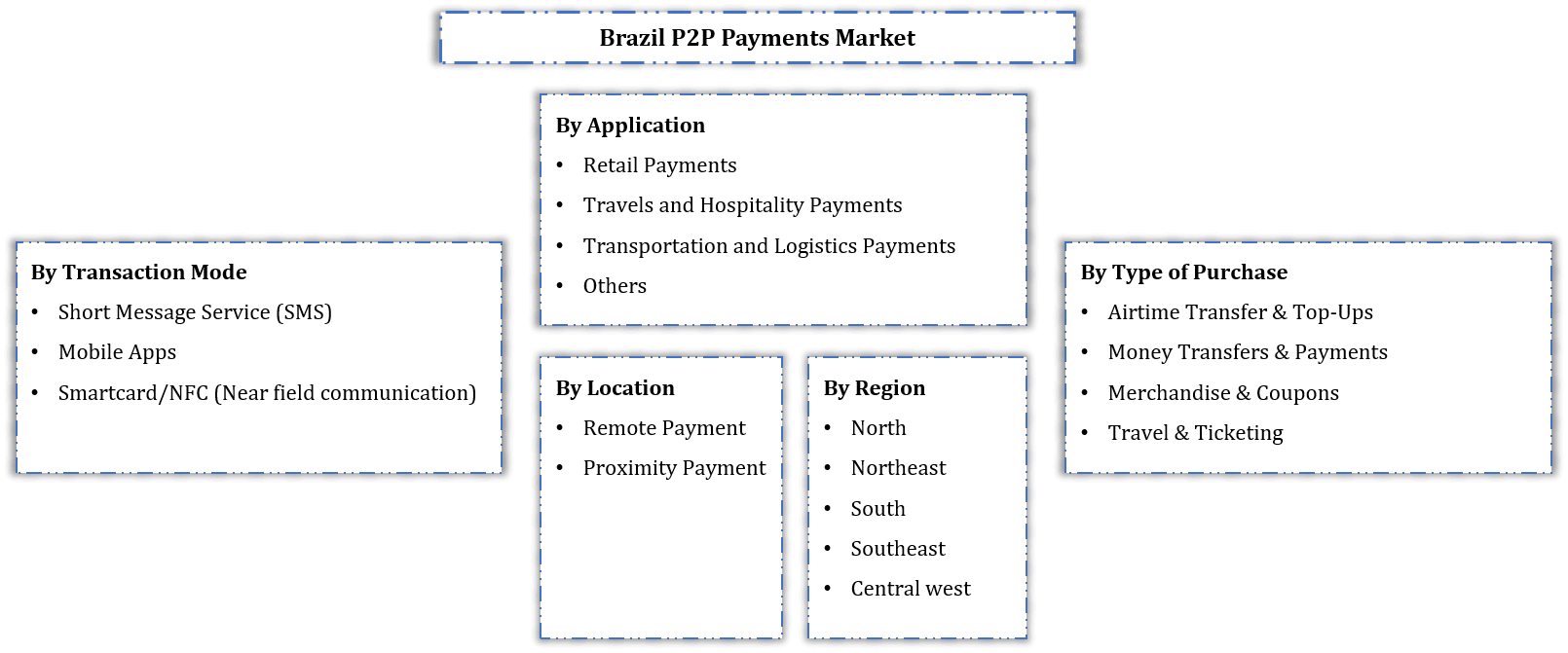
By Transaction Mode (Short Message Service (SMS), Mobile Apps, Smartcard/NFC (Near field communication)), By Location (Remote Payment, Proximity Payment), By Type of Purchase (Airt......ime Transfer & Top-Ups, Money Transfers & Payments, Merchandise & Coupons, Travel & Ticketing), By Application (Retail Payments, Travels and Hospitality Payments, Transportation and Logistics Payments, Others), By Region (North, Northeast, South, Southeast, Central West), By Competitors (Boleto Bancario, Boleto Flash, PagBrasil PIX, PEC Flash, Samsung Pay, Google Pay, WhatsApp Pay) Read more
- FinTech
- Aug 2021
- 103
- PDF, Excel, PPT
Market Definition
A Peer-to-Peer (P2P) payment is the process through which users can transfer funds from their bank account to that of another individual using the Internet. Pay Pal, Venmo, Google Pay, Paytm, Cash App, Amazon Pay, etc., are a few major P2P payment apps that allow users to send money to another person from their bank accounts. These platforms are gaining immense popularity among people of all ages across Brazil.
Market Insights
The Brazil P2P (Peer to Peer) Payments Market is projected to grow at a CAGR of around 15.1 % during 2021-26. The growth of the market is likely to be driven mainly by the surging acceptance of debit & credit cards among small merchants, the rising popularity of online banking, and the burgeoning emergence of digital banks. The market would expand strongly across categories led by mobile commerce, P2P transfer, & bill payments.
| Report Coverage | Details |
|---|---|
| Study Period | Historical Data: 2016-19 |
| Base Year: 2020 | |
| Forecast Period: 2021-26 | |
| CAGR | 15.1% |
| Region Covered | North, Northeast, South, Southeast, Centralwest |
| Key Companies Profiled | Boleto Bancario, Boleto Flash, PragBrasil PIX, PEC Flash, Samsung Pay, Google Pay, WhatsApp Pay |
| Unit Denominations | USD Million/Billion |
In addition, digital & mobile wallets that have gained immense momentum in the previous few years are expected to become more widespread during the forecast period and outperform other payment methods. Furthermore, banks are increasingly integrating online payment platforms into their mobile apps, which would lead to increased mobile proximity payments in the future.
- In 2020, Brazil Central Bank launched the instant payments platform 'PIX' to speed up & simplify online transactions. The payment system allows companies & consumers to transfer money 24*7 via smartphone, ATMs, etc. Moreover, by 2030, Pix is projected to account for 22% of electronic payments in the country.
Furthermore, since the penetration of mobile wallets has surged in proximity payments, the average value of the transaction is expected to decrease while its volume would increase significantly. As P2P payment services & mobile apps have become more widespread, the proportion of online transactions using these methods is growing with each passing year, and this trend is not showing any signs of slowing down in the near future. Additionally, various efforts by the Brazilian government to promote digital payments through Pix shall also contribute considerably to the overall market growth during 2021-26.
Moreover, P2P payments provide consumers with greater trust, accessibility, and faster, cheaper, & simpler transfer options. Users can make & receive payments from any location just using their cell phones. Being the administrator, each user can also manage his or her own shared sources. As a result, these aspects would lead the Brazil P2P (Peer to Peer) Payments Market to witness significant growth opportunities in the coming years.
- Introduction
- Product Definition
- Research Process
- Assumptions
- Market Segmentation
- Executive Summary
- Impact of COVID-19 on Brazilian P2P (Peer-to-Peer) Payments
- Expert Verbatim: What our expert says?
- Brazil P2P (Peer-to-Peer) Market Policies and Regulations
- Brazil P2P (Peer-to-Peer) Market Dynamics
- Drivers
- Challenges
- Impact Analysis
- Brazil P2P (Peer-to-Peer) Market Trends & Insights
- Brazil P2P (Peer-to-Peer) Market Key Strategic Imperatives for Growth and Success
- Brazil P2P (Peer-to-Peer) Payments Outlook (2016-2026)
- Market Size & Analysis
- By Revenues
- Market Share & Analysis
- By Transaction Mode
- Short Message Service (SMS)
- Mobile Apps
- Smartcard/NFC (Near field communication)
- By Location
- Remote Payment
- Proximity Payment
- By Type of Purchase
- Airtime Transfer & Top-Ups
- Money Transfers & Payments
- Merchandise & Coupons
- Travel & Ticketing
- By Application
- Retail Payments
- Travels and Hospitality Payments
- Transportation and Logistics Payments
- Others
- By Region
- North
- Northeast
- South
- Southeast
- Central west
- By Company
- Revenue Shares
- Strategic Factorial Indexing
- Competitor Placement in MarkNtel Quadrant
- By Transaction Mode
- Market Size & Analysis
- Competitive benchmarking
- Competitive Matrix
- Brand Specialization
- Target Market
- Target End-User (Market & End Users)
- Research and Development
- Strategic Alliance
- Strategic Initiative
- Company Profiles (Business Description, Product Offering, Strategic Alliances or Partnerships, etc.)
- Boleto Bancario
- Boleto Flash
- PragBrasil PIX
- PEC Flash
- Samsung Pay
- Google Pay
- WhatsApp Pay
- Competitive Matrix
- Disclaimer
MarkNtel Advisors follows a robust and iterative research methodology designed to ensure maximum accuracy and minimize deviation in market estimates and forecasts. Our approach combines both bottom-up and top-down techniques to effectively segment and quantify various aspects of the market. A consistent feature across all our research reports is data triangulation, which examines the market from three distinct perspectives to validate findings. Key components of our research process include:
1. Scope & Research Design At the outset, MarkNtel Advisors define the research objectives and formulate pertinent questions. This phase involves determining the type of research—qualitative or quantitative—and designing a methodology that outlines data collection methods, target demographics, and analytical tools. They also establish timelines and budgets to ensure the research aligns with client goals.
2. Sample Selection and Data Collection In this stage, the firm identifies the target audience and determines the appropriate sample size to ensure representativeness. They employ various sampling methods, such as random or stratified sampling, based on the research objectives. Data collection is carried out using tools like surveys, interviews, and observations, ensuring the gathered data is reliable and relevant.
3. Data Analysis and Validation Once data is collected, MarkNtel Advisors undertake a rigorous analysis process. This includes cleaning the data to remove inconsistencies, employing statistical software for quantitative analysis, and thematic analysis for qualitative data. Validation steps are taken to ensure the accuracy and reliability of the findings, minimizing biases and errors.

4. Data Forecast and FinalizationThe final phase involves forecasting future market trends based on the analyzed data. MarkNtel Advisors utilize predictive modeling and time series analysis to anticipate market behaviors. The insights are then compiled into comprehensive reports, featuring visual aids like charts and graphs, and include strategic recommendations to inform client decision-making
FILL THE FORM TO GET THE FREE SAMPLE PAGES
We offer flexible licensing options to cater to varying organizational needs. Choose the pricing pack that best suits your requirements:
Buy Now Inquire Before Buying
 Talk to our Consultant
 Request Customization