

Malaysia Islamic Banking Platforms Market Research Report: Growth Drivers & Forecast (2026-2032)
By Type (Islamic Retail Banking Platforms, Islamic Corporate Banking Platforms, Islamic Investment Banking Platforms, Islamic SME Banking Platforms, Islamic Asset Management Platfo ... rms, Islamic Treasury & Capital Markets Platforms), By Application (Personal Financing, Home & Mortgage Financing, Business Financing, Auto Financing, Trade Financing, Wealth Management Services), By Components Type (Platforms, Services), By Product Type (Murabaha (Cost-plus financing), Mudarabah (Profit-sharing investment), Musharakah (Joint partnership financing), Ijara (Islamic leasing), Istisna (Manufacturing/project financing), Salam (Forward financing contract), Sukuk (Islamic bonds)), By Deployment Mode (Cloud-Based Platforms, On-Premises Platforms), By End User (Individuals (Retail Customers), Small and Medium Enterprises (SMEs), Corporate Enterprises, Financial Institutions, Government & Public Sector), and others Read more
- FinTech
- Mar 2026
- Pages 145
- Report Format: PDF, Excel, PPT
Malaysia Islamic Banking Platforms Market
Projected 7.95% CAGR from 2026 to 2032
Study Period
2026-2032
Market Size (2026)
USD 198 Million
Market Size (2032)
USD 213 Million
Base Year
2025
Projected CAGR
7.95%
Leading Segments
By Type: Islamic Retail Banking Platforms
Malaysia Islamic Banking Platforms Market Report Key Takeaways:
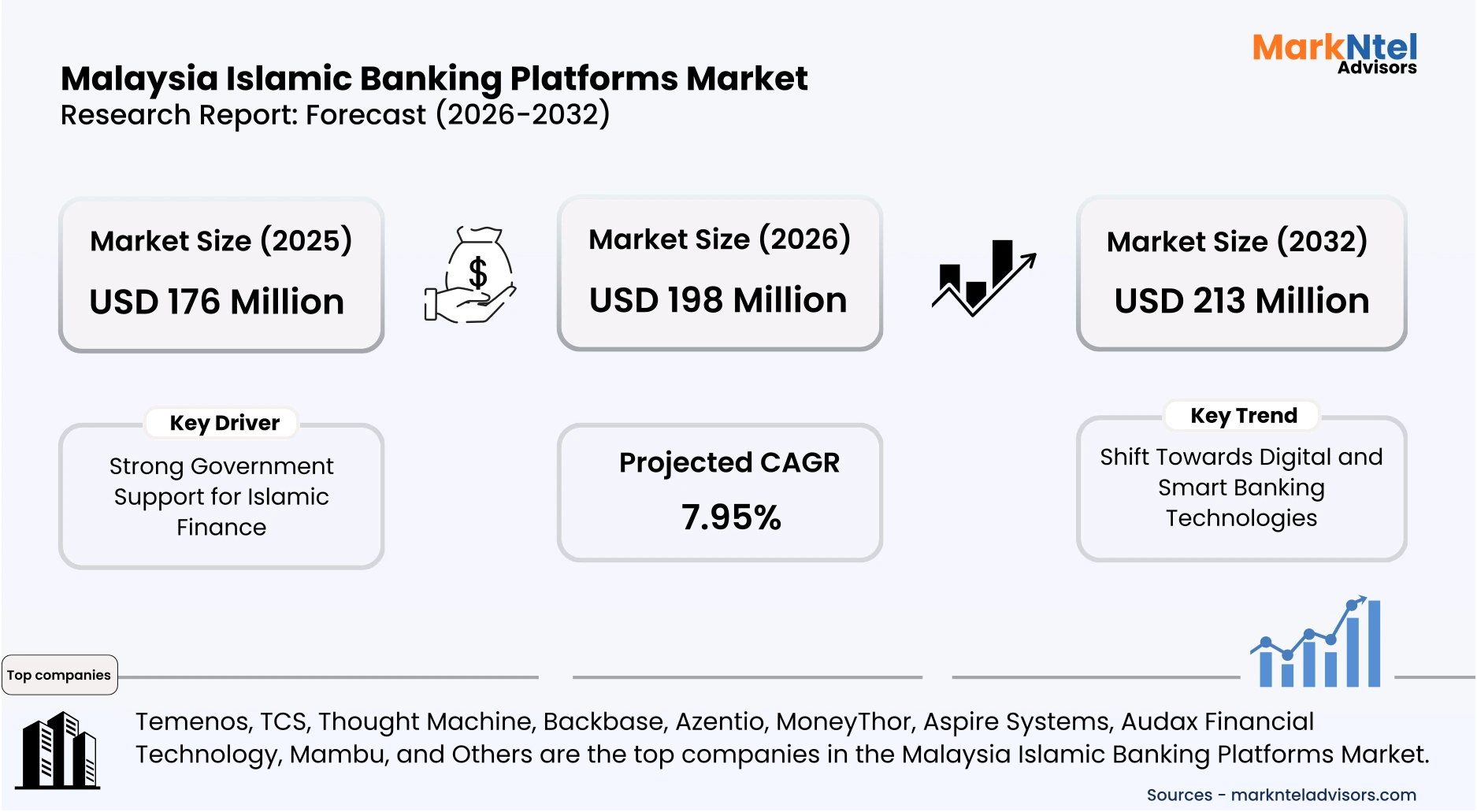
- The Malaysia Islamic Banking Platforms market size was valued at USD 176 million in 2025 and is projected to grow from USD 198 million in 2026 to USD 213 million by 2032, exhibiting a CAGR of 7.95% during the forecast period.
- Central Malaysia holds the largest market share of about 38% in the Malaysia Islamic Banking Platforms Market in 2026.
- By type, the Islamic retail banking platforms represented a significant share of about 42% in the Malaysia Islamic Banking Platforms Market in 2026.
- By Component Type, the platforms segment represented a significant share of about 85% in the Malaysia Islamic Banking Platforms Market in 2026.
- Leading companies in the Market are Temenos, TCS, Thought Machine, Backbase, Azentio, MoneyThor, Aspire Systems, Audax Financial Technology, Mambu, and Others.
Market Insights & Analysis: Malaysia Islamic Banking Platforms Market (2026-32):
The Malaysia Islamic Banking Platforms Market size was valued at USD 176 million in 2025 and is projected to grow from USD 198 million in 2026 to USD 213 million by 2032. Along with this, the market is estimated to grow at a CAGR of around 7.95% during the forecast period, i.e., 2026-32.
The Malaysia Islamic Banking Platforms Market is poised for robust expansion over the coming years, underpinned by strong government support, deepening digital transformation, and strategic initiatives that reinforce the nation’s leadership in Shariah‑compliant finance. Malaysia’s policy framework continues to prioritize financial inclusion, innovation, and digital ecosystem development, catalyzing growth opportunities for both incumbents and digital‑first Islamic banking providers.
A key driver is increased adoption of digital and smart banking technologies across the Islamic finance landscape. Traditional and new entrants alike are investing in modernizing core systems and enhancing digital delivery. For instance, KAF Digital Bank launched its Shariah‑compliant digital banking platform on a cloud‑based Temenos SaaS core banking system hosted on Microsoft Azure, integrating payments, analytics, and comprehensive digital services to offer fully online Islamic financial solutions to Malaysian consumers. This shift to cloud‑native infrastructure reflects broader industry momentum toward scalable, secure, and agile platforms that can support innovative Islamic financial products and data‑driven customer engagement.
Similarly, Bank Muamalat Malaysia Berhad has entered a multi‑year collaboration with Google Cloud, leveraging modern infrastructure, advanced analytics, security frameworks, and generative AI to accelerate its digital transformation . The partnership is aimed at delivering personalized, inclusive digital banking services that resonate with tech‑savvy consumers and SMEs in the Islamic finance ecosystem. These technology adoptions will enable Islamic banks to streamline operations, enhance customer experience, and respond swiftly to evolving market expectations.
Complementing technological progress, Malaysia’s policy environment continues to strengthen. In 2025, the government reinforced inclusive Shariah‑compliant finance policies and launched the i‑TEKAD programme to empower low‑income microentrepreneurs with affordable, digital‑ready financing. Backed by the Alliance for Financial Inclusion (AFI), i‑TEKAD expands access to capital for underserved segments, thereby deepening financial inclusion and broadening the base of customers engaging with Islamic banking platforms .
Malaysia’s strategic vision also encompasses becoming a global benchmark for Islamic fintech, climate‑oriented sukuk, and ESG standards by 2040. Plans include enhancing digital Islamic banking, deploying AI‑enabled Shariah advisory tools, and developing blockchain‑based sukuk platforms, all of which are expected to accelerate market sophistication and attract regional participation .
A noteworthy milestone in sustainable and digital‑linked Islamic finance was achieved in October 2025, when Malaysia issued the world’s first USD 28 million Climate Sukuk, combining Shariah compliance with green finance principles, digital tokenization, and carbon credit monetization. This issuance not only reinforces Labuan’s position as a digital Islamic finance hub but also signals growing investor interest in innovative Islamic financial instruments .
Overall, the Malaysia Islamic Banking Platforms Market is entering a phase of accelerated digital evolution, amplified by supportive regulations, strategic public–private collaborations, and targeted inclusion programmes. These developments collectively position Malaysia to sustain its competitive edge regionally and globally, with digital Islamic banking platforms central to future growth.
Malaysia Islamic Banking Platforms Market Recent Developments:
- 2025: KAF Digital Bank launched its Islamic digital banking platform built on the Temenos SaaS cloud infrastructure. The platform integrates core banking, digital banking, payments, and analytics services, enabling Shariah-compliant digital financial services and improving customer access to Islamic banking products across Malaysia .
- 2025: Bank Muamalat introduced ATLAS, Malaysia’s first faith-aligned Islamic digital-only banking platform. The platform provides Shariah-compliant financial services combined with lifestyle-focused digital features, allowing customers to access Islamic banking products entirely through digital channels.
Malaysia Islamic Banking Platforms Market Scope:
| Category | Segments |
|---|---|
| By Type | (Islamic Retail Banking Platforms, Islamic Corporate Banking Platforms, Islamic Investment Banking Platforms, Islamic SME Banking Platforms, Islamic Asset Management Platforms, Islamic Treasury & Capital Markets Platforms), |
| By Application | (Personal Financing, Home & Mortgage Financing, Business Financing, Auto Financing, Trade Financing, Wealth Management Services), |
| By Components Type | (Platforms, Services), |
| By Product Type | (Murabaha (Cost-plus financing), Mudarabah (Profit-sharing investment), Musharakah (Joint partnership financing), Ijara (Islamic leasing), Istisna (Manufacturing/project financing), Salam (Forward financing contract), Sukuk (Islamic bonds)), |
| By Deployment Mode | (Cloud-Based Platforms, On-Premises Platforms), |
| By End User | (Individuals (Retail Customers), Small and Medium Enterprises (SMEs), Corporate Enterprises, Financial Institutions, Government & Public Sector), |
Malaysia Islamic Banking Platforms Market Driver:
Strong Government Support for Islamic Finance
Strong government support has been a key driver of the Malaysia Islamic Banking Platforms Market, enabling rapid sector growth and technological advancement. Malaysia consistently ranks as a global leader in Islamic finance, with its Islamic banking sector accounting for 46.6% of total national financing in 2025, reflecting deep institutional and regulatory backing. This leadership is the result of strategic policies and regulatory frameworks designed to strengthen Shariah-compliant financial services, foster innovation, and enhance financial inclusion .
In 2024, Malaysia allocated USD 21.6 million under the Ekonomi MADANI framework to promote innovation in Islamic finance. Initiatives such as Project Hassan supported zakat management, socio-economic upliftment, and Shariah-compliant financing, encouraging the adoption of fintech solutions and digital banking platforms. These measures expanded access to financial services for underserved populations while reinforcing the robustness and inclusivity of the Islamic finance ecosystem.
Government commitment to digital transformation and policy-driven innovation has laid a strong foundation for future growth. Ongoing programs are expected to accelerate the adoption of advanced digital Islamic banking platforms, enabling greater operational efficiency, customer outreach, and integration of Shariah-compliant fintech solutions.
Sustained government support through targeted funding, regulatory initiatives, and inclusive programs continues to drive the growth of Malaysia’s Islamic banking market. By fostering innovation, digital adoption, and financial inclusion, these initiatives are expected to further accelerate the demand for advanced Islamic banking platforms in the coming years.
Malaysia Islamic Banking Platforms Market Trend:
Shift Towards Digital and Smart Banking Technologies
Smart and digital banking technologies, including mobile platforms, AI automation, and cloud‑native systems, are transforming Islamic banking in Malaysia, driving customer adoption and enhancing competitiveness in a rapidly evolving financial ecosystem.
The adoption of digital and smart banking technologies is a defining trend in the Malaysia Islamic Banking Platforms Market, fueled by rising consumer demand for seamless, technology-enabled financial services. High smartphone penetration and the growing use of mobile banking, which accounts for 62–89% of total digital banking interactions, have accelerated the adoption of digital Islamic banking solutions. Additionally, Malaysia’s expanding digital payment infrastructure, including over 2.6 million DuitNow QR acceptance points in 2024, provides a robust foundation for fintech and digital banking integration, enabling Shariah-compliant platforms to thrive .
Several Malaysian banks are leading this digital transformation. AEON Bank, one of the country’s first fully Shariah-compliant digital banks, has demonstrated strong user engagement, growth in digital deposits, and innovative app features, highlighting the effectiveness of technology-driven banking solutions in improving customer experience and operational efficiency.
Regulatory support from Bank Negara Malaysia has further accelerated innovation by granting digital banking licenses and providing a secure environment for fintech collaborations. These measures enable Islamic banks to experiment with AI-powered services, mobile apps, and cloud-based solutions while ensuring Shariah compliance.
The integration of digital and smart banking technologies is reshaping Malaysia’s Islamic finance ecosystem. By improving accessibility, operational efficiency, and customer engagement, these innovations are driving the adoption of Islamic banking platforms and supporting the market’s sustainable growth.
Malaysia Islamic Banking Platforms Market Opportunity:
Embedded Finance and Open API Ecosystem Growth
A concrete growth opportunity for Malaysia’s Islamic banking platforms lies in the government‑enabled open API and embedded finance ecosystem, which is transitioning from concept toward structured implementation under Bank Negara Malaysia (BNM). In November 2025, BNM issued an exposure draft on Open Finance to codify a regulatory framework for secure, consent‑driven sharing of customer data across financial institutions and licensed third parties, enabling API‑led connectivity for financial services delivery. The framework is designed to make financial data accessible, yet secure and interoperable, with participation and consent requirements in phased roll‑out by mid‑2026 and beyond.
Parallel to Open Finance, Malaysia’s Real‑Time Retail Payments Platform (RPP) and DuitNow systems built around API‑enabled rails illustrate how embedded services are already reshaping the payments landscape. DuitNow transaction volumes surged from 110 million in 2019 to approximately 3.5 billion in 2024, demonstrating broad‑based API adoption for payments that Islamic banking firms can leverage for embedding Shariah‑compliant services within merchant, e‑commerce, and fintech environments .
As API ecosystems mature under BNM’s Open Finance guidance, Islamic banks can embed financing, savings, and payment products directly into digital platforms, reducing customer acquisition costs and unlocking new fee‑based income streams, while participating in Malaysia’s increasingly interoperable financial infrastructure.
Malaysia Islamic Banking Platforms Market Challenge:
High Implementation and Operational Costs
A significant challenge for Malaysia’s Islamic banking sector is the high cost of technology implementation and ongoing operational expenditure required to support digital and Islamic‑compliant platforms. Under the Risk Management in Technology (RMiT) framework updated by Bank Negara Malaysia (BNM) in November 2025, financial institutions are mandated to strengthen technology risk governance, cybersecurity measures, and digital service resilience . This heightened regulatory compliance requires substantial investment in secure infrastructure and ongoing monitoring systems, increasing operational cost burdens for banks. Moreover, expanded requirements now include broader cyber control mechanisms, proactive fraud detection, and continuous service uptime assurance.
Malaysia’s banking industry is also experiencing accelerating technology expenditure. Recent banking sector analyses indicate that Banks’ technology spending in the country has been growing, with annual tech cost increases averaging around 13% between 2022 and 2023 for select Malaysian lenders, a trend expected to continue as systems scale and regulators maintain strict oversight.
For Islamic banks, the complexity of aligning digital infrastructures with Shariah‑compliant operations further compounds costs. Integrating digital onboarding, compliance engines, and secure Islamic financing modules while ensuring full adherence to regulatory and Shariah principles demands specialized technology stacks and expertise, which are cost-intensive. Smaller Islamic banks with limited balance‑sheet capacity face particular strain, as they must compete technologically with larger incumbents while managing elevated implementation and operational expenditures.
Malaysia Islamic Banking Platforms Market (2026-32) Segmentation Analysis:
The Malaysia Islamic Banking Platforms Market study of MarkNtel Advisors evaluates & highlights the major trends and influencing factors in each segment. It includes predictions for the period 2026–32 at the country level. Based on the analysis, the market has been further classified as;
Based on Type:
-
- Islamic Retail Banking Platforms
- Islamic Corporate Banking Platforms
- Islamic Investment Banking Platforms
- Islamic SME Banking Platforms
- Islamic Asset Management Platforms
- Islamic Treasury & Capital Platforms
Islamic Retail Banking Platforms emerge as the leading segment, capturing an estimated 42% market share in 2026. This dominance is driven by strong consumer demand for Shariah-compliant personal, home, and auto financing solutions in Malaysia. Retail banking remains the primary touchpoint for digital Islamic financial services, especially with the increasing adoption of mobile banking and online platforms among individuals. Government-backed initiatives such as i‑TEKAD, which provide micro entrepreneurs with Shariah-compliant digital financing, further expand retail reach, increasing the number of active users and transactions.
Moreover, Malaysia’s financial ecosystem is seeing high digital penetration, with over 97% internet access and mobile banking usage accounting for ~62% of transactions, enabling convenient, real-time services. The retail segment also benefits from regulatory support, targeted digital initiatives, and financial literacy programmes that encourage broader participation, making Islamic Retail Banking Platforms the backbone of digital Islamic finance in the country.
Based on Component Type:
-
- Platforms
- Core Banking Platforms
- Payments
- Digital Banking (Online & Mobile Banking Platforms)
- Data & Analytics
- Open Banking
- Risk Management
- Services
- Platforms
Platforms, encompassing core banking systems, payments, digital banking, data & analytics, open banking, and risk management modules, account for an estimated 85% of the total component type size. Their leadership is due to their central role in delivering digital Islamic financial services efficiently and securely. For instance, cloud-based core banking solutions like Temenos SaaS on Microsoft Azure, adopted by KAF Digital Bank, enable seamless integration of payments, analytics, and digital banking services.
Platforms drive customer engagement through mobile and online channels, manage operational workflows, and ensure regulatory compliance. High adoption of digital banking (~62% of total transactions) demonstrates that platform infrastructure is critical to delivering scalable, secure, and personalized Shariah-compliant services. Without robust platform investment, banks cannot implement digital transformation, making Platforms the most strategic and capital-intensive segment of the Malaysia Islamic Banking Platforms Market.
Malaysia Islamic Banking Platforms Market (2026-32): Regional Projection
The Malaysia Islamic Banking Platforms Market is dominated by Central Malaysia, accounting for approximately 38% of the market. This region includes Kuala Lumpur, Selangor, and Putrajaya, which are the nation’s financial and administrative hubs. The dominance is driven by the high concentration of Islamic banks, fintech firms, and corporate headquarters, which adopt digital banking platforms at a faster pace. Central Malaysia also has superior digital infrastructure, high internet penetration, and widespread smartphone usage, enabling seamless deployment of online and mobile banking services. Furthermore, government initiatives promoting Shariah-compliant finance, such as i‑TEKAD and open banking frameworks, are headquartered in these areas, facilitating easier collaboration and faster implementation of regulatory-compliant platforms. The presence of major banks like Bank Muamalat and KAF Digital Bank, which are actively investing in cloud-based core systems and AI-enabled digital platforms, further reinforces Central Malaysia as the leading region in the Islamic banking platforms market.
Gain a Competitive Edge with Our Malaysia Islamic Banking Platforms Market Report:
- Malaysia Islamic Banking Platforms Market Report by MarkNtel Advisors provides a detailed & thorough analysis of market size & share, growth rate, competitive landscape, and key players. This comprehensive analysis helps businesses gain a holistic understanding of the market dynamics & make informed decisions.
- This report also highlights current market trends & future projections, allowing businesses to identify emerging opportunities & potential challenges. By understanding market forecasts, companies can align their strategies & stay ahead of the competition.
- Malaysia Islamic Banking Platforms Market Report aids in assessing & mitigating risks associated with entering or operating in the market. By understanding market dynamics, regulatory frameworks, and potential challenges, businesses can develop strategies to minimize risks & optimize their operations.
*Reports Delivery Format - Market research studies from MarkNtel Advisors are offered in PDF, Excel and PowerPoint formats. Within 24 hours of the payment being successfully received, the report will be sent to your email address.
Frequently Asked Questions
- Market Segmentation
- Introduction
- Product Definition
- Research Process
- Assumptions
- Executive Summary
- Malaysia Islamic Banking Platforms Market Policies, Regulations, and Product Standards
- Malaysia Islamic Banking Platforms Market Trends & Developments
- Malaysia Islamic Banking Platforms Market Dynamics
- Growth Factors
- Challenges
- Malaysia Islamic Banking Platforms Market Hotspot & Opportunities
- Malaysia Islamic Banking Platforms Market Outlook, 2022-2032F
- Market Size & Outlook
- By Revenues (USD Million)
- Market Share & Outlook
- By Type- Market Size & Forecast 2022-2032, USD Million
- Islamic Retail Banking Platforms
- Islamic Corporate Banking Platforms
- Islamic Investment Banking Platforms
- Islamic SME Banking Platforms
- Islamic Asset Management Platforms
- Islamic Treasury & Capital Markets Platforms
- By Application- Market Size & Forecast 2022-2032, USD Million
- Personal Financing
- Home & Mortgage Financing
- Business Financing
- Auto Financing
- Trade Financing
- Wealth Management Services
- By Components Type- Market Size & Forecast 2022-2032, USD Million
- Platforms
- Core Banking Platforms
- Payments
- Digital Banking (Online & Mobile Banking Platforms)
- Data & Analytics
- Open Banking
- Risk Management
- Services
- Platforms
- By Product Type- Market Size & Forecast 2022-2032, USD Million
- Murabaha (Cost-plus financing)
- Mudarabah (Profit-sharing investment)
- Musharakah (Joint partnership financing)
- Ijara (Islamic leasing)
- Istisna (Manufacturing/project financing)
- Salam (Forward financing contract)
- Sukuk (Islamic bonds)
- By Deployment Mode- Market Size & Forecast 2022-2032, USD Million
- Cloud-Based Platforms
- On-Premises Platforms
- By End User- Market Size & Forecast 2022-2032, USD Million
- Individuals (Retail Customers)
- Small and Medium Enterprises (SMEs)
- Corporate Enterprises
- Financial Institutions
- Government & Public Sector
- By Region- Market Size & Forecast 2022-2032, USD Million
- North
- South
- East
- Central
- Sarawak
- Sabah
- By Company
- Competition Characteristics
- Market Share & Analysis
- By Type- Market Size & Forecast 2022-2032, USD Million
- Market Size & Outlook
- Malaysia Islamic Retail Banking Platforms Market Outlook, 2022-2032
- Market Size & Outlook
- By Revenues (USD Million)
- Market Share & Outlook
- By Application- Market Size & Forecast 2022-2032, USD Million
- By Components Type- Market Size & Forecast 2022-2032, USD Million
- By Product Type- Market Size & Forecast 2022-2032, USD Million
- By Deployment Mode- Market Size & Forecast 2022-2032, USD Million
- By End User- Market Size & Forecast 2022-2032, USD Million
- By Region- Market Size & Forecast 2022-2032, USD Million
- Market Size & Outlook
- Malaysia Islamic Corporate Banking Platforms Market Outlook, 2022-2032
- Market Size & Outlook
- By Revenues (USD Million)
- Market Share & Outlook
- By Application- Market Size & Forecast 2022-2032, USD Million
- By Components Type- Market Size & Forecast 2022-2032, USD Million
- By Product Type- Market Size & Forecast 2022-2032, USD Million
- By Deployment Mode- Market Size & Forecast 2022-2032, USD Million
- By End User- Market Size & Forecast 2022-2032, USD Million
- By Region- Market Size & Forecast 2022-2032, USD Million
- Market Size & Outlook
- Malaysia Islamic Investment Banking Platforms Market Outlook, 2022-2032
- Market Size & Outlook
- By Revenues (USD Million)
- Market Share & Outlook
- By Application- Market Size & Forecast 2022-2032, USD Million
- By Components Type- Market Size & Forecast 2022-2032, USD Million
- By Product Type- Market Size & Forecast 2022-2032, USD Million
- By Deployment Mode- Market Size & Forecast 2022-2032, USD Million
- By End User- Market Size & Forecast 2022-2032, USD Million
- By Region- Market Size & Forecast 2022-2032, USD Million
- Market Size & Outlook
- Malaysia Islamic SME Banking Platforms Market Outlook, 2022-2032
- Market Size & Outlook
- By Revenues (USD Million)
- Market Share & Outlook
- By Application- Market Size & Forecast 2022-2032, USD Million
- By Components Type- Market Size & Forecast 2022-2032, USD Million
- By Product Type- Market Size & Forecast 2022-2032, USD Million
- By Deployment Mode- Market Size & Forecast 2022-2032, USD Million
- By End User- Market Size & Forecast 2022-2032, USD Million
- By Region- Market Size & Forecast 2022-2032, USD Million
- Market Size & Outlook
- Malaysia Islamic Asset Management Platforms Market Outlook, 2022-2032
- Market Size & Outlook
- By Revenues (USD Million)
- Market Share & Outlook
- By Application- Market Size & Forecast 2022-2032, USD Million
- By Components Type- Market Size & Forecast 2022-2032, USD Million
- By Product Type- Market Size & Forecast 2022-2032, USD Million
- By Deployment Mode- Market Size & Forecast 2022-2032, USD Million
- By End User- Market Size & Forecast 2022-2032, USD Million
- By Region- Market Size & Forecast 2022-2032, USD Million
- Market Size & Outlook
- Malaysia Islamic Treasury & Capital Platforms Market Outlook, 2022-2032
- Market Size & Outlook
- By Revenues (USD Million)
- Market Share & Outlook
- By Application- Market Size & Forecast 2022-2032, USD Million
- By Components Type- Market Size & Forecast 2022-2032, USD Million
- By Product Type- Market Size & Forecast 2022-2032, USD Million
- By Deployment Mode- Market Size & Forecast 2022-2032, USD Million
- By End User- Market Size & Forecast 2022-2032, USD Million
- By Region- Market Size & Forecast 2022-2032, USD Million
- Market Size & Outlook
- Malaysia Islamic Banking Platforms Market Key Strategic Imperatives for Success & Growth
- Competitive Outlook
- Company Profiles
- Temenos
- Business Description
- Product Portfolio
- Collaborations & Alliances
- Recent Developments
- Financial Details
- Others
- TCS
- Business Description
- Product Portfolio
- Collaborations & Alliances
- Recent Developments
- Financial Details
- Others
- Thought Machine
- Business Description
- Product Portfolio
- Collaborations & Alliances
- Recent Developments
- Financial Details
- Others
- Backbase
- Business Description
- Product Portfolio
- Collaborations & Alliances
- Recent Developments
- Financial Details
- Others
- Azentio
- Business Description
- Product Portfolio
- Collaborations & Alliances
- Recent Developments
- Financial Details
- Others
- MoneyThor
- Business Description
- Product Portfolio
- Collaborations & Alliances
- Recent Developments
- Financial Details
- Others
- Aspire Systems
- Business Description
- Product Portfolio
- Collaborations & Alliances
- Recent Developments
- Financial Details
- Others
- Audax Financial technology
- Business Description
- Product Portfolio
- Collaborations & Alliances
- Recent Developments
- Financial Details
- Others
- Mambu
- Business Description
- Product Portfolio
- Collaborations & Alliances
- Recent Developments
- Financial Details
- Others
- Others
- Business Description
- Product Portfolio
- Collaborations & Alliances
- Recent Developments
- Financial Details
- Others
- Temenos
- Company Profiles
- Disclaimer
MarkNtel Advisors follows a robust and iterative research methodology designed to ensure maximum accuracy and minimize deviation in market estimates and forecasts. Our approach combines both bottom-up and top-down techniques to effectively segment and quantify various aspects of the market. A consistent feature across all our research reports is data triangulation, which examines the market from three distinct perspectives to validate findings. Key components of our research process include:
1. Scope & Research Design At the outset, MarkNtel Advisors define the research objectives and formulate pertinent questions. This phase involves determining the type of research—qualitative or quantitative—and designing a methodology that outlines data collection methods, target demographics, and analytical tools. They also establish timelines and budgets to ensure the research aligns with client goals.
2. Sample Selection and Data Collection In this stage, the firm identifies the target audience and determines the appropriate sample size to ensure representativeness. They employ various sampling methods, such as random or stratified sampling, based on the research objectives. Data collection is carried out using tools like surveys, interviews, and observations, ensuring the gathered data is reliable and relevant.
3. Data Analysis and Validation Once data is collected, MarkNtel Advisors undertake a rigorous analysis process. This includes cleaning the data to remove inconsistencies, employing statistical software for quantitative analysis, and thematic analysis for qualitative data. Validation steps are taken to ensure the accuracy and reliability of the findings, minimizing biases and errors.

4. Data Forecast and FinalizationThe final phase involves forecasting future market trends based on the analyzed data. MarkNtel Advisors utilize predictive modeling and time series analysis to anticipate market behaviors. The insights are then compiled into comprehensive reports, featuring visual aids like charts and graphs, and include strategic recommendations to inform client decision-making
We offer flexible licensing options to cater to varying organizational needs. Choose the pricing pack that best suits your requirements:
Buy Now Inquire Before Buying
 Request Customization
 Talk to our Consultant







