

India Payment Gateways Market Research Report: Forecast (2026-2032)
By Payment Method (Credit/Debit Cards, Digital Wallets, Bank Transfers, QR Code Payments, BNPL, Others), By Transaction Mode (Web, In-App / Mobile, POS / In-Store), By Enterprise S ... ize (SMEs, Large Enterprises), By End User (Retail & E-Commerce, BFSI, Travel & Hospitality, Healthcare, Education, Government, Transportation & Logistics, Telecommunications, Others), and others Read more
- FinTech
- Aug 2026
- Pages 145
- Report Format: PDF, Excel, PPT
India Payment Gateways Market
Projected 9.69% CAGR from 2026 to 2032
Study Period
2026-2032
Market Size (2026)
USD 2.25 Billion
Market Size (2032)
USD 3.92 Billion
Base Year
2025
Projected CAGR
9.69%
Leading Segments
By Payment Method: Credit/Debit Cards
India Payment Gateways Market Key Takeaways
- The India payment gateways market was valued at USD 2.06 billion in 2025 and is projected to grow from USD 2.25 billion in 2026 to USD 3.92 billion by 2032.
- The industry is projected to witness steady growth at a CAGR of 9.69% during 2026-2032.
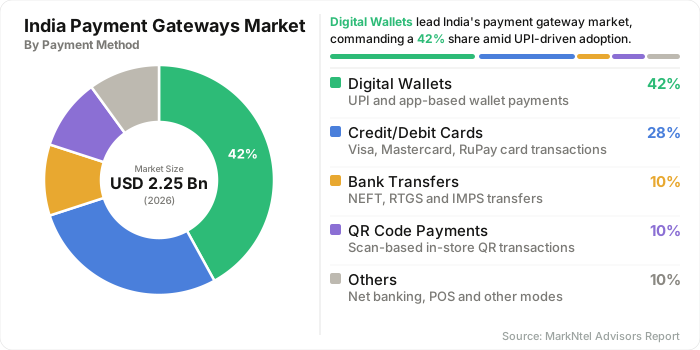
- Digital wallets are expected to dominate the market by payment method, accounting for approximately 8% market share in 2026.
- In-App/Mobile transactions are anticipated to hold nearly 5% of the market in 2026.
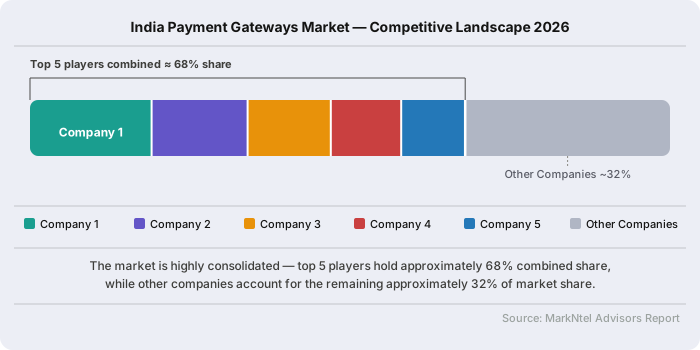
- The market remains moderately consolidated, with the top five companies collectively accounting for approximately 68% of the market.
India Payment Gateways Market Size and Outlook
The India payment gateways market was valued at USD 2.06 billion in 2025 and is projected to grow from USD 2.25 billion in 2026 to USD 3.92 billion by 2032, registering a CAGR of around 9.69% during 2026-2032. The market growth is primarily driven by India's unique digital payment ecosystem, led by the Unified Payments Interface (UPI) and the National Payments Corporation of India (NPCI). Unlike many global markets, payment gateways in India support interoperable payment rails, including UPI, Bharat BillPay, cards, net banking, and recurring e-mandates through a single platform.
Furthermore, the expansion of ONDC, rapid digitization of MSMEs, widespread merchant UPI QR deployment, and the RBI's regulatory framework for payment aggregators and tokenization are accelerating merchant adoption of licensed, feature-rich payment gateway platforms, supporting sustained market expansion.
India Payment Gateways Market Key Indicators
- India’s retail digital payment ecosystem continues to expand rapidly, increasing the transaction volumes that require payment processing, authentication, routing, reconciliation, and settlement services. According to the Ministry of Finance, India’s retail digital payments reached 22.17 billion transactions worth approximately USD 1.02 trillion in FY2024-25, compared with 16.42 billion transactions worth USD 860 billion in FY2023-24. The 35.04% increase in transaction volume demonstrates sustained digitization of payments and expands the underlying transaction pool for payment gateway providers.
- The growing scale of UPI is a major indicator influencing payment gateway demand. UPI processed 23.20 billion transactions worth approximately USD 339.8 billion in May 2026, representing a record monthly transaction volume. The exceptionally high frequency of digital transactions increases the requirement for reliable payment routing, transaction authentication, fraud monitoring, refunds, and reconciliation infrastructure, thereby supporting the growth of the India Payment Gateways Market.
- India’s e-commerce expansion is directly increasing the number of online transactions requiring gateway-based payment acceptance. India’s e-commerce market is projected to grow 12.4% in 2026 to approximately USD 225.9 billion, up from USD 200.9 billion in 2025. As online retail expands across marketplaces, direct-to-consumer platforms, travel, food delivery, and digital services, merchants increasingly require integrated payment gateways capable of supporting multiple payment methods and high transaction volumes.
- The expansion of India’s internet user base is enlarging the addressable population for online payments. India had approximately 1.09 billion internet subscribers as of March 2026, representing a 6.24% increase from 1.03 billion in December 2025. The expanding connected consumer base facilitates greater participation in e-commerce, online services, digital subscriptions, and app-based transactions, consequently increasing the potential transaction volume processed through payment gateways.
- Merchant digitization is also creating a larger customer base for payment gateway providers. India had more than 78.3 million registered MSMEs by February 2026, up substantially from 7.9 million in FY2021-22. The rapid formalization of micro, small, and medium enterprises increases the number of businesses requiring digital payment acceptance, payment links, online invoicing, recurring collections, and transaction reconciliation, thereby expanding the potential merchant base for payment gateway services.
- The expansion of digital payment acceptance infrastructure is strengthening merchant-side payment connectivity. UPI QR codes reached approximately 657.9 million in FY2024-25, registering a 91.5% year-on-year increase. The rapid deployment of QR-based acceptance points enables more merchants to participate in digital commerce and increases the need for payment infrastructure that connects merchants with banks, UPI applications, cards, and other payment instruments, supporting payment gateway market growth.
- The growing importance of digital public procurement is another measurable indicator for business payment processing. India’s Government e-Marketplace (GeM) surpassed USD 220 billion in cumulative GMV by April 2026, including more than USD 60 billion during FY2025-26. Increasing transaction activity across digital procurement platforms expands the requirement for secure electronic collections, payment processing, reconciliation, and settlement services, creating additional demand for payment gateway and payment infrastructure providers.
- The scale of UPI’s merchant and retail ecosystem is further strengthening the requirement for payment-processing infrastructure. UPI accounted for approximately 81% of India’s retail digital payment volume in FY2024-25, highlighting its dominance within the country's digital transaction ecosystem. As merchants increasingly prioritize UPI alongside cards, wallets, and other payment methods, payment gateway providers are required to support interoperable, multi-method checkout environments, thereby positively influencing the growth trajectory of the India payment gateways market.
India Payment Gateways Market Scope
| Category | Segments |
|---|---|
| By Payment Method | Credit/Debit Cards, Digital Wallets, Bank Transfers, QR Code Payments, BNPL, Others |
| By Transaction Mode | Web, In-App / Mobile, POS / In-Store |
| By Enterprise Size | SMEs, Large Enterprises |
| By End User | Retail & E-Commerce, BFSI, Travel & Hospitality, Healthcare, Education, Government, Transportation & Logistics, Telecommunications, Others |
India Payment Gateways Market Growth Drivers
Rapid Expansion of UPI QR Acceptance Infrastructure Accelerating Payment Gateway Adoption
The rapid expansion of UPI QR acceptance infrastructure across India is significantly driving demand for payment gateway solutions as merchants increasingly adopt integrated digital payment platforms. The widespread deployment of interoperable QR codes has enabled businesses across retail, healthcare, education, hospitality, and other service sectors to accept digital payments with minimal infrastructure investment. According to the Reserve Bank of India (RBI), more than 680 million UPI QR codes had been deployed across merchants by March 2025, reflecting the rapid expansion of merchant payment acceptance infrastructure. This growing merchant network is encouraging payment gateway providers to enhance scalable payment processing, automated settlements, reconciliation, and omnichannel payment capabilities to support rising transaction volumes.
For instance, in September 2025, PayU launched Smart Routing 2.0, an AI-powered payment orchestration solution that intelligently routes transactions to the acquiring bank with the highest real-time authorization rate. By improving payment success rates, reducing transaction failures, and optimizing checkout performance across multiple payment methods, the solution enables merchants to maximize payment conversions. The development highlights how payment gateway providers are increasingly investing in intelligent payment infrastructure to capitalize on India's expanding merchant acceptance ecosystem and strengthen their competitive positioning.
Recent Trends
AI-Powered Payment Infrastructure Emerging as a Defining Trend in the India Payment Gateways Market
The India payment gateways market is undergoing a strategic transformation as competition shifts from payment processing capabilities to merchant onboarding speed, integration efficiency, and platform scalability. With the rapid expansion of online retail, quick commerce, SaaS platforms, digital services, and MSMEs, payment gateway providers are prioritizing technologies that reduce merchant activation time while improving payment acceptance across UPI, cards, net banking, digital wallets, and recurring payments. According to the Reserve Bank of India (RBI), digital payment transactions (excluding paper clearing) increased by 35% year-on-year in volume during FY 2024-25, highlighting the continued expansion of India's digital payments ecosystem and the growing need for scalable payment gateway infrastructure.
Consequently, providers are deploying AI-enabled integration frameworks to automate API deployment, improve payment success rates, and strengthen merchant acquisition while reducing operational complexity. For instance, in May 2026, PhonePe Payment Gateway launched its AI-powered Integration Layer, built on AI coding assistants and its proprietary Integration Intelligence platform. The solution enables merchants to integrate payment gateway services through conversational AI, reducing deployment timelines from weeks to minutes while significantly lowering technical complexity. The launch reflects the market's growing emphasis on intelligent merchant onboarding as a key competitive differentiator, enabling faster merchant acquisition and strengthening PhonePe's position in the India payment gateways industry.
India Payment Gateways Market Opportunities and Challenges
Rising Digital Payment Fraud Leading to Increased Adoption of AI-Powered Fraud Prevention Solutions
The rapid expansion of India's digital payments ecosystem has intensified fraud risks for payment gateway providers, making transaction security and regulatory compliance increasingly critical. As payment volumes continue to grow across UPI, cards, digital wallets, and net banking, gateway providers are facing greater exposure to phishing attacks, account takeovers, identity fraud, and unauthorized transactions while maintaining seamless payment experiences. According to the Reserve Bank of India (RBI), banks reported 23,953 digital payment fraud cases involving approximately INR 1,457 crore (around USD 175 million) during FY 2024–25, highlighting the growing financial impact of cyber fraud on the digital payments ecosystem. These evolving threats are increasing compliance costs and technology investments for payment gateway providers.
At the same time, they are creating substantial opportunities for companies to expand their portfolios with AI-powered fraud detection, identity verification, behavioural analytics, tokenization, and real-time risk monitoring solutions. For instance, in April 2025, Cashfree Payments enhanced its SecureID platform with AI-driven identity verification and fraud prevention capabilities, enabling merchants to strengthen customer authentication while improving compliance and transaction security. The development illustrates how rising fraud risks are driving payment gateway providers to diversify into value-added security solutions, creating new revenue opportunities while strengthening merchant confidence and long-term platform competitiveness.
Segmentation Insights
Digital Wallets Capturing Approximately 42.8% Market Share in the India Payment Gateways Market
Digital wallets have emerged as the leading payment method in the India payment gateways market, supported by the rapid adoption of UPI-enabled payments, rising smartphone penetration, and growing consumer preference for cashless transactions across e-commerce, food delivery, travel, and digital service platforms. Payment gateway providers have increasingly integrated wallet-based payments with one-click checkout, tokenization, and UPI infrastructure to improve payment success rates and enhance customer convenience. The continued expansion of India's digital public infrastructure has further strengthened wallet acceptance among merchants of all sizes.
According to the National Payments Corporation of India (NPCI), UPI processed 18.68 billion transactions valued at approximately USD 288.5 billion in May 2025, demonstrating the scale of digital payment adoption supporting gateway transactions. For instance, in February 2025, Razorpay launched Turbo UPI with BHIM Vega, enabling customers to complete UPI payments within merchant applications without redirection, reducing checkout friction and enhancing payment efficiency. The development reflects the industry's increasing emphasis on seamless digital payment experiences, reinforcing the dominant position of digital wallets in the market. based on the payment method, the market is further bifurcated into:
- Credit/Debit Cards
- Digital Wallets
- Bank Transfers
- QR Code Payments
- BNPL
- Others
In-App/Mobile Transactions Holding Approximately 64.5% Market Share in the India Payment Gateways Market
The In-App/Mobile segment has established itself as the dominant transaction mode in the India payment gateways market, driven by the country's mobile-first digital economy and the widespread adoption of smartphone-based applications for shopping, banking, travel, food delivery, healthcare, education, entertainment, and financial services. Payment gateway providers continue to prioritize mobile-first payment infrastructure through embedded software development kits (SDKs), tokenized card payments, biometric authentication, one-click checkout, and seamless UPI integration to deliver faster and more secure payment experiences. The growing preference for app-based and smartphone-enabled transactions has encouraged merchants to optimize payment interfaces for mobile devices, improving customer engagement, transaction completion rates, and overall payment efficiency. According to the Ministry of Electronics and Information Technology (MeitY), India had over 970 million internet subscribers by 2025, with mobile devices accounting for the majority of digital access, creating a strong foundation for mobile payment gateway transactions.
For instance, in June 2025, the Nagpur Division of Central Railway reported that 22.10% of ticket counter transactions were completed through QR code-based payments, demonstrating how smartphone-enabled digital payments are increasingly being adopted even in high-frequency public transport services. The growing integration of QR-enabled mobile payments across everyday transit infrastructure reflects the rising dependence on mobile payment acceptance, increasing digital transaction volumes and reinforcing the demand for scalable payment gateway platforms capable of securely processing real-time payments across diverse merchant environments. Based on the transaction method, the market is further segmented into:
- Web
- In-App / Mobile
- POS / In-Store
India Payment Gateways Market Competitive Analysis
The India payment gateways market is moderately consolidated, with the top five players, Razorpay Software Limited, PayU Payments Private Limited, Paytm Payments, Infibeam Avenues Limited (CCAvenue), and IndiaIdeas.com Limited (BillDesk), collectively accounting for approximately 68% of the market.
Key Companies in the India Payment Gateways Market
- Razorpay Software Limited
- PayU Payments Private Limited
- Paytm Payments
- Infibeam Avenues Limited
- com Limited
- Cashfree Payments India Private Limited
- Juspay Technologies Private Limited
- Pine Labs Private Limited
- Instamojo Technologies Private Limited
- Easebuzz Private Limited
- Others
India Payment Gateways Industry News and Recent Developments
February 2026: Razorpay and NPCI Enable Agentic Payments Through Claude Integration
Razorpay partnered with the National Payments Corporation of India (NPCI) to introduce agentic payment capabilities through Claude, enabling AI-driven commerce experiences. The initiative allows users to authorize transactions within AI interfaces while leveraging India's UPI infrastructure. The development focuses on reducing friction in digital payments by enabling conversational commerce and automated checkout experiences for merchants.
Impact Analysis: The launch indicates a shift in India's payment gateway ecosystem toward AI-enabled transaction processing. By integrating payment infrastructure with AI platforms, gateway providers can create new merchant acquisition channels, improve checkout conversion rates, and support emerging agent-driven commerce models.
February 2026: Cashfree Payments Launches AI-Based Payment Extension for ChatGPT and Claude
Cashfree Payments introduced Cashfree Here, an AI-native payment extension developed in collaboration with Mastercard and Swiggy. The solution enables businesses to accept payments directly within AI applications such as ChatGPT and Claude by supporting UPI and passkey-based biometric authentication for card payments. The product was unveiled during the India AI Impact Summit 2026.
Impact Analysis: The launch strengthens the convergence between artificial intelligence and payment gateways by enabling embedded checkout within conversational platforms. It provides merchants with additional digital sales channels while improving customer convenience through integrated payment experiences without redirecting users to external checkout pages.
January 2026: PhonePe Payment Gateway Introduces Device Tokenization Solution "Bolt"
PhonePe Payment Gateway launched PhonePe PG Bolt, a device tokenization-based payment solution for Visa and Mastercard transactions. The service enables customers to securely tokenize their cards once and reuse them across participating merchants integrated with PhonePe PG. The solution reduces dependency on repeated card entry and enhances transaction security through token-based authentication.
Impact Analysis: The development highlights increasing competition among payment gateways to improve digital checkout security and reduce payment drop-offs. Tokenization adoption can improve transaction success rates, strengthen card payment security, and provide merchants with faster in-app payment experiences.
Frequently Asked Questions
- Market Segmentation
- Introduction
- Product Definition
- Research Process
- Assumptions
- Executive Summary
- India Payment Gateways Market Policies, Regulations, and Product Standards
- India Payment Gateways Market Trends & Developments
- India Payment Gateways Market Dynamics
- Growth Factors
- Challenges
- India Payment Gateways Market Hotspot & Opportunities
- India Payment Gateways Market Outlook, 2022-2032
- Market Size & Outlook
- By Revenues (USD Million)
- Market Segmentation & Outlook
- By Payment Method- Market Size & Forecast 2022-2032, USD Million
- Credit/Debit Cards
- Digital Wallets
- Bank Transfers
- QR Code Payments
- BNPL
- Others
- By Transaction Mode- Market Size & Forecast 2022-2032, USD Million
- Web
- In-App / Mobile
- POS / In-Store
- By Enterprise Size- Market Size & Forecast 2022-2032, USD Million
- SMEs
- Large Enterprises
- By End User- Market Size & Forecast 2022-2032, USD Million
- Retail & E-Commerce
- BFSI
- Travel & Hospitality
- Healthcare
- Education
- Government
- Transportation & Logistics
- Telecommunications
- Others
- By Region- Market Size & Forecast 2022-2032, USD Million
- North
- South
- East
- West
- By Company
- Competition Characteristics
- Market Share & Analysis
- By Payment Method- Market Size & Forecast 2022-2032, USD Million
- Market Size & Outlook
- India Credit/Debit Cards Market Outlook, 2022-2032
- Market Size & Outlook
- By Revenues (USD Million)
- Market Segmentation & Outlook
- By Transaction Mode- Market Size & Forecast 2022-2032, USD Million
- By Enterprise Size- Market Size & Forecast 2022-2032, USD Million
- By End User- Market Size & Forecast 2022-2032, USD Million
- By Region- Market Size & Forecast 2022-2032, USD Million
- Market Size & Outlook
- India Digital Wallets Market Outlook, 2022-2032
- Market Size & Outlook
- By Revenues (USD Million)
- Market Segmentation & Outlook
- By Transaction Mode- Market Size & Forecast 2022-2032, USD Million
- By Enterprise Size- Market Size & Forecast 2022-2032, USD Million
- By End User- Market Size & Forecast 2022-2032, USD Million
- By Region- Market Size & Forecast 2022-2032, USD Million
- Market Size & Outlook
- India Bank Transfers Market Outlook, 2022-2032
- Market Size & Outlook
- By Revenues (USD Million)
- Market Segmentation & Outlook
- By Transaction Mode- Market Size & Forecast 2022-2032, USD Million
- By Enterprise Size- Market Size & Forecast 2022-2032, USD Million
- By End User- Market Size & Forecast 2022-2032, USD Million
- By Region- Market Size & Forecast 2022-2032, USD Million
- Market Size & Outlook
- India QR Code Payments Market Outlook, 2022-2032
- Market Size & Outlook
- By Revenues (USD Million)
- Market Segmentation & Outlook
- By Transaction Mode- Market Size & Forecast 2022-2032, USD Million
- By Enterprise Size- Market Size & Forecast 2022-2032, USD Million
- By End User- Market Size & Forecast 2022-2032, USD Million
- By Region- Market Size & Forecast 2022-2032, USD Million
- Market Size & Outlook
- India BNPL Market Outlook, 2022-2032
- Market Size & Outlook
- By Revenues (USD Million)
- Market Segmentation & Outlook
- By Transaction Mode- Market Size & Forecast 2022-2032, USD Million
- By Enterprise Size- Market Size & Forecast 2022-2032, USD Million
- By End User- Market Size & Forecast 2022-2032, USD Million
- By Region- Market Size & Forecast 2022-2032, USD Million
- Market Size & Outlook
- India Payment Gateways Market Key Strategic Imperatives for Success & Growth
- Competitive Outlook
- Company Profiles
- Razorpay Software Limited
- Business Description
- Product Portfolio
- Collaborations & Alliances
- Recent Developments
- Financial Details
- Others
- PayU Payments Private Limited
- Business Description
- Product Portfolio
- Collaborations & Alliances
- Recent Developments
- Financial Details
- Others
- Paytm Payments
- Business Description
- Product Portfolio
- Collaborations & Alliances
- Recent Developments
- Financial Details
- Others
- Infibeam Avenues Limited
- Business Description
- Product Portfolio
- Collaborations & Alliances
- Recent Developments
- Financial Details
- Others
- IndiaIdeas.com Limited
- Business Description
- Product Portfolio
- Collaborations & Alliances
- Recent Developments
- Financial Details
- Others
- Cashfree Payments India Private Limited
- Business Description
- Product Portfolio
- Collaborations & Alliances
- Recent Developments
- Financial Details
- Others
- Juspay Technologies Private Limited
- Business Description
- Product Portfolio
- Collaborations & Alliances
- Recent Developments
- Financial Details
- Others
- Pine Labs Private Limited
- Business Description
- Product Portfolio
- Collaborations & Alliances
- Recent Developments
- Financial Details
- Others
- Instamojo Technologies Private Limited
- Business Description
- Product Portfolio
- Collaborations & Alliances
- Recent Developments
- Financial Details
- Others
- Easebuzz Private Limited
- Business Description
- Product Portfolio
- Collaborations & Alliances
- Recent Developments
- Financial Details
- Others
- Others
- Razorpay Software Limited
- Company Profiles
- Disclaimer
MarkNtel Advisors follows a robust and iterative research methodology designed to ensure maximum accuracy and minimize deviation in market estimates and forecasts. Our approach combines both bottom-up and top-down techniques to effectively segment and quantify various aspects of the market. A consistent feature across all our research reports is data triangulation, which examines the market from three distinct perspectives to validate findings. Key components of our research process include:
1. Scope & Research Design At the outset, MarkNtel Advisors define the research objectives and formulate pertinent questions. This phase involves determining the type of research—qualitative or quantitative—and designing a methodology that outlines data collection methods, target demographics, and analytical tools. They also establish timelines and budgets to ensure the research aligns with client goals.
2. Sample Selection and Data Collection In this stage, the firm identifies the target audience and determines the appropriate sample size to ensure representativeness. They employ various sampling methods, such as random or stratified sampling, based on the research objectives. Data collection is carried out using tools like surveys, interviews, and observations, ensuring the gathered data is reliable and relevant.
3. Data Analysis and Validation Once data is collected, MarkNtel Advisors undertake a rigorous analysis process. This includes cleaning the data to remove inconsistencies, employing statistical software for quantitative analysis, and thematic analysis for qualitative data. Validation steps are taken to ensure the accuracy and reliability of the findings, minimizing biases and errors.

4. Data Forecast and FinalizationThe final phase involves forecasting future market trends based on the analyzed data. MarkNtel Advisors utilize predictive modeling and time series analysis to anticipate market behaviors. The insights are then compiled into comprehensive reports, featuring visual aids like charts and graphs, and include strategic recommendations to inform client decision-making
We offer flexible licensing options to cater to varying organizational needs. Choose the pricing pack that best suits your requirements:
Buy Now Inquire Before Buying
 Request Customization
 Talk to our Consultant







