

By Battery Chemistry (Lithium Iron Phosphate, Nickel Manganese Cobalt, Nickel Cobalt Aluminum, Lithium Manganese Oxide, Lithium Titanate, Others), By Cell Form Factor (Prismatic, C......ylindrical, Pouch), By Vehicle Type (Passenger Cars, Commercial Vehicles, Two-Wheelers, Three-Wheelers), By Propulsion Type (Battery Electric Vehicles, Plug-in Hybrid Electric Vehicles, Hybrid Electric Vehicles), By Battery Capacity (Below 50 kilowatt-hours, 50–100 kilowatt-hours, Above 100 kilowatt-hours), and others Read more
- Automotive
- Sep 2026
- 265
- PDF, Excel, PPT
Asia-Pacific Automotive Lithium-Ion Battery Cell Market Key Takeaways
- The Asia-Pacific automotive lithium-ion battery cell market size was valued at USD 43 billion in 2025 and is projected to grow from USD 48 billion in 2026 to USD 71 billion by 2032.
- The industry is projected to sustain growth at a steady CAGR of 6.74% during 2026-2032.
- China holds the largest share of about 49% in 2026.
- By battery chemistry, lithium iron phosphate holds a significant share of about 73% in 2026.
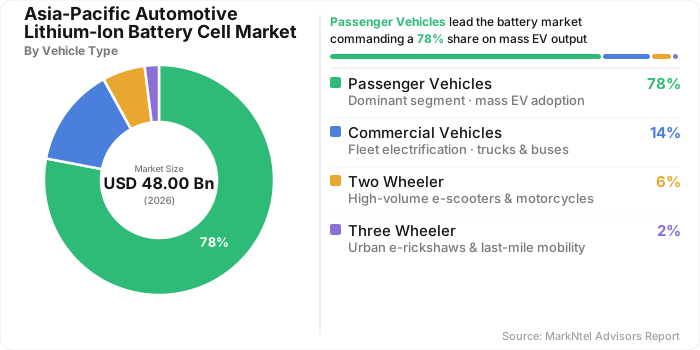
- By vehicle type, passenger vehicles seized a significant share of about 78% in 2026.
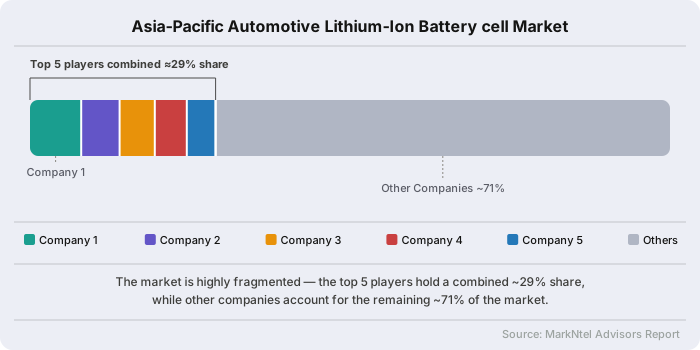
- The industry is highly fragmented. However, the top five players collectively account for nearly 29% share.
Asia-Pacific Automotive Lithium-Ion Battery Cell Market Size and Outlook
The Asia-Pacific automotive lithium-ion battery cell market size was valued at USD 43 billion in 2025 and is projected to grow from USD 48 billion in 2026 to USD 71 billion by 2032. Along with this, the market is estimated to grow at a CAGR of around 6.74% during the forecast period, i.e., 2026-32.
The demand for lithium-ion battery cells is expanding rapidly, driven by accelerating electric vehicle (EV) adoption, renewable energy integration, and rising demand for energy storage across China, India, Japan, South Korea, and Southeast Asia. China alone accounted for over 80% of global battery cell production in 2025, reinforcing the region’s manufacturing dominance. Government incentives supporting EV purchases, domestic battery manufacturing, localization, and clean-energy deployment are further strengthening regional demand. Opportunities are emerging in India and Southeast Asia through supply-chain diversification, localized production, LFP batteries, battery recycling, and grid-scale storage. Overall, the market outlook remains strongly positive, supported by electrification, technological innovation, and continued policy backing.
Asia-Pacific Automotive Lithium-Ion Battery Cell Market Key Indicators
- China's NEV sales hit 16.49 million units in 2025, up 28.2% from 12.86 million in 2024, with NEV penetration reaching 47.9% of total vehicle sales. NEV exports doubled to 2.62 million units. Domestic-only NEV sales grew 19.8% YoY to 13.88 million units. Since China alone accounts for roughly 60% of global battery deployment, this volume growth is the single strongest demand-side signal for Asia-Pacific cell consumption.
- Global nameplate lithium-ion capacity topped 4 TWh by end-2025, up 30% YoY, with China holding over 80% of it. CATL broke ground on a USD 5.9 billion, 15 GW cell plant in Karawang, Indonesia (targeting output for 300,000 EVs by 2028), while its own installed capacity reached 772 GWh, with a further 321 GWh under construction signaling continued regional supply build-out.
- Average lithium-ion pack prices fell to USD 108/kWh in 2025, an 8% YoY drop and the steepest fall since 2017. LFP packs averaged USD 81/kWh versus USD 128/kWh for NMC, and China's pack prices (USD 84/kWh) ran 13% below 2024 levels. Falling cell costs are the biggest driver of EV affordability and battery-storage economics across the region through 2025-26.
- China's retired power-battery volume is forecast to reach 1.04 million tonnes in 2025, rising toward 3.5 million tonnes by 2030. Recycler GEM processed 10,800 tonnes in Q1 2025 alone (+37% YoY) at over 90% lithium recovery, while GEM, Huayou, and Gotion are scaling toward 100+ global recycling centers- a fast-growing circular-supply indicator affecting regional cell input costs.
Asia-Pacific Automotive Lithium-Ion Battery Cell Market Scope
| Category | Segments |
|---|---|
| By Battery Chemistry | Lithium Iron Phosphate, Nickel Manganese Cobalt, Nickel Cobalt Aluminum, Lithium Manganese Oxide, Lithium Titanate, Others |
| By Cell Form Factor | Prismatic, Cylindrical, Pouch |
| By Vehicle Type | Passenger Cars, Commercial Vehicles, Two-Wheelers, Three-Wheelers |
| By Propulsion Type | Battery Electric Vehicles, Plug-in Hybrid Electric Vehicles, Hybrid Electric Vehicles |
| By Battery Capacity | Below 50 kilowatt-hours, 50–100 kilowatt-hours, Above 100 kilowatt-hours |
Asia-Pacific Automotive Lithium-Ion Battery Cell Market Growth Drivers
Rapid EV Adoption Accelerates Demand for Lithium-Ion Battery Cells
Rapid electric vehicle (EV) adoption is a key growth driver for the Asia-Pacific lithium-ion battery cell industry, as EVs require large battery packs and therefore directly increase cell consumption. In 2025, electric-car sales in Southeast Asia more than doubled year-on-year to exceed 500,000 units, with EVs accounting for nearly one-fifth of total car sales in the region. This momentum continued across major Asian markets, supported by expanding domestic EV manufacturing and favorable government policies.
In 2025, nearly 22 million electric cars were produced globally, with production in Southeast Asia increasing by 130% from 2024, highlighting the region's rapidly expanding EV manufacturing base. India also recorded 2.3 million EV sales in 2025, while its EV battery market was valued at USD 2.71 billion, demonstrating the direct link between vehicle electrification and battery demand. Furthermore, in 2026, EV sales in India, Korea, and Vietnam had roughly doubled during March–June compared with the same period in 2025.
Rising EV penetration across China, India, Southeast Asia, Japan, and South Korea is consequently increasing demand for lithium-ion cells, supporting capacity expansion and investment throughout the regional battery ecosystem.
Recent Trends
Increasing Adoption of LFP Battery Chemistry Transforming Cell Technology
The rapid shift toward lithium iron phosphate (LFP) chemistry is an important recent trend in the Asia-Pacific lithium-ion battery cell market, particularly because manufacturers are increasingly prioritizing lower-cost, safer, and longer-cycle battery technologies. In 2025, LFP batteries accounted for more than 55% of global EV battery deployment, up from nearly 50% in 2024. LFP packs were also more than 40% cheaper per kWh than NMC packs, strengthening their attractiveness for cost-sensitive applications.
The trend is particularly pronounced in Asia-Pacific, where Chinese manufacturers continue to lead LFP production and innovation. At the same time, other regional manufacturers are beginning to expand LFP capabilities. For instance, South Korea's L&F secured an approximately USD 1.17 billion LFP cathode-material supply agreement with Samsung SDI in 2026, marking an important step toward developing non-Chinese LFP supply chains. This diversification demonstrates that LFP adoption is expanding beyond China's established battery ecosystem.
In addition, LFP accounted for around 90% of global battery-storage deployments in 2025, highlighting its growing importance beyond EVs. Consequently, increasing LFP adoption is reshaping the regional cell-chemistry mix and encouraging Asian manufacturers to expand LFP cell and material production capacity.
Asia-Pacific Automotive Lithium-Ion Battery Cell Market Opportunities and Challenges
High Concentration of Battery-Cell Manufacturing in China Creates Supply-Chain Dependence and Drives Regional Manufacturing Diversification
The high concentration of lithium-ion battery-cell manufacturing in China is a major challenge for the Asia-Pacific automotive battery-cell market. China accounted for more than 80% of global battery-cell production in 2025, while China, Europe, and North America together represented around 95% of global output. This concentration increases the exposure of other Asia-Pacific countries to supply disruptions, trade restrictions, geopolitical tensions, and dependence on Chinese battery materials and components.
This challenge is encouraging regional manufacturing diversification and supply-chain localization, creating new opportunities for battery-cell production across Southeast Asia. For instance, Thailand approved more than USD 1 billion in investment by Sunwoda for electric-vehicle and energy-storage battery-cell manufacturing, with the first factory in Chonburi producing lithium-ion cells. Similarly, LG increased its Indonesian battery-cell investment by USD 1.7 billion, bringing its total commitment to USD 2.8 billion.
These investments are gradually expanding battery-cell manufacturing beyond China. As automakers seek more resilient and localized supply chains, additional investments in India and Southeast Asia are expected to support regional cell-market growth.
Segmentation Insights
Lithium Iron Phosphate Leads with Approximately 73% Market Share in 2026
Lithium Iron Phosphate (LFP) is estimated to account for approximately 73% of the Asia-Pacific automotive lithium-ion battery cell industry in 2026, making it the leading chemistry. Its dominance is primarily attributed to its lower cost, strong thermal stability, longer cycle life, and suitability for mass-market electric vehicles. The International Energy Agency reports that LFP batteries represented more than 55% of global electric-vehicle battery deployment in 2025, with adoption particularly concentrated in China.
China’s extensive electric-vehicle manufacturing base and large-scale battery production further support regional LFP demand. In Southeast Asia, governments are also encouraging localized battery manufacturing. These developments reinforce LFP’s cost and supply-chain advantages across Asia-Pacific. Based on battery chemistry, the scope has been segmented into
- Lithium Iron Phosphate
- Nickel Manganese Cobalt
- Nickel Cobalt Aluminum
- Lithium Manganese Oxide
- Lithium Titanate
- Others
Passenger Cars Account for Approximately 78% of Asia-Pacific Automotive Lithium-Ion Battery Cell Revenue
Passenger Cars are estimated to account for approximately 78% of the Asia-Pacific automotive lithium-ion battery cell market in 2026, making them the leading vehicle type. The segment’s dominance is primarily driven by the rapid adoption of battery-powered passenger vehicles, particularly in China, the region’s largest electric-vehicle market. The International Energy Agency reports that more than 85% of global electric-vehicle battery deployment in 2025 was associated with light-duty vehicles, reflecting their substantially higher battery requirements than smaller electric vehicles.
In addition, passenger cars typically use significantly larger battery packs than two-wheelers and three-wheelers, resulting in greater lithium-ion cell consumption per vehicle. China’s extensive electric-vehicle manufacturing ecosystem, combined with increasing electric-car adoption across Southeast Asia, further supports demand. Consequently, higher battery capacity per vehicle, large-scale electric passenger-car production, and expanding consumer adoption position passenger cars as the largest contributor to regional automotive lithium-ion battery cell demand. By vehicle type, the scope has been classified into
- Passenger Cars
- Commercial Vehicles
- Two-Wheelers
- Three-Wheelers
Asia-Pacific Automotive Lithium-Ion Battery Cell Market Geographical Outlook
China Accounts for Approximately 49% of Asia-Pacific Automotive lithium-ion Battery Cell Demand
China holds the largest share of approximately 49% in the Asia-Pacific automotive lithium-ion battery cell market in 2026. It’s leading position is supported by its large electric-vehicle market, extensive battery-cell manufacturing capacity, and highly integrated battery supply chain. The International Energy Agency reports that China accounted for more than 80% of global battery-cell production in 2025, demonstrating its exceptional manufacturing scale. China also produced approximately 16 million electric cars in 2025, around three-quarters of global electric-car production, while its electric-car exports exceeded 2.5 million units.
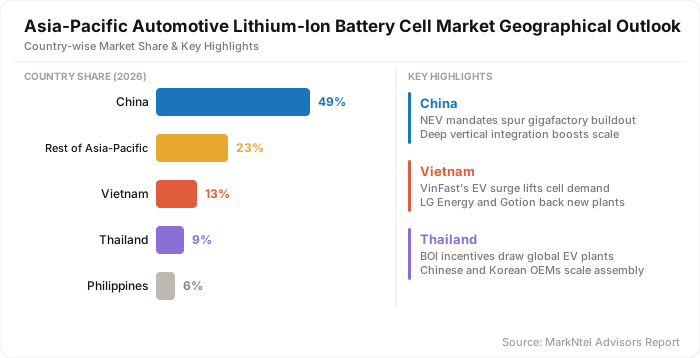
In addition, China represented approximately 60% of global electric-vehicle battery deployment in 2025, significantly ahead of other major markets. The presence of major domestic manufacturers, including Contemporary Amperex Technology Co., Limited and BYD Company Limited, further strengthens local cell production and technological capabilities. Moreover, China’s established cathode, anode, mineral-processing, and battery-component ecosystem enables manufacturers to achieve economies of scale and competitive costs.
Asia-Pacific Automotive Lithium-Ion Battery Cell Market Competitive Analysis
Top 5 Companies Account for Approximately 29% Market Share
The Asia-Pacific automotive lithium-ion battery cell market is highly fragmented, with leading companies such as Contemporary Amperex Technology Co., Limited, BYD Company Limited, LG Energy Solution, Ltd., CALB Group Co., Ltd., and Gotion High-tech Co., Ltd. collectively accounting for an estimated 29% of the regional market share.
Key Players in Asia-Pacific Automotive lithium-ion battery cell Market
- Contemporary Amperex Technology Co., Limited
- BYD Company Limited
- LG Energy Solution, Ltd.
- CALB Group Co., Ltd.
- Gotion High-tech Co., Ltd.
- SK On Co., Ltd.
- Panasonic Energy Co., Ltd.
- EVE Energy Co., Ltd.
- Samsung SDI Co., Ltd.
- SVOLT Energy Technology Co., Ltd.
- Sunwoda Electronic Co., Ltd.
- Farasis Energy (Gan Zhou) Co., Ltd.
- Others
Asia-Pacific Automotive Lithium-Ion Battery Cell Industry News and Recent Developments
April 2026: CATL launches next-generation Qilin and Shenxing batteries
Contemporary Amperex Technology Co., Limited introduced upgraded Qilin and Shenxing EV batteries in China. The new Qilin battery targets up to 1,000 km of driving range, while the Shenxing battery can charge from 10% to 98% in under seven minutes. The launches strengthen CATL’s focus on higher energy density and faster charging.
Impact Analysis: The launch is expected to strengthen CATL’s competitive position in Asia-Pacific’s automotive lithium-ion battery cell market by addressing two critical EV requirements: longer driving range and faster charging. Higher energy density can support greater vehicle range without proportionately increasing battery size, while rapid charging can improve consumer convenience. The development may accelerate adoption of advanced battery technologies and intensify competition among regional cell manufacturers.
March 2026: BYD launches second-generation Blade Battery
BYD Company Limited launched its second-generation Blade Battery in China, offering charging from 20% to 97% in less than 12 minutes, including in subzero conditions. The battery can support vehicles with ranges of up to 777 km, strengthening the company’s competitive position in high-performance EV batteries.
Impact Analysis: BYD’s second-generation Blade Battery is likely to intensify competition in the Asia-Pacific automotive lithium-ion battery cell market by combining faster charging, improved low-temperature performance, and extended driving range. Its ability to maintain charging performance in subzero conditions could expand EV usability across diverse climates. The launch may encourage competing battery manufacturers to accelerate investments in high-performance lithium-ion cell technologies.
March 2025: LG Energy Solution unveils 46-series cylindrical cells
LG Energy Solution unveiled its new 46-series cylindrical battery cells at InterBattery 2025 in Seoul. The company also introduced its Cell-to-Pack solution, targeting improved performance and safety. The development directly supports next-generation automotive lithium-ion cell commercialization and strengthens South Korea's position in the regional EV battery-cell industry.
Impact Analysis: LG Energy Solution’s 46-series cylindrical cells could support growth in Asia-Pacific’s automotive lithium-ion battery cell market by increasing the availability of higher-performance cylindrical formats for next-generation EVs. Improved cell-to-pack integration can enhance energy utilization, safety, and vehicle efficiency. The development also strengthens South Korea’s technological position and may encourage automakers and battery manufacturers to accelerate adoption of large-format cylindrical cells
- Market Segmentation
- Introduction
- Product Definition
- Research Process
- Assumptions
- Executive Summary
- Asia-Pacific Automotive Lithium-Ion Battery Cell Supply Chain Analysis
- Asia-Pacific Automotive Lithium-Ion Battery Cell Import/Export Data Analysis
- Asia-Pacific Automotive Lithium-Ion Battery Cell Market Policies, Regulations, and Product Standards
- Asia-Pacific Automotive Lithium-Ion Battery Cell Market Production Trend 2022-2032
- Asia-Pacific Automotive Lithium-Ion Battery Cell Market Production Trend By Battery Chemistry
- Lithium Iron Phosphate
- Nickel Manganese Cobalt
- Nickel Cobalt Aluminum
- Lithium Manganese Oxide
- Lithium Titanate
- Others
- Company-Wise Production Plants and Statistics
- Installed Production Capacity
- Actual Production
- Planned Production Target
- Asia-Pacific Automotive Lithium-Ion Battery Cell Market Production Trend By Battery Chemistry
- Asia-Pacific Automotive Lithium-Ion Battery Cell Market Pricing Analysis 2022-2032
- Asia-Pacific Automotive Lithium-Ion Battery Cell Market Pricing Trend (USD) 2022-2032
- Asia-Pacific Automotive Lithium-Ion Battery Cell Market Pricing Trend (USD) By Regions 2022-2032
- China
- Japan
- South Korea
- India
- Thailand
- Vietnam
- Indonesia
- Rest of Asia-Pacific
- Asia-Pacific Automotive Lithium-Ion Battery Cell Market Pricing Trend (USD) By Battery Chemistry 2022-2032
- Lithium Iron Phosphate
- Nickel Manganese Cobalt
- Nickel Cobalt Aluminum
- Lithium Manganese Oxide
- Lithium Titanate
- Others
- Asia-Pacific Automotive Lithium-Ion Battery Cell Market Trends & Developments
- Asia-Pacific Automotive Lithium-Ion Battery Cell Market Dynamics
- Growth Factors
- Challenges
- Asia-Pacific Automotive Lithium-Ion Battery Cell Market Hotspot & Opportunities
- Asia-Pacific Automotive Lithium-Ion Battery Cell Market Outlook, 2022-2032
- Market Size & Outlook
- By Revenues (USD Million)
- Market Segmentation & Outlook
- By Battery Chemistry- Market Size & Forecast 2022-2032, USD Million
- Lithium Iron Phosphate
- Nickel Manganese Cobalt
- Nickel Cobalt Aluminum
- Lithium Manganese Oxide
- Lithium Titanate
- Others
- By Cell Form Factor- Market Size & Forecast 2022-2032, USD Million
- Prismatic
- Cylindrical
- Pouch
- By Vehicle Type- Market Size & Forecast 2022-2032, USD Million
- Passenger Cars
- Commercial Vehicles
- Two-Wheelers
- Three-Wheelers
- By Propulsion Type- Market Size & Forecast 2022-2032, USD Million
- Battery Electric Vehicles
- Plug-in Hybrid Electric Vehicles
- Hybrid Electric Vehicles
- By Battery Capacity- Market Size & Forecast 2022-2032, USD Million
- Below 50 kilowatt-hours
- 50–100 kilowatt-hours
- Above 100 kilowatt-hours
- By Country
- China
- Japan
- South Korea
- India
- Thailand
- Vietnam
- Indonesia
- Rest of Asia-Pacific
- By Company
- Competition Characteristics
- Market Share & Analysis
- By Battery Chemistry- Market Size & Forecast 2022-2032, USD Million
- Market Size & Outlook
- China Automotive Lithium-Ion Battery Cell Market Outlook, 2022-2032
- Market Size & Outlook
- By Revenues (USD Million)
- Market Segmentation & Outlook
- By Battery Chemistry- Market Size & Forecast 2022-2032, USD Million
- By Cell Form Factor- Market Size & Forecast 2022-2032, USD Million
- By Vehicle Type- Market Size & Forecast 2022-2032, USD Million
- By Propulsion Type- Market Size & Forecast 2022-2032, USD Million
- By Battery Capacity- Market Size & Forecast 2022-2032, USD Million
- Market Size & Outlook
- Japan Automotive Lithium-Ion Battery Cell Market Outlook, 2022-2032
- Market Size & Outlook
- By Revenues (USD Million)
- Market Segmentation & Outlook
- By Battery Chemistry- Market Size & Forecast 2022-2032, USD Million
- By Cell Form Factor- Market Size & Forecast 2022-2032, USD Million
- By Vehicle Type- Market Size & Forecast 2022-2032, USD Million
- By Propulsion Type- Market Size & Forecast 2022-2032, USD Million
- By Battery Capacity- Market Size & Forecast 2022-2032, USD Million
- Market Size & Outlook
- South Korea Automotive Lithium-Ion Battery Cell Market Outlook, 2022-2032
- Market Size & Outlook
- By Revenues (USD Million)
- Market Segmentation & Outlook
- By Battery Chemistry- Market Size & Forecast 2022-2032, USD Million
- By Cell Form Factor- Market Size & Forecast 2022-2032, USD Million
- By Vehicle Type- Market Size & Forecast 2022-2032, USD Million
- By Propulsion Type- Market Size & Forecast 2022-2032, USD Million
- By Battery Capacity- Market Size & Forecast 2022-2032, USD Million
- Market Size & Outlook
- India Automotive Lithium-Ion Battery Cell Market Outlook, 2022-2032
- Market Size & Outlook
- By Revenues (USD Million)
- Market Segmentation & Outlook
- By Battery Chemistry- Market Size & Forecast 2022-2032, USD Million
- By Cell Form Factor- Market Size & Forecast 2022-2032, USD Million
- By Vehicle Type- Market Size & Forecast 2022-2032, USD Million
- By Propulsion Type- Market Size & Forecast 2022-2032, USD Million
- By Battery Capacity- Market Size & Forecast 2022-2032, USD Million
- Market Size & Outlook
- Thailand Automotive Lithium-Ion Battery Cell Market Outlook, 2022-2032
- Market Size & Outlook
- By Revenues (USD Million)
- Market Segmentation & Outlook
- By Battery Chemistry- Market Size & Forecast 2022-2032, USD Million
- By Cell Form Factor- Market Size & Forecast 2022-2032, USD Million
- By Vehicle Type- Market Size & Forecast 2022-2032, USD Million
- By Propulsion Type- Market Size & Forecast 2022-2032, USD Million
- By Battery Capacity- Market Size & Forecast 2022-2032, USD Million
- Market Size & Outlook
- Vietnam Automotive Lithium-Ion Battery Cell Market Outlook, 2022-2032
- Market Size & Outlook
- By Revenues (USD Million)
- Market Segmentation & Outlook
- By Battery Chemistry- Market Size & Forecast 2022-2032, USD Million
- By Cell Form Factor- Market Size & Forecast 2022-2032, USD Million
- By Vehicle Type- Market Size & Forecast 2022-2032, USD Million
- By Propulsion Type- Market Size & Forecast 2022-2032, USD Million
- By Battery Capacity- Market Size & Forecast 2022-2032, USD Million
- Market Size & Outlook
- Indonesia Automotive Lithium-Ion Battery Cell Market Outlook, 2022-2032
- Market Size & Outlook
- By Revenues (USD Million)
- Market Segmentation & Outlook
- By Battery Chemistry- Market Size & Forecast 2022-2032, USD Million
- By Cell Form Factor- Market Size & Forecast 2022-2032, USD Million
- By Vehicle Type- Market Size & Forecast 2022-2032, USD Million
- By Propulsion Type- Market Size & Forecast 2022-2032, USD Million
- By Battery Capacity- Market Size & Forecast 2022-2032, USD Million
- Market Size & Outlook
- Asia-Pacific Automotive Lithium-Ion Battery Cell Market Key Strategic Imperatives for Success & Growth
- Competitive Outlook
- Company Profiles
- Contemporary Amperex Technology Co., Limited
- Business Description
- Product Portfolio
- Collaborations & Alliances
- Recent Developments
- Financial Details
- Others
- BYD Company Limited
- Business Description
- Product Portfolio
- Collaborations & Alliances
- Recent Developments
- Financial Details
- Others
- LG Energy Solution, Ltd.
- Business Description
- Product Portfolio
- Collaborations & Alliances
- Recent Developments
- Financial Details
- Others
- CALB Group Co., Ltd.
- Business Description
- Product Portfolio
- Collaborations & Alliances
- Recent Developments
- Financial Details
- Others
- Gotion High-tech Co., Ltd.
- Business Description
- Product Portfolio
- Collaborations & Alliances
- Recent Developments
- Financial Details
- Others
- SK On Co., Ltd.
- Business Description
- Product Portfolio
- Collaborations & Alliances
- Recent Developments
- Financial Details
- Others
- Panasonic Energy Co., Ltd.
- Business Description
- Product Portfolio
- Collaborations & Alliances
- Recent Developments
- Financial Details
- Others
- EVE Energy Co., Ltd.
- Business Description
- Product Portfolio
- Collaborations & Alliances
- Recent Developments
- Financial Details
- Others
- Samsung SDI Co., Ltd.
- Business Description
- Product Portfolio
- Collaborations & Alliances
- Recent Developments
- Financial Details
- Others
- SVOLT Energy Technology Co., Ltd.
- Business Description
- Product Portfolio
- Collaborations & Alliances
- Recent Developments
- Financial Details
- Others
- Sunwoda Electronic Co., Ltd.
- Business Description
- Product Portfolio
- Collaborations & Alliances
- Recent Developments
- Financial Details
- Others
- Farasis Energy (Gan Zhou) Co., Ltd.
- Business Description
- Product Portfolio
- Collaborations & Alliances
- Recent Developments
- Financial Details
- Others
- Contemporary Amperex Technology Co., Limited
- Company Profiles
- Disclaimer

MarkNtel Advisors follows a robust and iterative research methodology designed to ensure maximum accuracy and minimize deviation in market estimates and forecasts. Our approach combines both bottom-up and top-down techniques to effectively segment and quantify various aspects of the market. A consistent feature across all our research reports is data triangulation, which examines the market from three distinct perspectives to validate findings. Key components of our research process include:
1. Scope & Research Design At the outset, MarkNtel Advisors define the research objectives and formulate pertinent questions. This phase involves determining the type of research—qualitative or quantitative—and designing a methodology that outlines data collection methods, target demographics, and analytical tools. They also establish timelines and budgets to ensure the research aligns with client goals.
2. Sample Selection and Data Collection In this stage, the firm identifies the target audience and determines the appropriate sample size to ensure representativeness. They employ various sampling methods, such as random or stratified sampling, based on the research objectives. Data collection is carried out using tools like surveys, interviews, and observations, ensuring the gathered data is reliable and relevant.
3. Data Analysis and Validation Once data is collected, MarkNtel Advisors undertake a rigorous analysis process. This includes cleaning the data to remove inconsistencies, employing statistical software for quantitative analysis, and thematic analysis for qualitative data. Validation steps are taken to ensure the accuracy and reliability of the findings, minimizing biases and errors.

4. Data Forecast and FinalizationThe final phase involves forecasting future market trends based on the analyzed data. MarkNtel Advisors utilize predictive modeling and time series analysis to anticipate market behaviors. The insights are then compiled into comprehensive reports, featuring visual aids like charts and graphs, and include strategic recommendations to inform client decision-making
FILL THE FORM TO GET THE FREE SAMPLE PAGES
We offer flexible licensing options to cater to varying organizational needs. Choose the pricing pack that best suits your requirements:
Buy Now Inquire Before Buying
 Talk to our Consultant
 Request Customization