

By Fiber Type (Natural Fibers, Synthetic Fibers, Man-Made Cellulosic Fibers), By Fiber Form (Staple Fibers, Continuous Filaments, Tow and Specialty Short-Cut Fibers), By End-Use Industry (Apparel and... ... dustry (Apparel and Footwear, Home Textiles, Carpets and Furnishings, Personal Care, Hygiene and Medical, Automotive and Transportation, Construction and Geotextiles, Filtration and Other Industrial Textiles, Protective, Defense and Aerospace, Other Industries), and others Read more
- Chemicals
- Aug 2026
- 160
- PDF, Excel, PPT
US Fibers Market Key Takeaways
- The market is estimated at USD 10.40 billion in 2025 and USD 10.90 billion in 2026, reaching USD 14.52 billion by 2032 with a 4.89% CAGR.
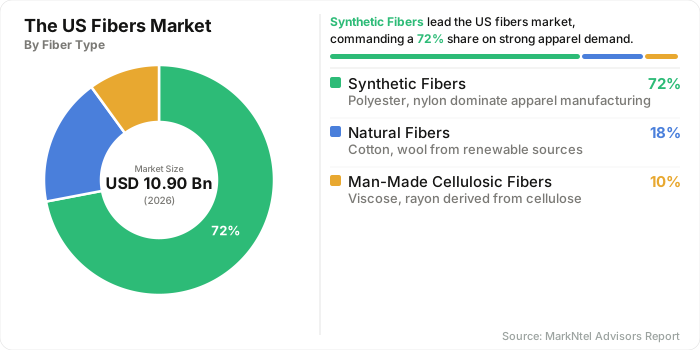
- Synthetic fibers lead by fiber type, accounting for an estimated 72% share in 2026.
- Home textiles, carpets and furnishings lead by end-use industry, with an estimated 24% market share in 2026.
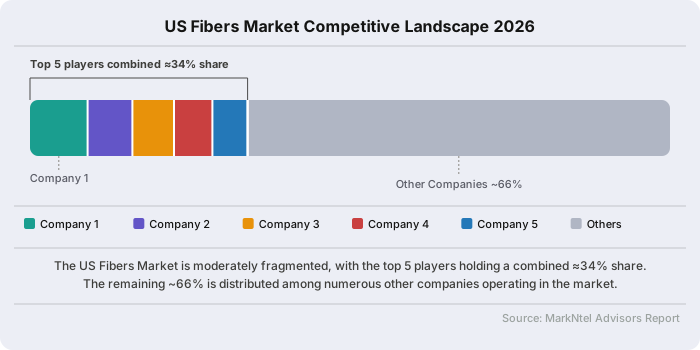
- The market is fragmented, with the top five companies collectively accounting for an estimated 34% share in 2026.
US Fibers Market Size and Outlook
The fibers market in the United States was valued at an estimated USD 10.40 billion in 2025 and is projected to reach around USD 10.90 billion in 2026. It is forecast to expand at a CAGR of about 4.89% during 2026–2032, reaching nearly USD 14.52 billion by 2032.
Demand is anchored by the US textile-converting base and rising fiber requirements in technical and nonwoven applications. Association of the Nonwoven Fabrics Industry (INDA) reported that North American nonwoven capacity grew by less than 1% in 2025, production declined by less than 0.5%, and the operating rate reached 78%, indicating that gains increasingly depend on utilization recovery and higher-value products. Meanwhile, USDA forecasts US cotton mill use at only 1.6 million bales in 2026/27, reinforcing a domestic conversion mix increasingly oriented toward man-made fibers.
Through 2032, value growth should outpace commodity-volume expansion as producers and converters shift toward recycled polyester, traceable feedstocks, engineered staple fibers, and application-specific performance grades. Technical textiles, hygiene and medical nonwovens, transportation materials, filtration media, and durable interiors are expected to support incremental demand. However, uneven downstream activity, volatile petrochemical and natural-fiber costs, import competition, and the expense of verified circularity will restrain pricing power. Overall, the outlook is moderately positive, led by product-mix upgrading rather than uniform growth across fiber categories.
US Fibers Market Key Indicators
- The Bureau of Labor Statistics reported that US synthetic-fiber producer prices rose 6.5% year on year in July 2026 and increased 1.6% during the month. The renewed price acceleration raises replacement and working-capital costs, supporting market value while intensifying margin pressure on fiber converters and downstream buyers.
- Federal Reserve data show that output from US textile and product mills declined 4.7% year on year in June 2026, following flat output across 2025. Softer converter activity limits near-term commodity-fiber offtake and strengthens supplier emphasis on technical grades, differentiated performance and import substitution.
- The US Census Bureau reported privately owned housing starts at an annualized 1.43 million units in June 2026, 3.5% above June 2025, while completions increased 1.5%. Continued building activity sustains fiber requirements in carpets, upholstery, insulation, roofing substrates, wipes and other construction-related textile products.
- Alliance for Automotive Innovation reported that total US light-duty vehicle sales increased 2.2% in 2025, adding approximately 340,000 vehicles. The larger production and replacement base supports recurring consumption of polyester, nylon and specialty fibers used in seating, carpets, headliners, airbags, filtration media and acoustic-management components.
US Fibers Market Domestic Supply and Trade Analysis
Large Export Base Coexists with Rising Import Pressure and Selective Trade Protection
The US retains a sizeable fiber-to-textile production and export platform, increasingly concentrated in technical and specialized products. The National Council of Textile Organizations reported that US textile and apparel shipments totaled USD 60.9 billion in 2025, while fiber, textile and apparel exports reached USD 26.9 billion. This downstream manufacturing and export base supports domestic fiber offtake where buyers require short lead times, product qualification, traceability or US-origin procurement compliance.
Import competition nevertheless shapes available supply and domestic pricing. Department of Commerce data show that US textile and apparel imports reached 106.64 billion square-meter equivalents in 2024, increasing 15.2%, while non-apparel textile imports rose 18.5% to 80.87 billion square-meter equivalents. Trade remedies remain relevant at the fiber level: in April 2026, Commerce assigned a 3.02% dumping margin to Korean low-melt polyester staple fiber in its final administrative review. Imports will continue providing cost and product-range flexibility, but trade enforcement, procurement requirements and supply-chain risk should preserve space for domestic capacity. Through 2032, US producers are therefore expected to compete most effectively through technical performance, recycled content, dependable delivery and customer-specific qualification rather than commodity scale alone.
US Fibers Market Scope
| Category | Segments |
|---|---|
| By Fiber Type | Natural Fibers, Synthetic Fibers, Man-Made Cellulosic Fibers |
| By Fiber Form | Staple Fibers, Continuous Filaments, Tow and Specialty Short-Cut Fibers |
| By End-Use Industry | Apparel and Footwear, Home Textiles, Carpets and Furnishings, Personal Care, Hygiene and Medical, Automotive and Transportation, Construction and Geotextiles, Filtration and Other Industrial Textiles, Protective, Defense and Aerospace, Other Industries |
US Fibers Market Growth Drivers
High-Performance Defense and Protective Applications Expand Value-Added Fiber Demand
Demand is shifting toward fibers providing ballistic protection, flame resistance, thermal control and durability beyond conventional textile performance. The Defense Logistics Agency recorded USD 1.84 billion in Clothing and Textiles obligations during FY2025 and manages more than 8,000 products across 50,000 line items. Procurement includes field clothing, chemical-protection suits, body armor and combat helmets. This recurring base creates pull-through demand for high-tenacity, heat-resistant and engineered fibers while rewarding suppliers meeting stringent sourcing, testing and qualification requirements.
In April 2025, the US Army launched an Advanced Fiber-Based Electronic Battery System solicitation to integrate rechargeable structural batteries into assault packs and equipment fabrics. The Army reported that dismounted soldiers carry combat loads exceeding 100 pounds, with batteries representing nearly 10% of that weight. Converting fabric from a passive material into a load-bearing power-storage system expands the functional content and potential value of fibers in each item. Similar innovation can extend into connected protective clothing, medical wearables and industrial safety equipment. Consequently, technical applications should generate faster revenue growth than commodity apparel in US fiber industry through 2032, supporting premium grades, longer qualification cycles and closer collaboration among fiber producers, textile converters and equipment manufacturers.
Recent Trends
Recycled and Traceable Fibers Move into the Commercial Product Mix
Recycled fiber is becoming a measurable commercial product platform rather than a limited brand claim. In February 2026, North Carolina-based UNIFI reported that its REPREVE brand generated 31% of its FY2025 revenue and set a target exceeding 50% by FY2030. The platform had converted more than 46 billion plastic bottles and textile waste equivalent to one billion T-shirts into recycled fiber. This scale demonstrates expanding use across apparel, footwear, furnishings and transportation, while embedded tracing and certification systems help buyers substantiate recycled-content claims throughout their supply chains.
The shift is now extending from bottle-derived inputs toward textile-to-textile circularity. In August 2025, UNIFI introduced REPREVE Takeback filament and staple fibers and ThermaLoop insulation made entirely from textile waste. Regulatory implementation is reinforcing this direction: California approved its textile producer-responsibility organization in March 2026 and required covered producers to join by July 1, covering a state with approximately 39.36 million residents as per July 2025 US Census Bureau estimate. Fiber companies must consequently provide stronger feedstock documentation, chain-of-custody verification and recovery-compatible materials. Through 2032, recycled and traceable grades should capture a larger share of supplier portfolios, although collection costs, contamination and price competition from virgin polymers will limit the pace of adoption.
US Fibers Market Opportunities and Challenges
Plant Attrition Constrains Domestic Scale While Strategic Consolidation Supports High-Value Fibers
Domestic plant attrition is reducing production redundancy and making it harder for US fiber companies to compete in standardized grades requiring high utilization and low unit costs. In February 2025, the National Council of Textile Organizations reported 27 US textile-plant closures during the preceding 20 months. Lost converting capacity weakens local fiber offtake, lengthens logistics for remaining customers and raises the commercial risk of maintaining specialized lines. Qualification-intensive fibers also require sustained testing, technical support and inventory commitments, which smaller producers may struggle to fund when commodity imports limit price realization.
The resulting opportunity lies in consolidating scale around defensible, performance-critical applications. In April 2026, US-based Arclin completed its approximately USD 1.8 billion acquisition of DuPont’s aramids business, adding Kevlar and Nomex, manufacturing operations in Europe and Asia, and approximately 1,800 employees. The combination gives Arclin established technology, qualified brands and access to aerospace, electrical infrastructure, electric-vehicle, personal-protection and defense customers. Suppliers that similarly integrate fiber technology, application engineering and customer qualification can capture higher margins and longer replacement cycles than commodity producers. Through 2032, selective consolidation should sustain investment in advanced fibers, although greater supplier concentration could increase sourcing risk and qualification dependence for downstream manufacturers.
Segmentation Insights
Synthetic Fibers Lead Through Scale, Cost, and Cross-Application Performance, Accounting for an Estimated 72% Market Share in 2026
Synthetic fibers command the broadest application coverage in the United States fiber industry because polyester, nylon, polypropylene, acrylic, elastane, and high-performance polymers combine scalable production with tunable strength, elasticity, moisture resistance, and chemical durability. Their specifications can be engineered for carpets, hygiene nonwovens, filtration media, vehicle interiors, and protective systems, allowing producers to serve multiple demand pools. Competitive pricing, consistent quality, and compatibility with high-speed spinning, extrusion, and nonwoven lines reinforce their advantage over natural and man-made cellulosic alternatives, particularly where uniformity and service life shape procurement decisions.
The supply structure supports this position. Textile Exchange reported that polyester alone represented 59% of global fiber output in 2024, growing 9.86% to reach 78 million tons. On the other hand, cotton declined 1% to reach 24.5 million tons, representing a share of 19%. These production values demonstrate the scale economics available to US buyers and converters. Synthetic leadership should persist as recycled-feedstock offerings widen and technical specifications become more demanding. Within the category, aramid, UHMWPE, and other high-performance synthetic fibers are expected to grow faster than mainstream polyester because defense, aerospace, and industrial users pay premiums for heat resistance, low weight, and exceptional tensile performance, although their smaller installed base limits absolute share. Based on fiber type, the market is segmented into:
- Natural Fibers
- Synthetic Fibers
- Man-Made Cellulosic Fibers
Home Textiles, Carpets and Furnishings Lead Through Fiber-Intensive Domestic Conversion, Accounting for an Estimated 24% Market Share in 2026
This end-use pool benefits from the fiber intensity of carpets, rugs, upholstery, bedding, curtains, and related interior products, supported by an established US conversion base. Flooring consumes polyester, nylon, and polypropylene in face yarns, backings, and cushioning, while furnishings absorb cotton, polyester, and cellulosic blends. The segment combines residential replacement, commercial refurbishment, and institutional demand, capturing more domestic fiber-stage value than apparel and footwear, where much finished-product manufacturing occurs overseas. Differentiation through stain resistance, softness, durability, and recycled content supports a broad price ladder.
The industry’s geographical concentration makes this demand durable. The Carpet and Rug Institute states that carpet represents 48% of the US flooring market, more than 85% of the country’s carpet and rug market is produced by mills within a 65-mile radius of Dalton, Georgia, and the state supplies more than 45% of the world’s carpets and rugs. This cluster sustains fiber procurement, technical qualification, and supplier relationships. The segment should remain largest through 2032, although personal care, hygiene, and medical applications are expected to grow faster as disposable nonwovens benefit from healthcare utilization, population aging, and material substitution. Based on end-use industry, the United States fibers industry is segmented into:
- Apparel and Footwear
- Home Textiles, Carpets and Furnishings
- Personal Care, Hygiene and Medical
- Automotive and Transportation
- Construction and Geotextiles
- Filtration and Other Industrial Textiles
- Protective, Defense and Aerospace
- Other Industries
US Fibers Market Competitive Landscape
The US fibers market is fragmented, with top five companies holding 34% market share in 2026. The top five companies in the market are Indorama Ventures Public Company Limited, Alpek S.A.B. de C.V., INVISTA, UNIFI Inc., and Ascend Performance Materials.
Key Companies in The US Fibers Market
- Alpek S.A.B. de C.V.
- Arclin
- Ascend Performance Materials
- Barnet
- Darling Fibers
- Eastman Chemical Company
- Hyosung TNC Corporation
- Indorama Ventures Public Company Limited
- INVISTA
- Lenzing AG
- Staple Cotton Cooperative Association
- The LYCRA Company
- UNIFI, Inc.
- Universal Fibers, Inc.
- USFibers
- Others
US Fibers Industry News and Recent Developments
-
May 2026 | USFibers Secures Strategic Investment to Expand Recycled Polyester-Fiber Capacity
USFibers announced a strategic investment from Glisco Partners and Orion Infrastructure Capital. The funding will support expanded production capacity, efficiency improvements, recycling infrastructure, specialized and engineered polyester staple fibers, and potential entry into new markets and value-added services.
Impact analysis: Additional domestic recycled-polyester capacity can improve supply reliability across these end markets. Greater technical capability should also intensify competition in customized, higher-value fibers and reduce dependence on imported recycled staple products.
-
July 2025 | INVISTA Expands CORDURA Investment after Deciding to Retain Nylon-Fibers Business
INVISTA announced that it would increase investment in its CORDURA brand, airbag, and industrial-fiber businesses, following an earlier decision to retain ownership of its nylon-fibers business. The company said it would expand business development, marketing, and fiber and fabric innovation while maintaining both filament and staple Berry Amendment-compliant fiber supply for regulated procurement applications.
Impact analysis: Retention removes uncertainty around supply continuity for US buyers of nylon fibers. Targeted investment should sustain competition in performance textiles and preserve access to domestically compliant materials for military, workwear, outdoor, and automotive-safety customers.
- Market Segmentation
- Introduction
- Product Definition
- Research Process
- Assumptions
- Executive Summary
- US Fibers Market Domestic Supply and Trade Analysis
- US Fibers Market Policies, Regulations, and Product Standards
- US Fibers Market Trends & Developments
- US Fibers Market Dynamics
- Growth Factors
- Challenges
- US Fibers Market Hotspot & Opportunities
- US Fibers Market Outlook, 2022-2032
- Market Size & Outlook
- By Revenues (USD Million)
- By Quantity Sold (Thousand Tons)
- Market Segmentation & Outlook
- By Fiber Type- Market Size & Forecast 2022-2032, USD Million & Thousand Tons
- Natural Fibers
- Synthetic Fibers
- Man-Made Cellulosic Fibers
- By Fiber Form- Market Size & Forecast 2022-2032, USD Million & Thousand Tons
- Staple Fibers
- Continuous Filaments
- Tow and Specialty Short-Cut Fibers
- By End-Use Industry- Market Size & Forecast 2022-2032, USD Million & Thousand Tons
- Apparel and Footwear
- Home Textiles, Carpets and Furnishings
- Personal Care, Hygiene and Medical
- Automotive and Transportation
- Construction and Geotextiles
- Filtration and Other Industrial Textiles
- Protective, Defense and Aerospace
- Other Industries
- By Region- Market Size & Forecast 2022-2032, USD Million & Thousand Tons
- Northeast
- Midwest
- South
- West
- By Company
- Competition Characteristics
- Market Share & Analysis
- By Fiber Type- Market Size & Forecast 2022-2032, USD Million & Thousand Tons
- Market Size & Outlook
- US Natural Fibers Market Outlook, 2022-2032
- Market Size & Outlook
- By Revenues (USD Million)
- By Quantity Sold (Thousand Tons)
- Market Segmentation & Outlook
- By Fiber Form- Market Size & Forecast 2022-2032, USD Million & Thousand Tons
- By End-Use Industry- Market Size & Forecast 2022-2032, USD Million & Thousand Tons
- By Region- Market Size & Forecast 2022-2032, USD Million & Thousand Tons
- Market Size & Outlook
- US Synthetic Fibers Market Outlook, 2022-2032
- Market Size & Outlook
- By Revenues (USD Million)
- By Quantity Sold (Thousand Tons)
- Market Segmentation & Outlook
- By Fiber Form- Market Size & Forecast 2022-2032, USD Million & Thousand Tons
- By End-Use Industry- Market Size & Forecast 2022-2032, USD Million & Thousand Tons
- By Region- Market Size & Forecast 2022-2032, USD Million & Thousand Tons
- Market Size & Outlook
- US Man-Made Cellulosic Fibers Market Outlook, 2022-2032
- Market Size & Outlook
- By Revenues (USD Million)
- By Quantity Sold (Thousand Tons)
- Market Segmentation & Outlook
- By Fiber Form- Market Size & Forecast 2022-2032, USD Million & Thousand Tons
- By End-Use Industry- Market Size & Forecast 2022-2032, USD Million & Thousand Tons
- By Region- Market Size & Forecast 2022-2032, USD Million & Thousand Tons
- Market Size & Outlook
- US Fibers Market Key Strategic Imperatives for Success & Growth
- Competitive Outlook
- Company Profiles
- Alpek S.A.B. de C.V.
- Business Description
- Product Portfolio
- Collaborations & Alliances
- Recent Developments
- Financial Details
- Others
- Arclin
- Business Description
- Product Portfolio
- Collaborations & Alliances
- Recent Developments
- Financial Details
- Others
- Ascend Performance Materials
- Business Description
- Product Portfolio
- Collaborations & Alliances
- Recent Developments
- Financial Details
- Others
- Barnet
- Business Description
- Product Portfolio
- Collaborations & Alliances
- Recent Developments
- Financial Details
- Others
- Darling Fibers
- Business Description
- Product Portfolio
- Collaborations & Alliances
- Recent Developments
- Financial Details
- Others
- Eastman Chemical Company
- Business Description
- Product Portfolio
- Collaborations & Alliances
- Recent Developments
- Financial Details
- Others
- Hyosung TNC Corporation
- Business Description
- Product Portfolio
- Collaborations & Alliances
- Recent Developments
- Financial Details
- Others
- Indorama Ventures Public Company Limited
- Business Description
- Product Portfolio
- Collaborations & Alliances
- Recent Developments
- Financial Details
- Others
- INVISTA
- Business Description
- Product Portfolio
- Collaborations & Alliances
- Recent Developments
- Financial Details
- Others
- Lenzing AG
- Business Description
- Product Portfolio
- Collaborations & Alliances
- Recent Developments
- Financial Details
- Others
- Staple Cotton Cooperative Association
- Business Description
- Product Portfolio
- Collaborations & Alliances
- Recent Developments
- Financial Details
- Others
- The LYCRA Company
- Business Description
- Product Portfolio
- Collaborations & Alliances
- Recent Developments
- Financial Details
- Others
- UNIFI, Inc.
- Business Description
- Product Portfolio
- Collaborations & Alliances
- Recent Developments
- Financial Details
- Others
- Universal Fibers, Inc.
- Business Description
- Product Portfolio
- Collaborations & Alliances
- Recent Developments
- Financial Details
- Others
- USFibers
- Business Description
- Product Portfolio
- Collaborations & Alliances
- Recent Developments
- Financial Details
- Others
- Others
- Alpek S.A.B. de C.V.
- Company Profiles
- Disclaimer

MarkNtel Advisors follows a robust and iterative research methodology designed to ensure maximum accuracy and minimize deviation in market estimates and forecasts. Our approach combines both bottom-up and top-down techniques to effectively segment and quantify various aspects of the market. A consistent feature across all our research reports is data triangulation, which examines the market from three distinct perspectives to validate findings. Key components of our research process include:
1. Scope & Research Design At the outset, MarkNtel Advisors define the research objectives and formulate pertinent questions. This phase involves determining the type of research—qualitative or quantitative—and designing a methodology that outlines data collection methods, target demographics, and analytical tools. They also establish timelines and budgets to ensure the research aligns with client goals.
2. Sample Selection and Data Collection In this stage, the firm identifies the target audience and determines the appropriate sample size to ensure representativeness. They employ various sampling methods, such as random or stratified sampling, based on the research objectives. Data collection is carried out using tools like surveys, interviews, and observations, ensuring the gathered data is reliable and relevant.
3. Data Analysis and Validation Once data is collected, MarkNtel Advisors undertake a rigorous analysis process. This includes cleaning the data to remove inconsistencies, employing statistical software for quantitative analysis, and thematic analysis for qualitative data. Validation steps are taken to ensure the accuracy and reliability of the findings, minimizing biases and errors.

4. Data Forecast and FinalizationThe final phase involves forecasting future market trends based on the analyzed data. MarkNtel Advisors utilize predictive modeling and time series analysis to anticipate market behaviors. The insights are then compiled into comprehensive reports, featuring visual aids like charts and graphs, and include strategic recommendations to inform client decision-making
We’d love to understand what matters most to you.