

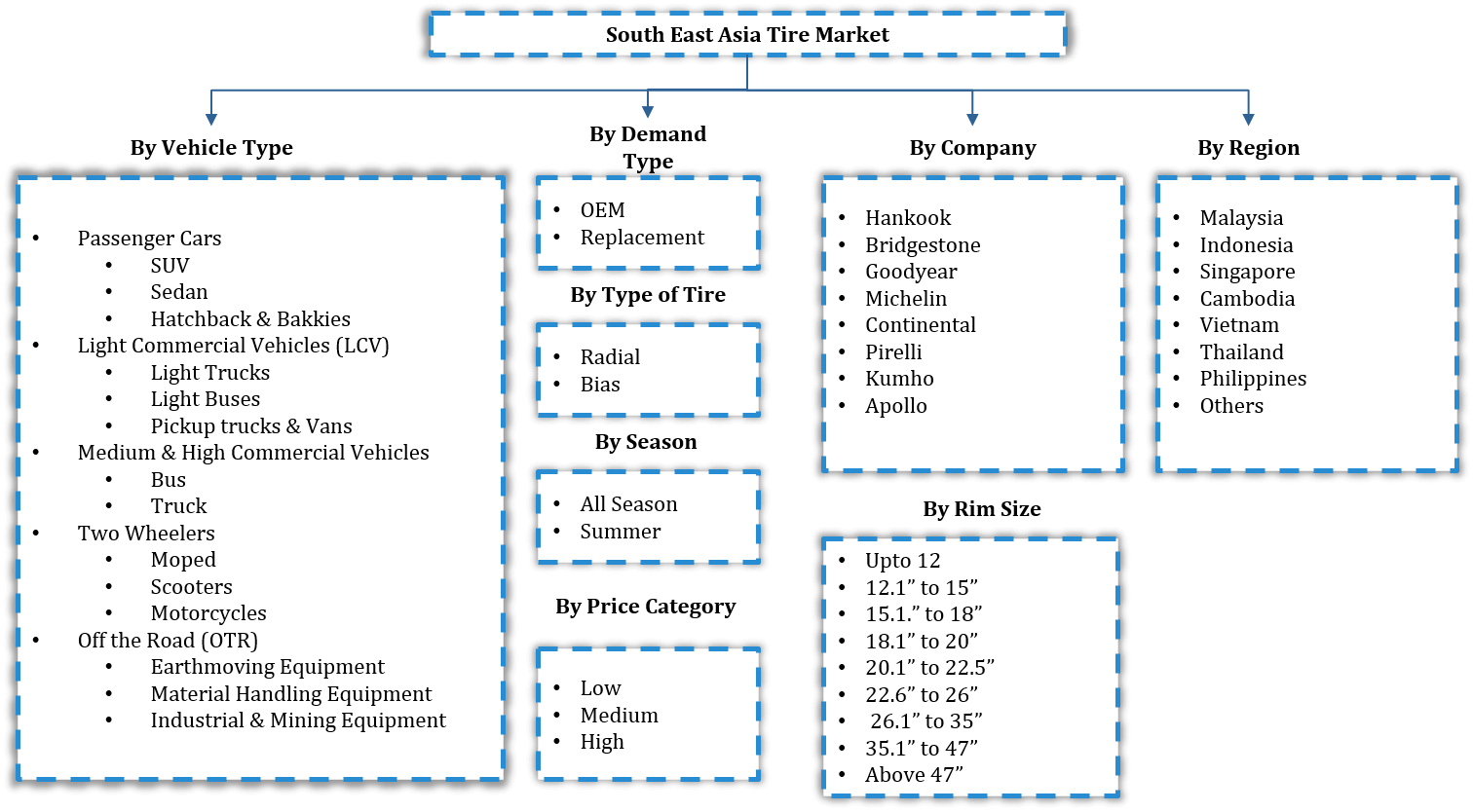
By Vehicle Type (Passenger Car, LCVs, MHCVs, Two-Wheelers, Off Road), By Demand Type (OEM, Replacement), By Type of Tire (Bias, Radial), By Season (All Season, Winter), By Rim Size (Upto 12, 12.1” to... ... (Upto 12, 12.1” to 15”, 15.1.” to 18”, 18.1” to 20”, 20.1” to 22.5”, 22.6” to 26”, 26.1” to 35”, 35.1” to 47”, Above 47”), By Price Category (Low, Medium, High), By Country (Malaysia, Indonesia, Singapore, Cambodia, Vietnam, Thailand, Philippines, Others), By Company (Hankook, Bridgestone, Goodyear, Michelin, Continental, Pirelli, Kumho, Apollo, Others) Read more
- Tire
- Mar 2022
- 167
- PDF, Excel, PPT
Market Definition
The tire industry across South East Asia is highly diverse and is experiencing rapid sales of passenger vehicles & two-wheelers. Besides, the region is highly rich in natural rubber, i.e., the primary raw material used in manufacturing tires. Hence, with the easy availability of these raw materials, low-cost labor, and mounting tire requirements, several prominent automakers & tire manufacturers are establishing their production facilities in South East Asia while generating remunerative growth opportunities for the tire industry.
Market Insights
The South East Asia Tire Market is projected to grow at a CAGR of around 8% during the forecast period, i.e., 2021-26. The growth of the market is likely to be driven primarily by the abundant availability of raw materials like natural rubber across South East Asia, i.e., generating lucrative growth opportunities for the leading tire manufacturers to establish their production facilities across different countries in the region and meet the increasing consumer requirements.
| Report Coverage | Details |
|---|---|
| Study Period | Historical Data: 2016-19 |
| Base Year: 2020 | |
| Forecast Period: 2021-26 | |
| CAGR (2022-2027) | 8% |
| Country Covered | Malaysia, Indonesia, Singapore, Cambodia, Vietnam, Thailand, Philippines, Others |
| Key Companies Profiled | Hankook, Bridgestone, Goodyear, Michelin, Continental, Pirelli, Kumho, Apollo, Others |
| Unit Denominations | USD Million/Billion |
Besides, improving economic conditions, changing living standards, and growing adoption of private vehicles like two-wheeler motorbikes & passenger cars, among others, are other crucial aspects expected to boost the tire market through 2026.
Moreover, massive government support through various initiatives & favorable policies to strengthen the automotive sector & import-export business and promote the establishment of new facilities across the region shall also play a crucial role in augmenting the overall market growth in the coming years.
Impact of Covid-19 on the South East Asia Tire Market
The advent of Covid-19 in 2020 had a decelerating impact on most industries across South East Asia, where the Tire Market was no exception. With the imposition of stringent movement restrictions & lockdown by governments of different countries across the region to curb the spread of this dreadful disease, the market underwent a significant decline while introducing several challenges for the leading players.
The cross-border trade restrictions significantly hampered tire imports & exports, while on the other front, unavailability & fluctuation in the prices of raw materials further constrained tire production. It, in turn, resulted in the expensive manufacturing of tires. Besides, the severely disrupted supply chain, transportation, & logistic sector further affected the distribution of tires across different countries and increased the demand-supply gaps.
As a result, several manufacturers had to reduce their production capacities & eventually shut down facilities. However, with the gradual improvement in the pandemic situation displaying a reducing number of cases, trade barriers & other restrictions were uplifted, and business operations recommenced. Consequently, tire imports & exports were back on track. Tire manufacturers have increased their production capacities to meet the burgeoning requirements of different end-users. As a result, the South East Asia Tire Market is expecting steady growth and recovery from revenue losses in the coming years.
- Introduction
- Product Definition
- Research Process
- Assumptions
- Market Segmentation
- Preface
- Executive Summary
- Impact of COVID-19 on South East Asia Tire Market
- Expert Verbatim-Interview Excerpts of industry experts
- South East Asia Tire Market Analysis, 2016-2026F
- Market Size & Analysis
- Revenues in (USD Billion)
- Units Sold in Million
- Market Share & Analysis
- By Vehicle Type
- Passenger Cars
- SUV
- Sedan
- Hatchback & Bakkies
- Light Commercial Vehicles (LCV)
- Light Trucks
- Light Buses
- Pickup trucks & Vans
- Medium & High Commercial Vehicles
- Bus
- Truck
- Two Wheelers
- Moped
- Scooters
- Motorcycles
- Off the Road (OTR)
- Earthmoving Equipment
- Material Handling Equipment
- Industrial & Mining Equipment
- Passenger Cars
- By Demand Type
- OEM
- Replacement
- By Type of Tire
- Radial
- Bias
- By Season
- All Season
- Summer
- By Rim Size
- Upto 12
- 12.1” to 15”
- 15.1.” to 18”
- 18.1” to 20”
- 20.1” to 22.5”
- 22.6” to 26”
- 26.1” to 35”
- 35.1” to 47”
- Above 47”
- By Price Category
- Low
- Medium
- High
- By Country
- Malaysia
- Indonesia
- Singapore
- Cambodia
- Vietnam
- Thailand
- Philippines
- Others
- By Company
- Market Shares, By Revenue
- Strategic Factorial Indexing
- Competitor Placement in MarkNtel Quadrant
- By Vehicle Type
- Market Attractiveness Index
- By Type of Vehicle
- By Demand Type
- By Type of Tire
- By Season
- By Rim Size
- By Price Category
- By Country
- By Competitors
- Total Units Sold
- Market Share
- Market Size & Analysis
- Malaysia Tire Market Analysis, 2021
- Market Size & Analysis
- Units Sold in Million
- Revenues in USD Billion
- Market Share & Analysis
- By Vehicle Type
- By Demand Type
- By Type of Tire
- By Season
- By Rim Size
- By Price Category
- Market Size & Analysis
- Indonesia Tire Market Analysis, 2021
- Market Size & Analysis
- Units Sold in Million
- Revenues in USD Billion
- Market Share & Analysis
- By Vehicle Type
- By Demand Type
- By Type of Tire
- By Season
- By Rim Size
- By Price Category
- Market Size & Analysis
- Singapore Tire Market Analysis, 2021
- Market Size & Analysis
- Units Sold in Million
- Revenues in USD Billion
- Market Share & Analysis
- By Vehicle Type
- By Demand Type
- By Type of Tire
- By Season
- By Rim Size
- By Price Category
- Market Size & Analysis
- Cambodia Tire Market Analysis, 2021
- Market Size & Analysis
- Units Sold in Million
- Revenues in USD Billion
- Market Share & Analysis
- By Vehicle Type
- By Demand Type
- By Type of Tire
- By Season
- By Rim Size
- By Price Category
- Market Size & Analysis
- Vietnam Tire Market Analysis, 2021
- Market Size & Analysis
- Units Sold in Million
- Revenues in USD Billion
- Market Share & Analysis
- By Vehicle Type
- By Demand Type
- By Type of Tire
- By Season
- By Rim Size
- By Price Category
- Market Size & Analysis
- Thailand Tire Market Analysis, 2021
- Market Size & Analysis
- Units Sold in Million
- Revenues in USD Billion
- Market Share & Analysis
- By Vehicle Type
- By Demand Type
- By Type of Tire
- By Season
- By Rim Size
- By Price Category
- Market Size & Analysis
- Philippines Tire Market Analysis, 2021
- Market Size & Analysis
- Units Sold in Million
- Revenues in USD Billion
- Market Share & Analysis
- By Vehicle Type
- By Demand Type
- By Type of Tire
- By Season
- By Rim Size
- By Price Category
- Market Size & Analysis
- South East Asia Tire Market Value Chain Analysis
- Key Stakeholders in Value Chain
- Margin at Various Levels
- South East Asia Tire Market Regulations, Policies, Regulation, Product Benchmarks
- South East Asia Tire Market Trends & Insights
- South East Asia Tire Market Dynamics
- Drivers
- Challenges
- Impact Analysis
- South East Asia Tire Market Hotspot & Opportunities
- South East Asia Tire Market Key Strategic Imperatives for Success & Growth
- South East Asia Tire Market Import & Export Statistics
- Competition Outlook
- Competition Matrix
- Product Portfolio
- Target Markets
- Research & Development
- Strategic Alliances
- Strategic Initiatives
- Company Profiles of Top Companies (Business Description, Product Segments, Business Segments, Financials, Strategic Alliances/ Partnerships, Future Plans)
- Hankook
- Bridgestone
- Goodyear
- Michelin
- Continental
- Pirelli
- Kumho
- Apollo
- Competition Matrix
- Disclaimer
MarkNtel Advisors follows a robust and iterative research methodology designed to ensure maximum accuracy and minimize deviation in market estimates and forecasts. Our approach combines both bottom-up and top-down techniques to effectively segment and quantify various aspects of the market. A consistent feature across all our research reports is data triangulation, which examines the market from three distinct perspectives to validate findings. Key components of our research process include:
1. Scope & Research Design At the outset, MarkNtel Advisors define the research objectives and formulate pertinent questions. This phase involves determining the type of research—qualitative or quantitative—and designing a methodology that outlines data collection methods, target demographics, and analytical tools. They also establish timelines and budgets to ensure the research aligns with client goals.
2. Sample Selection and Data Collection In this stage, the firm identifies the target audience and determines the appropriate sample size to ensure representativeness. They employ various sampling methods, such as random or stratified sampling, based on the research objectives. Data collection is carried out using tools like surveys, interviews, and observations, ensuring the gathered data is reliable and relevant.
3. Data Analysis and Validation Once data is collected, MarkNtel Advisors undertake a rigorous analysis process. This includes cleaning the data to remove inconsistencies, employing statistical software for quantitative analysis, and thematic analysis for qualitative data. Validation steps are taken to ensure the accuracy and reliability of the findings, minimizing biases and errors.

4. Data Forecast and FinalizationThe final phase involves forecasting future market trends based on the analyzed data. MarkNtel Advisors utilize predictive modeling and time series analysis to anticipate market behaviors. The insights are then compiled into comprehensive reports, featuring visual aids like charts and graphs, and include strategic recommendations to inform client decision-making
We’d love to understand what matters most to you.