

By Product Category (Laundry Liquid Detergent, Dishwashing Liquid Detergent, Multi-purpose / Surface Cleaning Liquid Detergent), By Formulation Type (Conventional, Bio-based / Organic, Enzyme-based),... ... nic, Enzyme-based), By Packaging Type (Bottles, Refill Pouches, Dispensers / Bulk Packaging), By Distribution Channel (Supermarkets / Hypermarkets, Convenience Stores, Online / E-commerce, Others), By Concentration Type (Standard Liquid, Concentrated Liquid, Ultra-Concentrated / Compact), By End User (Residential, Commercial, Industrial), and others Read more
- FMCG
- May 2026
- 165
- PDF, Excel, PPT
Japan Liquid Detergent Market Key Takeaways
- Japan liquid detergent market size was valued at USD 2.63 billion in 2025, expected to reach USD 2.75 billion in 2026, and USD 3.62 billion by 2032.
- The industry is projected to witness sustained growth at a steady CAGR of 4.69% during the forecast period.
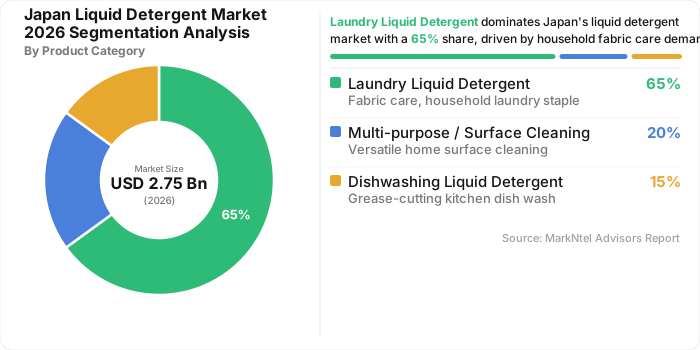
- Laundry liquid detergents dominate the product category, contributing approximately 65% of total market revenue.
- Residential segment leads end-user demand, accounting for nearly 68% market share in 2026.
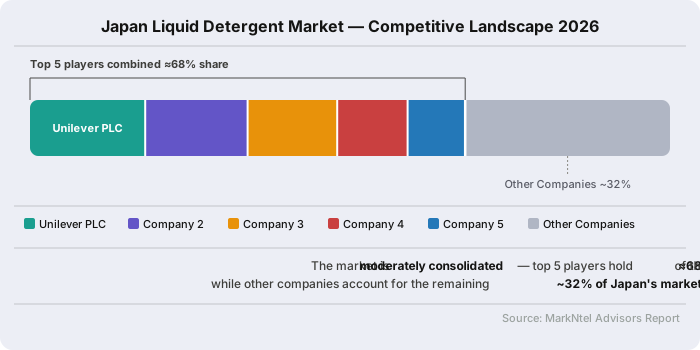
- The moderately consolidated industry structure, with the top five players collectively holding around 68% share.
Japan Liquid Detergent Market Size and Outlook
The Japan liquid detergent market size is projected to register a CAGR of 4.69% during the forecast period. This is supported by aging-driven convenience demand and long-term sustainability transition, reinforcing stable consumption across residential households. Manufacturers are increasingly focusing on efficient, easy-to-use, and environmentally aligned liquid detergent formulations to meet evolving consumer expectations across Japan’s urban and semi-urban population.
Simultaneously, the expansion of digital retail infrastructure is accelerating e-commerce detergent sales across Japan’s consumer goods landscape. According to METI, the domestic B2C e-commerce market reached approximately USD 174 billion in 2024, growing 5.1%, with penetration rising to 9.8%. This growth is strengthening subscription purchasing models and omnichannel distribution strategies, improving accessibility and driving premium product adoption growth across detergent categories nationwide, while enabling brands to directly engage consumers through digital platforms and personalized offerings.
Product innovation is further shaping market development through advanced detergent technology adoption and multifunctional product expansion trends. For instance, P&G Japan launched Ariel Gel Ball Pro in April 2024, integrating cleaning, deodorising, antibacterial protection, and anti-darkening features into one format. Such innovations enhance value perception, reduce laundry complexity, and support time-efficient cleaning, strengthening consumer preference for premium and high-performance detergent solutions across households, while also improving product differentiation and reinforcing brand positioning within competitive retail environments across Japan.
Additionally, increasing investment in circular systems is reinforcing a refill-based consumption ecosystem across Japan’s liquid detergent industry, which is projected to grow from USD 2.75 billion in 2026 to USD 3.62 billion by 2032. Kao Corporation’s RecyCreation initiative collected 2.68 million refill packs, equivalent to 48.2 tons of plastic, while offering 423 refillable formats covering nearly 80% of its product lineup.
Collectively, sustainability initiatives, product innovation, and digitalisation are strengthening long-term market growth potential by supporting repeat purchases, improving resource efficiency, and aligning industry practices with evolving regulatory requirements and environmentally conscious consumer preferences.
Japan Liquid Detergent Market Key Indicators
- Japan’s tourism surge is reshaping consumption dynamics within the cleaning ecosystem, particularly across hotels and short-term accommodations. In 2024, total overnight stays reached 651.49 million, rising 5.5% year-on-year, while foreign visitor stays climbed 38.8% to 163.48 million. This expansion is intensifying linen turnover and sanitation cycles, reinforcing tourism-driven consumption patterns and accelerating detergent usage frequency across high-traffic hospitality environments.
- Japan’s highly concentrated urban structure continues to sustain predictable and recurring detergent demand. With 92.13% of the population residing in urban areas, compact living conditions and frequent washing routines remain deeply embedded in daily life . Smaller living spaces and limited storage further encourage efficient product usage, while high-density urban consumption behavior supports steady demand for liquid detergents tailored to modern apartment-based lifestyles.
- Improved household financial stability is reinforcing a shift toward higher-quality home care products. The average monthly consumption expenditure reached USD 2,090 in 2025, reflecting continued growth in both nominal and real terms. This increase is encouraging consumers to prioritize multifunctional and performance-oriented solutions, with premium household product adoption driving demand for advanced liquid detergents offering enhanced fabric care and hygiene benefits.
- The growing penetration of advanced laundry appliances remains a critical determinant of detergent usage patterns. Japan imported over 3.38 million automatic washing machines in 2024, reflecting sustained replacement cycles and technological upgrades. The widespread use of high-efficiency systems is increasing reliance on specialized detergent formulations, while rising automatic washing machine penetration continues to reinforce long-term consumption stability within the residential segment.
Japan Liquid Detergent Market Scope
| Category | Segments |
|---|---|
| By Product Category | Laundry Liquid Detergent, Dishwashing Liquid Detergent, Multi-purpose / Surface Cleaning Liquid Detergent |
| By Formulation Type | Conventional, Bio-based / Organic, Enzyme-based |
| By Packaging Type | Bottles, Refill Pouches, Dispensers / Bulk Packaging |
| By Distribution Channel | Supermarkets / Hypermarkets, Convenience Stores, Online / E-commerce, Others |
| By Concentration Type | Standard Liquid, Concentrated Liquid, Ultra-Concentrated / Compact |
| By End User | Residential, Commercial, Industrial |
Japan Liquid Detergent Market Growth Drivers
Aging Population Driving Convenient Detergent Demand
Japan’s aging demographic structure is significantly reshaping demand patterns within the Japan liquid detergent market. The population aged 65 and above reached 36.2 million in 2025, accounting for 29.4% of the total , reinforcing aging household consumption patterns and increasing reliance on simplified, functional home-care products across urban and semi-urban households.
The rising number of elderly and single-person households is accelerating demand for low-effort laundry solutions that reduce physical strain during daily routines. Consumers are increasingly preferring liquid detergents that are easy to handle, quick to dissolve, and require minimal manual effort, aligning with changing lifestyle needs and independent living conditions.
Government projections indicating a nearly 47% increase in elderly individuals living alone by 2050 are further strengthening long-term demand visibility . This shift is intensifying reliance on convenience-oriented home care products, while encouraging manufacturers to prioritize senior-friendly packaging innovation and ergonomic product formats tailored to aging consumers’ evolving functional requirements.
Collectively, these demographic and behavioural shifts are strengthening long-term consumption stability within the Japan liquid detergent industry, where ease of use, accessibility, and continuous product innovation are emerging as critical growth enablers, supporting sustained demand expansion across diverse aging population segments nationwide.
Recent Trends
Integration of Advanced Formulation Technologies
Product innovation centred on hygiene and multifunctionality is emerging as a defining trend within the Japan liquid detergent sector. In June 2024, P&G Japan launched Ariel MiRAi, a concentrated detergent featuring bacteria-prevention technology, reflecting rising demand for multifunctional cleaning formulations combining stain removal, hygiene protection, and fabric care benefits among consumers.
This trend is further supported by the increasing adoption of compact detergent innovations designed for efficiency and space optimization in urban environments. Consumers are prioritising high-performance products delivering superior results in smaller quantities, while hybrid detergent formats integrating multiple cleaning functions are gaining traction due to convenience, usability, and improved overall washing effectiveness.
Technological advancements are also enabling the development of precision stain-removal solutions and performance-enhancing additives that improve washing outcomes across varied fabric types. Innovations supporting low-temperature washing and fabric protection are gaining importance, aligning with sustainability goals while addressing consumer demand for efficient and environmentally responsible laundry practices across households.
Collectively, these developments are reshaping product differentiation within the Japan liquid detergent industry, where multifunctionality, compactness, and formulation innovation are establishing new performance benchmarks, driving premiumization and strengthening competitive positioning across Japan’s evolving liquid detergent market landscape with sustained consumer preference shifts.
Japan Liquid Detergent Market Opportunities and Challenges
Plastic Regulations Driving Sustainable Packaging Innovation
Regulatory tightening under Japan’s Plastic Resource Circulation Act is increasing compliance complexity within the liquid detergent industry across Japan. The 2026 Design Certification System introduces strict standards requiring refillability, reduced plastic use, recyclability, and recycled material integration, significantly elevating plastic compliance costs and creating operational challenges for manufacturers adapting existing detergent packaging systems .
These evolving requirements are also intensifying the recycling infrastructure burden, as companies must align packaging formats with national circularity goals while ensuring cost efficiency. Redesigning packaging materials, adjusting supply chains, and meeting certification benchmarks are increasing short-term financial pressures, particularly for manufacturers lacking scalable, sustainable packaging capabilities and advanced material innovation expertise.
However, these regulatory pressures are simultaneously unlocking growth potential through circular packaging innovation and refill system expansion across retail channels. Companies are increasingly investing in alternative formats such as paper-based packaging and low-plastic designs, enabling differentiation while aligning with consumer demand for environmentally responsible and resource-efficient laundry care solutions.
For instance, AEON and P&G Japan introduced paper-packaged detergent pods, reducing plastic usage by nearly 50%, highlighting strong momentum toward sustainable material transition within the Japan liquid detergent industry , where sustainability-driven innovation is emerging as a key competitive advantage supporting long-term market growth and regulatory alignment.
Segmentation Insights
Laundry Liquid Detergents Lead the Market, due to Rising Preference for Convenient and High-Efficiency Cleaning Solutions
Laundry liquid detergent dominates the Japan liquid detergent market, accounting for nearly 65% of total revenue. This leadership is driven by widespread usage frequency, compatibility with modern washing machines, and strong consumer preference for convenient, high-performance cleaning solutions tailored to daily household laundry requirements across Japan’s urban and suburban residential segments.
The segment’s dominance is further reinforced by the rising adoption of concentrated liquid formulations that deliver superior cleaning efficiency with lower dosage requirements. These products are increasingly preferred due to reduced storage space needs and compatibility with compact urban living conditions, while offering improved stain removal and fabric protection compared to traditional detergent formats available today.
Innovation remains a key differentiator, with companies focusing on enzyme-based liquid cleaners and fabric-care performance enhancement. For instance, Lion Corporation launched Acron Yasashisa Premium in 2025, featuring built-in softening ingredients and zero-rinse capability, reducing water consumption and fabric stress while improving convenience for modern households and environmentally conscious consumers.
The increasing penetration of advanced washing machines is supporting demand for products with high-efficiency washing compatibility. Collectively, these factors are strengthening the segment’s leadership within the Japan liquid detergent landscape, that continue to drive sustained consumer preference across household cleaning needs. Based on product category, the scope has been classified into:
- Laundry Liquid Detergent
- Dishwashing Liquid Detergent
- Multi-purpose / Surface Cleaning Liquid Detergent
Residential Segment Dominates the Market, Driven by High Household Consumption and Repeat Purchase Demand
The residential segment dominates the liquid detergent demand in Japan, accounting for approximately 68% of total revenue. This leadership is primarily driven by consistent household cleaning demand and frequent product usage cycles, supported by Japan’s urbanised population structure and high reliance on automated laundry systems across residential households nationwide.
Urban apartment consumption patterns further reinforce segment dominance, as compact living spaces necessitate regular and efficient laundry routines. Consumers prioritise liquid detergents for their ease of use, storage convenience, and compatibility with modern appliances, driving sustained demand within densely populated cities and contributing to stable long-term consumption across urban residential environments.
In addition, rising focus on hygiene and cleanliness is strengthening demand for home hygiene maintenance products. Consumers are increasingly adopting liquid detergents offering antibacterial, deodorising, and fabric-care benefits, reflecting heightened awareness around cleanliness standards and driving continuous product usage across daily household activities and routine laundry practices.
Daily-use detergent consumption remains a defining characteristic of the residential segment. Collectively, these factors are reinforcing the segment’s leadership within the Japan liquid detergent industry, where consistent demand, convenience, and product effectiveness continue to sustain long-term growth across residential end users. The study categorizes the key end-use segments as follows:
- Residential
- Commercial
- Industrial
Japan Liquid Detergent Market Competitive Analysis
The Kao Corporation, Lion Corporation, Procter & Gamble Japan K.K., Unilever PLC, and Henkel AG & Co. KGaA represent the top five players, collectively accounting for an estimated 68% market share. The industry exhibits a moderately consolidated structure, led by strong domestic incumbents and supported by global brands. High brand loyalty, innovation in formulations, and extensive retail penetration define competition, while sustainability and premiumisation are key differentiators. Overall, this reflects stable competitive intensity with gradual innovation-led differentiation.
Leading Companies in Japan Liquid Detergent Industry
- Kao Corporation
- Lion Corporation
- Procter & Gamble Japan K.K.
- Unilever PLC
- Henkel AG & Co. KGaA
- Reckitt Benckiser Group plc
- S. C. Johnson & Son, Inc.
- The Clorox Company
- Church & Dwight Co., Inc.
- Colgate-Palmolive Company
- Others
Japan Liquid Detergent Industry News and Recent Developments
February 2026: Kao Receives Plastic Design Certification for Attack ZERO Under Japan's Plastic Resource Circulation Act
Kao Corporation received design certifications for three products: laundry detergents Attack ZERO and EMAL, and hand soap Bioré u Foaming Hand Wash under the "Guideline for Design of Plastic-Containing Products" certification system administered by Japan's Ministry of Economy, Trade and Industry, marking the first time any product achieved this certification since the scheme's launch. A total of 11 product items across the three brands received certification under the Act on Promotion of Resource Circulation for Plastics.
Impact Analysis: This certification positions Kao's Attack ZERO laundry detergent as a compliant product eligible for priority consideration under Japan's Green Purchase Act, opening a formal institutional procurement channel alongside existing retail distribution. For the broader liquid detergent market, Kao's first-mover certification status raises competitive pressure on rival laundry liquid brands to accelerate their own packaging redesign timelines, directly elevating sustainable packaging as a commercial differentiator and structural market driver rather than a voluntary initiative.
August 2025: Lion Corporation Launches Fully Renewed NANOX One Super Enzyme Complete Gel
Lion Corporation launched the fully renewed NANOX one super-concentrated laundry detergent, introducing a new enzyme in the brand's history that decomposes bacteria-derived DNA identified as the cellular root cause of persistent fabric yellowing and deep odour formation. The reformulated "Super Enzyme Complete Gel" delivers what Lion describes as gene-level cleaning capability.
Impact Analysis: This launch raises the functional performance benchmark for concentrated liquid laundry detergents in Japan, shifting category competition from deodorising efficacy to cellular-level stain and odour elimination. By embedding breakthrough enzyme science within a 100% recycled packaging format, Lion simultaneously addresses two dominant consumer and regulatory priorities: demonstrable cleaning superiority and plastic circularity, reinforcing the premiumisation trajectory of Japan's laundry liquid segment and compelling rival manufacturers to invest in comparable enzyme and sustainable packaging capabilities.
February 2025: Lion Launches NANOX one Heyaboshi, a Dedicated Indoor-Drying Liquid Laundry Detergent
Lion Corporation launched NANOX one Heyaboshi (indoor drying), a limited-edition liquid laundry detergent within the NANOX one brand. The product is specifically formulated for Japan's prevalent indoor laundry drying practice, delivering thorough antibacterial action and odour suppression even when clothing is hung densely indoors in humid conditions, the scenario most likely to generate the musty half-dried odour that Japanese consumers identify as a primary laundry concern.
Impact Analysis: The launch of a format dedicated entirely to indoor drying validates this usage behaviour as a commercially distinct and structurally significant demand segment. It signals Lion's strategy to expand revenue through occasion-specific formulation positioning rather than generalised product upgrades, directly intensifying sub-segment competition and accelerating the development of specialised liquid variants targeting Japan's unique climatic laundry challenges. This approach reinforces unit value growth by broadening the premium liquid detergent category beyond core everyday washing formats.
- Market Segmentation
- Introduction
- Product Definition
- Research Process
- Assumptions
- Executive Summary
- Japan Liquid Detergent Market Policies, Regulations, and Product Standards
- Japan Liquid Detergent Production Trend 2022-2032
- Japan Liquid Detergent Trend by Type of Product Category
- Laundry Liquid Detergent
- Dishwashing Liquid Detergent
- Multi-purpose / Surface Cleaning Liquid Detergent
- Company-Wise Production Plants and Statistics
- Installed Production Capacity
- Actual Production
- Planned Production Target
- Japan Liquid Detergent Trend by Type of Product Category
- Japan Liquid Detergent Pricing Analysis 2022-2032
- Japan Liquid Detergent Pricing Trend 2022-2032
- Japan Liquid Detergent Pricing Trend by Product Type 2022-2032
-
- Laundry Liquid Detergent
- Dishwashing Liquid Detergent
- Multi-purpose / Surface Cleaning Liquid Detergent
-
- Japan Liquid Detergent Market Dynamics
- Growth Factors
- Challenges
- Japan Liquid Detergent Market Hotspot & Opportunities
- Japan Liquid Detergent Market Outlook, 2022-2032F
- Market Size & Outlook
- By Revenues (USD Million)
- By Quantity Sold (Tons)
- Market Share & Outlook
- By Product Category - Market Size & Forecast 2022-2032, USD Million
- Laundry Liquid Detergent
- Dishwashing Liquid Detergent
- Multi-purpose / Surface Cleaning Liquid Detergent
- By Formulation Type - Market Size & Forecast 2022-2032, USD Million
- Conventional
- Bio-based / Organic
- Enzyme-based
- By Packaging Type- Market Size & Forecast 2022-2032, USD Million
- Bottles
- Refill Pouches
- Dispensers / Bulk Packaging
- By Distribution Channel- Market Size & Forecast 2022-2032, USD Million
- Supermarkets / Hypermarkets
- Convenience Stores
- Online / E-commerce
- Others
- By Concentration Type- Market Size & Forecast 2022-2032, USD Million
- Standard Liquid
- Concentrated Liquid
- Ultra-Concentrated / Compact
- By End User- Market Size & Forecast 2022-2032, USD Million
- Residential
- Commercial
- Industrial
- By Region - Market Size & Forecast 2022-2032, USD Million
- Hokkaido
- Tohoku
- Kanto
- Chubu
- Rest of Japan
- By Company
- Competition Characteristics
- Market Share & Analysis
- By Product Category - Market Size & Forecast 2022-2032, USD Million
- Market Size & Outlook
- Japan Laundry Liquid Detergent Market Outlook, 2022-2032
- Market Size & Outlook
- By Revenues (USD Million)
- By Quantity Sold (Tons)
- Market Share & Outlook
- By Formulation Type - Market Size & Forecast 2022-2032, USD Million
- By Packaging Type- Market Size & Forecast 2022-2032, USD Million
- By Distribution Channel- Market Size & Forecast 2022-2032, USD Million
- By Concentration Type- Market Size & Forecast 2022-2032, USD Million
- By End User- Market Size & Forecast 2022-2032, USD Million
- By Region - Market Size & Forecast 2022-2032, USD Million
- Market Size & Outlook
- Japan Dishwashing Liquid Detergent Market Outlook, 2022-2032
- Market Size & Outlook
- By Revenues (USD Million)
- By Quantity Sold (Tons)
- Market Share & Outlook
- By Formulation Type - Market Size & Forecast 2022-2032, USD Million
- By Packaging Type- Market Size & Forecast 2022-2032, USD Million
- By Distribution Channel- Market Size & Forecast 2022-2032, USD Million
- By Concentration Type- Market Size & Forecast 2022-2032, USD Million
- By End User- Market Size & Forecast 2022-2032, USD Million
- By Region - Market Size & Forecast 2022-2032, USD Million
- Market Size & Outlook
- Japan Multi-purpose / Surface Cleaning Liquid Detergent Market Outlook, 2022-2032
- Market Size & Outlook
- By Revenues (USD Million)
- By Quantity Sold (Tons)
- Market Share & Outlook
- By Formulation Type - Market Size & Forecast 2022-2032, USD Million
- By Packaging Type- Market Size & Forecast 2022-2032, USD Million
- By Distribution Channel- Market Size & Forecast 2022-2032, USD Million
- By Concentration Type- Market Size & Forecast 2022-2032, USD Million
- By End User- Market Size & Forecast 2022-2032, USD Million
- By Region - Market Size & Forecast 2022-2032, USD Million
- Market Size & Outlook
- Japan Liquid Detergent Market Key Strategic Imperatives for Success & Growth
- Competitive Outlook
- Company Profiles
- Kao Corporation
- Business Description
- Product Portfolio
- Collaborations & Alliances
- Recent Developments
- Financial Details
- Others
- Lion Corporation
- Business Description
- Product Portfolio
- Collaborations & Alliances
- Recent Developments
- Financial Details
- Others
- Procter & Gamble Japan K.K.
- Business Description
- Product Portfolio
- Collaborations & Alliances
- Recent Developments
- Financial Details
- Others
- Unilever PLC
- Business Description
- Product Portfolio
- Collaborations & Alliances
- Recent Developments
- Financial Details
- Others
- Henkel AG & Co. KGaA
- Business Description
- Product Portfolio
- Collaborations & Alliances
- Recent Developments
- Financial Details
- Others
- Reckitt Benckiser Group plc
- Business Description
- Product Portfolio
- Collaborations & Alliances
- Recent Developments
- Financial Details
- Others
- S. C. Johnson & Son, Inc.
- Business Description
- Product Portfolio
- Collaborations & Alliances
- Recent Developments
- Financial Details
- Others
- The Clorox Company
- Business Description
- Product Portfolio
- Collaborations & Alliances
- Recent Developments
- Financial Details
- Others
- Church & Dwight Co., Inc.
- Business Description
- Product Portfolio
- Collaborations & Alliances
- Recent Developments
- Financial Details
- Others
- Colgate-Palmolive Company
- Business Description
- Product Portfolio
- Collaborations & Alliances
- Recent Developments
- Financial Details
- Others
- Others
- Kao Corporation
- Company Profiles
- Disclaimer

MarkNtel Advisors follows a robust and iterative research methodology designed to ensure maximum accuracy and minimize deviation in market estimates and forecasts. Our approach combines both bottom-up and top-down techniques to effectively segment and quantify various aspects of the market. A consistent feature across all our research reports is data triangulation, which examines the market from three distinct perspectives to validate findings. Key components of our research process include:
1. Scope & Research Design At the outset, MarkNtel Advisors define the research objectives and formulate pertinent questions. This phase involves determining the type of research—qualitative or quantitative—and designing a methodology that outlines data collection methods, target demographics, and analytical tools. They also establish timelines and budgets to ensure the research aligns with client goals.
2. Sample Selection and Data Collection In this stage, the firm identifies the target audience and determines the appropriate sample size to ensure representativeness. They employ various sampling methods, such as random or stratified sampling, based on the research objectives. Data collection is carried out using tools like surveys, interviews, and observations, ensuring the gathered data is reliable and relevant.
3. Data Analysis and Validation Once data is collected, MarkNtel Advisors undertake a rigorous analysis process. This includes cleaning the data to remove inconsistencies, employing statistical software for quantitative analysis, and thematic analysis for qualitative data. Validation steps are taken to ensure the accuracy and reliability of the findings, minimizing biases and errors.

4. Data Forecast and FinalizationThe final phase involves forecasting future market trends based on the analyzed data. MarkNtel Advisors utilize predictive modeling and time series analysis to anticipate market behaviors. The insights are then compiled into comprehensive reports, featuring visual aids like charts and graphs, and include strategic recommendations to inform client decision-making
We’d love to understand what matters most to you.