

By Network Technology (3G, 4G/LTE, 5G), By Connectivity (Embedded Connectivity, Integrated Connectivity, Tethered Connectivity), By Application (Safety & Security, Infotainment & Navigation, Vehicle D... ... avigation, Vehicle Diagnostics & Predictive Maintenance, Fleet Management & Telematics, Remote Vehicle Management, Autonomous Driving Support, Others), By Sales Channel (OEM, Aftermarket), and others Read more
- Automotive
- Jul 2026
- 140
- PDF, Excel, PPT
Japan Connected Car Market Key Takeaways
- The Japan Connected Car market, valued at nearly USD 7.10 billion in 2025, is anticipated to expand steadily, reaching USD 22.34 billion by 2032 from USD 8.36 billion in 2026.
- The industry is projected to witness steady growth at a CAGR of 17.80% over 2026–2032.
- 5G held the largest network technology share at 53% in 2026.
- Safety & Security held the largest application share at 31% in 2026.
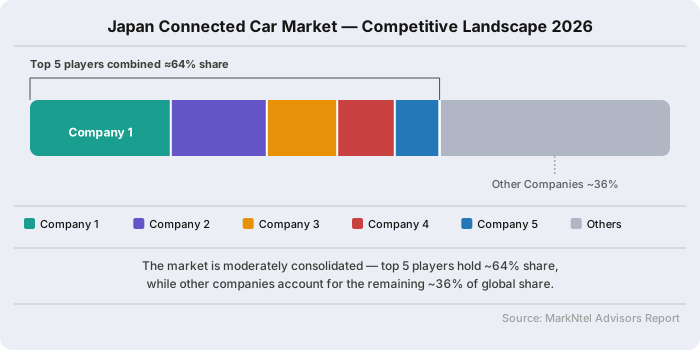
- The industry is characterized by a moderately consolidated market structure, where the top five manufacturers hold roughly 64% of the market share.
Japan Connected Car Market Size and Outlook
At a CAGR of approximately 17.80% over 2026–2032, the Japan connected car market is expected to rise from USD 8.36 billion in 2026 to USD 22.34 billion by 2032, following a valuation of USD 7.10 billion in 2025.
Japan's advanced automotive manufacturing base, robust digital infrastructure, and supportive mobility policies have created a strong foundation for connected vehicle adoption. Passenger cars remain the largest source of demand as manufacturers integrate factory-installed telematics, cloud connectivity, and over-the-air software capabilities into new vehicles. In June 2025, Japan's Ministry of Economy, Trade and Industry (METI) and Ministry of Land, Infrastructure, Transport and Tourism (MLIT) updated the Mobility Digital Transformation (DX) Strategy, reaffirming the goal of strengthening software-defined vehicles (SDVs) and targeting a 30% global share of SDV unit sales by Japanese automakers by 2030 and 2035.
Supporting these national goals, continued investments in intelligent transportation infrastructure are accelerating connected mobility adoption across the country. During 2026, MLIT advanced next-generation ITS programs, autonomous driving infrastructure initiatives, and roadside cooperative driving demonstrations while expanding the use of ETC2.0 probe data for mobility applications. Meanwhile, Japan's Digital Agency is promoting digital mobility platforms that improve data exchange among vehicles, infrastructure, and public services, benefiting both private users and commercial fleet operators.
The automotive industry is complementing these initiatives through continuous investments in connected mobility technologies and digital vehicle services. Manufacturers are expanding telematics, remote vehicle management, predictive maintenance, connected navigation, and digital infotainment capabilities to improve vehicle performance and customer experience. At the same time, commercial fleet operators are increasingly adopting connected technologies to optimize fleet operations, reduce maintenance costs, and improve overall operational efficiency.
As digital transformation continues to reshape the automotive sector, the market is expected to sustain its growth trajectory through continued policy support, expanding digital infrastructure, and rapid technological advancements. Increasing deployment of 5G connectivity, artificial intelligence, and cloud-based mobility services will further strengthen connected vehicle capabilities. Growing demand for advanced safety features, predictive diagnostics, and real-time connectivity, supported by Japan's strong manufacturing ecosystem, is expected to reinforce the country's leadership in connected mobility technologies.
Japan Connected Car Market Key Indicators
- Japan produced more than 8 million motor vehicles in 2025, according to OICA, reflecting its strong automotive manufacturing base. Higher vehicle production supports wider integration of factory-installed connectivity, telematics, and intelligent mobility technologies.
- Japan's nationwide 5G population coverage reached 98.4% at the end of fiscal 2024, according to MIC, strengthening high-speed, low-latency connectivity for connected vehicles, intelligent transport systems, and advanced telematics.
- Japan recorded 2,547 road traffic fatalities in 2025, the lowest annual total on record, while 55.9% of those killed were aged 65 years or older, according to the National Police Agency. The ageing driver population is accelerating demand for advanced driver-assistance systems (ADAS), collision avoidance technologies, and connected vehicle safety feature.
Japan Connected Car Market Scope
| Category | Segments |
|---|---|
| By Network Technology | 3G, 4G/LTE, 5G |
| By Connectivity | Embedded Connectivity, Integrated Connectivity, Tethered Connectivity |
| By Application | Safety & Security, Infotainment & Navigation, Vehicle Diagnostics & Predictive Maintenance, Fleet Management & Telematics, Remote Vehicle Management, Autonomous Driving Support, Others |
| By Sales Channel | OEM, Aftermarket |
Japan Connected Car Market Growth Drivers
Government Investment in Smart Mobility and Digital Road Infrastructure
Japan's transition toward an intelligent transportation ecosystem is being supported by sustained government investment in smart mobility and digital road infrastructure. As connected mobility becomes a national priority, public funding is accelerating the deployment of technologies that enable seamless communication between vehicles, roadside infrastructure, and traffic management systems. In fiscal 2025, the Cabinet Office allocated approximately USD 225 million to advance smart city technologies, while additional investments from local governments and private stakeholders continue to strengthen the country's connected mobility ecosystem. These initiatives are expanding connected traffic systems and Vehicle-to-Everything (V2X) communication networks, creating a stronger foundation for connected vehicle adoption.
Alongside these infrastructure developments, Japan is advancing policies that promote digital transformation across the automotive sector. The Ministry of Economy, Trade andIndustry (METI) continues to support software-defined vehicles (SDVs) through its Mobility DX strategy, while the Ministry of Land, Infrastructure, Transport and Tourism (MLIT) launched its Local Mobility DX: MaaS 2.0 initiative in 2025, selecting 15 pilot projects to standardize mobility data and integrate connected transportation services across regional networks. Together, these initiatives are strengthening Japan's connected mobility ecosystem and accelerating the growth of connected vehicle industry across the country.
Recent Trends
Growing Shift Toward Software-Defined Vehicles and Over-the-Air (OTA) Updates
Japan's automotive industry is witnessing a growing shift toward software-defined vehicles (SDVs), transforming vehicles from hardware-centric products into continuously evolving digital platforms. Rather than relying on dealership visits for upgrades, automakers are increasingly equipping connected vehicle platforms with over-the-air (OTA) update capabilities that remotely enhance infotainment systems, navigation, cybersecurity, vehicle performance, and advanced driver assistance functions. This transition enables manufacturers to continuously introduce new features while extending vehicle functionality throughout its lifecycle.
Supporting this transformation, leading Japanese automakers are accelerating investments in software-defined mobility. Toyota is advancing its software-defined vehicle strategy through the deployment of its Arene software platform, while Honda is expanding connected technologies through its Honda 0 Series and Nissan continues to strengthen its connected vehicle ecosystem with remote vehicle diagnostics, remote software updates, and AI-driven driver assistance technologies. As software becomes increasingly central to vehicle innovation, the adoption of software-defined vehicles and OTA technologies is expected to remain a defining trend across Japan's connected mobility ecosystem.
Japan Connected Car Market Opportunities and Challenges
Tightening Vehicle Cybersecurity and Software-Update Regulation Creating Demand for Secure Connected Vehicle Platforms
Japan's connected vehicle market is entering a more stringent regulatory environment as cybersecurity and software governance become increasingly important. The country enforces United Nations Regulations No. 155 and No. 156, covering cybersecurity and software updates, through its vehicle type-approval system under the UNECE World Forum for Harmonization of Vehicle Regulations (WP.29). Since July 2024, every new vehicle sold in Japan must be certified under a Cybersecurity Management System (CSMS) and Software Update Management System (SUMS), while the Ministry of Land, Infrastructure, Transport and Tourism (MLIT) requires ongoing compliance audits, increasing engineering complexity and development costs for automakers and connectivity solution providers.
Instead of slowing the adoption of connected mobility, these evolving regulatory requirements are encouraging greater investment in automotive cybersecurity solutions. As every connected vehicle must support lifecycle threat monitoring, secure over-the-air (OTA) updates, and auditable software supply chains, demand is increasing for embedded cybersecurity, intrusion detection, and vulnerability management solutions. Suppliers of telematics, advanced driver assistance systems, and cloud-based automotive software that demonstrate regulatory compliance are strengthening their competitive position, while automakers are expanding recurring software-based services through secure OTA update capabilities. Consequently, cybersecurity compliance is evolving from a regulatory obligation into a key competitive differentiator, creating long-term growth opportunities across Japan's connected car industry.
Segmentation Insights
Ultra-Low-Latency Connectivity Positions 5G as the Leading Network Technology in Japan's Connected Car Market
5G holds the largest network technology share at 53% in 2026, anchored by its ultra-low latency and high capacity the qualities connected-car applications most depend on. Real-time functions such as vehicle-to-everything (V2X) communication, collision avoidance, and automated-driving support require millisecond response times that older network generations cannot deliver. As Japanese automakers continue integrating these safety- and autonomy-critical capabilities into mainstream models, 5G has evolved from a premium connectivity feature into the default communication infrastructure for new connected vehicles.
Recognizing the growing data requirements of connected mobility, Japan is strengthening the digital infrastructure needed to support next-generation vehicle communication. In April 2025, Japan enacted amendments to the Radio Act introducing a competitive spectrum assignment mechanism for frequency bands above 6 GHz, enabling more efficient allocation of high-capacity spectrum for next-generation wireless services, including data-intensive connected vehicle applications. At the same time, domestic telecom operators are advancing 5G Evolution toward 6G to support vehicle-to-everything communication and autonomous driving, positioning 5G as the preferred connectivity standard for future connected vehicle ecosystems in Japan. Based on network technology, the market has been segmented into:
- 5G
- 4G/LTE
- 3G
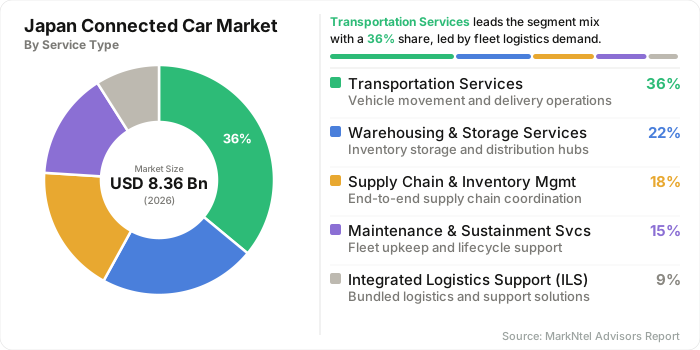
Regulatory Safety Mandates and an Aging Driver Base Drive Safety & Security to the Leading Application Segment
Safety & Security holds the largest application share at 31% in 2026, driven by regulations that have made connected safety technologies a standard feature in new vehicles. Japan has required automatic emergency braking on all new domestically manufactured passenger cars since November 2021, extending the mandate to existing models from December 2025 under the Ministry of Land, Infrastructure, Transport and Tourism. These requirements have transformed connected safety systems from optional technologies into essential vehicle features across the country's automotive fleet.
Demographic shifts are adding further momentum to this regulatory push, reinforcing the need for advanced driver assistance systems (ADAS) across Japan's vehicle fleet. According to Japan's National Police Agency, the number of licensed drivers aged 65 and over increased from approximately 7.89 million in 2003 to 19.84 million in 2023, highlighting the growing need for connected safety technologies. In November 2024, Japan-developed pedal misapplication acceleration control technology was adopted as a United Nations vehicle safety regulation under UNECE WP.29, further strengthening the adoption of connected safety systems and cementing Safety & Security as the leading application segment. Based on application, the market is categorized into:
- Safety & Security
- Infotainment & Navigation
- Vehicle Diagnostics & Predictive Maintenance
- Fleet Management & Telematics
- Remote Vehicle Management
- Autonomous Driving Support
- Others
Japan Connected Car Market Competitive Analysis
The Japan connected car market is moderately consolidated, led by domestic automakers investing in connected mobility, software-defined vehicles, and advanced safety technologies. The top five players Toyota Motor Corporation, Honda Motor Co., Ltd., Nissan Motor Co., Ltd., Mazda Motor Corporation, and Subaru Corporation collectively account for approximately 64% of the market, supported by strong domestic production, ADAS integration, and over-the-air (OTA) connectivity capabilities.
Key Players in Japan Connected Car Market
- Toyota Motor Corporation
- Honda Motor Co., Ltd.
- Nissan Motor Co., Ltd.
- Mazda Motor Corporation
- Subaru Corporation
- Suzuki Motor Corporation
- Mitsubishi Motors Corporation
- Isuzu Motors Limited
- Mercedes-Benz Group AG
- Bayerische Motoren Werke Aktiengesellschaft (BMW AG)
- Others
Japan Connected Car Industry News and Recent Developments
June 2025: DIMO and HAKUHODO KEY3 Launch DIMO Japan to Advance Connected Vehicle Ecosystem
DIMO and HAKUHODO KEY3 established DIMO Japan, a joint venture focused on expanding connected vehicle capabilities by collaborating with regional automakers. The initiative enables secure vehicle data access, consent-based data sharing, real-time diagnostics, and software-defined vehicle applications, strengthening Japan's connected mobility ecosystem.
Impact Analysis: The launch accelerates the development of connected vehicle services by improving vehicle data interoperability and supporting AI-enabled mobility applications, reinforcing Japan's transition toward software-defined and data-driven connected transportation.
- Market Segmentation
- Introduction
- Product Definition
- Research Process
- Assumptions
- Executive Summary
- Japan Connected Car Market Policies, Regulations, and Product Standards
- Japan Connected Car Market Trends & Developments
- Japan Connected Car Market Dynamics
- Growth Factors
- Challenges
- Japan Connected Car Market Hotspot & Opportunities
- Japan Connected Car Market Outlook, 2022-2032
- Market Size & Outlook
- By Revenues (USD Million)
- Market Segmentation & Outlook
- By Network Technology- Market Size & Forecast 2022-2032, USD Million
- 3G
- 4G/LTE
- 5G
- By Connectivity- Market Size & Forecast 2022-2032, USD Million
- Embedded Connectivity
- Integrated Connectivity
- Tethered Connectivity
- By Application- Market Size & Forecast 2022-2032, USD Million
- Safety & Security
- Infotainment & Navigation
- Vehicle Diagnostics & Predictive Maintenance
- Fleet Management & Telematics
- Remote Vehicle Management
- Autonomous Driving Support
- Others
- By Sales Channel- Market Size & Forecast 2022-2032, USD Million
- OEM
- Aftermarket
- By Company
- Competition Characteristics
- Market Share & Analysis
- By Network Technology- Market Size & Forecast 2022-2032, USD Million
- Market Size & Outlook
- Japan Embedded Connectivity Car Market Outlook, 2022-2032
- Market Size & Outlook
- By Revenues (USD Million)
- Market Segmentation & Outlook
- By Connectivity- Market Size & Forecast 2022-2032, USD Million
- By Application- Market Size & Forecast 2022-2032, USD Million
- By Sales Channel- Market Size & Forecast 2022-2032, USD Million
- Market Size & Outlook
- Japan Integrated Connectivity Car Market Outlook, 2022-2032
- Market Size & Outlook
- By Revenues (USD Million)
- Market Segmentation & Outlook
- By Connectivity- Market Size & Forecast 2022-2032, USD Million
- By Application- Market Size & Forecast 2022-2032, USD Million
- By Sales Channel- Market Size & Forecast 2022-2032, USD Million
- Market Size & Outlook
- Japan Tethered Connectivity Car Market Outlook, 2022-2032
- Market Size & Outlook
- By Revenues (USD Million)
- Market Segmentation & Outlook
- By Connectivity- Market Size & Forecast 2022-2032, USD Million
- By Application- Market Size & Forecast 2022-2032, USD Million
- By Sales Channel- Market Size & Forecast 2022-2032, USD Million
- Market Size & Outlook
- Japan Connected Car Market Key Strategic Imperatives for Success & Growth
- Competitive Outlook
- Company Profiles
- Toyota Motor Corporation
- Business Description
- Product Portfolio
- Collaborations & Alliances
- Recent Developments
- Financial Details
- Others
- Honda Motor Co., Ltd.
- Business Description
- Product Portfolio
- Collaborations & Alliances
- Recent Developments
- Financial Details
- Others
- Nissan Motor Co., Ltd.
- Business Description
- Product Portfolio
- Collaborations & Alliances
- Recent Developments
- Financial Details
- Others
- Mazda Motor Corporation
- Business Description
- Product Portfolio
- Collaborations & Alliances
- Recent Developments
- Financial Details
- Others
- Subaru Corporation
- Business Description
- Product Portfolio
- Collaborations & Alliances
- Recent Developments
- Financial Details
- Others
- Suzuki Motor Corporation
- Business Description
- Product Portfolio
- Collaborations & Alliances
- Recent Developments
- Financial Details
- Others
- Mitsubishi Motors Corporation
- Business Description
- Product Portfolio
- Collaborations & Alliances
- Recent Developments
- Financial Details
- Others
- Isuzu Motors Limited
- Business Description
- Product Portfolio
- Collaborations & Alliances
- Recent Developments
- Financial Details
- Others
- Mercedes-Benz Group AG
- Business Description
- Product Portfolio
- Collaborations & Alliances
- Recent Developments
- Financial Details
- Others
- Bayerische Motoren Werke Aktiengesellschaft (BMW AG)
- Business Description
- Product Portfolio
- Collaborations & Alliances
- Recent Developments
- Financial Details
- Others
- Toyota Motor Corporation
- Company Profiles
- Disclaimer

MarkNtel Advisors follows a robust and iterative research methodology designed to ensure maximum accuracy and minimize deviation in market estimates and forecasts. Our approach combines both bottom-up and top-down techniques to effectively segment and quantify various aspects of the market. A consistent feature across all our research reports is data triangulation, which examines the market from three distinct perspectives to validate findings. Key components of our research process include:
1. Scope & Research Design At the outset, MarkNtel Advisors define the research objectives and formulate pertinent questions. This phase involves determining the type of research—qualitative or quantitative—and designing a methodology that outlines data collection methods, target demographics, and analytical tools. They also establish timelines and budgets to ensure the research aligns with client goals.
2. Sample Selection and Data Collection In this stage, the firm identifies the target audience and determines the appropriate sample size to ensure representativeness. They employ various sampling methods, such as random or stratified sampling, based on the research objectives. Data collection is carried out using tools like surveys, interviews, and observations, ensuring the gathered data is reliable and relevant.
3. Data Analysis and Validation Once data is collected, MarkNtel Advisors undertake a rigorous analysis process. This includes cleaning the data to remove inconsistencies, employing statistical software for quantitative analysis, and thematic analysis for qualitative data. Validation steps are taken to ensure the accuracy and reliability of the findings, minimizing biases and errors.

4. Data Forecast and FinalizationThe final phase involves forecasting future market trends based on the analyzed data. MarkNtel Advisors utilize predictive modeling and time series analysis to anticipate market behaviors. The insights are then compiled into comprehensive reports, featuring visual aids like charts and graphs, and include strategic recommendations to inform client decision-making
We’d love to understand what matters most to you.