

By Service Proposition (Digital Payments (Peer-to-Peer Payments, Merchant Payments, Payment Gateway and Aggregation, Cross-Border Payments), Digital Lending and Financing (Consumer Lending, SME Lendin... ... Lending, SME Lending, Buy Now Pay Later), Digital Investments (Online Brokerage, Mutual Fund Investment Platforms, Robo-Advisory), Insurtech (Digital Insurance Distribution, Claims Management Platforms), Neobanking (Retail Neobanking, Business Neobanking)), By End User (Retail, Businesses), By User Interface (Mobile Applications, Web / Browser, POS / IoT Devices), and others Read more
- FinTech
- Apr 2026
- 125
- PDF, Excel, PPT
India Fintech Market Key Takeaways
- India Fintech market size was valued at around USD 51.2 billion in 2025 and is projected to grow from USD 59.44 billion in 2026 to USD 145.57 billion by 2032, exhibiting a CAGR of 16.1% during 2026-2032.
- West India leads the regional distribution, contributing nearly 29.8% of the total share.
- Based on Service Proposition, the Digital Lending & Financing holds a significant share of about 43%.
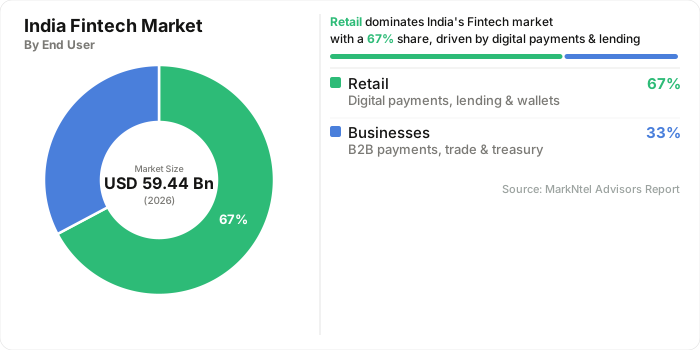
- By End User, the Retail segment seized a significant share of about 67% in 2026.
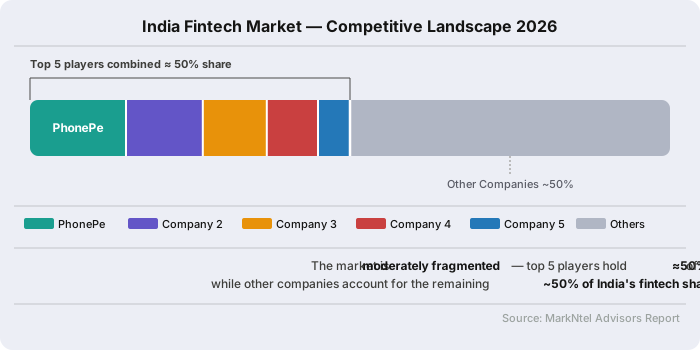
- The industry in India is moderately fragmented, with over 2,500 active companies operating across payments, lending, wealth management, insurtech, and neobanking segments. However, the top five players collectively account for approximately 50% of the total market share.
India Fintech Market Size and Outlook
The India Fintech market size was valued at USD 51.2 billion in 2025 and is projected to grow from USD 59.44 billion in 2026 to USD 145.57 billion by 2032. Along with this, the market is estimated to grow at a CAGR of around 16.1% during the forecast period, i.e., 2026-32.
As more people get online and more people have access to financial services, India's fintech industry has become one of the most active parts of the country's digital economy. A key turning point has been the success of UPI, developed by National Payments Corporation of India, which processed over 21.6 billion transactions in a single month in 2025, reflecting unprecedented scale. Additionally, the Reserve Bank of India reported that digital payments contributed 99.8% of total transaction volume in H1 2025, highlighting the near-universal shift toward digital channels . These developments have significantly expanded access to financial services across both urban and rural populations.
The current phase of the market reflects a gradual move toward sustainable revenue models, supported by increasing engagement from both retail and business users. Consumers continue to drive demand through mobile payments, digital lending, and investment platforms, while enterprises are rapidly adopting payment gateways and digital credit solutions. As transaction volumes continue to scale, the need for sustainable monetization has become increasingly important, prompting the introduction of selective charges on merchant-side UPI transactions in 2025. At the same time, the Reserve Bank of India has reinforced regulatory frameworks, including digital lending guidelines, to improve transparency and ensure long-term ecosystem stability.
On the infrastructure front, India continues to strengthen its fintech backbone through initiatives such as the Account Aggregator framework and the Open Credit Enablement Network, which facilitate secure data sharing and expand access to formal credit. Industry participants like PhonePe and Paytm are actively investing in merchant-focused services, subscription models, and cross-selling strategies to enhance revenue streams. These efforts, combined with growing collaboration between fintech firms and traditional financial institutions, are accelerating the adoption of embedded finance across multiple end-user segments.
As the market evolves, India’s fintech sector is expected to grow steadily, backed by favorable demographics, increasing digital adoption, and supportive policy initiatives. Expansion into Tier-2 and Tier-3 regions is expected to unlock new demand, particularly for credit, insurance, and wealth management solutions. Regulatory developments in 2025, including the Reserve Bank of India guidelines enabling risk-based authentication for digital payments, are expected to enhance transaction efficiency while maintaining security standards. These measures are likely to strengthen user trust and improve the overall experience of digital financial services .
India Fintech Market Key Indicators
- According to the Government of India (Economic Survey 2025–26), the total number of demat accounts in India exceeded 216 million by December 2025, reflecting a sharp rise in retail investor participation. This expanding investor base directly increases demand for digital brokerage, wealth management platforms, and investment applications, thereby supporting fintech ecosystem growth .
- India’s total credit flow to the commercial sector increased by around 15% year-on-year to approximately USD 3.31 trillion by 2025, as per Reserve Bank of India data. This sustained expansion in credit availability reflects rising demand for financing across businesses and consumers, thereby supporting the growth of digital lending platforms and fintech-driven credit solutions .
- India’s Financial Inclusion Index reached around 67 in 2025, indicating steady improvement in access, usage, and quality of financial services. The rising index reflects deeper penetration of formal financial systems, thereby supporting sustained demand for fintech platforms across user segments .
- In 2025, India had over 1.21 billion telecom subscribers, as per official telecom data, including a significant rural user base, which is enabling broader access to mobile-based financial services and supporting fintech adoption across diverse regions .
India Fintech Market Scope
| Category | Segments |
|---|---|
| By Service Proposition | (Digital Payments (Peer-to-Peer Payments, Merchant Payments, Payment Gateway and Aggregation, Cross-Border Payments), Digital Lending and Financing (Consumer Lending, SME Lending, Buy Now Pay Later), Digital Investments (Online Brokerage, Mutual Fund Investment Platforms, Robo-Advisory), Insurtech (Digital Insurance Distribution, Claims Management Platforms), Neobanking (Retail Neobanking, Business Neobanking)), |
| By End User | (Retail, Businesses), |
| By User Interface | (Mobile Applications, Web / Browser, POS / IoT Devices), |
India Fintech Market Growth Drivers
Rapid Expansion of Digital Public Infrastructure (DPI)
India’s Digital Public Infrastructure (DPI) has emerged as a foundational driver of fintech growth, built on interoperable systems such as Aadhaar, UPI, and the Account Aggregator framework. Its expansion has accelerated through policy-backed initiatives focused on improving financial access and system efficiency across the economy. In 2025, the Reserve Bank of India highlighted the role of frameworks such as the Account Aggregator ecosystem and Unified Lending Interface in strengthening digital credit deliver y. These systems enable seamless, consent-based data sharing, significantly reducing onboarding time and operational inefficiencies for financial service providers.
The measurable impact of DPI is most evident in credit access expansion across underserved segments, particularly MSMEs and retail borrowers. India has over 71 million MSMEs, yet less than 11% have access to formal credit, resulting in an estimated credit gap of approximately USD 240–300 billion. DPI-led frameworks such as the Open Credit Enablement Network and Account Aggregator directly address this gap by enabling data-driven underwriting and faster loan disbursal. This has led to increased participation from small businesses and first-time borrowers, particularly in Tier-2 and Tier-3 regions, thereby expanding fintech usage across both business and retail end users.
As a structural factor , DPI structurally increases market volume by creating entirely new demand channels rather than shifting existing financial activity. By digitizing identity, payments, and financial data flows, DPI enables fintech firms to serve previously excluded populations at scale. Government-led initiatives under Digital India and ongoing regulatory enhancements in 2025–2026 continue to strengthen trust, interoperability, and adoption across the ecosystem. As a result, DPI not only accelerates service penetration but also deepens engagement across payments, lending , and insurance, making it a critical driver of sustained and broad-based expansion in the digital finance ecosystem.
Recent Trends
UPI Dominance with Low Monetization
UPI's rise to prominence has become a defining trend in India's fintech industry, due to the widespread use of digital technology and government-backed infrastructure growth. Operated by National Payments Corporation of India, UPI has scaled rapidly due to zero-cost transactions and seamless interoperability across banks and platforms. Between April and December 2025, UPI transaction value exceeded USD 2.5 trillion, reflecting its deep penetration across retail and merchant ecosystems. Notably, the Government of India has maintained a zero Merchant Discount Rate (MDR) policy on UPI transactions, reinforcing high adoption while limiting direct revenue generation.
Despite its scale, UPI’s low monetization has structurally reshaped fintech business models, particularly in the payments segment. The absence of MDR has constrained revenue streams for payment service providers, prompting a shift toward alternative income models such as merchant services, subscriptions, and cross-selling financial products. In 2025, industry discussions and regulatory considerations began exploring the introduction of selective charges for large merchants to improve ecosystem sustainability. These developments indicate a gradual transition from a free transaction model toward monetization-focused frameworks.
This trend is expected to persist as UPI continues to dominate digital payment activity while evolving toward sustainable revenue generation. Its widespread adoption across retail users and small businesses ensures continued reliance on the platform as a primary payment method. At the same time, regulatory oversight by the Reserve Bank of India and ongoing industry efforts to introduce value-added services will shape long-term monetization strategies. As a result, UPI’s scale combined with structural revenue limitations will remain central to the evolution of the fintech ecosystem .
India Fintech Market Opportunities and Challenges
Rising Credit Risk in Digital Lending Accelerating the Adoption of Advanced Risk Analytics and AI-Based Credit Assessment Models
Rising credit risk in India’s digital lending ecosystem is emerging as a significant challenge, particularly due to the rapid expansion of unsecured consumer and MSME lending. The Reserve Bank of India has highlighted that unsecured retail lending continues to warrant close regulatory vigilance, with such loans accounting for over 53% of retail loan slippages, prompting tighter risk management and supervisory measures during 2025–2026. Additionally, India’s MSME sector faces a significant credit gap, with estimates indicating an unmet financing demand of approximately USD 240–300 billion, while less than 20% of credit needs are fulfilled through formal channels, increasing reliance on informal lending and elevating default risks. The growing base of first-time borrowers and thin-file customers further intensifies underwriting complexity and credit exposure.
This challenge is simultaneously creating a strong opportunity for the adoption of advanced risk analytics and AI-driven credit assessment models. Fintech firms are increasingly leveraging alternative data sources such as GST filings, bank statements, and digital transaction histories enabled through digital public infrastructure to improve credit profiling accuracy. Platforms integrated with the Account Aggregator ecosystem, including applications such as Finvu and CAMS FinServ, facilitate real-time, consent-based data sharing, with the ecosystem enabling loans worth over USD 19 billion in FY2025. Furthermore, machine learning models are being deployed for predictive risk scoring, fraud detection, and portfolio monitoring across lending platforms. As regulatory expectations and credit risks continue to rise, fintech companies are investing in data-driven decision-making capabilities, enabling scalable, efficient, and more resilient lending models while unlocking new growth opportunities in India’s fintech industry.
Segmentation Insights
Digital Lending & Financing Accounts for the Largest Share of the Market
Digital lending and financing account for approximately 43% of the overall market, making it the leading service proposition across the ecosystem. This dominance is primarily driven by its high revenue-generating nature, as lending platforms earn through interest spreads, late fees, and servicing charges, unlike payments which operate on near-zero margins. The rapid expansion of unsecured personal loans, credit lines, and embedded credit offerings has significantly accelerated adoption. Additionally, the increasing participation of non-banking financial companies and fintech players has strengthened credit distribution beyond traditional banking channels, further reinforcing its leading position.
From a demand perspective, structural shifts in borrower behavior and formal credit expansion continue to support digital lending growth. Personal loans have been among the fastest-growing segments in retail credit, reflecting strong consumer demand for instant and short-term financing . Furthermore, the rise of e-commerce and digital platforms has fueled adoption of embedded credit and buy-now-pay-later solutions across retail users. On the supply side, fintech firms are leveraging real-time underwriting, alternative data, and automated loan processing to reduce turnaround time and improve scalability. As a result, digital lending continues to dominate the India fintech market, supported by strong monetization potential, expanding borrower base, and continuous innovation in credit delivery models. Based on Service Proposition, the industry is segmented into:
- Digital Payments
- Digital Lending and Financing
- Digital Investments
- Insurtech
- Neobanking
Retail Represents the Largest End-User Category
With a share of around 67%, the retail segment emerges as the leading contributor to the India fintech Industry. This dominance is primarily driven by the widespread adoption of mobile-based financial services, including digital payments, personal lending, and investment platforms among individual users. The rapid proliferation of smartphones and low-cost internet has enabled millions of consumers to access fintech applications seamlessly. Additionally, platforms offering instant payments, small-ticket loans, and simplified investment options have significantly increased user engagement, making retail customers the primary drivers of transaction volumes across the ecosystem.
In terms of demand, the scale of individual user participation continues to reinforce retail dominance in the fintech market. The continued growth in demat accounts highlights increasing retail investor participation through digital platforms . Furthermore, the expansion of digital payment adoption across everyday transactions such as bill payments, peer-to-peer transfers, and online shopping has significantly increased fintech usage among consumers. The integration of financial services into mobile applications, along with the rise of embedded finance and buy-now-pay-later solutions, has further strengthened retail demand. As a result, the retail segment continues to dominate the fintech ecosystem, supported by high user volume, frequent transaction activity, and expanding access to digital financial services. Based on end user, the India fintech industry is categorized into:
- Retail
- Businesses
India Fintech Market Geographical Outlook
West India accounts for approximately 29.8% of the India fintech industry, making it the leading regional contributor. This dominance is primarily driven by the region’s position as the country’s financial and commercial hub, particularly with cities such as Mumbai hosting a dense concentration of banks, non-banking financial companies, stock exchanges, and fintech headquarters. The presence of major financial institutions and capital markets infrastructure supports high-value financial transactions, lending activity, and investment services. Additionally, the region’s strong corporate and SME base further accelerates demand for digital payments, credit solutions, and treasury management services across enterprises.
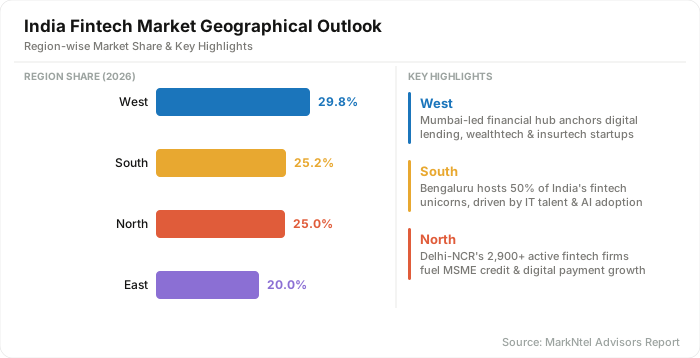
From a demand perspective, the scale of financial activity and investment participation continues to reinforce West India’s leadership. According to the Reserve Bank of India, Maharashtra accounted for nearly 25% of India’s total industrial bank credit in FY2025, reflecting its position as the largest hub for lending activity and financial intermediation . Mumbai-based capital markets, anchored by major exchanges such as the Bombay Stock Exchange and National Stock Exchange, drive significant trading volumes, with India’s equity derivatives segment accounting for nearly 60% of global trading volumes, highlighting the scale of market activity . The concentration of high-income urban consumers and large enterprises also results in higher transaction values and greater adoption of advanced fintech services. As a result, West India maintains its dominant position, supported by financial infrastructure depth, high-value transactions, and strong institutional presence.
India Fintech Market Competitive Analysis
The industry is moderately fragmented, with approximately 2,500 active companies operating across payments, lending, wealth management, insurtech, and neobanking segments. The top five players, including PhonePe, Paytm, Razorpay, Pine Labs, and PayU, collectively account for approximately 50% of the total market share.
Key Companies in the India Fintech Market
- PhonePe
- Paytm
- Razorpay
- Pine Labs
- PayU
- BharatPe
- Policybazaar
- Zerodha
- Groww
- CRED
- MobiKwik
- Open Financial Technologies
- Others
India Fintech Industry News and Recent Developments
June 2025: RUGR Launches “UDAAN” Digital Banking Platform
RUGR introduced its “UDAAN” digital banking transformation platform at Global Fintech Fest 2025, offering scalable and customizable solutions for banks and merchants. The platform is designed to enhance digital banking capabilities, operational efficiency, and security across financial institutions.
Impact Analysis: The launch strengthens digital banking infrastructure by enabling financial institutions to adopt scalable and secure platforms. It is expected to accelerate digital transformation among banks and merchants, improve operational efficiency, and enhance service delivery, thereby supporting the expansion of fintech-enabled banking solutions across India.
August 2025: Reserve Bank of India Introduces AI and IoT-Based Payment Innovations
The Reserve Bank of India unveiled AI-powered UPI assistance, IoT-based payment systems, and interoperable banking solutions at Global Fintech Fest 2025. These initiatives aim to enhance user experience, expand payment accessibility, and strengthen digital payment infrastructure across multiple devices and platforms.
Impact Analysis: These innovations are expected to significantly improve payment efficiency and accessibility, particularly across emerging digital touchpoints such as IoT-enabled devices. The move reinforces India’s leadership in digital payments and is likely to drive higher transaction volumes and adoption of advanced fintech solutions.
January 2026: Razorpay Expands Cross-Border Payment Capabilities
Razorpay received regulatory approval to expand its cross-border payment services across over 130 currencies and entered global markets. This expansion enhances its ability to support international digital commerce and cross-border transactions.
Impact Analysis: The expansion strengthens India’s position in global fintech by enabling seamless international payments for businesses. It is expected to boost cross-border trade, increase transaction volumes, and enhance revenue opportunities for fintech players, while supporting the globalization of India’s digital payment ecosystem.
- Market Segmentation
- Introduction
- Product Definition
- Research Process
- Assumptions
- Executive Summary
- India Fintech Market Policies, Regulations, and Product Standards
- India Fintech Market Trends & Developments
- India Fintech Market Dynamics
- Growth Factors
- Challenges
- India Fintech Market Hotspot & Opportunities
- India Fintech Market Outlook, 2022-2032F
- Market Size & Outlook
- By Revenues (USD Million)
- Market Share & Outlook
- By Service Proposition- Market Size & Forecast 2022-2032, USD Million
- Digital Payments
- Peer-to-Peer Payments
- Merchant Payments
- Payment Gateway and Aggregation
- Cross-Border Payments
- Digital Lending and Financing
- Consumer Lending
- SME Lending
- Buy Now Pay Later
- Digital Investments
- Online Brokerage
- Mutual Fund Investment Platforms
- Robo-Advisory
- Insurtech
- Digital Insurance Distribution
- Claims Management Platforms
- Neobanking
- Retail Neobanking
- Business Neobanking
- Digital Payments
- By End User- Market Size & Forecast 2022-2032, USD Million
- Retail
- Businesses
- By User Interface
- Mobile Applications
- Web / Browser
- POS / IoT Devices
- By Region- Market Size & Forecast 2022-2032, USD Million
- North India
- Delhi
- Uttar Pradesh
- Punjab
- Haryana
- Rajasthan
- South India
- Karnataka
- Tamil Nadu
- Telangana
- Kerala
- West India
- Maharashtra
- Gujarat
- Goa
- East India
- West Bengal
- Odisha
- Bihar
- Assam
- North India
- By Company
- Competition Characteristics
- Market Share & Analysis
- By Service Proposition- Market Size & Forecast 2022-2032, USD Million
- Market Size & Outlook
- India Digital Payments Market Outlook, 2022-2032
- Market Size & Outlook
- By Revenues (USD Million)
- Market Share & Outlook
- By End User- Market Size & Forecast 2022-2032, USD Million
- By User Interface- Market Size & Forecast 2022-2032, USD Million
- By Region- Market Size & Forecast 2022-2032, USD Million
- Market Size & Outlook
- India Digital Lending and Financing Market Outlook, 2022-2032
- Market Size & Outlook
- By Revenues (USD Million)
- Market Share & Outlook
- By End User- Market Size & Forecast 2022-2032, USD Million
- By User Interface- Market Size & Forecast 2022-2032, USD Million
- By Region- Market Size & Forecast 2022-2032, USD Million
- Market Size & Outlook
- India Digital Investments Market Outlook, 2022-2032
- Market Size & Outlook
- By Revenues (USD Million)
- Market Share & Outlook
- By End User- Market Size & Forecast 2022-2032, USD Million
- By User Interface- Market Size & Forecast 2022-2032, USD Million
- By Region- Market Size & Forecast 2022-2032, USD Million
- Market Size & Outlook
- India Insurtech Market Outlook, 2022-2032
- Market Size & Outlook
- By Revenues (USD Million)
- Market Share & Outlook
- By End User- Market Size & Forecast 2022-2032, USD Million
- By User Interface- Market Size & Forecast 2022-2032, USD Million
- By Region- Market Size & Forecast 2022-2032, USD Million
- Market Size & Outlook
- India Neobanking Market Outlook, 2022-2032
- Market Size & Outlook
- By Revenues (USD Million)
- Market Share & Outlook
- By End User- Market Size & Forecast 2022-2032, USD Million
- By User Interface- Market Size & Forecast 2022-2032, USD Million
- By Region- Market Size & Forecast 2022-2032, USD Million
- Market Size & Outlook
- India Fintech Market Key Strategic Imperatives for Success & Growth
- Competitive Outlook
- Company Profiles
- PhonePe
- Business Description
- Product Portfolio
- Collaborations & Alliances
- Recent Developments
- Financial Details
- Others
- Paytm
- Business Description
- Product Portfolio
- Collaborations & Alliances
- Recent Developments
- Financial Details
- Others
- Razorpay
- Business Description
- Product Portfolio
- Collaborations & Alliances
- Recent Developments
- Financial Details
- Others
- Pine Labs
- Business Description
- Product Portfolio
- Collaborations & Alliances
- Recent Developments
- Financial Details
- Others
- PayU
- Business Description
- Product Portfolio
- Collaborations & Alliances
- Recent Developments
- Financial Details
- Others
- BharatPe
- Business Description
- Product Portfolio
- Collaborations & Alliances
- Recent Developments
- Financial Details
- Others
- Policybazaar
- Business Description
- Product Portfolio
- Collaborations & Alliances
- Recent Developments
- Financial Details
- Others
- Zerodha
- Business Description
- Product Portfolio
- Collaborations & Alliances
- Recent Developments
- Financial Details
- Others
- Groww
- Business Description
- Product Portfolio
- Collaborations & Alliances
- Recent Developments
- Financial Details
- Others
- CRED
- Business Description
- Product Portfolio
- Collaborations & Alliances
- Recent Developments
- Financial Details
- Others
- MobiKwik
- Business Description
- Product Portfolio
- Collaborations & Alliances
- Recent Developments
- Financial Details
- Others
- Open Financial Technologies
- Business Description
- Product Portfolio
- Collaborations & Alliances
- Recent Developments
- Financial Details
- Others
- PhonePe
- Company Profiles
- Disclaimer

MarkNtel Advisors follows a robust and iterative research methodology designed to ensure maximum accuracy and minimize deviation in market estimates and forecasts. Our approach combines both bottom-up and top-down techniques to effectively segment and quantify various aspects of the market. A consistent feature across all our research reports is data triangulation, which examines the market from three distinct perspectives to validate findings. Key components of our research process include:
1. Scope & Research Design At the outset, MarkNtel Advisors define the research objectives and formulate pertinent questions. This phase involves determining the type of research—qualitative or quantitative—and designing a methodology that outlines data collection methods, target demographics, and analytical tools. They also establish timelines and budgets to ensure the research aligns with client goals.
2. Sample Selection and Data Collection In this stage, the firm identifies the target audience and determines the appropriate sample size to ensure representativeness. They employ various sampling methods, such as random or stratified sampling, based on the research objectives. Data collection is carried out using tools like surveys, interviews, and observations, ensuring the gathered data is reliable and relevant.
3. Data Analysis and Validation Once data is collected, MarkNtel Advisors undertake a rigorous analysis process. This includes cleaning the data to remove inconsistencies, employing statistical software for quantitative analysis, and thematic analysis for qualitative data. Validation steps are taken to ensure the accuracy and reliability of the findings, minimizing biases and errors.

4. Data Forecast and FinalizationThe final phase involves forecasting future market trends based on the analyzed data. MarkNtel Advisors utilize predictive modeling and time series analysis to anticipate market behaviors. The insights are then compiled into comprehensive reports, featuring visual aids like charts and graphs, and include strategic recommendations to inform client decision-making
We’d love to understand what matters most to you.