

By Radar Type (Primary Surveillance Radar (PSR), Conventional Secondary Surveillance Radar (SSR), Mode S Secondary Surveillance Radar (incl. Enhanced Mode S), Surface Movement Rada......r / ASDE-X Systems), By Component (Antenna & Rotary Joint, Transmitter, Receiver, Signal & Data Processor, Power Supply & Conditioning Systems, Display & Controller Systems, Software), By Frequency Band (L-Band, S-Band, X-Band), By Application (En Route Surveillance, Terminal Area Surveillance, Airport Surface Surveillance), By Offering (Equipment (Hardware & Software), Installation & Integration Services, Maintenance, Support & Upgrade Services), By Replacement Type (Full System Replacement, Upgrade & Retrofit, New Site Installation), By Platform (Fixed Ground-Based Systems, Mobile & Transportable Systems), By End User (Federal Aviation Administration (FAA) / Civil Aviation, Department of Defense (DoD) / Military Agencies, Joint-Use Facilities) Read more
- Aerospace & Defense
- Aug 2026
- 120
- PDF, Excel, PPT
US Air Traffic Surveillance Radar Replacement Market Key Takeaways
- The United States air traffic surveillance radar replacement market, valued at nearly USD 1.73 billion in 2025, is anticipated to expand steadily, reaching USD 3.29 billion by 2032 from USD 1.89 billion in 2026.
- The industry is projected to witness steady growth at a CAGR of 9.68% over 2026–2032.
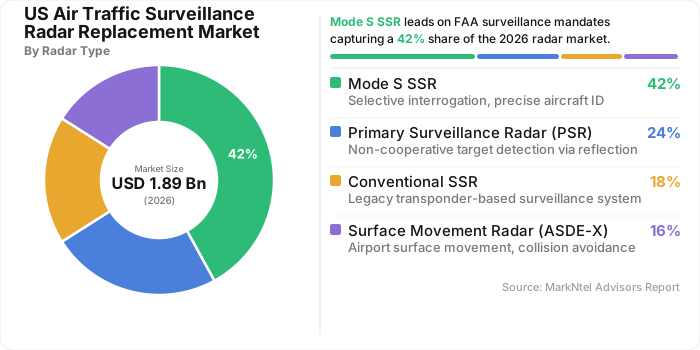
- By radar type, Mode S secondary surveillance radar accounted for the largest market share of approximately 42% in 2026.
- By end user, the Federal Aviation Administration (FAA) / civil aviation segment held nearly 68% of the market share in 2026.
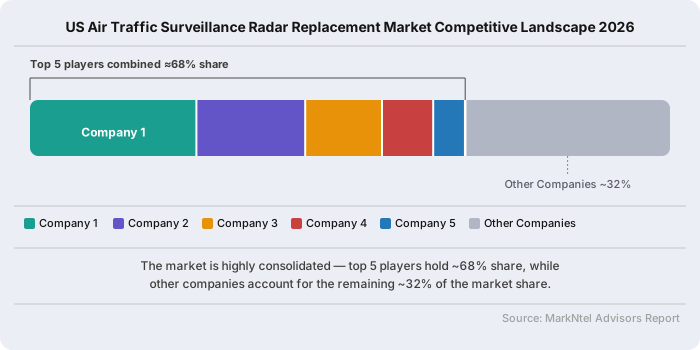
- The industry is characterized by a moderately consolidated market structure, where the top five manufacturers hold roughly 64% of the market share.
US Air Traffic Surveillance Radar Replacement Market Size and Outlook
At a CAGR of approximately 9.68% over 2026–2032, the US air traffic surveillance radar replacement market is expected to rise from USD 1.89 billion in 2026 to USD 3.29 billion by 2032, following a valuation of USD 1.73 billion in 2025.
The replacement market continues to expand as aging surveillance infrastructure across the National Airspace System (NAS) requires timely modernization. Many radar systems have been operating for decades, increasing the need for advanced solutions that enhance surveillance accuracy, operational reliability, and maintenance efficiency. As a result, civil aviation remains the largest end-user due to the FAA's nationwide surveillance responsibilities, while defense agencies continue upgrading radar assets to strengthen national airspace security.
Building on these modernization efforts, FAA radar modernization programs are reinforcing long-term market growth by prioritizing resilient ground-based surveillance alongside advanced air traffic management technologies. Although automatic dependent surveillance–broadcast (ADS-B) has been widely adopted, ground-based radar continues to play a critical role in tracking non-equipped aircraft, providing surveillance redundancy, and ensuring uninterrupted operations during communication or satellite-based system disruptions. This balanced surveillance approach continues to strengthen the reliability of the country's air traffic management network.
Supported by these developments, the market is expected to maintain a positive growth trajectory over the forecast period. In January 2026, the FAA awarded radar replacement contracts to RTX Corporation and Indra Sistemas, S.A. to replace up to 612 aging radar systems by 2028, accelerating modernization across the national airspace system. Together with increasing aviation activity and continued infrastructure renewal, these investments are expected to sustain demand for advanced radar replacement solutions in the coming years.
US Air Traffic Surveillance Radar Replacement Market Key Indicators
- The Federal Aviation Administration (FAA) proposed USD 8 billion under its Facility Replacement and Radar Modernization (FRRM) initiative over five years to modernize 377 critical radar systems and more than 20 air traffic control facilities. The initiative is expected to accelerate replacement of aging surveillance infrastructure and support continued demand for next-generation radar technologies across the national airspace system.
- More than 60% of the FAA's radar portfolio is planned for modernization under the radar modernization proposal, including up to 343 cooperative radars and 34 non-cooperative radars. The initiative also aims to consolidate multiple legacy radar configurations into standardized systems, reducing maintenance complexity and improving operational efficiency, thereby creating long-term opportunities for radar replacement providers.
US Air Traffic Surveillance Radar Replacement Market Scope
| Category | Segments |
|---|---|
| By Radar Type | Primary Surveillance Radar (PSR), Conventional Secondary Surveillance Radar (SSR), Mode S Secondary Surveillance Radar (incl. Enhanced Mode S), Surface Movement Radar / ASDE-X Systems |
| By Component | Antenna & Rotary Joint, Transmitter, Receiver, Signal & Data Processor, Power Supply & Conditioning Systems, Display & Controller Systems, Software |
| By Frequency Band | L-Band, S-Band, X-Band |
| By Application | En Route Surveillance, Terminal Area Surveillance, Airport Surface Surveillance |
| By Offering | Equipment (Hardware & Software), Installation & Integration Services, Maintenance, Support & Upgrade Services |
| By Replacement Type | Full System Replacement, Upgrade & Retrofit, New Site Installation |
| By Platform | Fixed Ground-Based Systems, Mobile & Transportable Systems |
| By End User | Federal Aviation Administration (FAA) / Civil Aviation, Department of Defense (DoD) / Military Agencies, Joint-Use Facilities |
US Air Traffic Surveillance Radar Replacement Market Growth Drivers
Modernization of Ageing Air Traffic Surveillance Infrastructure Driving Market Growth
The modernization of ageing air traffic surveillance infrastructure has become a major driver as many radar systems operating within the National Airspace System (NAS) have remained in service for decades. Legacy primary and secondary surveillance radars require replacement to improve surveillance accuracy, operational reliability, and lifecycle efficiency while supporting the growing complexity of US airspace. Consequently, the Federal Aviation Administration (FAA) continues investing in advanced air traffic control radar systems featuring digital processing, enhanced target detection, and improved cybersecurity to strengthen air traffic management systems. According to the FAA, more than 16 million flights are handled annually across the National Airspace System, further increasing operational demands on surveillance infrastructure.
Reflecting this commitment to infrastructure modernization, in March 2026, the FAA awarded contracts to RTX Corporation and Indra to replace up to 612 ageing surveillance radar systems by June 2028, supporting the deployment of commercially available next-generation surveillance radar technologies while simplifying maintenance through platform standardization. The FAA has also confirmed that many existing ground-based radar systems will remain operational beyond 2040, reinforcing the need for continuous technical refresh and investments in ground-based radar replacement technologies. As modernization programs continue, sustained federal investment and the adoption of advanced surveillance technologies are expected to strengthen the resilience, efficiency, and long-term reliability of the US air traffic management network.
Recent Trends
Growing Adoption of Digital and Software-Defined Surveillance Radar Technologies
The US aviation sector is increasingly adopting digital and software-defined surveillance radar technologies to enhance surveillance performance, operational flexibility, and lifecycle efficiency. Unlike conventional analogue radar systems, modern software-defined architectures offer advanced digital signal processing, improved target detection and tracking accuracy, remote diagnostics, and software-based upgrades without requiring extensive hardware replacement. These capabilities enable aviation authorities to strengthen operational resilience, simplify system maintenance, and support the broader digital transformation of air traffic management infrastructure.
The transition towards software-defined surveillance radar is becoming increasingly evident through continued industry innovation. In October 2025, Indra introduced its next-generation NORMARC digital air traffic surveillance radar, featuring a fully software-defined architecture, advanced digital signal processing, enhanced cybersecurity protection, and remote maintenance capabilities to support evolving air navigation requirements. The new system enables easier technology upgrades while improving operational availability, surveillance accuracy, and long-term system sustainability across civil aviation environments.
As modernization initiatives continue across the national airspace system, software-defined surveillance radar technologies are expected to become a key consideration in future radar replacement programs. Their ability to improve system scalability, reduce lifecycle costs, simplify technology upgrades, and support evolving operational requirements is accelerating the transition towards next-generation digital surveillance infrastructure, strengthening the long-term efficiency and resilience of US air traffic management systems.
US Air Traffic Surveillance Radar Replacement Market Opportunities and Challenges
Growing Spectrum Congestion Creating Opportunities for Advanced Multi-Sensor Surveillance Solutions
Growing demand for wireless communications, satellite services, and unmanned aircraft operations is increasing pressure on the radio frequency spectrum used by aviation surveillance systems. As more services operate within adjacent frequency bands, the risk of signal interference and reduced surveillance performance is becoming a greater challenge for maintaining safe and efficient air traffic operations. Consequently, aviation authorities are placing greater emphasis on spectrum protection and resilient surveillance infrastructure to ensure uninterrupted aircraft monitoring within increasingly complex airspace.
This challenge is creating significant opportunities for advanced multi-sensor surveillance solutions that integrate surveillance radar with technologies such as Automatic Dependent Surveillance–Broadcast (ADS-B), multilateration (MLAT), and airport automation systems. Reflecting this transition, the Federal Aviation Administration's (FAA) Airport Surface Surveillance Capability (ASSC) combines ASDE-3 Surface Movement Radar, Mode S radar, ADS-B, multilateration, and the Standard Terminal Automation Replacement System (STARS) to provide controllers with a unified real-time surveillance picture, improving aircraft and vehicle tracking on airport surfaces. As airports continue modernising their surveillance infrastructure, integrated multi-sensor architectures are expected to create new growth opportunities for radar manufacturers by enhancing operational reliability, situational awareness, and overall air traffic management efficiency.
Segmentation Insights
Mode S Secondary Surveillance Radar Accounts for 42% Market Share Through Superior Aircraft Identification and NextGen Compatibility
Mode S secondary surveillance radar has established itself as the leading radar technology owing to its ability to deliver highly accurate aircraft identification, enhanced surveillance performance, and more efficient communication than conventional secondary surveillance systems. By assigning a unique identification code to each aircraft and enabling selective interrogation, the system reduces signal congestion while improving controller situational awareness across busy airspace. These capabilities are particularly valuable at high-density airports and en-route air traffic control facilities, where maintaining operational efficiency and aviation safety remains a top priority.
Its widespread adoption is further supported by the Federal Aviation Administration's continued modernization of the National Airspace System through the NextGen programme, which is gradually integrating advanced surveillance technologies to improve the efficiency and reliability of air traffic management. As legacy radar infrastructure is progressively replaced with interoperable and digitally connected systems, Mode S radar continues to offer the performance, compatibility, and scalability required for future airspace operations. These advantages are expected to reinforce its leadership over other radar technologies throughout the forecast period. Based on radar type, the market has been segmented into:
- Mode S Secondary Surveillance Radar
- Primary Surveillance Radar (PSR)
- Conventional Secondary Surveillance Radar (SSR)
- Surface Movement Radar / ASDE-X Systems
FAA / Civil Aviation Accounts for 68% Market Share Backed by Nationwide Air Traffic Surveillance Modernization
The Federal Aviation Administration (FAA) / civil aviation continues to represent the largest end user of air traffic surveillance radar replacement systems owing to its responsibility for operating and modernizing the National Airspace System (NAS), one of the world's busiest and most complex aviation networks. The agency manages extensive controlled airspace and a nationwide network of surveillance radar installations that are essential for maintaining safe aircraft separation, efficient traffic flow, and uninterrupted flight operations. As a result, replacing ageing radar infrastructure has become a strategic priority to enhance surveillance accuracy, improve operational resilience, and support the long-term efficiency of the country's air traffic management system.
Its dominant position is further reinforced by the steady expansion of civil aviation activity, which continues to place greater demands on existing surveillance infrastructure. According to the US Government Accountability Office (GAO), civil air travel is expected to grow by an average of 6.2% annually, increasing pressure on the FAA's ageing cooperative and non-cooperative radar inventory used for civil airspace separation. This growing operational demand is driving sustained investment in advanced surveillance radar technologies, enabling the FAA to strengthen airspace capacity, enhance operational reliability, and support the safe integration of future air traffic across the United States. Based on end user, the market is categorized into:
- Federal Aviation Administration (FAA) / Civil Aviation
- Department of Defense (DoD) / Military Agencies
- Joint-Use Facilities
US Air Traffic Surveillance Radar Replacement Market Competitive Analysis
The market is moderately consolidated, with established defense contractors and air traffic management technology providers competing in surveillance radar modernization and system integration. The top five players, RTX Corporation (Collins Aerospace), Indra Sistemas, S.A., Peraton Inc., Leidos Holdings, Inc., and Saab, Inc., collectively account for approximately 64% of the market, supported by FAA modernization contracts, advanced radar technologies, and long-term integration expertise.
Key Players in US Air Traffic Surveillance Radar Replacement Market
- RTX Corporation (Collins Aerospace)
- Indra Sistemas, S.A.
- Peraton Inc.
- Leidos Holdings, Inc.
- Saab, Inc.
- Lockheed Martin Corporation
- Others
US Air Traffic Surveillance Radar Replacement Industry News and Recent Developments
September 2025: Saab Secures FAA Contract to Modernize Airport Surface Surveillance Radars
Saab, Inc. secured a USD 267.3 million contract from the Federal Aviation Administration (FAA) to replace ageing ASDE-3 Surface Movement Radars with next-generation SMR-4 systems at 44 major US airports. The programme aims to modernize airport surface surveillance infrastructure, improve situational awareness, and enhance operational efficiency through advanced radar technology.
Impact Analysis: The contract reinforces the FAA's commitment to modernizing airport surveillance infrastructure and is expected to accelerate the deployment of next-generation surface movement radar systems, supporting improved runway safety, operational reliability, and long-term demand for advanced surveillance radar technologies across the United States.
- Market Segmentation
- Introduction
- Product Definition
- Research Process
- Assumptions
- Executive Summary
- US Air Traffic Surveillance Radar Replacement Market Policies, Regulations, and Product Standards
- US Air Traffic Surveillance Radar Replacement Market Trends & Developments
- US Air Traffic Surveillance Radar Replacement Market Dynamics
- Growth Factors
- Challenges
- US Air Traffic Surveillance Radar Replacement Market Hotspot & Opportunities
- US Air Traffic Surveillance Radar Replacement Market Outlook, 2022-2032
- Market Size & Outlook
- By Revenues (USD Million)
- Market Segmentation & Outlook
- By Radar Type- Market Size & Forecast 2022-2032, USD Million
- Primary Surveillance Radar (PSR)
- Conventional Secondary Surveillance Radar (SSR)
- Mode S Secondary Surveillance Radar (incl. Enhanced Mode S)
- Surface Movement Radar / ASDE-X Systems
- By Component- Market Size & Forecast 2022-2032, USD Million
- Antenna & Rotary Joint
- Transmitter
- Receiver
- Signal & Data Processor
- Power Supply & Conditioning Systems
- Display & Controller Systems
- Software
- By Frequency Band- Market Size & Forecast 2022-2032, USD Million
- L-Band
- S-Band
- X-Band
- By Application- Market Size & Forecast 2022-2032, USD Million
- En Route Surveillance
- Terminal Area Surveillance
- Airport Surface Surveillance
- By Offering- Market Size & Forecast 2022-2032, USD Million
- Equipment (Hardware & Software)
- Installation & Integration Services
- Maintenance, Support & Upgrade Services
- By Replacement Type- Market Size & Forecast 2022-2032, USD Million
- Full System Replacement
- Upgrade & Retrofit
- New Site Installation
- By Platform- Market Size & Forecast 2022-2032, USD Million
- Fixed Ground-Based Systems
- Mobile & Transportable Systems
- By End User- Market Size & Forecast 2022-2032, USD Million
- Federal Aviation Administration (FAA) / Civil Aviation
- Department of Defense (DoD) / Military Agencies
- Joint-Use Facilities
- By Company
- Competition Characteristics
- Market Share & Analysis
- By Radar Type- Market Size & Forecast 2022-2032, USD Million
- Market Size & Outlook
- US Primary Surveillance Radar (PSR) Market Outlook, 2022-2032
- Market Size & Outlook
- By Revenues (USD Million)
- Market Segmentation & Outlook
- By Component- Market Size & Forecast 2022-2032, USD Million
- By Frequency Band- Market Size & Forecast 2022-2032, USD Million
- By Application- Market Size & Forecast 2022-2032, USD Million
- By Offering- Market Size & Forecast 2022-2032, USD Million
- By Replacement Type- Market Size & Forecast 2022-2032, USD Million
- By Platform- Market Size & Forecast 2022-2032, USD Million
- By End User- Market Size & Forecast 2022-2032, USD Million
- Market Size & Outlook
- US Conventional Secondary Surveillance Radar (SSR) Market Outlook, 2022-2032
- Market Size & Outlook
- By Revenues (USD Million)
- Market Segmentation & Outlook
- By Component- Market Size & Forecast 2022-2032, USD Million
- By Frequency Band- Market Size & Forecast 2022-2032, USD Million
- By Application- Market Size & Forecast 2022-2032, USD Million
- By Offering- Market Size & Forecast 2022-2032, USD Million
- By Replacement Type- Market Size & Forecast 2022-2032, USD Million
- By Platform- Market Size & Forecast 2022-2032, USD Million
- By End User- Market Size & Forecast 2022-2032, USD Million
- Market Size & Outlook
- US Mode S Secondary Surveillance Radar (incl. Enhanced Mode S) Market Outlook, 2022-2032
- Market Size & Outlook
- By Revenues (USD Million)
- Market Segmentation & Outlook
- By Component- Market Size & Forecast 2022-2032, USD Million
- By Frequency Band- Market Size & Forecast 2022-2032, USD Million
- By Application- Market Size & Forecast 2022-2032, USD Million
- By Offering- Market Size & Forecast 2022-2032, USD Million
- By Replacement Type- Market Size & Forecast 2022-2032, USD Million
- By Platform- Market Size & Forecast 2022-2032, USD Million
- By End User- Market Size & Forecast 2022-2032, USD Million
- Market Size & Outlook
- US Surface Movement Radar / ASDE-X Systems Market Outlook, 2022-2032
- Market Size & Outlook
- By Revenues (USD Million)
- Market Segmentation & Outlook
- By Component- Market Size & Forecast 2022-2032, USD Million
- By Frequency Band- Market Size & Forecast 2022-2032, USD Million
- By Application- Market Size & Forecast 2022-2032, USD Million
- By Offering- Market Size & Forecast 2022-2032, USD Million
- By Replacement Type- Market Size & Forecast 2022-2032, USD Million
- By Platform- Market Size & Forecast 2022-2032, USD Million
- By End User- Market Size & Forecast 2022-2032, USD Million
- Market Size & Outlook
- US Air Traffic Surveillance Radar Replacement Market Key Strategic Imperatives for Success & Growth
- Competitive Outlook
- Company Profiles
- RTX Corporation (Collins Aerospace)
- Business Description
- Product Portfolio
- Collaborations & Alliances
- Recent Developments
- Financial Details
- Others
- Indra Sistemas, S.A.
- Business Description
- Product Portfolio
- Collaborations & Alliances
- Recent Developments
- Financial Details
- Others
- Peraton Inc.
- Business Description
- Product Portfolio
- Collaborations & Alliances
- Recent Developments
- Financial Details
- Others
- Leidos Holdings, Inc.
- Business Description
- Product Portfolio
- Collaborations & Alliances
- Recent Developments
- Financial Details
- Others
- Saab, Inc.
- Business Description
- Product Portfolio
- Collaborations & Alliances
- Recent Developments
- Financial Details
- Others
- Lockheed Martin Corporation
- Business Description
- Product Portfolio
- Collaborations & Alliances
- Recent Developments
- Financial Details
- Others
- Others
- RTX Corporation (Collins Aerospace)
- Company Profiles
- Disclaimer

MarkNtel Advisors follows a robust and iterative research methodology designed to ensure maximum accuracy and minimize deviation in market estimates and forecasts. Our approach combines both bottom-up and top-down techniques to effectively segment and quantify various aspects of the market. A consistent feature across all our research reports is data triangulation, which examines the market from three distinct perspectives to validate findings. Key components of our research process include:
1. Scope & Research Design At the outset, MarkNtel Advisors define the research objectives and formulate pertinent questions. This phase involves determining the type of research—qualitative or quantitative—and designing a methodology that outlines data collection methods, target demographics, and analytical tools. They also establish timelines and budgets to ensure the research aligns with client goals.
2. Sample Selection and Data Collection In this stage, the firm identifies the target audience and determines the appropriate sample size to ensure representativeness. They employ various sampling methods, such as random or stratified sampling, based on the research objectives. Data collection is carried out using tools like surveys, interviews, and observations, ensuring the gathered data is reliable and relevant.
3. Data Analysis and Validation Once data is collected, MarkNtel Advisors undertake a rigorous analysis process. This includes cleaning the data to remove inconsistencies, employing statistical software for quantitative analysis, and thematic analysis for qualitative data. Validation steps are taken to ensure the accuracy and reliability of the findings, minimizing biases and errors.

4. Data Forecast and FinalizationThe final phase involves forecasting future market trends based on the analyzed data. MarkNtel Advisors utilize predictive modeling and time series analysis to anticipate market behaviors. The insights are then compiled into comprehensive reports, featuring visual aids like charts and graphs, and include strategic recommendations to inform client decision-making
FILL THE FORM TO INQUIRE BEFORE BUYING THIS REPORT
We offer flexible licensing options to cater to varying organizational needs. Choose the pricing pack that best suits your requirements:
Buy Now Talk to our Consultant
 Request Customization