Russia Sea Skimmer Missile Market Research Report: Size, Share, Trends & Forecast (2026-2032)
By Type (Surface-to-Surface Sea Skimmer Missiles, Air-to-Surface Sea Skimmer Missiles), By Range (Short Range (Up to 50 km), Medium Range (51–150 km), Long Range (Above 150 km)), B ... y Launch Platform (Shipborne, Airborne, Submarine-Launched), By Guidance System (Active Radar Guidance, Infrared Guidance, Multi-Mode Guidance), By End User (Russian Navy, Naval Aviation, Coastal Defense Forces) Read more
- Aerospace & Defense
- Aug 2026
- Pages 165
- Report Format: PDF, Excel, PPT
Russia Sea Skimmer Missile Market
Projected 3.93% CAGR from 2026 to 2032
Study Period
2026-2032
Market Size (2026)
USD 327 Million
Market Size (2032)
USD 0.472 Billion
Base Year
2025
Projected CAGR
3.93%
Leading Segments
By Type: Surface-to-Surface Sea Skimmer Missiles
Russia Sea Skimmer Missile Market Key Takeaways
- The Russia sea skimmer missile market size was valued at around USD 298 million in 2025 and is projected to grow from USD 327 million in 2026 to USD 0.472 billion by 2032, exhibiting a CAGR of 3.93% during 2026-2032.
- Surface-to-surface sea skimmer missiles led the market by type with an 82% share.
- The Russian navy accounted for 69% of end-user demand.
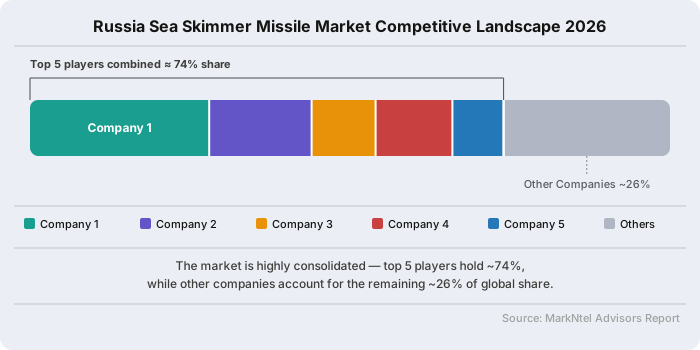
- The industry is moderately consolidated, with the top five leading players accounting for approximately 74% of the total market share.
Russia Sea Skimmer Missile Market Size and Outlook
At a CAGR of approximately 3.93% over 2026–2032, the sea skimmer missile market in Russia is expected to rise from USD 327 million in 2026 to USD 0.472 billion by 2032, following a valuation of USD 298 million in 2025.
Russia's sustained investment in maritime defense capabilities has played a vital role in strengthening its sea-skimmer missile market. Rising defense expenditure, continued naval modernization, and growing adoption of precision-guided weapon systems have supported steady market expansion. Sea-skimming anti-ship missiles remain a key element of Russia's anti-access/area-denial strategy, equipping surface combatants, submarines, coastal defense formations, and naval aviation. In 2025, the government finalized the 2027–2036 State Armament Program, reinforcing long-term investment in advanced precision weapons and next-generation military technologies.
Building on these modernization efforts, procurement demand continues to be led by the Russian Navy, followed by coastal defense forces and naval aviation. Ongoing naval fleet modernization initiatives emphasize the deployment of long-range precision-guided missile systems across ships, submarines, and coastal defense assets, strengthening operational readiness and maritime deterrence. This sustained focus on fleet capability enhancement is expected to support consistent demand for advanced sea-skimming missile systems throughout the forecast period.
Complementing these procurement initiatives, government policies continue to strengthen the domestic defense ecosystem through long-term industrial and technological development. The State Armament Program supports weapons research, manufacturing capacity, testing infrastructure, and the integration of advanced technologies, including artificial intelligence. At the same time, localization policies encourage domestic production, reduce dependence on imported technologies, and reinforce the country's precision-guided missile manufacturing capabilities.
In response to these policy priorities, leading defense companies are expanding production capacity while advancing missile guidance, radar, and fire-control technologies. Rostec reports that nearly half of Russia's state defense procurement is fulfilled through its enterprises, alongside increased production of high-precision weapons and military equipment. Supported by sustained government procurement and continuous industrial investment, the Russia sea skimmer missile market is expected to maintain stable growth over the forecast period.
Russia Sea Skimmer Missile Market Key Indicators
- Russia allocated approximately USD 145 billion to national defense in its 2025 federal budget, marking one of its highest defense spending levels. Higher defense expenditure supports procurement of advanced naval weapon systems, including sea-skimming missiles, thereby driving market growth.
- SIPRI reported that Russia's major arms exports declined by 64% between 2015–2019 and 2020–2024. The shift toward prioritizing production for Russia's own armed forces is supporting domestic procurement of advanced naval weapon systems, including sea-skimming missiles.
- Rosatom reported that cargo traffic along the Northern Sea Route reached a record 37.9 million tonnes in 2024, while cargo volumes are projected to grow by around 20% in 2025. Rising Arctic maritime activity is strengthening the strategic importance of Russia's northern coastline, supporting continued investment in coastal defense and maritime security capabilities.
- Russia continues to strengthen its coastal defense posture through the deployment and operational exercises of Bastion and Bal coastal missile systems across the Baltic, Arctic, and Pacific regions. Expanding deployment of these anti-ship missile systems supports sustained demand for sea-skimming missile capabilities used to protect strategic maritime assets and coastal infrastructure.
Russia Sea Skimmer Missile Market Scope
| Category | Segments |
|---|---|
| By Type | Surface-to-Surface Sea Skimmer Missiles, Air-to-Surface Sea Skimmer Missiles |
| By Range | Short Range (Up to 50 km), Medium Range (51–150 km), Long Range (Above 150 km |
| By Launch Platform | Shipborne, Airborne, Submarine-Launched |
| By Guidance System | Active Radar Guidance, Infrared Guidance, Multi-Mode Guidance |
| By End User | Russian Navy, Naval Aviation, Coastal Defense Forces |
Russia Sea Skimmer Missile Market Growth Drivers
Expansion of Maritime A2/AD Capabilities Driving Sea Skimmer Missile Procurement
Russia continues to strengthen its anti-access/area-denial (A2/AD) capabilities across the Arctic, Baltic Sea, Black Sea, Pacific Ocean, and the Sea of Okhotsk to safeguard strategic maritime interests. This approach is driving procurement of advanced sea-skimming missile technology, as its low-altitude flight profile improves survivability against modern naval air-defense systems. Consequently, the Russian Navy and coastal defense forces continue expanding their anti-ship missile capabilities to strengthen maritime deterrence.
Supporting these efforts, Russia's updated Maritime Doctrine prioritizes a stronger naval presence and enhanced precision strike capabilities. The Ministry of Defense continues integrating advanced anti-ship missile systems into Bastion coastal defense complexes, modern frigates, corvettes, and submarines. According to the Stockholm International Peace Research Institute (SIPRI), Russia was the world's third-largest military spender in 2024, with military expenditure increasing by 38% year over year to approximately USD 149 billion, reflecting sustained investment in strategic defense capabilities.
This sustained defense investment is expected to support steady demand for sea skimmer missiles over the forecast period. Continuous advancements in missile seekers, propulsion systems, electronic counter-countermeasure technologies, and network-enabled targeting are improving the effectiveness of next-generation anti-ship missiles. Alongside continued investment in maritime strike weapons, these developments are expected to support the long-term growth of the Russia sea skimmer missile market.
Recent Trends
Growing Integration of Multi-Platform Anti-Ship Missile Systems
Russia is increasingly emphasizing anti-ship missile families that can be deployed across surface warships, submarines, coastal defense batteries, and naval aviation platforms. This approach improves operational flexibility, simplifies logistics, and enhances interoperability across naval forces. As a result, procurement of advanced naval precision-guided missiles continues to expand, supporting more effective precision strike capabilities across diverse operational environments.
Building on this approach, the Russian Navy continues expanding the operational deployment of advanced anti-ship missile systems across multiple naval platforms. In June 2026, the Northern Fleet's Yasen-M class submarine Arkhangelsk successfully launched a P-800 Oniks anti-ship missile during a combat training exercise in the Barents Sea, highlighting the growing integration of multi-platform missile capabilities. At the same time, continued investments in advanced fire-control systems, secure data links, and guidance technologies are strengthening naval combat systems, improving strike accuracy and operational effectiveness.
As these modernization efforts continue, demand for multi-platform sea skimmer missile systems is expected to grow steadily. Ongoing advancements in indigenous electronics, propulsion systems, and guidance technologies are further enhancing missile performance while supporting wider deployment across Russia's naval forces. Together, these developments are expected to reinforce long-term procurement of advanced anti-ship missile systems and strengthen the country's maritime deterrence capabilities.
Russia Sea Skimmer Missile Market Opportunities and Challenges
Technology Restrictions Accelerating Indigenous Missile Development
International sanctions and export restrictions continue to limit Russia's access to advanced semiconductor components, specialized manufacturing equipment, and dual-use technologies required for precision-guided missile systems. As a result, defense manufacturers are accelerating supply chain localization while expanding investments in indigenous research, guidance systems, propulsion technologies, and onboard electronics. These efforts are strengthening domestic technological capabilities and reducing reliance on foreign suppliers for critical missile components.
In response, the Russian government continues promoting import substitution and localization across the defense sector to reinforce domestic manufacturing capacity. Rostec has also reported increased production of high-precision weapons and military equipment while expanding localization across its defense enterprises. As indigenous capabilities continue to advance, domestic manufacturers are expected to improve production resilience, strengthen supply security, and accelerate the development of next-generation missile technologies, creating long-term opportunities for the country's defense industrial base.
Segmentation Insights
Surface-to-Surface Sea Skimmer Missiles Captured Around 82% of the Market Owing to their Extensive Deployment
The widespread deployment of anti-ship missile systems across Russia's naval fleet and coastal defense network has established surface-to-surface sea skimmer missiles as the primary procurement category. These systems are extensively integrated into frigates, corvettes, missile boats, and Bastion coastal defense systems responsible for safeguarding strategic maritime approaches and restricting hostile naval access. Their capability to deliver long-range precision strikes while maintaining a low-altitude flight profile makes them the primary strike weapon for maritime denial and coastal defense operations.
This strong market position is reinforced by sustained investments in coastal defense modernization and fleet expansion initiatives. Modern surface combatants continue to receive advanced anti-ship missile systems, while coastal missile units are being upgraded to enhance maritime deterrence and operational readiness. Supported by expanding coastal defense capabilities and continued indigenous missile production, surface-to-surface sea skimmer missiles are expected to remain the preferred procurement category as Russia strengthens its maritime strike capabilities. Based on type, the market has been segmented into:
- Surface-to-Surface Sea Skimmer Missiles
- Air-to-Surface Sea Skimmer Missiles
Russian Navy Held Nearly 69% of the Market Due to Sustained Procurement of Advanced Naval Strike Systems
Driven by sustained investments in fleet expansion and maritime strike capabilities, the Russian navy remains the principal procurement authority for advanced sea skimmer missile systems. Large-scale acquisition of missile-equipped surface combatants, submarines, and associated naval weapon systems continues to strengthen fleet defense, maritime deterrence, sea-denial operations, and long-range precision engagement through advanced surface warfare missiles.
This leadership is further reinforced by continued fleet modernization and expansion of advanced surface combatants. In August 2025, Russia launched the fifth Admiral Gorshkov-class frigate, while additional vessels remained under construction with UKSK vertical launch systems capable of deploying Oniks, Zircon, and Kalibr missiles, reflecting sustained investment in advanced naval strike capabilities. Together with ongoing modernization of integrated combat management systems and indigenous missile technologies, these developments are expected to reinforce the Russian Navy's position as the country's primary operator and procurement authority for sea skimmer missile systems. Based on end user, the market is categorized into:
- Russian Navy
- Naval Aviation
- Coastal Defense Forces
Russia Sea Skimmer Missile Market Competitive Analysis
A moderately consolidated competitive structure characterizes the Russia Sea Skimmer Missile Market, with Tactical Missiles Corporation (KTRV), NPO Mashinostroyenia, Raduga Design Bureau (GosMKB Raduga), Almaz-Antey Air and Space Defence Corporation, and Rostec State Corporation collectively accounting for approximately 74% of the market revenue.
Key Players of Russia Sea Skimmer Missile Market
- Tactical Missiles Corporation (KTRV)
- NPO Mashinostroyenia
- Raduga Design Bureau (GosMKB Raduga)
- BrahMos Aerospace
- Almaz-Antey Air and Space Defence Corporation
- United Shipbuilding Corporation (USC)
- Concern Morinformsystem-Agat
- United Engine Corporation (UEC)
- Ruselectronics Holding
- Rostec State Corporation
- Others
Russia Sea Skimmer Missile Industry News and Recent Developments
March 2026: Russia's Baltic Fleet Conducts Bal and Bastion Anti-Ship Missile Exercise
Russia's Baltic Fleet carried out a coastal defense exercise featuring Bal (Kh-35) and Bastion (P-800 Oniks) anti-ship missile systems to simulate coordinated strikes against surface naval targets. The exercise evaluated combat readiness, missile deployment procedures, and coastal defense capabilities while demonstrating the operational integration of Russia's key sea-skimming missile systems in maritime security operations.
Impact Analysis: The exercise reinforces Russia's continued emphasis on operational deployment and readiness of sea-skimming missile systems, supporting sustained procurement of coastal defense capabilities and strengthening demand for advanced anti-ship missile technologies across naval and coastal defense forces.
Frequently Asked Questions
- Market Segmentation
- Introduction
- Product Definition
- Research Process
- Assumptions
- Executive Summary
- Russia Sea Skimmer Missile Market Policies, Regulations, and Product Standards
- Russia Sea Skimmer Missile Market Trends & Developments
- Russia Sea Skimmer Missile Market Dynamics
- Growth Factors
- Challenges
- Russia Sea Skimmer Missile Market Hotspot & Opportunities
- Russia Sea Skimmer Missile Market Outlook, 2022-2032
- Market Size & Outlook
- By Revenues (USD Million)
- Market Share & Outlook
- By Type- Market Size & Forecast 2022-2032, USD Million
- Surface-to-Surface Sea Skimmer Missiles
- Air-to-Surface Sea Skimmer Missiles
- By Range- Market Size & Forecast 2022-2032, USD Million
- Short Range (Up to 50 km)
- Medium Range (51–150 km)
- Long Range (Above 150 km)
- By Launch Platform- Market Size & Forecast 2022-2032, USD Million
- Shipborne
- Airborne
- Submarine-Launched
- By Guidance System- Market Size & Forecast 2022-2032, USD Million
- Active Radar Guidance
- Infrared Guidance
- Multi-Mode Guidance
- By End User- Market Size & Forecast 2022-2032, USD Million
- Russian Navy
- Naval Aviation
- Coastal Defense Forces
- By Company
- Competition Characteristics
- Market Share & Analysis
- By Type- Market Size & Forecast 2022-2032, USD Million
- Market Size & Outlook
- Russia Surface-to-Surface Sea Skimmer Missiles Market Outlook, 2022-2032
- Market Size & Outlook
- By Revenues (USD Million)
- Market Share & Outlook
- By Range- Market Size & Forecast 2022-2032, USD Million
- By Launch Platform- Market Size & Forecast 2022-2032, USD Million
- By Guidance System- Market Size & Forecast 2022-2032, USD Million
- By End User- Market Size & Forecast 2022-2032, USD Million
- Market Size & Outlook
- Russia Air-to-Surface Sea Skimmer Missiles Market Outlook, 2022-2032
- Market Size & Outlook
- By Revenues (USD Million)
- Market Share & Outlook
- By Range- Market Size & Forecast 2022-2032, USD Million
- By Launch Platform- Market Size & Forecast 2022-2032, USD Million
- By Guidance System- Market Size & Forecast 2022-2032, USD Million
- By End User- Market Size & Forecast 2022-2032, USD Million
- Market Size & Outlook
- Russia Sea Skimmer Missile Market Key Strategic Imperatives for Success & Growth
- Competitive Outlook
- Company Profiles
- Tactical Missiles Corporation (KTRV)
- Business Description
- Product Portfolio
- Collaborations & Alliances
- Recent Developments
- Financial Details
- Others
- NPO Mashinostroyenia
- Business Description
- Product Portfolio
- Collaborations & Alliances
- Recent Developments
- Financial Details
- Others
- Raduga Design Bureau (GosMKB Raduga)
- Business Description
- Product Portfolio
- Collaborations & Alliances
- Recent Developments
- Financial Details
- Others
- BrahMos Aerospace
- Business Description
- Product Portfolio
- Collaborations & Alliances
- Recent Developments
- Financial Details
- Others
- Almaz-Antey Air and Space Defence Corporation
- Business Description
- Product Portfolio
- Collaborations & Alliances
- Recent Developments
- Financial Details
- Others
- United Shipbuilding Corporation (USC)
- Business Description
- Product Portfolio
- Collaborations & Alliances
- Recent Developments
- Financial Details
- Others
- Concern Morinformsystem-Agat
- Business Description
- Product Portfolio
- Collaborations & Alliances
- Recent Developments
- Financial Details
- Others
- United Engine Corporation (UEC)
- Business Description
- Product Portfolio
- Collaborations & Alliances
- Recent Developments
- Financial Details
- Others
- Ruselectronics Holding
- Business Description
- Product Portfolio
- Collaborations & Alliances
- Recent Developments
- Financial Details
- Others
- Rostec State Corporation
- Business Description
- Product Portfolio
- Collaborations & Alliances
- Recent Developments
- Financial Details
- Others
- Tactical Missiles Corporation (KTRV)
- Company Profiles
- Disclaimer
MarkNtel Advisors follows a robust and iterative research methodology designed to ensure maximum accuracy and minimize deviation in market estimates and forecasts. Our approach combines both bottom-up and top-down techniques to effectively segment and quantify various aspects of the market. A consistent feature across all our research reports is data triangulation, which examines the market from three distinct perspectives to validate findings. Key components of our research process include:
1. Scope & Research Design At the outset, MarkNtel Advisors define the research objectives and formulate pertinent questions. This phase involves determining the type of research—qualitative or quantitative—and designing a methodology that outlines data collection methods, target demographics, and analytical tools. They also establish timelines and budgets to ensure the research aligns with client goals.
2. Sample Selection and Data Collection In this stage, the firm identifies the target audience and determines the appropriate sample size to ensure representativeness. They employ various sampling methods, such as random or stratified sampling, based on the research objectives. Data collection is carried out using tools like surveys, interviews, and observations, ensuring the gathered data is reliable and relevant.
3. Data Analysis and Validation Once data is collected, MarkNtel Advisors undertake a rigorous analysis process. This includes cleaning the data to remove inconsistencies, employing statistical software for quantitative analysis, and thematic analysis for qualitative data. Validation steps are taken to ensure the accuracy and reliability of the findings, minimizing biases and errors.

4. Data Forecast and FinalizationThe final phase involves forecasting future market trends based on the analyzed data. MarkNtel Advisors utilize predictive modeling and time series analysis to anticipate market behaviors. The insights are then compiled into comprehensive reports, featuring visual aids like charts and graphs, and include strategic recommendations to inform client decision-making
We offer flexible licensing options to cater to varying organizational needs. Choose the pricing pack that best suits your requirements:
Buy Now Inquire Before Buying
 Request Customization
 Talk to our Consultant