

By System Configuration (Submerged MBR Systems (SMBR), Side-stream / External MBR Systems), By Flow Rate Capacity (Less than 50,000 GPD, 50,000 - 250,000 GPD, 250,000 - 1,000,000 G......PD, Over 1,000,000 GPD), By Membrane Type (Hollow Fiber Membranes, Flat Sheet Membranes, Multi-tubular Membranes), By Application (Municipal Wastewater Treatment, Industrial Wastewater Treatment, Water reuse and recycling), By End-Use Industry (Pharmaceuticals, Food & Beverage, Chemical & Petrochemical, Textile Industry, Power & Energy, Oil & Gas, Pulp & Paper), By Technology Integration (Microfiltration (MF) based MBR, Ultrafiltration (UF) based MBR, Hybrid systems (advanced combinations with NF/RO in reuse plants)), By Module Configuration (Spiral wound systems, Hollow fiber modules (dominant), Tubular modules), and others Read more
- Environment
- Jun 2026
- 180
- PDF, Excel, PPT
United States Membrane Bioreactor Market Report Key Takeaways
- The U.S. membrane bioreactor market is valued at USD 0.860 billion in 2025, increasing to USD 0.928 billion in 2026, and is projected to reach USD 1.341 billion by 2032, expanding at a CAGR of 6.31% during 2026-32.
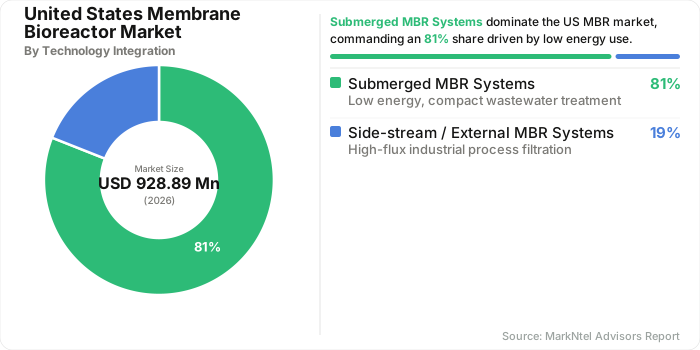
- Submerged MBR (SMBR) systems dominate the system configuration segment with an 81% market share.
- Ultrafiltration (UF)-based MBR technology leads the technology integration segment with a 68% share.
- The Southern United States leads the regional landscape with a 34% market share.
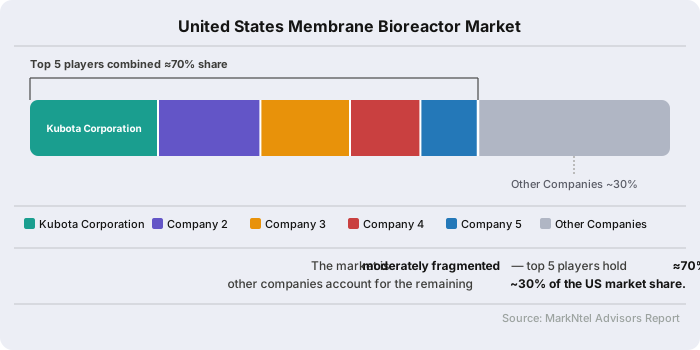
- The market remains moderately consolidated, with the top five players collectively accounting for approximately 70% of total market revenue.
United States Membrane Bioreactor Market Size and Outlook
The U.S. membrane bioreactor market is grow at a CAGR of 6.31% during the forecast period i.e., 2026-32. The market is transitioning from a niche wastewater treatment technology to a mainstream solution for municipal reuse and industrial compliance-driven upgrades. This shift is primarily driven by tightening discharge regulations, water scarcity in key states, and strong federal funding support for advanced water infrastructure. Regulatory frameworks such as the U.S. National Water Reuse Action Plan and state-level clean water initiatives are accelerating adoption across both municipal utilities and high-load industrial facilities.
A major insight is the rapid integration of MBR systems in water-stressed urban regions such as California and the Southwest, where reuse-ready effluent is becoming a policy priority. For instance, projects like California’s advanced water recycling initiatives (including large-scale municipal reuse programs) increasingly rely on MBR-based treatment trains due to their ability to produce high-quality effluent suitable for indirect potable reuse. This reflects a structural shift where MBRs are no longer optional upgrades but core infrastructure components in circular water systems.
Another emerging thing is the strong adoption in packaged and modular wastewater treatment systems, especially for industrial parks, remote facilities, and decentralized treatment needs. The rise of containerized and compact MBR units is enabling faster deployment with lower land requirements, which is particularly relevant in urban redevelopment and data center clusters where space constraints are critical. These systems are increasingly preferred over conventional activated sludge systems due to higher efficiency, smaller footprint, and consistent effluent quality.
Competitive dynamics also show that the market is highly driven by engineering firms and water technology leaders integrating digital monitoring and smart automation into MBR systems. Real-time membrane performance tracking, predictive fouling control, and AI-enabled plant optimization are increasingly being deployed to improve operational reliability and reduce maintenance downtime. This digital integration is becoming a differentiating factor in new project awards and is expected to support market expansion from USD 0.928 Billion in 2026 to USD 1.341 Billion by 2032.
United States Membrane Bioreactor Market Key Indicators
- The U.S. Environmental Protection Agency (EPA) has committed USD 11.7 billion through the Clean Water State Revolving Fund (CWSRF) under the Bipartisan Infrastructure Law (Public Law 117-58) across fiscal years 2022–2026 for wastewater, stormwater, and nonpoint source infrastructure projects. This scale of public expenditure directly funds upgrades to publicly owned treatment works (POTWs), a primary deployment environment for membrane bioreactor technology, as municipalities pursue advanced treatment to meet increasingly stringent effluent discharge standards.
- In April 2024, the EPA issued the first-ever national legally enforceable drinking water standard for per- and polyfluoroalkyl substances (PFAS), with a concurrent USD 1 billion commitment to help states and territories implement PFAS testing and advanced treatment at public water systems. The PFAS regulation mandates measurable reductions in contaminant concentrations that c onventional secondary treatment cannot achieve, pushing water utilities and industrial dischargers toward membrane-based advanced treatment solutions, including MBR systems, to comply with the new limits.
- The U.S. FDA, as of 2025, reported that approximately 53% of brand drug products and 69% of generic drug products consumed in the United States are manufactured overseas, prompting Executive Order 14293 in May 2025 directing FDA to streamline regulation of pharmaceutical manufacturing to restore domestic production capacity. Each new domestic pharmaceutical manufacturing facility constructed under this reshoring initiative generates highly complex wastewater containing active pharmaceutical ingredients (APIs), solvents, and fermentation byproducts that require advanced membrane-based treatment before discharge, directly expanding MBR demand in the pharmaceutical sector.
- According to the North Carolina Rural Health Research Program, the U.S. had 4,497 acute care hospitals and 1,457 specialty hospitals operating as of January 1, 2024. These facilities generate complex wastewater streams containing pharmaceuticals, disinfectants, antibiotic residues, and pathogenic contaminants that often require treatment beyond conventional secondary processes. As a result, membrane bioreactor systems are increasingly being adopted for hospital wastewater treatment due to their ability to deliver high-quality effluent and achieve stringent pathogen-removal standards suitable for safe discharge and water reuse applications.
United States Membrane Bioreactor Market Scope
| Category | Segments |
|---|---|
| By System Configuration | Submerged MBR Systems (SMBR), Side-stream / External MBR Systems |
| By Flow Rate Capacity | Less than 50,000 GPD, 50,000 - 250,000 GPD, 250,000 - 1,000,000 GPD, Over 1,000,000 GPD |
| By Membrane Type | Hollow Fiber Membranes, Flat Sheet Membranes, Multi-tubular Membranes |
| By Application | Municipal Wastewater Treatment, Industrial Wastewater Treatment, Water reuse and recycling |
| By End-Use Industry | Pharmaceuticals, Food & Beverage, Chemical & Petrochemical, Textile Industry, Power & Energy, Oil & Gas, Pulp & Paper |
| By Technology Integration | Microfiltration (MF) based MBR, Ultrafiltration (UF) based MBR, Hybrid systems (advanced combinations with NF/RO in reuse plants, |
| By Module Configuration | Spiral wound systems, Hollow fiber modules (dominant), Tubular modules |
United States Membrane Bioreactor Industry Growth Drivers
Water Scarcity and Reclamation Driving Adoption of Membrane Bioreactors in the U.S.
Prolonged drought conditions and declining freshwater availability across states such as California, Arizona, and Texas are accelerating investment in advanced wastewater recycling infrastructure in the United States. Membrane bioreactors (MBRs) are increasingly preferred because they generate high-quality treated effluent with low suspended solids and pathogen content, making them suitable for water reclamation, irrigation, industrial reuse, and advanced purification systems. Additionally, municipal utilities are adopting MBR technology to strengthen long-term water security while reducing dependence on freshwater withdrawals.
This growing demand is strongly experienced through Pure Water Monterey project that was developed after severe drought and groundwater overdraft concerns impacted regional water reliability. The facility converts wastewater into purified recycled water for aquifer replenishment , directly increasing adoption of advanced membrane treatment technologies.
Industrial sectors are also increasing adoption of reuse-oriented treatment systems. In Texas and Arizona, manufacturing facilities and commercial campuses are deploying compact MBR systems for cooling tower supply and process-water recycling to reduce operational water consumption during drought periods. For instance, Kubota Tractor Corporation implemented an MBR-based non-potable reuse system at its Texas facility to capture, treat, and reuse wastewater onsite, reducing freshwater consumption for operational activities. This growing focus on circular water management continues to strengthen demand for MBR industry in US.
Recent Trends
Energy-Efficient Membrane Technologies Emerging as a Key Trend in the Membrane Bioreactors
The U.S. membrane bioreactors market is increasingly shifting toward energy-efficient membrane technologies as utilities and industrial operators focus on lowering operational expenditure and reducing carbon emissions from wastewater treatment facilities.
Conventional MBR systems consume significant energy during aeration and membrane cleaning processes, driving demand for advanced low-pressure hollow-fiber and flat-sheet membrane configurations that improve permeability while minimizing energy requirements. Manufacturers are developing membranes with enhanced fouling resistance, higher throughput, and optimized oxygen transfer efficiency to improve long-term plant economics.
A major recent development was Toray Industries' introduction in 2025 of a high-precision hollow-fiber membrane module with nano-structural control technology to improve permeability and reduce operational energy consumption i n industrial filtration and bioprocessing applications. The technology is designed to enhance the efficiency of liquid flow while lowering processing costs and carbon emissions.
Similarly, Pall Corporation launched its Membralox® GP-IC ceramic membrane systems in 2025, featuring graduated permeability technology that improves filtration efficiency and lowers capital and operating costs. The company stated that the system delivers up to 45% higher filtration capacity compared to conventional ceramic membran es, supporting energy-efficient wastewater and industrial treatment operations.
This trend is expected to accelerate the adoption of advanced MBR configurations across decentralized treatment plants, industrial water recycling systems, and large-scale municipal reuse infrastructure throughout the United States.
United States Membrane Bioreactors Industry Opportunities and Challenges
High Energy Intensity and Operational Cost of MBR Systems Driving Innovation in Low-Energy Configurations
Submerged MBR configurations require continuous aeration for membrane scouring and fouling control, resulting in substantially higher electricity consumption compared to gravity-based clarification systems. The high capital investment associated with membrane modules, blowers, automated cleaning systems, and advanced process controls further increases the overall lifecycle cost of MBR deployment.
The U.S. Department of Energy (DOE) has quantified this broader problem, that water resource recovery facilities across the United States are directly and indirectly responsible for over 44 million metric tons of greenhouse gas emissions annually, equivalent to more than nine million gasoline-powered passenger vehicles, a figure that reflects the energy intensity embedded in biological wastewater treatment infrastructure, of which MBR systems form an increasingly large share.
This energy cost challenge has directly triggered a measurable federal investment response that is now accelerating low-energy MBR innovation and broadening the technology's commercial reach. This is observed in 2025, the DOE's Advanced Research Projects Agency-Energy (ARPA-E) committed USD 25 million across 10 projects under the Realize Energy-rich Compound Opportunities Valorizing Extraction from Refuse Waters (RECOVER) program, targeting membrane-based technologies that reduce the energy and emissions burden of wastewater treatment while recovering ammonia and critical minerals from process streams.
Separately, the DOE Industrial Technologies also awarded USD 27.8 million to 10 projects mandated to achieve a 50% reduction in greenhouse gas emissions from key wastewater treatment unit processes without increasing total operating costs, a performance target that directly incentivises next-generation low-energy membrane configurations and anaerobic MBR designs that generate biogas as a recoverable energy offset.
Therefore, suppliers capable of delivering low-energy membrane configurations, reduced aeration demand, and lower lifecycle operating costs are expected to gain stronger commercial traction as utilities increasingly prioritize both regulatory compliance and decarbonization objectives in wastewater infrastructure investments.
Segmentation Analysis
Submerged Configuration Drives US Membrane Bioreactor Deployment
Submerged membrane bioreactor (SMBR) systems account for approximately 81% of the US membrane bioreactor market by configuration, establishing an overwhelming lead over side-stream alternatives. SMBR systems position the membrane module directly inside the biological reactor, eliminating the need for external recirculation pumping and substantially reducing the energy demand associated with liquid transfer. This gives a decisive operational advantage for municipal treatment plants operating under tight energy and cost budgets.
The elimination of a secondary clarifier further reduces plant footprint, which is critical for urban installations and facility upgrades where land availability constrains expansion.
According to the U.S. Environmental Protection Agency (EPA), membrane filtration in submerged configurations produces effluent turbidities consistently below 1 NTU, a quality threshold that directly satisfies California's disinfected tertiary recycled water standard of 0.2 NTU for microfiltration and ultrafiltration systems, positioning SMBR effluent as reuse-grade wit hout additional polishing in most non-potable applications.
Companies also contribute to their leadership in the market, for example, KUBOTA Water and Environment USA Corporation is the master distributor of the KUBOTA Submerged Membrane Unit® (SMU) in North America, with active deployment in the US market since 2002. The company completed its second North American project of 30 MGD or larger capacity in 2024 a facility with an ultimate build-out of 38 MGD and peak day flow of 76 MGD backed by a global installed base of more than 6,500 commercial MBR plants, the largest of any membrane manufacturer. Thus, their strong alignment with municipal wastewater reuse requirements, urban infrastructure constraints, and rising investment in water recycling projects continues to reinforce large-scale adoption across the country. By system configuration, the market is further segmented into the following sub-categories:
- Submerged MBR Systems
- Side-stream / External MBR Systems
Ultrafiltration Membranes Set the Standard for MBR Performance in the US
Ultrafiltration (UF)-based membrane bioreactor systems hold approximately 68% of the US membrane bioreactor market by technology integration, driven by their ability to achieve both regulatory-grade effluent quality and water reuse specifications within a single treatment stage.
Ultrafiltration membranes, operating at pore sizes between 0.005 and 0.2 micrometres, provide 90–100% pathogen removal, including protozoa, bacteria, and large viruses, a performance envelope the National Academies of Sciences has confirmed as consistently superior to conventional filtration in terms of pathogen control and effluent consistency.
This capability makes UF-based MBR systems the default specification for municipal water reuse projects, hospital wastewater treatment, and pharmaceutical effluent management where pathogen log-reduction credits are required under National Pollutant Discharge Elimination System (NPDES) permits. One of the major companies contributing in this segment includes Toray Industries, which supplies hollow-fiber PVDF UF membrane modules with a 0.01 μm nominal pore size across US water reuse installations, including projects in Texas, North Dakota, California, Wyoming, Delaware (Ohio), and Valley Center (California). In February 2025, Toray unveiled a high-efficiency UF membrane reducing CO₂ emissions by more than 30%, with mass production initiated in mid-2025, targeting North America as the primary launch market, where wastewater reuse demand is expanding fastest.
Thus, the dominance of UF-based membrane bioreactor systems in the United States is expected to strengthen further over the forecast period, with expanding municipal water reuse programs and growing demand for advanced industrial wastewater treatment. UF-based MBR systems will be the preferred technology across municipal, healthcare, and pharmaceutical applications. By Technology integration, the market is further segmented into the following sub-categories:
- Microfiltration (MF) based MBR
- Ultrafiltration (UF) based MBR
- Hybrid systems (advanced combinations with NF/RO in reuse plants)
United States Membrane Bioreactor Market Geographical Analysis
The South accounts for approximately 34% of the US membrane bioreactor market, establishing it as the dominant regional market and the largest contributor to national demand growth. This leadership position is primarily driven by rapid population expansion across states such as Texas, Florida, and North Carolina, which is placing sustained pressure on municipal wastewater treatment infrastructure and accelerating investment in advanced water reuse technologies.
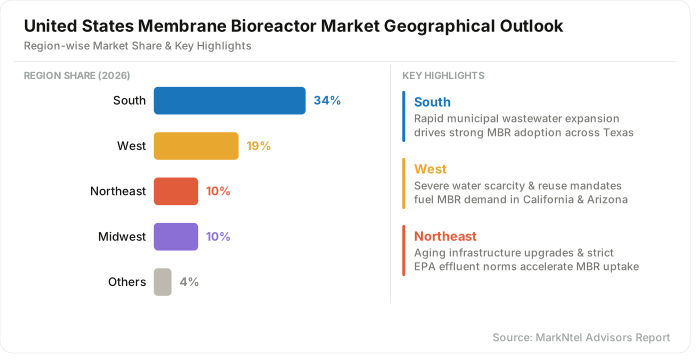
Consequently, state and federal infrastructure funding is increasingly being directed toward advanced treatment and water reclamation projects that favour membrane bioreactor deployment. In November 2025, Texas voters approved a landmark USD 20 billion water infrastructure investment program, the largest state-level water commitment in US history, specifically targeting wastewater treatment modernization, water reuse expansion, and advance d purification systems. This large-scale funding pipeline is expected to substantially strengthen long-term MBR adoption across municipal utilities throughout the region.
Furthermore, project-level investments continue to reinforce the South’s dominance in the national market. In December 2025, the U.S. Environmental Protection Agency approved a USD 347 million Water Infrastructure Finance and Innovation Act (WIFIA) loan to Fort Worth for the development of a new water reclamation facility designed to treat wastewater for industrial and irrigation reuse. Since reuse-focused facilities require consistently high-quality effluent suitable for non-potable applications, these projects directly support increasing deployment of membrane bioreactor systems across the southern United States.
United States Membrane Bioreactors Competitive Landscape
The U.S. Membrane Bioreactor market exhibits a moderately fragmented structure, characterized by the presence of a few large multinational water technology companies alongside numerous regional and niche MBR system integrators. The top 5 players SUEZ Water Technologies & Solutions, Kubota Membrane USA, Koch Membrane Systems, Veolia Water Technologies, Xylem collectively holding the share of 70% of the market.
Major Companies in the US membrane bioreactors Market:
- SUEZ Water Technologies & Solutions
- Kubota Membrane
- Newterra Ltd.
- Dynatec Systems Inc.
- A3-USA Inc.
- BioMicrobics Inc.
- Sperta (USA) Inc.
- Kovalus Separation Solutions
- bioprocessH2O
- Envirogen Technologies Inc.
- BioMicrobics
United States Membrane Bioreactors News and Recent Developments
2026: BluMetric Wins Florida MBR Wastewater Treatment Contract
BluMetric Wins secured a US$1.5 million contract to design and supply a membrane bioreactor wastewater treatment plant for a residential housing development project in Florida. The modular system will initially treat around 150,000 gallons per day and can later expand to nearly 300,000 GPD. The project uses advanced membrane filtration combined with biological wastewater treatment to improve treated water quality. The treated wastewater can support reuse applications such as irrigation and landscaping in water-stressed regions.
Impact analysis: The development supports long-term growth opportunities for membrane manufacturers, packaged treatment providers, and engineering companies operating in the U.S. membrane bioreactor market. Companies offering modular and decentralized MBR technologies are expected to benefit from rising infrastructure modernization activity. Increasing residential construction and pressure on municipal sewer systems are further supporting adoption of compact wastewater treatment systems. The project demonstrates how decentralized MBR deployment is emerging as an important growth segment within the U.S. wastewater treatment industry.
- Market Segmentation
- Introduction
- Product Definition
- Research Process
- Assumptions
- Executive Summary
- US Membrane Bioreactor Market Policies, Regulations, and Product Standards
- US Membrane Bioreactor Market Trends & Developments
- US Membrane Bioreactor Market Dynamics
- Growth Factors
- Challenges
- US Membrane Bioreactor Market Hotspot & Opportunities
- US Membrane Bioreactor Market Outlook, 2022-2032F
- Market Size & Outlook
- By Revenues (USD Million)
- Market Share & Outlook
- By System Configuration- Market Size & Forecast 2022-2032, USD Million
- Submerged MBR Systems (SMBR)
- Side-stream / External MBR Systems
- By Flow Rate Capacity - Market Size & Forecast 2022-2032, USD Million
- Less than 50,000 GPD
- 50,000 - 250,000 GPD
- 250,000 - 1,000,000 GPD
- Over 1,000,000 GPD
- By Membrane Type- Market Size & Forecast 2022-2032, USD Million
- Hollow Fiber Membranes
- Flat Sheet Membranes
- Multi-tubular Membranes
- By Application- Market Size & Forecast 2022-2032, USD Million
- Municipal Wastewater Treatment
- Industrial Wastewater Treatment
- Water reuse and recycling
- By End-Use Industry- Market Size & Forecast 2022-2032, USD Million
- Pharmaceuticals
- Food & Beverage
- Chemical & Petrochemical
- Textile Industry
- Power & Energy
- Oil & Gas
- Pulp & Paper
- By Technology Integration- Market Size & Forecast 2022-2032, USD Million
- Microfiltration (MF) based MBR
- Ultrafiltration (UF) based MBR
- Hybrid systems (advanced combinations with NF/RO in reuse plants)
- By Module Configuration- Market Size & Forecast 2022-2032, USD Million
- Spiral wound systems
- Hollow fiber modules (dominant)
- Tubular modules
- By region- Market Size & Forecast 2022-2032, USD Million
- North
- South
- East
- West
- Central
- By Company
- Competition Characteristics
- Market Share & Analysis
- By System Configuration- Market Size & Forecast 2022-2032, USD Million
- Market Size & Outlook
- US Municipal Wastewater Treatment Market Outlook, 2022-2032
- Market Size & Outlook
- By Revenues (USD Million)
- Market Share & Outlook
- By Flow Rate Capacity - Market Size & Forecast 2022-2032, USD Million
- By Membrane Type- Market Size & Forecast 2022-2032, USD Million
- By Application- Market Size & Forecast 2022-2032, USD Million
- By End-Use Industry- Market Size & Forecast 2022-2032, USD Million
- By Technology Integration- Market Size & Forecast 2022-2032, USD Million
- By Module Configuration- Market Size & Forecast 2022-2032, USD Million
- By region- Market Size & Forecast 2022-2032, USD Million
- Market Size & Outlook
- US Industrial Wastewater Treatment Market Outlook, 2022-2032
- Market Size & Outlook
- By Revenues (USD Million)
- Market Share & Outlook
- By Flow Rate Capacity - Market Size & Forecast 2022-2032, USD Million
- By Membrane Type- Market Size & Forecast 2022-2032, USD Million
- By Application- Market Size & Forecast 2022-2032, USD Million
- By End-Use Industry- Market Size & Forecast 2022-2032, USD Million
- By Technology Integration- Market Size & Forecast 2022-2032, USD Million
- By Module Configuration- Market Size & Forecast 2022-2032, USD Million
- By region- Market Size & Forecast 2022-2032, USD Million
- Market Size & Outlook
- US Water reuse and recycling Market Outlook, 2022-2032
- Market Size & Outlook
- By Revenues (USD Million)
- Market Share & Outlook
- By Flow Rate Capacity - Market Size & Forecast 2022-2032, USD Million
- By Membrane Type- Market Size & Forecast 2022-2032, USD Million
- By Application- Market Size & Forecast 2022-2032, USD Million
- By End-Use Industry- Market Size & Forecast 2022-2032, USD Million
- By Technology Integration- Market Size & Forecast 2022-2032, USD Million
- By Module Configuration- Market Size & Forecast 2022-2032, USD Million
- By region- Market Size & Forecast 2022-2032, USD Million
- Market Size & Outlook
- US Membrane Bioreactor Market Key Strategic Imperatives for Success & Growth
- Competitive Outlook
- Company Profiles
- SUEZ Water Technologies & Solutions
- Business Description
- Product Portfolio
- Collaborations & Alliances
- Recent Developments
- Financial Details
- Others
- Kubota Membrane
- Business Description
- Product Portfolio
- Collaborations & Alliances
- Recent Developments
- Financial Details
- Others
- Newterra Ltd.
- Business Description
- Product Portfolio
- Collaborations & Alliances
- Recent Developments
- Financial Details
- Others
- Dynatec Systems Inc.
- Business Description
- Product Portfolio
- Collaborations & Alliances
- Recent Developments
- Financial Details
- Others
- A3-USA Inc.
- Business Description
- Product Portfolio
- Collaborations & Alliances
- Recent Developments
- Financial Details
- Others
- BioMicrobics Inc.
- Business Description
- Product Portfolio
- Collaborations & Alliances
- Recent Developments
- Financial Details
- Others
- Sperta (USA) Inc.
- Business Description
- Product Portfolio
- Collaborations & Alliances
- Recent Developments
- Financial Details
- Others
- Kovalus Separation Solutions
- Business Description
- Product Portfolio
- Collaborations & Alliances
- Recent Developments
- Financial Details
- Others
- bioprocessH2O
- Business Description
- Product Portfolio
- Collaborations & Alliances
- Recent Developments
- Financial Details
- Others
- Envirogen Technologies Inc.
- Business Description
- Product Portfolio
- Collaborations & Alliances
- Recent Developments
- Financial Details
- Others
- SUEZ Water Technologies & Solutions
- Company Profiles
- Disclaimer

MarkNtel Advisors follows a robust and iterative research methodology designed to ensure maximum accuracy and minimize deviation in market estimates and forecasts. Our approach combines both bottom-up and top-down techniques to effectively segment and quantify various aspects of the market. A consistent feature across all our research reports is data triangulation, which examines the market from three distinct perspectives to validate findings. Key components of our research process include:
1. Scope & Research Design At the outset, MarkNtel Advisors define the research objectives and formulate pertinent questions. This phase involves determining the type of research—qualitative or quantitative—and designing a methodology that outlines data collection methods, target demographics, and analytical tools. They also establish timelines and budgets to ensure the research aligns with client goals.
2. Sample Selection and Data Collection In this stage, the firm identifies the target audience and determines the appropriate sample size to ensure representativeness. They employ various sampling methods, such as random or stratified sampling, based on the research objectives. Data collection is carried out using tools like surveys, interviews, and observations, ensuring the gathered data is reliable and relevant.
3. Data Analysis and Validation Once data is collected, MarkNtel Advisors undertake a rigorous analysis process. This includes cleaning the data to remove inconsistencies, employing statistical software for quantitative analysis, and thematic analysis for qualitative data. Validation steps are taken to ensure the accuracy and reliability of the findings, minimizing biases and errors.

4. Data Forecast and FinalizationThe final phase involves forecasting future market trends based on the analyzed data. MarkNtel Advisors utilize predictive modeling and time series analysis to anticipate market behaviors. The insights are then compiled into comprehensive reports, featuring visual aids like charts and graphs, and include strategic recommendations to inform client decision-making
FILL THE FORM TO INQUIRE BEFORE BUYING THIS REPORT
We offer flexible licensing options to cater to varying organizational needs. Choose the pricing pack that best suits your requirements:
Buy Now Talk to our Consultant
 Request Customization