

By Product Type (Lamps, Luminaires), By Application (Indoor, Outdoor), By Installation (New, Retrofit), By Sales Channel (Indirect Sales, Direct Sales), and others... Read more
- FMCG
- Jun 2026
- 150
- PDF, Excel, PPT
UAE LED Lighting Market Key Takeaways
- UAE LED lighting market valued at USD 1.12 billion in 2025, reaching USD 1.29 billion in 2026 and USD 2.28 billion by 2032.
- The industry is projected to grow at 9.96% CAGR during 2026-32.
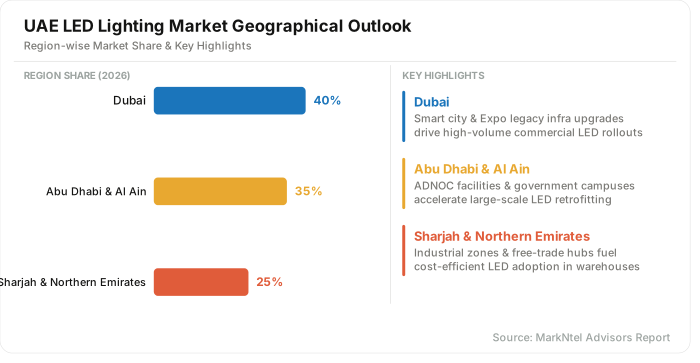
- Dubai dominates regional demand, contributing approximately 40% share.
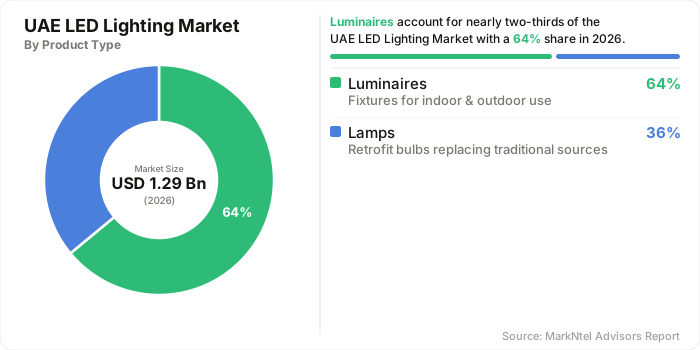
- Luminaires lead the product type segment with nearly 64% share in 2026.
- Indoor applications account for about 68% share in 2026.
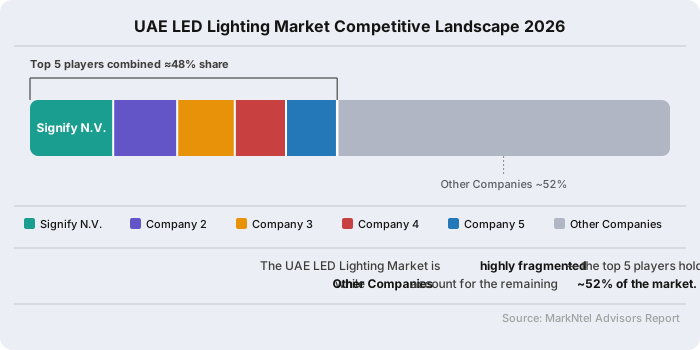
- The industry remains moderately fragmented, with top five players collectively holding around 48% share, balancing global brand dominance with strong participation from regional suppliers.
UAE LED Lighting Market Size and Outlook
The LED lighting market size in the UAE was estimated at USD 1.12 billion in 2025 and is projected to grow to USD 1.29 billion in 2026 and further reach USD 2.28 billion by 2032, reflecting a CAGR of 9.96%. Growth is strongly anchored in construction expansion, with Dubai Municipality recording over 30,000 building permits in H1 2025, covering more than 5.5 million square meters. Notably, commercial buildings accounted for 45% of licensed space, while villas represented 40%, directly driving demand for commercial LED lighting and residential lighting systems across diverse project categories.
Project pipeline depth further strengthens demand visibility, with over 726 developments underway across Dubai in 2025. As projects transition from structural completion to fit-out and commissioning phases, lighting demand intensifies significantly. This stage drives large-scale deployment of LED fixtures across interiors, façades, and infrastructure elements. Developers are prioritizing energy-efficient installations to meet regulatory standards, while also aligning lighting specifications with lifecycle cost optimization and long-term operational performance objectives.
Residential supply expansion is creating a strong multiplier effect on lighting demand. Dubai is expected to deliver around 44,000 homes in 2025, followed by more than 69,000 units in 2026, each requiring multiple lighting layers across indoor, outdoor, and shared spaces. Simultaneously, the integration of smart lights in the UAE is increasing, as developers adopt connected systems to enhance automation, monitoring, and energy management capabilities within newly built residential communities and mixed-use developments.
Looking ahead, the convergence of construction growth, digital lighting adoption, and sustainability priorities will shape market evolution. Increasing pressure to reduce energy consumption is accelerating interest in efficient and renewable-compatible lighting solutions, including solar-integrated systems. In conclusion, these factors are expected to reinforce steady expansion of the UAE LED lighting industry, supported by strong project pipelines, technological innovation, and a continuously expanding installed base across urban infrastructure.
UAE LED Lighting Market Key Indicators
- Dubai’s electricity consumption reached 59,594 GWh in 2024, marking a 5.4% annual increase, while peak demand touched 10.76 GW. This sustained rise is intensifying pressure on utilities and property owners to adopt energy-efficient solutions. As a result, widespread transition toward energy lighting is accelerating, with LEDs becoming central to demand-side management and long-term electricity cost optimization strategies.
- With 19.59 million international visitors recorded in 2025 and hotel occupancy exceeding 80%, Dubai’s hospitality sector continues to expand at scale. The presence of over 154,000 hotel rooms across 827 establishments fuels continuous upgrades in ambience and design. This trend is significantly boosting demand for architectural lighting, as hotels increasingly prioritize aesthetic differentiation alongside operational energy efficiency.
- The UAE’s construction pipeline, valued at approximately USD 772 billion, remains a fundamental growth engine for lighting installations across sectors. Large-scale residential, commercial, and infrastructure developments are continuously integrating advanced lighting systems. This robust pipeline directly supports demand for LED fixtures, ensuring consistent volume growth as new projects prioritize energy-efficient and durable illumination technologies.
- Dubai’s population is projected to grow from 3.3 million to 5.8 million by 2040, accompanied by a 25% expansion in land allocated to healthcare and education. This demographic and institutional growth significantly increases lighting requirements across multiple end-use environments. Consequently, demand for residential lighting is rising steadily, supported by new housing developments and expanding public infrastructure.
UAE LED Lighting Market Scope
| Category | Segments |
|---|---|
| By Product Type | Lamps, Luminaires |
| By Application | Indoor, Outdoor |
| By Installation | New, Retrofit |
| By Sales Channel | Indirect Sales, Direct Sales |
UAE LED Lighting Market Growth Drivers
Real Estate Expansion Accelerating LED Adoption
The real estate expansion in the UAE remains a central growth driver for the LED lighting industry, supported by record transaction volumes and sustained investor participation. Dubai recorded approximately 226,000 property transactions worth approximately USD 207 billion in 2024, reflecting strong development momentum. This scale of activity is directly increasing demand for LED luminaires, as new residential and commercial projects prioritize efficient, long-lasting lighting systems across interior and exterior environments.
Beyond transaction values, the sector’s operational intensity is evident from over 2.78 million real estate procedures recorded during the year. Rising occupancy rates and leasing activity are accelerating upgrades in lighting controls in the UAE, particularly in high-density buildings where automation reduces operational costs. Property owners are increasingly integrating LED-based systems to enhance energy efficiency, improve maintenance cycles, and align with evolving building performance standards.
The influx of nearly 110,000 new investors in 2024, marking a 55% increase, reinforces the long-term project pipeline. Developers across hospitality, mixed-use, and residential segments are actively deploying commercial LED lighting solutions to meet sustainability mandates and tenant expectations. This trend is further supported by regulatory frameworks promoting green construction and energy-efficient infrastructure across the UAE.
Collectively, sustained transaction growth, expanding investor participation, and continuous construction activity are significantly enlarging the installed base of LED systems, reinforcing long-term demand visibility and ensuring stable growth momentum across the UAE LED lighting sector.
Recent Trends
Emergence of Cloud-Based Connected Lighting Platforms
Lighting systems across the UAE are shifting toward software-managed ecosystems, reflecting a broader transition within the UAE LED lighting industry toward digital infrastructure. This evolution is characterized by the deployment of connected lighting solutions that enable centralized monitoring and automation. Buildings are increasingly adopting intelligent lighting frameworks to enhance operational efficiency while supporting energy optimization across large-scale commercial and institutional assets.
A notable example of this shift is the 2025 launch of Signify’s Interact Emergency Lighting System, a cloud-based platform enabling wireless control, monitoring, and automated testing . Such innovations highlight growing adoption of smart lighting systems, particularly in environments where compliance reporting and safety management are critical. These systems significantly reduce manual intervention while improving reliability and real-time visibility.
The integration of lighting with broader digital infrastructure is further accelerating this transformation. Systems are increasingly linked with sensors and building management platforms, enabling adaptive lighting responses based on occupancy and usage patterns. This trend is strengthening the role of IoT lighting, allowing facilities to optimize performance while delivering enhanced user-centric lighting experiences.
As adoption of cloud-enabled lighting platforms accelerates across commercial and institutional infrastructure, demand for intelligent control systems is expected to rise steadily, reinforcing the UAE LED lighting demand transition toward integrated, software-driven ecosystems supporting long-term operational efficiency improvements.
UAE LED Lighting Market Opportunities and Challenges
Energy Demand Pressures Driving Solar LED Solutions
The UAE’s rapid electrification and infrastructure expansion are placing increasing pressure on energy systems, creating a structural challenge for the UAE LED lighting industry. Clean energy accounts for around 21.5% of Dubai’s installed capacity, yet rising electricity demand continues to strain grid infrastructure. This intensifies the need for energy lighting solutions that reduce consumption across buildings, transportation networks, and large-scale urban developments.
At the same time, the expansion of renewable energy capacity is reshaping long-term energy planning. The Mohammed bin Rashid Al Maktoum Solar Park is projected to exceed 8,000 MW by 2030, highlighting the scale of clean energy investments. Within this evolving framework, lighting systems are increasingly evaluated for compatibility with renewables, driving demand for solar lighting across both grid-connected and off-grid applications.
A clear demonstration of this opportunity is the 125-km solar-powered street lighting corridor between Abu Dhabi and Al Ain, completed in 2025 with 2,248 installations. Recognized by Guinness World Records, this project validates the commercial viability of solar LED solutions for highways and infrastructure, particularly in areas where extending grid connectivity is economically or operationally challenging.
The rising electricity demand and grid limitations present structural constraints, while large-scale renewable expansion and proven solar deployments are creating strong opportunities, enabling the UAE LED lighting market to align energy efficiency improvements with national decarbonization and long-term infrastructure sustainability objectives.
Segmentation Insights
Luminaires Segment Leading Through Integrated System Demand
Luminaires account for approximately 64% of total revenue, establishing clear dominance within the UAE LED lighting industry. Unlike lamps, which serve as replaceable components, luminaires offer integrated solutions combining housing, optics, and controls. This functional advantage is accelerating adoption of LED fixtures, particularly across commercial and infrastructure projects where performance, durability, and system compatibility are critical procurement considerations for developers and facility operators.
The dominance is further reinforced by large-scale retrofit and development projects. For instance, the DIFC lighting retrofit involved installation of over 40,000 luminaires across a 48-hectare mixed-use district, incorporating offices, retail, and public spaces . Such projects highlight growing reliance on lighting systems that integrate controls, automation, and energy optimization, rather than standalone lamp replacements, thereby increasing overall system value and long-term operational efficiency.
Within luminaires, subsegments such as downlighting, decorative, and directional lighting are witnessing strong demand across commercial and hospitality environments. Meanwhile, lamps, including A-Type, B-Type, and C-Type, are primarily driven by replacement cycles. Increasing preference for architectural lighting in modern developments is further strengthening luminaire demand, positioning the segment to maintain its leadership as integrated lighting solutions continue to evolve. Product-wise, the market is divided into the following segments:
- Lamps
- A-Type
- B-Type
- C-Type
- Others
- Luminaires
- Down Lighting
- Decorative Lighting
- Directional Lighting
- Others
Indoor Applications Leading Through High-Volume Deployment
The indoor segment dominates application demand, accounting for approximately 68% of total revenue within the UAE LED lighting industry. This leadership is driven by extensive deployment across residential, commercial, and industrial environments where lighting density and usage intensity are significantly higher than outdoor applications. Strong demand for indoor lighting is supported by continuous construction activity and rising occupancy levels across urban development requiring layered, energy-efficient illumination systems across multiple use cases.
Commercial spaces, particularly retail environments, are a major growth engine within indoor applications. Retailers increasingly invest in advanced lighting solutions to enhance product visibility and customer engagement. For instance, LEDWORLD has delivered lighting solutions across more than 1,500 retail outlets in Dubai, highlighting the scale of retail lighting adoption . Such deployments demonstrate how indoor lighting is evolving beyond functionality toward experience-driven and brand-enhancing applications in competitive commercial environments.
Subsegments including offices, hospitality, and residential spaces further reinforce indoor dominance, as each unit requires multiple lighting layers across functional and decorative uses. Compared to outdoor segments, indoor environments demand higher fixture density and customization. Growing emphasis on commercial lighting and interior design integration is expected to sustain the segment’s leadership as urbanization and retail expansion continue across the region. The scope of application segmentation covers the following areas:
- Indoor
- Residential
- Commercial
- Offices
- Retail Stores
- Hospitality
- Others
- Industrial
- Others
- Outdoor
- Streets and Roadways
- Architectural Buildings
- Sports Complexes
- Tunnels
- Parks & Plazas
- Others
UAE LED Lighting Market Geographical Outlook
Dubai accounts for approximately 40% of total demand, positioning it as the leading regional hub within the UAE LED lighting industry. This dominance is primarily driven by sustained urban expansion, high construction intensity, and strong commercial activity. The emirate’s continuous infrastructure development is significantly increasing demand for urban lighting, particularly across mixed-use developments, commercial towers, and large-scale residential communities requiring advanced illumination systems.
Recent construction data further reinforces Dubai’s leadership position. The emirate issued 10,776 building permits in Q1 2026, reflecting a 12% increase compared with the same period in 2025. This consistent pipeline of new developments is accelerating demand for lighting solutions, as each project progresses from construction to fit-out phases where lighting installations become critical to functionality, design, and regulatory compliance across multiple asset classes.
Dubai’s diversified economic base also strengthens lighting demand across end-use segments. Commercial hubs, hospitality infrastructure, and retail environments are continuously expanding, requiring high-performance and aesthetically advanced systems. This trend is supporting increased adoption of smart lighting, as developers integrate automation and energy-efficient technologies to enhance operational performance while meeting sustainability objectives within modern building ecosystems.
Collectively, sustained construction growth, expanding commercial infrastructure, and rising adoption of advanced lighting technologies are reinforcing Dubai’s leadership, ensuring it remains the primary demand center shaping long-term expansion of the UAE LED lighting industry.
UAE LED Lighting Market Competitive Analysis
The competitive landscape of the UAE LED lighting industry is led by key global players including Signify, OSRAM, Acuity Brands, Zumtobel Group, and LEDVANCE, which together account for an estimated 48% of total market share. The market structure is moderately fragmented, characterized by the coexistence of multinational corporations and numerous regional suppliers.
Prominent Companies in UAE LED Lighting Market
- Signify
- OSRAM
- Panasonic
- Acuity Brands
- Zumtobel Group
- Cree Lighting
- Hubbell
- Opple Lighting
- LEDVANCE
- Seoul Semiconductor
- Others
UAE LED Lighting Industry News and Recent Developments
October 2025: Signify Launches Interact Emergency Lighting System
Signify introduced the Interact Emergency Lighting System, a wireless, cloud-based platform that enables centralized monitoring, automated testing, compliance reporting, and remote management of emergency lighting assets. The solution integrates emergency and general lighting into a single dashboard, reducing manual inspection requirements while improving operational visibility for building operators.
Impact Analysis: This development highlights the growing shift toward connected, software-driven lighting ecosystems in commercial buildings. The launch strengthens the business case for smart lighting investments by improving compliance management, reducing maintenance costs, and enhancing operational efficiency. As intelligent buildings become more prevalent across the UAE, cloud-managed lighting platforms are expected to accelerate adoption of connected LED systems, creating new opportunities for value-added lighting solutions beyond traditional fixture sales.
August 2025: Dubai Metro Completes Major LED Lighting Upgrade
Dubai’s Roads and Transport Authority (RTA) completed a major LED lighting modernization program across the Dubai Metro network in 2025. The project generated electricity savings of approximately 16.7 million kWh over two years and reduced energy costs by around approximately USD 2.1 million. The first phase alone replaced 7,200 lighting units and significantly lowered carbon emissions.
Impact Analysis: The project demonstrates the economic and environmental benefits of large-scale LED retrofits in transportation infrastructure. Its success is likely to encourage similar upgrades across airports, municipal facilities, public buildings, and transit systems throughout the UAE. The measurable reductions in energy consumption and operating expenses strengthen the return-on-investment case for LED adoption, supporting broader market growth through public-sector modernization and sustainability initiatives.
January 2025: Abu Dhabi Municipality Upgrades Musaffah Tunnel Lighting
The Abu Dhabi City Municipality completed the rehabilitation of lighting systems in two vehicle tunnels in Musaffah. The project replaced legacy lamps, cables, and control panels with advanced LED-based infrastructure designed to improve illumination quality, energy efficiency, and compliance with international standards and the Abu Dhabi City Lighting Guide.
Impact Analysis: The initiative reflects increasing government commitment to upgrading critical infrastructure through energy-efficient lighting technologies. Beyond improving road safety and visibility, such projects expand demand for high-performance LED systems, controls, and maintenance services. Continued municipal investments in tunnel, roadway, and public-space lighting are expected to support long-term market expansion while reinforcing sustainability objectives and infrastructure modernization programs across the UAE.
- Market Segmentation
- Introduction
- Market Definition
- Research Process
- Assumptions
- Executive Summary
- Total Cost of Ownership (TCO) Analysis — LED vs conventional, payback period benchmarks
- UAE LED Lighting Market Trends & Developments
- UAE LED Lighting Market Dynamics
- Growth Drivers
- Challenges
- UAE LED Lighting Market Policy & Regulatory Landscape, 2026
- UAE LED Lighting Market Value Chain and Margin Analysis
- UAE LED Lighting Market Pricing Analysis, 2025
- Comparative Price Points, By Company
- YoY Product Wise Price Trends
- Forecast- Average Price
- UAE LED Lighting Market Import and Export Analysis, 2022-2026
- UAE LED Lighting Market Customer & Demand-Side Insights
- End-User Buying Behavior & Decision Criteria (price vs quality vs brand vs energy certification)
- Specifier/Contractor/Consultant Influence Map — who influences purchase decisions in large projects
- Unmet Needs & White Space Analysis by application segment
- UAE LED Lighting Market Hotspots & Opportunities
- UAE LED Lighting Market Outlook, 2022-2032F
- Market Size & Analysis
- By Revenues (USD Million)
- Market Share & Analysis
- By Product Type- (USD Million)
- Lamps
- A-Type
- B-Type
- C-Type
- Others
- Luminaires
- Down Lighting
- Decorative Lighting
- Directional Lighting
- Others
- Lamps
- By Application- (USD Million)
- Indoor
- Residential
- Commercial
- Offices
- Retail Stores
- Hospitality
- Others
- Industrial
- Others
- Outdoor
- Streets and Roadways
- Architectural Buildings
- Sports Complexes
- Tunnels
- Parks & Plazas
- Others
- Indoor
- By Installation- (USD Million)
- New
- Retrofit
- By Sales Channel- (USD Million)
- Indirect Sales
- Dealers & Distributors
- Retail Stores
- Direct Sales
- Indirect Sales
- By Region
- Dubai
- Abu Dhabi & Al Ain
- Sharjah & Northern Emirates
- By Company
- Competition Characteristics
- Market Share of Leading Companies
- Competitive Positioning Matrix (innovation vs price vs geographic reach)
- Brand Perception & Preference Study by End-User Segment
- Key Contracts & Project Wins (Expo City, NEOM-linked supply, Etihad Arena, etc.)
- Private Label & OEM Supply Chain Mapping
- By Product Type- (USD Million)
- Market Size & Analysis
- Dubai LED Lighting Market Outlook, 2022-2032F
- Market Size & Analysis
- By Revenues (USD Million)
- Market Share & Analysis
- By Product Type- (USD Million)
- By Application- (USD Million)
- By Installation- (USD Million)
- By Sales Channel- (USD Million)
- Market Size & Analysis
- Abu Dhabi & Al Ain LED Lighting Market Outlook, 2022-2032F
- Market Size & Analysis
- By Revenues (USD Million)
- Market Share & Analysis
- By Product Type- (USD Million)
- By Application- (USD Million)
- By Installation- (USD Million)
- By Sales Channel- (USD Million)
- Market Size & Analysis
- Sharjah & Northern Emirates LED Lighting Market Outlook, 2022-2032F
- Market Size & Analysis
- By Revenues (USD Million)
- Market Share & Analysis
- By Product Type- (USD Million)
- By Application- (USD Million)
- By Installation- (USD Million)
- By Sales Channel- (USD Million)
- Market Size & Analysis
- UAE LED Lighting Market Key Strategic Imperatives for Growth & Success
- Competition Outlook
- Company Profiles
- Signify
- Business Description
- Product Segments
- Strategic Alliances or Partnerships
- Recent Developments
- Financial Details
- Others
- OSRAM
- Business Description
- Product Segments
- Strategic Alliances or Partnerships
- Recent Developments
- Financial Details
- Others
- Panasonic
- Business Description
- Product Segments
- Strategic Alliances or Partnerships
- Recent Developments
- Financial Details
- Others
- Acuity Brands
- Business Description
- Product Segments
- Strategic Alliances or Partnerships
- Recent Developments
- Financial Details
- Others
- Zumtobel Group
- Business Description
- Product Segments
- Strategic Alliances or Partnerships
- Recent Developments
- Financial Details
- Others
- Cree Lighting
- Business Description
- Product Segments
- Strategic Alliances or Partnerships
- Recent Developments
- Financial Details
- Others
- Hubbell
- Business Description
- Product Segments
- Strategic Alliances or Partnerships
- Recent Developments
- Financial Details
- Others
- Opple Lighting
- Business Description
- Product Segments
- Strategic Alliances or Partnerships
- Recent Developments
- Financial Details
- Others
- LEDVANCE
- Business Description
- Product Segments
- Strategic Alliances or Partnerships
- Recent Developments
- Financial Details
- Others
- Seoul Semiconductor
- Business Description
- Product Segments
- Strategic Alliances or Partnerships
- Recent Developments
- Financial Details
- Others
- Others
- Signify
- Company Profiles
- Disclaimer

MarkNtel Advisors follows a robust and iterative research methodology designed to ensure maximum accuracy and minimize deviation in market estimates and forecasts. Our approach combines both bottom-up and top-down techniques to effectively segment and quantify various aspects of the market. A consistent feature across all our research reports is data triangulation, which examines the market from three distinct perspectives to validate findings. Key components of our research process include:
1. Scope & Research Design At the outset, MarkNtel Advisors define the research objectives and formulate pertinent questions. This phase involves determining the type of research—qualitative or quantitative—and designing a methodology that outlines data collection methods, target demographics, and analytical tools. They also establish timelines and budgets to ensure the research aligns with client goals.
2. Sample Selection and Data Collection In this stage, the firm identifies the target audience and determines the appropriate sample size to ensure representativeness. They employ various sampling methods, such as random or stratified sampling, based on the research objectives. Data collection is carried out using tools like surveys, interviews, and observations, ensuring the gathered data is reliable and relevant.
3. Data Analysis and Validation Once data is collected, MarkNtel Advisors undertake a rigorous analysis process. This includes cleaning the data to remove inconsistencies, employing statistical software for quantitative analysis, and thematic analysis for qualitative data. Validation steps are taken to ensure the accuracy and reliability of the findings, minimizing biases and errors.

4. Data Forecast and FinalizationThe final phase involves forecasting future market trends based on the analyzed data. MarkNtel Advisors utilize predictive modeling and time series analysis to anticipate market behaviors. The insights are then compiled into comprehensive reports, featuring visual aids like charts and graphs, and include strategic recommendations to inform client decision-making
FILL THE FORM TO INQUIRE BEFORE BUYING THIS REPORT
We offer flexible licensing options to cater to varying organizational needs. Choose the pricing pack that best suits your requirements:
Buy Now Talk to our Consultant
 Request Customization