

By Components (Software (Enterprise Application Software, Infrastructure Software, Vertical Software, Gen AI Models, Others), Devices (Mobile Phones, Tablets, Desktops, Laptops), D......ata Centers (Servers, Enterprise Network Equipment, External Controller-Based Software, Others), Communication Services (Unified Communications, Fixed Connectivity, Mobile Connectivity), Services (Consulting, Business Process Services, Infrastructure Implementation & Managed Services, Infrastructure as a Service (IaaS))), By Type of Enterprises (Large Enterprises (Headcount Above 10,000), Mid-Size Enterprises (Headcount 5,000 to 10,000), Small Enterprises (Headcount Up to 5,000)), By End Users (Banking & Financial Services, Manufacturing, Retail & Ecommerce, IT, Telecom & Media, Healthcare, Government or Public Sector, Education, Others), By Deployment Model (Onshore Delivery, Nearshore Delivery, Offshore Delivery), By Engagement Model (Project-based / Fixed Price, Staff Augmentation / Time-and-Material, Managed Services / Outcome-based), and others Read more
- ICT & Electronics
- Apr 2026
- 160
- PDF, Excel, PPT
UAE IT Spending Market Report Key Takeaways
- The UAE IT Spending Market was valued atUSD 7.32 billion in 2025 and is projected to reach USD 12.43 billion by 2032, registering a CAGR of 8.56% over the forecast period. Spending is expected to rise to USD 8.46 billion in 2026, indicating steady year-on-year expansion.
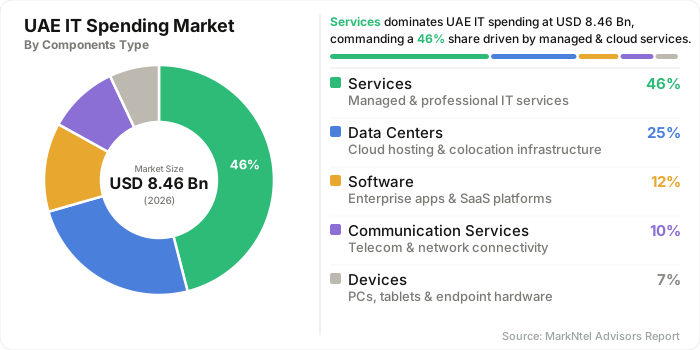
- By components, the services segment is leading the market with a share of 46%, and the data center segment is also rapidly growing with a market share of 25%. Additionally, the server segment is expected to grow robustly, with a CAGR of approximately 32% during 2026–2032.
- By End-User, around 30% of the total spending incurred on the Government and public sector segment in 2026. Moreover, BFSI IT spending is expected to grow at a CAGR of 13.86%, driven by rising spending on digital transformation, integration of fraud detection & Prevention, and anti-money laundering.
- Leading Companies of UAE IT spending industry are e& (Etisalat Group), Emirates Integrated Telecommunications Company PJSC (du), Microsoft Corporation, Amazon Web Services, Inc., IBM Corporation, Oracle Corporation, SAP SE, Cisco Systems, Inc., Huawei Technologies Co., Ltd., Dell Technologies Inc., Hewlett Packard Enterprise Company, Google Cloud LLC, Accenture plc, Injazat Data Systems LLC, Gulf Business Machines (Gulf BM LLC), Tata Consultancy Services Limited, Digital 14 LLC (DarkMatter), Rackspace Technology Inc., Palo Alto Networks, Inc., Fortinet, Inc., and others.
UAE IT Spending Market Size and Outlook
The UAE information & technology (IT) spending market was valued at USD 7.32 billion in 2025 and is projected to grow from USD 8.46 billion in 2026 to USD 12.43 billion by 2032, exhibiting a CAGR of 8.56% during 2026–2032.
The IT spending industry in the UAE has evolved as part of a broader transition toward a digitally integrated economy, supported by strong national economic planning and technology-led diversification. The UAE Government highlights that the digital economy contributed 9.7% to GDP and is targeted to reach 19.4% within a decade under national strategy frameworks. This structural shift reflects the increasing reliance of sectors such as finance, logistics, and public administration on digital systems. As a result, enterprise demand for cloud computing, cybersecurity, and enterprise software solutions has steadily expanded.
Government policy frameworks have been central in institutionalizing IT adoption across public-sector and institutional end users. The UAE Digital Government Strategy 2025 mandates end-to-end digitalization of government services, with targets such as 100% digitized services and 85% of transactions conducted digitally. This policy direction has significantly increased procurement of IT infrastructure, digital platforms, and data systems across ministries and federal entities. The emphasis on “digital by design” governance has ensured sustained, policy-driven IT expenditure growth.
From an industry perspective, commercial and financial sectors are emerging as major demand centers for IT spending due to rapid digital transformation initiatives. UAE banks are significantly increasing investments in digital platforms, AI, and cloud infrastructure as part of long-term transformation strategies. According to a 2026 update referencing the UAE Central Bank outlook, financial institutions are accelerating spending on advanced technologies to drive growth, improve efficiency, and enhance customer experience. Within the Dubai International Financial Centre, AI adoption has scaled rapidly, with around 52% of firms using AI in 2025, up from 33% in 2024, reflecting increased enterprise investment in analytics, automation, and digital infrastructure.
Looking ahead, infrastructure expansion and national innovation strategies are expected to sustain long-term market growth. The UAE Ministry of Economy emphasizes that the country is building a knowledge-based, innovation-driven economy centered on artificial intelligence, entrepreneurship, and advanced technologies. In parallel, initiatives under “We the UAE 2031” aim to strengthen digital infrastructure and economic competitiveness across sectors. These combined efforts position IT spending as a critical enabler of future economic expansion and technological leadership.
UAE IT Spending Industry Key Indicators
- According to the UAE Digital Government / TDRA impact assessment, the country’s digital transformation initiatives have generated approximately USD 5.4 billion in direct government savings and reduced administrative workload by around 530 million working hours across federal and local entities. This highlights strong efficiency gains from large-scale digitization of public services, reinforcing sustained demand for cloud infrastructure, AI-driven automation, and digital government platforms in the UAE IT ecosystem.
- TDRA’s updated National Frequency Plan (2024) allocates the 600 MHz and 6 GHz bands for IMT systems to enhance 5G capacity and coverage. The bands are expected to be progressively deployed between 2025 and 2026, supporting next-generation use cases such as IoT, AI-driven networks, and advanced 5G evolution, while also forming part of the UAE’s long-term roadmap toward 6G development around 2030.
- Abu Dhabi aims to become the world’s first fully AI-native government by 2027 under its USD 3.5 billion Digital Strategy (2025–2027), focused on full-scale AI integration and automation. Dubai’s digital transformation agenda (D33) targets significant economic contribution from AI and digital technologies, estimated at around AED 100 billion annually, though productivity uplift metrics are not formally defined.
- Abu Dhabi Global Market continues to record strong financial sector expansion with rising assets under management and growing institutional participation, reflecting Abu Dhabi’s strengthening position as a global financial hub. Meanwhile, Hub71’s Digital Assets ecosystem has attracted over USD 2 billion in committed capital from partners and investors, supporting the growth of Web3, blockchain, and digital asset startups in the UAE.
UAE IT Spending Market Scope
| Category | Segments |
|---|---|
| By Components | Software (Enterprise Application Software, Infrastructure Software, Vertical Software, Gen AI Models, Others), Devices (Mobile Phones, Tablets, Desktops, Laptops), Data Centers (Servers, Enterprise Network Equipment, External Controller-Based Software, Others), Communication Services (Unified Communications, Fixed Connectivity, Mobile Connectivity), Services (Consulting, Business Process Services, Infrastructure Implementation & Managed Services, Infrastructure as a Service (IaaS |
| By Type of Enterprises | Large Enterprises (Headcount Above 10,000), Mid-Size Enterprises (Headcount 5,000 to 10,000), Small Enterprises (Headcount Up to 5,000 |
| By End Users | Banking & Financial Services, Manufacturing, Retail & Ecommerce, IT, Telecom & Media, Healthcare, Government or Public Sector, Education, Others |
| By Deployment Model | Onshore Delivery, Nearshore Delivery, Offshore Delivery |
| By Engagement Model | Project-based / Fixed Price, Staff Augmentation / Time-and-Material, Managed Services / Outcome-based |
UAE IT Spending Industry Growth Drivers
Cloud-First Federal Mandates and Digital-Transformation Programs
The primary factor driving the growth of IT expenditure in the UAE is the widespread implementation of cloud-first mandates and government-led digital transformation programs. This shift has accelerated through the UAE Cloud First Policy, which requires government entities to prioritize cloud adoption for new IT deployments and modernization initiatives. The UAE government has further strengthened cloud adoption through the National Cloud Security Policy, which establishes comprehensive security, data governance, and operational requirements for cloud usage, ensuring that organizations adopt secure, scalable, and compliant cloud environments as part of national digital transformation efforts.
The impact of this mandate is evident across the public sector, BFSI, and enterprise ecosystems, where demand for cloud infrastructure and related services has significantly increased. The UAE Government highlights that its digital government strategy aims for fully integrated, proactive digital services, requiring scalable cloud environments and secure data systems. In parallel, major technology providers such as Microsoft have made over USD 15.2 billion investments in the UAE focused on AI and cloud infrastructure expansion through 2029, while Amazon Web Services continues to operate established regional cloud infrastructure supporting enterprise and government workloads to meet growing demand. These developments show how policy mandates are directly translating into increased IT procurement across multiple end-user segments.
This driver significantly increases market volume by embedding continuous cloud adoption as a standard practice across government entities and industry sectors. The World Bank highlights that scalable digital infrastructure, including cloud-based platforms, improves public service delivery efficiency and supports the expansion of digital economies. As UAE entities increasingly rely on cloud-native applications, cybersecurity frameworks, and data analytics platforms, IT spending extends beyond initial migration into ongoing service consumption. This creates a recurring and expanding demand cycle, ensuring long-term growth in IT infrastructure, software, and managed services.
Recent Trends
Proliferation of Sovereign Cloud and Data Localization Frameworks
A notable shift in the UAE IT spending landscape is the growing emphasis on sovereign cloud adoption and stricter data localization practices across key sectors. The increasing focus on sovereign cloud adoption in the UAE is accelerated by the strategic recognition of data as a critical national asset, requiring secure governance and protection within domestic jurisdictions. The UAE Government emphasizes data governance and digital sovereignty as core pillars of its digital transformation agenda, reinforcing the need for locally controlled digital infrastructure.
This shift is structurally transforming IT architecture and procurement models across government, BFSI, and regulated industries. The Dubai International Financial Centre introduced the DIFC Data Protection Law, requiring firms to adopt robust data governance and secure infrastructure aligned with international standards.
Additionally, the expansion of sovereign cloud ecosystems in the UAE is being accelerated by strategic investments and partnerships among global technology providers and local entities. Microsoft's partnership with G42 (through its subsidiary Core42) to build sovereign cloud infrastructure for Abu Dhabi government systems. This platform processes millions of daily digital transactions while ensuring data remains under UAE jurisdiction. Moreover, e& enterprise launched “OneCloud,” a UAE-sovereign hyperscale cloud platform powered by Oracle Alloy, which delivers 200+ cloud and AI services fully hosted in UAE data centers, ensuring strict data residency compliance . Also, in 2025, AWS partnered with e& to launch the UAE Sovereign Launchpad, a compliant cloud platform aligned with national cybersecurity frameworks. It is designed to support government and regulated industries with secure, locally managed cloud environments.
The persistence of this trend is reinforced by the UAE’s long-term focus on digital sovereignty and secure data governance embedded within national development agendas. The UAE Government continues to prioritize resilient and locally governed digital infrastructure to support critical sectors and future technologies. As regulatory expectations around data control and cybersecurity become more stringent, organizations are required to adopt compliant cloud environments and advanced security frameworks. This ongoing shift ensures that IT investments remain continuous and volume-driven, positioning sovereign cloud adoption as a foundational element of the UAE’s long-term digital economy strategy.
UAE IT Spending Market Opportunities and Challenges
Critical Talent Shortage and Rising Demand for Upskilling and Managed IT Services
A critical challenge that the digital transformation spending of the UAE is currently facing is an increase in constrained structural shortage of advanced digital talent, particularly in high-skill domains such as enterprise and government digital programs, where rapid deployment of cloud, AI, and automation tools has outpaced the availability of locally trained specialists. A global cybersecurity study found that around 40% of organizations in the UAE report a shortage of qualified IT security professionals , which is limiting their ability to manage cyber risks effectively. As a result, organizations face operational delays, increased hiring costs, and reliance on limited pools of experts.
However, this challenge is simultaneously generating a significant market opportunity by accelerating demand for structured upskilling ecosystems and external technology support services. The UAE has launched large-scale initiatives, aiming to develop approximately 1 million individuals with AI skills by 2027, including around 100,000 highly specialized professionals and 900,000 AI-literate workers. This initiative reflects a structured effort to strengthen digital capabilities across both technical and non-technical segments of the economy, ensuring a broader talent base for future technology adoption.
In parallel, global technology players are reinforcing this ecosystem and outsourcing models to bridge capability gaps, shifting from in-house execution to third-party expertise for complex IT functions such as cybersecurity monitoring, cloud operations, and AI model deployment. For instance, Microsoft has committed to building digital skills across the UAE by training 1 million individuals, including approximately 55,000 government employees in artificial intelligence capabilities, as part of its broader workforce development initiative. This reflects a large-scale effort to strengthen AI proficiency across both public sector institutions and the wider economy. This structural dependency is expanding the addressable market for IT services providers.
Over the long term, this talent constraint is expected to reshape the UAE IT ecosystem by institutionalizing continuous workforce development and increasing reliance on specialized external vendors. This dual effect workforce shortage, combined with rapid upskilling investment, is reinforcing a self-sustaining cycle of IT service demand, ensuring that the market expands not only through technology adoption but also through persistent capability gaps that require ongoing external support.
Segmentation Insights
Services Segment Leads the Market Due to Increasing Adoption of Cloud and Digital Transformation Services
The Services segment leads UAE IT expenditure primarily with a share of 46% due to the country’s aggressive national digital transformation agenda and rapid enterprise modernization. Government-led programs such as smart government platforms, cloud-first policies, and AI integration frameworks have forced both public and private organizations to rely heavily on external IT expertise rather than on in-house capabilities. This structural dependency has made services like consulting, managed services, and cloud migration the backbone of IT expenditure. For example, large-scale digital government platforms and banking modernization programs require continuous integration, security upgrades, and system optimization, which are service-intensive rather than product-heavy.
A second key driver is the surge in cloud adoption and hybrid infrastructure models, which has significantly increased demand for Infrastructure as a Service (IaaS) and managed cloud operations. Enterprises in banking, telecom, and energy sectors are increasingly partnering with global providers like AWS, Microsoft, and IBM to run hybrid cloud ecosystems, requiring long-term service contracts for deployment, monitoring, and cybersecurity.
Finally, investment flows and enterprise complexity are reinforcing recurring service demand. The UAE’s sovereign cloud initiatives and AI-driven financial infrastructure projects are increasing reliance on specialized consulting, integration, and managed service providers. For instance, AI-powered financial cloud deployment in the banking sector and large-scale smart city projects demand continuous system management and compliance alignment. This creates a stable revenue base for service providers, ensuring sustained dominance of consulting, BPS, and managed IT services within the overall IT budget. By components type, the market is further segmented into the following sub-categories:
- Software
- Devices
- Data Centers
- Communication Services
- Services
Government & Public Sector as the Primary IT Spending End User
The Government or Public Sector leads UAE IT spending with 30% of total market share, owing to digital transformation in the country is fundamentally state-driven rather than market-driven. Unlike private industries, public sector IT demand is anchored in national programs such as smart governance, AI-enabled public administration, and centralized digital identity systems. For instance, the Abu Dhabi government launched a Digital Strategy 2025–2027 with a budget of USD 3.5 billion to build an AI-driven government system.
These are not optional upgrades but mandated infrastructure shifts, which make IT spending continuous and large-scale. The government also acts as the primary coordinator of digital ecosystems, meaning almost every sectoral digitization project (health, transport, utilities) ultimately depends on public sector IT procurement, pushing its spending share higher than any other end-user group.
The market impact of this dominance is significant: it creates a stable, recurring revenue base for IT service providers, unlike cyclical private-sector spending. It also accelerates cloud adoption, cybersecurity investment, and AI integration at a national scale, as private vendors align with government-led standards. Large-scale public procurement also influences the broader IT ecosystem, pushing banks, telecom firms, and healthcare providers to adopt compatible digital frameworks. As a result, the government or Public Sector plays a decisive role in shaping overall market structure as well as influencing vendor strategies and investment priorities across the ecosystem. By end users, the market is further segmented into the following sub-categories:
- Banking & Financial Services
- Manufacturing
- Retail & Ecommerce
- IT, Telecom & Media
- Healthcare
- Government or Public Sector
- Education
- Others
UAE IT Spending Industry News and Recent Developments
2025: Microsoft receives a license to export thousands of AI chips to the UAE
The US government has granted Microsoft approval to export advanced Nvidia AI chips to the United Arab Emirates. This license allows Microsoft to ship large quantities of high-performance GPUs used for artificial intelligence data centres. The chips will be deployed in UAE-based AI infrastructure projects and cloud computing facilities. The approval is part of stricter US export controls, which require government permission for sensitive technology transfers. Microsoft is using these chips to expand AI services and support models like Copilot and other AI platforms in the region. The move strengthens US–UAE cooperation in building large-scale AI computing capacity.
Impact Analysis: This decision significantly boosts the UAE’s position as an emerging AI and data centre hub. It accelerates demand for advanced semiconductors, especially high-end GPUs from Nvidia. Cloud and infrastructure service providers like Microsoft benefit from stronger regional expansion opportunities. It also increases competition among global tech firms to secure export licences for AI hardware deployment. The deal strengthens US influence in the Gulf’s digital ecosystem while limiting alternative tech dependencies. Overall, it signals faster AI infrastructure spending growth across the Middle East market.
2025: IBM and AWS expand strategic collaboration to accelerate cloud adoption in the Middle East
IBM and Amazon Web Services (AWS) have expanded their partnership to strengthen cloud adoption across Middle Eastern countries like the UAE and Saudi Arabia. The collaboration focuses on modernizing enterprise IT systems using hybrid cloud, AI tools, and secure cloud infrastructure. IBM software and AI solutions will now be made available more easily through AWS cloud platforms in the region. The goal is to help governments and enterprises shift from legacy systems to scalable digital platforms. It also supports compliance needs like local data hosting and security requirements. The partnership is aligned with national digital transformation agendas such as the UAE and Saudi cloud-first strategies.
Impact Analysis: This strengthens the Middle East cloud services market by increasing enterprise-level cloud migration speed. It boosts demand for hybrid cloud architecture, especially in government, banking, and telecom sectors. AWS gains deeper penetration in regulated markets by leveraging IBM’s enterprise software ecosystem. IBM benefits by expanding its AI and SaaS footprint through AWS distribution channels. Competition in the regional cloud market intensifies among global hyperscalers and consulting-led providers. Overall, it accelerates AI-driven cloud transformation spending across the region’s IT services sector.
2025: Microsoft pledges nearly USD 8 billion for data centers and cloud expansion in the UAE
Microsoft announced an investment of about USD 7.9 billion in the UAE focused on building data centers and expanding cloud computing capacity. The investment will be deployed over several years to strengthen AI infrastructure and cloud services in the region. It also includes scaling up advanced AI chip usage, particularly Nvidia GPUs, to support large-scale AI workloads. The move builds on earlier Microsoft investments in the UAE and partnerships with local AI firms like G42. The funding aims to expand Azure cloud availability and support enterprise and government digital transformation. It reflects growing US–UAE cooperation in AI and high-performance computing infrastructure.
Impact Analysis: This significantly accelerates the UAE’s position as a regional AI and hyperscale cloud hub. Demand for data center construction, cooling systems, and high-performance computing infrastructure will increase sharply. Microsoft strengthens its Azure footprint, gaining an advantage in government and enterprise cloud contracts. It intensifies competition with AWS, Oracle, and Google Cloud in the Middle East market. AI chip demand (especially Nvidia GPUs) rises further due to large-scale deployment requirements. Overall, it pushes the UAE deeper into global AI infrastructure supply chains and boosts long-term IT spending growth.
2026: UAE joins US-led AI supply chain program to strengthen tech and economic ties
The UAE has joined a US-led initiative focused on securing global AI and semiconductor supply chains. The program is designed to strengthen cooperation between allied countries in critical technologies like AI hardware, chips, and infrastructure. It includes several major economies such as Japan, South Korea, Singapore, and others, alongside the UAE. The initiative aims to reduce dependency on unstable or competing supply networks and improve resilience in tech production. The UAE’s participation reflects its growing ambition to become a major AI and digital infrastructure hub. It also deepens strategic economic and technology cooperation between the UAE and the United States.
Impact Analysis: This move increases the UAE’s importance in the global AI and semiconductor ecosystem. It is likely to attract more foreign investment into AI infrastructure, data centers, and chip-related supply chains in the region. US tech firms may gain easier access to UAE markets for advanced AI systems and hardware deployment. It strengthens geopolitical alignment in tech supply chains, especially between Gulf countries and Western economies. Demand for AI infrastructure services, cloud computing, and high-performance chips is expected to rise further. Overall, it positions the UAE as a strategic node in global AI supply chain restructuring.
2026: du (UAE telecom) adopts Oracle Alloy to deliver sovereign cloud and AI services
UAE telecom operator du has implemented Oracle Alloy to strengthen its cloud and AI service offerings. This setup allows du to operate a “sovereign cloud,” meaning data stays within UAE borders while using Oracle’s cloud infrastructure. The platform enables du to offer full Oracle Cloud Infrastructure (OCI) services, including AI, machine learning, and generative AI tools.
It supports both government and private sector clients who require secure, localised cloud environments. The move also helps to modernize its data centers and scale advanced digital services more efficiently. Overall, it positions you as a cloud service provider, not just a telecom operator.
Impact Analysis: This strengthens the UAE’s sovereign cloud and AI infrastructure ecosystem significantly. It increases demand for localized cloud platforms instead of purely foreign-hosted hyperscalers. Oracle benefits by expanding distributed cloud adoption through telecom partners like du. It accelerates AI adoption in government and regulated industries due to data residency compliance. Telecom companies in the region are shifting into cloud service providers, intensifying competition with global cloud vendors. Overall, it deepens enterprise AI infrastructure spending and supports the UAE’s digital sovereignty strategy.
- Market Segmentation
- Introduction
- Product Definition
- Research Process
- Assumptions
- Executive Summary
- UAE Information & Technology (IT) Spending Market Policies, Regulations, and Product Standards
- UAE Information & Technology (IT) Spending Market Trends & Developments
- UAE Information & Technology (IT) Spending Market Dynamics
- Growth Factors
- Challenges
- UAE Information & Technology (IT) Spending Market Hotspot & Opportunities
- UAE Information & Technology (IT) Spending Market Outlook, 2022-2032F
- Market Size & Outlook
- By Revenues (USD Million)
- Market Share & Outlook
- By Components- Market Size & Forecast 2022-2032, USD Million
- Software
- Enterprise Application Software
- Infrastructure Software
- Vertical Software
- Gen AI Models
- Others
- Devices
- Mobile Phones
- Tablets
- Desktops
- Laptops
- Data Centers
- Servers
- Enterprise Network Equipment
- External Controller-Based Software
- Others
- Communication Services
- Unified Communications
- Fixed Connectivity
- Mobile Connectivity
- Services
- Consulting
- Business Process Services
- Infrastructure Implementation & Managed Services
- Infrastructure as a Service (IaaS)
- Software
- By Type of Enterprises- Market Size & Forecast 2022-2032, USD Million
- Large Enterprises (Headcount Above 10,000)
- Mid-Size Enterprises (Headcount 5,000 to 10,000)
- Small Enterprises (Headcount Up to 5,000)
- By End Users- Market Size & Forecast 2022-2032, USD Million
- Banking & Financial Services
- Manufacturing
- Retail & Ecommerce
- IT, Telecom & Media
- Healthcare
- Government or Public Sector
- Education
- Others
- By Deployment Model- Market Size & Forecast 2022-2032, USD Million
- Onshore Delivery
- Nearshore Delivery
- Offshore Delivery
- By Engagement Model- Market Size & Forecast 2022-2032, USD Million
- Project-based / Fixed Price
- Staff Augmentation / Time-and-Material
- Managed Services / Outcome-based
- By Region- Market Size & Forecast 2022-2032, USD Million
- Abu Dhabi
- Dubai
- Sharjah
- Northern Emirates
- By Company
- Competition Characteristics
- Market Share & Analysis
- By Components- Market Size & Forecast 2022-2032, USD Million
- Market Size & Outlook
- UAE Software Market Outlook, 2022-2032
- Market Size & Outlook
- By Revenues (USD Million)
- Market Share & Outlook
- By Type of Enterprises- Market Size & Forecast 2022-2032, USD Million
- By End Users- Market Size & Forecast 2022-2032, USD Million
- By Deployment Model- Market Size & Forecast 2022-2032, USD Million
- By Engagement Model- Market Size & Forecast 2022-2032, USD Million
- By Region- Market Size & Forecast 2022-2032, USD Million
- Market Size & Outlook
- UAE Devices Market Outlook, 2022-2032
- Market Size & Outlook
- By Revenues (USD Million)
- Market Share & Outlook
- By Type of Enterprises- Market Size & Forecast 2022-2032, USD Million
- By End Users- Market Size & Forecast 2022-2032, USD Million
- By Deployment Model- Market Size & Forecast 2022-2032, USD Million
- By Engagement Model- Market Size & Forecast 2022-2032, USD Million
- By Region- Market Size & Forecast 2022-2032, USD Million
- Market Size & Outlook
- UAE Data Centers Market Outlook, 2022-2032
- Market Size & Outlook
- By Revenues (USD Million)
- Market Share & Outlook
- By Type of Enterprises- Market Size & Forecast 2022-2032, USD Million
- By End Users- Market Size & Forecast 2022-2032, USD Million
- By Deployment Model- Market Size & Forecast 2022-2032, USD Million
- By Engagement Model- Market Size & Forecast 2022-2032, USD Million
- By Region- Market Size & Forecast 2022-2032, USD Million
- Market Size & Outlook
- UAE Communication Services Market Outlook, 2022-2032
- Market Size & Outlook
- By Revenues (USD Million)
- Market Share & Outlook
- By Type of Enterprises- Market Size & Forecast 2022-2032, USD Million
- By End Users- Market Size & Forecast 2022-2032, USD Million
- By Deployment Model- Market Size & Forecast 2022-2032, USD Million
- By Engagement Model- Market Size & Forecast 2022-2032, USD Million
- By Region- Market Size & Forecast 2022-2032, USD Million
- Market Size & Outlook
- UAE Services Market Outlook, 2022-2032
- Market Size & Outlook
- By Revenues (USD Million)
- Market Share & Outlook
- By Type of Enterprises- Market Size & Forecast 2022-2032, USD Million
- By End Users- Market Size & Forecast 2022-2032, USD Million
- By Deployment Model- Market Size & Forecast 2022-2032, USD Million
- By Engagement Model- Market Size & Forecast 2022-2032, USD Million
- By Region- Market Size & Forecast 2022-2032, USD Million
- Market Size & Outlook
- UAE Information & Technology (IT) Spending Market Key Strategic Imperatives for Success & Growth
- Competitive Outlook
- Company Profiles
- e& (Etisalat Group)
- Business Description
- Product Portfolio
- Collaborations & Alliances
- Recent Developments
- Financial Details
- Others
- Emirates Integrated Telecommunications Company PJSC (du)
- Business Description
- Product Portfolio
- Collaborations & Alliances
- Recent Developments
- Financial Details
- Others
- Microsoft Corporation
- Business Description
- Product Portfolio
- Collaborations & Alliances
- Recent Developments
- Financial Details
- Others
- Amazon Web Services, Inc.
- Business Description
- Product Portfolio
- Collaborations & Alliances
- Recent Developments
- Financial Details
- Others
- IBM Corporation
- Business Description
- Product Portfolio
- Collaborations & Alliances
- Recent Developments
- Financial Details
- Others
- Oracle Corporation
- Business Description
- Product Portfolio
- Collaborations & Alliances
- Recent Developments
- Financial Details
- Others
- SAP SE
- Business Description
- Product Portfolio
- Collaborations & Alliances
- Recent Developments
- Financial Details
- Others
- Cisco Systems, Inc.
- Business Description
- Product Portfolio
- Collaborations & Alliances
- Recent Developments
- Financial Details
- Others
- Huawei Technologies Co., Ltd.
- Business Description
- Product Portfolio
- Collaborations & Alliances
- Recent Developments
- Financial Details
- Others
- Dell Technologies Inc.
- Business Description
- Product Portfolio
- Collaborations & Alliances
- Recent Developments
- Financial Details
- Others
- Hewlett Packard Enterprise Company
- Business Description
- Product Portfolio
- Collaborations & Alliances
- Recent Developments
- Financial Details
- Others
- Google Cloud LLC
- Business Description
- Product Portfolio
- Collaborations & Alliances
- Recent Developments
- Financial Details
- Others
- Accenture plc
- Business Description
- Product Portfolio
- Collaborations & Alliances
- Recent Developments
- Financial Details
- Others
- Injazat Data Systems LLC
- Business Description
- Product Portfolio
- Collaborations & Alliances
- Recent Developments
- Financial Details
- Others
- Gulf Business Machines (Gulf BM LLC)
- Business Description
- Product Portfolio
- Collaborations & Alliances
- Recent Developments
- Financial Details
- Others
- Tata Consultancy Services Limited
- Business Description
- Product Portfolio
- Collaborations & Alliances
- Recent Developments
- Financial Details
- Others
- Digital 14 LLC (DarkMatter)
- Business Description
- Product Portfolio
- Collaborations & Alliances
- Recent Developments
- Financial Details
- Others
- Rackspace Technology Inc.
- Business Description
- Product Portfolio
- Collaborations & Alliances
- Recent Developments
- Financial Details
- Others
- Palo Alto Networks, Inc.
- Business Description
- Product Portfolio
- Collaborations & Alliances
- Recent Developments
- Financial Details
- Others
- Fortinet, Inc.
- Business Description
- Product Portfolio
- Collaborations & Alliances
- Recent Developments
- Financial Details
- Others
- Others
- e& (Etisalat Group)
- Company Profiles
- Disclaimer

MarkNtel Advisors follows a robust and iterative research methodology designed to ensure maximum accuracy and minimize deviation in market estimates and forecasts. Our approach combines both bottom-up and top-down techniques to effectively segment and quantify various aspects of the market. A consistent feature across all our research reports is data triangulation, which examines the market from three distinct perspectives to validate findings. Key components of our research process include:
1. Scope & Research Design At the outset, MarkNtel Advisors define the research objectives and formulate pertinent questions. This phase involves determining the type of research—qualitative or quantitative—and designing a methodology that outlines data collection methods, target demographics, and analytical tools. They also establish timelines and budgets to ensure the research aligns with client goals.
2. Sample Selection and Data Collection In this stage, the firm identifies the target audience and determines the appropriate sample size to ensure representativeness. They employ various sampling methods, such as random or stratified sampling, based on the research objectives. Data collection is carried out using tools like surveys, interviews, and observations, ensuring the gathered data is reliable and relevant.
3. Data Analysis and Validation Once data is collected, MarkNtel Advisors undertake a rigorous analysis process. This includes cleaning the data to remove inconsistencies, employing statistical software for quantitative analysis, and thematic analysis for qualitative data. Validation steps are taken to ensure the accuracy and reliability of the findings, minimizing biases and errors.

4. Data Forecast and FinalizationThe final phase involves forecasting future market trends based on the analyzed data. MarkNtel Advisors utilize predictive modeling and time series analysis to anticipate market behaviors. The insights are then compiled into comprehensive reports, featuring visual aids like charts and graphs, and include strategic recommendations to inform client decision-making
FILL THE FORM TO INQUIRE BEFORE BUYING THIS REPORT
We offer flexible licensing options to cater to varying organizational needs. Choose the pricing pack that best suits your requirements:
Buy Now Talk to our Consultant
 Request Customization