

By Product (Facial Skincare (Cleansers, Toners, Essences, Serums & Ampoules, Moisturizers, Sunscreens, Sheet Masks, Wash-off Masks, Others), Color Cosmetics (Face Makeup, Eye Makeu......p, Lip Makeup, Nail Products), Hair Care (Shampoo, Conditioner, Hair Masks, Hair Serums, Scalp Treatments, Styling Products), Body Care (Body Lotion, Body Wash, Scrubs, Hand & Foot Care), Fragrances, Beauty Devices & Tools), By Distribution Channel (Online (Direct-to-Consumer (Brand Websites), Third-Party E-commerce Platforms), Offline (Specialty Beauty Stores, Hypermarkets & Supermarkets, Department Stores, Pharmacies & Drugstores, Convenience Stores)), By Price Tier (Mass, Mid-Premium, Premium, Luxury), By End User (Male, Female, Unisex), and others Read more
- FMCG
- Jul 2026
- 240
- PDF, Excel, PPT
South Korea K-Beauty Products Market Key Takeaways
- South Korea K-beauty products market size was valued at USD 1.72 billion in 2025 and is projected to grow from USD 1.99 billion in 2026 to USD 5.39 billion by 2032, exhibiting a CAGR of 18.07% during 2026-2032.
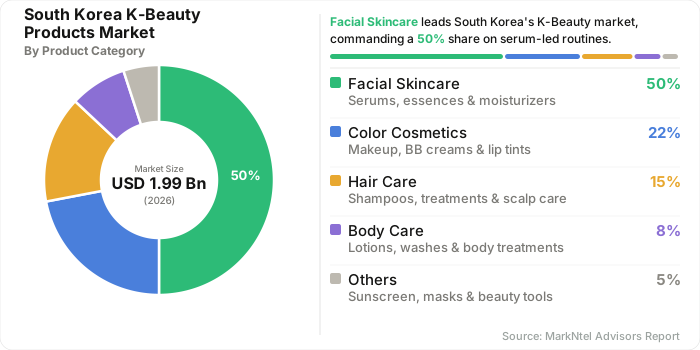
- Facial skincare dominates product categories, contributing nearly 50% share.
- The female segment accounted for around a 74% share in 2026.
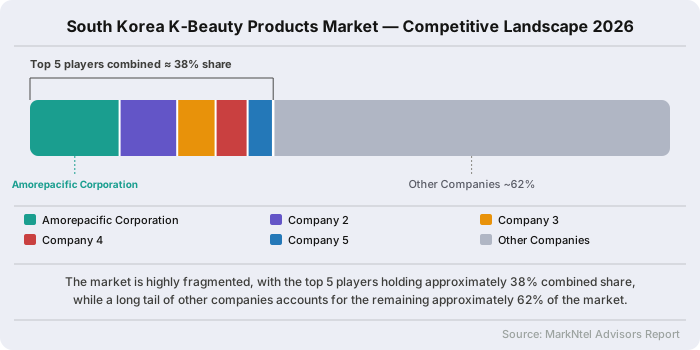
- The industry is moderately fragmented, with the top five companies collectively accounting for nearly 38% of total market revenue, reflecting strong competition alongside continuous innovation from emerging brands.
South Korea K-Beauty Products Market Size and Outlook
The South Korea K-beauty products market was valued at USD 1.72 billion in 2025 and is projected to increase to USD 1.99 billion in 2026, reaching USD 5.39 billion by 2032. Along with this, the market is projected to witness a CAGR of 18.07% during the forecast period. Growth is supported by expanding domestic consumption, sustained export momentum, and continuous product innovation. Increasing consumer preference for premium cosmetics and high-performance skincare solutions is expected to strengthen South Korea's position as a leading global center for beauty innovation and product development.
A robust manufacturing ecosystem continues to underpin long-term market expansion. According to the Korean government, domestic cosmetics production reached a record USD 12.87 billion in 2024, reflecting 20.9% year-on-year growth and demonstrating the industry's rapidly expanding production capabilities. Continuous investments in biotechnology, ingredient innovation, and advanced formulation technologies enable manufacturers to commercialize differentiated products while strengthening South Korea's global leadership in dermocosmetics and clinically validated skincare solutions across domestic and export markets.
Government-backed financial support is further reinforcing industry competitiveness and innovation capacity. In April 2025, South Korea's Ministry of SMEs and Startups established a USD 27 million public-private K-Beauty Fund in collaboration with COSMAX and Kolmar Korea. The initiative finances research and development, brand commercialization, overseas expansion, and beauty technology start-ups, enabling emerging and established companies to accelerate innovation, strengthen export readiness, and enhance long-term competitiveness across rapidly evolving global beauty markets.
Digital commerce remains another structural pillar supporting future market growth. According to Statistics Korea, cosmetics generated approximately USD 457 million in cross-border online direct sales during the first quarter of 2026, making them the country's largest online export category. Supported by internet penetration of approximately 97% and smartphone usage reaching 97.3%, South Korea's highly connected digital beauty ecosystem continues to accelerate product discovery, consumer engagement, and cross-border purchasing, creating sustained domestic and international expansion of South Korea K-beauty products industry.
South Korea K-Beauty Products Market Key Indicators
- Basic skincare remained the cornerstone of South Korea's cosmetics industry in 2025, with exports reaching USD 8.54 billion, accounting for nearly 75% of total cosmetics shipments, according to the Ministry of Food and Drug Safety. The dominance of facial skincare categories, including toners, essences, serums, and barrier creams, continues to direct investment toward clinically supported formulations, reinforcing the country's competitive strength in barrier repair solutions and premium skincare innovation.
- Beyond skincare, makeup emerged as the second-largest export category, generating USD 1.51 billion in 2025, according to the Ministry of Food and Drug Safety. Strong international demand for cushion foundations, lip tints, and eye palettes, fueled by K-pop and K-drama beauty trends, has encouraged manufacturers to shorten product development cycles, diversify shade portfolios, and prioritize trend-driven cosmetics that resonate with digitally engaged younger consumers.
- South Korea's cosmetics exports remain heavily supported by small and medium-sized enterprises, which generated USD 6.80 billion, or 63% of national cosmetics exports, in 2024, according to the Ministry of SMEs and Startups. Their ability to commercialize differentiated formulations and respond rapidly to changing consumer preferences has strengthened the country's reputation for innovation while intensifying competition across the industry through indie beauty brands with global growth ambitions.
- Statistics Korea reported that online shopping transactions reached approximately USD 16.34 billion in August 2025, with mobile devices accounting for 79.4% of total transactions. This widespread smartphone adoption has fundamentally transformed beauty purchasing behavior, making digital discovery, livestream commerce, and app-based loyalty programs increasingly important for brand engagement. Companies investing in mobile-first retailing are better positioned to accelerate customer acquisition and improve conversion rates across beauty categories.
South Korea K-Beauty Products Market Scope
| Category | Segments |
|---|---|
| By Product | Facial Skincare (Cleansers, Toners, Essences, Serums & Ampoules, Moisturizers, Sunscreens, Sheet Masks, Wash-off Masks, Others), Color Cosmetics (Face Makeup, Eye Makeup, Lip Makeup, Nail Products), Hair Care (Shampoo, Conditioner, Hair Masks, Hair Serums, Scalp Treatments, Styling Products), Body Care (Body Lotion, Body Wash, Scrubs, Hand & Foot Care), Fragrances, Beauty Devices & Tools |
| By Distribution Channel | Online (Direct-to-Consumer (Brand Websites), Third-Party E-commerce Platforms), Offline (Specialty Beauty Stores, Hypermarkets & Supermarkets, Department Stores, Pharmacies & Drugstores, Convenience Stores |
| By Price Tier | Mass, Mid-Premium, Premium, Luxury |
| By End User | Male, Female, Unisex |
South Korea K-Beauty Products Market Growth Drivers
Global Expansion of the Korean Wave (Hallyu) Accelerating Beauty Consumption
The South Korea K-beauty products industry continues to benefit from the global influence of the Korean Wave (Hallyu), which has transformed K-pop, K-dramas, and Korean cinema into powerful demand generators for skincare and cosmetics. The growing international appeal of Korean culture has broadened beauty adoption across diverse consumer groups while strengthening demand for beauty tourism and premium Korean cosmetic brands. Recognizing this momentum, the South Korean government integrated Hallyu-based marketing into its national K-beauty export strategy announced in November 2025.
The commercial impact of Hallyu is evident in export performance across international markets. According to the Korea Customs Service, Korean cosmetics exports reached USD 8.52 billion during the first nine months of 2025, increasing 15.4% year over year while extending to 205 countries, marking the ninth consecutive quarter of export growth. This sustained expansion reinforces the South Korea K-beauty products market by demonstrating that cultural influence is translating into measurable overseas demand and stronger global brand recognition for Korean beauty products.
To sustain this momentum, the government's strategy focuses on expanding international market presence and strengthening industry capabilities. The initiative aims to develop 300 young beauty entrepreneurs and 500 small-business teams into export-ready companies while increasing overseas K-beauty flagship stores to eight and pop-up stores to 10 across emerging markets. These initiatives will strengthen consumer engagement through cultural marketing, broaden export channels, and reinforce premium positioning, creating a durable foundation for long-term expansion and international competitiveness.
Recent Trends
Skinimalism Driving Demand for Multifunctional Functional Skincare
The K-beauty products market is witnessing a strong shift toward skinimalism as consumers increasingly replace lengthy multi-step skincare routines with fewer, high-performance products delivering hydration, barrier repair, anti-aging, and brightening benefits simultaneously. This evolution is encouraging manufacturers to develop clinically proven formulations that simplify skincare routines while meeting rising demand for efficacy, convenience, and multifunctional skincare solutions supported by advanced cosmetic science.
Across the South Korea K-beauty products industry, manufacturers are investing heavily in peptides, ceramides, probiotics, and PDRN to formulate products addressing multiple skin concerns within a single application. Instead of expanding portfolios with numerous single-purpose products, companies increasingly prioritize active ingredient innovation to deliver premium formulations supported by dermatological research. This approach aligns with growing consumer preference for scientifically validated, effective, and convenient skincare solutions.
Commercial product launches continue to reinforce this trend. In January 2025, Amorepacific Group expanded its dermatologist-developed AESTURA brand into more than 400 Sephora stores across the United States through the ATOBARRIER365 Cream. Featuring patented ceramide capsule technology and backed by over 40 years of dermatological research, the launch demonstrates how science-backed formulations are enabling Korean manufacturers to strengthen premium positioning while responding to global demand for minimalist, high-performance skincare products.
South Korea K-Beauty Products Market Opportunities and Challenges
Tariff Escalation Driving Accelerated Export-Market Diversification
The South Korea K-beauty products market faces significant short-term uncertainty following the escalation of United States import tariffs on South Korean goods. Although Korean cosmetics historically benefited from duty-free access under the Korea–US Free Trade Agreement (KORUS FTA), a bilateral agreement established a 15% tariff effective August 7, 2025. This policy shift is increasing cost pressures across the industry while reinforcing the importance of export diversification to sustain international competitiveness.
The United States remains the largest overseas destination for Korean cosmetics, importing approximately USD 1.70 billion in products during 2024, representing a 54% year-on-year increase, according to the US International Trade Commission. Higher import duties compress exporter margins, increase retail prices for products and create disproportionate challenges for smaller manufacturers. Consequently, the South Korea K-beauty products industry is placing greater emphasis on regional market expansion to reduce dependence on individual export destinations.
Despite near-term trade headwinds, the tariff environment is creating opportunities for broader international growth. Korean beauty companies are increasingly targeting Europe, the Middle East, Latin America, and South Asia while strengthening direct-to-consumer channels to diversify revenue streams. According to a Korea Federation of SMEs survey, 86.4% of surveyed cosmetics companies expect exports to increase in 2026, supported by new product launches, quality improvements, and geographic diversification.
Segmentation Insights
Facial Skincare Dominance Driven by Routine-Based Consumption and Product Innovation
The South Korea K-beauty products market is led by Facial Skincare, accounting for approximately 50% of total market revenue. The segment's dominance reflects South Korean consumers' long-standing emphasis on preventive skincare, skin barrier maintenance, and healthy complexion enhancement over decorative cosmetics. Growing demand for dermatological skincare products formulated with clinically validated ingredients continues to strengthen category leadership while encouraging manufacturers to expand premium and science-backed skincare portfolios.
According to industry data, basic skincare exports reached approximately USD 4.10 billion during the first half of 2025, highlighting the segment's importance across domestic and international markets. Strong overseas demand for cleansers, toners, essences, serums, moisturizers, and sunscreens has reinforced South Korea's global reputation for skincare innovation. The South Korea K-beauty products industry continues to benefit from sustained investment in skin barrier care technologies that improve product efficacy and differentiate Korean brands.
Other categories continue to expand alongside evolving consumer preferences but remain smaller than facial skincare. Manufacturers are increasingly integrating biotechnology, premium ingredients, and digital innovation across these segments to strengthen competitiveness and diversify product offerings. Rising demand for high-performance formulations is expected to support balanced growth while preserving facial skincare as the industry's largest and most influential product category. Based on product category, the scope has been divided into:
- Facial Skincare
- Color Cosmetics
- Hair Care
- Body Care
- Fragrances
- Beauty Devices & Tools
Higher Product Adoption and Routine-Based Consumption Driving Female Consumer Dominance
The South Korea K-beauty products market is dominated by Female consumers, accounting for approximately 74% of total end-user demand. Women continue to drive consumption across skincare, color cosmetics, fragrances, and anti-aging products, supported by a deeply rooted beauty culture emphasizing healthy skin and preventive care. Strong demand for premium skincare routines has encouraged manufacturers to expand high-value product portfolios tailored to diverse skin concerns and evolving consumer preferences.
The industry mainly benefits from women's consistently high product usage and repeat purchasing behavior, particularly within multi-step skincare regimens that incorporate cleansers, toners, essences, serums, moisturizers, and sunscreens. This purchasing pattern supports steady category growth while enabling brands to introduce premium formulations and ingredient-led innovations. Increasing preference for personalized beauty solutions is further encouraging product differentiation and strengthening long-term consumer loyalty to beauty products.
Although female consumers remain the dominant customer base, demand from male consumers is gradually expanding due to grooming awareness and self-care adoption. Brands are responding by broadening product assortments, improving inclusivity, and introducing targeted formulations. Continued investment in consumer-centric innovation and customized product development is expected to sustain market expansion while preserving women as the industry's largest end-user segment. The study categorizes key end users into the following segments:
- Male
- Female
- Unisex
South Korea K-Beauty Products Market Competitive Analysis
The South Korea K-beauty products industry remains fragmented, with the top five companies collectively accounting for an estimated 38% of total market revenue. While Amorepacific Corporation and LG Household & Health Care Ltd. maintain leadership through extensive brand portfolios, research capabilities, and global distribution networks, companies such as APR Co., Ltd., CLIO Co., Ltd., and COSRX Inc. continue to strengthen their positions through digital-first strategies, premium product innovation, and international expansion.
Leading Companies in South Korea K-Beauty Products Market
- Amorepacific Corporation
- LG Household & Health Care Ltd.
- APR Co., Ltd.
- CLIO Co., Ltd.
- Able C&C Co., Ltd.
- COSRX Inc.
- Nature Republic Co., Ltd.
- TONYMOLY Co., Ltd.
- The Saem International Co., Ltd.
- Beauty of Joseon Co., Ltd.
- Others
South Korea K-Beauty Products Industry News and Recent Developments:
June 2026: APR Enhanced the Medicube AGE-R Beauty Device Portfolio
South Korean beauty technology company APR expanded its Medicube AGE-R portfolio in 2026 with the next-generation Booster Pro X2, featuring enhanced AI-enabled skincare functions, seven treatment modes, improved LED coverage, and upgraded electroporation technology. The launch builds on the global success of the AGE-R series, with the company reporting more than 6 million beauty devices sold worldwide by early 2026.
Impact Analysis: The upgraded AGE-R platform demonstrates South Korea's leadership in integrating beauty technology with skincare, creating higher-value product categories beyond conventional cosmetics. Advanced home-use devices complement functional skincare products by improving ingredient absorption and supporting personalized beauty routines. The rapid global adoption of Korean beauty devices reflects rising consumer acceptance of technology-enabled skincare and opens new revenue streams for domestic manufacturers.
August 2025: Sulwhasoo Introduced Concentrated Ginseng Rejuvenating Serum with Advanced Ginseng Science
Amorepacific's luxury skincare brand Sulwhasoo launched the Concentrated Ginseng Rejuvenating Serum in September 2025. The serum incorporates the company's proprietary Ginseng Peptide™ technology and decades of ginseng research to improve skin firmness, elasticity, and visible signs of aging. Positioned within Sulwhasoo's premium anti-aging portfolio, the launch reinforces South Korea's emphasis on biotechnology-backed skincare and clinically validated formulations for global consumers.
Impact Analysis: The product launch strengthens South Korea's leadership in premium functional skincare by combining traditional botanical ingredients with advanced dermatological science. It reflects manufacturers' increasing investment in proprietary active ingredients to differentiate products within the global prestige beauty segment. The commercialization of Ginseng Peptide™ technology enhances value addition while supporting demand for clinically proven anti-aging solutions. As consumers increasingly prioritize efficacy and ingredient transparency, innovations such as the Concentrated Ginseng Rejuvenating Serum are expected to improve premium export opportunities.
August 2025: Sulwhasoo's Concentrated Ginseng Rejuvenating Serum Recognized Among Asia's Best New Beauty Products
Sulwhasoo's Concentrated Ginseng Rejuvenating Serum was recognized among the year's leading premium beauty innovations by The Asia Business Daily (Asiae). The recognition highlighted the serum's proprietary ginseng-derived technology, premium positioning, and contribution to advancing Korean luxury skincare through scientifically developed anti-aging formulations. This acknowledgement further strengthened the global reputation of South Korean beauty innovation.
Impact Analysis: Independent industry recognition enhances consumer confidence and strengthens the international positioning of Korean premium skincare brands. Awards and editorial recognition from reputable media increase product visibility across overseas markets while supporting premium pricing strategies. Such recognition also validates continued investment in biotechnology, proprietary ingredients, and research-led product development by South Korean manufacturers.
- Market Segmentation
- Introduction
- Product Definition
- Research Process
- Assumptions
- Executive Summary
- South Korea K-Beauty Products Market Policies, Regulations, and Product Standards
- South Korea K-Beauty Products Production Trend 2022-2032
- South Korea K-Beauty Products Trend by Type of Product Category
- Facial Skincare
- Color Cosmetics
- Hair Care
- Body Care
- Fragrances
- Beauty Devices & Tools
- Company Wise Production Plants and Statistics
- Installed Production Capacity
- Actual Production
- Planned Production Target
- South Korea K-Beauty Products Trend by Type of Product Category
- South Korea K-Beauty Products Pricing Analysis 2022-2032
- South Korea K-Beauty Products Pricing Trend 2022-2032
- South Korea K-Beauty Products Pricing Trend by Product Category 2022-2032
- Facial Skincare
- Color Cosmetics
- Hair Care
- Body Care
- Fragrances
- Beauty Devices & Tools
- South Korea K-Beauty Products Market Dynamics
- Growth Factors
- Challenges
- South Korea K-Beauty Products Market Import & Export Analysis
- South Korea K-Beauty Products Market Hotspot & Opportunities
- South Korea K-Beauty Products Market Outlook, 2022-2032F
- Market Size & Outlook
- By Revenues (USD Million)
- Market Segmentation & Outlook
- By Product Category - Market Size & Forecast 2022-2032, USD Million
- Facial Skincare
- Cleansers
- Toners
- Essences
- Serums & Ampoules
- Moisturizers
- Sunscreens
- Sheet Masks
- Wash-off Masks
- Others
- Color Cosmetics
- Face Makeup
- Eye Makeup
- Lip Makeup
- Nail Products
- Hair Care
- Shampoo
- Conditioner
- Hair Masks
- Hair Serums
- Scalp Treatments
- Styling Products
- Body Care
- Body Lotion
- Body Wash
- Scrubs
- Hand & Foot Care
- Fragrances
- Beauty Devices & Tools
- Facial Skincare
- By Distribution Channel - Market Size & Forecast 2022-2032, USD Million
- Online
- Direct-to-Consumer (Brand Websites)
- Third-Party E-commerce Platforms
- Offline
- Specialty Beauty Stores
- Hypermarkets & Supermarkets
- Department Stores
- Pharmacies & Drugstores
- Convenience Stores
- Online
- By Price Tier - Market Size & Forecast 2022-2032, USD Million
- Mass
- Mid-Premium
- Premium
- Luxury
- By End User - Market Size & Forecast 2022-2032, USD Million
- Male
- Female
- Unisex
- By Region- Market Size & Forecast 2022-2032, USD Million
- Seoul Capital Area
- Central Region
- Honam Region
- Yeongnam Region
- Jeju Island
- By Company
- Competition Characteristics
- Market Share & Analysis
- By Product Category - Market Size & Forecast 2022-2032, USD Million
- Market Size & Outlook
- South Korea K-Beauty Facial Skincare Products Market Outlook, 2022-2032
- Market Size & Outlook
- By Revenues (USD Million)
- Market Segmentation & Outlook
- By Distribution Channel - Market Size & Forecast 2022-2032, USD Million
- By Price Tier - Market Size & Forecast 2022-2032, USD Million
- By End User - Market Size & Forecast 2022-2032, USD Million
- By Region- Market Size & Forecast 2022-2032, USD Million
- Market Size & Outlook
- South Korea K-Beauty Color Cosmetics Products Market Outlook, 2022-2032
- Market Size & Outlook
- By Revenues (USD Million)
- Market Segmentation & Outlook
- By Distribution Channel - Market Size & Forecast 2022-2032, USD Million
- By Price Tier - Market Size & Forecast 2022-2032, USD Million
- By End User - Market Size & Forecast 2022-2032, USD Million
- By Region- Market Size & Forecast 2022-2032, USD Million
- Market Size & Outlook
- South Korea K-Beauty Hair Care Products Market Outlook, 2022-2032
- Market Size & Outlook
- By Revenues (USD Million)
- Market Segmentation & Outlook
- By Distribution Channel - Market Size & Forecast 2022-2032, USD Million
- By Price Tier - Market Size & Forecast 2022-2032, USD Million
- By End User - Market Size & Forecast 2022-2032, USD Million
- By Region- Market Size & Forecast 2022-2032, USD Million
- Market Size & Outlook
- South Korea K-Beauty Body Care Products Market Outlook, 2022-2032
- Market Size & Outlook
- By Revenues (USD Million)
- Market Segmentation & Outlook
- By Distribution Channel - Market Size & Forecast 2022-2032, USD Million
- By Price Tier - Market Size & Forecast 2022-2032, USD Million
- By End User - Market Size & Forecast 2022-2032, USD Million
- By Region- Market Size & Forecast 2022-2032, USD Million
- Market Size & Outlook
- South Korea K-Beauty Fragrances Products Market Outlook, 2022-2032
- Market Size & Outlook
- By Revenues (USD Million)
- Market Segmentation & Outlook
- By Distribution Channel - Market Size & Forecast 2022-2032, USD Million
- By Price Tier - Market Size & Forecast 2022-2032, USD Million
- By End User - Market Size & Forecast 2022-2032, USD Million
- By Region- Market Size & Forecast 2022-2032, USD Million
- Market Size & Outlook
- South Korea K-Beauty Devices & Tools Market Outlook, 2022-2032
- Market Size & Outlook
- By Revenues (USD Million)
- Market Segmentation & Outlook
- By Distribution Channel - Market Size & Forecast 2022-2032, USD Million
- By Price Tier - Market Size & Forecast 2022-2032, USD Million
- By End User - Market Size & Forecast 2022-2032, USD Million
- By Region- Market Size & Forecast 2022-2032, USD Million
- Market Size & Outlook
- South Korea K-Beauty Products Market Key Strategic Imperatives for Success & Growth
- Competitive Outlook
- Company Profiles
- Amorepacific Corporation
- Business Description
- Product Portfolio
- Collaborations & Alliances
- Recent Developments
- Financial Details
- Others
- LG Household & Health Care Ltd.
- Business Description
- Product Portfolio
- Collaborations & Alliances
- Recent Developments
- Financial Details
- Others
- APR Co., Ltd.
- Business Description
- Product Portfolio
- Collaborations & Alliances
- Recent Developments
- Financial Details
- Others
- CLIO Co., Ltd.
- Business Description
- Product Portfolio
- Collaborations & Alliances
- Recent Developments
- Financial Details
- Others
- Able C&C Co., Ltd.
- Business Description
- Product Portfolio
- Collaborations & Alliances
- Recent Developments
- Financial Details
- Others
- COSRX Inc.
- Business Description
- Product Portfolio
- Collaborations & Alliances
- Recent Developments
- Financial Details
- Others
- Nature Republic Co., Ltd.
- Business Description
- Product Portfolio
- Collaborations & Alliances
- Recent Developments
- Financial Details
- Others
- TONYMOLY Co., Ltd
- Business Description
- Product Portfolio
- Collaborations & Alliances
- Recent Developments
- Financial Details
- Others
- The Saem International Co., Ltd.
- Business Description
- Product Portfolio
- Collaborations & Alliances
- Recent Developments
- Financial Details
- Others
- Beauty of Joseon Co., Ltd.
- Business Description
- Product Portfolio
- Collaborations & Alliances
- Recent Developments
- Financial Details
- Others
- Others
- Amorepacific Corporation
- Company Profiles
- Disclaimer

MarkNtel Advisors follows a robust and iterative research methodology designed to ensure maximum accuracy and minimize deviation in market estimates and forecasts. Our approach combines both bottom-up and top-down techniques to effectively segment and quantify various aspects of the market. A consistent feature across all our research reports is data triangulation, which examines the market from three distinct perspectives to validate findings. Key components of our research process include:
1. Scope & Research Design At the outset, MarkNtel Advisors define the research objectives and formulate pertinent questions. This phase involves determining the type of research—qualitative or quantitative—and designing a methodology that outlines data collection methods, target demographics, and analytical tools. They also establish timelines and budgets to ensure the research aligns with client goals.
2. Sample Selection and Data Collection In this stage, the firm identifies the target audience and determines the appropriate sample size to ensure representativeness. They employ various sampling methods, such as random or stratified sampling, based on the research objectives. Data collection is carried out using tools like surveys, interviews, and observations, ensuring the gathered data is reliable and relevant.
3. Data Analysis and Validation Once data is collected, MarkNtel Advisors undertake a rigorous analysis process. This includes cleaning the data to remove inconsistencies, employing statistical software for quantitative analysis, and thematic analysis for qualitative data. Validation steps are taken to ensure the accuracy and reliability of the findings, minimizing biases and errors.

4. Data Forecast and FinalizationThe final phase involves forecasting future market trends based on the analyzed data. MarkNtel Advisors utilize predictive modeling and time series analysis to anticipate market behaviors. The insights are then compiled into comprehensive reports, featuring visual aids like charts and graphs, and include strategic recommendations to inform client decision-making
FILL THE FORM TO INQUIRE BEFORE BUYING THIS REPORT
We offer flexible licensing options to cater to varying organizational needs. Choose the pricing pack that best suits your requirements:
Buy Now Talk to our Consultant
 Request Customization