

By Components (Software (Enterprise Application Software, Infrastructure Software, Vertical Software, Gen AI Models, Others), Devices (Mobile Phones, Tablets, Desktops, Laptops), D......ata Centers (Servers, Enterprise Network Equipment, External Controller-Based Software, Others), Communication Services (Unified Communications, Fixed Connectivity, Mobile Connectivity), Services (Consulting, Business Process Services, Infrastructure Implementation & Managed Services, Infrastructure as a Service (IaaS))), By Type of Enterprises (Large Enterprises (Headcount Above 10,000), Mid-Size Enterprises (Headcount 5,000 to 10,000), Small Enterprises (Headcount Up to 5,000)), By End Users (Banking & Financial Services, Manufacturing, Retail & Ecommerce, IT, Telecom & Media, Healthcare, Government or Public Sector, Education, Others), By Deployment Model (Onshore Delivery, Nearshore Delivery, Offshore Delivery), By Engagement Model (Project-based / Fixed Price, Staff Augmentation / Time-and-Material, Managed Services / Outcome-based), and others Read more
- ICT & Electronics
- Apr 2026
- 130
- PDF, Excel, PPT
Qatar IT Spending Market Report Key Takeaways
- The Qatar IT spending market was valued at USD 2.19 billion in 2025 and is projected to reach USD 3.77 billion by 2032, registering a CAGR of 4% over the forecast period. Spending is expected to rise to USD 2.98 billion in 2026, indicating steady year-on-year expansion.
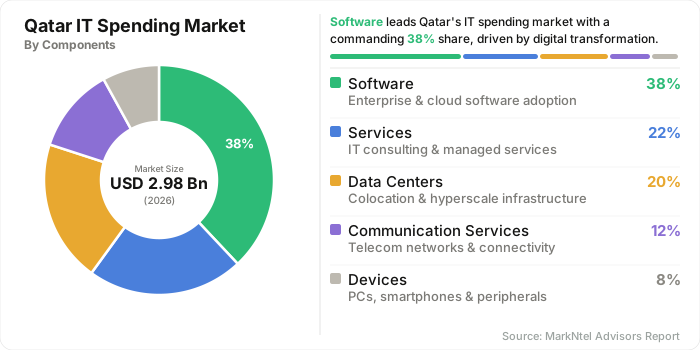
- By components, the software segment is leading the market with a share of 38%, reflecting its significance in 2026.
- By End-User, around 35% of the total spending incurred on the Government and public sector segment in 2026.
- Leading Companies in the IT spending industry are Accenture, Amazon Web Services, Atos SE, Cisco Systems, Ericsson, Gulf Bridge International, Huawei Technologies, Infosys, IBM, Microsoft, Ooredoo, Oracle Corporation, SAP, Vodafone Qatar, Vistas Global, Workz Group, Wipro, ZTE Corporation, and others.
Qatar IT Spending Market Size and Outlook
The Qatar information & technology (IT) spending market was valued at USD 2.19 billion in 2025 and is projected to grow from USD 2.98 billion in 2026 to USD 3.77 billion by 2032, exhibiting a CAGR of 4% during 2026–2032.
Qatar’s IT budget growth rate demonstrates a strong upward trajectory, supported by sustained public-sector digitalization and structured national technology programs. The Ministry of Communications and Information Technology Qatar is implementing the Digital Agenda 2030, which focuses on digital infrastructure, government efficiency, and innovation-led economic growth. In 2025, the government further strengthened AI adoption through partnerships with the global giant Microsoft, enabling advanced applications across public services and institutions . These initiatives have significantly increased procurement of enterprise software, AI tools, and cloud-based systems, particularly among institutional end users such as government agencies and public-sector organizations. As a result, state-led digital transformation continues to act as a foundational pillar driving consistent IT spending expansion.
The market is further supported by expanding ecosystem collaboration between government entities and global technology providers. In 2025, MCIT signed multiple agreements with firms, including Google Cloud, Oracle, and Accenture, to accelerate AI deployment under national programs. These partnerships are designed to improve service delivery efficiency and integrate advanced analytics into government operations, directly increasing demand for consulting, platform services, and infrastructure solutions. At the same time, large-scale innovation platforms and global events such as Web Summit Qatar 2025 have strengthened startup participation and investor engagement in the digital economy. This ecosystem-wide collaboration ensures that both commercial enterprises and emerging technology firms contribute to sustained IT spending and investment growth.
Infrastructure expansion remains a critical enabler of the market, particularly through the development of local cloud and data center capabilities. Microsoft has established and expanded its cloud infrastructure in Qatar, enabling organizations to deploy AI, analytics, and enterprise applications locally with high reliability. Additionally, in 2026, MCIT partnered with Oracle to expand dedicated government cloud regions, enhancing data protection, service continuity, and scalability for digital services. These developments are accelerating cloud migration across industries, particularly among industrial and energy sector users adopting IoT-enabled systems and predictive analytics platforms. Consequently, infrastructure-led modernization continues to diversify IT spending across multiple end-user segments.
Looking ahead, these efforts collectively position Qatar as a growing regional technology hub, ensuring long-term expansion of IT spending through policy-driven demand and ongoing digital transformation across sectors.
Qatar IT Spending Industry Key Indicators
- Ministry of Communications and Information Technology Qatar (2026): Qatar updated its National Frequency Allocation Plan to enhance spectrum efficiency and support advanced ICT and radiocommunication services; this enables faster 5G deployment and next-gen connectivity, leading to increased investments in telecom infrastructure, network equipment, and IT integration services across the country.
- The Digital Agenda 2030 (DA2030) launched by the Ministry of Communications and Information Technology (MCIT) targets approximately 26,000 new ICT-related jobs and an economic impact of nearly USD 11 billion by 2030. The strategy is structured around 32 programmes across digital infrastructure, government services , skills, and the private digital economy. DA2030 also projects a compound annual growth rate of 7.8% in real GDP attributable to digital transformation initiatives.
- As of the start of 2023, Qatar recorded an internet penetration rate of 99%, corresponding to 2.68 million internet users against a total population base that also sustains 4.89 million active mobile connections equivalent to over 180% of the population reflecting the prevalence of multi-SIM usage among residents and businesses. On network quality, 99.8% of Qatar's population has access to 4G service, per ITU data cited by MCIT, while MCIT's own published statistics confirm that 96% of users are already on 5G speeds a figure that places Qatar among the most advanced 5G markets worldwide. This is further corroborated by Qatar's recorded median 5G download speed of 517.44 Mbps, benchmarked among the highest globally.
- The ITU Data Hub recorded mobile broadband penetration value at approximately 4.59 million, reflecting near-complete saturation in smartphone data use; this forces IT buyers across both public and private sectors to invest in mobile device management systems, enterprise mobility frameworks, and API-driven application layers to serve a workforce operating predominantly on mobile-connected devices.
Qatar IT Spending Market Scope
| Category | Segments |
|---|---|
| By Components | Software (Enterprise Application Software, Infrastructure Software, Vertical Software, Gen AI Models, Others), Devices (Mobile Phones, Tablets, Desktops, Laptops), Data Centers (Servers, Enterprise Network Equipment, External Controller-Based Software, Others), Communication Services (Unified Communications, Fixed Connectivity, Mobile Connectivity), Services (Consulting, Business Process Services, Infrastructure Implementation & Managed Services, Infrastructure as a Service (IaaS |
| By Type of Enterprises | Large Enterprises (Headcount Above 10,000), Mid-Size Enterprises (Headcount 5,000 to 10,000), Small Enterprises (Headcount Up to 5,000 |
| By End Users | Banking & Financial Services, Manufacturing, Retail & Ecommerce, IT, Telecom & Media, Healthcare, Government or Public Sector, Education, Others |
| By Deployment Model | Onshore Delivery, Nearshore Delivery, Offshore Delivery |
| By Engagement Model | Project-based / Fixed Price, Staff Augmentation / Time-and-Material, Managed Services / Outcome-based |
Qatar IT Spending Industry Growth Drivers
Accelerated 5G Roll-Out and Network Densification Driving Data-Intensive IT Demand
The rapid expansion of 5G networks and continuous network densification has emerged as a critical structural driver of Qatar’s IT expenditure growth. Telecom operators have significantly intensified infrastructure investments, supported by a regulatory push and rising digital consumption needs. In 2025, Vodafone Qatar partnered with Nokia to modernize its nationwide network, enabling expanded 5G capacity, lower latency, and enhanced service delivery across sectors. Simultaneously, regulatory actions have accelerated the transition from legacy networks to advanced 4G and 5G systems, reinforcing a nationwide shift toward high-speed connectivity. This combination of policy enforcement and operator investment has structurally increased the scale and speed of 5G deployment.
The measurable impact of this 5G network integration is evident in performance improvements and increased data usage across consumer and enterprise segments. According to Opensignal’s 2025 report, Qatar’s 5G download speeds reached up to 427 Mbps, with consistent improvements in coverage and user experience across operators. Additionally, Vodafone Qatar reported that more than 90% of its outdoor sites were upgraded with advanced 5G capabilities by 2025, alongside an expansion in network sites and fiber infrastructure. These developments are enabling b andwidth-intensive applications such as cloud computing, video streaming, and real-time analytics, thereby increasing demand for enterprise IT systems, edge computing, and data management platforms across commercial and industrial users.
This expansion of 5G rollout increases market volume by enabling entirely new categories of digital services rather than merely improving connectivity quality. 5G network densification supports advanced use cases such as IoT-enabled industrial automation, smart city applications, and AI-driven enterprise operations, all of which require continuous IT infrastructure and software investments. Telecom operators are also introducing capabilities like network slicing and ultra-low latency services, allowing businesses to deploy customized digital solutions at scale. As these applications proliferate across sectors such as energy, logistics, and urban infrastructure, they generate recurring demand for IT services, making 5G expansion a fundamental driver of sustained market growth.
Recent Trends
Rising Adoption of Hybrid Cloud and Managed Services to Meet Data Sovereignty Requirements
A key trend shaping Qatar’s digital transformation spending is the growing adoption of hybrid cloud models combined with managed services, driven by strict data sovereignty and privacy requirements. This shift has accelerated as organizations seek to balance global scalability with compliance to national data regulations governing sensitive information. In 2025, the Qatar Central Bank reinforced cloud risk management and data governance expectations for financial institutions, encouraging secure and compliant deployment models. These regulatory developments are prompting enterprises to adopt hybrid architectures integrating both on-premise and localized cloud environments.
This trend is transforming enterprise IT operating models by increasing reliance on managed service providers to handle complex hybrid environments. Organizations are outsourcing infrastructure management, cybersecurity monitoring, and compliance operations to specialized vendors to ensure efficiency and regulatory adherence. In 2025, Ooredoo deployed NVIDIA-powered sovereign AI cloud infrastructure in local data centers, enabling enterprises to access high-performance computing while ensuring data remains within national boundaries. This development highlights how managed services are evolving to include AI-ready infrastructure and secure data processing capabilities.
The persistence of this trend is supported by the long-term need for secure data handling and operational flexibility across sectors such as banking, healthcare, and public administration. Hybrid cloud models allow organizations to store sensitive data locally while leveraging global cloud capabilities for analytics and scalability. As digital workloads continue to grow, enterprises will increasingly depend on managed services to optimize performance and ensure compliance. Consequently, the integration of hybrid cloud and managed services represents a sustained structural shift that will continue to influence IT expenditure patterns and enterprise technology strategies in Qatar.
Opportunities and Challenges
Data Security Concerns Driving Local Data Infrastructure Expansion and Secure Cloud Opportunities
A major challenge in Qatar’s IT spending industry is the persistent concern around data security, particularly related to storing and processing data outside national borders. As organizations accelerate cloud adoption, apprehensions regarding unauthorized access, jurisdictional risks, and data breaches have intensified. Qatar has one of the region’s strictest data protection regimes under its Personal Data Privacy Protection Law, w hich imposes stringent requirements on how data is handled and transferred. Additionally, cloud environments introduce new vulnerabilities, with studies indicating that 65% of cloud breaches are linked to misconfigurations, highlighting operational risks. These concerns have slowed migration to fully public cloud models, particularly among government and regulated sectors.
These security challenges are simultaneously creating a significant opportunity through the expansion of localized data infrastructure and secure cloud ecosystems in Qatar. The establishment of in-country cloud regions, particularly by Google Cloud, has enabled organizations to store and process data domestically while maintaining high security standards. Local hosting capabilities are helping mitigate concerns around cross-border data exposure and regulatory compliance, accelerating enterprise confidence in cloud adoption. This shift is encouraging both public and private sector entities to migrate workloads to secure, compliant digital environments.
Moreover, Qatar is leveraging partnerships and ecosystem development to strengthen its secure digital infrastructure and attract further investment. Strategic collaborations between government entities and global cloud providers are enabling the deployment of advanced cybersecurity platforms and locally compliant cloud solutions. For example, government institutions have implemented platforms in partnership with Google Cloud to ensure secure data handling within national systems. These initiatives are not only addressing existing security concerns but also creating long-term services, opportunities for managed cybersecurity solutions, and data center investments, thereby expanding Qatar’s overall digital ecosystem.
Segmentation Analysis
Software Segment Leads the Market Driven by Rising Enterprise Digitalization and SaaS Adoption
Software dominates Qatar’s IT budget with a market share of 38% due to its central role in enabling large-scale digital transformation across government and enterprise sectors. National programs led by the Ministry of Communications and Information Technology Qatar are prioritizing AI integration, digital platforms, and automation, which directly increase demand for enterprise software solutions. In 2025, multiple public-sector entities deployed advanced digital platforms to enhance service delivery, reinforcing the need for scalable application software. This policy-driven push ensures sustained adoption across institutional users.
The dominance is further strengthened by enterprise demand for ERP, CRM, and analytics platforms across banking, telecom, and logistics sectors. The Dhareeba tax platform highlight the reliance on enterprise applications for citizen services and compliance . Companies like Microsoft Corporation has enabled organizations in Qatar to deploy enterprise solutions such as Dynamics 365 to modernize operations. These real-world deployments show how enterprise software is deeply embedded in operational workflows across industries.
Additionally, the rise of AI-driven applications and data analytics platforms is further strengthening software demand across both public and private sectors. Organizations are investing in automation tools, cybersecurity software, and data management platforms to enhance efficiency and compliance. Unlike hardware, software requires continuous updates, subscriptions, and integration services, creating recurring expenditure. This recurring demand, combined with strong policy backing and widespread enterprise adoption, ensures software’s sustained leadership in Qatar’s IT software expenditure. By components segments, the market is further divided into the following sub-categories:
- Software
- Devices
- Data Centers
- Communication Services
- Services
Government and Public Sector Dominance Driven by Large-Scale Digital Infrastructure and National Service Delivery Systems
The government and public sector lead IT spending with a market share of 35%. This significant growth is attributed to the large-scale national digital transformation initiatives and policy-backed investments. Programs such as TASMU Smart Qatar are enabling digital infrastructure across transport, healthcare, and environmental systems, significantly increasing IT expenditure. These initiatives require extensive deployment of cloud platforms, data analytics tools, and integrated software systems, making government entities the largest contributors to market demand.
This dominance is further supported by continuous capital allocation toward the modernization of public services and infrastructure. Government entities are investing in smart governance platforms, digital identity systems, and AI-driven applications to improve efficiency and citizen engagement. For example, digital service platforms across ministries are being enhanced to deliver seamless and automated public services. The Hukoomi Qatar digital government platform serves as a centralized interface for delivering a wide range of public services, including visa processing, licensing, and administrative approvals. This platform integrates multiple government entities through a unified digital infrastructure, requiring robust backend systems, secure authentication mechanisms, and cloud-based service delivery frameworks. Its multi-agency integration necessitates continuous system enhancements and interoperability upgrades. These investments generate sustained demand for IT infrastructure, consulting, and managed services.
Moreover, the public sector acts as a catalyst for broader ecosystem development by driving adoption among private enterprises and technology providers. Large-scale government projects create opportunities for global and local IT vendors, fostering partnerships and innovation. This multiplier effect expands market participation and increases overall IT spending. As a result, the government segment maintains its leadership position, supported by strong policy direction, consistent funding, and its central role in shaping Qatar’s digital economy. By end users, the market is further divided into the following sub-categories:
- Banking & Financial Services
- Manufacturing
- Retail & Ecommerce
- IT, Telecom & Media
- Healthcare
- Government or Public Sector
- Education
- Others
Qatar IT Spending Industry News and Recent Developments
2026: Ooredoo Qatar launches IoT e-SIM for enterprise connectivity
Ooredoo introduced a new IoT eSIM solution to support enterprise connectivity needs. The solution enables seamless device connectivity without physical SIM cards. It is designed for sectors like logistics, smart cities, and industrial operations. The initiative enhances scalability and flexibility in managing IoT devices. It aligns with the growing demand for digital and connected solutions in Qatar.
Impact Analysis: This drives growth in IoT-related IT and telecom spending. Enterprises will invest more in connected devices and digital platforms. It supports smart infrastructure development across multiple industries. Managed services and connectivity solutions demand will increase. Overall, it expands enterprise IT spending linked to digital transformation.
2025: Brookfield & Qatar’s QIA form USD 20 billion AI infrastructure JV
The news highlights a joint venture between Brookfield and Qatar Investment Authority to invest USD 20 billion in AI infrastructure. This includes the development of large-scale data centers and advanced computing capabilities. The initiative focuses on supporting AI model training and cloud-based workloads. It aims to position Qatar as a regional AI and digital infrastructure hub. The investment is part of broader efforts to expand digital and technology capabilities.
Impact Analysis: This directly boosts IT infrastructure spending, especially in data centers and the cloud. Demand for high-performance computing and storage solutions will rise. It accelerates enterprise AI adoption, increasing software and services spending. Global partnerships will bring advanced technologies into the domestic market. Overall, it strengthens long-term IT CAPEX and digital ecosystem growth.
2025: Ooredoo & Qatar Airways partner for AI and cloud innovation
Ooredoo and Qatar Airways signed a strategic MoU to enhance AI, cloud, and cybersecurity capabilities. The partnership focuses on building a national AI hub with advanced infrastructure. It combines telecom and aviation expertise to accelerate digital transformation. The initiative includes investments in GPU platforms and AI tools. It also emphasizes talent development and upskilling in emerging technologies.
Impact Analysis: Drives enterprise spending on AI, cloud, and cybersecurity solutions. Increases demand for high-performance computing and infrastructure services. Encourages cross-industry digital adoption beyond telecom (aviation, logistics). Boosts managed services and consulting demand. Strengthens long-term IT services and platform spending growth.
2025: MEEZA secures QAR 800M to expand data centre and AI infrastructure
MEEZA secured QAR 800 million financing from Dukhan Bank. The funding will support the expansion of 44 MW of data center capacity. A portion is dedicated to AI-specific infrastructure deployment. The project enhances cloud, cybersecurity, and enterprise IT services. It aligns with Qatar’s digital infrastructure and Vision 2030 goals.
Impact Analysis: Directly increases infrastructure and data center spending. Drives enterprise demand for cloud, storage, and cybersecurity solutions. Supports AI workload expansion, boosting software and platform spending. Encourages hyperscale and colocation investments. Strengthens Qatar’s position as a regional IT infrastructure hub.
2025: Qatar launches a USD 1 billion investment incentive program
Qatar introduced a USD 1 billion incentive program to attract foreign and domestic investments. The initiative is led by Invest Qatar and aligns with its national development strategy. It offers up to 40% financial support on business costs like setup, leasing, and staffing. The program targets key sectors including digital economy, AI, cloud, and cybersecurity. It aims to boost economic diversification and strengthen Qatar’s global business position.
Impact Analysis: Directly accelerates IT spending by incentivizing tech-sector investments. Encourages companies to invest in AI, cloud, and digital infrastructure. Reduces entry cost, increasing participation from global tech firms. Drives demand for IT services, software, and infrastructure solutions. Overall, it acts as a strong policy-driven catalyst for IT market expansion.
2025: Qatar to establish National Center for Artificial Intelligence
Qatar has announced plans to set up a National Center for Artificial Intelligence. The initiative is led by the Ministry of Communications and Information Technology. It aims to coordinate AI research, development, and adoption across sectors. The center will support public-private collaboration in AI innovation. It also focuses on building talent and governance frameworks for AI use.
Impact Analysis: This directly increases government IT spending on AI infrastructure and platforms. It accelerates adoption of AI solutions across public sector services. Creates demand for cloud, data centers, and advanced computing systems. Encourages private sector participation through partnerships and projects. Overall, it strengthens AI-driven digital transformation in Qatar.
- Market Segmentation
- Introduction
- Product Definition
- Research Process
- Assumptions
- Executive Summary
- Qatar IT Spending Market Policies, Regulations, and Product Standards
- Qatar IT Spending Market Trends & Developments
- Qatar IT Spending Market Dynamics
- Growth Factors
- Challenges
- Qatar IT Spending Market Hotspot & Opportunities
- Qatar IT Spending Market Outlook, 2022-2032F
- Market Size & Outlook
- By Revenues (USD Million)
- Market Share & Outlook
- By Components- Market Size & Forecast 2022-2032, USD Million
- Software
- Enterprise Application Software
- Infrastructure Software
- Vertical Software
- Gen AI Models
- Others
- Devices
- Mobile Phones
- Tablets
- Desktops
- Laptops
- Data Centers
- Servers
- Enterprise Network Equipment
- External Controller-Based Software
- Others
- Communication Services
- Unified Communications
- Fixed Connectivity
- Mobile Connectivity
- Services
- Consulting
- Business Process Services
- Infrastructure Implementation & Managed Services
- Infrastructure as a Service (IaaS)
- Software
- By Type of Enterprises- Market Size & Forecast 2022-2032, USD Million
- Large Enterprises (Headcount Above 10,000)
- Mid-Size Enterprises (Headcount 5,000 to 10,000)
- Small Enterprises (Headcount Up to 5,000)
- By End Users- Market Size & Forecast 2022-2032, USD Million
- Banking & Financial Services
- Manufacturing
- Retail & Ecommerce
- IT, Telecom & Media
- Healthcare
- Government or Public Sector
- Education
- Others
- By Deployment Model- Market Size & Forecast 2022-2032, USD Million
- Onshore Delivery
- Nearshore Delivery
- Offshore Delivery
- By Engagement Model- Market Size & Forecast 2022-2032, USD Million
- Project-based / Fixed Price
- Staff Augmentation / Time-and-Material
- Managed Services / Outcome-based
- By Region- Market Size & Forecast 2022-2032, USD Million
- Central Region
- Southern Region
- Northern Region
- Western Region
- By Company
- Competition Characteristics
- Market Share & Analysis
- By Components- Market Size & Forecast 2022-2032, USD Million
- Market Size & Outlook
- Qatar Software Market Outlook, 2022-2032
- Market Size & Outlook
- By Revenues (USD Million)
- Market Share & Outlook
- By Type of Enterprises- Market Size & Forecast 2022-2032, USD Million
- By End Users- Market Size & Forecast 2022-2032, USD Million
- By Deployment Model- Market Size & Forecast 2022-2032, USD Million
- By Engagement Model- Market Size & Forecast 2022-2032, USD Million
- By Region- Market Size & Forecast 2022-2032, USD Million
- Market Size & Outlook
- Qatar Data Centers Market Outlook, 2022-2032
- Market Size & Outlook
- By Revenues (USD Million)
- Market Share & Outlook
- By Type of Enterprises- Market Size & Forecast 2022-2032, USD Million
- By End Users- Market Size & Forecast 2022-2032, USD Million
- By Deployment Model- Market Size & Forecast 2022-2032, USD Million
- By Engagement Model- Market Size & Forecast 2022-2032, USD Million
- By Region- Market Size & Forecast 2022-2032, USD Million
- Market Size & Outlook
- Qatar Services Market Outlook, 2022-2032
- Market Size & Outlook
- By Revenues (USD Million)
- Market Share & Outlook
- By Type of Enterprises- Market Size & Forecast 2022-2032, USD Million
- By End Users- Market Size & Forecast 2022-2032, USD Million
- By Deployment Model- Market Size & Forecast 2022-2032, USD Million
- By Engagement Model- Market Size & Forecast 2022-2032, USD Million
- By Region- Market Size & Forecast 2022-2032, USD Million
- Market Size & Outlook
- Qatar Devices Market Outlook, 2022-2032
- Market Size & Outlook
- By Revenues (USD Million)
- Market Share & Outlook
- By Type of Enterprises- Market Size & Forecast 2022-2032, USD Million
- By End Users- Market Size & Forecast 2022-2032, USD Million
- By Deployment Model- Market Size & Forecast 2022-2032, USD Million
- By Engagement Model- Market Size & Forecast 2022-2032, USD Million
- By Region- Market Size & Forecast 2022-2032, USD Million
- Market Size & Outlook
- Qatar Communication Services Market Outlook, 2022-2032
- Market Size & Outlook
- By Revenues (USD Million)
- Market Share & Outlook
- By Type of Enterprises- Market Size & Forecast 2022-2032, USD Million
- By End Users- Market Size & Forecast 2022-2032, USD Million
- By Deployment Model- Market Size & Forecast 2022-2032, USD Million
- By Engagement Model- Market Size & Forecast 2022-2032, USD Million
- By Region- Market Size & Forecast 2022-2032, USD Million
- Market Size & Outlook
- Qatar IT Spending Market Key Strategic Imperatives for Success & Growth
- Competitive Outlook
- Company Profiles
- Accenture Middle East (Qatar) W.L.L.
- Business Description
- Product Portfolio
- Collaborations & Alliances
- Recent Developments
- Financial Details
- Others
- Amazon Web Services Middle East (Qatar) W.L.L.
- Business Description
- Product Portfolio
- Collaborations & Alliances
- Recent Developments
- Financial Details
- Others
- Atos SE
- Business Description
- Product Portfolio
- Collaborations & Alliances
- Recent Developments
- Financial Details
- Others
- Cisco Systems Inc.
- Business Description
- Product Portfolio
- Collaborations & Alliances
- Recent Developments
- Financial Details
- Others
- Ericsson AB
- Business Description
- Product Portfolio
- Collaborations & Alliances
- Recent Developments
- Financial Details
- Others
- Gulf Bridge International Q.S.C.
- Business Description
- Product Portfolio
- Collaborations & Alliances
- Recent Developments
- Financial Details
- Others
- Huawei Technologies Co., Ltd.
- Business Description
- Product Portfolio
- Collaborations & Alliances
- Recent Developments
- Financial Details
- Others
- Infosys Limited
- Business Description
- Product Portfolio
- Collaborations & Alliances
- Recent Developments
- Financial Details
- Others
- International Business Machines Corporation
- Business Description
- Product Portfolio
- Collaborations & Alliances
- Recent Developments
- Financial Details
- Others
- Microsoft Corporation
- Business Description
- Product Portfolio
- Collaborations & Alliances
- Recent Developments
- Financial Details
- Others
- Ooredoo Q.P.S.C.
- Business Description
- Product Portfolio
- Collaborations & Alliances
- Recent Developments
- Financial Details
- Others
- Oracle Corporation
- Business Description
- Product Portfolio
- Collaborations & Alliances
- Recent Developments
- Financial Details
- Others
- SAP SE
- Business Description
- Product Portfolio
- Collaborations & Alliances
- Recent Developments
- Financial Details
- Others
- Vodafone Qatar P.Q.S.C.
- Business Description
- Product Portfolio
- Collaborations & Alliances
- Recent Developments
- Financial Details
- Others
- Vistas Global Qatar LLC
- Business Description
- Product Portfolio
- Collaborations & Alliances
- Recent Developments
- Financial Details
- Others
- Workz Group
- Business Description
- Product Portfolio
- Collaborations & Alliances
- Recent Developments
- Financial Details
- Others
- Wipro Limited
- Business Description
- Product Portfolio
- Collaborations & Alliances
- Recent Developments
- Financial Details
- Others
- ZTE Corporation
- Business Description
- Product Portfolio
- Collaborations & Alliances
- Recent Developments
- Financial Details
- Others
- Others
- Accenture Middle East (Qatar) W.L.L.
- Company Profiles
- Disclaimer

MarkNtel Advisors follows a robust and iterative research methodology designed to ensure maximum accuracy and minimize deviation in market estimates and forecasts. Our approach combines both bottom-up and top-down techniques to effectively segment and quantify various aspects of the market. A consistent feature across all our research reports is data triangulation, which examines the market from three distinct perspectives to validate findings. Key components of our research process include:
1. Scope & Research Design At the outset, MarkNtel Advisors define the research objectives and formulate pertinent questions. This phase involves determining the type of research—qualitative or quantitative—and designing a methodology that outlines data collection methods, target demographics, and analytical tools. They also establish timelines and budgets to ensure the research aligns with client goals.
2. Sample Selection and Data Collection In this stage, the firm identifies the target audience and determines the appropriate sample size to ensure representativeness. They employ various sampling methods, such as random or stratified sampling, based on the research objectives. Data collection is carried out using tools like surveys, interviews, and observations, ensuring the gathered data is reliable and relevant.
3. Data Analysis and Validation Once data is collected, MarkNtel Advisors undertake a rigorous analysis process. This includes cleaning the data to remove inconsistencies, employing statistical software for quantitative analysis, and thematic analysis for qualitative data. Validation steps are taken to ensure the accuracy and reliability of the findings, minimizing biases and errors.

4. Data Forecast and FinalizationThe final phase involves forecasting future market trends based on the analyzed data. MarkNtel Advisors utilize predictive modeling and time series analysis to anticipate market behaviors. The insights are then compiled into comprehensive reports, featuring visual aids like charts and graphs, and include strategic recommendations to inform client decision-making
FILL THE FORM TO INQUIRE BEFORE BUYING THIS REPORT
We offer flexible licensing options to cater to varying organizational needs. Choose the pricing pack that best suits your requirements:
Buy Now Talk to our Consultant
 Request Customization