

By Battery Product Type (Battery Modules, Battery Packs), By Vehicle Type (Passenger Cars, Light Commercial Vehicles, Medium-Duty Vehicles, Heavy-Duty Vehicles, Buses), By Propulsi......on Type (Battery Electric Vehicles, Plug-in Hybrid Electric Vehicles, Hybrid Electric Vehicles), By Battery Chemistry (Lithium Iron Phosphate, Lithium Nickel Manganese Cobalt Oxide, Lithium Nickel Cobalt Aluminum Oxide, Nickel-Metal Hydride, Lithium Titanate Oxide, Other), By Battery Capacity (Below 40 kWh, 40–80 kWh, 80–150 kWh, Above 150 kWh), By Sales Channel (OEM Supply, Replacement/Aftermarket), and others Read more
- Automotive
- Aug 2026
- 295
- PDF, Excel, PPT
North America Automotive Battery Pack & Module Market Key Takeaways
- The North America automotive battery pack & module market size was valued at USD 2.38 billion in 2025 and is projected to grow from USD 3.22 billion in 2026 to USD 5.48 billion by 2032.
- The industry is projected to sustain growth at a steady CAGR of 9.27% during 2026-2032.
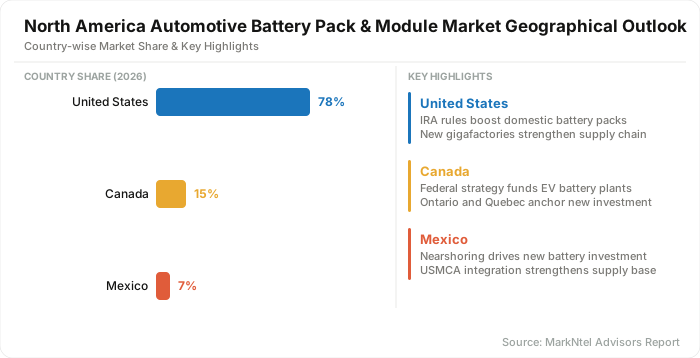
- The US holds the largest share of about 78% in 2026.
- By vehicle type, passenger cars hold a significant share of about 70% in 2026.
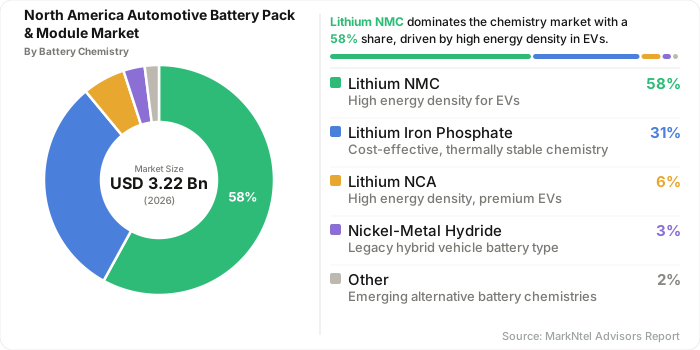
- By battery chemistry, lithium nickel manganese cobalt oxide seized a significant share of about 58% in 2026.
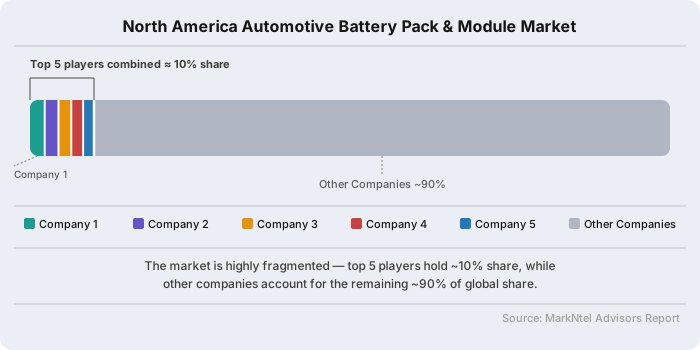
- The industry is highly fragmented. However, the top five players collectively account for nearly a 10% share.
North America Automotive Battery Pack & Module Market Size and Outlook
North America automotive battery pack & module market size was valued at USD 2.38 billion in 2025 and is projected to grow from USD 3.22 billion in 2026 to USD 5.48 billion by 2032. Along with this, the market is estimated to grow at a CAGR of around 9.27% during the forecast period, i.e., 2026-32.
The demand for automotive battery pack & module in North America is being driven by vehicle electrification, rising demand for high-capacity batteries, and continued investment in regional battery manufacturing. U.S. average BEV battery size reached 90 kWh in 2025, increasing battery content per vehicle. Policy support for domestic battery production and critical-mineral supply chains is also strengthening regional manufacturing, including USD 500 million in new U.S. funding for battery-material projects in 2026. Future opportunities include LFP localization, battery recycling, advanced pack technologies, and supply-chain diversification. Despite near-term electric vehicle demand uncertainty, the market has a positive long-term outlook as electrification and domestic battery ecosystems expand.
North America Automotive Battery Pack & Module Market Key Indicators
- DOE projects North American EV battery manufacturing capacity will grow from 55 GWh/year in 2021 to nearly 1,000 GWh/year by 2030, an 18-fold increase, enough for 10 to 13 million EVs annually. Argonne separately projects battery cell production exceeding 1,200 GWh by 2030, supporting 12 to 15 million vehicles. IEA data show US lithium-ion capacity grew roughly 50% year-on-year between 2024 and 2025.
- Redwood Materials produced 60,000 metric tons of recovered critical minerals, including nickel, cobalt, lithium, and copper, at its Nevada campus in 2025, and added over 20,000 metric tons of annual processing capacity at a new South Carolina facility's first phase, backed by an oversubscribed USD 350 million Series E funding round. Growing recycled-material supply reduces raw-material input costs for North American pack and module makers.
- North American battery manufacturing continues expanding through projects scheduled to begin production during 2025–2030. The US Department of Energy indicates planned North American capacity could approach 1,000 GWh annually by 2030, supporting approximately 10–13 million electric vehicles annually. Additionally, in 2025, North America-headquartered companies owned more than 35% of US nameplate capacity but produced only approximately 3% of batteries installed in EVs sold globally, indicating continued reliance on established Asian producers.
- US EV demand remained under pressure during 2026, directly affecting downstream requirements for battery packs and modules. According to Cox Automotive, 247,226 EVs were sold in Q2 2026, representing approximately 5.8% of total new-vehicle volume. Although quarterly sales increased 14.7% from Q1 2026, volumes declined 20.5% year over year. Consequently, the near-term EV demand environment remains softer, creating pressure on battery production and procurement volumes.
North America Automotive Battery Pack & Module Market Scope
| Category | Segments |
|---|---|
| By Battery Product Type | Battery Modules, Battery Packs |
| By Vehicle Type | Passenger Cars, Light Commercial Vehicles, Medium-Duty Vehicles, Heavy-Duty Vehicles, Buses |
| By Propulsion Type | Battery Electric Vehicles, Plug-in Hybrid Electric Vehicles, Hybrid Electric Vehicles |
| By Battery Chemistry | Lithium Iron Phosphate, Lithium Nickel Manganese Cobalt Oxide, Lithium Nickel Cobalt Aluminum Oxide, Nickel-Metal Hydride, Lithium Titanate Oxide, Other |
| By Battery Capacity | Below 40 kWh, 40–80 kWh, 80–150 kWh, Above 150 kWh |
| By Sales Channel | OEM Supply, Replacement/Aftermarket |
North America Automotive Battery Pack & Module Market Growth Drivers
Rising Electric Vehicle Production and Growing Demand for High-Capacity Battery Systems
Rising electric vehicle (EV) production is a key growth driver for the North America automotive battery pack & module industry because every battery-electric and plug-in hybrid vehicle requires an integrated battery system. In 2025, electric car production in North America increased 10% year over year, reversing the previous year’s decline. Mexico’s EV production also increased nearly 5%, strengthening the region’s vehicle manufacturing base.
Battery demand is further supported by the increasing battery content of North American vehicles. The U.S. market is particularly important because more than 85% of available EV models in 2025 were large cars or SUVs, while large vehicles accounted for more than 80% of U.S. car sales. These vehicles generally require larger battery packs to deliver adequate range and performance, increasing battery-pack value per vehicle.
In 2025, U.S. electric-car sales reached approximately 1.5 million units, while battery-electric vehicles represented nearly 70% of U.S. electric-car sales. Although U.S. EV sales weakened toward the end of 2025, North American EV production continued expanding, supporting sustained demand for battery modules, packs, thermal-management systems, and battery-management electronics.
Recent Trends
Repurposing EV Battery Manufacturing Capacity for Energy Storage Applications
Repurposing automotive battery manufacturing capacity for energy storage systems (ESS) is emerging as a key trend in the North America automotive battery pack and module market as manufacturers respond to changing EV demand and growing stationary-storage requirements. In August 2026, LG Energy Solution announced that five of its eight North American battery factories are expected to produce ESS batteries by the end of 2026, demonstrating a strategic shift in the utilization of battery manufacturing infrastructure.
The shift is particularly significant because slower-than-expected EV demand has encouraged battery manufacturers to diversify production rather than leave automotive battery capacity underutilized. LG Energy Solution is expanding ESS production to serve rising demand from utilities, grid operators, and data centers, including power requirements associated with artificial-intelligence infrastructure. The company expects 50 GWh of ESS production capacity in North America by the end of 2026, making the region a major manufacturing base for stationary batteries.
Samsung SDI is following a similar strategy. Its Indiana facility, initially developed for automotive battery production, is being redirected toward ESS applications, while the company has secured a three-year ESS battery supply agreement worth more than KRW 2 trillion, with deliveries beginning in 2027.
This trend enables manufacturers to improve factory utilization, diversify revenue streams, and preserve battery-production ecosystems, supporting the broader North American battery-pack and module industry.
North America Automotive Battery Pack & Module Market Opportunities and Challenges
High Battery-Pack Costs Creating Opportunities for Cost-Efficient Manufacturing
A major challenge for the North America automotive battery pack and module industry is the high cost of locally produced battery systems compared with Asian manufacturing hubs. In 2025, battery-pack prices in North America were approximately 30% higher than in China, widening the regional cost gap from 20% in 2022. This disadvantage can increase EV production costs and constrain the competitiveness of North American battery-pack and module manufacturers.
However, this challenge is creating a significant opportunity for cost-efficient battery technologies, localized manufacturing, and simplified pack architectures. A notable example is General Motors, which is expanding the use of prismatic cells and LFP chemistry. GM states that its prismatic-cell architecture can reduce battery-module components by 75% and total pack components by 50%, while combining the architecture with LFP chemistry is expected to reduce the cost of a Chevrolet Silverado EV battery pack by USD 6,000.
Another emerging opportunity is next-generation chemistry development. GM and LG Energy Solution plan to begin U.S. commercial production of lithium-manganese-rich (LMR) prismatic cells in 2028. The technology is designed to deliver 33% higher energy density than leading LFP cells at comparable cost, potentially enabling lower-cost, higher-range battery packs for electric trucks and SUVs.
Thus, the cost disadvantage is driving localized, automated, component-efficient, and lower-cost battery-pack technologies, directly supporting market growth.
Segmentation Insights
Passenger Cars Account for Nearly 70% of Revenue, Supported by High Electrification and Larger Battery Capacities
Passenger cars represent the leading vehicle-type segment, accounting for nearly 70% of North America’s automotive battery pack and module market revenue. Their dominance is supported by the large volume of electrified passenger vehicles and the increasing battery content of these vehicles. In the United States, 22% of light-duty vehicles sold in 2025 were hybrid, battery electric, or plug-in hybrid vehicles, demonstrating the expanding electrification of the passenger-vehicle segment.
Battery size further strengthens revenue generation. In 2025, the average battery capacity of battery electric cars in the United States reached approximately 90 kilowatt-hours, following around 5% growth from the previous year. Larger battery systems increase the value of battery packs and modules installed per vehicle. Additionally, North American consumers have strong demand for larger vehicles such as SUVs and crossovers, which generally require higher-capacity batteries. Consequently, the combination of high passenger-vehicle volumes, increasing electrification, and large battery capacities enables passenger cars to maintain their leading revenue position. Based on vehicle type, the scope has been segmented into
- Passenger Cars
- Light Commercial Vehicles
- Medium-Duty Vehicles
- Heavy-Duty Vehicles
- Buses
Lithium Nickel Manganese Cobalt Oxide Holds Approximately 58% Share, Supported by High Energy Density
Lithium nickel manganese cobalt oxide accounted for approximately 58% of North America’s electric-vehicle battery-pack and module industry in 2026, maintaining its leading position because of its superior energy density, driving range, and performance characteristics. The International Energy Agency notes that Lithium Nickel Manganese Cobalt Oxide packs have approximately 20% higher gravimetric energy density and one-third higher volumetric energy density than Lithium Iron Phosphate packs, making them well suited to larger electric vehicles and long-range applications.
A strong North American example is General Motors, which currently uses high-nickel chemistry in its electric trucks and is developing lithium-manganese-rich technology with LG Energy Solution. GM states that its future cells could deliver 33% higher energy density than leading Lithium Iron Phosphate cells at comparable cost, while targeting more than 400 miles of range in electric trucks.
These performance advantages support continued demand for high-energy-density battery packs in North American electric SUVs, pickups, and long-range passenger vehicles. By battery chemistry, the market is categorized into
- Lithium Iron Phosphate
- Lithium Nickel Manganese Cobalt Oxide
- Lithium Nickel Cobalt Aluminum Oxide
- Nickel-Metal Hydride
- Lithium Titanate Oxide
- Other
North America Automotive Battery Pack & Module Market Geographical Outlook
The US Commands Approximately 78% Share, Supported by High EV Adoption and Expanding Battery Manufacturing
The US accounts for approximately 78% of North America’s automotive battery pack & module demand, primarily because it combines the region’s largest EV sales base with substantial battery manufacturing capacity. In 2025, US electric-car sales reached approximately 1.5 million units, while more than 85% of available EV models were large cars or SUVs, which generally require higher-capacity battery systems. Additionally, the average battery capacity of US battery-electric cars reached approximately 90 kWh in 2025, increasing battery content per vehicle. Furthermore, domestic battery production is expanding rapidly.
Panasonic Energy began mass production at its Kansas facility in July 2025, targeting approximately 32 GWh of annual capacity, while its Nevada facility already had approximately 41 GWh of capacity. Consequently, the combination of high EV volumes, larger vehicle formats, higher battery capacities, and expanding localized manufacturing makes the US the dominant demand center within North America.
North America Automotive Battery Pack & Module Market Competitive Analysis
Top Five Players Account for Approximately 10% Collective Share
The North America automotive battery pack and module market is highly fragmented, with the top five manufacturers collectively accounting for approximately 10% of the market. Key participants include Panasonic Energy Co., Ltd., Samsung SDI Co., Ltd., LG Energy Solution Ltd., SK On Co., Ltd., and Contemporary Amperex Technology Co., Limited.
Major Companies in North America Automotive Battery Pack & Module Industry
- Panasonic Energy Co., Ltd.
- LG Energy Solution Ltd.
- SK On Co., Ltd.
- Samsung SDI Co., Ltd.
- AESC Group Ltd.
- Contemporary Amperex Technology Co., Limited
- BYD Company Limited
- Gotion High-tech Co., Ltd.
- EVE Energy Co., Ltd.
- American Battery Solutions, Inc.
- Microvast Holdings, Inc.
- EnerSys
- Others
North America Automotive Battery Pack & Module Industry News and Recent Developments:
2026: NextStar Energy Starts New Battery-Pack Production Line
In June 2026, NextStar Energy announced the start of production on a new battery-pack manufacturing line at its Windsor, Ontario facility. The development strengthens Canada's domestic battery-pack manufacturing capabilities and expands the region's integrated battery production ecosystem.
Impact Analysis: NextStar Energy’s new battery-pack production line strengthens Canada’s localized battery manufacturing ecosystem by increasing domestic pack-assembly capabilities and reducing reliance on imported battery systems. The development also supports greater integration between cell production and pack manufacturing, improving supply-chain resilience for regional automakers. Increased local capacity can attract additional component suppliers and accelerate investment across Canada’s growing electric-vehicle battery value chain.
2025: Panasonic Energy Begins Mass Production at Kansas Facility
Panasonic Energy began mass production of automotive lithium-ion batteries at its new Kansas facility in July 2025. The plant is designed for approximately 32 GWh of annual capacity, strengthening localized battery production and supply for North American EV manufacturers. The facility represents a USD 4 billion investment and is expected to create up to 4,000 jobs.
Impact Analysis: Panasonic Energy’s Kansas facility strengthens U.S. battery-pack and module supply by adding approximately 32 GWh of annual lithium-ion battery capacity. The USD 4 billion investment supports localized battery production, reduces supply-chain dependence on overseas manufacturing, and strengthens Panasonic’s ability to supply North American automakers. The facility’s scale also supports economies of scale, regional employment, and continued development of the domestic battery manufacturing ecosystem.
- Market Segmentation
- Introduction
- Product Definition
- Research Process
- Assumptions
- Executive Summary
- North America Automotive Battery Pack & Module Market Policies, Regulations, and Product Standards
- North America Automotive Battery Pack & Module Supply Chain Analysis
- North America Automotive Battery Pack & Module Import/Export Analysis
- North America Automotive Battery Pack & Module Market Production Trend 2022-2032
- North America Automotive Battery Pack & Module Market Production Trend by Battery Product Type
- Battery Modules
- Battery Packs
- Company-Wise Production Plants and Statistics
- Installed Production Capacity
- Actual Production
- Planned Production Target
- North America Automotive Battery Pack & Module Market Production Trend by Battery Product Type
- North America Automotive Battery Pack & Module Market Pricing Analysis 2022-2032
- North America Automotive Battery Pack & Module Market Pricing Trend (USD) 2022-2032
- North America Automotive Battery Pack & Module Market Pricing Trend (USD) By Regions 2022-2032
- United States
- Canada
- Mexico
- North America Automotive Battery Pack & Module Market Pricing Trend (USD) By Battery Type 2022-2032
- Battery Modules
- Battery Packs
- North America Automotive Battery Pack & Module Market Trends & Developments
- North America Automotive Battery Pack & Module Market Dynamics
- Growth Factors
- Challenges
- North America Automotive Battery Pack & Module Market Hotspot & Opportunities
- North America Automotive Battery Pack & Module Market Outlook, 2022-2032
- Market Size & Outlook
- By Revenues (USD Million)
- Market Share & Analysis
- By Battery Product Type- Market Size & Forecast 2022-2032, USD Million
- Battery Modules
- Battery Packs
- By Vehicle Type- Market Size & Forecast 2022-2032, USD Million
- Passenger Cars
- Light Commercial Vehicles
- Medium-Duty Vehicles
- Heavy-Duty Vehicles
- Buses
- By Propulsion Type- Market Size & Forecast 2022-2032, USD Million
- Battery Electric Vehicles
- Plug-in Hybrid Electric Vehicles
- Hybrid Electric Vehicles
- By Battery Chemistry- Market Size & Forecast 2022-2032, USD Million
- Lithium Iron Phosphate
- Lithium Nickel Manganese Cobalt Oxide
- Lithium Nickel Cobalt Aluminum Oxide
- Nickel-Metal Hydride
- Lithium Titanate Oxide
- Other
- By Battery Capacity- Market Size & Forecast 2022-2032, USD Million
- Below 40 kWh
- 40–80 kWh
- 80–150 kWh
- Above 150 kWh
- By Sales Channel- Market Size & Forecast 2022-2032, USD Million
- OEM Supply
- Replacement/Aftermarket
- By Country
- The United States
- Canada
- Mexico
- By Company
- Competition Characteristics
- Market Share & Analysis
- By Battery Product Type- Market Size & Forecast 2022-2032, USD Million
- Market Size & Outlook
- The United States Automotive Battery Pack & Module Market Outlook, 2022-2032
- Market Size & Outlook
- By Revenues (USD Million)
- By Quantity Sold (Thousand Units)
- Market Share & Analysis
- By Battery Product Type- Market Size & Forecast 2022-2032, USD Million
- By Vehicle Type- Market Size & Forecast 2022-2032, USD Million
- By Propulsion Type- Market Size & Forecast 2022-2032, USD Million
- By Battery Chemistry- Market Size & Forecast 2022-2032, USD Million
- By Battery Capacity- Market Size & Forecast 2022-2032, USD Million
- By Sales Channel- Market Size & Forecast 2022-2032, USD Million
- Market Size & Outlook
- Canada Automotive Battery Pack & Module Market Outlook, 2022-2032
- Market Size & Outlook
- By Revenues (USD Million)
- Market Share & Analysis
- By Battery Product Type- Market Size & Forecast 2022-2032, USD Million
- By Vehicle Type- Market Size & Forecast 2022-2032, USD Million
- By Propulsion Type- Market Size & Forecast 2022-2032, USD Million
- By Battery Chemistry- Market Size & Forecast 2022-2032, USD Million
- By Battery Capacity- Market Size & Forecast 2022-2032, USD Million
- By Sales Channel- Market Size & Forecast 2022-2032, USD Million
- Market Size & Outlook
- Mexico Automotive Battery Pack & Module Market Outlook, 2022-2032
- Market Size & Outlook
- By Revenues (USD Million)
- Market Share & Analysis
- By Battery Product Type- Market Size & Forecast 2022-2032, USD Million
- By Vehicle Type- Market Size & Forecast 2022-2032, USD Million
- By Propulsion Type- Market Size & Forecast 2022-2032, USD Million
- By Battery Chemistry- Market Size & Forecast 2022-2032, USD Million
- By Battery Capacity- Market Size & Forecast 2022-2032, USD Million
- By Sales Channel- Market Size & Forecast 2022-2032, USD Million
- Market Size & Outlook
- North America Automotive Battery Pack & Module Market Key Strategic Imperatives for Success & Growth
- Competitive Outlook
- Company Profiles
- Panasonic Energy Co., Ltd.
- Business Description
- Product Portfolio
- Collaborations & Alliances
- Recent Developments
- Financial Details
- Others
- LG Energy Solution Ltd.
- Business Description
- Product Portfolio
- Collaborations & Alliances
- Recent Developments
- Financial Details
- Others
- SK On Co., Ltd.
- Business Description
- Product Portfolio
- Collaborations & Alliances
- Recent Developments
- Financial Details
- Others
- Samsung SDI Co., Ltd.
- Business Description
- Product Portfolio
- Collaborations & Alliances
- Recent Developments
- Financial Details
- Others
- AESC Group Ltd.
- Business Description
- Product Portfolio
- Collaborations & Alliances
- Recent Developments
- Financial Details
- Others
- Contemporary Amperex Technology Co., Limited
- Business Description
- Product Portfolio
- Collaborations & Alliances
- Recent Developments
- Financial Details
- Others
- BYD Company Limited
- Business Description
- Product Portfolio
- Collaborations & Alliances
- Recent Developments
- Financial Details
- Others
- Gotion High-tech Co., Ltd.
- Business Description
- Product Portfolio
- Collaborations & Alliances
- Recent Developments
- Financial Details
- Others
- EVE Energy Co., Ltd.
- Business Description
- Product Portfolio
- Collaborations & Alliances
- Recent Developments
- Financial Details
- Others
- American Battery Solutions, Inc.
- Business Description
- Product Portfolio
- Collaborations & Alliances
- Recent Developments
- Financial Details
- Others
- Microvast Holdings, Inc.
- Business Description
- Product Portfolio
- Collaborations & Alliances
- Recent Developments
- Financial Details
- Others
- EnerSys
- Business Description
- Product Portfolio
- Collaborations & Alliances
- Recent Developments
- Financial Details
- Others
- Panasonic Energy Co., Ltd.
- Company Profiles
- Disclaimer

MarkNtel Advisors follows a robust and iterative research methodology designed to ensure maximum accuracy and minimize deviation in market estimates and forecasts. Our approach combines both bottom-up and top-down techniques to effectively segment and quantify various aspects of the market. A consistent feature across all our research reports is data triangulation, which examines the market from three distinct perspectives to validate findings. Key components of our research process include:
1. Scope & Research Design At the outset, MarkNtel Advisors define the research objectives and formulate pertinent questions. This phase involves determining the type of research—qualitative or quantitative—and designing a methodology that outlines data collection methods, target demographics, and analytical tools. They also establish timelines and budgets to ensure the research aligns with client goals.
2. Sample Selection and Data Collection In this stage, the firm identifies the target audience and determines the appropriate sample size to ensure representativeness. They employ various sampling methods, such as random or stratified sampling, based on the research objectives. Data collection is carried out using tools like surveys, interviews, and observations, ensuring the gathered data is reliable and relevant.
3. Data Analysis and Validation Once data is collected, MarkNtel Advisors undertake a rigorous analysis process. This includes cleaning the data to remove inconsistencies, employing statistical software for quantitative analysis, and thematic analysis for qualitative data. Validation steps are taken to ensure the accuracy and reliability of the findings, minimizing biases and errors.

4. Data Forecast and FinalizationThe final phase involves forecasting future market trends based on the analyzed data. MarkNtel Advisors utilize predictive modeling and time series analysis to anticipate market behaviors. The insights are then compiled into comprehensive reports, featuring visual aids like charts and graphs, and include strategic recommendations to inform client decision-making
FILL THE FORM TO INQUIRE BEFORE BUYING THIS REPORT
We offer flexible licensing options to cater to varying organizational needs. Choose the pricing pack that best suits your requirements:
Buy Now Talk to our Consultant
 Request Customization