

By Product Category (Facial Skincare (Cleansers, Toners, Essences, Serums & Ampoules, Moisturizers, Sunscreens, Sheet Masks, Wash-off Masks, Others), Color Cosmetics (Face Makeup,......Eye Makeup, Lip Makeup, Nail Products), Hair Care (Shampoo, Conditioner, Hair Masks, Hair Serums, Scalp Treatments, Styling Products), Body Care (Body Lotion, Body Wash, Scrubs, Hand & Foot Care), Fragrances, Beauty Devices & Tools), By Distribution Channel (Online (Direct-to-Consumer (Brand Websites), Third-Party E-commerce Platforms), Offline (Specialty Beauty Stores, Hypermarkets & Supermarkets, Department Stores, Pharmacies & Drugstores, Convenience Stores)), By Price Tier (Mass, Mid-Premium, Premium, Luxury), By End User (Male, Female), and others Read more
- FMCG
- Jun 2026
- 155
- PDF, Excel, PPT
India K-Beauty Products Market Key Takeaways
- India K-beauty products market size was valued at USD 310 million in 2025, rising to USD 322 million in 2026 and reaching USD 872 million by 2032.
- The industry is projected to witness steady growth at a CAGR of 18.06% during the forecast period, i.e., 2026-32.
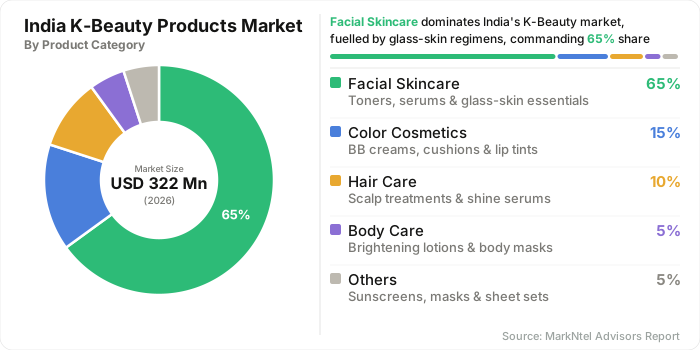
- Facial skincare dominates product categories, contributing nearly 65% share.
- The female segment accounted for around an 80% share in 2026.
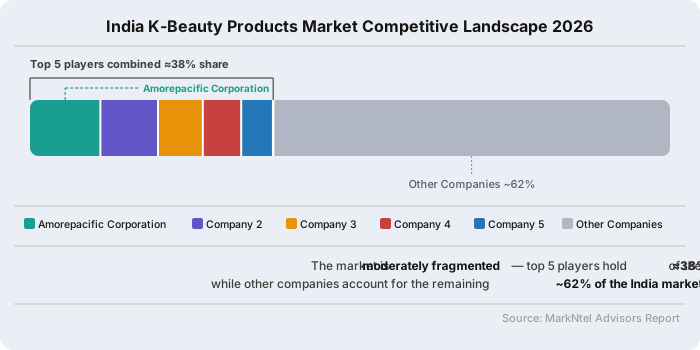
- The industry exhibits moderate fragmentation, with the top five players holding around 38% share, reflecting a balance between established global brands and emerging niche K-beauty companies.
India K-Beauty Products Market Size and Outlook
The K-beauty products market size in India was valued at USD 310 million in 2025 and is projected to grow from USD 322 million in 2026 to USD 872 million by 2032, registering a CAGR of 18.06% during 2026–2032. Growth is primarily driven by rising demand for protective skincare products and increasing adoption of functional K-beauty formulations. The shift toward skinimalism continues to influence purchasing behavior, as consumers increasingly prefer simplified routines focused on hydration, barrier repair, and long-term dermatological skin health outcomes.
The market outlook is strongly supported by India’s expanding digital infrastructure. According to the Telecom Regulatory Authority of India, India recorded 999.81 million broadband subscribers by October 2025, with average monthly data consumption reaching approximately 24 GB per wireless user. This digital penetration is accelerating online beauty retail, enabling faster product discovery through influencer-led content and seamless purchase conversions via e-commerce platforms.
Expansion is further reinforced by the rapid growth of the broader beauty ecosystem. As per the India Brand Equity Foundation, India’s beauty and personal care market is projected to expand from USD 28 billion in 2024 to nearly USD 34 billion by 2028 . This growth is significantly increasing premium skincare demand in India, creating a wider consumer base for Korean brands to scale across both urban and emerging markets with innovative and differentiated product portfolios.
Looking beyond 2026, strategic investments by global players are expected to accelerate innovation and long-term growth. L'Oréal announced the acquisition of a majority stake in Innovist, highlighting India’s position as a high-growth skincare market . Such developments will strengthen K-beauty market growth drivers, including localized manufacturing, product innovation, and omnichannel expansion, ultimately supporting sustained and scalable growth in the India K-beauty products industry over the forecast period.
India K-Beauty Products Market Key Indicators
- The World Bank reported India's urban population at 36.87% of the total in 2024 . Metropolitan concentration matters for Korean beauty because tier-one consumers in Mumbai, Delhi, and Bengaluru hold the disposable income, retail access, and trend exposure that convert interest in glass skin routines into recurring purchases of imported skincare.
- India's GDP per capita stood at USD 2,694.7 in 2024, with the economy expanding 6.5% that year, as per the World Bank. Rising household incomes place masstige Korean labels priced between mass and luxury squarely within the discretionary budgets of young earners, supporting steady trade-up from basic creams to multi-step regimens of serums, essences, and ampoules.
- The United Nations Department of Economic and Social Affairs estimates that one-fifth of the world's youth live in India, with over 66% of the population under the age of 35. This concentration of trend-receptive consumers forms the primary adopter base for derma-cosmetics and treatment-led routines, giving the industry a multi-decade demographic runway few markets can match.
- The World Bank reported that India received USD 129 billion in remittances in 2024, equivalent to roughly 3.4% of GDP, the highest inflow of any country. These transfers lift household discretionary spending in urban and semi-urban homes, supporting trade-up into imported skincare and sustaining repeat purchases across cleansers, toners, and serums.
India K-Beauty Products Market Scope
| Category | Segments |
|---|---|
| By Product Category | Facial Skincare (Cleansers, Toners, Essences, Serums & Ampoules, Moisturizers, Sunscreens, Sheet Masks, Wash-off Masks, Others), Color Cosmetics (Face Makeup, Eye Makeup, Lip Makeup, Nail Products), Hair Care (Shampoo, Conditioner, Hair Masks, Hair Serums, Scalp Treatments, Styling Products), Body Care (Body Lotion, Body Wash, Scrubs, Hand & Foot Care), Fragrances, Beauty Devices & Tools |
| By Distribution Channel | Online (Direct-to-Consumer (Brand Websites), Third-Party E-commerce Platforms), Offline (Specialty Beauty Stores, Hypermarkets & Supermarkets, Department Stores, Pharmacies & Drugstores, Convenience Stores |
| By Price Tier | Mass, Mid-Premium, Premium, Luxury |
| By End User | Male, Female |
India K-Beauty Products Market Growth Drivers
Rising Skin-Health Awareness and Demand for Protective Skincare
Mounting concern over skin damage from urban air pollution is the foremost growth driver for the India K-beauty products industry. India ranked as the fifth most polluted country worldwide in 2024, with New Delhi recording an annual average PM2.5 concentration of 91.6 µg/m³, the most polluted capital globally. Such exposure accelerates oxidative stress, dullness, and skin-barrier damage, pushing consumers toward protective, antioxidant-rich skincare.
The scale of exposure underpins durable demand. Six of the world's ten most polluted cities were located in India in 2024, and prolonged PM2.5 exposure shortens average life expectancy in the country by an estimated 5.2 years, reinforcing daily skin-protection habits. Korean formulations answer this need precisely through lightweight sunscreen (SPF), antioxidant serums, and barrier repair ingredients such as centella asiatica and panthenol suited to humid, polluted conditions.
This dynamic favors brands that lead on functional, dermatologically positioned claims rather than cosmetic cover-up. Korean labels emphasizing acne control, pigmentation correction, and pollution defense are best placed to convert first-time buyers into routine users, while domestic players increasingly localise similar actives. Consequently, skin-health positioning, not fragrance or packaging alone, will determine which participants capture sustained, repeat-driven demand across India's metros and fast-urbanising tier-2 cities.
Recent Trends
Adoption of Skinimalism with Functional Products
The India K-beauty products market is witnessing a shift toward skinimalism, driven by increasing dermatological awareness and demand for simplified skincare routines. Experts are emphasizing minimal yet effective regimens focused on cleansing, hydration, and sun protection to prevent skin barrier damage. This transition is encouraging consumers to replace multi-step routines with multifunctional skincare products that deliver combined benefits such as hydration, repair, and brightening, aligning with evolving preferences for efficiency and long-term skin health.
This trend is further reinforced by retail expansion and product innovation. In January 2025, Korean brand TIRTIR entered offline retail through Reliance Retail’s Tira platform, introducing Milk Skin Toner and Ceramic Milk Ampoule. These products emphasize hydration, barrier repair, and efficacy-driven formulations, reflecting the growing demand for K-beauty functional products that simplify routines while maintaining performance. The offline expansion also highlights increasing consumer trust in curated K-beauty offerings.
The continued investments in science-backed skincare and ingredient-focused formulations are expected to sustain this trend. Beauty retailers and global brands are expanding portfolios centered on skinimalism trend principles, targeting urban and emerging city consumers seeking convenience and results. As awareness grows and product accessibility improves, multifunctional skincare formats are likely to dominate innovation pipelines, reinforcing a long-term shift toward simplified, high-performance beauty solutions in the India K-beauty products industry.
India K-Beauty Products Market Opportunities and Challenges
Complex Cosmetic Import Regulation Driving Demand for Duty-Free CEPA Sourcing and Local Manufacturing
Regulatory compliance remains a primary challenge in the India K-beauty products industry. All imported cosmetics must be registered with the Central Drugs Standard Control Organisation under the Cosmetics Rules, 2020, alongside mandatory labeling and ingredient compliance aligned with BIS standards such as IS 4707. Approval timelines typically range from three to six months, increasing entry costs and delaying time-to-market, particularly for smaller brands without established Indian distribution partners, thereby restricting speed-to-scale and competitive agility.
However, India’s growing acceptance of Korean skincare is creating strong opportunities through K-beauty localization strategies. Korean brands are increasingly partnering with Indian distributors and compliance specialists to navigate regulatory frameworks efficiently. These collaborations provide support in CDSCO registration, retail onboarding, and documentation management, significantly reducing operational friction. As a result, new entrants can accelerate their market entry timelines while maintaining regulatory compliance, enabling faster penetration across both online and offline retail ecosystems.
Furthermore, the rise of OEM/ODM beauty partnerships and India-Korea beauty collaboration is enabling localized manufacturing and product customization. Korean manufacturers are working with Indian partners to adapt formulations to local climate conditions, skin types, and price sensitivities. This hybrid model, combining Korean innovation with domestic production, helps brands reduce costs, improve accessibility, and scale effectively across mass and masstige segments, transforming regulatory complexity into a long-term strategic advantage for India K-beauty products market.
Segmentation Insights
Facial Skincare Dominance Driven by Routine-Based Consumption and Product Innovation
The India K-beauty products market is led by the facial skincare segment, accounting for nearly 65% of total revenue. This dominance is driven by strong consumer focus on skin health, hydration, and anti-aging solutions. Increasing awareness of preventive skincare and rising demand for K-beauty facial products are accelerating segment growth. Consumers are prioritizing targeted treatments that deliver visible results, reinforcing the segment’s leadership across both premium and masstige categories.
Growth in this segment is further supported by digital adoption and expanding retail access. According to the Telecom Regulatory Authority of India, rising internet penetration is enabling consumers to explore skincare routines and purchase products online, strengthening facial skincare demand. E-commerce platforms and curated beauty retailers are expanding their Korean skincare portfolios, improving accessibility across metro and Tier II cities and accelerating product adoption.
Looking ahead, continued innovation and investments are expected to sustain segment dominance. Brands are increasingly introducing functional skincare products that combine hydration, barrier repair, and brightening benefits in simplified formats. These developments will strengthen facial skincare as the core growth engine within the India K-beauty products market over the forecast period. Based on product category, the scope has been divided into:
- Facial Skincare
- Color Cosmetics
- Hair Care
- Body Care
- Fragrances
- Beauty Devices & Tools
Higher Product Adoption and Routine-Based Consumption Driving Female Consumer Dominance
The India K-beauty products market is predominantly driven by the female segment, accounting for nearly 80% of total demand. This dominance is attributed to higher product adoption, structured skincare routines, and strong engagement with evolving beauty innovations. Women consumers are more inclined toward experimenting with multi-step regimens and K-beauty consumer trends, including serums, essences, and sheet masks, which reinforces consistent consumption patterns and higher spending across both premium and masstige product categories.
This segment’s growth is further supported by increasing digital influence and accessibility. According to the Telecom Regulatory Authority of India, rising internet penetration is accelerating content consumption across beauty platforms, driving female skincare demand through tutorials, reviews, and influencer-led engagement. E-commerce platforms and omnichannel retailers are effectively targeting female consumers with curated product offerings, subscription models, and personalized recommendations, strengthening repeat purchases and long-term brand loyalty.
The continued product innovation and targeted marketing strategies are expected to sustain segment dominance. Brands are increasingly focusing on women beauty consumption patterns by introducing functional and dermatologically tested formulations tailored to diverse skin concerns. At the same time, rising workforce participation and disposable incomes among women are supporting premium product adoption, positioning female consumers as the primary growth driver over the forecast period. The study categorizes key end users into the following segments:
- Male
- Female
India K-Beauty Products Market Competitive Analysis
The India K-beauty products industry is led by key global players including Amorepacific Corporation, LG Household & Health Care, COSRX, TONYMOLY, and Able C&C. Collectively, these companies account for an estimated 38% market share, indicating a moderately fragmented market structure. The market remains highly competitive with the presence of emerging indie brands, alongside increasing localization strategies. The competitive landscape is characterized by innovation-led differentiation, strong digital distribution, and growing partnerships with Indian retailers, enabling both established and niche brands to scale effectively.
Leading Companies in India K-Beauty Products Market
- Amorepacific Corporation
- LG Household & Health Care (LG H&H)
- Aekyung Industrial Co., Ltd.
- COSRX, Inc.
- CLIO Cosmetics Co., Ltd.
- TONYMOLY Co., Ltd.
- Nature Republic Co., Ltd.
- Able C&C Co., Ltd. (Missha)
- APR Corp.
- Abib Co., Ltd.
- Anua
- Beauty of Joseon
- Round Lab
- SOME BY MI
- Isntree
- Others
India K-Beauty Products Industry News and Recent Developments
March 2026: APR Expands into India Through Medicube Launch on Nykaa
South Korean beauty technology company APR entered the Indian market through a strategic partnership with Nykaa, launching its flagship Medicube brand. The rollout includes leading skincare lines such as Zero, PDRN, Collagen, and Deep Vita C, with products initially available online and scheduled for expansion into offline retail stores.
Impact Analysis: The development strengthens India’s position as a strategic destination for premium Korean skincare brands. Medicube’s entry increases competition within the science-backed skincare category while expanding consumer access to clinically positioned K-beauty products. The partnership also highlights the growing importance of omnichannel distribution, as brands increasingly combine digital and physical retail channels to maximize reach.
November 2025: ONLY Partners with Laneige for Fashion and Beauty Collaboration
Fashion retailer ONLY partnered with Korean beauty brand Laneige to launch a fashion-and-beauty collaboration aimed at combining skincare with lifestyle retail experiences. The initiative brought together Laneige’s premium skincare, reflecting growing convergence between beauty, fashion, and experiential consumer engagement. The collaboration was designed to increase brand visibility among young consumers while promoting Korean beauty products through non-traditional retail touchpoints and integrated marketing initiatives.
Impact Analysis: The collaboration demonstrates how K-beauty brands are diversifying customer acquisition strategies beyond beauty-specialist channels. The partnership also reflects the increasing premiumization of the Indian beauty market, where lifestyle-driven purchasing decisions are becoming more influential. Such cross-industry collaborations are expected to improve brand awareness, enhance consumer trial rates, and create new distribution opportunities, supporting the long-term expansion of premium Korean skincare brands in India’s evolving beauty landscape.
June 2025: Anua Launches in India Through Exclusive Nykaa Partnership
Korean skincare brand Anua officially entered India through an exclusive partnership with Nykaa, making its product portfolio available through the platform’s website, mobile application, and more than 230 retail stores nationwide. The launch introduced popular products including the Heartleaf 77% Soothing Toner, Niacinamide 10% + TXA 4% Serum, and Heartleaf Pore Control Cleansing Oil. Anua’s arrival reflects increasing demand for ingredient-focused and sensitive-skin-friendly Korean skincare solutions among Indian consumers.
Impact Analysis: Anua’s entry further strengthens the localization and expansion of K-beauty within India. The partnership expands product variety in the fast-growing Korean skincare segment while reinforcing Nykaa’s role as a leading gateway for international beauty brands. As more Korean brands secure large-scale retail partnerships, market accessibility and consumer awareness are expected to increase substantially. This trend is likely to intensify competition, encourage product innovation, and support the sustained growth of the India K-beauty products industry.
- Market Segmentation
- Introduction
- Product Definition
- Research Process
- Assumptions
- Executive Summary
- India K-Beauty Products Market Policies, Regulations, and Product Standards
- India K-Beauty Products Production Trend 2022-2032
- India K-Beauty Products Trend by Type of Product Category
- Facial Skincare
- Color Cosmetics
- Hair Care
- Body Care
- Fragrances
- Beauty Devices & Tools
- Company Wise Production Plants and Statistics
- Installed Production Capacity
- Actual Production
- Planned Production Target
- India K-Beauty Products Trend by Type of Product Category
- India K-Beauty Products Pricing Analysis 2022-2032
- India K-Beauty Products Pricing Trend 2022-2032
- India K-Beauty Products Pricing Trend by Product Category 2022-2032
- Facial Skincare
- Color Cosmetics
- Hair Care
- Body Care
- Fragrances
- Beauty Devices & Tools
- India K-Beauty Products Market Dynamics
- Growth Factors
- Challenges
- India K-Beauty Products Market Import & Export Analysis
- India K-Beauty Products Market Hotspot & Opportunities
- India K-Beauty Products Market Outlook, 2022-2032F
- Market Size & Outlook
- By Revenues (USD Million)
- Market Share & Outlook
- By Product Category - Market Size & Forecast 2022-2032, USD Million
- Facial Skincare
- Cleansers
- Toners
- Essences
- Serums & Ampoules
- Moisturizers
- Sunscreens
- Sheet Masks
- Wash-off Masks
- Others
- Color Cosmetics
- Face Makeup
- Eye Makeup
- Lip Makeup
- Nail Products
- Hair Care
- Shampoo
- Conditioner
- Hair Masks
- Hair Serums
- Scalp Treatments
- Styling Products
- Body Care
- Body Lotion
- Body Wash
- Scrubs
- Hand & Foot Care
- Fragrances
- Beauty Devices & Tools
- Facial Skincare
- By Distribution Channel - Market Size & Forecast 2022-2032, USD Million
- Online
- Direct-to-Consumer (Brand Websites)
- Third-Party E-commerce Platforms
- Offline
- Specialty Beauty Stores
- Hypermarkets & Supermarkets
- Department Stores
- Pharmacies & Drugstores
- Convenience Stores
- Online
- By Price Tier - Market Size & Forecast 2022-2032, USD Million
- Mass
- Mid-Premium
- Premium
- Luxury
- By End User - Market Size & Forecast 2022-2032, USD Million
- Male
- Female
- By Region- Market Size & Forecast 2022-2032, USD Million
- North
- South
- East
- West
- By Company
- Competition Characteristics
- Market Share & Analysis
- By Product Category - Market Size & Forecast 2022-2032, USD Million
- Market Size & Outlook
- India K-Beauty Facial Skincare Products Market Outlook, 2022-2032
- Market Size & Outlook
- By Revenues (USD Million)
- Market Segmentation & Outlook
- By Distribution Channel - Market Size & Forecast 2022-2032, USD Million
- By Price Tier - Market Size & Forecast 2022-2032, USD Million
- By End User - Market Size & Forecast 2022-2032, USD Million
- By Region- Market Size & Forecast 2022-2032, USD Million
- Market Size & Outlook
- India K-Beauty Color Cosmetics Products Market Outlook, 2022-2032
- Market Size & Outlook
- By Revenues (USD Million)
- Market Segmentation & Outlook
- By Distribution Channel - Market Size & Forecast 2022-2032, USD Million
- By Price Tier - Market Size & Forecast 2022-2032, USD Million
- By End User - Market Size & Forecast 2022-2032, USD Million
- By Region- Market Size & Forecast 2022-2032, USD Million
- Market Size & Outlook
- India K-Beauty Hair Care Products Market Outlook, 2022-2032
- Market Size & Outlook
- By Revenues (USD Million)
- Market Segmentation & Outlook
- By Distribution Channel - Market Size & Forecast 2022-2032, USD Million
- By Price Tier - Market Size & Forecast 2022-2032, USD Million
- By End User - Market Size & Forecast 2022-2032, USD Million
- By Region- Market Size & Forecast 2022-2032, USD Million
- Market Size & Outlook
- India K-Beauty Body Care Products Market Outlook, 2022-2032
- Market Size & Outlook
- By Revenues (USD Million)
- Market Segmentation & Outlook
- By Distribution Channel - Market Size & Forecast 2022-2032, USD Million
- By Price Tier - Market Size & Forecast 2022-2032, USD Million
- By End User - Market Size & Forecast 2022-2032, USD Million
- By Region- Market Size & Forecast 2022-2032, USD Million
- Market Size & Outlook
- India K-Beauty Fragrances Products Market Outlook, 2022-2032
- Market Size & Outlook
- By Revenues (USD Million)
- Market Segmentation & Outlook
- By Distribution Channel - Market Size & Forecast 2022-2032, USD Million
- By Price Tier - Market Size & Forecast 2022-2032, USD Million
- By End User - Market Size & Forecast 2022-2032, USD Million
- By Region- Market Size & Forecast 2022-2032, USD Million
- Market Size & Outlook
- India K-Beauty Devices & Tools Market Outlook, 2022-2032
- Market Size & Outlook
- By Revenues (USD Million)
- Market Segmentation & Outlook
- By Distribution Channel - Market Size & Forecast 2022-2032, USD Million
- By Price Tier - Market Size & Forecast 2022-2032, USD Million
- By End User - Market Size & Forecast 2022-2032, USD Million
- By Region- Market Size & Forecast 2022-2032, USD Million
- Market Size & Outlook
- India K-Beauty Products Market Key Strategic Imperatives for Success & Growth
- Competitive Outlook
- Company Profiles
- Amorepacific Corporation
- Business Description
- Product Portfolio
- Collaborations & Alliances
- Recent Developments
- Financial Details
- Others
- LG Household & Health Care (LG H&H)
- Business Description
- Product Portfolio
- Collaborations & Alliances
- Recent Developments
- Financial Details
- Others
- Aekyung Industrial Co., Ltd.
- Business Description
- Product Portfolio
- Collaborations & Alliances
- Recent Developments
- Financial Details
- Others
- COSRX, Inc.
- Business Description
- Product Portfolio
- Collaborations & Alliances
- Recent Developments
- Financial Details
- Others
- CLIO Cosmetics Co., Ltd.
- Business Description
- Product Portfolio
- Collaborations & Alliances
- Recent Developments
- Financial Details
- Others
- TONYMOLY Co., Ltd.
- Business Description
- Product Portfolio
- Collaborations & Alliances
- Recent Developments
- Financial Details
- Others
- Nature Republic Co., Ltd.
- Business Description
- Product Portfolio
- Collaborations & Alliances
- Recent Developments
- Financial Details
- Others
- Able C&C Co., Ltd. (Missha)
- Business Description
- Product Portfolio
- Collaborations & Alliances
- Recent Developments
- Financial Details
- Others
- APR Corp.
- Business Description
- Product Portfolio
- Collaborations & Alliances
- Recent Developments
- Financial Details
- Others
- Abib Co., Ltd.
- Business Description
- Product Portfolio
- Collaborations & Alliances
- Recent Developments
- Financial Details
- Others
- Anua
- Business Description
- Product Portfolio
- Collaborations & Alliances
- Recent Developments
- Financial Details
- Others
- Beauty of Joseon
- Business Description
- Product Portfolio
- Collaborations & Alliances
- Recent Developments
- Financial Details
- Others
- Round Lab
- Business Description
- Product Portfolio
- Collaborations & Alliances
- Recent Developments
- Financial Details
- Others
- SOME BY MI
- Business Description
- Product Portfolio
- Collaborations & Alliances
- Recent Developments
- Financial Details
- Others
- Isntree
- Business Description
- Product Portfolio
- Collaborations & Alliances
- Recent Developments
- Financial Details
- Others
- Others
- Amorepacific Corporation
- Company Profiles
- Disclaimer

MarkNtel Advisors follows a robust and iterative research methodology designed to ensure maximum accuracy and minimize deviation in market estimates and forecasts. Our approach combines both bottom-up and top-down techniques to effectively segment and quantify various aspects of the market. A consistent feature across all our research reports is data triangulation, which examines the market from three distinct perspectives to validate findings. Key components of our research process include:
1. Scope & Research Design At the outset, MarkNtel Advisors define the research objectives and formulate pertinent questions. This phase involves determining the type of research—qualitative or quantitative—and designing a methodology that outlines data collection methods, target demographics, and analytical tools. They also establish timelines and budgets to ensure the research aligns with client goals.
2. Sample Selection and Data Collection In this stage, the firm identifies the target audience and determines the appropriate sample size to ensure representativeness. They employ various sampling methods, such as random or stratified sampling, based on the research objectives. Data collection is carried out using tools like surveys, interviews, and observations, ensuring the gathered data is reliable and relevant.
3. Data Analysis and Validation Once data is collected, MarkNtel Advisors undertake a rigorous analysis process. This includes cleaning the data to remove inconsistencies, employing statistical software for quantitative analysis, and thematic analysis for qualitative data. Validation steps are taken to ensure the accuracy and reliability of the findings, minimizing biases and errors.

4. Data Forecast and FinalizationThe final phase involves forecasting future market trends based on the analyzed data. MarkNtel Advisors utilize predictive modeling and time series analysis to anticipate market behaviors. The insights are then compiled into comprehensive reports, featuring visual aids like charts and graphs, and include strategic recommendations to inform client decision-making
FILL THE FORM TO INQUIRE BEFORE BUYING THIS REPORT
We offer flexible licensing options to cater to varying organizational needs. Choose the pricing pack that best suits your requirements:
Buy Now Talk to our Consultant
 Request Customization