

By Type (Terpenes and Terpenoids, Benzenoids and Other Aromatic Compounds, Musk Chemicals, Aliphatic Aldehydes, Alcohols and Esters, Ketones, Lactones and Other Specialty Fragrance...... Chemicals), By Production Route (Conventional Synthetic Fragrance Chemicals, Plant-Derived Natural Isolates, Plant-Derived Semi-Synthetic Fragrance Chemicals, Biotechnology), By End-Use Application (Fine Fragrances, Personal Care & Cosmetics, Soaps, Detergents and Fabric Care, Household and Air Care, Other Applications), and others Read more
- Chemicals
- Aug 2026
- 224
- PDF, Excel, PPT
Europe Fragrance Chemicals Market Key Takeaways
- The market is expected to rise from USD 1.31 billion in 2025 to USD 1.37 billion in 2026, and is further projected to reach USD 1.83 billion by 2032, representing a 4.94% CAGR.
- Cosmetics and Personal Care represent the leading end-use application, accounting for an estimated 32% market share in 2026.
- Terpenes and Terpenoids lead by product type, accounting for an estimated 38% market share in 2026.
- Germany is the leading regional market, with an estimated 24% market share in 2026.
- The market is fragmented, with the top five companies collectively accounting for an estimated 46% market share.
Europe Fragrance Chemicals Market Size and Outlook
The fragrance chemicals market in Europe was valued at an estimated USD 1.31 billion in 2025 and is projected to reach approximately USD 1.37 billion in 2026. It is forecast to expand at a CAGR of around 4.94% during 2026–2032, reaching nearly USD 1.83 billion by 2032.
Market expansion is supported by Europe’s extensive production and consumption of perfumes, cosmetics, personal-care products, detergents, and household-care formulations. Cosmetics Europe valued the regional cosmetics and personal-care market at approximately USD 124 billion in 2025, including approximately USD 19.3 billion from fragrances and perfumes. This downstream scale creates recurring requirements for terpenoids, benzenoids, musks, aldehydes, esters, and other specialty molecules across new launches and continuing formulations. Demand extends beyond fine fragrance: Detergents Europe estimates that the regional cleaning and hygiene products industry has a market value of approximately USD 56.5 billion. Laundry detergents, fabric conditioners, surface cleaners and air-care products require ingredients offering diffusion, substantivity, stability and compatibility with concentrated formulations, broadening the addressable market beyond discretionary perfume purchases.
Through 2032, growth is expected to reflect moderate expansion in conventional synthetic volumes alongside faster value migration toward renewable-feedstock, biotechnology-derived and high-performance specialty chemicals. Regulatory reformulation, expanded allergen disclosure, and customer sustainability requirements should accelerate substitution of selected established molecules and support premiums for safer, traceable, and lower-impact alternatives. However, the market’s maturity, extended qualification cycles, energy and feedstock costs, and price competition from Asian suppliers are likely to restrain volume and realization gains. Fragrance chemical companies combining reliable European availability with regulatory documentation, application support and differentiated molecules should therefore outperform commodity-focused participants, while fine fragrances, personal care, fabric care and air care remain the principal demand pools.
Europe Fragrance Chemicals Market Key Indicators
- The International Fragrance Association reported in January 2025 that Europe’s fragrance industry comprised about 750 SMEs, which generated 50% of its economic output, and supplied fragrance technologies used across more than 500,000 everyday products. This broad producer and application base supports demand for both standardized molecules and low-volume, specialized ingredients.
- The French Federation of Beauty Companies (FEBEA) reported that French perfume exports increased 1.9% to approximately USD 9.04 billion in 2025 and had more than doubled over six years. Continued export growth from Europe’s largest fine-fragrance production center sustains ingredient procurement, formulation turnover and demand for distinctive high-performance molecules.
- Cosmetica Italia reported Italian beauty-industry revenue of approximately USD 20.34 billion in 2025, increasing 2.9%, while exports rose 4.1% to approximately USD 9.72 billion. This expansion strengthens ingredient consumption across fragrances, toiletries and personal care while reinforcing Italy’s role as a regional customer.
- The European Chemical Industry Council reported EU27 chemicals capacity utilization of 74.6% in the first half of 2025, 9.5% below its pre-crisis operating level, while European gas prices were three times US levels. Underutilization and energy disadvantages constrain local commodity aroma-chemical economics, increasing pressure for specialty differentiation, efficient processes and selective imports.
Europe Fragrance Chemicals Market Regulatory and Compliance Analysis
Expanded Allergen Disclosure and CLP Requirements Elevate Reformulation Capabilities as a Supplier Differentiator
Europe’s fragrance chemicals industry entered a reformulation phase on 31 July 2026, when the first transition period under Commission Regulation (EU) 2023/1545 expired. The measure expands individual disclosure of fragrance allergens while retaining thresholds of 0.001% in leave-on and 0.01% in rinse-off cosmetics. Products placed on the EU market before the deadline may remain available only until 31 July 2028. Suppliers must consequently provide more granular composition, purity, and allergen data, while fragrance houses and cosmetics manufacturers screen established formulas and labels across portfolios.
Classification obligations are tightening under Regulation (EU) 2024/2865, which revises the Classification, Labelling and Packaging framework. Provisions applying from 1 July 2026 allow qualifying substances and mixtures marketed earlier to transition until 1 July 2028; a further group applies from 1 January 2027, with qualifying legacy stock transitioning until 1 January 2029. The staged timetable spreads implementation cost but does not remove dossier, label and customer-communication work. These requirements can shorten the commercial life of poorly documented or difficult-to-substitute molecules. Conversely, they strengthen opportunities for suppliers offering low-allergen alternatives, traceable production, standardized dossiers and application support. Through 2032, regulatory readiness should become a purchasing criterion, favoring reformulation that preserves odor profile, stability, dosage and cost.
Europe Fragrance Chemicals Market Scope
| Category | Segments |
|---|---|
| By Type | Terpenes and Terpenoids, Benzenoids and Other Aromatic Compounds, Musk Chemicals, Aliphatic Aldehydes, Alcohols and Esters, Ketones, Lactones and Other Specialty Fragrance Chemicals |
| By Production Route | Conventional Synthetic Fragrance Chemicals, Plant-Derived Natural Isolates, Plant-Derived Semi-Synthetic Fragrance Chemicals, Biotechnology |
| By End-Use Application | Fine Fragrances, Personal Care & Cosmetics, Soaps, Detergents and Fabric Care, Household and Air Care, Other Applications |
Europe Fragrance Chemicals Market Growth Drivers
Fine-Fragrance Expansion and Product Proliferation Broaden Formulation Demand
Finished-fragrance growth is increasing the volume and variety of chemical inputs required by European formulators. Each new perfume, concentration or extension creates a formulation brief involving aroma molecules, performance testing and differentiated scent signatures. Circana data covering France, Germany, Italy, Spain and the UK showed fragrance sales rising 4.5% year-on-year in the first quarter of 2025, outperforming skincare and makeup. Higher concentrations and sub-20-milliliter formats were among the principal growth areas, indicating simultaneous demand for stronger olfactory performance and accessible trial sizes.
Downstream manufacturers are expanding accordingly. In November 2025, L’Oréal announced an investment of more than USD 69 million in its Gauchy fragrance plant in France and doubled production capacity. The expansion matters to fragrance-chemical suppliers because higher finished-product throughput increases recurring ingredient requirements, while large multi-brand beauty groups generate considerable formulation breadth. New launches and extensions also require formula-specific molecule combinations, stability across concentrations and reliable commercial-scale supply. Suppliers combining broad portfolios with rapid sampling, application support and batch consistency should therefore capture disproportionate benefit. Continued investment by European beauty manufacturers is expected to enlarge addressable chemical demand through 2032, even when finished-fragrance sales grow partly through product mix and pricing.
Recent Trends
Measurable Carbon and Biodegradability Profiles Are Reshaping Molecule Design
European fragrance-chemical suppliers are translating sustainability targets into measurable molecule specifications rather than relying only on natural-positioning claims. Product carbon footprint, renewable-carbon content and biodegradability are increasingly being disclosed alongside odor and application performance. In April 2025, BASF commercialized its first reduced-carbon-footprint aroma ingredient, offering a 10–15% reduction versus its conventional equivalent. The company applies mass balancing without changing the production process, enabling customers to retain quality and avoid requalification while reducing purchased-material emissions. This approach makes lower-carbon variants easier to adopt across existing fragrance and personal-care formulations.
Recent launches show the same criteria being embedded in new molecule design. BASF’s Micadelva, introduced in Europe in May 2026, contains 80% renewable carbon, is readily biodegradable and is expected to have a product carbon footprint below 2 kilograms of CO₂ equivalent per kilogram, while providing a longer-lasting citrus profile. In June 2026, Givaudan launched Scentaurus Aquamelon, an OECD-biodegradable, oxygen-activated molecule that gradually releases notes in hair, beauty and fabric-care applications. These products demonstrate that suppliers are combining lower environmental impact with longevity and formulation performance. Through 2032, quantified sustainability attributes should influence customer qualification, allowing differentiated molecules to command preference without requiring customers to sacrifice sensory effect or processing reliability.
Europe Fragrance Chemicals Market Opportunities and Challenges
Downstream Fragrance Insourcing Pressures Intermediaries While Expanding Direct Molecule-Supply Opportunities
Vertical integration by consumer-goods buyers is changing how fragrance-chemical suppliers access formulation briefs. When brand owners internalize fragrance design, compounding and ingredient procurement, external fragrance houses can lose development work, face greater price transparency and encounter stricter molecule-level qualification. In May 2025, Unilever announced GBP 80 million (USD 107 million) for in-house fragrance capabilities and a proposed Port Sunlight facility comprising research, compounding and evaluation operations. Robotics, real-time data and artificial intelligence will support development. This scale of insourcing can concentrate purchasing power and require suppliers to demonstrate performance, documentation and supply reliability beyond creative services.
However, the company explicitly stated that it would continue working with key fragrance-house partners, indicating that the emerging model is hybrid rather than captive. This creates an opening for producers of discrete aroma chemicals and proprietary molecules: internal perfumers still require broad palettes, samples, regulatory dossiers and commercial volumes. Faster in-house iteration may increase the number of molecules screened and purchased even when less composition work is outsourced. Fragrance houses can protect their position through exclusive ingredients, application testing and digital formulation support, while chemical manufacturers pursue direct brand-owner relationships. Through 2032, suppliers integrating molecule supply with technical data and rapid co-development should gain access, whereas businesses relying on opaque bundled formulations face mounting pressure.
Segmentation Insights
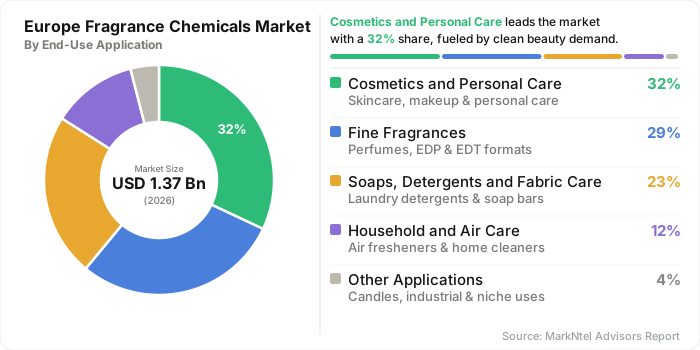
Cosmetics and Personal Care Lead Through Recurring Multi-Format Demand, Accounting for an Estimated 32% Market Share in 2026
Cosmetics and personal-care products create recurring demand across skin care, hair care, deodorants, body washes, oral care, shaving products and color cosmetics. These categories combine frequent replenishment with numerous formats, while fragrance delivers product identity, masks base-material odors and signals cleanliness or efficacy. Individual formulas use lower fragrance concentrations than perfumes, but their wider unit base and continuous reformulation across mass, premium and dermocosmetic ranges generate larger aggregate chemical demand.
German Association of Body Care and Detergent Manufacturers (IKW) reported that domestic beauty and home-care sales increased 5.5% in 2025, while skin and face care grew 11.1% and hair care expanded 8.1%. These formulation-intensive categories require access to floral, citrus, musk, aldehydic and specialty molecules compatible with surfactants, emulsions and active ingredients. Suppliers offering low color contribution, allergen documentation and application testing can address a wider customer base than fine-fragrance specialists. Cosmetics and personal care should remain the largest end use through 2032.
Fine fragrances are expected to grow faster, supported by premium concentrations and frequent launches, but their narrower finished-product volume should keep total chemical demand below daily-use personal-care applications. Based on end-use application, the market is segmented into:
- Fine Fragrances
- Cosmetics and Personal Care
- Soaps, Detergents and Fabric Care
- Household and Air Care
- Other Applications
Terpenes and Terpenoids Lead Through Cross-Application Versatility, Accounting for an Estimated 38% Market Share in 2026
Terpenes and terpenoids provide citrus, floral, mint, woody, and herbal profiles through molecules including limonene, linalool, menthol, geraniol, and citronellol. Their odor range supports use in fine fragrances, shampoos, deodorants, oral care, detergents and air-care formulations. Suppliers can obtain related molecules through plant isolation, conventional synthesis, semi-synthesis and fermentation, creating multiple cost and positioning options. Large-volume availability and compatibility with natural-positioned and conventional products therefore support the segment’s leading share.
Supply investment reinforces this position. In April 2026, BASF began commercial production at newly commissioned world-scale menthol and linalool plants in Ludwigshafen, Germany. Integration with existing infrastructure improves production efficiency and supply reliability for two high-use terpene-derived ingredients. The investment demonstrates that established synthetic routes remain important alongside renewable and biotechnology-based alternatives. Terpenes and terpenoids should retain leadership through 2032 because formulators can apply familiar profiles across high-volume and premium products. Musk chemicals should grow faster from a smaller base as suppliers develop biodegradable macrocyclic and alicyclic fixatives that provide longevity while replacing less favorable legacy chemistries. Based on product type, the Europe fragrance chemicals industry is segmented into:
- Terpenes and Terpenoids
- Benzenoids and Other Aromatic Compounds
- Musk Chemicals
- Aliphatic Aldehydes, Alcohols and Esters
- Ketones, Lactones and Other Specialty Fragrance Chemicals
Europe Fragrance Chemicals Market Geographical Outlook
Germany is estimated to account for 24% market share in 2026, supported by the region’s broadest combination of chemical manufacturing, consumer-product production and demand from personal care, detergents, oral care, household products and fine fragrances. Its integrated chemical sites provide access to intermediates, utilities, technical labor and distribution infrastructure, while a large base of domestic formulators creates demand across high-volume terpenoids and specialty molecules. The wider German chemical and pharmaceutical industry generated USD 123.4 billion during the first half of 2026, despite sales declining by 1%. This industrial depth supports local qualification, production and customer service, although high costs and weak European demand are likely to restrain growth. Germany should therefore retain leadership through 2032, but its share may gradually narrow as faster-growing southern European markets expand.
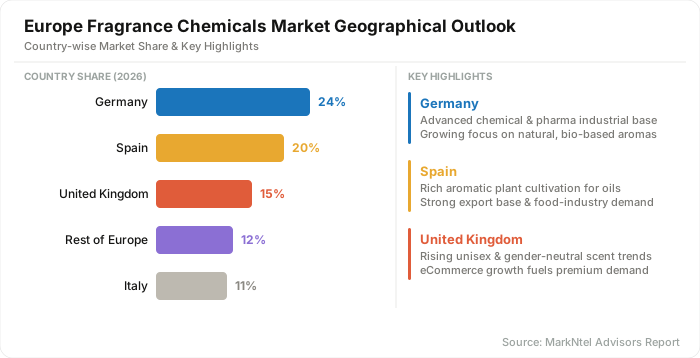
Spain is expected to record the fastest growth in the Europe fragrance chemicals market. Spain’s cosmetics and perfume market expanded by 5.8% in 2025, while perfume sales increased by 9.5% and represented 21% of the market. The country also remained the world’s second-largest perfume exporter. Expanding premium-fragrance production, export-oriented manufacturing and local consumption increase requirements for differentiated aroma molecules, natural isolates and formulation support. Spain’s growth should consequently outpace the regional average through 2032, although its smaller chemical-manufacturing base will preserve Germany’s overall lead.
Europe Fragrance Chemicals Industry Competitive Analysis
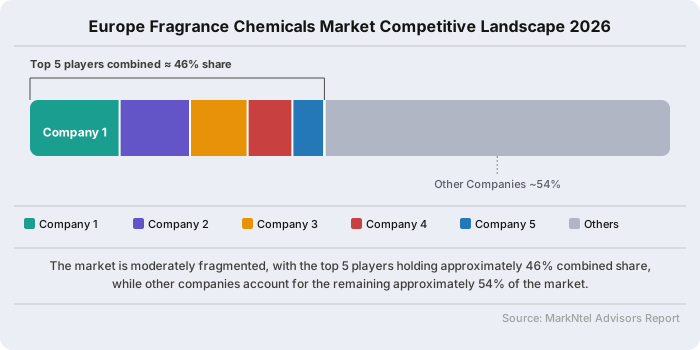
Europe fragrance chemicals market is fragmented, with the top five companies holding an estimated 46% market share. The top five players in the market are BASF SE, dsm-firmenich, Givaudan SA, International Flavors & Fragrances Inc., and Symrise AG.
Key Companies in the Europe Fragrance Chemicals Market
- BASF SE
- Bell Flavors & Fragrances, Inc.
- dsm-firmenich
- Eternis Fine Chemicals Limited
- Givaudan SA
- International Flavors & Fragrances Inc. (IFF)
- Kao Corporation
- MANE Group
- Privi Speciality Chemicals Limited
- Robertet Group
- S H Kelkar and Company Limited
- Syensqo SA
- Symrise AG
- Takasago International Corporation
- Zhejiang NHU Co., Ltd.
- Others
Europe Fragrance Chemicals Industry News and Recent Developments
-
June 2026 | MANE Announces Experimental Fragrance-Plant Garden in Grasse
MANE announced an experimental fragrance-plant garden at La Rose St Jean in Grasse, developed with farmer Sebastien Rodriguez. The open-air laboratory is intended to cultivate emblematic species and new hybrids, advance regenerative agriculture, and test JUNGLE ESSENCE and E-PURE JUNGLE ESSENCE extraction processes, including field-based work with freshly harvested plants.
Impact analysis: Bringing cultivation, agronomy and extraction trials together can shorten the path from botanical screening to differentiated natural ingredients. The project should expand MANE’s future isolate pipeline, improve raw-material resilience and intensify technology competition among Europe’s Grasse-based suppliers of premium perfumery ingredients.
-
November 2025 | IFF Installs Green-Hydrogen Facility for Fragrance-Ingredient Production
IFF installed an on-site green-hydrogen production facility at its Scent R&D and fragrance-ingredient plant in Benicarló, Spain, under a 10-year agreement with Iberdrola. Powered by renewable electricity, the system can produce 100 tons annually for hydrogenation reactions used in more than 50 ingredients, including Cashmeran and Kharismal, avoiding 2,000 tons of CO₂ emissions each year.
Impact analysis: Replacing off-site grey hydrogen lowers the production footprint of a broad ingredient portfolio and improves supply resilience through on-site generation and storage. It also raises the sustainability benchmark for competing European aroma-chemical plants and supports customers’ formulation-level decarbonization goals.
-
September 2025 | Givaudan Launches Labdanum Absolute SIGNature
Givaudan launched Labdanum Absolute SIGNature, a market-wide natural fragrance ingredient developed in Grasse from cistus harvested in Andalusia, Spain. Advanced engineering refines crude cistus extract into a highly purified absolute with a dry amber profile and woody and mineral nuances for fine-fragrance and personal-care applications.
Impact analysis: Market-wide availability broadens perfumers’ access to a differentiated, traceable Mediterranean natural and expands competition within high-value plant-derived isolates. Refining locally sourced crude extract into a standardized ingredient can also improve formulation consistency while supporting premium positioning in fine-fragrance and personal-care briefs.
-
September 2025 | Syensqo Announces Restart of French Synthetic-Vanillin Production
Syensqo announced that its mothballed synthetic-vanillin unit in Saint-Fons, France, was scheduled to resume operations by the end of 2025. The restart followed the EU’s 131% anti-dumping duties and was intended to increase regional output and serve European food, flavor and fragrance customers. The site continued producing natural vanillin and hydroquinone while synthetic capacity was offline.
Impact analysis: Restoring local synthetic-vanillin production increases European capacity for a widely used benzenoid fragrance chemical and reduces dependence on Asian imports. The additional regional output should improve supply continuity while increasing price competition between European and imported material.
- Market Segmentation
- Introduction
- Product Definition
- Research Process
- Assumptions
- Executive Summary
- Europe Fragrance Chemicals Market Supply Chain Analysis
- Europe Fragrance Chemicals Market Production Capabilities
- Europe Fragrance Chemicals Market Pricing Analysis
- Europe Fragrance Chemicals Market Policies, Regulations, and Product Standards
- Europe Fragrance Chemicals Market Trends & Developments
- Europe Fragrance Chemicals Market Dynamics
- Growth Factors
- Challenges
- Europe Fragrance Chemicals Market Hotspot & Opportunities
- Europe Fragrance Chemicals Market Outlook, 2022-2032
- Market Size & Outlook
- By Revenues (USD Million)
- By Quantity Sold (Thousand Tons)
- Market Segmentation & Outlook
- By Type- Market Size & Forecast 2022-2032, USD Million & Thousand Tons
- Terpenes and Terpenoids
- Benzenoids and Other Aromatic Compounds
- Musk Chemicals
- Aliphatic Aldehydes, Alcohols and Esters
- Ketones, Lactones and Other Specialty Fragrance Chemicals
- By Production Route- Market Size & Forecast 2022-2032, USD Million & Thousand Tons
- Conventional Synthetic Fragrance Chemicals
- Plant-Derived Natural Isolates
- Plant-Derived Semi-Synthetic Fragrance Chemicals
- Biotechnology- and Fermentation-Derived Fragrance Chemicals
- By End-Use Application- Market Size & Forecast 2022-2032, USD Million & Thousand Tons
- Fine Fragrances
- Personal Care & Cosmetics
- Soaps, Detergents and Fabric Care
- Household and Air Care
- Other Applications
- By Country
- Germany
- France
- United Kingdom
- Italy
- Spain
- Switzerland
- Rest of Europe
- By Company
- Competition Characteristics
- Market Share & Analysis
- By Type- Market Size & Forecast 2022-2032, USD Million & Thousand Tons
- Market Size & Outlook
- Germany Fragrance Chemicals Market Outlook, 2022-2032
- Market Size & Outlook
- By Revenues (USD Million)
- By Quantity Sold (Thousand Tons)
- Market Segmentation & Outlook
- By End-Use Application- Market Size & Forecast 2022-2032, USD Million & Thousand Tons
- By Product Type- Market Size & Forecast 2022-2032, USD Million & Thousand Tons
- By Production Route- Market Size & Forecast 2022-2032, USD Million & Thousand Tons
- Market Size & Outlook
- France Fragrance Chemicals Market Outlook, 2022-2032
- Market Size & Outlook
- By Revenues (USD Million)
- By Quantity Sold (Thousand Tons)
- Market Segmentation & Outlook
- By End-Use Application- Market Size & Forecast 2022-2032, USD Million & Thousand Tons
- By Product Type- Market Size & Forecast 2022-2032, USD Million & Thousand Tons
- By Production Route- Market Size & Forecast 2022-2032, USD Million & Thousand Tons
- Market Size & Outlook
- United Kingdom Fragrance Chemicals Market Outlook, 2022-2032
- Market Size & Outlook
- By Revenues (USD Million)
- By Quantity Sold (Thousand Tons)
- Market Segmentation & Outlook
- By End-Use Application- Market Size & Forecast 2022-2032, USD Million & Thousand Tons
- By Product Type- Market Size & Forecast 2022-2032, USD Million & Thousand Tons
- By Production Route- Market Size & Forecast 2022-2032, USD Million & Thousand Tons
- Market Size & Outlook
- Italy Fragrance Chemicals Market Outlook, 2022-2032
- Market Size & Outlook
- By Revenues (USD Million)
- By Quantity Sold (Thousand Tons)
- Market Segmentation & Outlook
- By End-Use Application- Market Size & Forecast 2022-2032, USD Million & Thousand Tons
- By Product Type- Market Size & Forecast 2022-2032, USD Million & Thousand Tons
- By Production Route- Market Size & Forecast 2022-2032, USD Million & Thousand Tons
- Market Size & Outlook
- Spain Fragrance Chemicals Market Outlook, 2022-2032
- Market Size & Outlook
- By Revenues (USD Million)
- By Quantity Sold (Thousand Tons)
- Market Segmentation & Outlook
- By End-Use Application- Market Size & Forecast 2022-2032, USD Million & Thousand Tons
- By Product Type- Market Size & Forecast 2022-2032, USD Million & Thousand Tons
- By Production Route- Market Size & Forecast 2022-2032, USD Million & Thousand Tons
- Market Size & Outlook
- Switzerland Fragrance Chemicals Market Outlook, 2022-2032
- Market Size & Outlook
- By Revenues (USD Million)
- By Quantity Sold (Thousand Tons)
- Market Segmentation & Outlook
- By End-Use Application- Market Size & Forecast 2022-2032, USD Million & Thousand Tons
- By Product Type- Market Size & Forecast 2022-2032, USD Million & Thousand Tons
- By Production Route- Market Size & Forecast 2022-2032, USD Million & Thousand Tons
- Market Size & Outlook
- Europe Fragrance Chemicals Market Key Strategic Imperatives for Success & Growth
- Competitive Outlook
- Company Profiles
- BASF SE
- Business Description
- Product Portfolio
- Collaborations & Alliances
- Recent Developments
- Financial Details
- Others
- Bell Flavors & Fragrances, Inc.
- Business Description
- Product Portfolio
- Collaborations & Alliances
- Recent Developments
- Financial Details
- Others
- dsm-firmenich AG
- Business Description
- Product Portfolio
- Collaborations & Alliances
- Recent Developments
- Financial Details
- Others
- Eternis Fine Chemicals Limited
- Business Description
- Product Portfolio
- Collaborations & Alliances
- Recent Developments
- Financial Details
- Others
- Givaudan SA
- Business Description
- Product Portfolio
- Collaborations & Alliances
- Recent Developments
- Financial Details
- Others
- International Flavors & Fragrances Inc.
- Business Description
- Product Portfolio
- Collaborations & Alliances
- Recent Developments
- Financial Details
- Others
- Kao Corporation
- Business Description
- Product Portfolio
- Collaborations & Alliances
- Recent Developments
- Financial Details
- Others
- MANE SA
- Business Description
- Product Portfolio
- Collaborations & Alliances
- Recent Developments
- Financial Details
- Others
- Privi Speciality Chemicals Limited
- Business Description
- Product Portfolio
- Collaborations & Alliances
- Recent Developments
- Financial Details
- Others
- Robertet SA
- Business Description
- Product Portfolio
- Collaborations & Alliances
- Recent Developments
- Financial Details
- Others
- S H Kelkar and Company Limited
- Business Description
- Product Portfolio
- Collaborations & Alliances
- Recent Developments
- Financial Details
- Others
- Syensqo SA/NV
- Business Description
- Product Portfolio
- Collaborations & Alliances
- Recent Developments
- Financial Details
- Others
- Symrise AG
- Business Description
- Product Portfolio
- Collaborations & Alliances
- Recent Developments
- Financial Details
- Others
- Takasago International Corporation
- Business Description
- Product Portfolio
- Collaborations & Alliances
- Recent Developments
- Financial Details
- Others
- Zhejiang NHU Co., Ltd.
- Business Description
- Product Portfolio
- Collaborations & Alliances
- Recent Developments
- Financial Details
- Others
- Others
- BASF SE
- Company Profiles
- Disclaimer

MarkNtel Advisors follows a robust and iterative research methodology designed to ensure maximum accuracy and minimize deviation in market estimates and forecasts. Our approach combines both bottom-up and top-down techniques to effectively segment and quantify various aspects of the market. A consistent feature across all our research reports is data triangulation, which examines the market from three distinct perspectives to validate findings. Key components of our research process include:
1. Scope & Research Design At the outset, MarkNtel Advisors define the research objectives and formulate pertinent questions. This phase involves determining the type of research—qualitative or quantitative—and designing a methodology that outlines data collection methods, target demographics, and analytical tools. They also establish timelines and budgets to ensure the research aligns with client goals.
2. Sample Selection and Data Collection In this stage, the firm identifies the target audience and determines the appropriate sample size to ensure representativeness. They employ various sampling methods, such as random or stratified sampling, based on the research objectives. Data collection is carried out using tools like surveys, interviews, and observations, ensuring the gathered data is reliable and relevant.
3. Data Analysis and Validation Once data is collected, MarkNtel Advisors undertake a rigorous analysis process. This includes cleaning the data to remove inconsistencies, employing statistical software for quantitative analysis, and thematic analysis for qualitative data. Validation steps are taken to ensure the accuracy and reliability of the findings, minimizing biases and errors.

4. Data Forecast and FinalizationThe final phase involves forecasting future market trends based on the analyzed data. MarkNtel Advisors utilize predictive modeling and time series analysis to anticipate market behaviors. The insights are then compiled into comprehensive reports, featuring visual aids like charts and graphs, and include strategic recommendations to inform client decision-making
FILL THE FORM TO INQUIRE BEFORE BUYING THIS REPORT
We offer flexible licensing options to cater to varying organizational needs. Choose the pricing pack that best suits your requirements:
Buy Now Talk to our Consultant
 Request Customization