

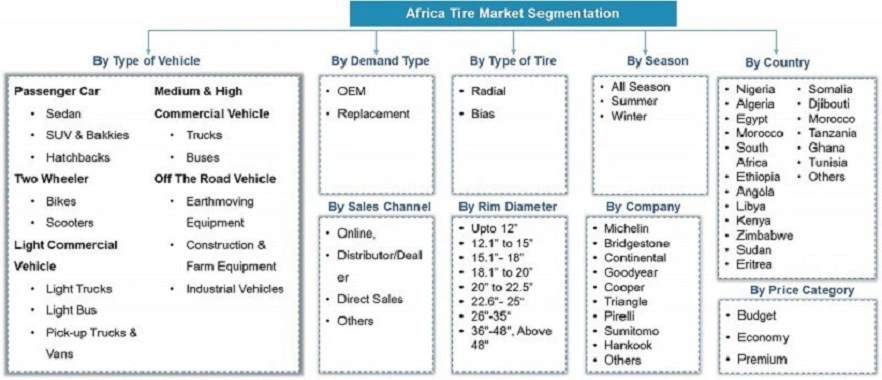
By Tire Type (Radial, Bias), By Vehicle Type (Three-Wheeler, Two Wheelers, Passenger Car, Light Commercial Vehicle (LCV), Medium & Heavy Commercial Vehicle (MHCV), Off-the-Road Veh......icle (OTR)), By Demand Type (OEM, Replacement), By Season (Summer, Winter, All-Season), By Sales Channel (Direct Sales, Exclusive Outlets & Multi-brand Stores, Online Platform), By Tire Size (Tire Size 1, Tire Size 2, Tire Size 3, Tire Size 4, Tire Size 5), By Price Category (Economy, Mid-Range, Premium), and others Read more
- Tire
- Aug 2026
- 245
- PDF, Excel, PPT
Africa Tire Market Key Takeaways
- The Africa tire market was valued at USD 7.08 billion in 2025 and is projected to grow from USD 7.92 billion in 2026 to USD 10.20 billion by 2032.
- The industry is projected to witness steady growth at a CAGR of 4.31% during 2026–2032.
- Based on demand type, replacement tires are expected to dominate the market, accounting for approximately 4% market share in 2026.
- By vehicle type, passenger car tires are anticipated to hold the largest share of approximately 2% in 2026.
- South Africa is expected to lead the Africa Tire Market geographically, accounting for approximately 22% market share in 2026.
- The industry is fragmented, with the top five companies collectively accounting for an estimated 20% market share in 2026.
Africa Tire Market Size and Outlook
The Africa tire market was valued at USD 7.08 billion in 2025 and is projected to grow from USD 7.92 billion in 2026 to USD 10.20 billion by 2032, registering a CAGR of around 4.31 % during 2026-32. Market growth is supported by rising vehicle utilization, expanding industrial activity, and increasing investments in automotive manufacturing across Africa. Growing mining, agriculture, logistics, and construction activities continue to strengthen demand for commercial and off-the-road tires, while urban mobility supports passenger vehicle tire consumption. According to the African Development Bank, Africa's economy is projected to grow by 4.3% in 2026, encouraging fleet expansion, automotive investment, and sustained tire demand.
Africa Tire Market Key Indicators
- Morocco exported more than 700,000 vehicles in 2025, according to the Ministry of Industry and Trade. Rising vehicle exports strengthen OEM tire consumption and encourage investment across the regional automotive supply chain.
- Africa accounts for approximately 69% of global platinum, 39% of manganese, and 31% of cobalt production, according to the African Development Bank. Higher mining activity increases the utilization of heavy-duty haul trucks and off-the-road equipment, driving sustained demand for OTR and commercial vehicle tires across major mining economies.
- The African Development Bank reported that nearly 2,000 km of roads were constructed or rehabilitated during 2025, improving transport access for more than 8 million people. Better road connectivity increases vehicle movement and freight activity, resulting in higher tire utilization and replacement demand across the continent.
- Sub-Saharan Africa averages fewer than two tractors per 1,000 hectares of arable land, compared with roughly ten per 1,000 hectares in South Asia and Latin America. This mechanization gap represents a large untapped replacement- and first-fitment-tire opportunity as national programs push to close it; for example, Nigeria's government began distributing 2,000 tractors in February 2026 under a national mechanization program targeting 1.5 million hectares of cultivation.
USD 2.48B Imports vs. USD 421M Exports: Africa’s Tire Trade Remains Import-Heavy
Africa’s tire trade demonstrates a pronounced dependence on imports, with Nigeria, Algeria, Egypt, Morocco, South Africa, and Ghana collectively importing USD 2.48 billion of tires in 2024, compared with only USD 421.3 million in exports, creating a USD 2.06 billion trade deficit across these markets.
South Africa remained the largest trade hub, with tire imports reaching USD 741 million in 2024, up from USD 703 million in 2022, while exports stood at USD 279 million. Its import volume also reached approximately 10 million units, against 2.1 million exported units, indicating a substantial domestic replacement and vehicle-fleet demand base.
Egypt recorded USD 665 million in imports in 2024, up 37% from USD 486 million in 2022, while exports declined to USD 123 million from USD 147 million. Nigeria also saw imports increase sharply from USD 126 million to USD 230 million, alongside tire import volumes rising from 66,000 tonnes to 187,000 tonnes, reflecting strengthening replacement and commercial-vehicle demand. Morocco’s imports reached USD 474 million, while Ghana’s declined to USD 95 million. Algeria reported USD 275 million of imports and USD 8.2 million of exports in 2024.
Overall impact: the sizeable import-export gap highlights substantial opportunities for tire manufacturers and distributors across Africa, particularly in high-import markets where local production remains insufficient relative to vehicle and replacement-tire demand.
Africa Tire Market Scope
| Category | Segments |
|---|---|
| By Tire Type | Radial, Bias |
| By Vehicle Type | Three-Wheeler, Two Wheelers, Passenger Car, Light Commercial Vehicle (LCV), Medium & Heavy Commercial Vehicle (MHCV), Off-the-Road Vehicle (OTR |
| By Demand Type | OEM, Replacement |
| By Season | Summer, Winter, All-Season |
| By Sales Channel | Direct Sales, Exclusive Outlets & Multi-brand Stores, Online Platform |
| By Tire Size | Tire Size 1, Tire Size 2, Tire Size 3, Tire Size 4, Tire Size 5 |
| By Price Category | Economy, Mid-Range, Premium |
Africa Tire Market Growth Drivers
Expanding Road Freight and Logistics Networks Accelerating Commercial Tire Demand Across Africa
The rapid expansion of road freight transportation and regional logistics networks is expected to remain a key growth driver for the Africa Tire Market during 2026–2032. Road transport carries the majority of freight across the continent, making commercial vehicles the backbone of intra-African trade. According to the African Development Bank, Africa requires annual infrastructure investments of USD 130–170 billion to address transport and logistics gaps, while the Programme for Infrastructure Development in Africa (PIDA) continues to expand strategic highways and cross-border transport corridors. Improved road connectivity is increasing truck utilization, freight movement, and vehicle kilometres travelled, leading to higher tire wear and more frequent replacement cycles. This sustained utilization is expected to support long-term demand for truck, bus, and off-the-road tires across logistics, construction, mining, and agricultural operations.
The market is further supported by investments from tire manufacturers that are strengthening regional production and supply capabilities. In 2025, Continental Tyre South Africa continued enhancing production at its Gqeberha manufacturing facility, the company's only tire manufacturing plant in Africa, supplying passenger and light commercial vehicle tires to domestic and export markets. The facility enables faster regional distribution while improving supply chain resilience for Southern African customers. As freight transportation, industrial activity, and cross-border trade continue expanding, investments in local manufacturing and efficient distribution networks are expected to reinforce tire availability and sustain market growth across the continent.
- Market Segmentation
- Introduction
- Product Definition
- Research Process
- Assumptions
- Executive Summary
- Africa Tire Market Production (Thousand Units) Trend 2022-2032
- Company Wise Production Plants and Statistics
- List of all the Manufacturing Plants
- Installed Capacity in (Units)
- Actual Production Capacity
- Type of Tires Produced
- New Plants & Plant Closure Details
- Others
- . Planned Production Target
- List of all the Manufacturing Plants
- Company Wise Production Plants and Statistics
- Africa Tire Market Pricing Analysis 2022-2032
- Africa Tire Market Pricing Trend (USD/Units) 2022-2032
- By Type of Tires (USD/Units)
- Three-Wheeler
- Two Wheelers
- Passenger Car
- Light Commercial Vehicle (LCV)
- Medium & Heavy Commercial Vehicle (MHCV)
- Off-the-Road Vehicle (OTR)
- Competitor Wise Price Benchmarking
- Historical Price YoY Increase by Brands
- By Type of Tires (USD/Units)
- Africa Tire Market Pricing Trend (USD/Units) 2022-2032
- Africa Tire Market Import & Export Analysis 2022-2032
- Africa Tire Market Supply Chain Analysis 2022-20232
- Africa Tire Market Policies, Regulations, and Product Standards
- Africa Tire Market Trends & Developments
- Africa Tire Market Dynamics
- Growth Factors
- Challenges
- Africa Tire Market Hotspot & Opportunities
- Africa Tire Market Outlook, 2022-2032
- Market Size & Outlook
- By Revenues (USD Million)
- By Unit Sold (Thousand Units)
- Market Segmentation & Outlook
- By Tire Type- Market Size & Forecast 2022-2032, USD Million & Thousand Units
- Radial
- Bias
- By Vehicle Type- Market Size & Forecast 2022-2032, USD Million & Thousand Units
- Three-Wheeler
- Two Wheelers
- Passenger Car
- Light Commercial Vehicle (LCV)
- Medium & Heavy Commercial Vehicle (MHCV)
- Off-the-Road Vehicle (OTR)
- By Demand Type- Market Size & Forecast 2022-2032, USD Million & Thousand Units
- OEM
- Replacement
- By Season- Market Size & Forecast 2022-2032, USD Million & Thousand Units
- Summer
- Winter
- All-Season
- By Sales Channel- Market Size & Forecast 2022-2032, USD Million & Thousand Units
- Direct Sales
- Exclusive Outlets & Multi-brand Stores
- Online Platform
- By Tire Size- Market Size & Forecast 2022-2032, USD Million & Thousand Units
- Tire Size 1
- Tire Size 2
- Tire Size 3
- Tire Size 4
- Tire Size 5
- By Price Category- Market Size & Forecast 2022-2032, USD Million & Thousand Units
- Economy
- Mid-Range
- Premium
- By Country
- Nigeria
- Algeria
- Egypt
- Morocco
- South Africa
- Ethiopia
- Ghana
- Rest of Africa
- By Company
- Competition Characteristics
- Market Share & Analysis
- By Tire Type- Market Size & Forecast 2022-2032, USD Million & Thousand Units
- Market Size & Outlook
- Nigeria Tire Market Outlook, 2022-2032
- Market Size & Outlook
- By Revenues (USD Million)
- By Unit Sold (Thousand Units)
- Market Segmentation & Outlook
- By Tire Type- Market Size & Forecast 2022-2032, USD Million & Thousand Units
- By Vehicle Type- Market Size & Forecast 2022-2032, USD Million & Thousand Units
- By Demand Type- Market Size & Forecast 2022-2032, USD Million & Thousand Units
- By Season- Market Size & Forecast 2022-2032, USD Million & Thousand Units
- By Sales Channel- Market Size & Forecast 2022-2032, USD Million & Thousand Units
- By Tire Size- Market Size & Forecast 2022-2032, USD Million & Thousand Units
- By Price Category- Market Size & Forecast 2022-2032, USD Million & Thousand Units
- Market Size & Outlook
- Algeria Tire Market Outlook, 2022-2032
- Market Size & Outlook
- By Revenues (USD Million)
- By Unit Sold (Thousand Units)
- Market Segmentation & Outlook
- By Tire Type- Market Size & Forecast 2022-2032, USD Million & Thousand Units
- By Vehicle Type- Market Size & Forecast 2022-2032, USD Million & Thousand Units
- By Demand Type- Market Size & Forecast 2022-2032, USD Million & Thousand Units
- By Season- Market Size & Forecast 2022-2032, USD Million & Thousand Units
- By Sales Channel- Market Size & Forecast 2022-2032, USD Million & Thousand Units
- By Tire Size- Market Size & Forecast 2022-2032, USD Million & Thousand Units
- By Price Category- Market Size & Forecast 2022-2032, USD Million & Thousand Units
- Market Size & Outlook
- Egypt Tire Market Outlook, 2022-2032
- Market Size & Outlook
- By Revenues (USD Million)
- By Unit Sold (Thousand Units)
- Market Segmentation & Outlook
- By Tire Type- Market Size & Forecast 2022-2032, USD Million & Thousand Units
- By Vehicle Type- Market Size & Forecast 2022-2032, USD Million & Thousand Units
- By Demand Type- Market Size & Forecast 2022-2032, USD Million & Thousand Units
- By Season- Market Size & Forecast 2022-2032, USD Million & Thousand Units
- By Sales Channel- Market Size & Forecast 2022-2032, USD Million & Thousand Units
- By Tire Size- Market Size & Forecast 2022-2032, USD Million & Thousand Units
- By Price Category- Market Size & Forecast 2022-2032, USD Million & Thousand Units
- Market Size & Outlook
- Morocco Tire Market Outlook, 2022-2032
- Market Size & Outlook
- By Revenues (USD Million)
- By Unit Sold (Thousand Units)
- Market Segmentation & Outlook
- By Tire Type- Market Size & Forecast 2022-2032, USD Million & Thousand Units
- By Vehicle Type- Market Size & Forecast 2022-2032, USD Million & Thousand Units
- By Demand Type- Market Size & Forecast 2022-2032, USD Million & Thousand Units
- By Season- Market Size & Forecast 2022-2032, USD Million & Thousand Units
- By Sales Channel- Market Size & Forecast 2022-2032, USD Million & Thousand Units
- By Tire Size- Market Size & Forecast 2022-2032, USD Million & Thousand Units
- By Price Category- Market Size & Forecast 2022-2032, USD Million & Thousand Units
- Market Size & Outlook
- South Africa Tire Market Outlook, 2022-2032
- Market Size & Outlook
- By Revenues (USD Million)
- By Unit Sold (Thousand Units)
- Market Segmentation & Outlook
- By Tire Type- Market Size & Forecast 2022-2032, USD Million & Thousand Units
- By Vehicle Type- Market Size & Forecast 2022-2032, USD Million & Thousand Units
- By Demand Type- Market Size & Forecast 2022-2032, USD Million & Thousand Units
- By Season- Market Size & Forecast 2022-2032, USD Million & Thousand Units
- By Sales Channel- Market Size & Forecast 2022-2032, USD Million & Thousand Units
- By Tire Size- Market Size & Forecast 2022-2032, USD Million & Thousand Units
- By Price Category- Market Size & Forecast 2022-2032, USD Million & Thousand Units
- Market Size & Outlook
- Ethiopia Tire Market Outlook, 2022-2032
- Market Size & Outlook
- By Revenues (USD Million)
- By Unit Sold (Thousand Units)
- Market Segmentation & Outlook
- By Tire Type- Market Size & Forecast 2022-2032, USD Million & Thousand Units
- By Vehicle Type- Market Size & Forecast 2022-2032, USD Million & Thousand Units
- By Demand Type- Market Size & Forecast 2022-2032, USD Million & Thousand Units
- By Season- Market Size & Forecast 2022-2032, USD Million & Thousand Units
- By Sales Channel- Market Size & Forecast 2022-2032, USD Million & Thousand Units
- By Tire Size- Market Size & Forecast 2022-2032, USD Million & Thousand Units
- By Price Category- Market Size & Forecast 2022-2032, USD Million & Thousand Units
- Market Size & Outlook
- Africa Tire Market Key Strategic Imperatives for Success & Growth
- Competitive Outlook
- Company Profiles
- Michelin
- Business Description
- Product Portfolio
- Collaborations & Alliances
- Recent Developments
- Financial Details
- Others
- Bridgestone Corporation
- Business Description
- Product Portfolio
- Collaborations & Alliances
- Recent Developments
- Financial Details
- Others
- The Goodyear Tire & Rubber Company
- Business Description
- Product Portfolio
- Collaborations & Alliances
- Recent Developments
- Financial Details
- Others
- Continental AG
- Business Description
- Product Portfolio
- Collaborations & Alliances
- Recent Developments
- Financial Details
- Others
- Pirelli & C. S.p.A.
- Business Description
- Product Portfolio
- Collaborations & Alliances
- Recent Developments
- Financial Details
- Others
- Sumitomo Rubber Industries Ltd.
- Business Description
- Product Portfolio
- Collaborations & Alliances
- Recent Developments
- Financial Details
- Others
- Hankook Tire & Technology
- Business Description
- Product Portfolio
- Collaborations & Alliances
- Recent Developments
- Financial Details
- Others
- Yokohama Rubber Company
- Business Description
- Product Portfolio
- Collaborations & Alliances
- Recent Developments
- Financial Details
- Others
- Apollo Tyres Ltd.
- Business Description
- Product Portfolio
- Collaborations & Alliances
- Recent Developments
- Financial Details
- Others
- Zhongce Rubber Group Co., Ltd.
- Business Description
- Product Portfolio
- Collaborations & Alliances
- Recent Developments
- Financial Details
- Others
- Kumho Tire Co., Inc.
- Business Description
- Product Portfolio
- Collaborations & Alliances
- Recent Developments
- Financial Details
- Others
- Toyo Tire Corporation
- Business Description
- Product Portfolio
- Collaborations & Alliances
- Recent Developments
- Financial Details
- Others
- Sailun Group Co., Ltd.
- Business Description
- Product Portfolio
- Collaborations & Alliances
- Recent Developments
- Financial Details
- Others
- Shandong Linglong Tire Co., Ltd.
- Business Description
- Product Portfolio
- Collaborations & Alliances
- Recent Developments
- Financial Details
- Others
- Triangle Tyre Co., Ltd.
- Business Description
- Product Portfolio
- Collaborations & Alliances
- Recent Developments
- Financial Details
- Others
- Others
- Michelin
- Company Profiles
- Disclaimer
MarkNtel Advisors follows a robust and iterative research methodology designed to ensure maximum accuracy and minimize deviation in market estimates and forecasts. Our approach combines both bottom-up and top-down techniques to effectively segment and quantify various aspects of the market. A consistent feature across all our research reports is data triangulation, which examines the market from three distinct perspectives to validate findings. Key components of our research process include:
1. Scope & Research Design At the outset, MarkNtel Advisors define the research objectives and formulate pertinent questions. This phase involves determining the type of research—qualitative or quantitative—and designing a methodology that outlines data collection methods, target demographics, and analytical tools. They also establish timelines and budgets to ensure the research aligns with client goals.
2. Sample Selection and Data Collection In this stage, the firm identifies the target audience and determines the appropriate sample size to ensure representativeness. They employ various sampling methods, such as random or stratified sampling, based on the research objectives. Data collection is carried out using tools like surveys, interviews, and observations, ensuring the gathered data is reliable and relevant.
3. Data Analysis and Validation Once data is collected, MarkNtel Advisors undertake a rigorous analysis process. This includes cleaning the data to remove inconsistencies, employing statistical software for quantitative analysis, and thematic analysis for qualitative data. Validation steps are taken to ensure the accuracy and reliability of the findings, minimizing biases and errors.

4. Data Forecast and FinalizationThe final phase involves forecasting future market trends based on the analyzed data. MarkNtel Advisors utilize predictive modeling and time series analysis to anticipate market behaviors. The insights are then compiled into comprehensive reports, featuring visual aids like charts and graphs, and include strategic recommendations to inform client decision-making
FILL THE FORM TO INQUIRE BEFORE BUYING THIS REPORT
We offer flexible licensing options to cater to varying organizational needs. Choose the pricing pack that best suits your requirements:
Buy Now Talk to our Consultant
 Request Customization