

Indonesia Water Pump Market Research Report: Forecast (2026-2032)
Indonesia Water Pump Market - By Type of Pumps Centrifugal Pump (Overhung Pump (Vertical Inline, Horizontal End Suction), Split Case Pump (Single/Two Stage, Multistage), Vertical P ... ump (Turbine (Solid handling, Nonsolid handling), Axial, Mixed Flow), Submersible Pump (Solid Handling, Non-solid Handling)), Positive Displacement Pump (Diaphragm Pump, Piston Pump, Gear Pump, Lobe Pump, Progressive Cavity Pump, Screw Pump, Vane Pump, Peristaltic Pump), By End- User (Oil & Gas, Power Generation, Residential, Agriculture & Irrigation, Commercial Building, HVAC, Chemicals, Water & Wastewater, Food & Beverage, Others), and others Read more
- Environment
- Apr 2026
- Pages 135
- Report Format: PDF, Excel, PPT
Indonesia Water Pump Market
Projected 4.73% CAGR from 2026 to 2032
Study Period
2026-2032
Market Size (2026)
USD 420 Million
Market Size (2032)
USD 553 Million
Base Year
2025
Projected CAGR
4.73%
Leading Segments
By Type of Pumps: Centrifugal Pumps
Indonesia Water Pump Market Report Key Takeaways:
- Indonesia Water Pump Market market size was valued at around USD 382 Million in 2025 and is projected to grow from USD 420 Million in 2026 to USD 553 Million by 2032, exhibiting a CAGR of 4.73% during 2026-2032.
- By pump type, the centrifugal pumps segment represented 76% of the Indonesia Water Pump Market size in 2025.
- By end user, the water and wastewater segment represented 27% of the Indonesia Water Pump Market size in 2025.
- The leading Water Pump companies are PT. Grundfos Pompa, PT. Wilo Pumps Indonesia, PT. Ebara Indonesia, Flowserve, Xylem, PT. Torishima Guna Indonesia, Sulzer, and others.
Market Insights & Analysis: Indonesia Water Pump Market (2026-2032):
The Indonesia Water Pump Market size was valued at around USD 382 Million in 2025 and is projected to grow from USD 419 Million in 2026 to USD 553 Million by 2032, exhibiting a CAGR of 4.73% during 2026-2032. The Indonesia Water Pump Market is primarily driven by strong government-led water infrastructure programs, rising industrial demand, and increasing adoption of advanced pumping technologies. Indonesia continues to face structural challenges in clean water access, with only about 19.8% of the population connected to piped water systems as of mid-2025, creating sustained demand for pumping solutions across treatment, distribution, and rural supply networks.
Government intervention remains a major growth catalyst. In February 2025, Bank Indonesia, in collaboration with the Indonesian Army, launched the United Water Program, which deployed hydraulic pumps, drilled wells, and pipeline networks at 123 locations across provinces, including East Java and Papua. The program provided reliable, clean water to approximately 37,085 people, demonstrating how decentralized pumping solutions are being used to address rural water shortages. Building on such initiatives, the government announced a nationwide overhaul of the piped water system in September 2025, targeting 100% clean water access by 2045. Achieving this objective will require large-scale investments in water treatment plants, distribution pipelines, and high-capacity pumping infrastructure over the coming decade.
Alongside public sector investment, technological advancement is shaping the next phase of market development. For instance, in March 2025, Flowserve introduced the INNOMAG TB-MAG Dual Drive Pump, featuring seamless magnetic-drive technology that enhances safety and reduces leakage risks in water and wastewater operations. At the same time, Xylem’s strong 2025 performance, including USD 2.3 billion in Q3 revenue growth and a full-year forecast of nearly USD 9 billion, reflects rising global demand for modern water infrastructure solutions, with emerging markets such as Indonesia playing an increasingly important role.
Overall, from 2025 to 2032, Indonesia’s push toward universal clean water access, combined with the modernization of pumping technologies, will continue to strengthen demand across municipal, rural, and industrial segments, positioning the water pump market for steady and resilient growth.
Indonesia Water Pump Market Recent Developments:
- December 2025: Hankook Tire & Technology completed a community water pump and storage system project in Naga Cipta Village, Bekasi Regency, Indonesia. The initiative improved access to clean water for over 300 households, addressed local drought-related shortages, reduced household water expenses, and supported UN SDG 6 on Clean Water and Sanitation.
- December 2025: KSB Indonesia, in partnership with the Bandung Institute of Technology, launched Indonesia’s first village-level solar-powered water well in Tumpangkrasak village, Central Java. The project integrates solar energy with water pumps to deliver off-grid clean water, reduce diesel dependence, and support sustainable rural water security initiatives.
Indonesia Water Pump Market Scope:
| Category | Segments |
|---|---|
| By Type of Pumps | Centrifugal Pump (Overhung Pump (Vertical Inline, Horizontal End Suction), Split Case Pump (Single/Two Stage, Multistage), Vertical Pump (Turbine (Solid handling, Nonsolid handling), Axial, Mixed Flow), Submersible Pump (Solid Handling, Non-solid Handling)), Positive Displacement Pump (Diaphragm Pump, Piston Pump, Gear Pump, Lobe Pump, Progressive Cavity Pump, Screw Pump, Vane Pump, Peristaltic Pump), |
| By End- User | Oil & Gas, Power Generation, Residential, Agriculture & Irrigation, Commercial Building, HVAC, Chemicals, Water & Wastewater, Food & Beverage, Others), and others |
Indonesia Water Pump Market Drivers:
Increasing Government Investment in Water Infrastructure
Increasing government investment in water infrastructure and clean water access is a pivotal driver of the Indonesia Water Pump Market, as public funding directly enables the expansion, modernization, and reliability of water delivery systems nationwide. Indonesia’s government has established ambitious infrastructure goals, recognizing that access to clean water underpins public health and economic development. Under the 2025–2029 National Medium-Term Development Plan (RPJMN), extensive water resources projects such as rehabilitation of dams, expanded irrigation across 180,000 hectares, and raw water infrastructure upgrades are backed by national budget allocations despite fiscal limitations, with continued emphasis on water security through infrastructure investment.
International cooperation further supplements government commitments. For instance, in May 2025, the Dutch government allocated approximately USD 360 million to support Indonesia’s water infrastructure, including peat-water treatment facilities to produce potable water in Riau and South Kalimantan.
Meanwhile, the National Urban Water Supply Project (NUWSP) mobilized about USD 160 million in combined public and non-public funding in 2025 to strengthen municipal water utilities and extend services to thousands of new households.
In 2025, Indonesia aims to scale up clean water access dramatically. National targets include boosting piped clean water coverage from around 22 % toward 40 % and eventual universal access by 2045, backed by projected investments of nearly USD 6.25 billion dedicated to clean water systems.
Overall, sustained government investment, bolstered by international funding and long-term national targets, is expanding infrastructure for water treatment, supply, and distribution. This expanded infrastructure directly drives demand for water pumps across residential, municipal, agricultural, and industrial applications, positioning the market for continued growth.
Indonesia Water Pump Market Trends:
Adoption of Solar-Powered Water Pumps Changing Market Dynamics
Solar-Powered Water Pumps are an emerging and increasingly significant trend within the Indonesian Water Pump Market, driven by national priorities on renewable energy and rural development. The Government of Indonesia is actively promoting solar energy deployment across villages, with initiatives such as a directive to install 1 MW solar plants in every village to boost rural electrification and support clean energy infrastructure, which can underpin water pumping systems powered by solar electricity.
Regulatory support is also underway. In July 2025, Indonesia prepared regulations to boost village solar energy development as part of a broader strategy to achieve energy self-sufficiency, backed by an estimated USD 100 billion investment for solar power generation. This push helps create an enabling environment for solar-powered water pumps, especially in off-grid and underserved rural regions where conventional electricity is unavailable or costly.
Local institutional initiatives highlight practical agricultural applications of solar water pump technologies. For instance, the Solar-Powered Water Pumps (PATS) implementation in Central Java has improved irrigation efficiency, significantly reducing operational fuel costs by approximately 30 % compared with diesel pumps, enhancing sustainable irrigation capability.
Together, these government directives and renewable energy strategies are encouraging the integration of solar-powered pumping solutions, lowering energy costs, reducing carbon emissions, and expanding water access in remote and rural areas across Indonesia. This trend ultimately supports the broader goals of energy transition, climate resilience, and sustainable water management.
Indonesia Water Pump Market Challenges:
Skilled Labor Shortage
Skilled labor shortage is a persistent challenge in the Indonesia Water Pump Market, largely because limited technical capacity undermines efficient operation, repair, and long-term upkeep of pumping infrastructure. According to an OECD study on Indonesia’s water sector, water utilities (PDAMs) suffer from inefficient operation and maintenance and a lack of skilled operators, contributing to high non-revenue water and operational inefficiencies that restrict service expansion and financial sustainability. The report highlights that many water systems struggle to deliver reliable service, partly due to these workforce and maintenance gaps.
Further illustrating the challenge, industry voice from PT PAM Lyonnaise Jaya, a major water supply operator, points to a chronic shortage of qualified water sector experts. The company estimates that to adequately serve Indonesia’s population with piped water systems, around 200,000 skilled professionals are needed, yet only about 55,000 such experts are currently available. This shortfall not only constrains routine pump maintenance but also limits technical planning, troubleshooting, and modernization of infrastructure.
Compounding the issue, water utilities vary widely in operational health due to fragmentation and limited technical resources, making it difficult to standardize maintenance best practices across regions. Without targeted investment in workforce development, training programs, and institutional capacity building, the market risks higher lifetime costs for pump systems, increased downtime, and slower adoption of advanced pumping technologies challenges that must be addressed to support Indonesia’s water infrastructure goals.
Indonesia Water Pump Market (2026-32) Segmentation Analysis:
The Indonesia Water Pump Market Report and Forecast 2026-2032 offers a detailed analysis of the market based on the following segments:
Based on Type of Pumps:
- Centrifugal Pump
- Submersible Pump
- Solid Handling
- Non-solid Handling
- Vertical Pump
- Turbine
- Solid Handling
- Non-Solid Handling
- Axial
- Mixed Flow
- Turbine
- Split Case Pump
- Single/Two Stage
- Multistage
- Overhung Pump
- Vertical Inline
- Horizontal End Suction
- Positive Displacement Pump
- Diaphragm Pump
- Piston Pump
- Gear Pump
- Lobe Pump
- Progressive Cavity Pump
- Screw Pump
- Vane Pump
- Peristaltic Pump
- Others
- Submersible Pump
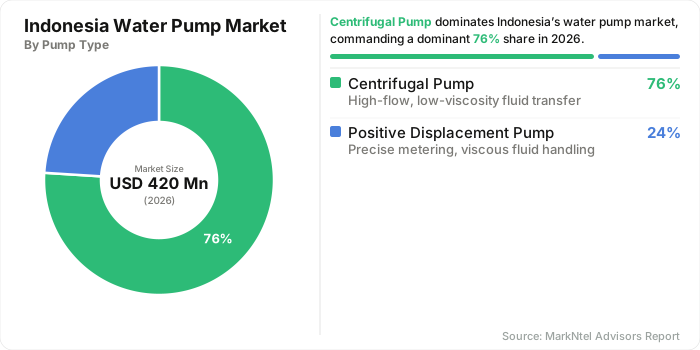
Centrifugal pumps dominate the Indonesia water pump industry with a share of around 76%, mainly due to their versatility, operational simplicity, and cost-effectiveness. These pumps are widely used across municipal water supply, wastewater treatment, agriculture, residential buildings, and industrial facilities. Their ability to handle large volumes of water continuously makes them ideal for Indonesia’s expanding water distribution networks, flood-control systems, and irrigation projects. Compared to positive displacement pumps, centrifugal pumps require lower maintenance and are easier to install and operate, which is especially important for local utilities and rural installations.
Additionally, centrifugal pumps are available in multiple configurations, such as vertical, horizontal, split-case, and submersible, allowing customization for diverse applications. The growing focus on infrastructure development and clean water access further strengthens demand for centrifugal pumps, reinforcing their position as the leading pump type in the Indonesian market.
Based on End Users:
- Oil & Gas
- Power Generation
- Residential
- Agriculture & Irrigation
- Commercial Building
- HVAC
- Chemicals
- Water & Wastewater
- Food & Beverage
- Others
The water and wastewater segment leads Indonesia’s water pump market by end use, accounting for approximately 27% of total demand. This dominance is driven by government initiatives to expand clean water coverage, modernize wastewater treatment plants, and reduce water losses across urban and rural regions. Large-scale investments in water treatment facilities, sewage networks, pumping stations, and flood management systems require extensive use of high-capacity and durable pumps. In addition, efforts to address low piped water penetration and improve sanitation standards are increasing the installation of pumps for water distribution, sludge handling, and wastewater transfer. As water security remains a national priority, continuous upgrades and capacity expansion in municipal water infrastructure are expected to sustain strong demand from this end-user segment.
Indonesia Water Pump Market (2026-32): Regional Projection
The Indonesia water pump market is dominated by the Java region, particularly West Java, Jakarta, East Java, and Banten. This region leads demand due to its high population density, concentration of industrial zones, and presence of major urban water utilities. Java hosts most manufacturing facilities, commercial buildings, and residential developments, all of which require reliable water supply and wastewater management systems.
The region also accounts for a large share of Indonesia’s piped water networks and wastewater treatment plants, driving sustained demand for centrifugal and submersible pumps. Major infrastructure projects, including urban water supply expansion, flood control systems, and industrial estates, are heavily concentrated in Java. Additionally, provincial governments and water utilities in Java receive higher infrastructure budgets and faster project execution compared to the outer islands. The presence of pump manufacturers and service providers further strengthens Java’s dominance.
Gain a Competitive Edge with Our Indonesia Water Pump Market Report
- Indonesia Water Pump Market Report by MarkNtel Advisors provides a detailed & thorough analysis of market size & share, growth rate, competitive landscape, and key players. This comprehensive analysis helps businesses gain a holistic understanding of the market dynamics & make informed decisions.
- This report also highlights current market trends & future projections, allowing businesses to identify emerging opportunities & potential challenges. By understanding market forecasts, companies can align their strategies & stay ahead of the competition.
- Indonesia Water Pump Market Report aids in assessing & mitigating risks associated with entering or operating in the market. By understanding market dynamics, regulatory frameworks, and potential challenges, businesses can develop strategies to minimize risks & optimize their operations.
*Reports Delivery Format - Market research studies from MarkNtel Advisors are offered in PDF, Excel and PowerPoint formats. Within 24 hours of the payment being successfully received, the report will be sent to your email address.
Frequently Asked Questions
- Market Segmentation
- Introduction
- Product Definition
- Research Process
- Assumptions
- Executive Summary
- Indonesia Water Pump Market Policies, Regulations, and Product Standards
- Indonesia Water Pump Market Supply Chain Analysis
- Indonesia Water Pump Market Trends & Developments
- Indonesia Water Pump Market Dynamics
- Growth Drivers
- Challenges
- Indonesia Water Pump Market Hotspot & Opportunities
- Indonesia Water Pump Market Outlook, 2022-2032
- Market Size & Outlook
- By Revenues (USD Million)
- Market Share & Outlook
- By Types of Pumps- Market Size & Forecast 2022-2032F, USD Million
- Centrifugal Pump
- Overhung Pump
- Vertical Inline
- Horizontal End Suction
- Split Case Pump
- Single/Two Stage
- Multi Stage
- Vertical Pump
- Turbine
- Solid Handling
- Non-Solid Handling
- Axial
- Mixed Flow
- Turbine
- Submersible Pump
- Solid Handling
- Non-Solid Handling
- Overhung Pump
- Positive Displacement
- Diaphragm Pump
- Piston Pump
- Gear Pump
- Lobe Pump
- Progressive Cavity Pump
- Screw Pump
- Vane Pump
- Peristaltic Pump
- Centrifugal Pump
- By End- User- Market Size & Forecast 2022-2032F, USD Million
- Oil & Gas
- Power Generation
- Residential
- Agriculture & Irrigation
- Commercial Building
- HVAC
- Chemicals
- Water & Wastewater
- Food & Beverage
- Others
- By Region
- Java
- Sumatra
- Kalimantan
- Sulawesi
- Jakarta
- Rest of Indonesia
- By Company
- Company Revenue Shares
- Competitor Characteristics
- By Types of Pumps- Market Size & Forecast 2022-2032F, USD Million
- Market Size & Outlook
- Indonesia Centrifugal Pump Water Pump Market Outlook, 2022-2032
- Market Size & Analysis
- Market Share & Analysis
- By Types of Pumps- Market Size & Forecast 2022-2032, USD Million
- By End Users- Market Size & Forecast 2022-2032, USD Million
- Indonesia Positive Displacement Pump Water Pump Market Outlook, 2022-2032
- Market Size & Analysis
- Market Revenues (USD Million)
- Market Share & Analysis
- By Types of Pumps- Market Size & Forecast 2022-2032, USD Million
- By End Users- Market Size & Forecast 2022-2032, USD Million
- Market Size & Analysis
- Indonesia Water Pump Market Key Strategic Imperatives for Success & Growth
- Competition Outlook
- Company Profiles
- Grundfos
- Business Description
- Product Portfolio
- Strategic Alliances or Partnerships
- Recent Developments
- Financial Details
- Others
- PT. Wilo Pump Indonesia
- Business Description
- Product Portfolio
- Strategic Alliances or Partnerships
- Recent Developments
- Financial Details
- Others
- PT. Ebara Indonesia
- Business Description
- Product Portfolio
- Strategic Alliances or Partnerships
- Recent Developments
- Financial Details
- Others
- Flowserve
- Business Description
- Product Portfolio
- Strategic Alliances or Partnerships
- Recent Developments
- Financial Details
- Others
- Xylem
- Business Description
- Product Portfolio
- Strategic Alliances or Partnerships
- Recent Developments
- Financial Details
- Others
- PT. Torishima Guna Indonesia
- Business Description
- Product Portfolio
- Strategic Alliances or Partnerships
- Recent Developments
- Financial Details
- Others
- Sulzer
- Business Description
- Product Portfolio
- Strategic Alliances or Partnerships
- Recent Developments
- Financial Details
- Others
- Others
- Grundfos
- Company Profiles
- Disclaimer
MarkNtel Advisors follows a robust and iterative research methodology designed to ensure maximum accuracy and minimize deviation in market estimates and forecasts. Our approach combines both bottom-up and top-down techniques to effectively segment and quantify various aspects of the market. A consistent feature across all our research reports is data triangulation, which examines the market from three distinct perspectives to validate findings. Key components of our research process include:
1. Scope & Research Design At the outset, MarkNtel Advisors define the research objectives and formulate pertinent questions. This phase involves determining the type of research—qualitative or quantitative—and designing a methodology that outlines data collection methods, target demographics, and analytical tools. They also establish timelines and budgets to ensure the research aligns with client goals.
2. Sample Selection and Data Collection In this stage, the firm identifies the target audience and determines the appropriate sample size to ensure representativeness. They employ various sampling methods, such as random or stratified sampling, based on the research objectives. Data collection is carried out using tools like surveys, interviews, and observations, ensuring the gathered data is reliable and relevant.
3. Data Analysis and Validation Once data is collected, MarkNtel Advisors undertake a rigorous analysis process. This includes cleaning the data to remove inconsistencies, employing statistical software for quantitative analysis, and thematic analysis for qualitative data. Validation steps are taken to ensure the accuracy and reliability of the findings, minimizing biases and errors.

4. Data Forecast and FinalizationThe final phase involves forecasting future market trends based on the analyzed data. MarkNtel Advisors utilize predictive modeling and time series analysis to anticipate market behaviors. The insights are then compiled into comprehensive reports, featuring visual aids like charts and graphs, and include strategic recommendations to inform client decision-making
We offer flexible licensing options to cater to varying organizational needs. Choose the pricing pack that best suits your requirements:
Buy Now Inquire Before Buying
 Request Customization
 Talk to our Consultant







