

US Agritourism Market Research Report: Size, Share, Trends & Forecast (2026-2032)
By Activity (On-Farm Sales, Outdoor Recreation, Agritainment, Educational Tourism, Accommodations), By Booking Channel (Online, Travel Agencies, Direct Booking), By Tourist Type (D ... omestic Tourists, International Tourists), ansd others Read more
- Environment
- Mar 2026
- Pages 145
- Report Format: PDF, Excel, PPT
US Agritourism Market
Projected 10.12% CAGR from 2026 to 2032
Study Period
2026-2032
Market Size (2026)
USD 12.55 Billion
Market Size (2032)
USD 22.38 Billion
Base Year
2025
Projected CAGR
10.12%
Leading Segments
By Tourist Type: Domestic Tourists
US Agritourism Market Report Key Takeaways:
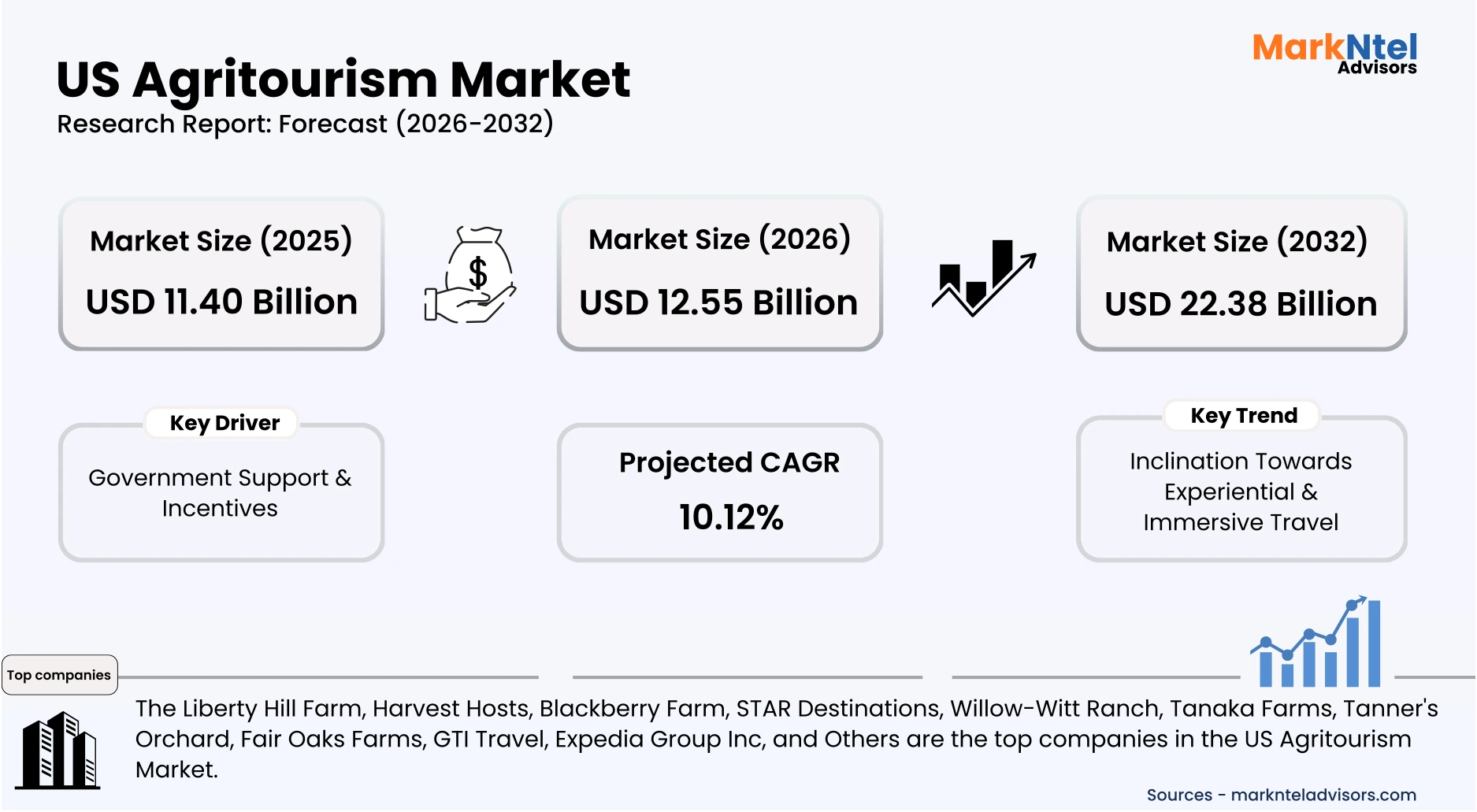
- The US Agritourism market size was valued at USD 11.40 billion in 2025 and is projected to grow from USD 12.55 billion in 2026 to USD 22.38 billion by 2032, exhibiting a CAGR of 10.12% during the forecast period.
- By booking channel, the direct booking segment represented a significant share of about 51% in the US Agritourism Market in 2026.
- By tourist type, the domestic tourists seized a significant share of about 76% in the US Agritourism Market in 2026.
- Leading Agritourism companies in the US Market are Liberty Hill Farm, Harvest Hosts, Blackberry Farm, STAR Destinations, Willow-Witt Ranch, Tanaka Farms, Tanner's Orchard, Fair Oaks Farms, GTI Travel, Expedia Group Inc, and Others.
Market Insights & Analysis: US Agritourism Market (2026-32):
The US Agritourism Market size was valued at around USD 11.40 billion in 2025 and is projected to grow from USD 12.55 billion in 2026 to USD 22.38 billion by 2032. Along with this, the market is estimated to grow at a CAGR of around 10.12% during the forecast period, i.e., 2026-32.
The US Agritourism Market is poised for sustained growth driven by a combination of government support, experiential travel trends, and strategic future investments. Government initiatives at both federal and state levels play a crucial role in enabling farms to diversify into tourism-related activities. Federal programs, such as the Beginning Farmer and Rancher Development Program (BFRDP), allocated USD 23.7 million to strengthen agritourism service provider training. This funding supports the development of a national agritourism curriculum and a community of practice, providing farmers with the knowledge and tools to expand visitor experiences and diversify farm income .
At the regional level, Northeastern states benefit from USDA Cooperative Extension services through the National Extension Tourism (NET) program, which promotes initiatives like West Virginia’s Agritourism Initiative, Vermont’s Opening Your Farms to Visitors, and Pennsylvania’s Open Gate Farm Tours. These programs equip farmers with education, marketing strategies, and operational support, helping them build capacity for tourism-focused ventures.
State-specific programs also accelerate market growth. For example, the Montana Department of Commerce Agritourism Grants Program awarded over USD 350,000 in 2025 to 17 farms and tribal agricultural businesses. These funds supported infrastructure development, educational activities, and enhanced visitor experiences. The program aims to diversify rural operations, boost tourism revenue, and expand farm-based attractions, with the next funding cycle scheduled for 2027.
Alongside government support, a key trend shaping the market is experiential and immersive travel, where visitors actively engage with farm activities, educational tours, and rural experiences. Hickory Hearth Highlands in Pennsylvania exemplifies this trend, offering guided tours where visitors interact with Scottish Highland cows, goats, and chickens, with experiences priced around USD 55 per person via Airbnb Experiences. Such hands-on engagement fosters deeper visitor satisfaction, encourages repeat visits, and drives revenue growth .
Looking forward, continued investments in training, infrastructure, and digital engagement platforms are expected to expand market reach, support farm diversification, and enhance the overall quality of agritourism offerings. With growing domestic demand for authentic rural experiences, the US agritourism market is set to witness robust growth, benefiting from sustained governmental and regional support, immersive travel trends, and strategic capacity-building initiatives.
Overall, strong government backing, experiential travel trends, and targeted future investments collectively position the US agritourism market for long-term growth, offering farms the tools to enhance visitor engagement, diversify revenue streams, and strengthen rural tourism ecosystems.
US Agritourism Market Recent Developments:
- 2025: Westview Orchards in Michigan, known for its bakery and cider mill, received the Michigan Agritourism Association’s 2025 excellence award, highlighting quality visitor‑focused farm experiences.
US Agritourism Market Scope:
| Category | Segments |
|---|---|
| By Activity | (On-Farm Sales, Outdoor Recreation, Agritainment, Educational Tourism, Accommodations), |
| By Booking Channel | (Online, Travel Agencies, Direct Booking), |
| By Tourist Type | (Domestic Tourists, International Tourists), |
US Agritourism Market Driver:
Government Support & Incentives
Government support and incentives are playing an increasingly vital role in strengthening the US agritourism market by providing financial backing, training, and structural support that enable farm operators to diversify into tourism-related activities. At the federal level, the U.S. Department of Agriculture (USDA) Agricultural Marketing Service administers programs such as the Local Agriculture Market Program (LAMP), which in 2026 awarded USD 26.8 million in grants to enhance farmers markets, agritourism operations, and direct-to-consumer activities across 28 states, improving infrastructure, marketing, and sales channels .
Additional USDA programs including the Farmers Market Promotion Program, Local Food Promotion Program, and Federal-State Marketing Improvement Program provide funding for feasibility studies, marketing initiatives, and business development linked to agritourism, empowering rural enterprises to expand their offerings.
State-level support complements federal initiatives. For instance, the New Jersey Agritourism Grant Program allocates USD 5 million, with individual operators eligible for up to USD 100,000 to develop visitor-attracting programs, educational workshops, and seasonal events .
Looking beyond 2025, continued investments in local food markets, digital marketing tools, and state grant pools are expected to enhance farm diversification and visitor engagement. These initiatives, combined with federal commitments to value-added agriculture and tourism learning resources, are likely to sustain long-term growth in the US agritourism sector.
Conclusion: Government support and incentives significantly reduce barriers to entry, increase operational capacity, and drive market expansion, making them a key driver of agritourism growth nationwide.
US Agritourism Market Trend:
Inclination Towards Experiential & Immersive Travel
A key trend shaping the US agritourism market is the growing demand for experiential and immersive travel, where visitors seek hands-on farm activities, outdoor recreation, and authentic rural engagement rather than passive sightseeing. According to the US Department of Agriculture’s Census of Agriculture, approximately 28,600 U.S. farms and ranches reported earning agritourism income in 2022, reflecting strong participation in farm-based experiences such as harvest visits, guided tours, and direct interaction with agricultural operations. Participatory activities, including “pick-your-own” fruit harvesting, farm stays, and educational workshops, are increasingly popular, encouraging repeat visits and longer stays.
For example, Carter Mountain Orchard in Virginia offers seasonal U-pick strawberries, peaches, apples, and pumpkins, along with farm-fresh products, a wine shop, and a cider taproom, creating a full sensory experience for visitors . Similarly, Mini Cow Adventures at Swartz Farm in Pennsylvania provides hands-on engagement through cow walks, mini-Highland cow interactions, and farm-based yoga events, blending outdoor recreation with rural immersion .
USDA data further supports this trend, showing agritourism revenues have more than tripled between 2002 and 2017, signaling rising demand for interactive farm travel. As domestic travelers increasingly prioritize authentic and engaging experiences, farms that offer immersive tours, educational activities, and participatory events are capturing larger visitor shares and enhancing rural tourism revenue.
Overall, experiential and immersive travel is a pivotal trend driving growth in US agritourism by transforming farms into interactive, educational, and recreational destinations that attract a broader visitor base and increase revenue potential.
US Agritourism Market Opportunity:
Expanding Agritourism Through Technology‑Driven Reach
A major opportunity for the US agritourism market lies in leveraging digital technology and improved rural connectivity to expand reach, engage visitors, and attract a broader audience. According to the USDA Technology Use (Farm Computer Usage and Ownership) report (2023), 85% of US farms reported having internet access, and 23% actively used it to market agricultural activities, highlighting the growing adoption of digital tools in rural areas.
Virtual platforms, such as Virtual Farm Trips, allow audiences to participate in live and on-demand farm tours across the United States, exploring livestock operations, crop management, and sustainable practices remotely. These experiences increase accessibility for domestic and international tourists, expand educational outreach, and promote farm products beyond local markets .
Federal initiatives support this opportunity further. The USDA ReConnect Program has allocated over USD 1 billion to expand high-speed broadband in underserved rural areas, enabling farms to offer online bookings, virtual tours, e-commerce sales, and real-time communication with potential visitors. Research shows counties with higher broadband speeds tend to host more agritourism operations, demonstrating a direct link between digital infrastructure and market growth.
Overall, by embracing technology and improving rural connectivity, agritourism operators can broaden their customer base, enhance visitor engagement, and increase revenue, making technology-driven reach a critical opportunity for sustainable growth in the US agritourism market.
US Agritourism Market Challenge:
Seasonality & Weather Dependency
One of the major challenges facing the US Agritourism Market is its inherent seasonality and dependence on weather conditions, which restrict consistent visitor turnout and revenue throughout the year. Many agritourism activities such as U‑pick harvests, outdoor festivals, crop mazes, and farm tours are tied to specific seasonal windows like spring planting or autumn harvest, limiting their occurrence to a few peak months. Seasonal planning is crucial because activities outside these windows often see significantly lower visitor numbers and reduced income generation. Government extension resources note that agritourism businesses often align events with weather‑sensitive outdoor experiences, making timing and planning complex for operators, especially in regions with harsh winters or unpredictable weather conditions.
Furthermore, climate variability and extreme weather events such as heavy rains, droughts, or heat waves can force cancellations or closures of planned experiences, damaging crops and reducing the quality and availability of attractions that draw tourists. For example, U‑pick farms and outdoor agritourism festivals have reported closures or reduced operations due to unseasonable weather, disrupting anticipated visitor engagement and income.
These seasonal and weather‑driven fluctuations make it difficult for operators to predict cash flow, maintain staffing, and plan marketing outside peak periods.
Overall, seasonality and weather dependency pose persistent operational and financial barriers to year‑round profitability and stability for many agritourism providers, underscoring the need for diversified offerings and climate‑adaptive planning to sustain growth.
US Agritourism Market (2026-32) Segmentation Analysis:
The US Agritourism Market study of MarkNtel Advisors evaluates & highlights the major trends and influencing factors in each segment. It includes predictions for the period 2026–32 at the country level. Based on the analysis, the market has been further classified as;
Based on Booking Channel:
- Online
- Travel Agencies
- Direct Booking
Direct booking is the leading channel in the US Agritourism Market, accounting for 51% of total bookings. This trend is primarily driven by the increasing preference of tourists to interact directly with farms and ranches for a more personalized experience. Direct booking allows visitors to negotiate tailored packages, choose specific activities, and secure exclusive offers, enhancing the overall farm experience.
Additionally, farm operators often provide incentives, such as discounts or early access to seasonal events, which further encourage tourists to book directly rather than through intermediaries. The growth of digital tools like farm websites, social media, and messaging apps has made direct bookings more convenient and reliable. Furthermore, tourists perceive direct booking as safer and more transparent, minimizing the risk of third-party booking errors. As agritourism operators focus on cultivating closer relationships with their visitors, direct booking remains the preferred method for both convenience and cost-effectiveness.
Based on Tourist Type:
-
- Domestic Tourists
- International Tourists
Domestic tourists dominate the US agritourism market, representing 76% of total visitors. The high share is attributed to easier accessibility, lower travel costs, and the growing trend of weekend farm getaways within the country. Domestic travelers are more likely to explore local farms, orchards, and ranches, as these trips require less planning and fewer regulatory requirements compared to international travel. Seasonal events, such as pumpkin patches, corn mazes, and harvest festivals, attract families and groups seeking short recreational experiences close to home.
Additionally, the rise of health-conscious and experiential tourism in the US motivates domestic tourists to engage in farm-to-table activities, educational workshops, and hands-on agritourism experiences. Domestic travel also benefits from strong social media influence, where local attractions gain visibility quickly through reviews and recommendations. Overall, affordability, convenience, and a growing interest in sustainable agriculture make domestic tourists the primary driver of the US agritourism market.
US Agritourism Market (2026-32): Regional Projection
The US agritourism market is dominated by the Midwest region, particularly states like Iowa, Wisconsin, Minnesota, and Michigan. This region leads due to its extensive agricultural land, diverse crop production, and a high density of family-owned farms that are well-suited for visitor engagement. Farms in the Midwest offer a wide range of experiences, including U-pick fruit and vegetable farms, corn mazes, dairy tours, and seasonal festivals, attracting domestic tourists seeking authentic rural experiences. The presence of strong cooperative extension programs and state-level agritourism support, such as marketing assistance and safety guidelines from the USDA and local universities, further strengthens operations.
Additionally, the region benefits from proximity to large urban centers like Chicago and Minneapolis, providing a steady flow of visitors within short travel distances. Midwestern farms also leverage technology, online booking platforms, and educational programming to enhance visitor engagement and year-round revenue. These factors collectively make the Midwest the most prominent region in the US agritourism market.
Gain a Competitive Edge with Our US Agritourism Market Report:
- The US Agritourism Market Report by MarkNtel Advisors provides a detailed & thorough analysis of market size & share, growth rate, competitive landscape, and key players. This comprehensive analysis helps businesses gain a holistic understanding of the market dynamics & make informed decisions.
- This report also highlights current market trends & future projections, allowing businesses to identify emerging opportunities & potential challenges. By understanding market forecasts, companies can align their strategies & stay ahead of the competition.
- The US Agritourism Market Report aids in assessing & mitigating risks associated with entering or operating in the market. By understanding market dynamics, regulatory frameworks, and potential challenges, businesses can develop strategies to minimize risks & optimize their operations.
*Reports Delivery Format - Market research studies from MarkNtel Advisors are offered in PDF, Excel and PowerPoint formats. Within 24 hours of the payment being successfully received, the report will be sent to your email address.
Frequently Asked Questions
- Market Segmentation
- Introduction
- Product Definition
- Research Process
- Assumptions
- Executive Summary
- US Agritourism Market Policies, Regulations, and Product Standards
- US Agritourism Market Trends & Developments
- US Agritourism Market Dynamics
- Growth Factors
- Challenges
- US Agritourism Market Hotspot & Opportunities
- US Agritourism Market Outlook, 2022-2032F
- Market Size & Outlook
- By Revenues (USD Million)
- Market Share & Outlook
- By Activity- Market Size & Forecast 2022-2032, USD Million
- On-Farm Sales
- Outdoor Recreation
- Agritainment
- Educational Tourism
- Accommodations
- By Booking Channel- Market Size & Forecast 2022-2032, USD Million
- Online
- Travel Agencies
- Direct Booking
- By Tourist Type- Market Size & Forecast 2022-2032, USD Million
- Domestic Tourists
- International Tourists
- By Region- Market Size & Forecast 2022-2032, USD Million
- Northeast
- South
- Midwest
- West
- By Company
- Competition Characteristics
- Market Share & Analysis
- By Activity- Market Size & Forecast 2022-2032, USD Million
- Market Size & Outlook
- US Agritourism On-Farm Sales Market Outlook, 2022-2032
- Market Size & Outlook
- By Revenues (USD Million)
- Market Share & Outlook
- By Booking Channel- Market Size & Forecast 2022-2032, USD Million
- By Tourist Type- Market Size & Forecast 2022-2032, USD Million
- By Region- Market Size & Forecast 2022-2032, USD Million
- Market Size & Outlook
- US Agritourism Outdoor Recreation Market Outlook, 2022-2032
- Market Size & Outlook
- By Revenues (USD Million)
- Market Share & Outlook
- By Booking Channel- Market Size & Forecast 2022-2032, USD Million
- By Tourist Type- Market Size & Forecast 2022-2032, USD Million
- By Region- Market Size & Forecast 2022-2032, USD Million
- Market Size & Outlook
- US Agritourism Agritainment Market Outlook, 2022-2032
- Market Size & Outlook
- By Revenues (USD Million)
- Market Share & Outlook
- By Booking Channel- Market Size & Forecast 2022-2032, USD Million
- By Tourist Type- Market Size & Forecast 2022-2032, USD Million
- By Region- Market Size & Forecast 2022-2032, USD Million
- Market Size & Outlook
- US Educational Agritourism Market Outlook, 2022-2032
- Market Size & Outlook
- By Revenues (USD Million)
- Market Share & Outlook
- By Booking Channel- Market Size & Forecast 2022-2032, USD Million
- By Tourist Type- Market Size & Forecast 2022-2032, USD Million
- By Region- Market Size & Forecast 2022-2032, USD Million
- Market Size & Outlook
- US Agritourism Accommodations Market Outlook, 2022-2032
- Market Size & Outlook
- By Revenues (USD Million)
- Market Share & Outlook
- By Booking Channel- Market Size & Forecast 2022-2032, USD Million
- By Tourist Type- Market Size & Forecast 2022-2032, USD Million
- By Region- Market Size & Forecast 2022-2032, USD Million
- Market Size & Outlook
- US Agritourism Market Key Strategic Imperatives for Success & Growth
- Competitive Outlook
- Company Profiles
- Liberty Hill Farm
- Business Description
- Product Portfolio
- Collaborations & Alliances
- Recent Developments
- Financial Details
- Others
- Harvest Hosts
- Business Description
- Product Portfolio
- Collaborations & Alliances
- Recent Developments
- Financial Details
- Others
- Blackberry Farm
- Business Description
- Product Portfolio
- Collaborations & Alliances
- Recent Developments
- Financial Details
- Others
- STAR Destinations
- Business Description
- Product Portfolio
- Collaborations & Alliances
- Recent Developments
- Financial Details
- Others
- Willow-Witt Ranch
- Business Description
- Product Portfolio
- Collaborations & Alliances
- Recent Developments
- Financial Details
- Others
- Tanaka Farms
- Business Description
- Product Portfolio
- Collaborations & Alliances
- Recent Developments
- Financial Details
- Others
- Tanner's Orchard
- Business Description
- Product Portfolio
- Collaborations & Alliances
- Recent Developments
- Financial Details
- Others
- Fair Oaks Farms
- Business Description
- Product Portfolio
- Collaborations & Alliances
- Recent Developments
- Financial Details
- Others
- GTI Travel
- Business Description
- Product Portfolio
- Collaborations & Alliances
- Recent Developments
- Financial Details
- Others
- Expedia Group Inc
- Business Description
- Product Portfolio
- Collaborations & Alliances
- Recent Developments
- Financial Details
- Others
- Liberty Hill Farm
- Company Profiles
- Disclaimer
MarkNtel Advisors follows a robust and iterative research methodology designed to ensure maximum accuracy and minimize deviation in market estimates and forecasts. Our approach combines both bottom-up and top-down techniques to effectively segment and quantify various aspects of the market. A consistent feature across all our research reports is data triangulation, which examines the market from three distinct perspectives to validate findings. Key components of our research process include:
1. Scope & Research Design At the outset, MarkNtel Advisors define the research objectives and formulate pertinent questions. This phase involves determining the type of research—qualitative or quantitative—and designing a methodology that outlines data collection methods, target demographics, and analytical tools. They also establish timelines and budgets to ensure the research aligns with client goals.
2. Sample Selection and Data Collection In this stage, the firm identifies the target audience and determines the appropriate sample size to ensure representativeness. They employ various sampling methods, such as random or stratified sampling, based on the research objectives. Data collection is carried out using tools like surveys, interviews, and observations, ensuring the gathered data is reliable and relevant.
3. Data Analysis and Validation Once data is collected, MarkNtel Advisors undertake a rigorous analysis process. This includes cleaning the data to remove inconsistencies, employing statistical software for quantitative analysis, and thematic analysis for qualitative data. Validation steps are taken to ensure the accuracy and reliability of the findings, minimizing biases and errors.

4. Data Forecast and FinalizationThe final phase involves forecasting future market trends based on the analyzed data. MarkNtel Advisors utilize predictive modeling and time series analysis to anticipate market behaviors. The insights are then compiled into comprehensive reports, featuring visual aids like charts and graphs, and include strategic recommendations to inform client decision-making
We offer flexible licensing options to cater to varying organizational needs. Choose the pricing pack that best suits your requirements:
Buy Now Inquire Before Buying
 Request Customization
 Talk to our Consultant







