

UAE Hydroponics Market Research Report: Forecast (2026-2032)
By Type (Aggregate Systems (EBB & Flow Systems, Drip Systems, Wick Systems), Liquid Systems (Nutrient Film Technique (NFT), Deep Water Culture (DWC), Aeroponics)), By Equipment (HV ... AC, LED Grow Light, Control Systems, Irrigation Systems, Others), By Crop Type (Fruits & Vegetable, Flowers & Turfs), By Farm Type (Indoor farming, Outdoor farming), By End Users (Restaurants, Commercial Farms), and others Read more
- Environment
- May 2026
- Pages 150
- Report Format: PDF, Excel, PPT
UAE Hydroponics Market
Projected 8.89% CAGR from 2026 to 2032
Study Period
2026-2032
Market Size (2026)
USD 135 Million
Market Size (2032)
USD 200 Million
Base Year
2025
Projected CAGR
8.89%
Leading Segments
By Equipment: HVAC
UAE Hydroponics Market Key Takeaways
- The United Arab Emirates hydroponics market was valued at USD 110 million in 2025 and is projected to grow from USD 135 million in 2026 to USD 200 million by 2032, registering a CAGR of 8.89% during 2026–2032.
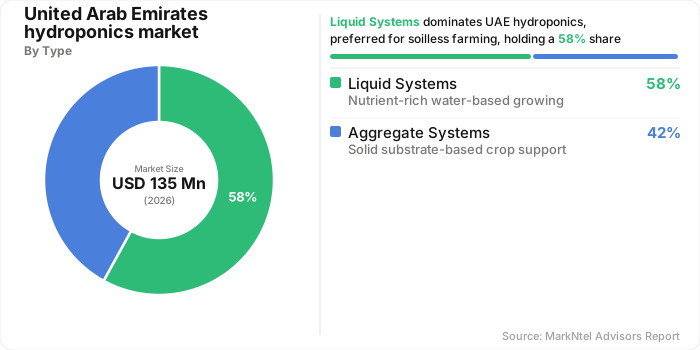
- By type, the liquid systems segment holds a significant market share of approximately 58%, driven by its operational efficiency, nutrient delivery precision, and suitability for controlled-environment agriculture.
- By equipment, the HVAC segment accounted for a notable share of nearly 33% in 2026, supported by the increasing need for temperature, humidity, and climate control in hydroponic farming systems.
- The industry remains moderately fragmented; however, the top five players collectively account for an estimated 42% market share, reflecting the presence of several regional and international participants operating across the UAE hydroponics ecosystem.
UAE Hydroponics Market Size and Outlook
The United Arab Emirates hydroponics market is expected to grow at a CAGR of around 8.89% during 2026–2032, driven by increasing investments in controlled-environment agriculture, rising adoption of sustainable cultivation techniques, growing demand for water-efficient farming systems, and the country’s long-term focus on strengthening domestic food security and agricultural self-sufficiency.
Limited arable land availability, extreme climatic conditions, and growing concerns regarding water scarcity are encouraging rapid deployment of hydroponic farming systems, vertical farms, and climate-controlled greenhouse infrastructure across the UAE. In addition, increasing consumer preference for locally produced fresh vegetables and premium-quality crops is accelerating commercial adoption of advanced hydroponic cultivation technologies.
A notable development reflecting the growing scale of vertical farming in UAE was announced in July 2024, when Plenty Unlimited partnered with Abu Dhabi-based Mawarid Holding to establish a large-scale indoor vertical strawberry farm in Abu Dhabi. The project involves an investment of nearly USD 130 million and is expected to produce more than 2 million kilograms of strawberries annually through advanced controlled-environment agriculture technologies. The initiative demonstrates the increasing commercial viability of hydroponic farming and the UAE commitment toward resource-efficient domestic food production.
The market is also benefiting from continuous technological advancements in smart agriculture solutions. During the 2025 Emirates Agriculture Conference and Exhibition held under the UAE “Plant the Emirates” National Program, Khalifa University showcased AI-enabled farming systems, intelligent climate-control technologies, and precision cultivation solutions designed to improve crop productivity and optimize greenhouse operations. The increasing integration of these innovations is expected to strengthen adoption of smart agriculture UAE practices across commercial hydroponic facilities and urban farming projects.
Further supporting market growth, UAE-based AgriTech company Armela announced expansion plans in 2025 to scale its high-tech farming operations across Dubai and Abu Dhabi through additional greenhouse and horizontal farming facilities. The company’s planned expansion into strawberry, blueberry, and spinach cultivation highlights the growing demand for indoor farming in UAE infrastructure capable of supporting year-round crop production in desert environments.
Overall, rising investments in advanced farming infrastructure, smart greenhouse technologies, and sustainable crop production systems are expected to strengthen the long-term demand for the United Arab Emirates hydroponics market, which is projected to grow from USD 135 million in 2026 to USD 200 million by 2032. Continued government support for food security initiatives and increasing adoption of resource-efficient cultivation technologies will remain key factors driving future market expansion.
UAE Hydroponics Industry Key Indicators
- According to the Food and Agriculture Organization (FAO) Statistical Yearbook 2024, the UAE is among the most water-stressed countries globally, with annual freshwater withdrawals reaching nearly 9 to 40 times its renewable freshwater resources. This severe groundwater pressure is accelerating investment in water-efficient farming practices, including hydroponics and controlled-environment agriculture, to support sustainable domestic food production amid rising agricultural resource constraints.
- The UAE government continues prioritizing long-term food security through advanced agricultural technologies. Under the UAE National Food Security Strategy 2051, the country aims to increase domestic food production by 30% by 2030 and 50% by 2051 using hydroponics and controlled-environment farming as primary implementation methods. With nearly 85% of food currently imported, expansion of controlled environment agriculture in the UAE infrastructure is expected to accelerate significantly in the coming years.
- Harsh climatic conditions and limited agricultural land is accelerating the hydroponic adoption across the UAE. Nearly 80% of the country’s land area is classified as desert, while only 0.7% is arable, creating strong dependence on controlled farming systems for local food production. This challenge is encouraging large-scale investments in vertical farming and climate-controlled greenhouse technologies to improve long-term agricultural sustainability.
UAE Hydroponics Market Scope
| Category | Segments |
|---|---|
| By Type | Aggregate Systems (EBB & Flow Systems, Drip Systems, Wick Systems), Liquid Systems (Nutrient Film Technique (NFT), Deep Water Culture (DWC), Aeroponics |
| By Equipment | HVAC, LED Grow Light, Control Systems, Irrigation Systems, Others |
| By Crop Type | Fruits & Vegetable, Flowers & Turfs |
| By Farm Type | Indoor farming, Outdoor farming |
| By End Users | Restaurants, Commercial Farms |
UAE Hydroponics Market Growth Drivers
Rising Focus on Food Security and Controlled Environment Agriculture Expansion
The expansion of controlled environment agriculture UAE is becoming a major growth driver for the UAE Hydroponics Market as the country accelerates efforts to strengthen domestic food production and reduce dependence on imports. Due to limited arable land and high water scarcity, the UAE government is increasingly supporting hydroponic and greenhouse farming solutions that enable year-round crop cultivation with lower resource consumption. According to the UAE Ministry of Climate Change and Environment, agriculture consumes nearly 70% of the country’s groundwater resources, prompting stronger adoption of water-efficient farming UAE practices such as hydroponics and protected cultivation systems.
Financial support for sustainable agriculture is also accelerating market expansion. In September 2024, Emirates Development Bank stated that it had provided nearly USD 257 million in financing to strengthen the UAE food security sector, including advanced greenhouse and hydroponic farming projects under its AgriTech financing program. Furthermore, in December 2024, the bank revealed total food-security-related financing had exceeded USD 305 million, reflecting rising investments in indoor farming infrastructure and sustainable cultivation systems.
Beyond 2025, long-term national food security strategies and continued investments in water efficient farming technologies are expected to accelerate hydroponic farm adoption across commercial greenhouses and urban farming projects. These developments will continue strengthening demand for hydroponic systems, climate-controlled cultivation facilities, and resource-efficient agricultural infrastructure in the coming years.
Recent Trends
Growing Integration of Smart Farming Technologies
The integration of advanced digital technologies into hydroponic and greenhouse cultivation is becoming a prominent trend in the UAE Hydroponics Market as farmers increasingly prioritize resource efficiency, automation, and climate-resilient agriculture. Rising water scarcity and the need for higher crop productivity are accelerating the adoption of smart agriculture trends, particularly across controlled-environment farming systems.
A major example emerged in July 2025 the United Arab Emirates University introduced the AI-powered “Falaj” irrigation system, designed to optimize greenhouse water management. The system combines AI algorithms, IoT sensors, smart valves, and remote-access monitoring to provide real-time irrigation control based on soil moisture, temperature, pH levels, and electrical conductivity. Farmers can manage irrigation through a mobile application while receiving automated alerts regarding environmental fluctuations that may affect crop productivity. The system also integrates solar-powered infrastructure and wireless communication technologies such as 4G and LoRa to improve operational efficiency and sustainability.
The broader transition toward IoT farming solutions is also encouraging the deployment of AI-enabled irrigation platforms and precision cultivation tools across commercial farms. Companies such as MIIT are expanding AI-driven irrigation technologies capable of reducing water consumption by up to 70% while improving crop yields and lowering operational costs through real-time agricultural analytics.
As the continues investing in automated irrigation in UAE infrastructure and precision agriculture innovation, the integration of AI, sensor-based monitoring, and intelligent irrigation systems is expected to transform hydroponic farming operations by improving sustainability, crop efficiency, and long-term agricultural productivity.
UAE Hydroponics Industry Opportunities and Challenges
High Initial Capital Investment Creating Opportunities Through Government Support Programs
The UAE hydroponics industry continues to face challenges due to the high capital investment required for advanced greenhouse infrastructure, cooling systems, nutrient delivery equipment, and climate-controlled cultivation facilities. In the UAE harsh desert climate, hydroponic operators also experience elevated operational costs associated with electricity consumption and environmental control systems. These financial pressures can limit adoption among small-scale farmers and new agricultural enterprises despite the country’s increasing focus on sustainable food production.
However, the rising cost burden is simultaneously creating opportunities for government-backed agricultural support and localized farming innovation. To encourage adoption of modern cultivation methods, the UAE Ministry of Climate Change and Environment provides subsidized farming inputs under its farmer support program, where eligible farmers can access approved agricultural supplies and equipment at nearly 50% of their actual cost. The initiative supports the deployment of hydroponic equipment, protected cultivation systems, and resource-efficient greenhouse farming technologies aimed at improving domestic food security and reducing long-term production costs.
The growing emphasis on agri tech innovation is also encouraging the development of energy-efficient greenhouse systems and modular farming infrastructure designed to lower operational expenses. As financial accessibility improves and adoption of sustainable food production in UAE practices increases, the market is expected to witness stronger investment in hydroponic farming systems and advanced controlled-environment agriculture solutions.
Segmentation Insights
Liquid Systems Dominating the UAE Hydroponics Market
The Liquid Systems segment holds the largest share of nearly 58% in the UAE Hydroponics Market due to its superior water efficiency, faster nutrient absorption capability, and suitability for high-temperature desert environments. Liquid-based hydroponic systems, including Nutrient Film Technique (NFT), Deep Water Culture (DWC), and aeroponics, allow crops to grow directly in nutrient-rich water solutions without soil, making them highly effective for regions with limited arable land and water scarcity. These systems are increasingly adopted across commercial greenhouse facilities and vertical farms in the UAE as they enable controlled nutrient delivery, higher crop yield consistency, and reduced agricultural waste.
The dominance of liquid systems is further supported by the UAE’s growing investment in controlled environment agriculture and indoor farming projects focused on year-round production of leafy vegetables, herbs, and premium produce. Compared to aggregate systems, liquid hydroponics generally require lower growing media replacement and offer improved oxygenation for plant roots, which enhances crop productivity in climate-controlled environments. In addition, the expansion of water efficient farming practices and government support for advanced agricultural technologies continue accelerating adoption of liquid-based hydroponic infrastructure across commercial cultivation facilities. As demand for sustainable and resource-efficient food production rises, liquid systems are expected to maintain their leading market position in the coming years. Based on type, the scope has been segmented into
- Aggregate Systems
- EBB & Flow Systems
- Drip Systems
- Wick Systems
- Liquid Systems
- Nutrient Film Technique (NFT)
- Deep Water Culture (DWC)
- Aeroponics
HVAC leads the Equipment Segment
The HVAC segment accounts for nearly 33% share of the UAE Hydroponics Market owing to the critical role of climate control systems in maintaining stable growing conditions within hydroponic greenhouses and indoor farms. The UAE extremely high outdoor temperatures and arid climate make temperature regulation, humidity management, and air circulation essential for successful hydroponic cultivation. HVAC systems help maintain optimal environmental conditions required for crop growth, particularly for temperature-sensitive vegetables, herbs, and leafy greens cultivated in controlled-environment facilities.
The increasing expansion of indoor farming and vertical agriculture projects is significantly driving demand for advanced HVAC infrastructure capable of improving energy efficiency and crop productivity. Commercial hydroponic farms increasingly deploy automated cooling and ventilation technologies to minimize crop stress, reduce disease risks, and stabilize nutrient absorption cycles. Furthermore, the rising adoption of smart farming technologies is encouraging integration of intelligent HVAC monitoring systems that optimize airflow and environmental performance through sensor-based controls and real-time analytics.
The UAE government focus on sustainable agriculture and food security is also accelerating investments in climate-controlled farming infrastructure. As hydroponic greenhouse projects continue expanding across urban and commercial farming applications, demand for energy-efficient HVAC systems is expected to remain strong, supporting the long-term growth of this segment. The key equipment mapped in the study involve
- HVAC
- LED Grow Light
- Control Systems
- Irrigation Systems
- Others
UAE Hydroponics Market Competitive Analysis
The UAE Hydroponics Market is moderately fragmented, with key players such as Eurofins Wafra Farms LLC, Emirates Hydroponics Farms, Smart Acres, Badia Farms, and VeggiTech collectively accounting for nearly 42% share. These companies are strengthening their market presence through expansion of climate-controlled farming facilities, premium hydroponic produce cultivation, retail partnerships, and investments in sustainable agricultural technologies across the UAE.
Major Companies in UAE Hydroponics Market
- Eurofins Wafra Farms LLC
- Emirates Hydroponics Farms
- Smart Acres
- VeggiTech
- Badia Farms
- Majid Al Futtaim
- GreenOponics Agricultural Services LLC
- Beyond Hydroponics Green Houses Trading LLC
- Argus Control Systems Ltd
- Others
UAE Hydroponics Industry News and Recent Developments
February 2025: Pure Harvest & PlanTFarm Launch Pioneering Integrated Smart Farm in Al Ain
Pure Harvest Smart Farms and South Korea-based PlanTFarm officially launched a redeveloped high-tech smart farm in Al Ain integrating AI-powered controlled-environment agriculture technologies. The facility supports year-round cultivation of Korean strawberries, leafy greens, and resource-efficient animal fodder using advanced vertical farming and climate-control systems. The project also claims to reduce water usage for fodder production by nearly 95% compared to conventional farming methods.
Impact Analysis: The project highlights the accelerating adoption of smart farming and advanced hydroponic infrastructure across the UAE. Integration of AI-enabled climate control, vertical farming, and precision cultivation technologies is expected to improve domestic food production while reducing dependence on imports and excessive water consumption. The initiative also strengthens the UAE position as a regional hub for controlled-environment agriculture and supports future investments in sustainable, technology-driven farming solutions.
Frequently Asked Questions
- Market Segmentation
- Introduction
- Product Definition
- Research Process
- Assumptions
- Executive Summary
- UAE Hydroponics Market Policies, Regulations, and Product Standards
- UAE Hydroponics Market Trends & Developments
- UAE Hydroponics Market Dynamics
- Growth Factors
- Challenges
- UAE Hydroponics Market Hotspot & Opportunities
- UAE Hydroponics Market Outlook, 2022-2032F
- Market Size & Outlook
- By Revenues (USD Million)
- Market Share & Outlook
- By Type - Market Size & Forecast 2022-2032, USD Million
- Aggregate Systems
- EBB & Flow Systems
- Drip Systems
- Wick Systems
- Liquid Systems
- Nutrient Film Technique (NFT)
- Deep Water Culture (DWC)
- Aeroponics
- Aggregate Systems
- By Equipment- Market Size & Forecast 2022-2032, USD Million
- HVAC
- LED Grow Light
- Control Systems
- Irrigation Systems
- Others
- By Crop Type- Market Size & Forecast 2022-2032, USD Million
- Fruits & Vegetable
- Flowers & Turfs
- By Farm Type- Market Size & Forecast 2022-2032, USD Million
- Indoor farming
- Outdoor farming
- By End Users- Market Size & Forecast 2022-2032, USD Million
- Restaurants
- Commercial Farms
- By Region- Market Size & Forecast 2022-2032, USD Million
- Dubai
- Abu Dhabi & Al Ain
- Sharjah & Northern Emirates
- By Company
- Competition Characteristics
- Market Share & Analysis
- By Type - Market Size & Forecast 2022-2032, USD Million
- Market Size & Outlook
- UAE Aggregate Systems Market Outlook, 2022-2032
- Market Size & Outlook
- By Revenues (USD Million)
- Market Share & Outlook
- By Equipment- Market Size & Forecast 2022-2032, USD Million
- By Crop Type- Market Size & Forecast 2022-2032, USD Million
- By Farm Type- Market Size & Forecast 2022-2032, USD Million
- By End Users- Market Size & Forecast 2022-2032, USD Million
- By Region- Market Size & Forecast 2022-2032, USD Million
- Market Size & Outlook
- UAE Liquid Systems Market Outlook, 2022-2032
- Market Size & Outlook
- By Revenues (USD Million)
- Market Share & Outlook
- By Equipment- Market Size & Forecast 2022-2032, USD Million
- By Crop Type- Market Size & Forecast 2022-2032, USD Million
- By Farm Type- Market Size & Forecast 2022-2032, USD Million
- By End Users- Market Size & Forecast 2022-2032, USD Million
- By Region- Market Size & Forecast 2022-2032, USD Million
- Market Size & Outlook
- UAE Hydroponics Market Key Strategic Imperatives for Success & Growth
- Competitive Outlook
- Company Profiles
- Eurofins Wafra Farms LLC
- Business Description
- Product Portfolio
- Collaborations & Alliances
- Recent Developments
- Financial Details
- Others
- Emirates Hydroponics Farms
- Business Description
- Product Portfolio
- Collaborations & Alliances
- Recent Developments
- Financial Details
- Others
- Smart Acres
- Business Description
- Product Portfolio
- Collaborations & Alliances
- Recent Developments
- Financial Details
- Others
- VeggiTech
- Business Description
- Product Portfolio
- Collaborations & Alliances
- Recent Developments
- Financial Details
- Others
- Badia Farms
- Business Description
- Product Portfolio
- Collaborations & Alliances
- Recent Developments
- Financial Details
- Others
- Majid Al Futtaim
- Business Description
- Product Portfolio
- Collaborations & Alliances
- Recent Developments
- Financial Details
- Others
- GreenOponics Agricultural Services LLC
- Business Description
- Product Portfolio
- Collaborations & Alliances
- Recent Developments
- Financial Details
- Others
- Beyond Hydroponics Green Houses Trading LLC
- Business Description
- Product Portfolio
- Collaborations & Alliances
- Recent Developments
- Financial Details
- Others
- Argus Control Systems Ltd
- Business Description
- Product Portfolio
- Collaborations & Alliances
- Recent Developments
- Financial Details
- Others
- Others
- Eurofins Wafra Farms LLC
- Company Profiles
- Disclaimer
MarkNtel Advisors follows a robust and iterative research methodology designed to ensure maximum accuracy and minimize deviation in market estimates and forecasts. Our approach combines both bottom-up and top-down techniques to effectively segment and quantify various aspects of the market. A consistent feature across all our research reports is data triangulation, which examines the market from three distinct perspectives to validate findings. Key components of our research process include:
1. Scope & Research Design At the outset, MarkNtel Advisors define the research objectives and formulate pertinent questions. This phase involves determining the type of research—qualitative or quantitative—and designing a methodology that outlines data collection methods, target demographics, and analytical tools. They also establish timelines and budgets to ensure the research aligns with client goals.
2. Sample Selection and Data Collection In this stage, the firm identifies the target audience and determines the appropriate sample size to ensure representativeness. They employ various sampling methods, such as random or stratified sampling, based on the research objectives. Data collection is carried out using tools like surveys, interviews, and observations, ensuring the gathered data is reliable and relevant.
3. Data Analysis and Validation Once data is collected, MarkNtel Advisors undertake a rigorous analysis process. This includes cleaning the data to remove inconsistencies, employing statistical software for quantitative analysis, and thematic analysis for qualitative data. Validation steps are taken to ensure the accuracy and reliability of the findings, minimizing biases and errors.

4. Data Forecast and FinalizationThe final phase involves forecasting future market trends based on the analyzed data. MarkNtel Advisors utilize predictive modeling and time series analysis to anticipate market behaviors. The insights are then compiled into comprehensive reports, featuring visual aids like charts and graphs, and include strategic recommendations to inform client decision-making
We offer flexible licensing options to cater to varying organizational needs. Choose the pricing pack that best suits your requirements:
Buy Now Inquire Before Buying
 Request Customization
 Talk to our Consultant







