

UAE Green Energy Market Research Report: Trends & Forecast (2026-2032)
By Energy Source (Solar Energy, Wind Energy, Hydropower, Bioenergy, Geothermal Energy, Waste-to-Energy), By Deployment Type (On-Grid, Off-Grid), By Technology (Photovoltaic (PV) Sy ... stems, Concentrated Solar Power (CSP), Onshore Wind Turbines, Offshore Wind Turbines, Hydroelectric Turbines, Biomass Power Generation Systems, Geothermal Power Systems), By Application (Electricity Generation, Heating & Cooling, Transportation, Industrial Processes, Others), By End User (Residential, Commercial, Industrial, Others), and others Read more
- Energy
- Mar 2026
- Pages 180
- Report Format: PDF, Excel, PPT
UAE Green Energy Market
Projected 9.41% CAGR from 2026 to 2032
Study Period
2026-2032
Market Size (2026)
USD 2.32 Billion
Market Size (2032)
USD 3.98 Billion
Base Year
2025
Projected CAGR
9.41%
Leading Segments
By End User: Industrial
UAE Green Energy Market Report Key Takeaways:
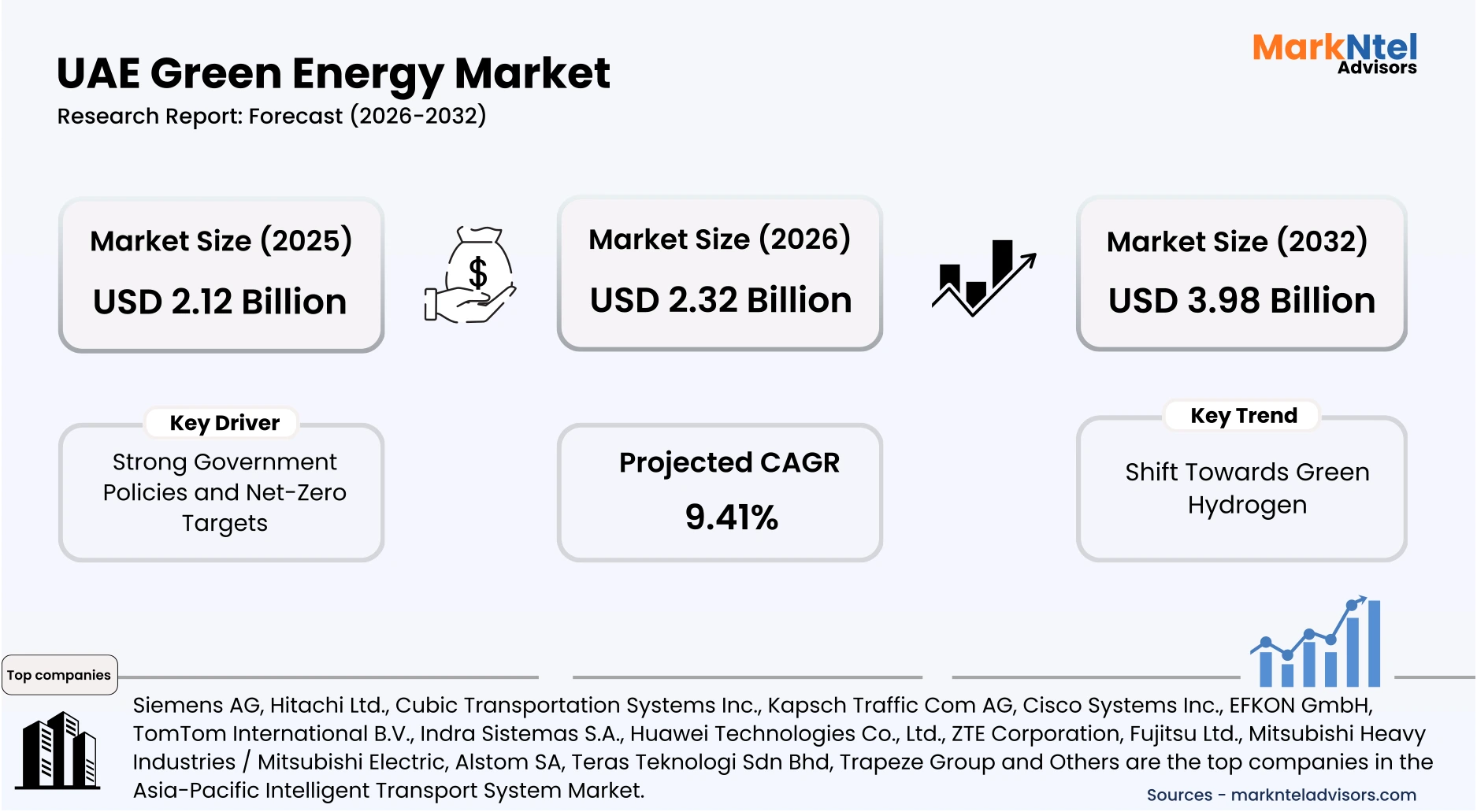
- The UAE Green Energy Market size was valued at USD 2.12 billion in 2025 and is projected to grow from USD 2.32 billion in 2026 to USD 3.98 billion by 2032, exhibiting a CAGR of 9.41% during the forecast period.
- By energy source, the solar energy segment seized a significant share of about 80% in the UAE Green Energy Market in 2026.
- By end user, the industrial segment captured a significant share of about 67% in the UAE Green Energy Market in 2026.
- Leading green energy companies in the UAE Market are Abu Dhabi Future Energy Company PJSC, Dubai Electricity and Water Authority (DEWA), Abu Dhabi National Energy Company PJSC (TAQA), Emirates Water and Electricity Company (EWEC), Yellow Door Energy, AMEA Power LLC, ENGIE SA, EDF Renewables SA, TotalEnergies SE, ACWA Power Company, Siemens Energy AG, and Others.
Market Insights & Analysis: UAE Green Energy Market (2026-32):
The UAE Green Energy Market size was valued at USD 2.12 billion in 2025 and is projected to grow from USD 2.32 billion in 2026 to USD 3.98 billion by 2032. Along with this, the market is estimated to grow at a CAGR of around 9.41% during the forecast period, i.e., 2026-32.
The UAE Green Energy Market is projected to expand steadily, driven by strong government policies, net-zero emission targets, and the increasing development of green hydrogen production initiatives across the country.
A key policy supporting this transition is the UAE Energy Strategy 2050, which aims to increase the share of clean energy in the national energy mix to 50% by 2050 while significantly reducing carbon emissions from electricity generation. This strategy focuses on expanding renewable power generation, improving energy efficiency, and modernizing the country’s electricity infrastructure. To support these objectives, the UAE government has outlined large-scale investments in clean energy development and related technologies.
In 2023, the government further strengthened its commitment to climate goals by announcing plans to invest approximately USD 54 billion in renewable energy projects by 2030 as part of the Net Zero 2050 Strategic Initiative. These investments are intended to accelerate the deployment of solar power, hydrogen technologies, and other low-carbon energy systems across the country.
Additionally, national policy frameworks indicate investments of approximately USD 41–54 billion by 2030 to expand clean energy capacity, upgrade grid infrastructure, and improve energy efficiency across various sectors of the economy.
As a result of these policy initiatives and financial commitments, renewable energy capacity in the UAE has expanded rapidly in recent years. By the end of 2024, the country’s installed renewable energy capacity reached approximately 6.8 GW, reflecting the rapid development of large-scale solar power projects and other clean energy initiatives . Government plans aim to further increase this capacity to around 19.8 GW by 2030, highlighting the country’s strong focus on scaling renewable electricity generation.
Alongside solar expansion, the emergence of green hydrogen production is becoming an important trend shaping the future of the UAE’s energy landscape. Green hydrogen is produced using renewable electricity through electrolysis and is increasingly viewed as a critical solution for decarbonizing heavy industries, transportation, and energy-intensive sectors. The development of hydrogen production facilities integrated with renewable energy systems is expected to strengthen the role of clean energy in the national economy.
Looking beyond 2030, government-backed entities are also expanding renewable investments internationally. For instance, Masdar has announced plans to develop up to 100 GW of renewable energy capacity globally by 2030, demonstrating the UAE’s ambition to scale clean energy deployment and strengthen its position as a global renewable energy leader .
Overall, strong government policies, large-scale investment commitments, and emerging technologies such as green hydrogen are expected to significantly accelerate the expansion of renewable energy capacity in the UAE. These factors will play a crucial role in strengthening the long-term growth trajectory of the UAE green energy market.
UAE Green Energy Market Recent Developments:
- 2025: the UAE laid the foundation stone for a USD 6 billion renewable energy project integrating a 5.2 GW solar plant with a 19 GWh battery storage system. The project is expected to supply 1 GW of continuous clean power by 2027, create over 10,000 jobs, and cut 5.7 million tonnes of carbon emissions annually.
UAE Green Energy Market Scope:
| Category | Segments |
|---|---|
| By Energy Source | (Solar Energy, Wind Energy, Hydropower, Bioenergy, Geothermal Energy, Waste-to-Energy), |
| By Deployment Type | (On-Grid, Off-Grid), |
| By Technology | (Photovoltaic (PV) Systems, Concentrated Solar Power (CSP), Onshore Wind Turbines, Offshore Wind Turbines, Hydroelectric Turbines, Biomass Power Generation Systems, Geothermal Power Systems), |
| By Application | (Electricity Generation, Heating & Cooling, Transportation, Industrial Processes, Others), |
| By End User | (Residential, Commercial, Industrial, Others), |
UAE Green Energy Market Driver:
Strong Government Policies and Net-Zero Targets
The expansion of large-scale renewable energy projects is driving the UAE green energy market, as government-backed initiatives accelerate solar and wind infrastructure development, strengthening renewable electricity generation and supporting the country’s long-term energy transition goals.
In 2024, the government-owned Emirates Water and Electricity Company (EWEC) announced the allocation of nearly 75 km² of land in Abu Dhabi for the development of new renewable energy projects. The planned developments include three large solar photovoltaic plants and one wind power project, which are expected to collectively add approximately 4.5 GW of solar capacity and around 140 MW of wind generation. Such large-scale projects highlight the increasing focus on expanding renewable energy infrastructure to meet rising electricity demand and climate targets.
These projects are aligned with Abu Dhabi’s Clean Energy Strategic Target 2035, which aims to expand the emirate’s solar capacity to around 10 GW by 2030 and further increase it to approximately 18 GW by 2035. This long-term strategy demonstrates the government’s commitment to strengthening renewable electricity production across the region.
Similarly, Dubai is also advancing renewable energy expansion through large solar initiatives. By 2026, the emirate’s renewable electricity generation capacity is projected to reach approximately 4.7 GW, moving closer to its long-term target of over 5 GW of solar capacity by 2030.
The continuous expansion of large-scale solar and wind projects across Abu Dhabi and Dubai is significantly increasing renewable power capacity in the UAE. These infrastructure investments will strengthen the clean energy supply and accelerate the long-term growth of the UAE green energy market.
UAE Green Energy Market Trend:
Shift Towards Green Hydrogen
The shift towards green hydrogen is becoming a key trend shaping the UAE green energy market as the country strengthens its long-term decarbonization strategy and energy diversification plans.
Hydrogen produced through renewable energy sources is increasingly viewed as a strategic solution for reducing emissions in sectors such as heavy industry, transportation, and power generation. In 2023, the UAE government approved a national hydrogen strategy designed to establish the country as a global hub for low-carbon hydrogen production and export.
Under this strategy, the UAE aims to produce approximately 1.4 million tonnes of hydrogen annually by 2031, marking a major step toward building a competitive hydrogen economy. The government has also outlined a long-term ambition to scale production significantly to around 15 million tonnes per year by 2050, which would position the UAE among the leading global suppliers of hydrogen-based fuels . These production targets are supported by the country’s strong renewable energy expansion, particularly in solar power, which provides the low-carbon electricity needed for hydrogen generation through electrolysis.
The development of large-scale hydrogen production is strengthening the UAE’s transition toward a diversified clean energy system. As hydrogen projects expand and production capacity rises in the coming decades, the demand for renewable electricity and supporting infrastructure will increase significantly, accelerating growth in the UAE green energy market.
UAE Green Energy Market Opportunity:
Development of Sustainable Infrastructure and Green Buildings
The expansion of sustainable infrastructure and green buildings is creating significant opportunities for the UAE green energy market as the country intensifies its transition toward low-carbon urban development.
Government regulations and sustainability policies increasingly require energy-efficient construction practices, integration of renewable energy technologies, and environmentally responsible building designs across new developments.
A notable example is the implementation of green building regulations introduced by Dubai Municipality, which aim to reduce energy consumption and environmental impact in the built environment. By 2023, more than 72,000 buildings in Dubai complied with green building standards, representing approximately 58% of the emirate’s total building stock. These buildings incorporate measures such as improved insulation, efficient lighting systems, and renewable energy integration. As a result, certified structures can achieve energy consumption reductions ranging from around 19% to 35%, depending on the level of sustainability compliance .
Such regulatory frameworks are encouraging developers and property owners to integrate renewable energy technologies and energy-efficient systems within residential, commercial, and mixed-use developments.
The rising adoption of green building standards and sustainable urban infrastructure is expected to significantly increase the demand for renewable energy technologies in the UAE. This shift will create long-term opportunities for solar energy systems, energy-efficient solutions, and smart infrastructure, thereby accelerating the expansion of the UAE green energy market.
UAE Green Energy Market Challenge:
High Capital Requirements
High upfront capital requirements represent a major challenge for the expansion of the UAE green energy market, particularly for large-scale renewable infrastructure projects. Developing utility-scale renewable facilities requires significant financial resources for land acquisition, engineering and construction, grid connectivity, and advanced technologies such as battery storage systems.
A clear example is the Al Dhafra Solar PV Plant, one of the largest single-site solar power facilities in the world with a generation capacity of approximately 2 GW. The project required extensive international financing arrangements and partnerships among global energy developers and financial institutions to support its development. Large renewable infrastructure projects like this demonstrate the substantial capital needed to deploy clean energy at scale.
Similarly, energy infrastructure developments in the UAE frequently involve investments approaching USD 1 billion , highlighting the high financial commitment required for modern electricity generation systems.
For instance, in 2025, Abu Dhabi-based utilities completed financial closure for a major power project valued at approximately USD 980 million, illustrating the capital-intensive nature of power sector investments.
Such high capital requirements can slow the pace of renewable energy deployment and limit participation primarily to large investors and government-backed entities. Consequently, financing constraints may hinder the rapid expansion of green energy infrastructure across the UAE.
UAE Green Energy Market (2026-32) Segmentation Analysis:
The UAE Green Energy Market study of MarkNtel Advisors evaluates & highlights the major trends and influencing factors in each segment. It includes predictions for the period 2026–32 at the country level. Based on the analysis, the market has been further classified as;
Based on Energy Source:
- Solar Energy
- Wind Energy
- Hydropower
- Bioenergy
- Geothermal Energy
- Waste-to-Energy
The solar energy segment dominates the UAE Green Energy Market with 80% market share, due to the country’s strong solar resource availability, supportive government strategies, and large-scale project development.
The UAE experiences high levels of solar irradiation throughout the year, enabling solar photovoltaic technology to generate electricity efficiently and at competitive costs. Consequently, solar energy has become the primary focus of national renewable energy deployment and investment strategies.
Large utility-scale solar projects have played a critical role in strengthening the country’s renewable energy capacity. Major developments such as the Mohammed bin Rashid Al Maktoum Solar Park, Noor Abu Dhabi Solar Plant, and Al Dhafra Solar PV Plant are significantly expanding the nation’s solar power generation capabilities.
These projects illustrate the UAE’s long-term commitment to clean energy deployment and infrastructure expansion. Notably, the Mohammed bin Rashid Al Maktoum Solar Park in Dubai is projected to achieve approximately 5,000 MW of installed capacity by 2030, positioning it among the largest single-site solar installations globally .
In addition to favorable climatic conditions, the decreasing cost of photovoltaic technology and the implementation of competitive power procurement frameworks have further enhanced the financial feasibility of solar projects. These factors, combined with growing electricity demand and national sustainability objectives, continue to reinforce the leading role of solar energy in the UAE’s renewable energy landscape.
Based on End User:
- Residential
- Commercial
- Industrial
- Others
The industrial segment dominates the UAE Green Energy Market with 67% market share, due to the substantial electricity requirements of energy-intensive industries such as aluminum smelting, petrochemicals, cement manufacturing, and desalination. These industries operate large-scale facilities that require a continuous and reliable power supply for production processes, making energy procurement a critical operational factor. As a result, industrial entities are increasingly adopting renewable energy solutions to manage rising electricity demand while improving long-term cost efficiency.
In addition, the UAE’s economic diversification strategy has accelerated the expansion of manufacturing and heavy industrial sectors, particularly in industrial zones across Abu Dhabi and Dubai. This industrial growth has further increased the need for sustainable and reliable energy sources.
Consequently, renewable energy technologies, particularly solar power, are being integrated into industrial operations through on-site installations and long-term renewable electricity procurement agreements.
Government sustainability initiatives and decarbonization targets are also encouraging industries to transition toward cleaner energy sources. Many large industrial operators are aligning their energy strategies with the country’s long-term environmental objectives, including the national commitment to reduce carbon emissions and achieve net-zero targets.
Therefore, the combination of high energy consumption, industrial expansion, and sustainability-driven energy transition continues to reinforce the dominance of the industrial segment within the UAE green energy market.
Gain a Competitive Edge with Our UAE Green Energy Market Report:
- UAE Green Energy Market Report by MarkNtel Advisors provides a detailed & thorough analysis of market size & share, growth rate, competitive landscape, and key players. This comprehensive analysis helps businesses gain a holistic understanding of the market dynamics & make informed decisions.
- This report also highlights current market trends & future projections, allowing businesses to identify emerging opportunities & potential challenges. By understanding market forecasts, companies can align their strategies & stay ahead of the competition.
- UAE Green Energy Market Report aids in assessing & mitigating risks associated with entering or operating in the market. By understanding market dynamics, regulatory frameworks, and potential challenges, businesses can develop strategies to minimize risks & optimize their operations.
*Reports Delivery Format - Market research studies from MarkNtel Advisors are offered in PDF, Excel and PowerPoint formats. Within 24 hours of the payment being successfully received, the report will be sent to your email address.
Frequently Asked Questions
- Market Segmentation
- Introduction
- Product Definition
- Research Process
- Assumptions
- Executive Summary
- UAE Green Energy Market Policies, Regulations, and Product Standards
- UAE Green Energy Market Trends & Developments
- UAE Green Energy Market Dynamics
- Growth Factors
- Challenges
- UAE Green Energy Market Hotspot & Opportunities
- UAE Green Energy Market Outlook, 2022-2032F
- Market Size & Outlook
- By Revenues (USD Million)
- Market Share & Outlook
- By Energy Source- Market Size & Forecast 2022-2032, USD Million
- Solar Energy
- Wind Energy
- Hydropower
- Bioenergy
- Geothermal Energy
- Waste-to-Energy
- By Deployment Type- Market Size & Forecast 2022-2032, USD Million
- On-Grid
- Off-Grid
- By Technology- Market Size & Forecast 2022-2032, USD Million
- Photovoltaic (PV) Systems
- Concentrated Solar Power (CSP)
- Onshore Wind Turbines
- Offshore Wind Turbines
- Hydroelectric Turbines
- Biomass Power Generation Systems
- Geothermal Power Systems
- By Application- Market Size & Forecast 2022-2032, USD Million
- Electricity Generation
- Heating & Cooling
- Transportation
- Industrial Processes
- Others
- By End User- Market Size & Forecast 2022-2032, USD Million
- Residential
- Commercial
- Industrial
- Others
- By Region- Market Size & Forecast 2022-2032, USD Million
- Abu Dhabi & Al Ain
- Dubai
- Sharjah & Northern Emirates
- By Company
- Competition Characteristics
- Market Share & Analysis
- By Energy Source- Market Size & Forecast 2022-2032, USD Million
- Market Size & Outlook
- UAE Solar Energy Market Outlook, 2022-2032
- Market Size & Outlook
- By Revenues (USD Million)
- Market Share & Outlook
- By Deployment Type- Market Size & Forecast 2022-2032, USD Million
- By Technology- Market Size & Forecast 2022-2032, USD Million
- By Application- Market Size & Forecast 2022-2032, USD Million
- By End User- Market Size & Forecast 2022-2032, USD Million
- By Region- Market Size & Forecast 2022-2032, USD Million
- Market Size & Outlook
- UAE Wind Energy Market Outlook, 2022-2032
- Market Size & Outlook
- By Revenues (USD Million)
- Market Share & Outlook
- By Deployment Type- Market Size & Forecast 2022-2032, USD Million
- By Technology- Market Size & Forecast 2022-2032, USD Million
- By Application- Market Size & Forecast 2022-2032, USD Million
- By End User- Market Size & Forecast 2022-2032, USD Million
- By Region- Market Size & Forecast 2022-2032, USD Million
- Market Size & Outlook
- UAE Hydropower Market Outlook, 2022-2032
- Market Size & Outlook
- By Revenues (USD Million)
- Market Share & Outlook
- By Deployment Type- Market Size & Forecast 2022-2032, USD Million
- By Technology- Market Size & Forecast 2022-2032, USD Million
- By Application- Market Size & Forecast 2022-2032, USD Million
- By End User- Market Size & Forecast 2022-2032, USD Million
- By Region- Market Size & Forecast 2022-2032, USD Million
- Market Size & Outlook
- UAE Bioenergy Market Outlook, 2022-2032
- Market Size & Outlook
- By Revenues (USD Million)
- Market Share & Outlook
- By Deployment Type- Market Size & Forecast 2022-2032, USD Million
- By Technology- Market Size & Forecast 2022-2032, USD Million
- By Application- Market Size & Forecast 2022-2032, USD Million
- By End User- Market Size & Forecast 2022-2032, USD Million
- By Region- Market Size & Forecast 2022-2032, USD Million
- Market Size & Outlook
- UAE Geothermal Energy Market Outlook, 2022-2032
- Market Size & Outlook
- By Revenues (USD Million)
- Market Share & Outlook
- By Deployment Type- Market Size & Forecast 2022-2032, USD Million
- By Technology- Market Size & Forecast 2022-2032, USD Million
- By Application- Market Size & Forecast 2022-2032, USD Million
- By End User- Market Size & Forecast 2022-2032, USD Million
- By Region- Market Size & Forecast 2022-2032, USD Million
- Market Size & Outlook
- UAE Waste-to-Energy Market Outlook, 2022-2032
- Market Size & Outlook
- By Revenues (USD Million)
- Market Share & Outlook
- By Deployment Type- Market Size & Forecast 2022-2032, USD Million
- By Technology- Market Size & Forecast 2022-2032, USD Million
- By Application- Market Size & Forecast 2022-2032, USD Million
- By End User- Market Size & Forecast 2022-2032, USD Million
- By Region- Market Size & Forecast 2022-2032, USD Million
- Market Size & Outlook
- UAE Green Energy Market Key Strategic Imperatives for Success & Growth
- Competitive Outlook
- Company Profiles
- Abu Dhabi Future Energy Company PJSC
- Business Description
- Product Portfolio
- Collaborations & Alliances
- Recent Developments
- Financial Details
- Others
- Dubai Electricity and Water Authority (DEWA)
- Business Description
- Product Portfolio
- Collaborations & Alliances
- Recent Developments
- Financial Details
- Others
- Abu Dhabi National Energy Company PJSC (TAQA)
- Business Description
- Product Portfolio
- Collaborations & Alliances
- Recent Developments
- Financial Details
- Others
- Emirates Water and Electricity Company (EWEC)
- Business Description
- Product Portfolio
- Collaborations & Alliances
- Recent Developments
- Financial Details
- Others
- Yellow Door Energy
- Business Description
- Product Portfolio
- Collaborations & Alliances
- Recent Developments
- Financial Details
- Others
- AMEA Power LLC
- Business Description
- Product Portfolio
- Collaborations & Alliances
- Recent Developments
- Financial Details
- Others
- ENGIE SA
- Business Description
- Product Portfolio
- Collaborations & Alliances
- Recent Developments
- Financial Details
- Others
- EDF Renewables SA
- Business Description
- Product Portfolio
- Collaborations & Alliances
- Recent Developments
- Financial Details
- Others
- TotalEnergies SE
- Business Description
- Product Portfolio
- Collaborations & Alliances
- Recent Developments
- Financial Details
- Others
- ACWA Power Company
- Business Description
- Product Portfolio
- Collaborations & Alliances
- Recent Developments
- Financial Details
- Others
- Siemens Energy AG
- Business Description
- Product Portfolio
- Collaborations & Alliances
- Recent Developments
- Financial Details
- Others
- Abu Dhabi Future Energy Company PJSC
- Company Profiles
- Disclaimer
MarkNtel Advisors follows a robust and iterative research methodology designed to ensure maximum accuracy and minimize deviation in market estimates and forecasts. Our approach combines both bottom-up and top-down techniques to effectively segment and quantify various aspects of the market. A consistent feature across all our research reports is data triangulation, which examines the market from three distinct perspectives to validate findings. Key components of our research process include:
1. Scope & Research Design At the outset, MarkNtel Advisors define the research objectives and formulate pertinent questions. This phase involves determining the type of research—qualitative or quantitative—and designing a methodology that outlines data collection methods, target demographics, and analytical tools. They also establish timelines and budgets to ensure the research aligns with client goals.
2. Sample Selection and Data Collection In this stage, the firm identifies the target audience and determines the appropriate sample size to ensure representativeness. They employ various sampling methods, such as random or stratified sampling, based on the research objectives. Data collection is carried out using tools like surveys, interviews, and observations, ensuring the gathered data is reliable and relevant.
3. Data Analysis and Validation Once data is collected, MarkNtel Advisors undertake a rigorous analysis process. This includes cleaning the data to remove inconsistencies, employing statistical software for quantitative analysis, and thematic analysis for qualitative data. Validation steps are taken to ensure the accuracy and reliability of the findings, minimizing biases and errors.

4. Data Forecast and FinalizationThe final phase involves forecasting future market trends based on the analyzed data. MarkNtel Advisors utilize predictive modeling and time series analysis to anticipate market behaviors. The insights are then compiled into comprehensive reports, featuring visual aids like charts and graphs, and include strategic recommendations to inform client decision-making
We offer flexible licensing options to cater to varying organizational needs. Choose the pricing pack that best suits your requirements:
Buy Now Inquire Before Buying
 Request Customization
 Talk to our Consultant







