Sweden SaaS Market Research Report: Size, Share, Trends & Forecast (2026-2032)
By Deployment (Public Cloud, Private Cloud, Hybrid Cloud), By Organization Size (Small & Medium-Sized Enterprises, Large Enterprises), By Business Application (Customer Relationshi ... p Management (CRM), Human Resource Management (HRM), Enterprise Resource Planning (ERP), Operations and Manufacturing (O&M), Supply Chain Management (SCM), Content, Collaboration, & Communication, BI & Analytics), By End Users (BFSI, Healthcare, Information & Communication Technology (ICT), Government Agencies, Manufacturing), and others Read more
- ICT & Electronics
- Mar 2026
- Pages 150
- Report Format: PDF, Excel, PPT
Sweden SaaS Market
Projected 19.13% CAGR from 2026 to 2032
Study Period
2026-2032
Market Size (2026)
USD 2.48 Billion
Market Size (2032)
USD 7.09 Billion
Base Year
2025
Projected CAGR
19.13%
Leading Segments
By Deployment: Public Cloud
Sweden SaaS Market Report Key Takeaways:
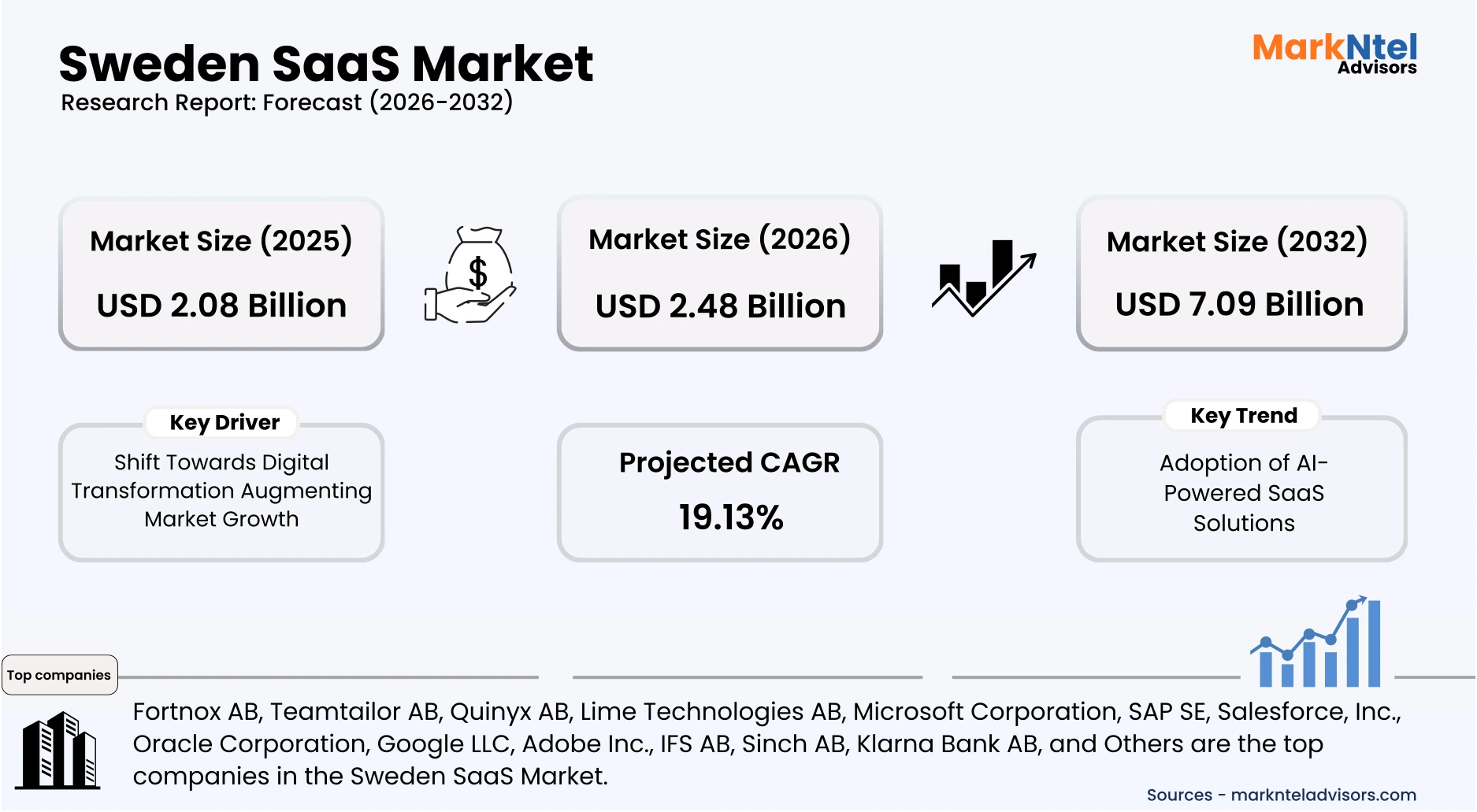
- The Sweden SaaS market size was valued at USD 2.08 billion in 2025 and is projected to grow from USD 2.48 billion in 2026 to USD 7.09 billion by 2032, exhibiting a CAGR of 19.13% during the forecast period.
- By deployment, the public cloud segment represented a significant share of about 60% in the Sweden SaaS Market in 2026.
- By end user, the information & communication technology (ICT) segment seized a significant share of about 22% in the Sweden SaaS Market in 2026.
- Leading SaaS companies in the Sweden Market are Fortnox AB, Teamtailor AB, Quinyx AB, Lime Technologies AB, Microsoft Corporation, SAP SE, Salesforce, Inc., Oracle Corporation, Google LLC, Adobe Inc., IFS AB, Sinch AB, Klarna Bank AB, and Others.
Market Insights & Analysis: Sweden SaaS Market (2026-32):
The Sweden SaaS Market size was valued at around USD 2.08 billion in 2025 and is projected to grow from USD 2.48 billion in 2026 to USD 7.09 billion by 2032. Along with this, the market is estimated to grow at a CAGR of around 19.13% during the forecast period, i.e., 2026-32.
The Sweden SaaS Market is projected to expand steadily, driven by accelerating enterprise digital transformation and increasing adoption of AI-powered SaaS solutions, enabling enhanced operational efficiency, data-driven decision-making, and scalable cloud-based business models across industries.
Swedish enterprises are progressively integrating advanced digital tools into their operations, creating a strong foundation for SaaS adoption. According to Statistics Sweden, 38.8% of enterprises used data analytics in 2025, reflecting a notable rise from 2023. This growth is supported by increased reliance on both internal systems (34.5%) and external service providers (15.0%), indicating a shift toward outsourced, cloud-based solutions.
Additionally, enterprises combining both approaches rose to 10.7%, while the use of customer data for analytics increased to 78.8%. The expansion of digital commerce further reinforces this trend, with 36.7% of enterprises engaged in e-commerce in 2024, including 31.2% via web-based platforms.
Government-backed initiatives are playing a crucial role in accelerating digital adoption. The European Commission’s Digital Decade framework highlights Sweden’s commitment of approximately USD 3.8 billion toward digital transformation, equivalent to 0.5% of GDP, focusing on cloud adoption and advanced technologies.
Furthermore, under Sweden’s national AI strategy, around USD 54 million has been allocated for 2026 through Vinnova to support AI-driven industrial and digital innovation projects, directly fostering SaaS ecosystem development.
The adoption of AI-powered SaaS solutions is accelerating market growth in Sweden, supported by strong private-sector investments. In 2024, Microsoft committed USD 3.2 billion to expand cloud and AI infrastructure, including deploying 20,000 advanced GPUs and enabling large-scale enterprise training programs.
Future infrastructure expansion plans are expected to significantly strengthen the SaaS ecosystem in Sweden. For instance, in 2026, Mistral AI announced a USD 1.43 billion investment to develop next-generation AI data centers, with operations scheduled to begin in 2027, enabling large-scale AI model training and enterprise cloud workloads.
Additionally, a USD 4 billion transaction involving Equinix and Canada Pension Plan Investment Board focuses on expanding North’s infrastructure capacity to 1 GW, with plans to add approximately 800 MW over the next five years, ensuring scalable and energy-efficient support for future AI-driven SaaS demand.
Moreover, Sweden’s Digitalisation Strategy 2025–2030 emphasizes AI-driven efficiency, automation, and cloud adoption, reinforcing enterprise demand for scalable SaaS platforms across industries.
Strong enterprise digital adoption, combined with large-scale public and private investments in AI and cloud infrastructure, will accelerate SaaS demand. These factors position Sweden as a high-growth market for scalable, AI-driven SaaS solutions in the coming years.
Sweden SaaS Market Recent Developments:
- 2025: Google Cloud announced the launch of its 42nd global cloud region in Sweden, strengthening the country’s digital infrastructure. The new region enables low-latency access to AI, analytics, and cloud-based applications while supporting local data residency requirements, thereby accelerating enterprise digital transformation and fostering increased adoption of SaaS solutions across industries.
- 2025: Brookfield Asset Management announced plans to invest up to USD 9.9 billion in developing a large-scale AI data center in Sweden. The project will support growing AI and cloud demand, leveraging Sweden’s strong energy and connectivity infrastructure, and is expected to strengthen enterprise digital transformation and SaaS ecosystem growth.
Sweden SaaS Market Scope:
| Category | Segments |
|---|---|
| By Deployment | (Public Cloud, Private Cloud, Hybrid Cloud), |
| By Organization Size | (Small & Medium-Sized Enterprises, Large Enterprises), |
| By Business Application | (Customer Relationship Management (CRM), Human Resource Management (HRM), Enterprise Resource Planning (ERP), Operations and Manufacturing (O&M), Supply Chain Management (SCM), Content, Collaboration, & Communication, BI & Analytics), |
| By End Users | (BFSI, Healthcare, Information & Communication Technology (ICT), Government Agencies, Manufacturing), |
Sweden SaaS Market Driver:
Shift Towards Digital Transformation Augmenting Market Growth
The Sweden SaaS market is strongly driven by increasing investments in digital technologies, reflecting a broad shift toward modernization and cloud-based business models. Companies across industries are prioritizing digital transformation to enhance operational efficiency, scalability, and data-driven decision-making.
Swedish enterprises have reported a 48% increase in digital technology investments, with expectations of a further 53% rise in the coming years . This sustained investment momentum highlights a long-term commitment to adopting advanced digital tools, including SaaS platforms, to remain competitive in a rapidly evolving business environment.
On a macroeconomic level, the growing importance of digitalization is further reinforced by the contribution of the ICT sector to the national economy. In 2024, Sweden’s ICT sector accounted for approximately 4.7% of GDP, demonstrating the expanding role of technology-driven industries in economic growth. This strong digital foundation supports widespread enterprise adoption of cloud computing, automation, and AI-enabled SaaS solutions.
The convergence of rising enterprise spending and a robust national digital ecosystem is accelerating demand for scalable and cost-efficient SaaS offerings across sectors such as finance, retail, manufacturing, and public services.
Sustained growth in enterprise digital investments is a key catalyst for SaaS adoption. This trend will continue to drive market expansion by enabling innovation, improving efficiency, and increasing reliance on cloud-based software solutions across Sweden.
Sweden SaaS Market Trend:
Adoption of AI-Powered SaaS Solutions
The integration of artificial intelligence into enterprise software is emerging as a defining trend in the Sweden SaaS market, supported by strong adoption metrics and infrastructure investments.
According to Statistics Sweden, 35.0% of enterprises with at least 10 employees used AI in 2025, rising significantly from 25.2% in 2024. Additionally, 11.1% of non-AI-using enterprises are planning to adopt AI, indicating a strong future pipeline for AI-enabled SaaS solutions.
AI is increasingly embedded across core enterprise functions, enhancing productivity and automation. Approximately 41.7% of AI-adopting firms are utilizing these technologies in marketing and sales operations, reflecting a shift toward data-driven customer engagement and decision-making. This growing integration is accelerating demand for intelligent SaaS platforms capable of delivering advanced analytics, automation, and personalization at scale.
Infrastructure investments further reinforce this trend. In 2025, EcoDataCenter secured USD 703.5 million in funding for AI-focused data center expansion, contributing to a broader USD 1.8 billion investment pipeline since 2023 . These developments are strengthening the digital backbone required for large-scale AI workloads and SaaS delivery environments.
The rapid adoption of AI across enterprises is transforming SaaS capabilities and use cases. This trend will continue to accelerate market growth by driving demand for intelligent, scalable, and automation-driven SaaS solutions across Sweden.
Sweden SaaS Market Opportunity:
Rise of Vertical-Specific SaaS
The growing preference for vertical-specific SaaS solutions represents a key opportunity in the Sweden market, as enterprises increasingly seek software tailored to industry-specific requirements.
Unlike horizontal platforms, vertical SaaS solutions are designed to address specialized workflows, regulatory standards, and operational complexities unique to sectors such as healthcare, manufacturing, finance, and public services.
As organizations deepen their digital transformation strategies, the limitations of one-size-fits-all software models are becoming more evident. Businesses now require solutions that integrate seamlessly with existing industry systems, ensure compliance with evolving regulatory frameworks, and support advanced functionalities such as sector-specific analytics and automation. Vertical SaaS platforms meet these needs by offering higher precision, improved efficiency, and better alignment with core business processes.
Furthermore, the increasing adoption of data-driven decision-making and AI technologies is reinforcing the demand for specialized platforms capable of handling industry-specific data environments. This enables organizations to derive more actionable insights and optimize performance at a granular level.
Vertical-specific SaaS enhances operational relevance and efficiency for enterprises. Its growing adoption will play a pivotal role in expanding and diversifying the Sweden SaaS market in the coming years.
Sweden SaaS Market Challenge:
Data Security & Compliance Barriers
Sweden’s SaaS market faces growing challenges due to increasing data breach incidents and stricter regulatory enforcement. According to the Swedish Authority for Privacy Protection, over 12,276 personal data breach cases were reported in 2025, marking a sharp rise of nearly 90% year-on-year. This surge highlights escalating cybersecurity vulnerabilities within cloud-based and digital infrastructures, raising concerns among enterprises regarding data integrity and system resilience.
At the same time, regulatory enforcement has intensified, increasing compliance risks for SaaS providers. In 2024, a Swedish financial institution was fined approximately USD 1.4 million for improper data transfers affecting up to one million customers. Such actions reflect stringent oversight and the financial consequences of failing to meet data protection standards under EU regulations.
These developments compel SaaS vendors to significantly increase investments in cybersecurity frameworks, compliance audits, and secure data management systems, thereby elevating operational costs and complexity.
Overall, the rapid rise in breach incidents, combined with strict regulatory penalties, creates a high-risk operating environment. This challenge increases costs and slows adoption, ultimately hindering the growth potential of the Sweden SaaS market.
Sweden SaaS Market (2026-32) Segmentation Analysis:
The Sweden SaaS Market study of MarkNtel Advisors evaluates & highlights the major trends and influencing factors in each segment. It includes predictions for the period 2026–32 at the country level. Based on the analysis, the market has been further classified as;
Based on Deployment:
- Public Cloud
- Private Cloud
- Hybrid Cloud
The public cloud segment dominates the Sweden SaaS market, accounting for approximately 60% of the market size, primarily due to its superior scalability, operational flexibility, and cost optimization benefits.
Organizations are increasingly prioritizing asset-light IT strategies, shifting away from capital-intensive infrastructure toward on-demand, subscription-based cloud environments. This transition enables enterprises to rapidly deploy applications, scale resources dynamically, and reduce the total cost of ownership.
In Sweden, high levels of digital maturity and widespread adoption of advanced technologies such as AI, data analytics, and automation further reinforce the preference for public cloud models. These platforms support seamless integration, continuous software updates, and real-time accessibility, which are critical for modern, distributed business operations.
Moreover, the growing reliance on external digital service providers and cloud-native ecosystems accelerates public cloud adoption, as enterprises seek agility and faster time-to-market. Public cloud infrastructure also enables efficient handling of fluctuating workloads, particularly in sectors with dynamic demand patterns such as e-commerce, finance, and technology.
Public cloud dominance is driven by its economic and operational advantages, aligning with enterprise digital priorities. This trend will continue to shape SaaS deployment strategies, reinforcing scalable and innovation-driven growth across Sweden.
Based on End User:
- BFSI
- Healthcare
- Information & Communication Technology (ICT)
- Government Agencies
- Manufacturing
- Others (Educational Institute, Transportation & Logistics, etc.)
The information & communication technology (ICT) segment dominates the Sweden SaaS market, accounting for about 22% of total market volume, supported by its advanced digital capabilities and strong alignment with cloud-first strategies.
ICT organizations inherently operate within technology-driven environments, making them early adopters of SaaS platforms for functions such as software development, infrastructure management, cybersecurity, and data analytics.
In Sweden, the ICT sector benefits from a highly developed digital infrastructure and a strong innovation ecosystem, enabling seamless integration of SaaS solutions into core business operations. The increasing adoption of artificial intelligence, automation, and cloud-native applications within the sector further accelerates demand for scalable and flexible SaaS offerings.
Moreover, the ICT segment plays a dual role in the market, acting both as a primary consumer and a provider of SaaS solutions. Companies within this sector not only leverage SaaS to enhance operational efficiency and reduce infrastructure dependency but also develop and distribute SaaS products across multiple industries, thereby expanding overall market penetration. Continuous investments in digital technologies and cloud infrastructure further reinforce its leadership position.
The ICT sector’s technological maturity and strategic role in digital service delivery underpin its market dominance. This leadership is expected to persist, driving sustained SaaS adoption and innovation across Sweden.
Gain a Competitive Edge with Our Sweden SaaS Market Report:
- Sweden SaaS Market Report by MarkNtel Advisors provides a detailed & thorough analysis of market size & share, growth rate, competitive landscape, and key players. This comprehensive analysis helps businesses gain a holistic understanding of the market dynamics & make informed decisions.
- This report also highlights current market trends & future projections, allowing businesses to identify emerging opportunities & potential challenges. By understanding market forecasts, companies can align their strategies & stay ahead of the competition.
- Sweden SaaS Market Report aids in assessing & mitigating risks associated with entering or operating in the market. By understanding market dynamics, regulatory frameworks, and potential challenges, businesses can develop strategies to minimize risks & optimize their operations.
*Reports Delivery Format - Market research studies from MarkNtel Advisors are offered in PDF, Excel and PowerPoint formats. Within 24 hours of the payment being successfully received, the report will be sent to your email address.
Frequently Asked Questions
- Market Segmentation
- Introduction
- Product Definition
- Research Process
- Assumptions
- Executive Summary
- Sweden SaaS Market Policies, Regulations, and Product Standards
- Sweden SaaS Market Trends & Developments
- Sweden SaaS Market Dynamics
- Growth Factors
- Challenges
- Sweden SaaS Market Hotspot & Opportunities
- Sweden SaaS Market Outlook, 2022-2032F
- Market Size & Outlook
- By Revenues (USD Million)
- Market Share & Outlook
- By Deployment - Market Size & Forecast 2022-2032, USD Million
- Public Cloud
- Private Cloud
- Hybrid Cloud
- By Organization Size- Market Size & Forecast 2022-2032, USD Million
- Small & Medium-Sized Enterprises
- Large Enterprises
- By Business Application - Market Size & Forecast 2022-2032, USD Million
- Customer Relationship Management (CRM)
- Human Resource Management (HRM)
- Enterprise Resource Planning (ERP)
- Operations and Manufacturing (O&M)
- Supply Chain Management (SCM)
- Content, Collaboration, & Communication
- BI & Analytics
- Others (Security Management, Transaction Processing, etc.)
- By End Users - Market Size & Forecast 2022-2032, USD Million
- BFSI
- Healthcare
- Information & Communication Technology (ICT)
- Government Agencies
- Manufacturing
- Others (Educational Institute, Transportation & Logistics, etc.)
- By Region - Market Size & Forecast 2022-2032, USD Million
- Stockholm Region
- West Sweden
- South Sweden
- North Sweden
- By Company
- Competition Characteristics
- Market Share & Analysis
- By Deployment - Market Size & Forecast 2022-2032, USD Million
- Market Size & Outlook
- Sweden Public Cloud Market Outlook, 2022-2032
- Market Size & Outlook
- By Revenues (USD Million)
- Market Share & Outlook
- By Organization Size- Market Size & Forecast 2022-2032, USD Million
- By Business Application - Market Size & Forecast 2022-2032, USD Million
- By End Users - Market Size & Forecast 2022-2032, USD Million
- By Region - Market Size & Forecast 2022-2032, USD Million
- Market Size & Outlook
- Sweden Private Cloud Market Outlook, 2022-2032
- Market Size & Outlook
- By Revenues (USD Million)
- Market Share & Outlook
- By Organization Size- Market Size & Forecast 2022-2032, USD Million
- By Business Application - Market Size & Forecast 2022-2032, USD Million
- By End Users - Market Size & Forecast 2022-2032, USD Million
- By Region - Market Size & Forecast 2022-2032, USD Million
- Market Size & Outlook
- Sweden Hybrid Cloud Market Outlook, 2022-2032
- Market Size & Outlook
- By Revenues (USD Million)
- Market Share & Outlook
- By Organization Size- Market Size & Forecast 2022-2032, USD Million
- By Business Application - Market Size & Forecast 2022-2032, USD Million
- By End Users - Market Size & Forecast 2022-2032, USD Million
- By Region - Market Size & Forecast 2022-2032, USD Million
- Market Size & Outlook
- Sweden SaaS Market Key Strategic Imperatives for Success & Growth
- Competitive Outlook
- Company Profiles
- Fortnox AB
- Business Description
- Product Portfolio
- Collaborations & Alliances
- Recent Developments
- Financial Details
- Others
- Teamtailor AB
- Business Description
- Product Portfolio
- Collaborations & Alliances
- Recent Developments
- Financial Details
- Others
- Quinyx AB
- Business Description
- Product Portfolio
- Collaborations & Alliances
- Recent Developments
- Financial Details
- Others
- Lime Technologies AB
- Business Description
- Product Portfolio
- Collaborations & Alliances
- Recent Developments
- Financial Details
- Others
- Microsoft Corporation
- Business Description
- Product Portfolio
- Collaborations & Alliances
- Recent Developments
- Financial Details
- Others
- SAP SE
- Business Description
- Product Portfolio
- Collaborations & Alliances
- Recent Developments
- Financial Details
- Others
- Salesforce, Inc.
- Business Description
- Product Portfolio
- Collaborations & Alliances
- Recent Developments
- Financial Details
- Others
- Oracle Corporation
- Business Description
- Product Portfolio
- Collaborations & Alliances
- Recent Developments
- Financial Details
- Others
- Google LLC
- Business Description
- Product Portfolio
- Collaborations & Alliances
- Recent Developments
- Financial Details
- Others
- Adobe Inc.
- Business Description
- Product Portfolio
- Collaborations & Alliances
- Recent Developments
- Financial Details
- Others
- IFS AB
- Business Description
- Product Portfolio
- Collaborations & Alliances
- Recent Developments
- Financial Details
- Others
- Sinch AB
- Business Description
- Product Portfolio
- Collaborations & Alliances
- Recent Developments
- Financial Details
- Others
- Klarna Bank AB
- Business Description
- Product Portfolio
- Collaborations & Alliances
- Recent Developments
- Financial Details
- Others
- Fortnox AB
- Company Profiles
- Disclaimer
MarkNtel Advisors follows a robust and iterative research methodology designed to ensure maximum accuracy and minimize deviation in market estimates and forecasts. Our approach combines both bottom-up and top-down techniques to effectively segment and quantify various aspects of the market. A consistent feature across all our research reports is data triangulation, which examines the market from three distinct perspectives to validate findings. Key components of our research process include:
1. Scope & Research Design At the outset, MarkNtel Advisors define the research objectives and formulate pertinent questions. This phase involves determining the type of research—qualitative or quantitative—and designing a methodology that outlines data collection methods, target demographics, and analytical tools. They also establish timelines and budgets to ensure the research aligns with client goals.
2. Sample Selection and Data Collection In this stage, the firm identifies the target audience and determines the appropriate sample size to ensure representativeness. They employ various sampling methods, such as random or stratified sampling, based on the research objectives. Data collection is carried out using tools like surveys, interviews, and observations, ensuring the gathered data is reliable and relevant.
3. Data Analysis and Validation Once data is collected, MarkNtel Advisors undertake a rigorous analysis process. This includes cleaning the data to remove inconsistencies, employing statistical software for quantitative analysis, and thematic analysis for qualitative data. Validation steps are taken to ensure the accuracy and reliability of the findings, minimizing biases and errors.

4. Data Forecast and FinalizationThe final phase involves forecasting future market trends based on the analyzed data. MarkNtel Advisors utilize predictive modeling and time series analysis to anticipate market behaviors. The insights are then compiled into comprehensive reports, featuring visual aids like charts and graphs, and include strategic recommendations to inform client decision-making
We offer flexible licensing options to cater to varying organizational needs. Choose the pricing pack that best suits your requirements:
Buy Now Inquire Before Buying
 Request Customization
 Talk to our Consultant