

Global Subcutaneous Biologics Market Research Report: Forecast (2025-2030)
Subcutaneous Biologics Market - By Subcutaneous Drug Delivery System (Prefilled Syringe, Wearable Injectors, Auto-Injectors, Implants, Pen Injectors, Drug Reconstitution Delivery S ... ystems), By Application (Crohn’s Disease, Rheumatoid Arthritis, Cancer, Leukaemia, Lymphoma, Psoriasis, Diabetes, Cardiovascular Disorder, Others), By Distribution Channel (Hospital Pharmacy, Retail Pharmacy, Online Pharmacy) and Others Read more
- Healthcare
- Jun 2025
- Pages 194
- Report Format: PDF, Excel, PPT
Market Definition
Subcutaneous biologics are specialized medications designed to be injected beneath the skin to treat chronic diseases (rheumatoid arthritis, diabetes, and certain cancers). They target specific components of the immune system or the disease pathways. They are made of living cells and are often used when traditional treatments are ineffective. They offer targeted long-term management with improved patient convenience and the potential for self-administration at home.
Market Insights & Analysis: Global Subcutaneous Biologics Market (2025-30):
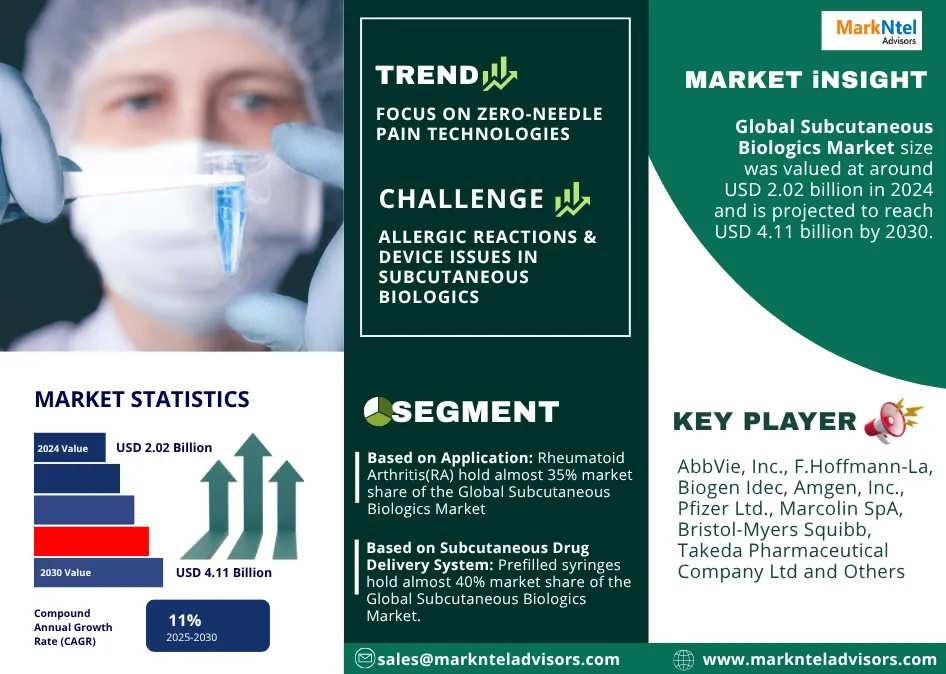
The Global Subcutaneous Biologics Market size was valued at around USD 2.02 billion in 2024 and is projected to reach USD 4.11 billion by 2030. Along with this, the market is estimated to grow at a CAGR of around 11% during the forecast period, i.e., 2025-30. This growth is attributed to various factors like technological advancements coupled with strategies built for individual patients. Also, regulatory support from governments worldwide through various policies & incentives is helping in the market growth. Additionally, access to biologists is increasing with regulatory approvals like the FDA’s nod for Amgen’s biosimilar Amjevita in 2023. Investments are being made in niche biologic therapies as the rare disease segment is becoming a lucrative growth market. This can be seen with 54% of novel drug approvals by the FDA for rare orphan diseases. Moreover, the market is growing in developing regions like Asia-Pacific, with nations like India reporting a 22% annual rise in pharmaceutical imports, including Biologics, with the expansion of domestic production. Also, China has seen a growth of 18% in the market due to government incentives and healthcare modernization efforts in 2023.
| Report Coverage | Details |
|---|---|
| Historical Years | 2020–23 |
| Forecast Years | 2025–30 |
| Market Value in 2024 | USD 2.02 Billion |
| Market Value by 2030 | USD 4.11 Billion |
| CAGR (2025–30) | 11% |
| Leading Region | North America |
| Top Key Players | AbbVie, Inc., F.Hoffmann-La, Biogen Idec, Amgen, Inc., Pfizer Ltd., Marcolin SpA, Bristol-Myers Squibb, Takeda Pharmaceutical Company Ltd., Roche AG, Genentech Inc., Eisai, Inc., Novartis AG, Bayer AG, Abbott Laboratories, GlaxoSmithKline, and Others |
| Segmentation | By Subcutaneous Drug Delivery System (Prefilled Syringe, Wearable Injectors, Auto-Injectors, Implants, Pen Injectors, Drug Reconstitution Delivery Systems), By Application (Crohn’s Disease, Rheumatoid Arthritis, Cancer, Leukaemia, Lymphoma, Psoriasis, Diabetes, Cardiovascular Disorder, Others), By Distribution Channel (Hospital Pharmacy, Retail Pharmacy, Online Pharmacy) and Others |
| Key Report Highlights |
|
*Boost strategic growth with in-depth market analysis - Get a free sample preview today!
Additionally, sustainability is becoming a priority, as seen in Roche’s biodegradable packaging initiatives, addressing environmental concerns. More than 20 pharmaceutical companies have developed nearly 80 auto-injectors by the present time study. Among all auto-injectors, 62% are disposable. Leading companies like Roche, Novartis, and Pfizer promote innovation through collaborations and enlarged pipelines. These collaborations will further amplify product growth through advanced solutions. Furthermore, personalized medicine has presented significant opportunities for customized treatments. Advancements in healthcare and biosimilars will provide more accuracy & efficiency in the treatments, propelling the market growth during the forecast period. The expansion toward global access, coupled with sustainable practices and innovative collaborations, plays a transformative role in shaping the future of global healthcare.
Global Subcutaneous Biologics Market Driver:
Growing Prevalence of Chronic Diseases – The ubiquity of chronic diseases is a major factor driving the market demand. These diseases are increasing rapidly due to the rise in the elderly population globally. By 2050, the elderly population will grow to around 2 billion, which was just 900 million in 2015. They are more prone to chronic & cardiovascular diseases that require long-term care with important medications like biologics. Around 800 million people are suffering from diabetes globally, with numbers growing over the years. Also, over 360 million people around the world are affected by arthritis. This creates the need for biologics to provide ease in treatment for both patients & doctors. Globally, over 20 million new cancer diagnoses happen annually, as per the American Cancer Society. With cancer treatment plans increasingly individualized, subcutaneous biologics are predicted to be used more regularly due to their benefits of fewer health center visits and improved patient compliance.
Global Subcutaneous Biologics Market Opportunity:
Advancements in Subcutaneous Delivery Technologies – The rapidly changing subcutaneous delivery technologies are offering lucrative opportunities for market growth. Various innovations are revolutionizing the patients’ experiences by enhancing their safety & convenience. Wearable injectors, needle-free devices, and auto-injectors are some of the innovations that are providing opportunities for the market players to cater to the rising consumer needs. For instance, the drug delivery wearable device YpsoDose by Ypsomed allows precision delivery of high-viscosity biologics over prolonged times. This helps the patients to explore the option of home treatments and avoid multiple visits to the hospital.
Moreover, digital healthcare innovations are also growing at a rapid rate, allowing the incorporation of smart technologies like Bluetooth-connected auto-injectors to facilitate real-time monitoring and dosage management. For instance, the auto-injector InPen™ is a reusable intelligent insulin pen that is enabled by AI, which utilizes Bluetooth to transmit dosage data to the mobile app. These advancements help in improving the patient's results and will further boost the market growth in the forecast period.
Global Subcutaneous Biologics Market Challenge:
Allergic Reactions & Device Issues in Subcutaneous Biologics – Side effects and allergic reactions are one of the most prominent issues for the global subcutaneous biologics industry. As these biologics are commonly made from proteins, they have the potential to trigger minor to severe allergic reactions by inciting an immunological response. Hypersensitivity response cases have been found in about 1-10% of the patients undergoing biologic treatments, as per the Journal of Allergy and Clinical Immunology. One of the important cases involved the monoclonal antibodies that could lead to infusion-related reactions like cytokine release syndrome. The need for monitoring and patient education has grown due to the 7% of patients experiencing injection site reactions as per studies on adalimumab biologics. Also, the major concerns are the long-term side effects, like increased risks of infections and malignancies. In addition, the occurrence of malfunctions and injuries due to a lack of AI capabilities in devices is rising, particularly in auto-injectors. Device problems, such as breakage, defects, jams, and others, accounted for 45% of incidents, while 10% are attributed to patient problems, particularly missed and underdoses.
Global Subcutaneous Biologics Market Trend:
Focus on Zero-Needle Pain Technologies – Focus on zero-needle pain technologies aimed at reducing the pain associated with traditional injections and increasing patient compliance are driving changes in the Global Subcutaneous Biologics Market. Innovations at the forefront include jet injectors, microneedle patches, and needle-free delivery systems. Because of its improved accuracy and reduced pain, the PharmaJets needle-free injector is gaining popularity. It uses a high-pressure stream to deliver biologics into the skin. Due to their painless operation, microneedle-based subcutaneous systems are also growing in popularity.
Other applications of microneedle patch technology, such as those marketed by 3M Drug Delivery Systems, are being applied for minimally invasive vaccinations and other biologics, including insulins. Growth is being led by increases in diabetes and other chronic diseases in Southeast Asia that drive a desire for patient-friendly solutions. Needle-free injection devices like the PharmaJet Tropis, which is authorized for administering vaccines, are being adapted for biologics to lower the risk of needlestick injuries and promote tolerance among individuals who are afraid of needles.
Global Subcutaneous Biologics Market (2025-30): Segmentation Analysis
The Global Subcutaneous Biologics Market study of MarkNtel Advisors evaluates & highlights the major trends and influencing factors in each segment. It includes predictions for the period 2025–2030 at the global level. Based on the analysis, the market has been further classified as:
Based on Subcutaneous Drug Delivery System:
- Prefilled Syringe
- Wearable Injectors
- Auto-Injectors
- Implants
- Pen Injectors
- Drug Reconstitution Delivery Systems
Prefilled syringes hold almost 40% market share of the Global Subcutaneous Biologics Market. Their ease reduces contamination risk, and the accuracy of dose delivery makes them incredibly popular. The applications are also prevalent in long-term disease treatments where consistent, dependable biologics administration is extremely crucial. These syringes are easy to use & support self-administration, which fits in nicely with patient-centric healthcare models. For instance, prefilled syringes like the Enbrel SureClick Auto-Injector are very popular because of their easy-to-use design, which guarantees precise dosages while reducing waste. Furthermore, improvements in syringe technology, such as the use of glass and sophisticated polymers, help in improving the stability and compatibility of drugs.
Based on Application:
- Crohn’s Disease
- Rheumatoid Arthritis
- Cancer
- Leukemia
- Lymphoma
- Psoriasis
- Diabetes
- Cardiovascular Disorder
- Others
Rheumatoid Arthritis(RA) is one of the main symptoms of subcutaneous biologics that drives a huge part of the market growth and holds a 35% share of this market. The primary signs and symptoms of RA are a chronic inflammatory disease. They include pain, swelling, and possible joint damage. As per data, there were about 18 million rheumatoid arthritis patients globally. These biologics have proved notable effectiveness in reducing disease activity by enhancing the quality of life and avoiding joint harm. The availability of biosimilars has also contributed to increased access to biologic treatments for RA by allowing patients to adopt more affordable alternatives. The market is dominated by RA because of its rising incidence and improvements in biological treatments. Furthermore, it's going to continue to grow gradually over the ensuing years due to new drug approvals and ongoing research.
Global Subcutaneous Biologics Market (2025-30): Regional Projections
Geographically, the Global Subcutaneous Biologics Market expands across:
- North America
- South America
- Europe
- The Middle East and Africa
- Asia-Pacific
Due to its developed healthcare network and high rate of diseases, North America now has the majority market share in the subcutaneous biologics market all over the world. This region holds about 38% of the entire global market. The status of prominent industry players such as Pfizer, Roche, and Amgen in the region contributes to its dominance. These organizations are in the process of developing biological treatments aggressively by forming strategic alliances, acquisitions, and ongoing innovation that is creating regional market expansion. There are numerous countries in the region with a growing elderly population that is susceptible to chronic illness and thus in need of these necessary therapies. Better awareness of healthcare, along with enhanced accessibility of biologic therapies, also stimulates demand for subcutaneous biologics in North America. Heavy uptake of biosimilars across the region continues to drive market growth by boosting the supply of cheaper substitutes for more expensive reference biologics.
Global Subcutaneous Biologics Industry Recent Development:
- August 2024: Novartis partnered with Lindy Biosciences to develop high-concentration subcutaneous biologic injectables using microglassification technology, enhancing treatment convenience and improving patient compliance in the global biologics market.
- May 2024: Biogen and Eisai submitted a rolling FDA application for a subcutaneous version of Leqembi, an Alzheimer’s drug, which may reduce hospital visits and nursing care, offering a more convenient treatment option.
Gain a Competitive Edge with Our Global Subcutaneous Biologics Market Report
- Global Subcutaneous Biologics Market Report by MarkNtel Advisors provides a detailed & thorough analysis of market size & share, growth rate, competitive landscape, and key players. This comprehensive analysis helps businesses gain a holistic understanding of the market dynamics & make informed decisions.
- This report also highlights current market trends & future projections, allowing businesses to identify emerging opportunities & potential challenges. By understanding market forecasts, companies can align their strategies & stay ahead of the competition.
- Global Subcutaneous Biologics Market Report aids in assessing & mitigating risks associated with entering or operating in the market. By understanding market dynamics, regulatory frameworks, and potential challenges, businesses can develop strategies to minimize risks & optimize their operations.
*Reports Delivery Format - Market research studies from MarkNtel Advisors are offered in PDF, Excel and PowerPoint formats. Within 24 hours of the payment being successfully received, the report will be sent to your email address.
Frequently Asked Questions
- Market Segmentation
- Introduction
- Product Definition
- Research Process
- Assumptions
- Executive Summary
- Global Subcutaneous Biologics Market Regulations and Policy
- Global Subcutaneous Biologics Market Trends & Developments
- Global Subcutaneous Biologics Market Supply Chain Analysis
- Global Subcutaneous Biologics Market Dynamics
- Drivers
- Challenges
- Global Subcutaneous Biologics Market & Opportunities
- Global Subcutaneous Biologics Market Outlook, 2020-2030
- Market Size & Analysis
- By Revenues (USD Million)
- Market Share & Analysis
- By Subcutaneous Drug Delivery System
- Prefilled Syringe - Market Size & Forecast 2020-2030, (USD Million)
- Wearable Injectors - Market Size & Forecast 2020-2030, (USD Million)
- Auto-Injectors - Market Size & Forecast 2020-2030, (USD Million)
- Implants - Market Size & Forecast 2020-2030, (USD Million)
- Pen Injectors - Market Size & Forecast 2020-2030, (USD Million)
- Drug Reconstitution Delivery Systems - Market Size & Forecast 2020-2030, (USD Million)
- By Application
- Crohn’s Disease - Market Size & Forecast 2020-2030, (USD Million)
- Rheumatoid Arthritis - Market Size & Forecast 2020-2030, (USD Million)
- Cancer - Market Size & Forecast 2020-2030, (USD Million)
- Leukaemia - Market Size & Forecast 2020-2030, (USD Million)
- Lymphoma - Market Size & Forecast 2020-2030, (USD Million)
- Psoriasis - Market Size & Forecast 2020-2030, (USD Million)
- Diabetes - Market Size & Forecast 2020-2030, (USD Million)
- Cardiovascular Disorder - Market Size & Forecast 2020-2030, (USD Million)
- Others - Market Size & Forecast 2020-2030, (USD Million)
- By Distribution Channel
- Hospital Pharmacy - Market Size & Forecast 2020-2030, (USD Million)
- Retail Pharmacy - Market Size & Forecast 2020-2030, (USD Million)
- Online Pharmacy - Market Size & Forecast 2020-2030, (USD Million)
- Others - Market Size & Forecast 2020-2030, (USD Million)
- By Region
- North America
- South America
- Europe
- Middle East & Africa
- Asia Pacific
- By Company
- Market Share
- Competition Characteristics
- By Subcutaneous Drug Delivery System
- Market Size & Analysis
- North America Subcutaneous Biologics Market Outlook, 2020-2030
- Market Size & Analysis
- By Revenues (USD Million)
- Market Share & Analysis
- By Subcutaneous Drug Delivery System - Market Size & Forecast 2020-2030, (USD Million)
- By Application - Market Size & Forecast 2020-2030, (USD Million)
- By Distribution Channel - Market Size & Forecast 2020-2030, (USD Million)
- By Country
- The US
- Canada
- Mexico
- The US Subcutaneous Biologics Market Outlook, 2020-2030
- Market Size & Analysis
- By Revenues (USD Million)
- Market Share & Analysis
- By Subcutaneous Drug Delivery System - Market Size & Forecast 2020-2030, (USD Million)
- By Application - Market Size & Forecast 2020-2030, (USD Million)
- By Distribution Channel - Market Size & Forecast 2020-2030, (USD Million)
- Market Size & Analysis
- Canada Subcutaneous Biologics Market Outlook, 2020-2030
- Market Size & Analysis
- By Revenues (USD Million)
- Market Share & Analysis
- By Subcutaneous Drug Delivery System - Market Size & Forecast 2020-2030, (USD Million)
- By Application - Market Size & Forecast 2020-2030, (USD Million)
- By Distribution Channel - Market Size & Forecast 2020-2030, (USD Million)
- Market Size & Analysis
- Mexico Subcutaneous Biologics Market Outlook, 2020-2030
- Market Size & Analysis
- By Revenues (USD Million)
- Market Share & Analysis
- By Subcutaneous Drug Delivery System - Market Size & Forecast 2020-2030, (USD Million)
- By Application - Market Size & Forecast 2020-2030, (USD Million)
- By Distribution Channel - Market Size & Forecast 2020-2030, (USD Million)
- Market Size & Analysis
- Market Size & Analysis
- South America Subcutaneous Biologics Market Outlook, 2020-2030
- Market Size & Analysis
- By Revenues (USD Million)
- Market Share & Analysis
- By Subcutaneous Drug Delivery System - Market Size & Forecast 2020-2030, (USD Million)
- By Application - Market Size & Forecast 2020-2030, (USD Million)
- By Distribution Channel - Market Size & Forecast 2020-2030, (USD Million)
- By Country
- Brazil
- Argentina
- Rest of South America
- Brazil Subcutaneous Biologics Market Outlook, 2020-2030
- Market Size & Analysis
- By Revenues (USD Million)
- Market Share & Analysis
- By Subcutaneous Drug Delivery System - Market Size & Forecast 2020-2030, (USD Million)
- By Application - Market Size & Forecast 2020-2030, (USD Million)
- By Distribution Channel - Market Size & Forecast 2020-2030, (USD Million)
- Market Size & Analysis
- Argentina Subcutaneous Biologics Market Outlook, 2020-2030
- Market Size & Analysis
- By Revenues (USD Million)
- Market Share & Analysis
- By Subcutaneous Drug Delivery System - Market Size & Forecast 2020-2030, (USD Million)
- By Application - Market Size & Forecast 2020-2030, (USD Million)
- By Distribution Channel - Market Size & Forecast 2020-2030, (USD Million)
- Market Size & Analysis
- Market Size & Analysis
- Europe Subcutaneous Biologics Market Outlook, 2020-2030
- Market Size & Analysis
- By Revenues (USD Million)
- Market Share & Analysis
- By Subcutaneous Drug Delivery System - Market Size & Forecast 2020-2030, (USD Million)
- By Application - Market Size & Forecast 2020-2030, (USD Million)
- By Distribution Channel - Market Size & Forecast 2020-2030, (USD Million)
- By Country
- Germany
- The UK
- France
- Italy
- Spain
- The Netherlands
- Scandinavia
- Rest of Europe
- Germany Subcutaneous Biologics Market Outlook, 2020-2030
- Market Size & Analysis
- By Revenues (USD Million)
- Market Share & Analysis
- By Subcutaneous Drug Delivery System - Market Size & Forecast 2020-2030, (USD Million)
- By Application - Market Size & Forecast 2020-2030, (USD Million)
- By Distribution Channel - Market Size & Forecast 2020-2030, (USD Million)
- Market Size & Analysis
- The UK Subcutaneous Biologics Market Outlook, 2020-2030
- Market Size & Analysis
- By Revenues (USD Million)
- Market Share & Analysis
- By Subcutaneous Drug Delivery System - Market Size & Forecast 2020-2030, (USD Million)
- By Application - Market Size & Forecast 2020-2030, (USD Million)
- By Distribution Channel - Market Size & Forecast 2020-2030, (USD Million)
- Market Size & Analysis
- France Subcutaneous Biologics Market Outlook, 2020-2030
- Market Size & Analysis
- By Revenues (USD Million)
- Market Share & Analysis
- By Subcutaneous Drug Delivery System - Market Size & Forecast 2020-2030, (USD Million)
- By Application - Market Size & Forecast 2020-2030, (USD Million)
- By Distribution Channel - Market Size & Forecast 2020-2030, (USD Million)
- Market Size & Analysis
- Italy Subcutaneous Biologics Market Outlook, 2020-2030
- Market Size & Analysis
- By Revenues (USD Million)
- Market Share & Analysis
- By Subcutaneous Drug Delivery System - Market Size & Forecast 2020-2030, (USD Million)
- By Application - Market Size & Forecast 2020-2030, (USD Million)
- By Distribution Channel - Market Size & Forecast 2020-2030, (USD Million)
- Market Size & Analysis
- Spain Subcutaneous Biologics Market Outlook, 2020-2030
- Market Size & Analysis
- By Revenues (USD Million)
- Market Share & Analysis
- By Subcutaneous Drug Delivery System - Market Size & Forecast 2020-2030, (USD Million)
- By Application - Market Size & Forecast 2020-2030, (USD Million)
- By Distribution Channel - Market Size & Forecast 2020-2030, (USD Million)
- Market Size & Analysis
- The Netherlands Subcutaneous Biologics Market Outlook, 2020-2030
- Market Size & Analysis
- By Revenues (USD Million)
- Market Share & Analysis
- By Subcutaneous Drug Delivery System - Market Size & Forecast 2020-2030, (USD Million)
- By Application - Market Size & Forecast 2020-2030, (USD Million)
- By Distribution Channel - Market Size & Forecast 2020-2030, (USD Million)
- Market Size & Analysis
- Scandinavia Subcutaneous Biologics Market Outlook, 2020-2030
- Market Size & Analysis
- By Revenues (USD Million)
- Market Share & Analysis
- By Subcutaneous Drug Delivery System - Market Size & Forecast 2020-2030, (USD Million)
- By Application - Market Size & Forecast 2020-2030, (USD Million)
- By Distribution Channel - Market Size & Forecast 2020-2030, (USD Million)
- Market Size & Analysis
- Market Size & Analysis
- Middle East & Africa Subcutaneous Biologics Market Outlook, 2020-2030
- Market Size & Analysis
- By Revenues (USD Million)
- Market Share & Analysis
- By Subcutaneous Drug Delivery System - Market Size & Forecast 2020-2030, (USD Million)
- By Application - Market Size & Forecast 2020-2030, (USD Million)
- By Distribution Channel - Market Size & Forecast 2020-2030, (USD Million)
- By Country
- Saudi Arabia
- UAE
- South Africa
- Turkey
- Israel
- Rest of Middle East & Africa
- Saudi Arabia Subcutaneous Biologics Market Outlook, 2020-2030
- Market Size & Analysis
- By Revenues (USD Million)
- Market Share & Analysis
- By Subcutaneous Drug Delivery System - Market Size & Forecast 2020-2030, (USD Million)
- By Application - Market Size & Forecast 2020-2030, (USD Million)
- By Distribution Channel - Market Size & Forecast 2020-2030, (USD Million)
- Market Size & Analysis
- UAE Subcutaneous Biologics Market Outlook, 2020-2030
- Market Size & Analysis
- By Revenues (USD Million)
- Market Share & Analysis
- By Subcutaneous Drug Delivery System - Market Size & Forecast 2020-2030, (USD Million)
- By Application - Market Size & Forecast 2020-2030, (USD Million)
- By Distribution Channel - Market Size & Forecast 2020-2030, (USD Million)
- Market Size & Analysis
- South Africa Subcutaneous Biologics Market Outlook, 2020-2030
- Market Size & Analysis
- By Revenues (USD Million)
- Market Share & Analysis
- By Subcutaneous Drug Delivery System - Market Size & Forecast 2020-2030, (USD Million)
- By Application - Market Size & Forecast 2020-2030, (USD Million)
- By Distribution Channel - Market Size & Forecast 2020-2030, (USD Million)
- Market Size & Analysis
- Turkey Subcutaneous Biologics Market Outlook, 2020-2030
- Market Size & Analysis
- By Revenues (USD Million)
- Market Share & Analysis
- By Subcutaneous Drug Delivery System - Market Size & Forecast 2020-2030, (USD Million)
- By Application - Market Size & Forecast 2020-2030, (USD Million)
- By Distribution Channel - Market Size & Forecast 2020-2030, (USD Million)
- Market Size & Analysis
- Israel Subcutaneous Biologics Market Outlook, 2020-2030
- Market Size & Analysis
- By Revenues (USD Million)
- Market Share & Analysis
- By Subcutaneous Drug Delivery System - Market Size & Forecast 2020-2030, (USD Million)
- By Application - Market Size & Forecast 2020-2030, (USD Million)
- By Distribution Channel - Market Size & Forecast 2020-2030, (USD Million)
- Market Size & Analysis
- Market Size & Analysis
- Asia Pacific Subcutaneous Biologics Market Outlook, 2020-2030
- Market Size & Analysis
- By Revenues (USD Million)
- Market Share & Analysis
- By Subcutaneous Drug Delivery System - Market Size & Forecast 2020-2030, (USD Million)
- By Application - Market Size & Forecast 2020-2030, (USD Million)
- By Distribution Channel - Market Size & Forecast 2020-2030, (USD Million)
- By Country
- China
- Japan
- India
- South Korea
- Australia
- Rest of Asia Pacific
- China Subcutaneous Biologics Market Outlook, 2020-2030
- Market Size & Analysis
- By Revenues (USD Million)
- Market Share & Analysis
- By Subcutaneous Drug Delivery System - Market Size & Forecast 2020-2030, (USD Million)
- By Application - Market Size & Forecast 2020-2030, (USD Million)
- By Distribution Channel - Market Size & Forecast 2020-2030, (USD Million)
- Market Size & Analysis
- Japan Subcutaneous Biologics Market Outlook, 2020-2030
- Market Size & Analysis
- By Revenues (USD Million)
- Market Share & Analysis
- By Subcutaneous Drug Delivery System - Market Size & Forecast 2020-2030, (USD Million)
- By Application - Market Size & Forecast 2020-2030, (USD Million)
- By Distribution Channel - Market Size & Forecast 2020-2030, (USD Million)
- Market Size & Analysis
- India Subcutaneous Biologics Market Outlook, 2020-2030
- Market Size & Analysis
- By Revenues (USD Million)
- Market Share & Analysis
- By Subcutaneous Drug Delivery System - Market Size & Forecast 2020-2030, (USD Million)
- By Application - Market Size & Forecast 2020-2030, (USD Million)
- By Distribution Channel - Market Size & Forecast 2020-2030, (USD Million)
- Market Size & Analysis
- South Korea Subcutaneous Biologics Market Outlook, 2020-2030
- Market Size & Analysis
- By Revenues (USD Million)
- Market Share & Analysis
- By Subcutaneous Drug Delivery System - Market Size & Forecast 2020-2030, (USD Million)
- By Application - Market Size & Forecast 2020-2030, (USD Million)
- By Distribution Channel - Market Size & Forecast 2020-2030, (USD Million)
- Market Size & Analysis
- Australia Subcutaneous Biologics Market Outlook, 2020-2030
- Market Size & Analysis
- By Revenues (USD Million)
- Market Share & Analysis
- By Subcutaneous Drug Delivery System - Market Size & Forecast 2020-2030, (USD Million)
- By Application - Market Size & Forecast 2020-2030, (USD Million)
- By Distribution Channel - Market Size & Forecast 2020-2030, (USD Million)
- Market Size & Analysis
- Market Size & Analysis
- Competitive Outlook
- Company Profiles
- AbbVie, Inc.
- Business Description
- Product Portfolio
- Strategic Alliances or Partnerships
- Recent Developments
- Financial Details
- Others
- F. Hoffmann-La
- Business Description
- Product Portfolio
- Strategic Alliances or Partnerships
- Recent Developments
- Financial Details
- Others
- Biogen Idec
- Business Description
- Product Portfolio
- Strategic Alliances or Partnerships
- Recent Developments
- Financial Details
- Others
- Amgen, Inc.,
- Business Description
- Product Portfolio
- Strategic Alliances or Partnerships
- Recent Developments
- Financial Details
- Others
- Pfizer Ltd.
- Business Description
- Product Portfolio
- Strategic Alliances or Partnerships
- Recent Developments
- Financial Details
- Others
- Marcolin SpA
- Business Description
- Product Portfolio
- Strategic Alliances or Partnerships
- Recent Developments
- Financial Details
- Others
- Bristol-Myers Squibb
- Business Description
- Product Portfolio
- Strategic Alliances or Partnerships
- Recent Developments
- Financial Details
- Others
- Takeda Pharmaceutical Company Ltd.
- Business Description
- Product Portfolio
- Strategic Alliances or Partnerships
- Recent Developments
- Financial Details
- Others
- Roche AG
- Business Description
- Product Portfolio
- Strategic Alliances or Partnerships
- Recent Developments
- Financial Details
- Others
- Genentech Inc.
- Business Description
- Product Portfolio
- Strategic Alliances or Partnerships
- Recent Developments
- Financial Details
- Others
- Eisai, Inc.
- Business Description
- Product Portfolio
- Strategic Alliances or Partnerships
- Recent Developments
- Financial Details
- Others
- Novartis AG
- Business Description
- Product Portfolio
- Strategic Alliances or Partnerships
- Recent Developments
- Financial Details
- Others
- Bayer AG
- Business Description
- Product Portfolio
- Strategic Alliances or Partnerships
- Recent Developments
- Financial Details
- Others
- Abbott Laboratories
- Business Description
- Product Portfolio
- Strategic Alliances or Partnerships
- Recent Developments
- Financial Details
- Others
- GlaxoSmithKline
- Business Description
- Product Portfolio
- Strategic Alliances or Partnerships
- Recent Developments
- Financial Details
- Others
- Others
- AbbVie, Inc.
- Company Profiles
- Disclaimer
MarkNtel Advisors follows a robust and iterative research methodology designed to ensure maximum accuracy and minimize deviation in market estimates and forecasts. Our approach combines both bottom-up and top-down techniques to effectively segment and quantify various aspects of the market. A consistent feature across all our research reports is data triangulation, which examines the market from three distinct perspectives to validate findings. Key components of our research process include:
1. Scope & Research Design At the outset, MarkNtel Advisors define the research objectives and formulate pertinent questions. This phase involves determining the type of research—qualitative or quantitative—and designing a methodology that outlines data collection methods, target demographics, and analytical tools. They also establish timelines and budgets to ensure the research aligns with client goals.
2. Sample Selection and Data Collection In this stage, the firm identifies the target audience and determines the appropriate sample size to ensure representativeness. They employ various sampling methods, such as random or stratified sampling, based on the research objectives. Data collection is carried out using tools like surveys, interviews, and observations, ensuring the gathered data is reliable and relevant.
3. Data Analysis and Validation Once data is collected, MarkNtel Advisors undertake a rigorous analysis process. This includes cleaning the data to remove inconsistencies, employing statistical software for quantitative analysis, and thematic analysis for qualitative data. Validation steps are taken to ensure the accuracy and reliability of the findings, minimizing biases and errors.

4. Data Forecast and FinalizationThe final phase involves forecasting future market trends based on the analyzed data. MarkNtel Advisors utilize predictive modeling and time series analysis to anticipate market behaviors. The insights are then compiled into comprehensive reports, featuring visual aids like charts and graphs, and include strategic recommendations to inform client decision-making
We offer flexible licensing options to cater to varying organizational needs. Choose the pricing pack that best suits your requirements:
Buy Now Inquire Before Buying
 Request Customization
 Talk to our Consultant







