

Southeast Asia Water and Wastewater Pump Market Research Report: Trends, Forecast & Opportunities (2026-2032)
By Pump Types (Centrifugal Pump (Overhung Pump (Vertical Inline, Horizontal End Suction), Split Case Pump (Single/Two Stage, Multistage), Vertical Pump (Turbine (Solid handling, No ... nsolid handling), Axial, Mixed Flow), Submersible Pump (Solid Handling, Non-solid Handling)), Positive Displacement Pump (Diaphragm Pump, Piston Pump, Gear Pump, Lobe Pump, Progressive Cavity Pump, Screw Pump, Vane Pump, Peristaltic Pump)), By End User (Municipal water and wastewater, Industrial water and wastewater), By Application (Water, Wastewater), Read more
- Environment
- Apr 2026
- Pages 155
- Report Format: PDF, Excel, PPT
Southeast Asia Water and Wastewater Pump Market
Projected 6.8% CAGR from 2026 to 2032
Study Period
2026-2032
Market Size (2026)
USD 332 Million
Market Size (2032)
USD 493 Million
Base Year
2025
Projected CAGR
6.8%
Leading Segments
By Pump Types: Centrifugal pumps
Southeast Asia Water and Wastewater Pump Market Report Key Takeaways:
- Southeast Asia Water and Wastewater Pump Market size was valued at around USD 318 million in 2025 and is projected to grow from USD 332 million in 2026 to USD 493 million by 2032, exhibiting a CAGR of 6.8% during 2026-2032.
- In 2025, Centrifugal pumps lead the Southeast Asia water and wastewater pump market due to their technical advantages and suitability for regional needs.
- In 2025, the municipal water & wastewater segment captured 65.41% of the Southeast Asia water and wastewater pump market. Meanwhile, the industrial water and wastewater segment is poised to be the fastest-growing end-user category, with a projected 8.19% CAGR during 2026-32.
- Leading companies in the Southeast Asia water and wastewater pump industry are ITT, IDEX, Dover, Flowserve, Sulzer AG, KSB, Xylem, Grundfos, Ebara, Wilo, and others.
Market Insights & Analysis: Southeast Asia Water and Wastewater Pump Market (2026-32):
The Southeast Asia Water and Wastewater Pump Market size was valued at around USD 318 million in 2025 and is projected to grow from USD 332 million in 2026 to USD 493 million by 2032, exhibiting a CAGR of 6.8% during 2026-2032.
This significant growth in the Southeast Asia water and wastewater pump market is fundamentally driven by accelerating urbanization, rising climate vulnerability, and persistent infrastructure gaps across major regional economies. Rapid population concentration in coastal and low-lying cities, combined with aging water networks, has increased stress on existing drainage and sewerage systems. Additionally, frequent flooding events and flat topographies in cities such as Jakarta, Bangkok, and Manila have reduced the effectiveness of gravity-based systems. As a result, municipal authorities are increasingly shifting toward pump-intensive drainage, sewerage, and flood-control networks, structurally raising demand for centrifugal, submersible, and axial-flow pumps.
Market expansion is further reinforced by sustained capital inflows into water and sanitation infrastructure, supported by both public funding and blended finance mechanisms. The Asian Development Bank has delivered over USD 10.3 billion in water-sector financing across developing Asia by 2023, with Southeast Asia receiving a meaningful share for urban sewerage expansion, flood mitigation, and wastewater treatment projects. Moreover, long-term projections estimate USD 4 trillion in Asia-Pacific water infrastructure investment needs through 2040, indicating a robust multi-year pipeline.
Additionally, constrained municipal budgets have accelerated the use of public–private partnerships (PPPs) across Indonesia, the Philippines, Vietnam, and Thailand, improving project execution speed, procurement scale, and standardization of pump systems. Also, expanding private-sector participation is reinforcing investment confidence in advanced water infrastructure. For instance:
- 2025 – Nanostone Water and Metro Pacific Water entered into a strategic collaboration to deploy advanced filtration and sustainable water treatment technologies across Southeast Asia, highlighting growing private investment momentum that complements pump-intensive water and wastewater infrastructure development.
Collectively, these structural growth factors are establishing a stable, long-term growth environment for the Southeast Asia water and wastewater pump market.
Southeast Asia Water and Wastewater Pump Industry Recent Developments:
- 2024: Sumitomo Corporation acquired PT Resource Equipment Indonesia (REL), an Indonesian pump rental specialist focused on large-capacity dewatering and water management pumps. The move strengthens Sumitomo’s service footprint in Southeast Asia and enhances access to high-capacity pumps used in industrial water management, drainage, and temporary wastewater handling applications.
- 2025: Sulzer opened a new service center in Semenyih, Selangor, Malaysia, dedicated to rotating equipment, including centrifugal pumps, a core technology used in water supply and wastewater handling systems. This facility enhances local service availability (maintenance, condition monitoring, dynamic balancing) for customers in water/wastewater and related sectors, reinforcing support infrastructure for pump equipment in the region.
- 2025: Roto Pumps Ltd. introduced its new P-Range compact pumps, engineered for high durability, easy installation, low maintenance, and precision performance. This range is designed for use in multiple sectors, including wastewater treatment, and the company says the launch will help drive double-digit global growth, particularly in emerging markets such as Southeast Asia, where demand for robust, energy-efficient pumping solutions is rising rapidly.
Southeast Asia Water and Wastewater Pump Market Scope:
| Category | Segments |
|---|---|
| By Pump Types | Centrifugal Pump (Overhung Pump (Vertical Inline, Horizontal End Suction), Split Case Pump (Single/Two Stage, Multistage), Vertical Pump (Turbine (Solid handling, Nonsolid handling), Axial, Mixed Flow), Submersible Pump (Solid Handling, Non-solid Handling)), Positive Displacement Pump (Diaphragm Pump, Piston Pump, Gear Pump, Lobe Pump, Progressive Cavity Pump, Screw Pump, Vane Pump, Peristaltic Pump) |
| By End User | Municipal water and wastewater, Industrial water and wastewater |
| By Application | Water, Wastewater |
Southeast Asia Water and Wastewater Pump Market Driver:
Emergency Rehabilitation of Flood-Damaged Urban Drainage & Sewerage Systems
Emergency rehabilitation of flood-damaged urban drainage and sewerage infrastructure has emerged as a primary demand driver for water and wastewater pumps across Southeast Asia. Intensifying monsoon rainfall, coastal inundation, and typhoon activity have repeatedly overwhelmed aging gravity-based drainage systems, forcing governments to initiate large-scale, pump-centric rehabilitation programs rather than incremental upgrades.
In Indonesia, repeated flooding in Jakarta and Semarang has accelerated post-flood rehabilitation of drainage canals and pumping stations under national and municipal flood mitigation programs (2023–2025). These initiatives emphasize the replacement and upscaling of axial-flow, centrifugal, and submersible wastewater pumps to restore hydraulic capacity and prevent sewer backflow in low-lying zones.
Similarly, in Thailand, the Bangkok Metropolitan Administration intensified rehabilitation of urban drainage pump stations following consecutive monsoon-induced flooding between 2022 and 2024. The programs specifically prioritize high-capacity stormwater pumps and redundant pump installations, reflecting a shift from repair-based maintenance to capacity-driven replacement.
In Vietnam, Ho Chi Minh City’s ongoing sewerage rehabilitation projects (initiated post-2023 floods) target combined sewer overflow (CSO) failures, driving demand for corrosion-resistant wastewater pumps suited for continuous submergence. Meanwhile, in the Philippines, Metro Manila’s post-typhoon recovery programs increasingly allocate funds toward drainage and lift-station pump replacement as a core flood-resilience measure.
The flood-rehabilitation projects are mandatory, time-sensitive, and recurrent, translating directly into repeat procurement of municipal pumps, spare units, and backup systems. This dynamic makes flood-driven rehabilitation one of the most structurally reliable growth drivers for the Southeast Asia water and wastewater pump market.
Southeast Asia Water and Wastewater Pump Market Trend:
Transition from Gravity-Based Networks to Pump-Centric Decentralized Treatment Systems
A defining trend reshaping Southeast Asia’s water and wastewater pump market is the accelerating transition from gravity-based sewerage networks to pump-centric decentralized treatment systems. Rapid urban densification, flat coastal topography, and limited availability of rights-of-way have significantly reduced the feasibility of deep excavation and long-gradient sewer construction. As a result, municipalities are increasingly favoring localized treatment architectures that depend on mechanical pumping for wastewater conveyance across short distances and variable elevations.
This transition is fundamentally altering system design. Instead of relying on a single centralized treatment plant, cities are deploying multiple neighborhood- or cluster-scale facilities, each supported by lift stations, inlet pumping systems, and non-clog centrifugal or submersible pumps. These configurations enable faster deployment, reduce land acquisition constraints, and allow sanitation coverage to expand incrementally in dense urban environments. For instance:
In the Philippines, Maynilad Water Services advanced the construction of the USD 86.4 million Las Piñas Water Reclamation Facility in January 2025. Designed to serve Metro Manila’s densely populated southern suburbs, the 88-MLD facility incorporates inlet lift stations and pumping infrastructure to bypass gravity sewer limitations in flat terrain, reinforcing pump-dependent decentralized conveyance within a metropolitan sanitation network.
At a regional level, WaterEquity invested USD 5 million in Organica Water in January 2026 to scale compact, near-source wastewater treatment systems across Indonesia, Vietnam, and the Philippines. These systems rely on integrated pumping modules to enable localized wastewater collection in high-density urban zones and industrial parks, accelerating the adoption of pump-centric decentralized designs beyond large municipal plants.
Collectively, these developments demonstrate how decentralized treatment models are multiplying pump installation points, increasing redundancy requirements, and driving repeat procurement cycles, positioning pumps as the core mechanical backbone of modern urban wastewater management across Southeast Asia.
Southeast Asia Water and Wastewater Pump Market Opportunity:
Industrial Water Reuse Mandates Driving High-Spec Process Pump Demand
A major upcoming opportunity for the Southeast Asia water and wastewater pump market lies in the regulatory shift toward industrial water reuse and zero-liquid-discharge (ZLD) compliance, particularly in water-intensive industries such as electronics manufacturing, food processing, textiles, and petrochemicals. As freshwater stress intensifies across industrial corridors, governments are moving beyond voluntary conservation and toward mandatory effluent recycling and discharge minimization frameworks.
In Malaysia, recent tightening of industrial effluent discharge standards under the Environmental Quality Act has pushed electronics and chemical manufacturers to adopt closed-loop water reuse systems, especially in water-stressed regions such as Penang and Johor. These systems require multi-stage treatment and reuse loops, directly driving demand for high-pressure, corrosion-resistant process pumps across reverse osmosis, ultrafiltration, and brine concentration stages.
Similarly, Vietnam has strengthened wastewater reuse expectations within industrial parks under revised environmental compliance frameworks implemented between 2023 and 2025. Export-oriented manufacturing zones are increasingly required to integrate on-site effluent recycling infrastructure, accelerating deployment of continuous-duty pumps capable of handling chemically aggressive streams.
In Indonesia, stricter industrial wastewater discharge thresholds and water abstraction controls are encouraging petrochemical and textile facilities to transition toward partial and full ZLD configurations, particularly in Java’s industrial belts. These systems rely on multiple pump-intensive treatment stages, significantly increasing unit pump demand per facility.
While compliance timelines extend over the next 3–7 years, once implemented, industrial water reuse systems generate long-term, high-margin demand through frequent pump replacement, maintenance, and capacity upgrades. This positions industrial water reuse mandates as one of the most structurally attractive growth opportunities for pump manufacturers in Southeast Asia.
Southeast Asia Water and Wastewater Pump Market Challenge:
Chronic Underinvestment in Pump O&M & Skilled Workforce Shortage
Despite strong demand drivers, a major challenge restricting the Southeast Asia water and wastewater pump market is chronic underinvestment in operations & maintenance (O&M), combined with a shortage of skilled pump technicians and system engineers. Many municipal utilities prioritize initial capital expenditure while underfunding lifecycle maintenance, leading to premature pump failures and system downtime.
This issue is particularly acute in secondary cities and peri-urban areas, where imported pumps are often operated beyond design parameters without adequate servicing. As a result, municipalities frequently face a high total cost of ownership, eroding trust in advanced pump technologies and slowing adoption of higher-efficiency models.
Additionally, the lack of trained personnel capable of handling variable-frequency drives, smart pump controls, and energy-optimized systems restricts the transition toward modern pump solutions. In several Southeast Asian markets, utilities continue to rely on oversized, inefficient pumps due to operational familiarity rather than performance optimization.
Until O&M funding structures and technical capacity are strengthened, this challenge will continue to act as a structural brake on long-term market efficiency and value realization, despite strong underlying demand.
Southeast Asia Water and Wastewater Pump Market (2026-32): Segmentation Analysis
The Southeast Asia Water and Wastewater Pump Market study of MarkNtel Advisors evaluates & highlights the major trends and influencing factors in each segment. It includes predictions for the period 2026–2032 at the regional level. Based on the analysis, the market has been further classified as:
Based on Pump Types:
- Centrifugal Pump
- Overhung Pump
- Vertical Inline
- Horizontal End Suction
- Split Case Pump
- Single/Two Stage
- Multistage
- Vertical Pump
- Turbine
- Solid Handling
- Non-Solid Handling
- Axial
- Mixed Flow
- Turbine
- Submersible Pump
- Solid Handling
- Non-solid Handling
- Overhung Pump
- Positive Displacement Pump
- Diaphragm Pump
- Piston Pump
- Gear Pump
- Lobe Pump
- Progressive Cavity Pump
- Screw Pump
- Vane Pump
- Peristaltic Pump
- Others
Centrifugal pumps dominate Southeast Asia’s water and wastewater pump industry in 2025, holding the largest share. Their leadership is primarily driven by their ability to efficiently handle high-volume, continuous-flow applications, which are central to municipal water supply, wastewater treatment, flood management, and irrigation systems across the region. The simple mechanical design of centrifugal pumps results in lower capital costs, reduced maintenance requirements, and high operational reliability, making them the preferred choice for large-scale public and industrial infrastructure projects.
Additionally, rapid urbanization, population growth, and sustained government investments in water and sanitation infrastructure further reinforce the dominance of centrifugal pumps. Their adaptability to diverse water qualities, ease of integration into existing systems, and availability across a wide range of capacities ensure continued preference over alternative pump types in Southeast Asia’s water and wastewater sector.
Based on End User:
- Municipal water and wastewater
- Industrial water and wastewater
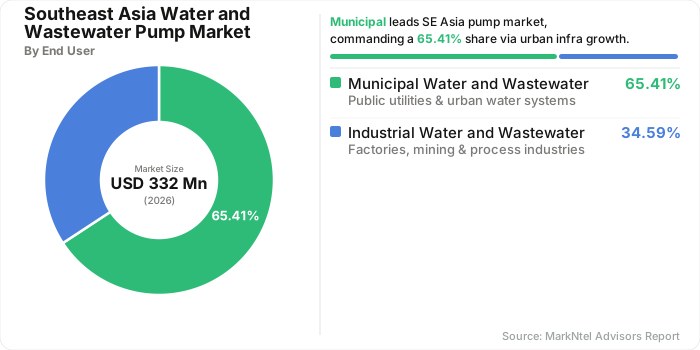
Based on end-user segmentation, the municipal water & wastewater segment clearly led the Southeast Asia water and wastewater pump market in 2025, accounting for a substantial 65.41% share of total demand. This dominance is supported by rapid urban population growth, expanding municipal boundaries, and sustained public-sector investments in potable water distribution, wastewater treatment plants, sewerage networks, and flood mitigation infrastructure. In addition, large-scale rehabilitation of aging pumping stations and pipelines across major Southeast Asian cities continues to drive steady replacement demand.
Looking forward, the industrial water & wastewater segment is expected to emerge as the fastest-growing end-user category, registering a projected CAGR of 8.19% during 2026–2032. Growth is being fueled by the expansion of manufacturing, power generation, food and beverage processing, and chemicals, alongside stricter environmental regulations and rising adoption of water recycling and effluent treatment systems. While municipalities will retain market leadership, industrial users will steadily increase their contribution to overall market growth.
Southeast Asia Water and Wastewater Pump Market (2026-32): Regional Projection
Geographically, the Southeast Asia Water and Wastewater Pump Market expands across:
- Philippines
- Singapore
- Indonesia
- Malaysia
- Thailand
- Vietnam
- Cambodia
- Myanmar
- Rest of Southeast Asia
Indonesia is projected to lead Southeast Asia’s water and wastewater pump market in the upcoming years, supported by strong structural and policy-driven fundamentals. First, rapid urbanization and a large population base continue to strain existing water supply and sewerage systems, creating sustained demand for new installations and replacement pumps. Second, the government’s focus on expanding piped water coverage, wastewater treatment capacity, and flood-control infrastructure under national development programs is accelerating municipal pump procurement. Third, large-scale dam, reservoir, and SPAM (Drinking Water Supply System) projects are boosting demand for high-capacity centrifugal pumps. Finally, rising industrial activity in manufacturing, mining, and food processing is increasing wastewater treatment investments. Together, these factors position Indonesia as the primary growth engine for water and wastewater pumps across Southeast Asia over the forecast period.
Gain a Competitive Edge with Our Southeast Asia Water and Wastewater Pump Market Report:
- Southeast Asia Water and Wastewater Pump Market Report by MarkNtel Advisors provides a detailed & thorough analysis of market size & share, growth rate, competitive landscape, and key players. This comprehensive analysis helps businesses gain a holistic understanding of the market dynamics & make informed decisions.
- This report also highlights current market trends & future projections, allowing businesses to identify emerging opportunities & potential challenges. By understanding market forecasts, companies can align their strategies & stay ahead of the competition.
- Southeast Asia Water and Wastewater Pump Market Report aids in assessing & mitigating risks associated with entering or operating in the market. By understanding market dynamics, regulatory frameworks, and potential challenges, businesses can develop strategies to minimize risks & optimize their operations.
*Reports Delivery Format - Market research studies from MarkNtel Advisors are offered in PDF, Excel and PowerPoint formats. Within 24 hours of the payment being successfully received, the report will be sent to your email address.
Frequently Asked Questions
- Market Segmentation
- Introduction
- Product Definition
- Research Process
- Assumptions
- Executive Summary
- Southeast Asia Water and Wastewater Pump Market Policies, Regulations, and Product Standards
- Southeast Asia Water and Wastewater Pump Market Trends & Developments
- Southeast Asia Water and Wastewater Pump Market Dynamics
- Growth Factors
- Challenges
- Southeast Asia Water and Wastewater Pump Market Hotspot & Opportunities
- Southeast Asia Water and Wastewater Pump Market Outlook, 2022-2032F
- Market Size & Outlook
- By Revenues (USD Million)
- Market Share & Analysis
- By Pump Types- Market Size & Forecast 2022-2032, USD Million
- Centrifugal Pump
- Overhung Pump
- Vertical Inline
- Horizontal End Suction
- Split Case Pump
- Single/Two Stage
- Multistage
- Vertical Pump
- Turbine
- Solid handling
- Nonsolid handling
- Axial
- Mixed Flow
- Turbine
- Submersible Pump
- Solid Handling
- Non-solid Handling
- Overhung Pump
- Positive Displacement Pump
- Diaphragm Pump
- Piston Pump
- Gear Pump
- Lobe Pump
- Progressive Cavity Pump
- Screw Pump
- Vane Pump
- Peristaltic Pump
- Centrifugal Pump
- By End User- Market Size & Forecast 2022-2032, USD Million
- Municipal water and wastewater
- Industrial water and wastewater
- By Application- Market Size & Forecast 2022-2032, USD Million
- Water
- Wastewater
- By Country
- Philippines
- Singapore
- Indonesia
- Malaysia
- Thailand
- Vietnam
- Cambodia
- Myanmar
- Rest of Southeast Asia
- By Company
- Competition Characteristics
- Market Share & Analysis
- By Pump Types- Market Size & Forecast 2022-2032, USD Million
- Market Size & Outlook
- Philippines Water and Wastewater Pump Market Outlook, 2022-2032F
- Market Size & Outlook
- By Revenues (USD Million)
- Market Share & Analysis
- By Pump Type- Market Size & Forecast 2022-2032, USD Million
- By End User- Market Size & Forecast 2022-2032, USD Million
- By Application- Market Size & Forecast 2022-2032, USD Million
- Market Size & Outlook
- Singapore Water and Wastewater Pump Market Outlook, 2022-2032F
- Market Size & Outlook
- By Revenues (USD Million)
- Market Share & Analysis
- By Pump Type- Market Size & Forecast 2022-2032, USD Million
- By End User- Market Size & Forecast 2022-2032, USD Million
- By Application- Market Size & Forecast 2022-2032, USD Million
- Market Size & Outlook
- Indonesia Water and Wastewater Pump Market Outlook, 2022-2032F
- Market Size & Outlook
- By Revenues (USD Million)
- Market Share & Analysis
- By Pump Type- Market Size & Forecast 2022-2032, USD Million
- By End User- Market Size & Forecast 2022-2032, USD Million
- By Application- Market Size & Forecast 2022-2032, USD Million
- Market Size & Outlook
- Malaysia Water and Wastewater Pump Market Outlook, 2022-2032F
- Market Size & Outlook
- By Revenues (USD Million)
- Market Share & Analysis
- By Pump Type- Market Size & Forecast 2022-2032, USD Million
- By End User- Market Size & Forecast 2022-2032, USD Million
- By Application- Market Size & Forecast 2022-2032, USD Million
- Market Size & Outlook
- Thailand Water and Wastewater Pump Market Outlook, 2022-2032F
- Market Size & Outlook
- By Revenues (USD Million)
- Market Share & Analysis
- By Pump Type- Market Size & Forecast 2022-2032, USD Million
- By End User- Market Size & Forecast 2022-2032, USD Million
- By Application- Market Size & Forecast 2022-2032, USD Million
- Market Size & Outlook
- Vietnam Water and Wastewater Pump Market Outlook, 2022-2032F
- Market Size & Outlook
- By Revenues (USD Million)
- Market Share & Analysis
- By Pump Type- Market Size & Forecast 2022-2032, USD Million
- By End User- Market Size & Forecast 2022-2032, USD Million
- By Application- Market Size & Forecast 2022-2032, USD Million
- Market Size & Outlook
- Cambodia Water and Wastewater Pump Market Outlook, 2022-2032F
- Market Size & Outlook
- By Revenues (USD Million)
- Market Share & Analysis
- By Pump Type- Market Size & Forecast 2022-2032, USD Million
- By End User- Market Size & Forecast 2022-2032, USD Million
- By Application- Market Size & Forecast 2022-2032, USD Million
- Market Size & Outlook
- Myanmar Water and Wastewater Pump Market Outlook, 2022-2032F
- Market Size & Outlook
- By Revenues (USD Million)
- Market Share & Analysis
- By Pump Type- Market Size & Forecast 2022-2032, USD Million
- By End User- Market Size & Forecast 2022-2032, USD Million
- By Application- Market Size & Forecast 2022-2032, USD Million
- Market Size & Outlook
- Southeast Asia Water and Wastewater Pump Market Key Strategic Imperatives for Success & Growth
- Competitive Outlook
- Company Profiles
- ITT
- Business Description
- Product Portfolio
- Collaborations & Alliances
- Recent Developments
- Financial Details
- Others
- IDEX
- Business Description
- Product Portfolio
- Collaborations & Alliances
- Recent Developments
- Financial Details
- Others
- Dover
- Business Description
- Product Portfolio
- Collaborations & Alliances
- Recent Developments
- Financial Details
- Others
- Flowserve
- Business Description
- Product Portfolio
- Collaborations & Alliances
- Recent Developments
- Financial Details
- Others
- Sulzer AG
- Business Description
- Product Portfolio
- Collaborations & Alliances
- Recent Developments
- Financial Details
- Others
- KSB
- Business Description
- Product Portfolio
- Collaborations & Alliances
- Recent Developments
- Financial Details
- Others
- Xylem
- Business Description
- Product Portfolio
- Collaborations & Alliances
- Recent Developments
- Financial Details
- Others
- Grundfos
- Business Description
- Product Portfolio
- Collaborations & Alliances
- Recent Developments
- Financial Details
- Others
- Ebara
- Business Description
- Product Portfolio
- Collaborations & Alliances
- Recent Developments
- Financial Details
- Others
- Wilo
- Business Description
- Product Portfolio
- Collaborations & Alliances
- Recent Developments
- Financial Details
- Others
- Others
- Business Description
- Product Portfolio
- Collaborations & Alliances
- Recent Developments
- Financial Details
- Others
- ITT
- Company Profiles
- Disclaimer
MarkNtel Advisors follows a robust and iterative research methodology designed to ensure maximum accuracy and minimize deviation in market estimates and forecasts. Our approach combines both bottom-up and top-down techniques to effectively segment and quantify various aspects of the market. A consistent feature across all our research reports is data triangulation, which examines the market from three distinct perspectives to validate findings. Key components of our research process include:
1. Scope & Research Design At the outset, MarkNtel Advisors define the research objectives and formulate pertinent questions. This phase involves determining the type of research—qualitative or quantitative—and designing a methodology that outlines data collection methods, target demographics, and analytical tools. They also establish timelines and budgets to ensure the research aligns with client goals.
2. Sample Selection and Data Collection In this stage, the firm identifies the target audience and determines the appropriate sample size to ensure representativeness. They employ various sampling methods, such as random or stratified sampling, based on the research objectives. Data collection is carried out using tools like surveys, interviews, and observations, ensuring the gathered data is reliable and relevant.
3. Data Analysis and Validation Once data is collected, MarkNtel Advisors undertake a rigorous analysis process. This includes cleaning the data to remove inconsistencies, employing statistical software for quantitative analysis, and thematic analysis for qualitative data. Validation steps are taken to ensure the accuracy and reliability of the findings, minimizing biases and errors.

4. Data Forecast and FinalizationThe final phase involves forecasting future market trends based on the analyzed data. MarkNtel Advisors utilize predictive modeling and time series analysis to anticipate market behaviors. The insights are then compiled into comprehensive reports, featuring visual aids like charts and graphs, and include strategic recommendations to inform client decision-making
We offer flexible licensing options to cater to varying organizational needs. Choose the pricing pack that best suits your requirements:
Buy Now Inquire Before Buying
 Request Customization
 Talk to our Consultant







