

South Korea Water and Wastewater Pump Market Research Report: Forecast (2026-2032)
South Korea Water and Wastewater Pump Market - By Pump Type: Centrifugal Pump, (Overhung Pump (Vertical Inline, Horizontal End Suction), Split Case Pump (Single/Two Stage, Multista ... ge), Vertical Pump (Turbine (Solid handling, Nonsolid handling), Axial, Mixed Flow), Submersible Pump (Solid Handling, Non-solid Handling)), Positive Displacement Pump (Diaphragm Pump, Piston Pump, Gear Pump, Lobe Pump, Progressive Cavity Pump, Screw Pump, Vane Pump, Peristaltic Pump) By End User: Municipal water and wastewater, and Industrial water and wastewater Application: Water and Wastewater), and others Read more
- Environment
- Apr 2026
- Pages 135
- Report Format: PDF, Excel, PPT
South Korea Water and Wastewater Pump Market
Projected 5.2% CAGR from 2026 to 2032
Study Period
2026-2032
Market Size (2026)
USD 378 Million
Market Size (2032)
USD 512 Million
Base Year
2025
Projected CAGR
5.2%
Leading Segments
By Pump Type: Centrifugal Pump
South Korea Water and Wastewater Pump Market Report Key Takeaways:
- South Korea Water and Wastewater Pump Market size was valued at around USD 361 million in 2025 and is projected to grow from USD 378 Million in 2026 to USD 512 Million by 2032, exhibiting a CAGR of 5.2% during 2026-2032.
- Centrifugal pumps lead the South Korea water and wastewater pump market in 2025, primarily due to their superior efficiency, versatility, and cost-effectiveness.
- In 2025, the municipal water & wastewater segment captured 66.2% of the South Korea water and wastewater pump market. However, the industrial water and wastewater segment is poised to be the fastest-growing end-user category, with a projected 6.31% CAGR during 2026-32.
- Leading companies in the South Korea water and wastewater pump industry are ITT, IDEX, Dover, Flowserve, Sulzer AG, KSB, Xylem, Grundfos, Ebara, SPX Flow, and others.
Market Insights & Analysis: South Korea Water and Wastewater Pump Market (2026-32):
The South Korea Water and Wastewater Pump Market size was valued at around USD 361 million in 2025 and is projected to grow from USD 378 Million in 2026 to USD 512 Million by 2032, exhibiting a CAGR of 5.2% during 2026-2032.
South Korea’s water & wastewater pump market is expanding steadily due to a mix of regulatory tightening, infrastructure renewal, and technology adoption. Firstly, increasingly strict effluent regulations now require treated wastewater to meet total phosphorus limits as low as 0.2–0.5 mg/L in environmentally sensitive zones, compelling municipalities to upgrade pumping systems that support advanced nutrient removal processes. Moreover, wastewater treatment facilities discharging over 1,000 m³/day typically operate large-scale treatment systems that require multiple high-capacity pumps across intake, treatment, recirculation, and sludge handling stages. Stricter pollutant control standards force these plants to add advanced treatment processes, increasing flow complexity and continuous pump usage. Consequently, utilities must upgrade to higher-efficiency, corrosion-resistant, and redundant pumping systems, driving sustained demand for new installations, retrofits, and maintenance within the water and wastewater pump market.
Additionally, national regulations enforce annual performance monitoring of key parameters such as BOD, COD, total nitrogen, and phosphorus, driving continuous system upgrades rather than one-time investments. Furthermore, environmental policy revisions have resulted in a growing proportion of treatment plants being scheduled for modernization to meet enhanced nutrient discharge limits, directly boosting demand for high-capacity, corrosion-resistant, and energy-efficient pumps. Finally, as compliance timelines tighten and operational accountability rises, utilities are increasingly prioritizing reliable pumping solutions capable of sustaining long-term regulatory performance, thereby reinforcing steady replacement and retrofit-driven market growth.
South Korea Water and Wastewater Pump Industry Recent Developments:
- 2025: South Korea's Ministry of Environment announced a comprehensive "System for Water Disaster Preparedness," allocating KRW 313.8 billion for sewage infrastructure expansions targeting urban flood vulnerabilities. This includes constructing new pumping stations, enlarging drainage pipes, and building storage facilities in high-risk areas such as Seoul's Dorimcheon watershed, Gangnam Station underpass, and Gwanghwamun, directly driving procurement of high-capacity submersible and centrifugal wastewater pumps engineered for rapid-response drainage and 100-year flood resilience.
- 2025: Korea Water Resources Corporation (K-Water) achieved the global water sector's first OECD Blue Dot Network (BDN) certification for its AI-powered water treatment plants, validating sustainability and efficiency across 43 facilities, including the Hwaseong plant (WEF Global Lighthouse Award winner). The AI system autonomously manages purification by analyzing influent quality, dosing chemicals, and optimizing wastewater pump schedules based on reservoir levels and demand forecasts, delivering KRW 9.2 billion ($6.8M) annual savings in energy, chemicals, and maintenance while enabling 24/7 operations.
- 2025: Grundfos launched a dedicated groundwater pump assembly facility in Gwangju, South Korea, partnering with local manufacturer Bando Pumps to produce submersible pumps tailored for industrial, commercial building, and wastewater applications. This sub-factory localizes production of high-efficiency models critical for semiconductor complexes (e.g., Yongin, requiring 1.07M tons/day water handling), urban sewage networks, and flood-prone drainage systems, slashing import lead times from 6-12 months to weeks while enhancing service responsiveness amid KRW 313.8 billion 2025 pumping station expansions.
South Korea Water and Wastewater Pump Market Scope:
| Category | Segments |
|---|---|
| By Pump Type: | Centrifugal Pump, (Overhung Pump (Vertical Inline, Horizontal End Suction), Split Case Pump (Single/Two Stage, Multistage), Vertical Pump (Turbine (Solid handling, Nonsolid handling), Axial, Mixed Flow), Submersible Pump (Solid Handling, Non-solid Handling)), Positive Displacement Pump (Diaphragm Pump, Piston Pump, Gear Pump, Lobe Pump, Progressive Cavity Pump, Screw Pump, Vane Pump, Peristaltic Pump) |
| By End User | Municipal water and wastewater, and Industrial water and wastewater Application: Water and Wastewater |
South Korea Water and Wastewater Pump Market Driver:
Massive Modernization of Aging Urban Water Infrastructure
South Korea’s water and wastewater pump demand is being primarily driven by the urgent modernization of aging urban water infrastructure, particularly in major metropolitan regions such as Seoul and Busan. A large share of pipelines, pumping stations, and treatment facilities across these cities were developed during the rapid industrial expansion phase of the 1970s–1990s and are now operating beyond their intended service life, resulting in efficiency losses, rising maintenance costs, and higher leakage risks.
To address this challenge, the Ministry of Environment (South Korea) has prioritized nationwide rehabilitation programs focused on reducing water losses, upgrading wastewater handling capacity, improving energy efficiency, and strengthening climate resilience. These initiatives are accelerating the replacement of outdated pumping infrastructure with high-capacity centrifugal, submersible, and smart-controlled systems designed to meet modern operational and regulatory demands. For instance:
2025 – The Suyeong Wastewater Treatment Facility Modernization Project in Busan was formally approved by the Ministry of Economy and Finance (South Korea) under a private investment framework, aiming to overhaul aging treatment assets, expand wastewater processing capacity, and enhance flood preparedness, driving significant demand for advanced wastewater and drainage pumps.
2024–2025 – Busan metropolitan authorities launched multiple large-scale infrastructure renewal initiatives focused on rehabilitating pumping stations, improving stormwater management systems, and deploying higher-capacity, energy-efficient pumps to cope with increasing urban wastewater volumes and extreme rainfall events.
Furthermore, tightening discharge regulations and rising urban population density are compelling municipalities to continuously expand and modernize pumping networks. Combined with climate-driven flood control investments, this sustained infrastructure renewal wave remains the most powerful force driving growth in South Korea’s water and wastewater pump market.
South Korea Water and Wastewater Pump Market Trend:
Rapid Adoption of Smart and Energy-Efficient Pumping Systems
A major trend reshaping South Korea’s water and wastewater pump market is the accelerated transition toward smart, digitally integrated pumping solutions designed to enhance operational efficiency, reduce energy consumption, and improve system reliability. Municipal utilities and industrial water operators are increasingly deploying pumps embedded with IoT sensors, real-time monitoring platforms, and variable frequency drives (VFDs) that enable dynamic flow control based on actual demand conditions.
South Korea’s advanced digital infrastructure and expanding smart city frameworks are allowing operators to remotely monitor pump performance indicators such as vibration, pressure, flow rates, and power usage. This predictive maintenance model is significantly reducing unexpected equipment failures in wastewater treatment plants, stormwater drainage networks, and large pumping stations.
Furthermore, rising electricity costs and national carbon neutrality goals are pushing utilities to replace conventional fixed-speed pumps with high-efficiency variable-speed systems that automatically optimize output, delivering substantial energy savings over long operational cycles. Industrial sectors, including semiconductor fabrication, petrochemicals, and power generation, are also adopting precision-controlled pumps to manage complex wastewater streams while complying with strict environmental standards. For instance:
2025 – Korea Water Resources Corporation initiated a collaboration with OpenAI to develop AI-powered smart water management systems focused on real-time infrastructure monitoring, predictive maintenance, and operational optimization, accelerating the adoption of digitally integrated pumping technologies across national water networks.
Collectively, this shift toward intelligent and energy-efficient pumping infrastructure is not only driving replacement demand but also increasing the average value of pump installations, significantly accelerating market penetration across both municipal and industrial segments.
South Korea Water and Wastewater Pump Market Opportunity:
Expansion of Advanced Water Reuse and Industrial Recycling Projects
The growing emphasis on water reuse and industrial wastewater recycling is emerging as a major long-term opportunity for South Korea’s water and wastewater pump market. Increasing pressure on freshwater resources, combined with rising industrial water consumption, is driving investments in advanced treatment infrastructure that supports closed-loop water circulation.
Industries such as electronics manufacturing, steel processing, automotive production, and power generation are deploying membrane filtration, reverse osmosis, and tertiary treatment systems. These facilities require high-pressure, corrosion-resistant, and continuous-duty pumps, including multi-stage centrifugal and chemical dosing pumps, significantly increasing pump demand per project.
Urban reclaimed water networks are also expanding, supplying treated wastewater for industrial cooling and non-potable municipal uses, further boosting pumping infrastructure requirements. For instance:
2025 – Busan launched an Industrial Water Supply Plan for the East Busan Industrial Complex, integrating seawater desalination with large-scale wastewater reuse systems to ensure sustainable industrial water supply and drive demand for high-performance pumping solutions.
Overall, expanding reuse infrastructure is set to generate sustained growth for advanced pump technologies in South Korea.
South Korea Water and Wastewater Pump Market Challenge:
High Capital Costs and Long Replacement Cycles in Municipal Systems
Despite strong long-term demand fundamentals, the South Korean water and wastewater pump market faces a significant challenge in the form of high upfront investment requirements and slow procurement cycles, especially within municipal projects. Upgrading large pumping stations or wastewater treatment facilities often involves multi-million-dollar budgets, extended planning approvals, and phased implementation.
Local governments frequently prioritize essential repairs over complete system modernization due to fiscal constraints, delaying large-scale pump replacement programs. This results in continued operation of outdated, inefficient pumping equipment far beyond optimal lifespans.
Additionally, advanced smart pumps and high-efficiency systems come with higher initial costs compared to conventional models, creating resistance among smaller municipalities and industrial operators with limited capital budgets.
Complex tender processes, strict compliance documentation, and lengthy supplier qualification procedures further slow market adoption rates. While long-term savings from energy-efficient pumps are substantial, the initial cost barrier remains a critical hurdle, particularly in rural regions and older urban districts, restraining the pace of market growth despite strong underlying infrastructure needs.
South Korea Water and Wastewater Pump Market (2026-32): Segmentation Analysis
The South Korea Water and Wastewater Pump Market study of MarkNtel Advisors evaluates & highlights the major trends and influencing factors in each segment. It includes predictions for the period 2026–2032 at the country level. Based on the analysis, the market has been further classified as:
Based on Pump Type:
- Centrifugal Pump
- Overhung Pump
- Vertical Inline
- Horizontal End Suction
- Split Case Pump
- Single/Two Stage
- Multistage
- Vertical Pump
- Turbine
- Solid Handling
- Non-Solid Handling
- Axial
- Mixed Flow
- Turbine
- Submersible Pump
- Solid Handling
- Non-solid Handling
- Overhung Pump
- Positive Displacement Pump
- Diaphragm Pump
- Piston Pump
- Gear Pump
- Lobe Pump
- Progressive Cavity Pump
- Screw Pump
- Vane Pump
- Peristaltic Pump
- Others
Centrifugal pumps dominate the water and wastewater pump market in South Korea in 2025, driven by their high flow capacity, simple design, and low maintenance costs. Their widespread adoption across municipal water supply, sewage treatment plants, flood control projects, and industrial wastewater management continues to fuel demand. Additionally, government investments in smart water infrastructure, urban drainage upgrades, and aging pipeline replacement further support this segment’s leadership. Looking ahead, centrifugal pumps are also projected to remain the dominant segment through the coming years as large-scale treatment facilities expand and climate-resilient water systems gain priority. Continuous efficiency improvements and integration with digital monitoring technologies are expected to enhance their operational appeal, reinforcing long-term market growth.
Based on End User:
- Municipal water and wastewater
- Industrial water and wastewater
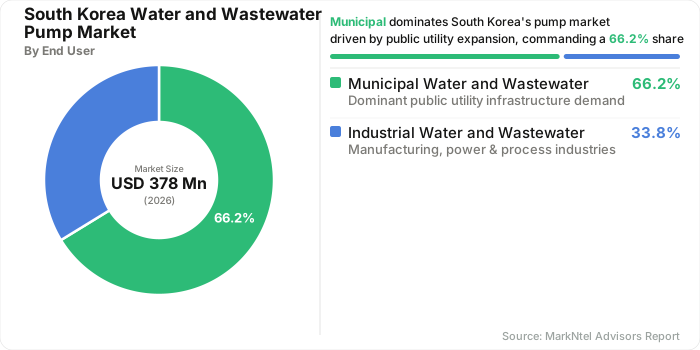
In 2025, the municipal water and wastewater segment leads the pump market in South Korea, capturing around 66.2% of total demand, supported by strong government investment in urban water supply upgrades, aging sewer network rehabilitation, and flood management infrastructure. Rapid urbanization and stricter environmental regulations continue to drive large-scale municipal treatment projects, sustaining high pump procurement volumes. Meanwhile, the industrial water and wastewater segment is projected to be the fastest-growing end-user category, expanding at a CAGR of approximately 6.31% during 2026–2032. This growth is significantly fueled by rising water-intensive manufacturing in semiconductors, chemicals, and power generation, alongside tighter industrial discharge standards and increased adoption of recycling and reuse systems. Over the coming years, industrial demand is expected to steadily narrow the gap with municipal applications, reshaping market dynamics.
Gain a Competitive Edge with Our South Korea Water and Wastewater Pump Market Report:
- South Korea Water and Wastewater Pump Market Report by MarkNtel Advisors provides a detailed & thorough analysis of market size & share, growth rate, competitive landscape, and key players. This comprehensive analysis helps businesses gain a holistic understanding of the market dynamics & make informed decisions.
- This report also highlights current market trends & future projections, allowing businesses to identify emerging opportunities & potential challenges. By understanding market forecasts, companies can align their strategies & stay ahead of the competition.
- South Korea Water and Wastewater Pump Market Report aids in assessing & mitigating risks associated with entering or operating in the market. By understanding market dynamics, regulatory frameworks, and potential challenges, businesses can develop strategies to minimize risks & optimize their operations.
Frequently Asked Questions
- Market Segmentation
- Introduction
- Product Definition
- Research Process
- Assumptions
- Executive Summary
- South Korea Water and Wastewater Pump Market Policies, Regulations, and Product Standards
- South Korea Water and Wastewater Pump Market Trends & Developments
- South Korea Water and Wastewater Pump Market Dynamics
- Growth Factors
- Challenges
- South Korea Water and Wastewater Pump Market Hotspot & Opportunities
- South Korea Water and Wastewater Pump Market Outlook, 2022-2032F
- Market Size & Outlook
- By Revenues (USD Million)
- Market Share & Outlook
- By Pump Type- Market Size & Forecast 2022-2032, USD Million
- Centrifugal Pump
- Overhung Pump
- Vertical Inline
- Horizontal End Suction
- Split Case Pump
- Single/Two Stage
- Multistage
- Vertical Pump
- Turbine
- Solid handling
- Nonsolid handling
- Axial
- Mixed Flow
- Turbine
- Submersible Pump
- Solid Handling
- Non-solid Handling
- Overhung Pump
- Positive Displacement Pump
- Diaphragm Pump
- Piston Pump
- Gear Pump
- Lobe Pump
- Progressive Cavity Pump
- Screw Pump
- Vane Pump
- Peristaltic Pump
- Centrifugal Pump
- By End User- Market Size & Forecast 2022-2032, USD Million
- Municipal water and wastewater
- Industrial water and wastewater
- By Application- Market Size & Forecast 2022-2032, USD Million
- Water
- Wastewater
- By Company
- Competition Characteristics
- Market Share & Analysis
- By Pump Type- Market Size & Forecast 2022-2032, USD Million
- Market Size & Outlook
- South Korea Centrifugal Water and Wastewater Pump Market Outlook, 2022-2032
- Market Size & Outlook
- By Revenues (USD Million)
- Market Share & Outlook
- By End User- Market Size & Forecast 2022-2032, USD Million
- By Application- Market Size & Forecast 2022-2032, USD Million
- Market Size & Outlook
- South Korea Positive Displacement Water and Wastewater Pump Market Outlook, 2022-2032
- Market Size & Outlook
- By Revenues (USD Million)
- Market Share & Outlook
- By End User- Market Size & Forecast 2022-2032, USD Million
- By Application- Market Size & Forecast 2022-2032, USD Million
- Market Size & Outlook
- South Korea Water and Wastewater Pump Market Key Strategic Imperatives for Success & Growth
- Competitive Outlook
- Company Profiles
- ITT
- Business Description
- Product Portfolio
- Collaborations & Alliances
- Recent Developments
- Financial Details
- Others
- IDEX
- Business Description
- Product Portfolio
- Collaborations & Alliances
- Recent Developments
- Financial Details
- Others
- Dover
- Business Description
- Product Portfolio
- Collaborations & Alliances
- Recent Developments
- Financial Details
- Others
- Flowserve
- Business Description
- Product Portfolio
- Collaborations & Alliances
- Recent Developments
- Financial Details
- Others
- Sulzer AG
- Business Description
- Product Portfolio
- Collaborations & Alliances
- Recent Developments
- Financial Details
- Others
- KSB
- Business Description
- Product Portfolio
- Collaborations & Alliances
- Recent Developments
- Financial Details
- Others
- Xylem
- Business Description
- Product Portfolio
- Collaborations & Alliances
- Recent Developments
- Financial Details
- Others
- Grundfos
- Business Description
- Product Portfolio
- Collaborations & Alliances
- Recent Developments
- Financial Details
- Others
- Ebara
- Business Description
- Product Portfolio
- Collaborations & Alliances
- Recent Developments
- Financial Details
- Others
- SPX Flow
- Business Description
- Product Portfolio
- Collaborations & Alliances
- Recent Developments
- Financial Details
- Others
- ITT
- Company Profiles
- Disclaimer
MarkNtel Advisors follows a robust and iterative research methodology designed to ensure maximum accuracy and minimize deviation in market estimates and forecasts. Our approach combines both bottom-up and top-down techniques to effectively segment and quantify various aspects of the market. A consistent feature across all our research reports is data triangulation, which examines the market from three distinct perspectives to validate findings. Key components of our research process include:
1. Scope & Research Design At the outset, MarkNtel Advisors define the research objectives and formulate pertinent questions. This phase involves determining the type of research—qualitative or quantitative—and designing a methodology that outlines data collection methods, target demographics, and analytical tools. They also establish timelines and budgets to ensure the research aligns with client goals.
2. Sample Selection and Data Collection In this stage, the firm identifies the target audience and determines the appropriate sample size to ensure representativeness. They employ various sampling methods, such as random or stratified sampling, based on the research objectives. Data collection is carried out using tools like surveys, interviews, and observations, ensuring the gathered data is reliable and relevant.
3. Data Analysis and Validation Once data is collected, MarkNtel Advisors undertake a rigorous analysis process. This includes cleaning the data to remove inconsistencies, employing statistical software for quantitative analysis, and thematic analysis for qualitative data. Validation steps are taken to ensure the accuracy and reliability of the findings, minimizing biases and errors.

4. Data Forecast and FinalizationThe final phase involves forecasting future market trends based on the analyzed data. MarkNtel Advisors utilize predictive modeling and time series analysis to anticipate market behaviors. The insights are then compiled into comprehensive reports, featuring visual aids like charts and graphs, and include strategic recommendations to inform client decision-making
We offer flexible licensing options to cater to varying organizational needs. Choose the pricing pack that best suits your requirements:
Buy Now Inquire Before Buying
 Request Customization
 Talk to our Consultant







