

South Korea Diagnostic Labs Market Research Report: Forecast (2026-2032)
South Korea Diagnostic Labs Market - By Test Type (Pathology, Radiology & Imaging), By Pathology Test Type (Clinical Chemistry, Hematology, Immunology & Serology, Microbiology, His ... topathology & Cytopathology, Molecular Diagnostics, Genetic Testing), By Radiology Type (X-Ray, Ultrasound, CT Scan, MRI, Mammography, PET-CT, Nuclear Imaging, Others), By Service Delivery Mode (Walk-in Testing, Home Sample Collection, Mobile Diagnostic Units), By Disease Type (Infectious Diseases, Oncology, Diabetes & Endocrinology, Cardiology, Neurology, Nephrology, Gastroenterology, Gynecology & Obstetrics, Respiratory Disorders, Orthopedics, Others), By End-User (Hospitals, Physician Clinics, Independent Diagnostic Centers, Corporate & Preventive Health Programs, Government & Public Healthcare Institutions), and others Read more
- Healthcare
- Feb 2026
- Pages 135
- Report Format: PDF, Excel, PPT
South Korea Diagnostic Labs Market
Projected 7.45% CAGR from 2026 to 2032
Study Period
2026-2032
Market Size (2025)
USD 1.06 Billion
Market Size (2032)
USD 1.81 Billion
Base Year
2025
Projected CAGR
7.45%
Leading Segments
By End-User: Hospitals
South Korea Diagnostic Labs Market Report Key Takeaways:
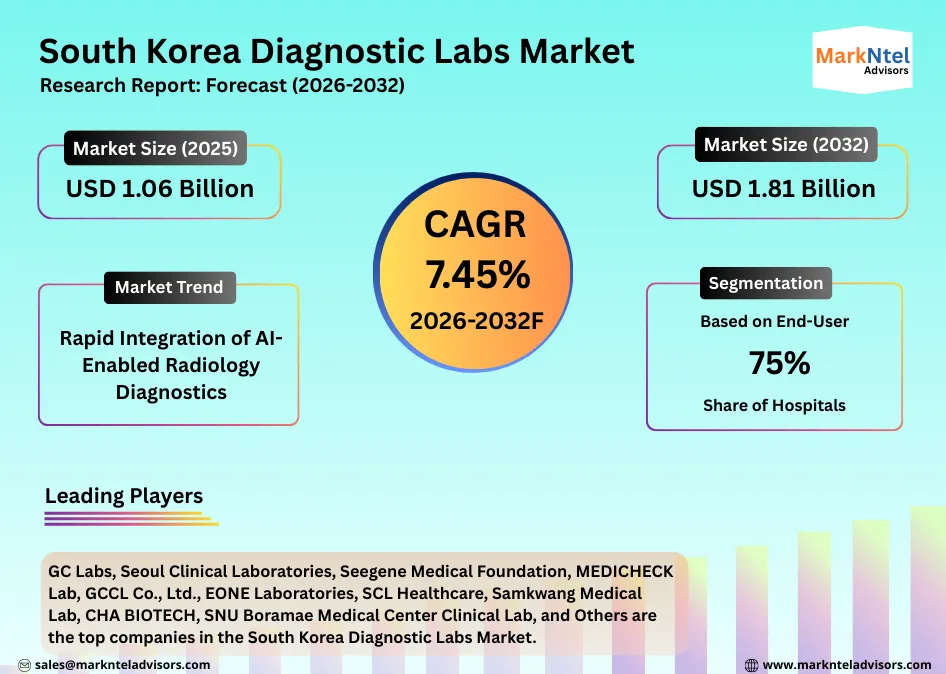
- Market size was valued at around USD1.06 billion in 2025 and is projected to reach USD1.81 billion by 2032. The estimated CAGR from 2026 to 2032 is around 7.45%, indicating strong growth.
- By Radiology Type, the X-Ray Testing segment represented a significant share of about 34% in the South Korea Diagnostic Labs Market in 2025.
- By End-User, the Hospitals seized a significant share of about 75% in the South Korea Diagnostic Labs Market in 2025.
- Leading Diagnostic Labs Companies in the South Korea Market are GC Labs, Seoul Clinical Laboratories, Seegene Medical Foundation, MEDICHECK Lab, GCCL Co., Ltd., EONE Laboratories, SCL Healthcare, Samkwang Medical Lab, CHA BIOTECH, SNU Boramae Medical Center Clinical Lab, and Others.
Market Insights & Analysis: South Korea Diagnostic Labs Market (2026-32):
The Diagnostic Labs Market size was valued at approximately USD1.06 billion in 2025 and is projected to reach USD1.81 billion by 2032. Along with this, the market is estimated to grow at a CAGR of around 7.45% during the forecast period, i.e., 2026-32.
The market operates within a highly regulated universal healthcare system driven by rapid technology adoption and strong public–private collaboration. According to the Ministry of Health and Welfare of South Korea, diagnostic imaging volumes rose steadily over the past few years. Additionally, South Korea’s aging population, with over 20% aged above 65 in 2024, continues to structurally increase diagnostic demand.
Additionally, market dynamics are shaped by high imaging utilization, early disease detection policies, and government-backed digital healthcare expansion. According to the National Health Insurance Service, radiology-linked diagnostics account for a substantial share of reimbursed outpatient services. Likewise, cancer screening mandates for breast, lung, colorectal, and liver cancers significantly elevate imaging frequency. Technological intensity remains high, with South Korea ranking among the top OECD countries for MRI and CT scanners per million individuals.
Moreover, manufacturing and infrastructure investments further reinforce market growth. For instance, in November 2025, the Republic of Korea government, including the Ministry of Trade, Industry and Energy, approved an advanced medical device R&D program worth about USD645 million over seven years to develop next-generation medical devices with a focus on AI diagnostics and high-tech solutions , targeting domestic supply chain resilience. Similarly, leading hospital networks expanded radiology wings and AI-enabled diagnostic centers in Seoul, Busan, and Gyeonggi Province. Greenfield expansions by private diagnostic chains focused on high-throughput imaging hubs integrated with laboratory information systems.
South Korea Diagnostic Labs Market Recent Developments:
- 2025 : Seoul Clinical Laboratories maintained its leadership in reference lab services, holding updated diagnostic test certifications through health authorities, and continued support for clinical trials via its central lab (C-LAB) operations.
- 2026 : GCCL announced a strategic collaboration with OPIS to advance global clinical trial lab capabilities, integrating central lab services and expanding multinational trial support.
South Korea Diagnostic Labs Market Scope:
| Category | Segments |
|---|---|
| By Test Type | Pathology, Radiology & Imaging |
| By Pathology Test Type | Clinical Chemistry, Hematology, Immunology & Serology, Microbiology, Histopathology & Cytopathology, Molecular Diagnostics, Genetic Testing |
| By Radiology Type | X-Ray, Ultrasound, CT Scan, MRI, Mammography, PET-CT, Nuclear Imaging, Others |
| By Service Delivery Mode | Walk-in Testing, Home Sample Collection, Mobile Diagnostic Units |
| By Disease Type | Infectious Diseases, Oncology, Diabetes & Endocrinology, Cardiology, Neurology, Nephrology, Gastroenterology, Gynecology & Obstetrics, Respiratory Disorders, Orthopedics, Others |
| By End-User | Hospitals, Physician Clinics, Independent Diagnostic Centers, Corporate & Preventive Health Programs, Government & Public Healthcare Institutions |
South Korea Diagnostic Labs Market Driver:
High Burden of Chronic Diseases
The rising prevalence of chronic diseases is a major driver of the South Korea diagnostic labs market, as long-term disease management depends heavily on frequent laboratory and imaging tests. According to the Korea Disease Control and Prevention Agency (KDCA), non-communicable diseases account for over 80% of total deaths in South Korea, with cancer, cardiovascular diseases, diabetes, and chronic respiratory conditions being the leading contributors. These conditions require continuous monitoring through pathology tests and diagnostic imaging.
Cancer remains the most significant disease burden. According to the National Cancer Center Korea, more than 280,000 new cancer cases are diagnosed annually, and the five-year cancer prevalence exceeded 2.3 million patients in recent years. Cancer diagnosis, staging, and post-treatment surveillance rely heavily on repeated imaging (CT, MRI, PET-CT) and laboratory testing, directly increasing diagnostic lab utilization across hospital and independent lab settings.
Chronic metabolic diseases further intensify diagnostic demand. According to the Korean Diabetes Association, approximately 16% of adults aged 30 and above have diabetes, while an additional 30% are classified as pre-diabetic . These patients require routine blood glucose, HbA1c, lipid profile, kidney function, and cardiovascular risk testing, ensuring recurring test volumes for diagnostic laboratories.
South Korea Diagnostic Labs Market Trend:
Rapid Integration of AI-Enabled Radiology Diagnostics
The rapid integration of AI-enabled radiology diagnostics is emerging as a defining trend in the South Korea diagnostic labs market, driven by strong regulatory backing, public funding, and hospital-level adoption. South Korea’s Ministry of Food and Drug Safety (MFDS) has actively streamlined approval pathways for AI-based medical devices, issuing dedicated guidelines and approving a growing number of AI imaging solutions for clinical use. In 2024 alone, more than 15 AI medical devices were designated as innovative, followed by 25 additional designations in 2025, many focused on X-ray, CT, and mammography interpretation.
This regulatory momentum is reinforced by government-supported deployment programs. National medical AI projects have connected around 47 hospitals into shared AI diagnostic networks , allowing validated algorithms to be used across institutions. These initiatives are supported by multi-million-dollar public investments aimed at improving diagnostic accuracy, reducing clinician workload, and addressing workforce shortages in radiology-heavy departments.
South Korea Diagnostic Labs Market Opportunity:
Expansion of Government-Funded Screening and Diagnostic Programs
The 2024 South Korea health and welfare budget earmarked a substantial USD95.1 billion for public health services , with allocations aimed at preventive healthcare, early disease screening, and diagnostic service expansion. According to the Ministry of Health and Welfare’s published 2024 budget breakdown, increased funding includes enhanced cancer screening programs and expanded national checkups, underscoring strong public investment in early detection pathways. Such government commitment creates a fertile opportunity for diagnostic labs to capture rising volumes of preventative tests.
Furthermore, the 2024 budget places additional emphasis on community health centers and mobile screening units, enabling diagnostic services in underserved regions. These initiatives aim to increase nationwide screening coverage, particularly for chronic diseases and age-related conditions, which are on the rise due to demographic shifts. With more funding flowing into reimbursable screening services, including X-ray, ultrasound, mammography, and related diagnostics, diagnostic labs can leverage this scale-up to expand service portfolios and geographic reach.
South Korea Diagnostic Labs Market Challenge:
Shortage and Uneven Distribution of Skilled Workforce
The shortage and uneven distribution of skilled healthcare professionals is a structural challenge for the South Korea diagnostic labs market, directly affecting service capacity, turnaround time, and geographic access. Although the number of radiologists increased to around 4,200 by 2023, imaging volumes have grown faster due to aging demographics, chronic disease prevalence, and expanded screening programs. As a result, the workload per radiologist has intensified, particularly in high-volume hospital labs.
This challenge is compounded by South Korea’s relatively low physician density of about 2.5 doctors per 1,000 people, which is below the OECD average. Moreover, medical professionals are heavily concentrated in Seoul and other metropolitan areas, creating shortages in regional hospitals and independent diagnostic labs. According to OECD and academic healthcare workforce analyses, rural and secondary cities face longer reporting times and limited access to specialized radiology and pathology services.
Laboratory technologist shortages further strain operations. Diagnostic labs depend on trained technologists for sample preparation, quality control, and molecular testing, yet retirements and limited training pipelines have tightened labor supply. These staffing gaps increase overtime costs and error risk, forcing labs to rely on automation and AI to sustain throughput.
South Korea Diagnostic Labs Market (2026-32) Segmentation Analysis:
The South Korea Diagnostic Labs Market study of MarkNtel Advisors evaluates & highlights the major trends and influencing factors in each segment. It includes predictions for the period 2026–32 at the country level. Based on the analysis, the market has been further classified as;
Based on Radiology Type:
- X-Ray
- Ultrasound
- CT Scan
- MRI
- Mammography
- PET-CT
- Nuclear Imaging
- Others
X-ray testing dominates the South Korea Diagnostic Labs Market with a market share of about 34% because it represents the largest installed imaging base and the highest examination volume in the country. According to national radiological statistics published by the Korean Society of Radiology, South Korea had 104,953 diagnostic radiological devices installed across medical institutions in 2023 , with conventional and digital X-ray systems accounting for the majority of this infrastructure due to their low cost and broad clinical utility.
Utilization data further confirms this dominance. Government radiation-use reports indicate that South Korea conducts over 390 million medical radiation examinations annually , equivalent to around eight imaging examinations per capita, among the highest globally. Plain X-ray examinations form the largest share of total imaging procedures, as they are routinely used for chest, skeletal, spinal, trauma, and dental assessments. These tests are typically performed as first-line diagnostics before referral to CT or MRI.
Public health and occupational policies reinforce high X-ray volumes. National health checkups, tuberculosis surveillance, workplace health examinations, and respiratory disease screening programs rely heavily on chest X-ray imaging, generating large, recurring test volumes independent of acute disease trends.
Based on End-User:
- Hospitals
- Physician Clinics
- Independent Diagnostic Centers
- Corporate & Preventive Health Programs
- Government & Public Healthcare Institutions
Hospitals dominate this market by accounting for about 75% market share because the country’s healthcare delivery, workforce structure, and reimbursement system are all centered on hospital-based care. South Korea has around 3,200 general hospitals nationwide, most of which operate in-house clinical laboratories covering biochemistry, hematology, immunology, microbiology, pathology, and radiology . These hospitals serve as the primary points of care for inpatient treatment, emergency services, and specialist referrals, each of which generates high volumes of diagnostic testing.
Moreover, workforce concentration reinforces this dominance. Specialized professionals such as radiologists, pathologists, and clinical laboratory physicians are primarily employed by hospitals, enabling them to perform complex diagnostics required for cancer, chronic disease, and inpatient monitoring. In parallel, national cancer screening and chronic disease management programs are largely routed through hospital settings.
Gain a Competitive Edge with Our South Korea Diagnostic Labs Market Report:
- South Korea Diagnostic Labs Market Report by MarkNtel Advisors provides a detailed & thorough analysis of market size & share, growth rate, competitive landscape, and key players. This comprehensive analysis helps businesses gain a holistic understanding of the market dynamics & make informed decisions.
- This report also highlights current market trends & future projections, allowing businesses to identify emerging opportunities & potential challenges. By understanding market forecasts, companies can align their strategies & stay ahead of the competition.
- South Korea Diagnostic Labs Market Report aids in assessing & mitigating risks associated with entering or operating in the market. By understanding market dynamics, regulatory frameworks, and potential challenges, businesses can develop strategies to minimize risks & optimize their operations.
*Reports Delivery Format - Market research studies from MarkNtel Advisors are offered in PDF, Excel and PowerPoint formats. Within 24 hours of the payment being successfully received, the report will be sent to your email address.
Frequently Asked Questions
- Market Segmentation
- Introduction
- Product Definition
- Research Process
- Assumptions
- Executive Summary
- South Korea Diagnostic Labs Market Policies, Regulations, and Product Standards
- South Korea Diagnostic Labs Market Trends & Developments
- South Korea Diagnostic Labs Market Dynamics
- Growth Factors
- Challenges
- South Korea Diagnostic Labs Market Hotspot & Opportunities
- South Korea Diagnostic Labs Market Outlook, 2022-2032F
- Market Size & Outlook
- By Revenues (USD Million)
- Market Share & Outlook
- By Test Type- Market Size & Forecast 2022-2032, USD Million
- Pathology
- Radiology & Imaging
- By Pathology Test Type- Market Size & Forecast 2022-2032, USD Million
- Clinical Chemistry
- Hematology
- Immunology & Serology
- Microbiology
- Histopathology & Cytopathology
- Molecular Diagnostics
- Genetic Testing
- By Radiology Type- Market Size & Forecast 2022-2032, USD Million
- X-Ray
- Ultrasound
- CT Scan
- MRI
- Mammography
- PET-CT
- Nuclear Imaging
- Others
- By Service Delivery Mode- Market Size & Forecast 2022-2032, USD Million
- Walk-in Testing
- Home Sample Collection
- Mobile Diagnostic Units
- By Disease Type - Market Size & Forecast 2022-2032, USD Million
- Infectious Diseases
- Oncology
- Diabetes & Endocrinology
- Cardiology
- Neurology
- Nephrology
- Gastroenterology
- Gynecology & Obstetrics
- Respiratory Disorders
- Orthopedics
- Others
- By End-User- Market Size & Forecast 2022-2032, USD Million
- Hospitals
- Physician Clinics
- Independent Diagnostic Centers
- Corporate & Preventive Health Programs
- Government & Public Healthcare Institutions
- By Region- Market Size & Forecast 2022-2032, USD Million
- Seoul
- Busan
- Central
- Gyeonggi
- Cheongju
- By Company
- Competition Characteristics
- Market Share & Analysis
- By Test Type- Market Size & Forecast 2022-2032, USD Million
- Market Size & Outlook
- South Korea Pathology Labs Market Outlook, 2022-2032
- Market Size & Outlook
- By Revenues (USD Million)
- Market Share & Outlook
- By Pathology Test Type- Market Size & Forecast 2022-2032, USD Million
- By Radiology Type- Market Size & Forecast 2022-2032, USD Million
- By Service Delivery Mode- Market Size & Forecast 2022-2032, USD Million
- By Disease Type - Market Size & Forecast 2022-2032, USD Million
- By End-User- Market Size & Forecast 2022-2032, USD Million
- By Region- Market Size & Forecast 2022-2032, USD Million
- Market Size & Outlook
- South Korea Radiology & Imaging Labs Market Outlook, 2022-2032
- Market Size & Outlook
- By Revenues (USD Million)
- Market Share & Outlook
- By Pathology Test Type- Market Size & Forecast 2022-2032, USD Million
- By Radiology Type- Market Size & Forecast 2022-2032, USD Million
- By Service Delivery Mode- Market Size & Forecast 2022-2032, USD Million
- By Disease Type - Market Size & Forecast 2022-2032, USD Million
- By End-User- Market Size & Forecast 2022-2032, USD Million
- By Region- Market Size & Forecast 2022-2032, USD Million
- Market Size & Outlook
- South Korea Diagnostic Labs Market Key Strategic Imperatives for Success & Growth
- Competitive Outlook
- Company Profiles
- GC Labs
- Business Description
- Product Portfolio
- Collaborations & Alliances
- Recent Developments
- Financial Details
- Others
- Seoul Clinical Laboratories
- Business Description
- Product Portfolio
- Collaborations & Alliances
- Recent Developments
- Financial Details
- Others
- Seegene Medical Foundation
- Business Description
- Product Portfolio
- Collaborations & Alliances
- Recent Developments
- Financial Details
- Others
- MEDICHECK Lab
- Business Description
- Product Portfolio
- Collaborations & Alliances
- Recent Developments
- Financial Details
- Others
- GCCL Co., Ltd.
- Business Description
- Product Portfolio
- Collaborations & Alliances
- Recent Developments
- Financial Details
- Others
- EONE Laboratories
- Business Description
- Product Portfolio
- Collaborations & Alliances
- Recent Developments
- Financial Details
- Others
- SCL Healthcare
- Business Description
- Product Portfolio
- Collaborations & Alliances
- Recent Developments
- Financial Details
- Others
- Samkwang Medical Lab
- Business Description
- Product Portfolio
- Collaborations & Alliances
- Recent Developments
- Financial Details
- Others
- CHA BIOTECH
- Business Description
- Product Portfolio
- Collaborations & Alliances
- Recent Developments
- Financial Details
- Others
- SNU Boramae Medical Center Clinical Lab
- Business Description
- Product Portfolio
- Collaborations & Alliances
- Recent Developments
- Financial Details
- Others
- GC Labs
- Company Profiles
- Disclaimer
MarkNtel Advisors follows a robust and iterative research methodology designed to ensure maximum accuracy and minimize deviation in market estimates and forecasts. Our approach combines both bottom-up and top-down techniques to effectively segment and quantify various aspects of the market. A consistent feature across all our research reports is data triangulation, which examines the market from three distinct perspectives to validate findings. Key components of our research process include:
1. Scope & Research Design At the outset, MarkNtel Advisors define the research objectives and formulate pertinent questions. This phase involves determining the type of research—qualitative or quantitative—and designing a methodology that outlines data collection methods, target demographics, and analytical tools. They also establish timelines and budgets to ensure the research aligns with client goals.
2. Sample Selection and Data Collection In this stage, the firm identifies the target audience and determines the appropriate sample size to ensure representativeness. They employ various sampling methods, such as random or stratified sampling, based on the research objectives. Data collection is carried out using tools like surveys, interviews, and observations, ensuring the gathered data is reliable and relevant.
3. Data Analysis and Validation Once data is collected, MarkNtel Advisors undertake a rigorous analysis process. This includes cleaning the data to remove inconsistencies, employing statistical software for quantitative analysis, and thematic analysis for qualitative data. Validation steps are taken to ensure the accuracy and reliability of the findings, minimizing biases and errors.

4. Data Forecast and FinalizationThe final phase involves forecasting future market trends based on the analyzed data. MarkNtel Advisors utilize predictive modeling and time series analysis to anticipate market behaviors. The insights are then compiled into comprehensive reports, featuring visual aids like charts and graphs, and include strategic recommendations to inform client decision-making
We offer flexible licensing options to cater to varying organizational needs. Choose the pricing pack that best suits your requirements:
Buy Now Inquire Before Buying
 Request Customization
 Talk to our Consultant







