

South America Water and Wastewater Pump Market Research Report: Size, Share, Trends & Forecast (2026-2032)
By Pump Type (Centrifugal Pump (Overhung Pump (Vertical Inline, Horizontal End Suction), Split Case Pump (Single/Two Stage, Multistage), Vertical Pump (Turbine (Solid handling, Non ... solid handling), Axial, Mixed Flow), Submersible Pump (Solid Handling, Non-solid Handling)), Positive Displacement Pump (Diaphragm Pump, Piston Pump, Gear Pump, Lobe Pump, Progressive Cavity Pump, Screw Pump, Vane Pump, Peristaltic Pump)), By End User (Municipal water and wastewater, Industrial water and wastewater), By Application (Water, Wastewater), and others Read more
- Environment
- Apr 2026
- Pages 160
- Report Format: PDF, Excel, PPT
South America Water and Wastewater Pump Market
Projected 4.1% CAGR from 2026 to 2032
Study Period
2026-2032
Market Size (2026)
USD 442 Million
Market Size (2032)
USD 564 Million
Base Year
2025
Projected CAGR
4.1%
Leading Segments
Water and Wastewater Pump Marke
South America Water and Wastewater Pump Market Report Key Takeaways:
- South America Water and Wastewater Pump Market size was valued at around USD 414 million in 2025 and is projected to grow from USD 442 million in 2026 to USD 564 million by 2032, exhibiting a CAGR of 4.1% during 2026-2032.
- In 2025, Centrifugal pumps lead the South America water and wastewater pump market owing to their high-volume handling for municipal distribution, sewage, and treatment; mechanical simplicity; low lifecycle costs; versatility with diverse fluids; and strong service networks in Brazil-led expansions.
- In 2025, the municipal water & wastewater segment captured 61.29% of the South America water and wastewater pump market. However, the industrial water and wastewater segment is poised to be the fastest-growing end-user category, with a projected 2.95% CAGR during 2026-32.
- Leading companies in the South America water and wastewater pump industry are ITT, Kirloskar Brothers Limited, Dover, Flowserve, Sulzer AG, KSB, Xylem, Grundfos, Ebara, Franklin Electric, Pentair PLC, and others.
Market Insights & Analysis: South America Water and Wastewater Pump Market (2026-32):
The South America Water and Wastewater Pump Market size was valued at around USD 414 million in 2025 and is projected to grow from USD 442 million in 2026 to USD 564 million by 2032, exhibiting a CAGR of 4.1% during 2026-2032.
The regional market landscape is defined by rapid urban expansion, rising municipal water demand, and persistent inefficiencies in aging pumping infrastructure across South America. More than 35% of wastewater generated in the region remains untreated, underscoring significant capacity gaps in collection, conveyance, and treatment systems. Urban population growth is placing sustained pressure on municipal utilities, many of which operate legacy pumping assets with high energy consumption and failure rates. As a result, infrastructure modernization has become a structural necessity rather than a discretionary investment.
Market dynamics are strongly influenced by regulatory mandates aimed at expanding wastewater treatment coverage, reducing non-revenue water, and improving effluent quality. Brazil’s National Sanitation Plan alone allocates over USD 25 billion toward water and sewage infrastructure upgrades through 2030, positioning the country as the primary driver of regional pump demand. In parallel, Argentina and Chile have collectively announced wastewater treatment investments exceeding USD 4.5 billion over the next decade, largely concentrated in urban and industrial corridors. These policy-led investments are directly translating into higher procurement of centrifugal, submersible, and energy-efficient pumping systems.
Infrastructure execution at the project level remains a critical growth lever for the market. Major wastewater treatment and network expansion projects in São Paulo, Rio de Janeiro, Santiago, and Lima typically involve capital expenditures ranging from USD 300 million to USD 600 million per project. Pumps represent a core component of mechanical equipment spending across intake, treatment, sludge handling, and discharge stages. In addition, flood control and stormwater management projects are expanding in coastal and flood-prone cities, further supporting pump installations.
Collectively, these structural, regulatory, and investment-driven factors underpin sustained market expansion over the forecast period. The increasing shift toward automation-ready, condition-monitored, and energy-efficient pumps is also raising the average value per installation. While growth remains moderate, it is highly resilient and investment-backed. As a result, the market is positioned for steady and durable growth through 2032.
South America Water and Wastewater Pump Industry Recent Developments:
- 2025: Sulzer opened its third facility in Ezeiza, Argentina, a rotating equipment service center offering maintenance, repair, and spares for water/wastewater pumps, enhancing regional capabilities.
- 2025: Seven wastewater treatment projects across Latin America (led by Peru/Brazil) were set for awards totaling over USD1,100 million, fueling infrastructure growth and centrifugal pump demand in municipal sewage/treatment systems.
- 2025: Lot 2 of the Riachuelo System in Buenos Aires, Argentina, was completed by a consortium including ACCIONA and Fisia Italimpianti, involving an inlet pumping station with a capacity of 36 m³/s and outlet pumping infrastructure. This project is part of one of the largest wastewater treatment systems in Latin America, improving sewage handling and sanitation in the Buenos Aires metropolitan area.
- 2025: Dorian Drake International Inc., an export leader in distribution and marketing for leading manufacturers in select industries, has announced a strategic alliance with Dynapro Pumps, a premier manufacturer of industrial pumps specializing in high-performance slurry pumps, process pumps, dewatering solutions, and interchangeable replacement parts.
| Category | Segments |
|---|---|
| By Pump Type | (Centrifugal Pump (Overhung Pump (Vertical Inline, Horizontal End Suction), Split Case Pump (Single/Two Stage, Multistage), Vertical Pump (Turbine (Solid handling, Nonsolid handling), Axial, Mixed Flow), Submersible Pump (Solid Handling, Non-solid Handling)), Positive Displacement Pump (Diaphragm Pump, Piston Pump, Gear Pump, Lobe Pump, Progressive Cavity Pump, Screw Pump, Vane Pump, Peristaltic Pump)), |
| By End User | (Municipal water and wastewater, Industrial water and wastewater), |
| By Application | (Water, Wastewater), |
South America Water and Wastewater Pump Market Driver:
Expansion of Urban Sanitation Coverage Under National Water Security Mandates
A primary growth driver for the South America water and wastewater pump market is the accelerated expansion of urban sanitation and sewerage coverage, driven by legally mandated water security and public health programs across major economies such as Brazil, Colombia, and Peru. Large portions of South America’s urban and peri-urban population remain connected to aging or incomplete sewer networks, creating sustained demand for new pumping stations, lift pumps, and replacement systems.
Governments are increasingly prioritizing continuous water supply and wastewater collection reliability, particularly in flood-prone and topographically uneven cities where gravity-based systems are insufficient. This has directly increased the deployment of submersible wastewater pumps, sewage lift pumps, and stormwater pumps across municipal networks. Additionally, population growth in informal settlements is forcing utilities to expand service coverage into non-planned urban zones, which rely heavily on pumped systems rather than centralized gravity flows.
The scale and long-term funding commitment of these sanitation programs make them a structural demand driver, ensuring sustained pump procurement not just for new installations but also for network reinforcement and capacity upgrades, thereby significantly driving market consumption across South America.
South America Water and Wastewater Pump Market Trend:
Digitalisation of Water and Wastewater Pumping Through Smart Pump Systems
The rapid adoption of smart pumps, integrating sensors, IoT connectivity, edge analytics, and remote control, represents a transformative trend in South America’s water and wastewater pump market. Smart pumps move beyond simple motor-driven devices to become data-rich assets that enable predictive maintenance, demand-driven operation, and real-time performance optimization. For utilities facing constrained budgets and aging assets, this technology reduces unplanned downtime, lowers lifecycle energy consumption through adaptive control (e.g., VFDs tied to flow/level telemetry), and enables condition-based spare-parts planning. For instance:
- 2024: Xylem Inc. and Veolia entered a strategic partnership integrating IoT-enabled sewage pumps for predictive maintenance, boosting energy efficiency and cutting costs in municipal wastewater plants worldwide, including South America.
Following deployments like this, utilities are prioritizing smart-pump retrofits that require minimal civil work but deliver immediate operational visibility. Procurement criteria are shifting: buyers now evaluate analytics platforms, API openness, cybersecurity posture, and service-level analytics alongside hydraulic performance. Implementation challenges include legacy SCADA integration, data governance, and skills gaps for in-house analytics. Still, as regulators and financiers increasingly reward demonstrable efficiency and resilience gains, smart pumps are becoming a decisive factor, accelerating market penetration, especially in retrofit, storm water management, and high-risk flood-control applications.
South America Water and Wastewater Pump Market Challenge:
Financial Constraints and Delayed Public Utility Investments
The most significant challenge restraining the South America water and wastewater pump market is the persistent financial pressure on public utilities, leading to delayed procurement cycles and deferred infrastructure upgrades. Many municipal water authorities operate under tight budget constraints, with limited capacity to fund large-scale pump replacement or modernization projects despite clear operational needs.
High dependence on public funding and political approval processes often results in long project timelines, disrupting consistent demand for pumping equipment. In several countries, water tariffs remain regulated at levels that do not fully reflect operational and capital costs, restricting utilities’ ability to reinvest in efficient pumping systems.
Additionally, currency volatility and inflation increase the cost of imported pump components, making advanced systems less accessible for smaller municipalities. This often forces utilities to opt for short-term repairs instead of full pump replacement, slowing market growth. The combination of financial limitations, procurement inefficiencies, and economic uncertainty continues to act as a structural barrier, limiting the pace at which modern water and wastewater pumping solutions can be deployed across South America.
South America Water and Wastewater Pump Market (2026-32): Segmentation Analysis
The South America Water and Wastewater Pump Market study of MarkNtel Advisors evaluates & highlights the major trends and influencing factors in each segment. It includes predictions for the period 2026–2032 at the regional level. Based on the analysis, the market has been further classified as:
Based on End User:
- Municipal water and wastewater
- Industrial water and wastewater
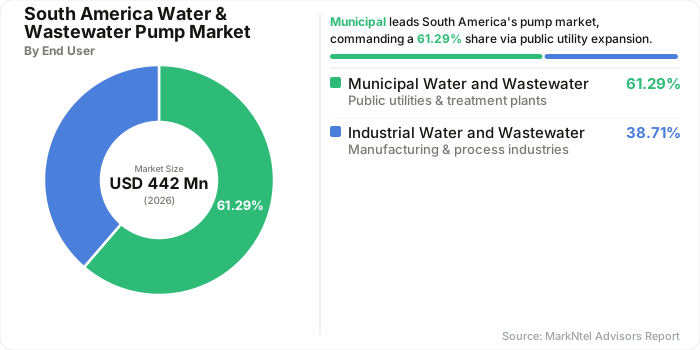
By end user, the municipal water & wastewater segment accounted for the largest share of the South America water and wastewater pump market in 2025, capturing 61.29% of total demand. This leadership is underpinned by the scale of public water supply and sanitation networks, which require extensive pumping infrastructure for raw water intake, sewage conveyance, wastewater treatment, and stormwater management. Ongoing investments in urban sanitation expansion, rehabilitation of aging pump stations, and flood-mitigation systems continue to sustain high and recurring pump procurement within municipal applications.
However, growth momentum is gradually shifting toward the industrial water & wastewater segment, which is projected to expand at the fastest CAGR of 2.95% during 2026–2032. Rising industrial water consumption, coupled with stricter effluent discharge regulations, is driving increased investment in process water handling and on-site wastewater treatment systems. Industries are increasingly adopting high-efficiency and automated pumping solutions to improve operational reliability and compliance. Consequently, while municipal end users will remain the dominant revenue contributor, industrial applications are expected to play a more decisive role in shaping incremental market growth over the forecast period.
Based on Types of Pumps:
- Centrifugal Pump
- Overhung Pump
- Vertical Inline
- Horizontal End Suction
- Split Case Pump
- Single/Two Stage
- Multistage
- Vertical Pump
- Turbine
- Overhung Pump
- Solid Handling
- Non-Solid Handling
-
- Axial
- Mixed Flow
- Submersible Pump
- Solid Handling
- Non-solid Handling
-
- Positive Displacement Pump
- Diaphragm Pump
- Piston Pump
- Gear Pump
- Lobe Pump
- Progressive Cavity Pump
- Screw Pump
- Vane Pump
- Peristaltic Pump
- Others
Based on pump type, centrifugal pumps held a dominant position in the South America water and wastewater pump market in 2025, accounting for the largest share of overall demand. Their leadership is primarily attributed to extensive use across municipal water supply, sewage transport, and wastewater treatment operations, where continuous, high-volume fluid handling is essential. Centrifugal pumps are well-suited to these applications due to their simple mechanical design, ease of operation, and comparatively lower lifecycle costs, making them a preferred choice for budget-constrained public utilities
Furthermore, their versatility in handling a wide range of fluids, from clean water to wastewater with moderate solids content, has reinforced their widespread adoption across both municipal and industrial installations. The availability of a strong regional service and maintenance ecosystem, particularly in Brazil-led infrastructure expansions, has further supported high penetration levels. These factors collectively position centrifugal pumps as the backbone of South America’s water and wastewater pumping infrastructure, sustaining their dominance in the market.
South America Water and Wastewater Pump Market (2026-32): Regional Projection
Geographically, the South America Water and Wastewater Pump Market expands across:
- Brazil
- Argentina
- Chile
- Ecuador
- Peru
- Rest of South America
Based on regional analysis, Brazil is projected to lead the South America water and wastewater pump market, maintaining its dominant position throughout the forecast period. This leadership is primarily driven by the country’s large population base, extensive municipal water and sanitation networks, and sustained investment in wastewater treatment infrastructure. Brazil accounts for the highest concentration of urban water utilities in the region, requiring significant pumping capacity for raw water abstraction, sewage conveyance, wastewater treatment, and stormwater management
Ongoing efforts to expand sanitation coverage, modernize aging pump stations, and improve flood resilience across major metropolitan areas continue to generate strong demand for water and wastewater pumps. In addition, Brazil’s industrial base creates steady requirements for process water and industrial effluent handling systems. The presence of established pump manufacturing, distribution, and service networks further strengthens market penetration and replacement demand. Collectively, these structural factors position Brazil as the primary revenue contributor within the South America water and wastewater pump market, outpacing Argentina, Chile, Ecuador, Peru, and the rest of the region.
Gain a Competitive Edge with Our South America Water and Wastewater Pump Market Report:
- South America Water and Wastewater Pump Market Report by MarkNtel Advisors provides a detailed & thorough analysis of market size & share, growth rate, competitive landscape, and key players. This comprehensive analysis helps businesses gain a holistic understanding of the market dynamics & make informed decisions.
- This report also highlights current market trends & future projections, allowing businesses to identify emerging opportunities & potential challenges. By understanding market forecasts, companies can align their strategies & stay ahead of the competition.
- South America Water and Wastewater Pump Market Report aids in assessing & mitigating risks associated with entering or operating in the market. By understanding market dynamics, regulatory frameworks, and potential challenges, businesses can develop strategies to minimize risks & optimize their operations.
*Reports Delivery Format - Market research studies from MarkNtel Advisors are offered in PDF, Excel and PowerPoint formats. Within 24 hours of the payment being successfully received, the report will be sent to your email address.
Frequently Asked Questions
- Market Segmentation
- Introduction
- Product Definition
- Research Process
- Assumptions
- Executive Summary
- South America Water and Wastewater Pump Market Policies, Regulations, and Product Standards
- South America Water and Wastewater Pump Market Trends & Developments
- South America Water and Wastewater Pump Market Dynamics
- Growth Factors
- Challenges
- South America Water and Wastewater Pump Market Hotspot & Opportunities
- South America Water and Wastewater Pump Market Outlook, 2022-2032F
- Market Size & Outlook
- By Revenues (USD Million)
- Market Share & Analysis
- By Pump Type- Market Size & Forecast 2022-2032, USD Million
- Centrifugal Pump
- Overhung Pump
- Vertical Inline
- Horizontal End Suction
- Split Case Pump
- Single/Two Stage
- Multistage
- Vertical Pump
- Turbine
- Solid handling
- Nonsolid handling
- Axial
- Mixed Flow
- Turbine
- Submersible Pump
- Solid Handling
- Non-solid Handling
- Overhung Pump
- Positive Displacement Pump
- Diaphragm Pump
- Piston Pump
- Gear Pump
- Lobe Pump
- Progressive Cavity Pump
- Screw Pump
- Vane Pump
- Peristaltic Pump
- Centrifugal Pump
- By End User- Market Size & Forecast 2022-2032, USD Million
- Municipal water and wastewater
- Industrial water and wastewater
- By Application- Market Size & Forecast 2022-2032, USD Million
- Water
- Wastewater
- By Country
- Brazil
- Argentina
- Chile
- Ecuador
- Peru
- Rest of South America
- By Company
- Competition Characteristics
- Market Share & Analysis
- By Pump Type- Market Size & Forecast 2022-2032, USD Million
- Market Size & Outlook
- Brazil Water and Wastewater Pump Market Outlook, 2022-2032F
- Market Size & Outlook
- By Revenues (USD Million)
- Market Share & Analysis
- By Pump Type- Market Size & Forecast 2022-2032, USD Million
- By End User- Market Size & Forecast 2022-2032, USD Million
- By Application- Market Size & Forecast 2022-2032, USD Million
- Market Size & Outlook
- Argentina Water and Wastewater Pump Market Outlook, 2022-2032F
- Market Size & Outlook
- By Revenues (USD Million)
- Market Share & Analysis
- By Pump Type- Market Size & Forecast 2022-2032, USD Million
- By End User- Market Size & Forecast 2022-2032, USD Million
- By Application- Market Size & Forecast 2022-2032, USD Million
- Market Size & Outlook
- Chile Water and Wastewater Pump Market Outlook, 2022-2032F
- Market Size & Outlook
- By Revenues (USD Million)
- Market Share & Analysis
- By Pump Type- Market Size & Forecast 2022-2032, USD Million
- By End User- Market Size & Forecast 2022-2032, USD Million
- By Application- Market Size & Forecast 2022-2032, USD Million
- Market Size & Outlook
- Ecuador Water and Wastewater Pump Market Outlook, 2022-2032F
- Market Size & Outlook
- By Revenues (USD Million)
- Market Share & Analysis
- By Pump Type- Market Size & Forecast 2022-2032, USD Million
- By End User- Market Size & Forecast 2022-2032, USD Million
- By Application- Market Size & Forecast 2022-2032, USD Million
- Market Size & Outlook
- Peru Water and Wastewater Pump Market Outlook, 2022-2032F
- Market Size & Outlook
- By Revenues (USD Million)
- Market Share & Analysis
- By Pump Type- Market Size & Forecast 2022-2032, USD Million
- By End User- Market Size & Forecast 2022-2032, USD Million
- By Application- Market Size & Forecast 2022-2032, USD Million
- Market Size & Outlook
- South America Water and Wastewater Pump Market Key Strategic Imperatives for Success & Growth
- Competitive Outlook
- Company Profiles
- ITT
- Business Description
- Product Portfolio
- Collaborations & Alliances
- Recent Developments
- Financial Details
- Others
- Kirloskar Brothers Limited
- Business Description
- Product Portfolio
- Collaborations & Alliances
- Recent Developments
- Financial Details
- Others
- Dover
- Business Description
- Product Portfolio
- Collaborations & Alliances
- Recent Developments
- Financial Details
- Others
- Flowserve
- Business Description
- Product Portfolio
- Collaborations & Alliances
- Recent Developments
- Financial Details
- Others
- Sulzer AG
- Business Description
- Product Portfolio
- Collaborations & Alliances
- Recent Developments
- Financial Details
- Others
- KSB
- Business Description
- Product Portfolio
- Collaborations & Alliances
- Recent Developments
- Financial Details
- Others
- Xylem
- Business Description
- Product Portfolio
- Collaborations & Alliances
- Recent Developments
- Financial Details
- Others
- Grundfos
- Business Description
- Product Portfolio
- Collaborations & Alliances
- Recent Developments
- Financial Details
- Others
- Ebara
- Business Description
- Product Portfolio
- Collaborations & Alliances
- Recent Developments
- Financial Details
- Others
- Franklin Electric
- Business Description
- Product Portfolio
- Collaborations & Alliances
- Recent Developments
- Financial Details
- Others
- Pentair PLC
- Business Description
- Product Portfolio
- Collaborations & Alliances
- Recent Developments
- Financial Details
- Others
- Others
- Business Description
- Product Portfolio
- Collaborations & Alliances
- Recent Developments
- Financial Details
- Others
- ITT
- Company Profiles
- Disclaimer
MarkNtel Advisors follows a robust and iterative research methodology designed to ensure maximum accuracy and minimize deviation in market estimates and forecasts. Our approach combines both bottom-up and top-down techniques to effectively segment and quantify various aspects of the market. A consistent feature across all our research reports is data triangulation, which examines the market from three distinct perspectives to validate findings. Key components of our research process include:
1. Scope & Research Design At the outset, MarkNtel Advisors define the research objectives and formulate pertinent questions. This phase involves determining the type of research—qualitative or quantitative—and designing a methodology that outlines data collection methods, target demographics, and analytical tools. They also establish timelines and budgets to ensure the research aligns with client goals.
2. Sample Selection and Data Collection In this stage, the firm identifies the target audience and determines the appropriate sample size to ensure representativeness. They employ various sampling methods, such as random or stratified sampling, based on the research objectives. Data collection is carried out using tools like surveys, interviews, and observations, ensuring the gathered data is reliable and relevant.
3. Data Analysis and Validation Once data is collected, MarkNtel Advisors undertake a rigorous analysis process. This includes cleaning the data to remove inconsistencies, employing statistical software for quantitative analysis, and thematic analysis for qualitative data. Validation steps are taken to ensure the accuracy and reliability of the findings, minimizing biases and errors.

4. Data Forecast and FinalizationThe final phase involves forecasting future market trends based on the analyzed data. MarkNtel Advisors utilize predictive modeling and time series analysis to anticipate market behaviors. The insights are then compiled into comprehensive reports, featuring visual aids like charts and graphs, and include strategic recommendations to inform client decision-making
We offer flexible licensing options to cater to varying organizational needs. Choose the pricing pack that best suits your requirements:
Buy Now Inquire Before Buying
 Request Customization
 Talk to our Consultant







