Global Smart Packaging Market Research Report: Forecast (2026-2032)
Smart Packaging Market - By Technology Type (Modified Atmosphere Packaging (MAP), Active Packaging (Oxygen Scavengers, Moisture Scavengers, Self-Venting Films, Ethylene Scavengers ... &Emitters, Microwave Susceptors, Antibacterial Films, Temperature Control Packaging, Carbon Dioxide Scavengers/Emitters, Ethanol Emitters, Flavor/Odor Absorbers, Antioxidants), Intelligent Packaging (Indicators, Sensors (Bio Sensors, Gas Sensors), Data Carriers (Barcodes (2D Matrix Codes, Quick Response Codes, Augmented Matrix Codes), RFID Tags))), By Material (Solid, Liquid), By Application (Food & beverage, Personal care, Automotive, Healthcare, Others), and others Read more
- FMCG
- Mar 2026
- Pages 195
- Report Format: PDF, Excel, PPT
Global Smart Packaging Market
Projected 7.39% CAGR from 2026 to 2032
Study Period
2026-2032
Market Size (2026)
USD 25.01 Billion
Market Size (2032)
USD 38.36 Billion
Largest Region
Asia-Pacific
Projected CAGR
7.39%
Leading Segments
By Material: Solid
Global Smart Packaging Market Report Key Takeaways:
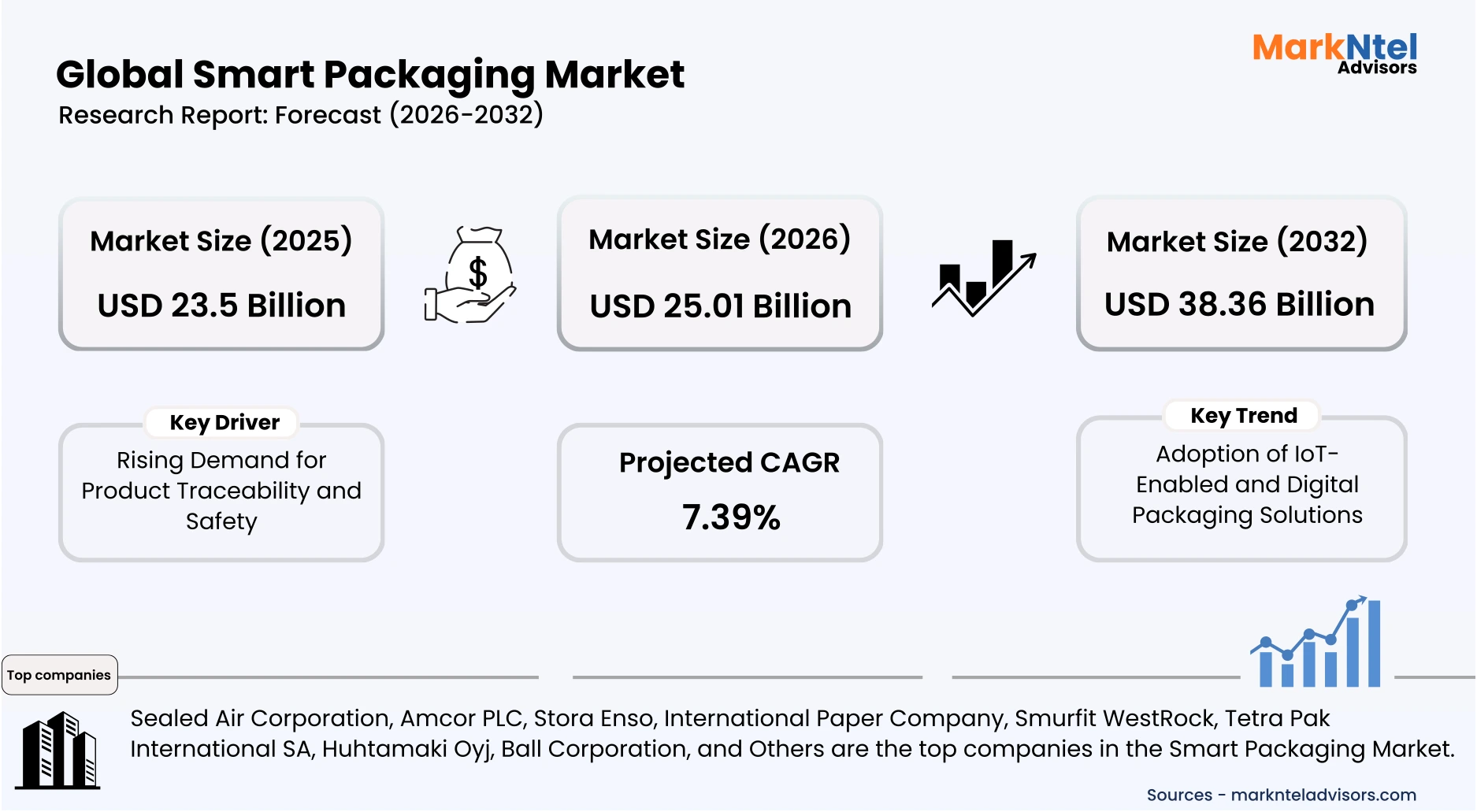
- Market size was valued at around USD23.5 billion in 2025 and is projected to grow from USD 25.01 billion to USD 38.36 billion by 2032. The estimated CAGR for 2026-2032 is approximately 7.39%, indicating strong growth.
- Asia-Pacific holds the largest market share of about 35.52% in the Global Smart Packaging Market in 2026.
- By Technology, the Modified Atmosphere Packaging segment represented a significant share of about 42% in the Global Smart Packaging Market in 2026.
- By Material, the Solid segment presented a significant share of about 82% in the Global Smart Packaging Market in 2026.
- Leading Smart Packaging Companies in the Global Market are Sealed Air Corporation, Amcor PLC, Stora Enso, International Paper Company, Smurfit WestRock, Tetra Pak International SA, Huhtamaki Oyj, Ball Corporation, and Others.
Market Insights & Analysis: Global Smart Packaging Market (2026-32):
The Global Smart Packaging Market size was valued at around USD 23.5 billion in 2025 and is projected to grow from USD 25.01 billion to USD 38.36 billion by 2032. Along with this, the market is estimated to grow at a CAGR of around 7.39% during the forecast period, i.e., 2026-32.
The Global Smart Packaging Market is expanding steadily, supported by rising regulatory emphasis on packaging transparency, traceability, and sustainability across major economies. Smart packaging technologies such as QR codes, RFID/NFC tags, and digital data carriers are increasingly integrated into packaging systems to bridge physical products with digital information, enabling compliance, supply-chain visibility, and improved consumer communication. These solutions are becoming structurally important across food, beverage, pharmaceutical, and consumer goods packaging, where safety, authenticity, and lifecycle data disclosure are difficult to address through conventional packaging formats.
For instance, regulatory reforms in the European Union are reinforcing long-term demand for digitally enabled packaging. The EU Packaging and Packaging Waste Regulation (PPWR) entered into force in February 2025 , introducing mandatory requirements for recyclability, material transparency, and standardized consumer information. Importantly, the regulation explicitly allows the use of digital data carriers such as QR codes to provide required packaging information, signaling a structural shift toward smart packaging as a compliance-enabling tool rather than a discretionary innovation.
From an industry perspective, digitalisation and traceability have become central themes shaping packaging investments. At FACHPACK, one of Europe’s largest packaging trade fairs, industry stakeholders highlighted smart labelling, data-enabled packaging, and sustainability-driven innovation as key priorities influencing future packaging design and material choices . The prominence of digital packaging solutions at such industry forums reflects a growing consensus that smart packaging is critical for meeting regulatory obligations, improving supply-chain resilience, and supporting circular-economy objectives.
Additionally, end-use sector requirements continue to strengthen adoption, particularly in pharmaceuticals and food. Pharmaceutical packaging systems increasingly rely on serialization and track-and-trace identifiers to combat counterfeiting and ensure drug safety across distribution networks, while food and beverage manufacturers are expanding the use of QR-based smart labels to provide origin, handling, and recycling information. Together, these developments indicate that smart packaging is transitioning from selective deployment to a foundational component of modern packaging ecosystems, driven by regulation, safety imperatives, and transparency expectations.
Global Smart Packaging Market Recent Developments:
- 2025 : Sealed Air launched a smart packaging solution for perishable foods with embedded sensors that monitor temperature and freshness, helping manufacturers and retailers improve food safety, reduce waste, and enhance supply-chain transparency.
- 2026 : Amcor showcased its Moda vacuum packaging system and AI-enabled Moda Bag on-demand technology at IPPE 2026, featuring real-time product scanning, customized bag sizes, and remote monitoring of equipment performance. These innovations enhance operational efficiency, reduce material waste, and support intelligent, data-driven packaging processes in fresh and processed protein packaging.
Global Smart Packaging Market Scope:
| Category | Segments |
|---|---|
| By Technology Type | Modified Atmosphere Packaging (MAP), Active Packaging (Oxygen Scavengers, Moisture Scavengers, Self-Venting Films, Ethylene Scavengers &Emitters, Microwave Susceptors, Antibacterial Films, Temperature Control Packaging, Carbon Dioxide Scavengers/Emitters, Ethanol Emitters, Flavor/Odor Absorbers, Antioxidants), Intelligent Packaging (Indicators, Sensors (Bio Sensors, Gas Sensors), Data Carriers (Barcodes (2D Matrix Codes, Quick Response Codes, Augmented Matrix Codes), RFID Tags) |
| By Material | Solid, Liquid |
| By Application | Food & beverage, Personal care, Automotive, Healthcare, Others |
| By Region | North America, South America, Europe, The Middle East & Africa, Asia Pacific |
Global Smart Packaging Market Driver:
Rising Demand for Product Traceability and Safety
The growing emphasis on product safety and authenticity is significantly driving demand for smart packaging solutions globally. For instance, the World Health Organization (WHO) reports that nearly 600 million people fall ill annually due to contaminated food , highlighting the critical need for traceability, real-time monitoring, and freshness management across supply chains. This scale of food production and consumption directly supports the adoption of packaging equipped with sensors, indicators, and digital tracking systems.
Specifically, perishable products such as dairy, meat, and fresh produce increasingly rely on technologies like RFID/NFC-enabled labels, temperature indicators, and modified atmosphere packaging (MAP) to maintain product integrity and extend shelf life. For instance, Avery Dennison reported that 61% of businesses lack full visibility into where food waste occurs, while innovations such as freshness-extending labels and item-level tracking can help retailers cut costs and reduce spoilage. In the meat category alone, projected waste is estimated at USD 94 billion in 2026, emphasizing the economic and operational impact of inadequate traceability .
Similarly, large and highly regulated industries such as pharmaceuticals are adopting serialization, track-and-trace identifiers, and tamper-evident packaging to prevent counterfeiting and ensure compliance with safety regulations. Regions with significant production volumes, including the United States, the European Union, and China, are particularly driving demand for intelligent and connected packaging solutions, reflecting the structural role of smart packaging in safeguarding products, enhancing operational efficiency, and building consumer trust globally.
Global Smart Packaging Market Trend:
Adoption of IoT-Enabled and Digital Packaging Solutions
The Global Smart Packaging Market is increasingly shifting toward IoT‑enabled and digital packaging solutions, driven by the need for enhanced traceability, real‑time monitoring, and supply chain visibility across industries. For instance, IFCO and Identiv company formed a strategic partnership to develop BLE‑enabled smart labels for real‑time monitoring of reusable packaging containers, aiming to enhance traceability, temperature tracking, and logistics efficiency for fresh produce worldwide, a move that underscores how IoT‑connected packaging solutions are being deployed to improve operational transparency.
For instance, Coldcha launched an NFC temperature label for produce and plants that allows senders to activate temperature monitoring via mobile devices and recipients to access condition data in real time, providing a cost‑effective alternative to complex hardware while enhancing visibility in temperature‑sensitive supply chains.
Similarly, companies are expanding infrastructure to support IoT adoption globally. Avery Dennison opened an RFID inlay and label manufacturing facility in India, strengthening regional capabilities for smart and traceable labeling technologies that support inventory control, item‑level tracking, and enhanced supply chain efficiency across multiple sectors . These developments demonstrate how IoT‑enabled and digital packaging technologies are advancing from pilot tests to scalable implementations, transforming packaging into interactive, data‑rich systems that support smarter decision‑making and operational resilience.
Global Smart Packaging Market Opportunity:
Growth of Sustainable and Eco-Friendly Smart Packaging
The Global Smart Packaging Market is benefiting from growing demand for sustainable and eco-friendly packaging solutions, driven by regulatory mandates, brand sustainability commitments, and rising consumer preference for environmentally responsible products. For instance, Tetra Pak launched eco-friendly carton packages in India incorporating certified recycled polymers, reducing reliance on fossil-based plastics and improving recyclability while meeting international sustainability standards.
Similarly, UFlex showcased a range of eco-friendly packaging solutions at Aahar 2025, combining recycled content with enhanced recyclability to support circular economy initiatives while maintaining product protection and performance . These developments highlight how packaging companies are integrating sustainability into smart packaging innovations, balancing environmental responsibility with operational and functional requirements.
Moreover, companies are increasingly focusing on ethical and cruelty-free packaging innovations, such as Smurfit WestRock’s vegan-certified packaging, which avoids all animal-derived components in glues, inks, and coatings, while ensuring environmentally conscious sourcing throughout the supply chain. Such initiatives demonstrate that sustainable and eco-friendly smart packaging is not only reducing environmental impact but also creating a structurally important growth opportunity by addressing consumer and regulatory expectations for responsible, ethical, and traceable solutions.
Global Smart Packaging Market Challenge:
Variations in Regulations Across Different Regions
Variation in standards and regulations across regions remains a notable challenge for the Global Smart Packaging Market, complicating compliance and cross‑border scalability of smart packaging technologies. Regulatory maturity and definitions vary widely by geography, with some markets focusing on primary packaging recyclability while others extend requirements to tertiary packaging or unique digital traceability mandates, creating heterogeneous compliance landscapes that increase complexity for global manufacturers.
For instance, sustainable packaging regulations differ significantly across countries, with definitions of recycling, scope of material requirements, and enforcement mechanisms varying by region, forcing companies to adapt packaging formats, labeling, and materials on a market‑by‑market basis rather than adopting a unified global standard. This regulatory fragmentation compels supply chains to maintain multiple packaging variants for different jurisdictions, adding time, cost, and operational burden.
Similarly, regulatory complexity extends to smart packaging features such as digital traceability or active materials, where compliance thresholds, acceptable technologies, and testing requirements are set at different levels from national to federal or city standards across regions. Such divergence not only raises compliance costs but also slows innovation adoption, as manufacturers must navigate a patchwork of evolving rules rather than leverage harmonized, interoperable frameworks that facilitate efficient global deployment.
Global Smart Packaging Market (2026-32) Segmentation Analysis:
The Global Smart Packaging Market study of MarkNtel Advisors evaluates & highlights the major trends and influencing factors in each segment. It includes predictions for the period 2026–32 at the global level. Based on the analysis, the market has been further classified as;
Based on Technology Type:
- Modified Atmosphere Packaging (MAP)
- Active Packaging
- Intelligent Packaging
Modified Atmosphere Packaging (MAP) dominates the Global Smart Packaging Market, accounting for approximately 42% market share, because it directly addresses the highest-volume and most time-sensitive end-use requirements, particularly in food and beverage packaging. MAP technologies actively control oxygen, carbon dioxide, and nitrogen levels inside packaging to slow microbial growth, oxidation, and ripening, making them indispensable for fresh meat, seafood, dairy, bakery, and fresh produce. These categories represent the largest share of global packaged food volumes, giving MAP a structural scale advantage over other smart packaging technologies that are more niche or application-specific.
For instance, food safety and shelf-life preservation remain central priorities for regulators and supply chains worldwide. Authorities such as the Food and Agriculture Organization (FAO) and World Health Organization (WHO) consistently emphasize post-harvest loss reduction and cold-chain efficiency as critical to food security, particularly for perishable products. Reflecting this priority, StePacPPC developed a new Modified Atmosphere Packaging range for fresh produce to improve shelf life and reduce waste in foodservice outlets, demonstrating MAP’s practical role in quality retention , waste reduction, and operational efficiency across high-throughput supply chains.
Additionally, production economics strongly favor MAP adoption at scale. MAP systems are compatible with high-speed packaging lines and can be integrated using established packaging materials such as flexible films and trays, allowing manufacturers to deploy them across large production volumes with predictable costs. Unlike sensor-heavy or electronics-embedded smart packaging, MAP delivers measurable performance benefits without significant increases in unit cost or recycling complexity. As a result, its ability to balance industrial scalability, regulatory acceptance, and cost efficiency has positioned Modified Atmosphere Packaging as the dominant segment within the Global Smart Packaging Market.
Based on Material:
- Solid
- Liquid
Solid formats dominate the Global Smart Packaging Market, accounting for approximately 82% market share, because they provide the most reliable and scalable substrate for integrating connected and digital packaging technologies at high volumes. Technologies such as QR codes, NFC tags, RFID labels, and embedded sensors are increasingly becoming mainstream within smart packaging ecosystems, and they are most effectively deployed on boxes, cartons, rigid containers, trays, and label surfaces. These solid formats ensure consistent print quality, signal readability, and physical durability, enabling seamless traceability, authentication, supply-chain visibility, and consumer engagement across manufacturing, logistics, and retail environments .
Additionally, regulatory and retail-driven traceability requirements structurally favor solid packaging formats. Preparatory initiatives around digital product information, serialization, and product identification frameworks, alongside rising retail demand for anti-counterfeiting and transparency solutions, rely heavily on standardized, scannable identifiers . Solid-format labels and tags are easier to harmonize across regions, production lines, and distribution networks compared with liquid or semi-liquid packaging formats, which face higher technical constraints for consistent digital integration.
As a result, solid packaging formats have become the default platform for smart packaging deployment rather than a niche application. Their compatibility with high-speed packaging lines, global scanning infrastructure, and regulatory traceability objectives allows manufacturers and brand owners to implement smart features at scale without disrupting existing operations. This combination of technological suitability, regulatory alignment, and operational efficiency underpins the dominant share of solid formats within the Global Smart Packaging Market.
Global Smart Packaging Market (2026-32): Regional Projection
Asia Pacific dominates the Global Smart Packaging Market with a share of approximately 35.52%, primarily due to its position as a major hub for food production, processing, and consumption. For instance, China was the world’s second-largest importer of food in 2024, totaling USD 197 billion, with a significant portion directed toward food processing. The sector grew by 2.2% to USD 1.26 trillion, reflecting sustained production and processing activity despite modest consumption growth . These high volumes of perishable and processed food products structurally increase demand for intelligent packaging solutions, including Modified Atmosphere Packaging (MAP), smart labels, and traceability technologies that maintain product integrity and extend shelf life.
Additionally, the region’s complex supply chains and dense manufacturing networks drive adoption of digital and IoT-enabled packaging. Connected packaging technologies such as QR codes, NFC tags, sensors, and RFID are increasingly integrated into solid packaging formats (boxes, cartons, rigid containers) to improve traceability, authenticity, and supply-chain visibility. Regulatory initiatives and retail demand for anti-counterfeiting and compliance solutions further reinforce the preference for smart packaging in the Asia Pacific.
Moreover, FAO reports highlight that Asia accounts for the largest share of global food, dairy, and aquaculture production, underlining the structural scale advantage for smart packaging adoption . UN ESCAP also emphasizes the region as the world’s fastest-growing manufacturing and logistics hub, with cross-border supply chains that benefit from traceable and connected packaging. The combination of high production volumes, regulatory emphasis, and supply-chain complexity positions Asia Pacific as the leading regional market for smart packaging globally.
Gain a Competitive Edge with Our Global Smart Packaging Market Report:
- Global Smart Packaging Market Report by MarkNtel Advisors provides a detailed & thorough analysis of market size & share, growth rate, competitive landscape, and key players. This comprehensive analysis helps businesses gain a holistic understanding of the market dynamics & make informed decisions.
- This report also highlights current market trends & future projections, allowing businesses to identify emerging opportunities & potential challenges. By understanding market forecasts, companies can align their strategies & stay ahead of the competition.
- Global Smart Packaging Market Report aids in assessing & mitigating risks associated with entering or operating in the market. By understanding market dynamics, regulatory frameworks, and potential challenges, businesses can develop strategies to minimize risks & optimize their operations.
*Reports Delivery Format - Market research studies from MarkNtel Advisors are offered in PDF, Excel and PowerPoint formats. Within 24 hours of the payment being successfully received, the report will be sent to your email address.
Frequently Asked Questions
- Market Segmentation
- Introduction
- Product Definition
- Research Process
- Assumptions
- Executive Summary
- Global Smart Packaging Market Policies, Regulations, and Product Standards
- Global Smart Packaging Market Trends & Developments
- Global Smart Packaging Market Dynamics
- Growth Factors
- Challenges
- Global Smart Packaging Market Hotspot & Opportunities
- Global Smart Packaging Market Outlook, 2022-2032F
- Market Size & Outlook
- By Revenues (USD Million)
- Market Share & Analysis
- By Technology Type- Market Size & Forecast 2022-2032, USD Million
- Modified Atmosphere Packaging (MAP)
- Active Packaging
- Oxygen Scavengers
- Moisture Scavengers
- Self-Venting Films
- Ethylene Scavengers &Emitters
- Microwave Susceptors
- Antibacterial Films
- Temperature Control Packaging
- Carbon Dioxide Scavengers/Emitters
- Ethanol Emitters
- Flavor/Odor Absorbers
- Antioxidants
- Intelligent Packaging
- Indicators
- Sensors
- Bio Sensors
- Gas Sensors
- Data Carriers
- Barcodes
- 2D Matrix Codes
- Quick Response Codes
- Augmented Matrix Codes
- RFID Tags
- Barcodes
- By Material- Market Size & Forecast 2022-2032, USD Million
- Solid
- Liquid
- By Application- Market Size & Forecast 2022-2032, USD Million
- Food & beverage
- Personal care
- Automotive
- Healthcare
- Others
- By Region
- North America
- South America
- Europe
- The Middle East & Africa
- Asia Pacific
- By Company
- Competition Characteristics
- Market Share & Analysis
- By Technology Type- Market Size & Forecast 2022-2032, USD Million
- Market Size & Outlook
- North America Smart Packaging Market Outlook, 2022-2032F
- Market Size & Outlook
- By Revenues (USD Million)
- Market Share & Analysis
- By Technology Type- Market Size & Forecast 2022-2032, USD Million
- By Material- Market Size & Forecast 2022-2032, USD Million
- By Application- Market Size & Forecast 2022-2032, USD Million
- By Country
- The US
- Canada
- Mexico
- Rest of North America
- The US Smart Packaging Market Outlook, 2022-2032F
- Market Size & Outlook
- By Revenues (USD Million)
- Market Share & Analysis
- By Technology Type- Market Size & Forecast 2022-2032, USD Million
- By Material- Market Size & Forecast 2022-2032, USD Million
- By Application- Market Size & Forecast 2022-2032, USD Million
- Market Size & Outlook
- Canada Smart Packaging Market Outlook, 2022-2032F
- Market Size & Outlook
- By Revenues (USD Million)
- Market Share & Analysis
- By Technology Type- Market Size & Forecast 2022-2032, USD Million
- By Material- Market Size & Forecast 2022-2032, USD Million
- By Application- Market Size & Forecast 2022-2032, USD Million
- Market Size & Outlook
- Mexico Smart Packaging Market Outlook, 2022-2032F
- Market Size & Outlook
- By Revenues (USD Million)
- Market Share & Analysis
- By Technology Type- Market Size & Forecast 2022-2032, USD Million
- By Material- Market Size & Forecast 2022-2032, USD Million
- By Application- Market Size & Forecast 2022-2032, USD Million
- Market Size & Outlook
- Market Size & Outlook
- South America Smart Packaging Market Outlook, 2022-2032F
- Market Size & Outlook
- By Revenues (USD Million)
- Market Share & Analysis
- By Technology Type- Market Size & Forecast 2022-2032, USD Million
- By Material- Market Size & Forecast 2022-2032, USD Million
- By Application- Market Size & Forecast 2022-2032, USD Million
- By Country
- Brazil
- Argentina
- Rest of South America
- Brazil Smart Packaging Market Outlook, 2022-2032F
- Market Size & Outlook
- By Revenues (USD Million)
- Market Share & Analysis
- By Technology Type- Market Size & Forecast 2022-2032, USD Million
- By Material- Market Size & Forecast 2022-2032, USD Million
- By Application- Market Size & Forecast 2022-2032, USD Million
- Market Size & Outlook
- Argentina Smart Packaging Market Outlook, 2022-2032F
- Market Size & Outlook
- By Revenues (USD Million)
- Market Share & Analysis
- By Technology Type- Market Size & Forecast 2022-2032, USD Million
- By Material- Market Size & Forecast 2022-2032, USD Million
- By Application- Market Size & Forecast 2022-2032, USD Million
- Market Size & Outlook
- Market Size & Outlook
- Europe Smart Packaging Market Outlook, 2022-2032F
- Market Size & Outlook
- By Revenues (USD Million)
- Market Share & Analysis
- By Technology Type- Market Size & Forecast 2022-2032, USD Million
- By Material- Market Size & Forecast 2022-2032, USD Million
- By Application- Market Size & Forecast 2022-2032, USD Million
- By Country
- The UK
- Germany
- France
- Italy
- Switzerland
- BENELUX
- Rest of Europe
- The UK Smart Packaging Market Outlook, 2022-2032F
- Market Size & Outlook
- By Revenues (USD Million)
- Market Share & Analysis
- By Technology Type- Market Size & Forecast 2022-2032, USD Million
- By Material- Market Size & Forecast 2022-2032, USD Million
- By Application- Market Size & Forecast 2022-2032, USD Million
- Market Size & Outlook
- Germany Smart Packaging Market Outlook, 2022-2032F
- Market Size & Outlook
- By Revenues (USD Million)
- Market Share & Analysis
- By Technology Type- Market Size & Forecast 2022-2032, USD Million
- By Material- Market Size & Forecast 2022-2032, USD Million
- By Application- Market Size & Forecast 2022-2032, USD Million
- Market Size & Outlook
- France Smart Packaging Market Outlook, 2022-2032F
- Market Size & Outlook
- By Revenues (USD Million)
- Market Share & Analysis
- By Technology Type- Market Size & Forecast 2022-2032, USD Million
- By Material- Market Size & Forecast 2022-2032, USD Million
- By Application- Market Size & Forecast 2022-2032, USD Million
- Market Size & Outlook
- Italy Smart Packaging Market Outlook, 2022-2032F
- Market Size & Outlook
- By Revenues (USD Million)
- Market Share & Analysis
- By Technology Type- Market Size & Forecast 2022-2032, USD Million
- By Material- Market Size & Forecast 2022-2032, USD Million
- By Application- Market Size & Forecast 2022-2032, USD Million
- Market Size & Outlook
- Switzerland Smart Packaging Market Outlook, 2022-2032F
- Market Size & Outlook
- By Revenues (USD Million)
- Market Share & Analysis
- By Technology Type- Market Size & Forecast 2022-2032, USD Million
- By Material- Market Size & Forecast 2022-2032, USD Million
- By Application- Market Size & Forecast 2022-2032, USD Million
- Market Size & Outlook
- BENELUX Smart Packaging Market Outlook, 2022-2032F
- Market Size & Outlook
- By Revenues (USD Million)
- Market Share & Analysis
- By Technology Type- Market Size & Forecast 2022-2032, USD Million
- By Material- Market Size & Forecast 2022-2032, USD Million
- By Application- Market Size & Forecast 2022-2032, USD Million
- Market Size & Outlook
- Market Size & Outlook
- The Middle East & Africa Smart Packaging Market Outlook, 2022-2032F
- Market Size & Outlook
- By Revenues (USD Million)
- Market Share & Analysis
- By Technology Type- Market Size & Forecast 2022-2032, USD Million
- By Material- Market Size & Forecast 2022-2032, USD Million
- By Application- Market Size & Forecast 2022-2032, USD Million
- By Country
- Saudi Arabia
- UAE
- Qatar
- Turkey
- Israel
- South Africa
- Egypt
- Rest of the Middle East & Africa
- Saudi Arabia Smart Packaging Market Outlook, 2022-2032F
- Market Size & Outlook
- By Revenues (USD Million)
- Market Share & Analysis
- By Technology Type- Market Size & Forecast 2022-2032, USD Million
- By Material- Market Size & Forecast 2022-2032, USD Million
- By Application- Market Size & Forecast 2022-2032, USD Million
- Market Size & Outlook
- UAE Smart Packaging Market Outlook, 2022-2032F
- Market Size & Outlook
- By Revenues (USD Million)
- Market Share & Analysis
- By Technology Type- Market Size & Forecast 2022-2032, USD Million
- By Material- Market Size & Forecast 2022-2032, USD Million
- By Application- Market Size & Forecast 2022-2032, USD Million
- Market Size & Outlook
- Qatar Smart Packaging Market Outlook, 2022-2032F
- Market Size & Outlook
- By Revenues (USD Million)
- Market Share & Analysis
- By Technology Type- Market Size & Forecast 2022-2032, USD Million
- By Material- Market Size & Forecast 2022-2032, USD Million
- By Application- Market Size & Forecast 2022-2032, USD Million
- Market Size & Outlook
- Turkey Smart Packaging Market Outlook, 2022-2032F
- Market Size & Outlook
- By Revenues (USD Million)
- Market Share & Analysis
- By Technology Type- Market Size & Forecast 2022-2032, USD Million
- By Material- Market Size & Forecast 2022-2032, USD Million
- By Application- Market Size & Forecast 2022-2032, USD Million
- Market Size & Outlook
- Israel Smart Packaging Market Outlook, 2022-2032F
- Market Size & Outlook
- By Revenues (USD Million)
- Market Share & Analysis
- By Technology Type- Market Size & Forecast 2022-2032, USD Million
- By Material- Market Size & Forecast 2022-2032, USD Million
- By Application- Market Size & Forecast 2022-2032, USD Million
- Market Size & Outlook
- South Africa Smart Packaging Market Outlook, 2022-2032F
- Market Size & Outlook
- By Revenues (USD Million)
- Market Share & Analysis
- By Technology Type- Market Size & Forecast 2022-2032, USD Million
- By Material- Market Size & Forecast 2022-2032, USD Million
- By Application- Market Size & Forecast 2022-2032, USD Million
- Market Size & Outlook
- Egypt Smart Packaging Market Outlook, 2022-2032F
- Market Size & Outlook
- By Revenues (USD Million)
- Market Share & Analysis
- By Technology Type- Market Size & Forecast 2022-2032, USD Million
- By Material- Market Size & Forecast 2022-2032, USD Million
- By Application- Market Size & Forecast 2022-2032, USD Million
- Market Size & Outlook
- Market Size & Outlook
- Asia Pacific Smart Packaging Market Outlook, 2022-2032F
- Market Size & Outlook
- By Revenues (USD Million)
- Market Share & Analysis
- By Technology Type- Market Size & Forecast 2022-2032, USD Million
- By Material- Market Size & Forecast 2022-2032, USD Million
- By Application- Market Size & Forecast 2022-2032, USD Million
- By Country
- China
- Japan
- India
- South Korea
- Indonesia
- Australia
- Singapore
- Vietnam
- Rest of Asia-Pacific
- China Smart Packaging Market Outlook, 2022-2032F
- Market Size & Outlook
- By Revenues (USD Million)
- Market Share & Analysis
- By Technology Type- Market Size & Forecast 2022-2032, USD Million
- By Material- Market Size & Forecast 2022-2032, USD Million
- By Application- Market Size & Forecast 2022-2032, USD Million
- Market Size & Outlook
- Japan Smart Packaging Market Outlook, 2022-2032F
- Market Size & Outlook
- By Revenues (USD Million)
- Market Share & Analysis
- By Technology Type- Market Size & Forecast 2022-2032, USD Million
- By Material- Market Size & Forecast 2022-2032, USD Million
- By Application- Market Size & Forecast 2022-2032, USD Million
- Market Size & Outlook
- India Smart Packaging Market Outlook, 2022-2032F
- Market Size & Outlook
- By Revenues (USD Million)
- Market Share & Analysis
- By Technology Type- Market Size & Forecast 2022-2032, USD Million
- By Material- Market Size & Forecast 2022-2032, USD Million
- By Application- Market Size & Forecast 2022-2032, USD Million
- Market Size & Outlook
- South Korea Smart Packaging Market Outlook, 2022-2032F
- Market Size & Outlook
- By Revenues (USD Million)
- Market Share & Analysis
- By Technology Type- Market Size & Forecast 2022-2032, USD Million
- By Material- Market Size & Forecast 2022-2032, USD Million
- By Application- Market Size & Forecast 2022-2032, USD Million
- Market Size & Outlook
- Indonesia Smart Packaging Market Outlook, 2022-2032F
- Market Size & Outlook
- By Revenues (USD Million)
- Market Share & Analysis
- By Technology Type- Market Size & Forecast 2022-2032, USD Million
- By Material- Market Size & Forecast 2022-2032, USD Million
- By Application- Market Size & Forecast 2022-2032, USD Million
- Market Size & Outlook
- Australia Smart Packaging Market Outlook, 2022-2032F
- Market Size & Outlook
- By Revenues (USD Million)
- Market Share & Analysis
- By Technology Type- Market Size & Forecast 2022-2032, USD Million
- By Material- Market Size & Forecast 2022-2032, USD Million
- By Application- Market Size & Forecast 2022-2032, USD Million
- Market Size & Outlook
- Singapore Smart Packaging Market Outlook, 2022-2032F
- Market Size & Outlook
- By Revenues (USD Million)
- Market Share & Analysis
- By Technology Type- Market Size & Forecast 2022-2032, USD Million
- By Material- Market Size & Forecast 2022-2032, USD Million
- By Application- Market Size & Forecast 2022-2032, USD Million
- Market Size & Outlook
- Vietnam Smart Packaging Market Outlook, 2022-2032F
- Market Size & Outlook
- By Revenues (USD Million)
- Market Share & Analysis
- By Technology Type- Market Size & Forecast 2022-2032, USD Million
- By Material- Market Size & Forecast 2022-2032, USD Million
- By Application- Market Size & Forecast 2022-2032, USD Million
- Market Size & Outlook
- Market Size & Outlook
- Global Smart Packaging Market Key Strategic Imperatives for Success & Growth
- Competitive Outlook
- Company Profiles
- Sealed Air Corporation
- Business Description
- Product Portfolio
- Collaborations & Alliances
- Recent Developments
- Financial Details
- Others
- Amcor PLC
- Business Description
- Product Portfolio
- Collaborations & Alliances
- Recent Developments
- Financial Details
- Others
- Stora Enso
- Business Description
- Product Portfolio
- Collaborations & Alliances
- Recent Developments
- Financial Details
- Others
- International Paper Company
- Business Description
- Product Portfolio
- Collaborations & Alliances
- Recent Developments
- Financial Details
- Others
- Smurfit WestRock
- Business Description
- Product Portfolio
- Collaborations & Alliances
- Recent Developments
- Financial Details
- Others
- Tetra Pak International SA
- Business Description
- Product Portfolio
- Collaborations & Alliances
- Recent Developments
- Financial Details
- Others
- Huhtamaki Oyj
- Business Description
- Product Portfolio
- Collaborations & Alliances
- Recent Developments
- Financial Details
- Others
- Ball Corporation
- Business Description
- Product Portfolio
- Collaborations & Alliances
- Recent Developments
- Financial Details
- Others
- Sealed Air Corporation
- Company Profiles
- Disclaimer
MarkNtel Advisors follows a robust and iterative research methodology designed to ensure maximum accuracy and minimize deviation in market estimates and forecasts. Our approach combines both bottom-up and top-down techniques to effectively segment and quantify various aspects of the market. A consistent feature across all our research reports is data triangulation, which examines the market from three distinct perspectives to validate findings. Key components of our research process include:
1. Scope & Research Design At the outset, MarkNtel Advisors define the research objectives and formulate pertinent questions. This phase involves determining the type of research—qualitative or quantitative—and designing a methodology that outlines data collection methods, target demographics, and analytical tools. They also establish timelines and budgets to ensure the research aligns with client goals.
2. Sample Selection and Data Collection In this stage, the firm identifies the target audience and determines the appropriate sample size to ensure representativeness. They employ various sampling methods, such as random or stratified sampling, based on the research objectives. Data collection is carried out using tools like surveys, interviews, and observations, ensuring the gathered data is reliable and relevant.
3. Data Analysis and Validation Once data is collected, MarkNtel Advisors undertake a rigorous analysis process. This includes cleaning the data to remove inconsistencies, employing statistical software for quantitative analysis, and thematic analysis for qualitative data. Validation steps are taken to ensure the accuracy and reliability of the findings, minimizing biases and errors.

4. Data Forecast and FinalizationThe final phase involves forecasting future market trends based on the analyzed data. MarkNtel Advisors utilize predictive modeling and time series analysis to anticipate market behaviors. The insights are then compiled into comprehensive reports, featuring visual aids like charts and graphs, and include strategic recommendations to inform client decision-making
We offer flexible licensing options to cater to varying organizational needs. Choose the pricing pack that best suits your requirements:
Buy Now Inquire Before Buying
 Request Customization
 Talk to our Consultant