

Saudi Arabia Tire Market Research Report Forecast: (2026-2032)
By Type of Vehicles (Passenger Car, Light Commercial Vehicle, Medium and Heavy Commercial Vehicles, Off the Road (OTR), Two Wheelers), By Demand Category (OEM, Aftermarket), By Typ ... e of Tire (Radial, Bias), By Sales Channel (Direct Sales, Exclusive Outlets & Multi-brand Stores, Online), By Price Category (Budget, Economy, Premium), By Tire Size (Tire Size 1, Tire Size 2, Tire Size 3, Tire Size 4, Tire Size 5), and others Read more
- Tire
- Feb 2026
- Pages 138
- Report Format: PDF, Excel, PPT
Saudi Arabia Tire Market
Projected 6.40% CAGR from 2026 to 2032
Study Period
2026-2032
Market Size (2025)
USD 4.52 Billion
Market Size (2032)
USD 6.98 Billion
Base Year
2025
Projected CAGR
6.40%
Leading Segments
By Vehicle Type: Passenger Cars
Saudi Arabia Tire Market Report Key Takeaways:
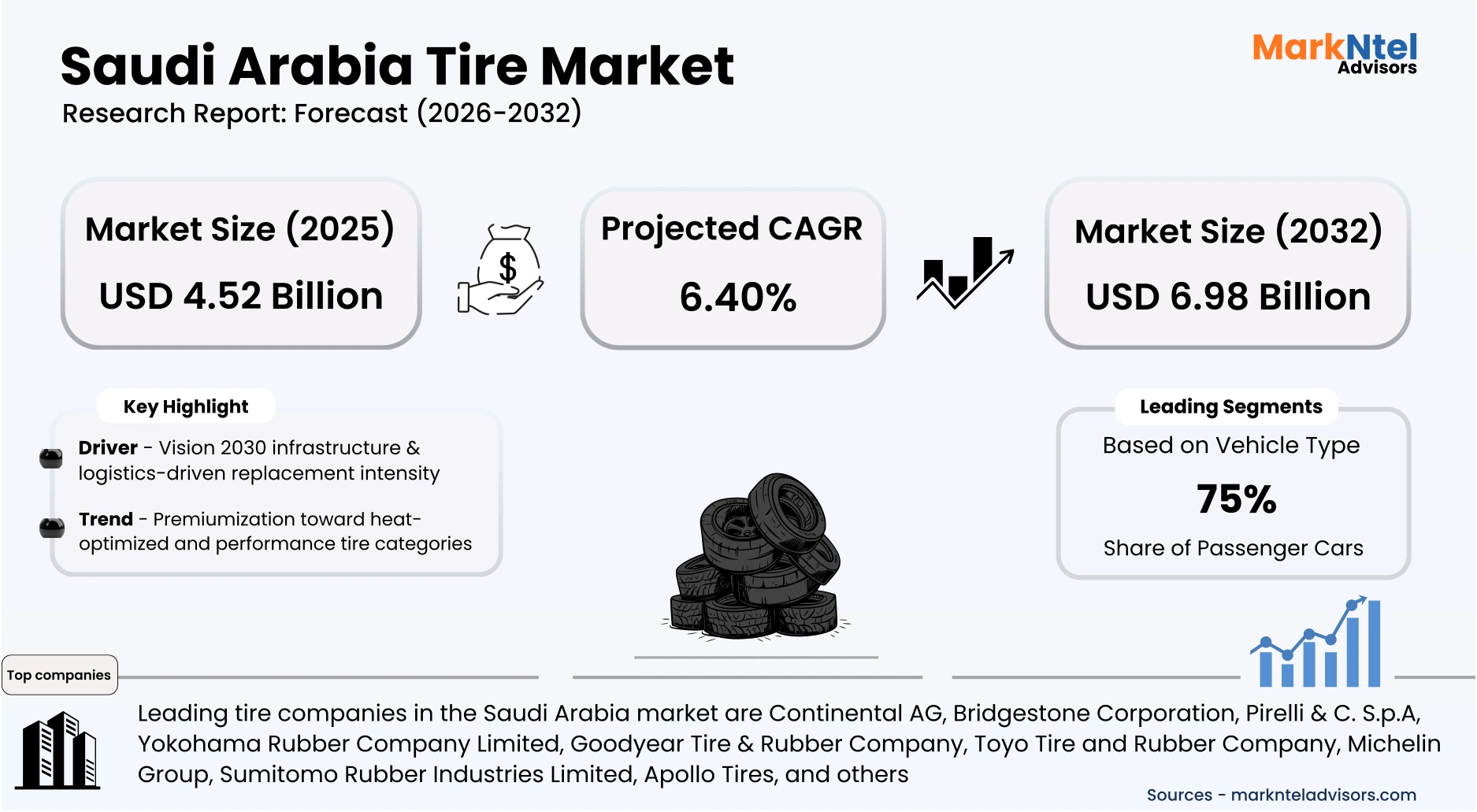
- Market size was valued at approximately USD 4.52 billion in 2025 and is projected to reach USD 6.98 billion by 2032. The estimated CAGR from 2026 to 2032 is around 6.40%, indicating strong growth.
- In 2025, passenger cars led the KSA tire market with 75% shares. However, SUV tires are projected to grow at a CAGR of 6.80% during the forecasting years, i.e., 2026-32.
- In 2025, radial tires captured 98% of the entire Saudi Arabia tire market primarily due to their superior performance, durability, and operating cost advantages over bias tires, which make them better suited to local driving and climatic conditions.
- The 225/45R17 tire size is anticipated to grow at a CAGR of around 8.3% in the coming years because it is a popular fitment for mid-size sedans, performance cars, and premium hatchbacks, which are seeing strong demand globally.
- The west region holds the largest share, i.e., 46% in 2025, primarily because it contains the Kingdom’s largest port (Jeddah Islamic Port), major pilgrimage cities (Mecca and Medina), and high population density, which together drive very high vehicle ownership and traffic volume.
- Leading tire companies in the Saudi Arabia market are Continental AG, Bridgestone Corporation, Pirelli & C. S.p.A, Yokohama Rubber Company Limited, Hankook Tire Co., Ltd., Goodyear Tire & Rubber Company, Toyo Tire and Rubber Company, Michelin Group, Sumitomo Rubber Industries Limited, Apollo Tires, and others.
Market Insights & Analysis: Saudi Arabia Tire Market (2026-32):
The Saudi Arabia Tire Market size was valued at around USD 4.52 billion in 2025 and is projected to reach USD 6.98 billion by 2032. Along with this, the market is estimated to grow at a CAGR of around 6.40% during the forecast period, i.e., 2026-32.
The growth of the market is likely to be driven primarily by the rapidly growing vehicle fleet due to the rising per capita income of people & their mounting inclination toward private ownership of vehicles across Saudi Arabia. It, in turn, is directly influencing the demand for tires and stimulating the overall market growth.
In addition, the soaring government focus on infrastructural development to diversify the economy away from oil in line with the strategic plan Saudi Vision 2030 is leading to various ongoing & upcoming construction projects throughout the country. It, in turn, is infusing the requirement for different commercial vehicles for multiple applications & boosting the demand for tires.
Besides, the government is also investing substantially and laying out favorable policies to attract foreign investments in setting up tire manufacturing facilities in the country and expanding the automotive & tire sectors through 2030.
- In 2024, in a significant development within the automotive sector, Petromin Express, the leading provider of Quick Vehicle Care services in Saudi Arabia, is proud to announce an exciting new project with Pirelli, a global leader in the tyre industry, aimed at establishing 20 co-branded locations across the Kingdom.
Moreover, the increasing population & influx of tourists, pilgrims, & migrants in Saudi Arabia is instigating the need for an extensive commercial sector, which has flooded the construction of airports, shopping malls, hotels, restaurants, etc. As a result, the demand for construction equipment & their robust tires is surging at a phenomenal pace.
On the other hand, the country also aims to build smart cities under its NEOM project and the National Industrial Development & Logistics Program (NIDLP), which shall also contribute to the expansion of the tire industry in the country. Furthermore, since there is a prominent volume of tire imports into the country due to the absence of manufacturing facilities, the penetration of international tire brands providing high quality & durable tires is escalating across Saudi Arabia and fueling the overall market growth.
Saudi Arabia Tire Industry Recent Development:
- June 2025: Saudi local authorities completed an expanded, climate‑controlled walking path for Hajj pilgrims in Makkah and Madinah to improve comfort and accessibility, especially for elderly and disabled pilgrims. A key feature of the infrastructure project is the use of rubberized asphalt made from recycled passenger car tires sourced from nearby landfills, supporting circular economy and sustainability goals.
- Apr 2025: Pirelli advanced its plans for a tire manufacturing plant in Saudi Arabia, with bidding underway for the construction of the facility. The project, backed by a joint venture with Saudi Arabia’s Public Investment Fund (PIF), is designed to produce around 3.5 million premium passenger car tires annually, with a total investment of approximately US$550 million.
- Mar 2025: Pirelli announced the 2025 Formula 1 tire allocations for the first five races, featuring a one-step softer compound for the Saudi Arabian Grand Prix in Jeddah. The C1 compound was selected for the first time in the season, reflecting the demanding nature of the Jeddah Corniche Circuit.
- Feb 2025: The Goodyear Tire & Rubber C ompany launched its advanced Tire Pressure Monitoring System (TPMS) in Saudi Arabia, targeting logistics and mass transit fleets. The solution integrates digital technology with Goodyear’s tire expertise to enable proactive tire monitoring and maintenance in the region’s harsh environment, reducing downtime and operating costs.
- Nov 2024: Saudi Arabia’s Black Arrow Tire Co. (Blatco) partnered with Thailand’s Golden Star Rubber Co. to build the Kingdom’s largest tire production facility in Yanbu, with an initial capacity of 4 million tires/year for passenger cars, expandable to 6 million units including truck and bus tires. The US$470 million joint venture is expected to generate over 2,000 local jobs and strengthen local manufacturing under Vision 2030.
Saudi Arabia Tire Market Driver:
Vision 2030 infrastructure & logistics-driven replacement intensity
Saudi Arabia’s tire market is primarily driven by Vision 2030-linked infrastructure development and logistics expansion, which is significantly increasing vehicle usage intensity and tire replacement frequency. As giga-projects, industrial zones, and large-scale construction activities accelerate, the movement of heavy trucks, pickups, buses, and contractor fleets rises sharply. This pushes tire consumption beyond just new vehicle additions, because commercial fleets typically run higher mileage and heavier load cycles, leading to faster tread wear. Moreover, Saudi Arabia’s extreme heat and road temperature conditions shorten tire life compared to moderate climates, making replacement demand structurally stronger. This demand driver is reinforced by several national initiatives and developments, which are directly intensifying freight movement, construction logistics, and fleet utilization:
- 2024: Acceleration of National Transport and Logistics Strategy (NTLS) execution to strengthen multi-modal connectivity (roads–ports–rail) and expand logistics activity
- 2024: NIDLP logistics reforms and licensing improvements to streamline freight operations, enabling higher fleet circulation and route frequency
- 2024: Expansion momentum across the giga-project infrastructure pipeline, increasing contractor fleet activity and heavy-duty tire replacement
- 2024: LME approval of Jeddah as a delivery point for copper and zinc, strengthening the city’s role as a commodities/logistics hub and driving industrial warehousing flows
- 2025: Riyadh Metro network expansion toward Diriyah Gate, adding sustained construction traffic and long-duration contractor mobility demand
- 2025: Growing recognition of giga-project contract acceleration, indicating stronger project execution pace and higher heavy-fleet deployment
- 2025: Transport & logistics positioned as a diversification pillar in outlook reports, highlighting continued investments across roads, rail, ports, and distribution networks
Additionally, the growth of last-mile delivery, ride-hailing, and intercity mobility increases daily vehicle utilization, thereby raising tire wear across passenger and light commercial segments. As a result, Saudi Arabia’s infrastructure-led logistics ecosystem converts national development spending into continuous tire replacement demand, making it the strongest and most structurally consistent driver of tire market growth in the country.
Saudi Arabia Tire Market Opportunity:
EV adoption creating a new high-value replacement cycle
The most promising growth opportunity in the Saudi tire market lies in the gradual but accelerating scale-up of electric vehicle (EV) adoption, which will create sustained demand for specialized and higher-value tire categories. Saudi Arabia is moving beyond an early EV phase by expanding the availability of EV models, strengthening policy alignment under Vision 2030, and steadily improving ecosystem readiness through charging infrastructure development. This expansion is already visible through market traction, Saudi Arabia recorded over 11,000 EV units sold in 2024, yet EVs still accounted for only a small portion of total vehicle sales, indicating substantial headroom for rapid growth ahead.
Moreover, confidence in EV adoption is strengthening as major brands expand presence in the Kingdom, including Tesla’s official market entry in April 2025, which supports premium EV penetration and raises EV acceptance among high-income consumers and corporate fleets. In parallel, charging infrastructure growth is being institutionalized through national rollout programs such as EVIQ, which is working toward 60 charging stations by the end of 2025, alongside longer-term targets of 5,000+ chargers across 1,000+ locations.
As EV penetration rises in both private and fleet segments, tire demand will increasingly shift toward EV-specific requirements, including low rolling resistance for higher range, low-noise designs for comfort, and higher load index tires for safety. Consequently, EV growth will not only increase replacement demand due to higher wear patterns, but it will also upgrade the market’s value mix, enabling tire suppliers to scale premium SKUs and margin-rich product portfolios.
Saudi Arabia Tire Market Challenge:
Price pressure from low-cost imports and counterfeit supply
The most significant challenge restraining the Saudi tire market is intense price pressure caused by low-cost imports and the ongoing risk of counterfeit and substandard tires, which weakens market value growth and erodes brand competitiveness. Since a large share of buyers remains price-sensitive, particularly in budget passenger segments and cost-focused commercial fleets, there is strong demand for cheaper tire options, which intensifies competition and compresses margins for established manufacturers. Moreover, counterfeit and low-grade tires disrupt market stability by undercutting legitimate products while creating safety concerns such as blowouts, uneven wear, and reduced grip performance. This reduces consumer trust and increases market uncertainty for distributors. Additionally, aggressive discounting practices across distribution networks can distort pricing discipline, making it difficult for premium brands to expand value share even when demand rises. As a result, the market faces a structural ceiling on premium growth unless enforcement and quality control become consistently stronger.
Saudi Arabia Tire Market Trend:
Premiumization toward heat-optimized and performance tire categories
A major ongoing trend in Saudi Arabia’s tire market is the shift toward premium, performance-based, and heat-optimized tires, driven by evolving consumer expectations and fleet procurement modernization. Instead of choosing tires purely on price, buyers are increasingly considering durability, wet grip performance, rolling resistance, and warranty coverage due to harsh driving conditions. This is accelerating demand for SUV tires, reinforced sidewall tires, and ultra-high-performance (UHP) categories, especially as the SUV-dominated fleet continues expanding. Furthermore, fleet operators are adopting total cost of ownership (TCO) based purchasing, where tires are selected for mileage performance and downtime reduction rather than upfront price. In addition, product differentiation is growing through advanced tread compounds tailored for high temperatures and long-distance highway driving. This trend is supported by KSA-focused instances showing how suppliers are actively strengthening premium-performance positioning in the Kingdom:
- 2025 (Apr): Hankook officially launched its Ultra-High-Performance tire “Ventus evo” in Saudi Arabia, reflecting rising demand for premium braking, cornering stability, and high-temperature performance in the passenger car and SUV segments
- 2025 (Feb): Hankook showcased advanced EV racing tire technology (GEN3 Evo iON Race) during the Formula E event in Jeddah, reinforcing the Kingdom’s growing performance-tire ecosystem and high-tech tire awareness in premium buyers
Consequently, the Saudi tire market is not only expanding in volume, but also upgrading in value, supporting higher revenue per unit and stronger premium-market penetration for global brands.
Saudi Arabia Tire Market (2026-32): Segmentation Analysis
The Saudi Arabia Tire Market study of MarkNtel Advisors evaluates & highlights the major trends & influencing factors in each segment & includes predictions for the period 2026–2032 at the global, regional, and national levels. Based on the analysis, the market has been further classified as:
Based on Vehicle Type:
- Passenger Cars
- Two Wheelers
- Light Commercial Vehicles (LCV)
- Medium & High Commercial Vehicles (MHCV)
- Off the Road Vehicles (OTR)
In 2025, passenger cars led the Saudi Arabia tire market with nearly 75% share, mainly because they account for the largest active vehicle parc and remain the most intensively used category for daily urban commuting in Riyadh, Jeddah, and Dammam. As a result, passenger car tires witness shorter replacement cycles, driven by high annual mileage and accelerated tread wear under extreme heat conditions. Moreover, the strong circulation of used passenger cars in KSA sustains recurring replacement demand, as pre-owned vehicles typically require immediate tire upgrades to ensure road safety and improve resale value. Additionally, passenger cars are widely utilized in rental and fleet operations, where continuous mileage accumulation creates predictable high-volume tire consumption.
However, SUV tires are projected to grow at the fastest pace (CAGR ~6.80% during 2026–2032), supported by the country’s shift toward SUVs for long-distance travel comfort and road dominance. Importantly, SUVs increasingly adopt larger rim sizes and higher-load rated premium tires, raising average selling prices and accelerating segment value growth, while desert-road exposure further increases wear intensity and replacement frequency.
Based on Type of Tire:
- Radial
- Bias
In 2025, radial tires dominated the Saudi Arabia tire market with nearly 98% share, as they deliver superior heat resistance, longer tread life, better road grip, and lower rolling resistance, critical advantages under KSA’s high-temperature driving conditions and long-distance highway usage. Moreover, radial tires reduce fuel consumption and maintenance costs, making them the preferred fitment across passenger cars, SUVs, and commercial vehicles, while bias tires remain limited to niche off-road or low-speed applications. Going forward, radial tires would continue to dominate the market in the upcoming years, supported by rising penetration of premium vehicles, increasing adoption of larger rim sizes, and growing demand for high-performance and all-season radial variants. Additionally, fleet operators and logistics companies are shifting toward advanced radial constructions to improve mileage efficiency and reduce downtime, further strengthening radial tire replacement demand across Saudi Arabia.
Gain a Competitive Edge with Our Saudi Arabia Tire Market Report
- Saudi Arabia Tire Market Report by MarkNtel Advisors provides a detailed & thorough analysis of market size & share, growth rate, competitive landscape, and key players. This comprehensive analysis helps businesses gain a holistic understanding of the market dynamics & make informed decisions.
- This report also highlights current market trends & future projections, allowing businesses to identify emerging opportunities & potential challenges. By understanding market forecasts, companies can align their strategies & stay ahead of the competition.
- Saudi Arabia Tire Market Report aids in assessing & mitigating risks associated with entering or operating in the market. By understanding market dynamics, regulatory frameworks, and potential challenges, businesses can develop strategies to minimize risks & optimize their operations.
*Reports Delivery Format - Market research studies from MarkNtel Advisors are offered in PDF, Excel and PowerPoint formats. Within 24 hours of the payment being successfully received, the report will be sent to your email address.
Frequently Asked Questions
- Market Segmentation
- Introduction
- Product Definition
- Research Process
- Assumptions
- Executive Summary
- Saudi Arabia Tire Market Supply Chain Analysis
- Saudi Arabia Tire Market Trends & Developments
- Saudi Arabia Tire Market Dynamics
- Growth Drivers
- Challenges
- Saudi Arabia Tire Market Import Export Statistics
- Saudi Arabia Tire Market Regulations, Policies, and Product Standards
- Saudi Arabia Tire Market Outlook 2022-2032F
- Market Size & Analysis
- By Revenue (USD Million)
- By Units Sold (Thousand Units)
- Market Segmentation & Analysis
- By Type of Vehicles
- Passenger Car- Market Size & Forecast 2022-2032, Thousand Units
- Light Commercial Vehicle- Market Size & Forecast 2022-2032, Thousand Units
- Medium and Heavy Commercial Vehicles- Market Size & Forecast 2022-2032, Thousand Units
- Off the Road (OTR) - Market Size & Forecast 2022-2032, Thousand Units
- Two Wheelers- Market Size & Forecast 2022-2032, Thousand Units
- By Demand Category
- OEM- Market Size & Forecast 2022-2032, Thousand Units
- Aftermarket- Market Size & Forecast 2022-2032, Thousand Units
- By Type of Tire
- Radial- Market Size & Forecast 2022-2032, Thousand Units
- Bias- Market Size & Forecast 2022-2032, Thousand Units
- By Sales Channel
- Direct Sales- Market Size & Forecast 2022-2032, Thousand Units
- Exclusive Outlets & Multi-brand Stores- Market Size & Forecast 2022-2032, Thousand Units
- Online- Market Size & Forecast 2022-2032, Thousand Units
- By Price Category
- Budget- Market Size & Forecast 2022-2032, Thousand Units
- Economy- Market Size & Forecast 2022-2032, Thousand Units
- Premium- Market Size & Forecast 2022-2032, Thousand Units
- By Tire Size
- Tire Size 1- Market Size & Forecast 2022-2032, Thousand Units
- Tire Size 2 - Market Size & Forecast 2022-2032, Thousand Units
- Tire Size 3 - Market Size & Forecast 2022-2032, Thousand Units
- Tire Size 4 - Market Size & Forecast 2022-2032, Thousand Units
- Tire Size 5 - Market Size & Forecast 2022-2032, Thousand Units
- By Region
- East
- West
- South
- Central
- By Company
- Competition Characteristics
- Volume Shares
- By Type of Vehicles
- Market Size & Analysis
- Saudi Arabia Passenger Car Tire Market Outlook, 2022-2032F
- Market Size & Analysis
- Market Revenue (USD Million)
- By Units Sold (Thousand Units)
- Market Segmentation & Analysis
- By Type of Vehicle- Market Size & Forecast 2022-2032, Thousand Units
- Hatchback- Market Size & Forecast 2022-2032, Thousand Units
- Sedan- Market Size & Forecast 2022-2032, Thousand Units
- SUV- Market Size & Forecast 2022-2032, Thousand Units
- By Demand Category- Market Size & Forecast 2022-2032, Thousand Units
- By Type of Tire- Market Size & Forecast 2022-2032, Thousand Units
- By Sales Channel- Market Size & Forecast 2022-2032, Thousand Units
- By Price Category- Market Size & Forecast 2022-2032, Thousand Units
- By Tire Size- Market Size & Forecast 2022-2032, Thousand Units
- By Type of Vehicle- Market Size & Forecast 2022-2032, Thousand Units
- Market Size & Analysis
- Saudi Arabia Light Commercial Vehicle Tire Market Outlook, 2022-2032F
- Market Size & Analysis
- Market Revenue (USD Million)
- By Units Sold (Thousand Units)
- Market Segmentation & Analysis
- By Type of Vehicle- Market Size & Forecast 2022-2032, Thousand Units
- Light Trucks- Market Size & Forecast 2022-2032, Thousand Units
- Light Buses- Market Size & Forecast 2022-2032, Thousand Units
- Pick-up Trucks and Vans- Market Size & Forecast 2022-2032, Thousand Units
- By Demand Category- Market Size & Forecast 2022-2032, Thousand Units
- By Type of Tire- Market Size & Forecast 2022-2032, Thousand Units
- By Sales Channel- Market Size & Forecast 2022-2032, Thousand Units
- By Price Category- Market Size & Forecast 2022-2032, Thousand Units
- By Tire Size- Market Size & Forecast 2022-2032, Thousand Units
- By Type of Vehicle- Market Size & Forecast 2022-2032, Thousand Units
- Market Size & Analysis
- Saudi Arabia Medium and Heavy Commercial Vehicle Tire Market Outlook, 2022-2032F
- Market Size & Analysis
- Market Revenue (USD Million)
- By Units Sold (Thousand Units)
- Market Segmentation & Analysis
- By Type of Vehicle- Market Size & Forecast 2022-2032, Thousand Units
- Buses- Market Size & Forecast 2022-2032, Thousand Units
- Trucks- Market Size & Forecast 2022-2032, Thousand Units
- By Demand Category- Market Size & Forecast 2022-2032, Thousand Units
- By Type of Tire- Market Size & Forecast 2022-2032, Thousand Units
- By Sales Channel- Market Size & Forecast 2022-2032, Thousand Units
- By Price Category- Market Size & Forecast 2022-2032, Thousand Units
- By Tire Size- Market Size & Forecast 2022-2032, Thousand Units
- By Type of Vehicle- Market Size & Forecast 2022-2032, Thousand Units
- Market Size & Analysis
- Saudi Arabia Two-Wheeler Tire Market Outlook, 2022-2032F
- Market Size & Analysis
- Market Revenue (USD Million)
- By Units Sold (Thousand Units)
- Market Segmentation & Analysis
- By Type of Vehicle- Market Size & Forecast 2022-2032, Thousand Units
- Scooters and Mopeds- Market Size & Forecast 2022-2032, Thousand Units
- Motorcycles- Market Size & Forecast 2022-2032, Thousand Units
- By Demand Category- Market Size & Forecast 2022-2032, Thousand Units
- By Type of Tire- Market Size & Forecast 2022-2032, Thousand Units
- By Sales Channel- Market Size & Forecast 2022-2032, Thousand Units
- By Price Category- Market Size & Forecast 2022-2032, Thousand Units
- By Tire Size- Market Size & Forecast 2022-2032, Thousand Units
- By Type of Vehicle- Market Size & Forecast 2022-2032, Thousand Units
- Market Size & Analysis
- Saudi Arabia OTR Vehicle Tire Market Outlook, 2022-2032F
- Market Size & Analysis
- Market Revenue (USD Million)
- By Units Sold (Thousand Units)
- Market Segmentation & Analysis
- By Type of Vehicle- Market Size & Forecast 2022-2032, Thousand Units
- Earthmoving Equipment- Market Size & Forecast 2022-2032, Thousand Units
- Agricultural Vehicles- Market Size & Forecast 2022-2032, Thousand Units
- Material Handling Vehicles- Market Size & Forecast 2022-2032, Thousand Units
- By Demand Category- Market Size & Forecast 2022-2032, Thousand Units
- By Type of Tire- Market Size & Forecast 2022-2032, Thousand Units
- By Sales Channel- Market Size & Forecast 2022-2032, Thousand Units
- By Price Category- Market Size & Forecast 2022-2032, Thousand Units
- By Tire Size- Market Size & Forecast 2022-2032, Thousand Units
- By Type of Vehicle- Market Size & Forecast 2022-2032, Thousand Units
- Market Size & Analysis
- Saudi Arabia Tire Market Key Strategic Imperatives for Success & Growth
- Competition Outlook
- Company Profiles
- Continental AG
- Business Description
- Type Portfolio
- Strategic Alliances or Partnerships
- Recent Developments
- Financial Details
- Others
- Bridgestone Corporation
- Business Description
- Type Portfolio
- Strategic Alliances or Partnerships
- Recent Developments
- Financial Details
- Others
- Pirelli & C. S.p.A.
- Business Description
- Type Portfolio
- Strategic Alliances or Partnerships
- Recent Developments
- Financial Details
- Others
- Yokohama Rubber Company Limited
- Business Description
- Type Portfolio
- Strategic Alliances or Partnerships
- Recent Developments
- Financial Details
- Others
- Hankook Tire Co., Ltd.
- Business Description
- Type Portfolio
- Strategic Alliances or Partnerships
- Recent Developments
- Financial Details
- Others
- Goodyear Tire & Rubber Company
- Business Description
- Type Portfolio
- Strategic Alliances or Partnerships
- Recent Developments
- Financial Details
- Others
- Toyo Tire and Rubber Company
- Business Description
- Type Portfolio
- Strategic Alliances or Partnerships
- Recent Developments
- Financial Details
- Others
- Michelin Group
- Business Description
- Type Portfolio
- Strategic Alliances or Partnerships
- Recent Developments
- Financial Details
- Others
- Sumitomo Rubber Industries Limited
- Business Description
- Type Portfolio
- Strategic Alliances or Partnerships
- Recent Developments
- Financial Details
- Others
- Apollo Tires
- Business Description
- Type Portfolio
- Strategic Alliances or Partnerships
- Recent Developments
- Financial Details
- Others
- Others
- Continental AG
- Company Profiles
- Disclaimer
MarkNtel Advisors follows a robust and iterative research methodology designed to ensure maximum accuracy and minimize deviation in market estimates and forecasts. Our approach combines both bottom-up and top-down techniques to effectively segment and quantify various aspects of the market. A consistent feature across all our research reports is data triangulation, which examines the market from three distinct perspectives to validate findings. Key components of our research process include:
1. Scope & Research Design At the outset, MarkNtel Advisors define the research objectives and formulate pertinent questions. This phase involves determining the type of research—qualitative or quantitative—and designing a methodology that outlines data collection methods, target demographics, and analytical tools. They also establish timelines and budgets to ensure the research aligns with client goals.
2. Sample Selection and Data Collection In this stage, the firm identifies the target audience and determines the appropriate sample size to ensure representativeness. They employ various sampling methods, such as random or stratified sampling, based on the research objectives. Data collection is carried out using tools like surveys, interviews, and observations, ensuring the gathered data is reliable and relevant.
3. Data Analysis and Validation Once data is collected, MarkNtel Advisors undertake a rigorous analysis process. This includes cleaning the data to remove inconsistencies, employing statistical software for quantitative analysis, and thematic analysis for qualitative data. Validation steps are taken to ensure the accuracy and reliability of the findings, minimizing biases and errors.

4. Data Forecast and FinalizationThe final phase involves forecasting future market trends based on the analyzed data. MarkNtel Advisors utilize predictive modeling and time series analysis to anticipate market behaviors. The insights are then compiled into comprehensive reports, featuring visual aids like charts and graphs, and include strategic recommendations to inform client decision-making
We offer flexible licensing options to cater to varying organizational needs. Choose the pricing pack that best suits your requirements:
Buy Now Inquire Before Buying
 Request Customization
 Talk to our Consultant







