

Saudi Arabia Raw Coffee Beans Market Research Report: Trends & Forecast (2026-2032)
By Beans Type (Arabica, Robusta, Liberica), By Grade (Specialty Grade, Commercial Grade, Commodity Grade), By Processing Method (Wet/Washed process, Dry/Natural process, Honey proc ... ess), By Packaging Type (Bags, Bulk/Unpackaged, Retail Packs), By Price Segment (Premium / Specialty Range, Mid-Range, Value / Commodity Range), By Distribution Channel (Wholesale Distributors & Importers, E-commerce / Online Platforms, Retail Chains (Grocery/Supermarkets), Direct Supply to B2B), By End-User (Household, Commercial), and others Read more
- Food & Beverages
- Feb 2026
- Pages 130
- Report Format: PDF, Excel, PPT
Saudi Arabia Raw Coffee Beans Market
Projected 4.74% CAGR from 2026 to 2032
Study Period
2026-2032
Market Size (2026)
USD 750 Million
Market Size (2032)
USD 990 Million
Base Year
2025
Projected CAGR
4.74%
Leading Segments
By Beans Type: Arabica
Saudi Arabia Raw Coffee Beans Market Report Key Takeaways:
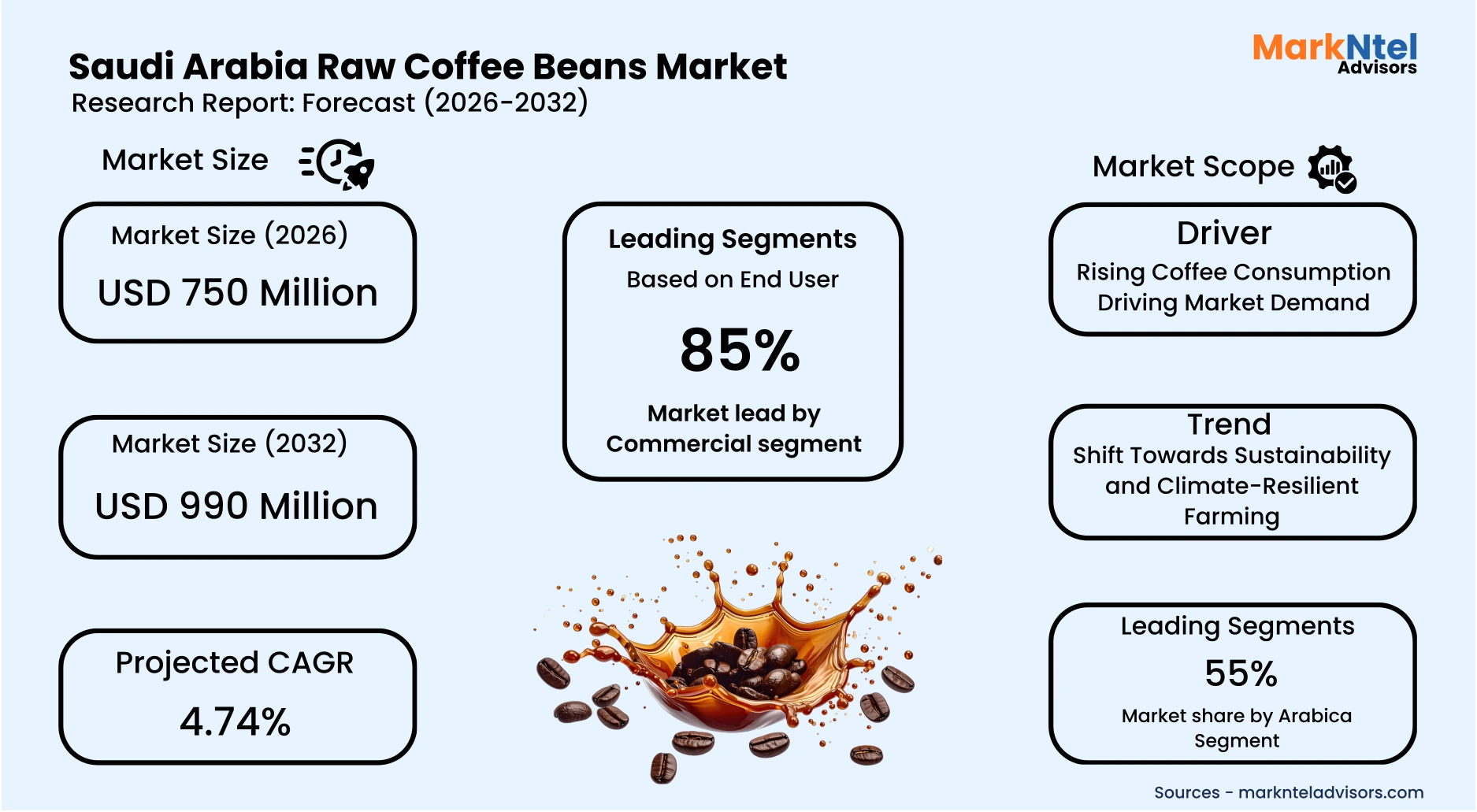
- The Saudi Arabia Raw Coffee Beans market size was valued at USD 715 million in 2025 and is projected to grow from USD 750 million in 2026 to USD 990 million by 2032, exhibiting a CAGR of 4.74% during the forecast period.
- Riyadh holds the largest market share of about 38% in the Saudi Arabia Raw Coffee Beans Market in 2026.
- By Beans Type, the arabica segment represented a significant share of about 55% in the Saudi Arabia Raw Coffee Beans Market in 2026.
- By end user, the commercial segment presented a significant share of about 85% in the Saudi Arabia Raw Coffee Beans Market in 2026.
- Leading raw coffee beans companies in Saudi Arabia are Al Mustaneer Trading Co Ltd, Coffee Farms Establishment, Almustaneer Co for International Trade, Diwan Al Qahwa Trading Co, Salem AbdulKader Bajubair Sons Co, Coffee Beans Co. Ltd., Alfanoos International Co Ltd, Bahadi Co For Trading and Indus, Black Knight Roastery, Al Amjaad Trading & Manufacturing, Mia Holding, and Others.
Market Insights & Analysis: Saudi Arabia Raw Coffee Beans Market (2026-32):
The Saudi Arabia Raw Coffee Beans Market size was valued at around USD 715 million in 2025 and is projected to grow from USD 750 million in 2026 to USD 990 million by 2032. Along with this, the market is estimated to grow at a CAGR of around 4.74% during the forecast period, i.e., 2026-32.
The Saudi Arabia Raw Coffee Beans Market is projected to expand steadily, driven by increasing domestic coffee consumption and strong government-led investments in sustainability and climate-resilient farming practices, strengthening local production capacity, and improving long-term supply stability across the value chain.
The Saudi Arabia raw coffee beans market is positioned for sustained expansion, underpinned by structural growth in café culture, demographic-driven specialty consumption, and strategic agricultural investments aligned with Vision 2030.
The national café market is projected to reach approximately USD 4.8 billion by 2025, expanding at an estimated 8% compound annual growth rate (CAGR). This growth reflects not only an increase in outlet density but also a qualitative shift toward premium and specialty coffee formats that require diverse, traceable, and high-grade green coffee beans.
Regional distribution of cafés demonstrates broad-based demand across major urban centers. For example, in the western region, Madinah (1,370 outlets) and Makkah (1,298 outlets) benefit from both resident demand and significant religious tourism flows, driving consistent year-round coffee consumption.
In the Eastern Province, Dammam accounts for 1,034 coffee shops, indicating expanding penetration beyond traditional metropolitan strongholds. This geographic diversification strengthens raw bean demand across multiple supply nodes.
Demographic factors further reinforce market expansion. For instance, the average Saudi coffee consumer is 28 years old, with Millennials and Generation Z shaping purchasing behaviour. This cohort increasingly favors specialty beverages, single-origin offerings, and customized blends, requiring consistent quality and diversified bean sourcing strategies. National coffee consumption is projected to grow by approximately 10% annually through 2027, sustaining upstream demand for raw beans.
On the supply side, sustainability and climate adaptation are becoming core pillars of sector development. The Food and Agriculture Organization (FAO) confirms the adoption of tissue culture technology to produce disease-free, drought-tolerant seedlings suited to Saudi Arabia’s arid conditions. More than 4,000 tissue-propagated Coffea arabica seedlings have been successfully rooted under controlled conditions, supporting long-term genetic preservation and productivity resilience.
Complementing these efforts, government initiatives under Vision 2030 aim to plant over 1.2 million coffee trees by 2026, with plans to increase annual domestic output from approximately 800 tons toward 2,500 tons. These measures seek to enhance supply stability, improve quality consistency, and gradually reduce reliance on imports.
Similarly, with coffee consumption expected to rise by around 10% annually through 2027, demand for raw coffee beans is set to increase steadily, reinforcing procurement volumes and long-term sourcing requirements across the supply chain.
The convergence of expanding café infrastructure, youth-driven specialty demand, and climate-resilient agricultural investments creates a favorable outlook for the Saudi raw coffee beans market. Strengthened domestic production alongside rising consumption is expected to enhance supply security, improve bean quality standards, and support long-term value creation across the coffee value chain.
Saudi Arabia Raw Coffee Beans Market Recent Developments:
- 2025: Saudi Arabia’s Sustainable Agricultural Rural Development Program (Saudi Reef) has launched a project to enhance the Kingdom’s coffee sector by producing high-quality seedlings and boosting cultivation productivity. The initiative will plant 50,000 coffee seedlings, targeting a 30% increase in coffee tree productivity by the end of 2025.
- 2025: A new agricultural hub in Al Baha has successfully planted 500,000 coffee trees, surpassing its initial target of 300,000. The site, spanning 1.6 million m², forms part of the kingdom’s first large-scale coffee-bean production centre under Vision 2030. Plans include planting an additional 100,000 Coffea arabica seedlings and positioning the region as a major source of raw coffee beans domestically and for export.
Saudi Arabia Raw Coffee Beans Market Scope:
| Category | Segments |
|---|---|
| By Beans Type | (Arabica, Robusta, Liberica), |
| By Grade | (Specialty Grade, Commercial Grade, Commodity Grade), |
| By Processing Method | (Wet/Washed process, Dry/Natural process, Honey process), |
| By Packaging Type | (Bags, Bulk/Unpackaged, Retail Packs), |
| By Price Segment | (Premium / Specialty Range, Mid-Range, Value / Commodity Range), |
| By Distribution Channel | (Wholesale Distributors & Importers, E-commerce / Online Platforms, Retail Chains (Grocery/Supermarkets), Direct Supply to B2B), |
| By End-User | (Household, Commercial), |
Saudi Arabia Raw Coffee Beans Market Driver:
Rising Coffee Consumption Driving Market Demand
Saudi Arabia’s raw coffee beans market is fundamentally supported by strong habitual consumption and a clear shift toward premium and specialty coffee formats. For instance, approximately 60% of the population consumes coffee at least once daily, underscoring the beverage’s cultural and routine significance. Urban consumers, in particular, increasingly favor café-prepared beverages over traditional home brewing, creating sustained demand for professionally roasted, high-quality green coffee beans.
The expansion of the specialty café ecosystem is a critical demand catalyst. Around 40% of total coffee consumption is attributed to specialty café chains, reflecting a structural preference for barista-crafted beverages prepared using premium and specialty-grade beans rather than instant alternatives . This transition elevates the importance of consistent bean quality, traceability, and diversified sourcing strategies to meet evolving consumer expectations.
Premiumization further reinforces upstream demand. Premium coffee accounts for approximately 25% of total retail sales, largely driven by younger consumers seeking artisanal blends, distinctive flavor profiles, and higher-grade single-origin beans. This demographic shift increases the requirement for superior raw bean inputs across both foodservice and retail channels.
Furthermore, domestically, coffee cultivation spans approximately 4,200 hectares, indicating expanding local production efforts to complement imports and address rising quality expectations.
High daily consumption, specialty café penetration, and growing premium coffee adoption collectively intensify demand for quality raw coffee beans. These structural consumption patterns are expected to sustain procurement growth, encourage quality standardization, and support long-term expansion of Saudi Arabia’s raw coffee beans market.
Saudi Arabia Raw Coffee Beans Market Trend:
Shift Towards Sustainability and Climate-Resilient Farming
Sustainability and climate-resilient agriculture are becoming structural pillars of Saudi Arabia’s raw coffee beans market, reflecting the need to secure long-term production in arid and water-constrained environments.
As domestic coffee cultivation expands across mountainous regions, producers are increasingly integrating resource-efficient irrigation systems and water management infrastructure to enhance yield reliability and preserve bean quality.
A key driver of this transition is the Sustainable Agricultural Rural Development Program (Saudi Reef), which has committed approximately USD 16 million to support sustainable coffee farming initiatives. The program emphasizes improved irrigation efficiency, rainwater harvesting systems, and technical guidance for farmers to reduce environmental stress while enhancing productivity. Such measures are critical in mitigating climate-related risks, including irregular rainfall and temperature variability.
Production targets further underscore the scale of this transformation. National coffee output is projected to rise to 7,000 tons annually by 2026, compared with approximately 1,485 tons in 2023, reflecting substantial expansion supported by structured sustainability investments. By aligning infrastructure development with climate-adaptive farming practices, Saudi Arabia is strengthening the resilience and consistency of its domestic green coffee supply.
The integration of climate-resilient farming methods and water-efficient infrastructure is reinforcing the long-term viability of Saudi Arabia’s coffee sector. These sustainability-driven investments are expected to improve yield stability, enhance raw bean quality, and create a more secure foundation for future market growth.
Saudi Arabia Raw Coffee Beans Market Opportunity:
Expansion of Vertical Integration and Processing Infrastructure
The expansion of vertically integrated infrastructure represents a strategic growth opportunity for Saudi Arabia’s raw coffee beans market. As domestic consumption and specialty demand increase, strengthening in-country processing capabilities is essential to ensure quality control, operational efficiency, and greater value retention within the national supply chain. Developing advanced post-harvest infrastructure enhances consistency in grading, cleaning, sorting, and storage critical factors for meeting premium and specialty standards.
In 2025, the Saudi Coffee Company, backed by the Public Investment Fund (PIF), advanced plans for a large-scale coffee processing facility in Jazan with a designed capacity of up to 27,000 metric tons of green coffee annually. The facility is structured to integrate cleaning, grading, quality assessment, warehousing, and processing operations under a centralized system. This integrated model enables both domestically cultivated and imported green beans to be efficiently prepared for roasting and downstream distribution.
Such infrastructure significantly reduces fragmentation within the supply chain, minimizes post-harvest losses, and improves traceability and quality assurance. Moreover, enhanced domestic processing capacity supports local farmers by creating structured procurement channels and standardized quality benchmarks.
The development of advanced processing infrastructure presents a substantial opportunity to enhance quality consistency, optimize supply chain efficiency, and reinforce domestic value addition. Vertical integration initiatives are expected to improve competitiveness and support the long-term expansion of Saudi Arabia’s raw coffee beans market.
Saudi Arabia Raw Coffee Beans Market Challenge:
Import Dependence & Inconsistent Supply Quality
Saudi Arabia’s raw coffee beans market continues to face structural pressure due to its high dependence on imported green coffee. While domestic cultivation is expanding, local production remains insufficient to meet national demand, resulting in continued reliance on international suppliers. In 2023, Saudi Arabia imported approximately 85,000 metric tons of green coffee, underscoring the magnitude of external sourcing within the supply chain .
Imports are heavily concentrated among key producing nations, with Brazil supplying around 42%, Vietnam approximately 25%, and Indonesia about 15% of total inbound volumes. This concentration increases vulnerability to climatic disruptions, harvest variability, geopolitical factors, and freight-related challenges in origin markets. Furthermore, differences in agricultural practices, processing standards, and grading systems across supplier countries can result in variability in bean size, moisture content, and cup profile consistency.
For domestic roasters and specialty café operators, such inconsistencies complicate procurement strategies, quality control, and long-term contracting arrangements. Price volatility linked to global supply fluctuations further adds financial uncertainty across the value chain.
Sustained dependence on imported green coffee, combined with origin-related quality variability, poses a significant constraint on supply stability and standardization. Without stronger domestic production capacity and diversified sourcing strategies, these factors may limit quality consistency and moderate long-term market expansion.
Saudi Arabia Raw Coffee Beans Market (2026-32) Segmentation Analysis:
The Saudi Arabia Raw Coffee Beans Market study of MarkNtel Advisors evaluates & highlights the major trends and influencing factors in each segment. It includes predictions for the period 2026–32 at the country level. Based on the analysis, the market has been further classified as;
Based on Beans Type:
- Arabica
- Robusta
- Liberica
The arabica segment dominates the Saudi Arabia Raw Coffee Beans Market, accounting for approximately 55% market share, driven by deep-rooted cultural traditions and evolving premium consumption patterns.
The Kingdom’s traditional beverage, Arabic coffee (qahwa), is predominantly prepared using lightly roasted Arabica beans, embedding this variety into daily social and cultural practices. In rural areas, traditional Arabic coffee consumption averaged approximately 1.2 cups per person per day, underscoring sustained structural demand anchored in heritage consumption .
Beyond cultural preference, Arabica’s sensory profile, characterized by smoother acidity, aromatic complexity, and comparatively lower caffeine content, aligns closely with both traditional preparation methods and the fast-growing specialty café segment.
As Saudi consumers increasingly shift toward barista-crafted beverages, single-origin offerings, and premium blends, roasters prioritize high-quality Arabica beans to meet expectations for flavor consistency and cup differentiation.
Domestic cultivation initiatives in mountainous regions such as Jazan, Asir, and Al-Baha also focus primarily on Arabica production, reinforcing its supply-side dominance. In contrast, Robusta and Liberica maintain relatively limited roles, largely confined to blended or instant coffee applications.
Strong cultural integration, specialty café expansion, and premiumization trends collectively reinforce Arabica’s leadership in the Saudi market. These factors are expected to sustain its dominant share across both traditional and modern coffee consumption channels.
Based on End User:
- Household
- Commercial
- Coffee Shops & Cafés
- Restaurants & Hospitality
The commercial segment dominates the Saudi Arabia Raw Coffee Beans market, accounting for about 85% of the total market size, supported by the rapid expansion of organized café chains, specialty coffee outlets, and the hospitality sector.
Urban centers such as Riyadh, Jeddah, Dammam, Makkah, and Madinah have experienced a notable rise in coffee shop density, reflecting changing lifestyle patterns and increasing out-of-home consumption. This structural shift has significantly elevated bulk procurement requirements for green coffee beans.
Coffee shops and specialty cafés form the core of commercial demand. These establishments rely on consistent, high-quality raw beans to produce espresso-based beverages, specialty brews, and customized blends. Compared with household consumption, commercial operators purchase beans in substantially larger volumes due to continuous daily service, diversified menus, and higher turnover rates.
The restaurants and hospitality segment further strengthens commercial dominance. Hotels, premium dining establishments, and large-scale catering providers increasingly integrate specialty coffee offerings as part of broader customer experience enhancement strategies. In cities with strong business and religious tourism activity, consistent visitor flows contribute to sustained commercial coffee consumption.
The continued growth of café culture and hospitality infrastructure firmly positions the commercial segment as the primary driver of raw coffee bean demand. Ongoing urbanization and tourism development are expected to maintain its leading market share.
Saudi Arabia Raw Coffee Beans Market (2026-32): Regional Projection
Riyadh dominates the Saudi Arabia Raw Coffee Beans Market with an estimated 38% share, supported by its demographic scale, economic concentration, and advanced café ecosystem. As the national capital and largest metropolitan economy, Riyadh benefits from high disposable incomes, strong commercial activity, and evolving consumer preferences that favor specialty coffee experiences.
The city accommodates approximately 6,270 coffee shops, the highest concentration in the Kingdom, underscoring a deeply established urban coffee culture. This extensive network of cafés and specialty outlets drives substantial and continuous demand for green coffee beans.
Commercial operators in Riyadh require consistent, high-quality raw beans to maintain standardized flavor profiles, specialty-grade offerings, and diversified beverage menus. Bulk purchasing agreements and centralized sourcing structures further elevate procurement volumes compared to other regions.
Riyadh’s position as a business and administrative hub also contributes to sustained out-of-home consumption. Corporate offices, large-scale events, conferences, and lifestyle-oriented social activity collectively stimulate daily café traffic. The coexistence of international chains and local specialty brands intensifies competition, reinforcing quality requirements and driving higher bean turnover rates.
Riyadh’s dense café infrastructure, strong purchasing power, and premium consumption patterns firmly establish it as the leading regional contributor to raw coffee bean demand. Continued urban development and commercial expansion are expected to reinforce its market dominance.
Gain a Competitive Edge with Our Saudi Arabia Raw Coffee Beans Market Report:
- Saudi Arabia Raw Coffee Beans Market Report by MarkNtel Advisors provides a detailed & thorough analysis of market size & share, growth rate, competitive landscape, and key players. This comprehensive analysis helps businesses gain a holistic understanding of the market dynamics & make informed decisions.
- This report also highlights current market trends & future projections, allowing businesses to identify emerging opportunities & potential challenges. By understanding market forecasts, companies can align their strategies & stay ahead of the competition.
- Saudi Arabia Raw Coffee Beans Market Report aids in assessing & mitigating risks associated with entering or operating in the market. By understanding market dynamics, regulatory frameworks, and potential challenges, businesses can develop strategies to minimize risks & optimize their operations.
*Reports Delivery Format - Market research studies from MarkNtel Advisors are offered in PDF, Excel and PowerPoint formats. Within 24 hours of the payment being successfully received, the report will be sent to your email address.
Frequently Asked Questions
- Market Segmentation
- Introduction
- Product Definition
- Research Process
- Assumptions
- Executive Summary
- Saudi Arabia Raw Coffee Beans Market Policies, Regulations, and Product Standards
- Saudi Arabia Raw Coffee Beans Market Trends & Developments
- Saudi Arabia Raw Coffee Beans Market Dynamics
- Growth Factors
- Challenges
- Saudi Arabia Raw Coffee Beans Market Hotspot & Opportunities
- Saudi Arabia Raw Coffee Beans Market Outlook, 2022-2032F
- Market Size & Outlook
- By Revenues (USD Million)
- Market Share & Outlook
- By Beans Type - Market Size & Forecast 2022-2032, USD Million
- Arabica
- Robusta
- Liberica
- By Grade- Market Size & Forecast 2022-2032, USD Million
- Specialty Grade
- Commercial Grade
- Commodity Grade
- By Processing Method- Market Size & Forecast 2022-2032, USD Million
- Wet/Washed process
- Dry/Natural process
- Honey process
- By Packaging Type- Market Size & Forecast 2022-2032, USD Million
- Bags
- Bulk/Unpackaged
- Retail Packs
- By Price Segment- Market Size & Forecast 2022-2032, USD Million
- Premium / Specialty Range
- Mid-Range
- Value / Commodity Range
- By Distribution Channel- Market Size & Forecast 2022-2032, USD Million
- Wholesale Distributors & Importers
- E-commerce / Online Platforms
- Retail Chains (Grocery/Supermarkets)
- Direct Supply to B2B
- By End-User- Market Size & Forecast 2022-2032, USD Million
- Household
- Commercial
- Coffee Shops & Cafés
- Restaurants & Hospitality
- By Region- Market Size & Forecast 2022-2032, USD Million
- Riyadh
- Jeddah
- Damam
- Mecca & Madinah
- Others
- By Company
- Competition Characteristics
- Market Share & Analysis
- By Beans Type - Market Size & Forecast 2022-2032, USD Million
- Market Size & Outlook
- Saudi Arabia Arabica Coffee Beans Market Outlook, 2022-2032
- Market Size & Outlook
- By Revenues (USD Million)
- Market Share & Outlook
- By Grade- Market Size & Forecast 2022-2032, USD Million
- By Processing Method- Market Size & Forecast 2022-2032, USD Million
- By Packaging Type- Market Size & Forecast 2022-2032, USD Million
- By Price Segment- Market Size & Forecast 2022-2032, USD Million
- By Distribution Channel- Market Size & Forecast 2022-2032, USD Million
- By End-User- Market Size & Forecast 2022-2032, USD Million
- By Region- Market Size & Forecast 2022-2032, USD Million
- Market Size & Outlook
- Saudi Arabia Robusta Coffee Beans Market Outlook, 2022-2032
- Market Size & Outlook
- By Revenues (USD Million)
- Market Share & Outlook
- By Grade- Market Size & Forecast 2022-2032, USD Million
- By Processing Method- Market Size & Forecast 2022-2032, USD Million
- By Packaging Type- Market Size & Forecast 2022-2032, USD Million
- By Price Segment- Market Size & Forecast 2022-2032, USD Million
- By Distribution Channel- Market Size & Forecast 2022-2032, USD Million
- By End-User- Market Size & Forecast 2022-2032, USD Million
- By Region- Market Size & Forecast 2022-2032, USD Million
- Market Size & Outlook
- Saudi Arabia Liberica Coffee Beans Market Outlook, 2022-2032
- Market Size & Outlook
- By Revenues (USD Million)
- Market Share & Outlook
- By Grade- Market Size & Forecast 2022-2032, USD Million
- By Processing Method- Market Size & Forecast 2022-2032, USD Million
- By Packaging Type- Market Size & Forecast 2022-2032, USD Million
- By Price Segment- Market Size & Forecast 2022-2032, USD Million
- By Distribution Channel- Market Size & Forecast 2022-2032, USD Million
- By End-User- Market Size & Forecast 2022-2032, USD Million
- By Region- Market Size & Forecast 2022-2032, USD Million
- Market Size & Outlook
- Saudi Arabia Raw Coffee Beans Market Key Strategic Imperatives for Success & Growth
- Competitive Outlook
- Company Profiles
- Al Mustaneer Trading Co Ltd
- Business Description
- Product Portfolio
- Collaborations & Alliances
- Recent Developments
- Financial Details
- Others
- Coffee Farms Establishment
- Business Description
- Product Portfolio
- Collaborations & Alliances
- Recent Developments
- Financial Details
- Others
- Almustaneer Co for International Trade
- Business Description
- Product Portfolio
- Collaborations & Alliances
- Recent Developments
- Financial Details
- Others
- Diwan Al Qahwa Trading Co
- Business Description
- Product Portfolio
- Collaborations & Alliances
- Recent Developments
- Financial Details
- Others
- Salem AbdulKader Bajubair Sons Co
- Business Description
- Product Portfolio
- Collaborations & Alliances
- Recent Developments
- Financial Details
- Others
- Coffee Beans Co. Ltd.
- Business Description
- Product Portfolio
- Collaborations & Alliances
- Recent Developments
- Financial Details
- Others
- Alfanoos International Co Ltd
- Business Description
- Product Portfolio
- Collaborations & Alliances
- Recent Developments
- Financial Details
- Others
- Bahadi Co For Trading and Indus
- Business Description
- Product Portfolio
- Collaborations & Alliances
- Recent Developments
- Financial Details
- Others
- Black Knight Roastery
- Business Description
- Product Portfolio
- Collaborations & Alliances
- Recent Developments
- Financial Details
- Others
- Al Amjaad Trading & Manufacturing
- Business Description
- Product Portfolio
- Collaborations & Alliances
- Recent Developments
- Financial Details
- Others
- Mia Holding
- Business Description
- Product Portfolio
- Collaborations & Alliances
- Recent Developments
- Financial Details
- Others
- Al Mustaneer Trading Co Ltd
- Company Profiles
- Disclaimer
MarkNtel Advisors follows a robust and iterative research methodology designed to ensure maximum accuracy and minimize deviation in market estimates and forecasts. Our approach combines both bottom-up and top-down techniques to effectively segment and quantify various aspects of the market. A consistent feature across all our research reports is data triangulation, which examines the market from three distinct perspectives to validate findings. Key components of our research process include:
1. Scope & Research Design At the outset, MarkNtel Advisors define the research objectives and formulate pertinent questions. This phase involves determining the type of research—qualitative or quantitative—and designing a methodology that outlines data collection methods, target demographics, and analytical tools. They also establish timelines and budgets to ensure the research aligns with client goals.
2. Sample Selection and Data Collection In this stage, the firm identifies the target audience and determines the appropriate sample size to ensure representativeness. They employ various sampling methods, such as random or stratified sampling, based on the research objectives. Data collection is carried out using tools like surveys, interviews, and observations, ensuring the gathered data is reliable and relevant.
3. Data Analysis and Validation Once data is collected, MarkNtel Advisors undertake a rigorous analysis process. This includes cleaning the data to remove inconsistencies, employing statistical software for quantitative analysis, and thematic analysis for qualitative data. Validation steps are taken to ensure the accuracy and reliability of the findings, minimizing biases and errors.

4. Data Forecast and FinalizationThe final phase involves forecasting future market trends based on the analyzed data. MarkNtel Advisors utilize predictive modeling and time series analysis to anticipate market behaviors. The insights are then compiled into comprehensive reports, featuring visual aids like charts and graphs, and include strategic recommendations to inform client decision-making
We offer flexible licensing options to cater to varying organizational needs. Choose the pricing pack that best suits your requirements:
Buy Now Inquire Before Buying
 Request Customization
 Talk to our Consultant







