

Saudi Arabia Port Automation Market Research Report: Trends, Forecast & Opportunities (2026-2032)
By Technology (Terminal Operating Systems (TOS), Automated Guided Vehicles (AGVs), Automated Stacking Cranes (ASC), Gate Automation Systems, Cargo Tracking & Monitoring Systems, Ot ... hers), By Component (Hardware, Software, Services), By Port Type (Container Ports, Bulk & General Cargo Ports, Oil & Gas Terminals) Read more
- ICT & Electronics
- Mar 2026
- Pages 120
- Report Format: PDF, Excel, PPT
Saudi Arabia Port Automation Market
Projected 14.1% CAGR from 2026 to 2032
Study Period
2026-2032
Market Size (2026)
USD 1.20 Billion
Market Size (2032)
USD 2.65 Billion
Base Year
2025
Projected CAGR
14.1%
Leading Segments
By Technology: Terminal Operating Systems (TOS)
Saudi Arabia Port Automation Market Report Key Takeaways:
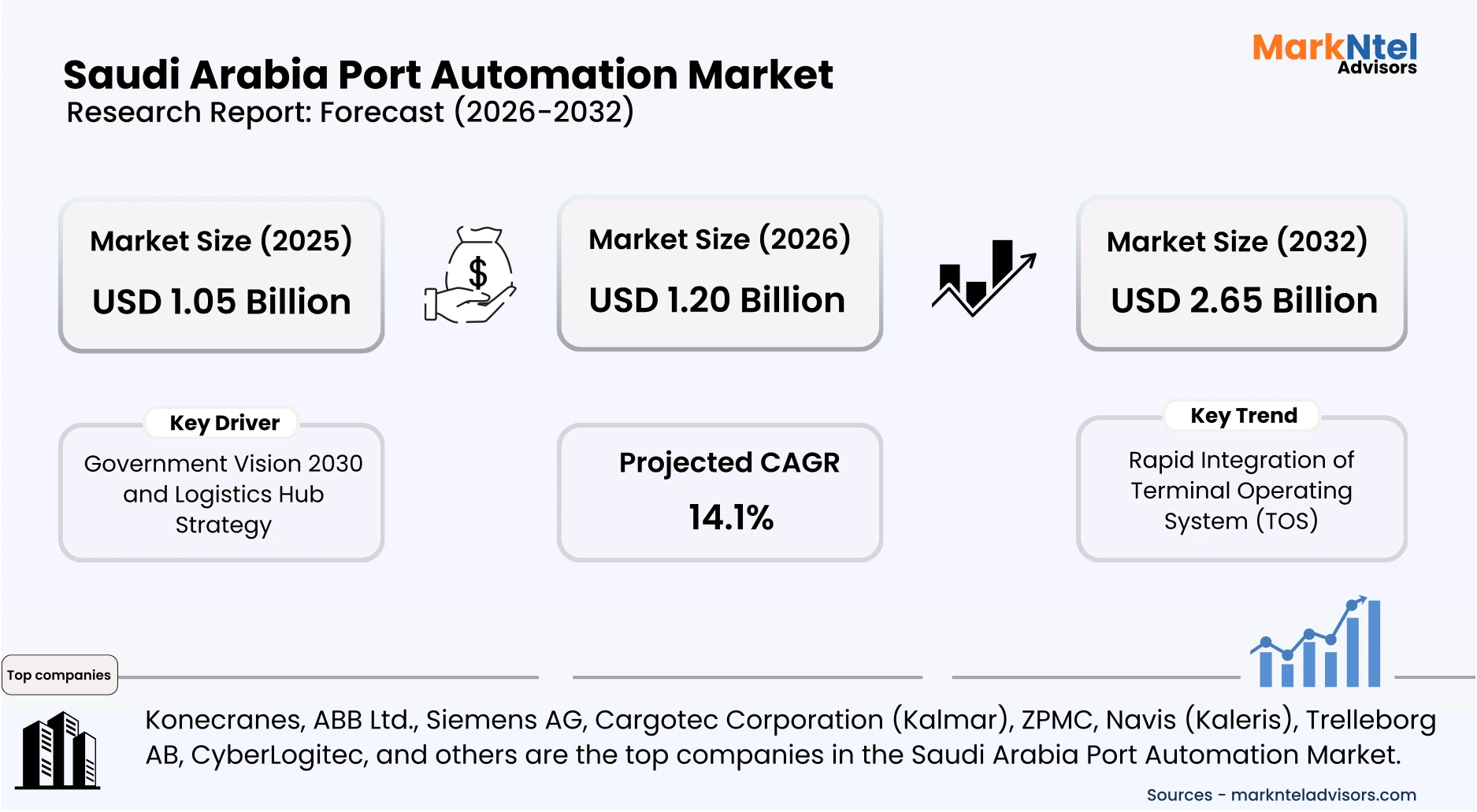
- The Saudi Arabia Port Automation Market size was valued at around USD 1.05 billion in 2025 and is projected grow from USD 1.20 billion in 2026 to USD 2.65 billion by 2032, exhibiting a CAGR of 14.1% during the forecast period.
- By Technology, the Terminal Operating Systems (TOS) segment represented a significant share of about 64% in the Saudi Arabia Port Automation Market in 2026.
- By Port Type, the Container Ports segment seized a significant share of about 63% in the Saudi Arabia Port Automation Market in 2026.
- Leading port automation companies in the Saudi Arabia Market are Konecranes, ABB Ltd., Siemens AG, Cargotec Corporation (Kalmar), ZPMC, Navis (Kaleris), Trelleborg AB, CyberLogitec, and others.
Market Insights & Analysis: Saudi Arabia Port Automation Market (2026-32):
The Saudi Arabia Port Automation Market size was valued at around USD 1.05 billion in 2025 and is projected grow from USD 1.20 billion in 2026 to USD 2.65 billion by 2032, exhibiting a CAGR of 14.1% during the forecast period, i.e., 2026-32.
Saudi Arabia’s port automation market has expanded alongside the Kingdom’s transformation into a regional logistics hub connecting Asia, Europe, and Africa. Growing maritime trade has increased operational complexity across port terminals, prompting large-scale investments in port infrastructure and logistics modernization. Investments in the Kingdom’s maritime sector have exceeded USD 6.66 billion through collaborations between the Saudi Ports Authority (Mawani) and private sector partners, supporting the expansion and modernization of major port facilitie s. According to Mawani, Saudi ports handled approximately 8.3 million TEUs in 2025, reflecting sustained growth in containerized trade and reinforcing the need for advanced digital and automated terminal systems .
Government policy continues to reinforce this expansion through comprehensive logistics and transport reforms. Under Saudi Vision 2030 and the National Transport and Logistics Strategy, Saudi Arabia is prioritizing port infrastructure upgrades, digital customs systems, and integrated logistics networks. These initiatives aim to position the Kingdom as a global maritime gateway while improving supply-chain efficiency across international trade routes. As a result, port operators are increasingly adopting automation technologies to optimize cargo handling, reduce vessel turnaround times, and enhance operational visibility.
Demand from end users such as global shipping lines, freight forwarders, and logistics providers has further accelerated automation adoption across container terminals. Containerized cargo remains the dominant trade format due to its efficiency in transporting manufactured goods and consumer products through standardized units. Mawani reported that transshipment containers reached 1.9 million TEUs, while outgoing containers totaled 3.1 million TEUs and incoming containers reached 3.2 million TEUs, highlighting the increasing scale of containerized trade handled by Saudi ports.
Looking ahead, continued infrastructure expansion and logistics modernization are expected to sustain market growth. Projects focused on automated terminals, smart logistics platforms, and integrated cargo management systems are gaining momentum across the Kingdom’s maritime network. A 120,490-square-meter integrated logistics center is currently being developed at Yanbu Commercial Port to strengthen cargo storage, consolidation, and distribution capabilities, supporting the long-term development of Saudi Arabia’s port and logistics ecosystem.
Saudi Arabia Port Automation Market Recent Developments:
- 2025 : The Port of NEOM introduced Saudi Arabia’s first fully automated remote-controlled ship-to-shore and electric rubber-tyred gantry cranes. These advanced systems support the development of a next-generation automated container terminal and enhance operational efficiency on the Red Sea trade corridor.
- 2025 : DP World and the Saudi Ports Authority (Mawani) inaugurated a USD 800 million South Container Terminal at Jeddah Islamic Port. The facility integrates automated and electrified yard cranes and expanded quay crane capacity, improving operational efficiency and supporting Saudi Arabia’s ambition to become a global logistics hub under Vision 2030.
Saudi Arabia Port Automation Market Scope:
| Category | Segments |
|---|---|
| By Technology | (Terminal Operating Systems (TOS), Automated Guided Vehicles (AGVs), Automated Stacking Cranes (ASC), Gate Automation Systems, Cargo Tracking & Monitoring Systems, Others), |
| By Component | (Hardware, Software, Services), |
| By Port Type | (Container Ports, Bulk & General Cargo Ports, Oil & Gas Terminals) |
Saudi Arabia Port Automation Market Driver:
Government Vision 2030 and Logistics Hub Strategy
Saudi Arabia’s Vision 2030 logistics strategy has emerged as the most influential structural driver accelerating demand for port automation. The government launched the National Transport and Logistics Strategy to position the Kingdom as a global logistics hub connecting Asia, Europe, and Africa. According to the Saudi Ministry of Transport and Logistics Services, the program aims to increase the sector’s contribution to GDP to about USD 120 billion by 2030 . As part of this initiative, port capacity expansion and digital modernization have become central policy priorities.
The strategy has intensified over recent years through large-scale infrastructure investments and regulatory reforms targeting maritime trade efficiency. The Saudi Ports Authority (Mawani) announced investments exceeding USD 2.6 billion between 2024 and 2025 to expand terminals, deploy smart port technologies, and enhance container capacity. Projects at ports such as Jeddah Islamic Port and King Abdullah Port include automated yard cranes, digital terminal systems, and smart logistics platforms. These initiatives aim to increase container throughput while reducing vessel turnaround time and operational costs.
The policy impact is already measurable through rising trade flows and expanding cargo handling capacity across Saudi ports. According to the Saudi Ports Authority, national ports handled more than 320 million tons of cargo and over 8 million TEUs of containers in recent years, reflecting steady maritime trade growth. Higher cargo volumes require automated cranes, terminal operating systems, and cargo tracking platforms to maintain operational efficiency. Consequently, automation investments are directly expanding market volume rather than merely improving operational margins.
Saudi Arabia Port Automation Market Trend:
Rapid Integration of Terminal Operating System (TOS)
The integration of Terminal Operating System (TOS) has emerged as a defining technological trend reshaping port operations in Saudi Arabia. Rapid growth in container traffic and increasing vessel sizes have intensified the need for centralized digital systems capable of coordinating yard planning, vessel scheduling, and cargo tracking. As per the Saudi Ports Authority (Mawani), national ports handled more than 320 million tons of cargo in 2024, creating operational complexity that requires advanced digital coordination platforms .
This trend is driving structural changes across the port value chain by transforming how terminals manage equipment, cargo flows, and logistics integration. Modern TOS platforms enable real-time data exchange between terminal operators, shipping lines, customs authorities, and freight companies, significantly improving operational transparency. In 2025, the expansion of automated terminals at Jeddah Islamic Port incorporated digital management systems designed to optimize container movement and reduce vessel turnaround time, reflecting the growing reliance on integrated software platforms.
The persistence of this trend is supported by government-led digitalization initiatives under Saudi Vision 2030 and the National Transport and Logistics Strategy. These programs prioritize smart port infrastructure, digital logistics platforms, and automated cargo management systems to enhance trade competitiveness. As maritime trade volumes expand and operational efficiency becomes critical, the deployment of TOS platforms is expected to remain central to long-term port automation strategies across Saudi Arabia.
Saudi Arabia Port Automation Market Opportunity:
Growing Non-Oil Trade and E-commerce Logistics
Saudi Arabia’s accelerating expansion of non-oil trade and digital commerce has created a structural opportunity for new entrants in port automation. Under Saudi Vision 2030, the government is actively diversifying exports and strengthening logistics infrastructure to support international trade. According to the Saudi Ports Authority (Mawani), Saudi ports handled more than 320 million tons of cargo and over 8 million TEUs in 2024 . According to the data from the General Authority for Statistics, Saudi non-oil exports reached USD 25.9 billion in Q4 2025, increasing 18.6% year-on-year and highlighting the rapid expansion of trade flows.
The opportunity is further reinforced by the strong growth of e-commerce and cross-border logistics across the Middle East. Official data indicates that e-commerce sales in Saudi Arabia reached about USD 23.5 billion in Q3 2025, reflecting the rapid expansion of digital retail activity . In addition, parcel deliveries across the Kingdom exceeded 15 million shipments during the first 20 days of Ramadan 2026, demonstrating the rising scale of logistics operations . Increasing parcel volumes and containerized shipments are driving demand for faster cargo processing and integrated digital terminal systems.
These structural developments create favorable conditions for smaller technology providers specializing in modular automation solutions. Emerging companies can deliver targeted platforms such as cargo-tracking software, AI-driven analytics systems, and automation sensors without competing directly in large-scale infrastructure development. Government programs supporting logistics innovation and technology partnerships are also enabling pilot deployments and digital experimentation. As Saudi Arabia continues expanding non-oil trade and e-commerce logistics, demand for scalable port automation technologies is expected to grow steadily.
Saudi Arabia Port Automation Market Challenge:
Requirement of High Initial Investment Impeding Smooth Market Progression
High initial investment requirements remain a critical barrier to the adoption of port automation technologies in Saudi Arabia. Automation systems such as automated cranes, terminal operating platforms, and digital cargo tracking infrastructure require substantial capital expenditure and specialized integration. Large-scale terminal modernization projects frequently involve multimillion-dollar investments in equipment, software, and infrastructure upgrades. For instance, the expansion of the South Container Terminal at Jeddah Islamic Port required an investment of approximately USD 800 million to deploy advanced cargo-handling and digital terminal technologies .
The financial burden associated with automation is particularly challenging for smaller port operators and logistics providers. According to the Saudi Ports Authority (Mawani), several modernization initiatives across national ports involve significant infrastructure upgrades, including electrified cranes, digital port platforms, and expanded container yards. These investments often require long project timelines, specialized technical expertise, and complex integration with legacy port systems. As a result, many operators face financial constraints when considering large-scale automation deployments.
This challenge directly limits the pace of technology adoption and restricts market entry for emerging automation vendors. High capital costs increase investment risk and require long payback periods before operational savings can be realized. Smaller terminals and regional logistics hubs may delay automation upgrades due to budget limitations and financing constraints. Consequently, despite strong trade growth and government support for logistics modernization, high upfront investment costs continue to slow the widespread adoption of port automation technologies across Saudi Arabia.
Saudi Arabia Port Automation Market (2026-32) Segmentation Analysis:
The Saudi Arabia Port Automation Market study of MarkNtel Advisors evaluates & highlights the major trends and influencing factors in each segment. It includes predictions for the period 2026–32 at the country level. Based on the analysis, the market has been further classified as;
Based on Technology:
- Terminal Operating Systems (TOS)
- Automated Guided Vehicles (AGVs)
- Automated Stacking Cranes (ASC)
- Gate Automation Systems
- Cargo Tracking & Monitoring Systems
- Others
The Terminal Operating Systems (TOS) segment dominates the Saudi Arabia Port Automation Market, accounting for approximately 64% of total adoption, primarily because modern container terminals rely on centralized digital platforms to manage vessel scheduling, yard planning, and cargo tracking. As Saudi Arabia continues expanding its maritime logistics infrastructure, ports are handling increasingly complex cargo flows that require integrated digital coordination systems. Managing container movement, truck gate operations, and yard equipment simultaneously requires advanced software platforms capable of optimizing terminal operations in real time.
Government-led digitalization initiatives are further strengthening the adoption of terminal management platforms. The Saudi Ports Authority (Mawani) has implemented the FASAH digital platform, which integrates customs clearance, shipping documentation, and port logistics processes into a unified digital system designed to accelerate cargo processing. The platform connects shipping lines, customs authorities, and logistics providers through a centralized interface, demonstrating the increasing reliance on integrated port management technologies. Additionally, Saudi Arabia’s Port of NEOM is developing a highly automated container terminal integrating advanced digital control systems and automation technologies to support next-generation terminal operations.
Unlike individual automation equipment such as cranes or automated guided vehicles, TOS platforms function as the operational backbone of automated terminals, enabling real-time coordination between terminal operators, shipping lines, freight forwarders, and customs agencies. This centralized control improves operational visibility, reduces vessel turnaround time, and enhances overall cargo handling efficiency. As Saudi Arabia continues advancing its logistics modernization initiatives, the need for integrated terminal coordination platforms continues to reinforce the dominant share of Terminal Operating Systems in the country’s port automation market.
Based on Port Type:
- Container Ports
- Bulk & General Cargo Ports
- Oil & Gas Terminals
The Container Ports segment dominates the Saudi Arabia Port Automation Market by port type, accounting for around 63% of total adoption, primarily because container terminals handle the largest share of international trade and require advanced automation to manage standardized cargo flows. Containerized shipping enables the efficient transportation of manufactured goods, electronics, and consumer products across global supply chains. According to the Saudi Ports Authority (Mawani), transshipment containers increased by 11.78%, reaching 1.9 million TEUs, highlighting the growing role of Saudi ports as regional transshipment hubs connecting Asia, Europe, and Africa.
Operational capacity and terminal specialization further reinforce the dominance of container ports within the country’s maritime infrastructure. Major container gateways such as Jeddah Islamic Port and King Abdullah Port process large volumes of containerized cargo through advanced terminal facilities. According to Mawani, the report also indicates that outgoing containers reached 3.1 million TEUs while incoming containers reached 3.2 million TEUs, reflecting the high level of container traffic handled by these ports .
Container terminals require significantly higher levels of automation compared with bulk or liquid cargo terminals. They rely on technologies such as terminal operating systems, automated cranes, yard management systems, and smart gate infrastructure to coordinate vessel berthing, yard planning, and truck movements. This operational complexity drives sustained investment in automation technologies. As Saudi Arabia strengthens its position as a regional logistics hub under national trade diversification strategies, the scale and operational intensity of containerized cargo continue to position container ports as the dominant port type within the country’s port automation market.
Gain a Competitive Edge with Our Saudi Arabia Port Automation Market Report:
- Saudi Arabia Port Automation Market Report by MarkNtel Advisors provides a detailed & thorough analysis of market size & share, growth rate, competitive landscape, and key players. This comprehensive analysis helps businesses gain a holistic understanding of the market dynamics & make informed decisions.
- This report also highlights current market trends & future projections, allowing businesses to identify emerging opportunities & potential challenges. By understanding market forecasts, companies can align their strategies & stay ahead of the competition.
- Saudi Arabia Port Automation Market Report aids in assessing & mitigating risks associated with entering or operating in the market. By understanding market dynamics, regulatory frameworks, and potential challenges, businesses can develop strategies to minimize risks & optimize their operations.
*Reports Delivery Format - Market research studies from MarkNtel Advisors are offered in PDF, Excel and PowerPoint formats. Within 24 hours of the payment being successfully received, the report will be sent to your email address.
Frequently Asked Questions
- Market Segmentation
- Introduction
- Product Definition
- Research Process
- Assumptions
- Executive Summary
- Saudi Arabia Port Automation Market Policies, Regulations, and Product Standards
- Saudi Arabia Port Automation Market Trends & Developments
- Saudi Arabia Port Automation Market Dynamics
- Growth Factors
- Challenges
- Saudi Arabia Port Automation Market Hotspot & Opportunities
- Saudi Arabia Port Automation Market Outlook, 2022-2032F
- Market Size & Outlook
- By Revenues (USD Million)
- Market Share & Outlook
- By Technology- Market Size & Forecast 2022-2032, USD Million
- Terminal Operating Systems (TOS)
- Automated Guided Vehicles (AGVs)
- Automated Stacking Cranes (ASC)
- Gate Automation Systems
- Cargo Tracking & Monitoring Systems
- Others
- By Component- Market Size & Forecast 2022-2032, USD Million
- Hardware
- Software
- Services
- By Port Type- Market Size & Forecast 2022-2032, USD Million
- Container Ports
- Bulk & General Cargo Ports
- Oil & Gas Terminals
- By Company
- Competition Characteristics
- Market Share & Analysis
- By Technology- Market Size & Forecast 2022-2032, USD Million
- Market Size & Outlook
- Saudi Arabia Terminal Operating Systems (TOS) Market Outlook, 2022-2032
- Market Size & Outlook
- By Revenues (USD Million)
- Market Share & Outlook
- By Component- Market Size & Forecast 2022-2032, USD Million
- By Port Type- Market Size & Forecast 2022-2032, USD Million
- Market Size & Outlook
- Saudi Arabia Automated Guided Vehicles (AGVs) Market Outlook, 2022-2032
- Market Size & Outlook
- By Revenues (USD Million)
- Market Share & Outlook
- By Component- Market Size & Forecast 2022-2032, USD Million
- By Port Type- Market Size & Forecast 2022-2032, USD Million
- Market Size & Outlook
- Saudi Arabia Automated Stacking Cranes (ASC) Market Outlook, 2022-2032
- Market Size & Outlook
- By Revenues (USD Million)
- Market Share & Outlook
- By Component- Market Size & Forecast 2022-2032, USD Million
- By Port Type- Market Size & Forecast 2022-2032, USD Million
- Market Size & Outlook
- Saudi Arabia Gate Automation Systems Market Outlook, 2022-2032
- Market Size & Outlook
- By Revenues (USD Million)
- Market Share & Outlook
- By Component- Market Size & Forecast 2022-2032, USD Million
- By Port Type- Market Size & Forecast 2022-2032, USD Million
- Market Size & Outlook
- Saudi Arabia Cargo Tracking & Monitoring Systems Market Outlook, 2022-2032
- Market Size & Outlook
- By Revenues (USD Million)
- Market Share & Outlook
- By Component- Market Size & Forecast 2022-2032, USD Million
- By Port Type- Market Size & Forecast 2022-2032, USD Million
- Market Size & Outlook
- Saudi Arabia Port Automation Market Key Strategic Imperatives for Success & Growth
- Competitive Outlook
- Company Profiles
- Konecranes
- Business Description
- Product Portfolio
- Collaborations & Alliances
- Recent Developments
- Financial Details
- Others
- ABB Ltd.
- Business Description
- Product Portfolio
- Collaborations & Alliances
- Recent Developments
- Financial Details
- Others
- Siemens AG
- Business Description
- Product Portfolio
- Collaborations & Alliances
- Recent Developments
- Financial Details
- Others
- Cargotec Corporation (Kalmar)
- Business Description
- Product Portfolio
- Collaborations & Alliances
- Recent Developments
- Financial Details
- Others
- ZPMC
- Business Description
- Product Portfolio
- Collaborations & Alliances
- Recent Developments
- Financial Details
- Others
- Navis (Kaleris)
- Business Description
- Product Portfolio
- Collaborations & Alliances
- Recent Developments
- Financial Details
- Others
- Trelleborg AB
- Business Description
- Product Portfolio
- Collaborations & Alliances
- Recent Developments
- Financial Details
- Others
- CyberLogitec
- Business Description
- Product Portfolio
- Collaborations & Alliances
- Recent Developments
- Financial Details
- Others
- Others
- Business Description
- Product Portfolio
- Collaborations & Alliances
- Recent Developments
- Financial Details
- Others
- Konecranes
- Company Profiles
- Disclaimer
MarkNtel Advisors follows a robust and iterative research methodology designed to ensure maximum accuracy and minimize deviation in market estimates and forecasts. Our approach combines both bottom-up and top-down techniques to effectively segment and quantify various aspects of the market. A consistent feature across all our research reports is data triangulation, which examines the market from three distinct perspectives to validate findings. Key components of our research process include:
1. Scope & Research Design At the outset, MarkNtel Advisors define the research objectives and formulate pertinent questions. This phase involves determining the type of research—qualitative or quantitative—and designing a methodology that outlines data collection methods, target demographics, and analytical tools. They also establish timelines and budgets to ensure the research aligns with client goals.
2. Sample Selection and Data Collection In this stage, the firm identifies the target audience and determines the appropriate sample size to ensure representativeness. They employ various sampling methods, such as random or stratified sampling, based on the research objectives. Data collection is carried out using tools like surveys, interviews, and observations, ensuring the gathered data is reliable and relevant.
3. Data Analysis and Validation Once data is collected, MarkNtel Advisors undertake a rigorous analysis process. This includes cleaning the data to remove inconsistencies, employing statistical software for quantitative analysis, and thematic analysis for qualitative data. Validation steps are taken to ensure the accuracy and reliability of the findings, minimizing biases and errors.

4. Data Forecast and FinalizationThe final phase involves forecasting future market trends based on the analyzed data. MarkNtel Advisors utilize predictive modeling and time series analysis to anticipate market behaviors. The insights are then compiled into comprehensive reports, featuring visual aids like charts and graphs, and include strategic recommendations to inform client decision-making
We offer flexible licensing options to cater to varying organizational needs. Choose the pricing pack that best suits your requirements:
Buy Now Inquire Before Buying
 Request Customization
 Talk to our Consultant







