Saudi Arabia Carbon Footprint Management Market Research Report: Trends, Forecast & Opportunities (2026-2032)
By Component (Solutions, Services (Consulting, Integration & Deployment, Support & Maintenance)), By Deployment Mode (Cloud, On-Premises), By Organization Size (Corporate Enterpris ... es, Mid-Tier Enterprises, Small Businesses), By Vertical (Manufacturing (Food & Beverages, Metals & Mining, Chemical & Materials, Electronics & Consumer Goods, Automotive, Pharmaceutical & Healthcare, Others), Energy & Utilities, Residential & Commercial Buildings, Transportation & Logistics, IT & Telecom, Financial Services, Government), and others Read more
- Environment
- Jul 2026
- Pages 175
- Report Format: PDF, Excel, PPT
Saudi Arabia Carbon Footprint Management Market
Projected 8.05% CAGR from 2026 to 2032
Study Period
2026-2032
Market Size (2026)
USD 142 Million
Market Size (2032)
USD 226 Million
Base Year
2025
Projected CAGR
8.05%
Leading Segments
By Component: Solutions
Saudi Arabia Carbon Footprint Management Market Key Takeaways
- The Saudi Arabia carbon footprint management market was valued at USD 123 million in 2025 and is projected to grow from USD 142 million in 2026 to USD 226 million by 2032.
- The industry is projected to witness steady growth at a CAGR of 8.05% during the forecast period.
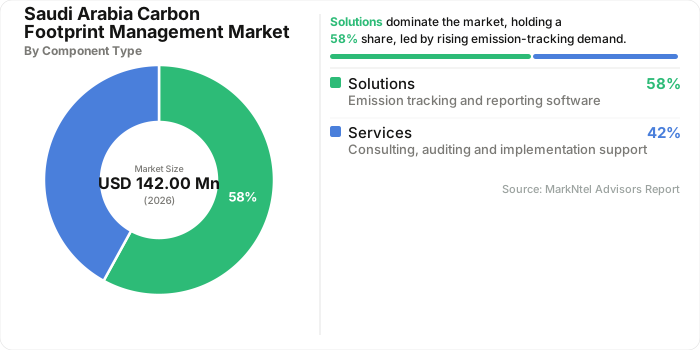
- By component, the Solutions segment leads the market with a 58% share.
- By organization size, Corporate Enterprises account for the largest 61% market share.
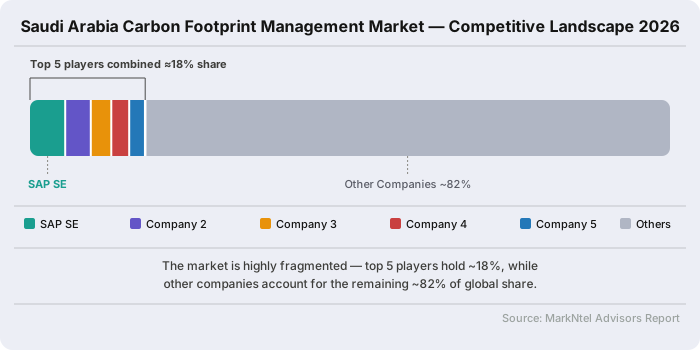
- The market remains fragmented, with the top five players collectively accounting for approximately 18% of the total market share.
Saudi Arabia Carbon Footprint Management Market Size and Outlook
The carbon footprint management market in Saudi Arabia was valued at USD 123 million in 2025 and is projected to reach USD 226 million by 2032, expanding at a CAGR of 8.05% from USD 142 million in 2026.
Market expansion is supported by the Kingdom's Second Nationally Determined Contribution (NDC), submitted to the UNFCCC in December 2025, which commits to reducing, avoiding, or removing 335 million tonnes of CO₂ equivalent annually by 2040 compared with 2019 levels. Achieving this target requires organizations to quantify emissions accurately, strengthening the adoption of carbon footprint management platforms across major economic sectors.
Industrial enterprises represent the largest adopters as Saudi Arabia integrates decarbonization into large-scale energy and manufacturing projects. In December 2024, Saudi Aramco, together with Linde and SLB, signed a shareholders' agreement to develop a carbon capture and storage hub in Jubail Industrial City with a planned first-phase capture capacity of 9 million tonnes of CO₂ per year from three Aramco gas plants. Operating infrastructure of this scale requires continuous emissions quantification, performance validation, and digital carbon data management, supporting long-term deployment of specialized carbon management solutions.
Industrial diversification is further broadening the addressable market. According to the Ministry of Industry and Mineral Resources, Saudi Arabia issued 1,660 industrial licenses in 2025, increasing the total number of operational factories to 12,946. Meanwhile, the Greenhouse Gas Crediting and Offsetting Mechanism (GCOM), introduced in 2024, established a national framework for registering emission-reduction projects and issuing verified carbon credits. The expansion of industrial facilities alongside standardized carbon credit mechanisms is increasing the need for consistent emissions quantification and transparent environmental reporting across production sites.
Corporate sustainability reporting is also becoming an important growth catalyst. The Capital Market Authority implemented its Guidelines for Issuing Green, Social, Sustainable, and Sustainability-Linked Debt Instruments on May 27, 2025, strengthening sustainability disclosure expectations within Saudi capital markets. At the same time, the number of listed companies publishing sustainability reports increased to 94 in 2024, up from 81 in 2023. As ESG reporting becomes increasingly integrated with financing and investor decision-making, organizations are expected to invest further in digital carbon footprint management systems that improve data accuracy, regulatory compliance, and disclosure quality.
Saudi Arabia Carbon Footprint Management Market Key Indicators
- According to the General Authority for Statistics (GASTAT), Saudi Arabia's operational renewable energy capacity reached 6,551 MW by the end of 2024. As renewable power generation expands, utilities and project developers are increasingly required to measure and verify avoided greenhouse gas emissions to meet regulatory reporting requirements, strengthen ESG disclosures, and enhance transparency for investors and other stakeholders.
- According to GASTAT, industrial sector waste rose to 26.7 million tonnes in 2024 from 22.1 million tonnes in 2023, while manufacturing activities generated 68.6% of industrial waste. As industrial waste becomes a larger source of environmental impact, manufacturers are increasingly adopting carbon footprint management solutions to quantify waste-related emissions, improve ESG disclosures , and support compliance with the Kingdom's emerging climate and sustainability policies.
- According to GASTAT, Saudi Arabia's Industrial Production Index (IPI) increased by 5.1% in 2025 compared with 2024, supported by growth in mining and quarrying, manufacturing, and electricity, gas, and water supply activities. The expansion of these carbon-intensive industries is increasing the number of facilities requiring greenhouse gas inventories, carbon accounting, and emissions management solutions to support regulatory compliance and sustainability reporting.
Saudi Arabia Carbon Footprint Management Market Scope
| Category | Segments |
|---|---|
| By Component | Solutions, Services (Consulting, Integration & Deployment, Support & Maintenance)), |
| By Deployment Mode | Cloud, On-Premises |
| By Organization Size | Corporate Enterprises, Mid-Tier Enterprises, Small Businesses |
| By Vertical | Manufacturing (Food & Beverages, Metals & Mining, Chemical & Materials, Electronics & Consumer Goods, Automotive, Pharmaceutical & Healthcare, Others), Energy & Utilities, Residential & Commercial Buildings, Transportation & Logistics, IT & Telecom, Financial Services, Government |
Saudi Arabia Carbon Footprint Management Market Growth Drivers
Heavy Industry and Oil & Gas Decarbonization Driving Adoption of Carbon Footprint Management Solutions
Saudi Arabia's transition toward industrial decarbonization is transforming carbon footprint management from a voluntary sustainability practice into an operational requirement across heavy industries. As the Kingdom advances its net-zero ambitions while expanding manufacturing and energy production under Vision 2030, industrial operators are increasingly required to quantify emissions accurately, establish reliable greenhouse gas inventories, and demonstrate measurable decarbonization progress. This shift is positioning heavy industry and the oil & gas sector as the largest adopters of enterprise carbon footprint management solutions.
A significant step in this transition came in January 2025, when King Abdullah University of Science and Technology (KAUST) launched the Future Cement Initiative in collaboration with the Public Investment Fund (PIF), the Ministry of Industry and Mineral Resources, and the National Committee for Cement Companies to accelerate decarbonization across Saudi Arabia's cement industry. The initiative targets a sector with approximately 85 million tonnes of annual cement production capacity, contributing nearly USD 3.7 billion to the national economy and supporting around 15,000 job s.
Since nearly 60% of cement-sector emissions originate from clinker production, they cannot be eliminated solely through renewable electricity, making continuous process-level emissions measurement essential. As similar decarbonization programs expand across other energy-intensive industries, investment in advanced carbon footprint management platforms is expected to accelerate to support emissions monitoring, regulatory compliance, and long-term operational efficiency.
Recent Trends
Commercial Deployment of Direct Air Capture Technologies Reshaping Carbon Footprint Management
Saudi Arabia's carbon footprint management market is evolving beyond conventional emissions reporting as the Kingdom begins deploying advanced carbon removal technologies. The commercialization of Direct Air Capture (DAC) is creating a new layer of demand for high-precision carbon monitoring, requiring organizations to measure, verify, and document captured carbon dioxide throughout the project lifecycle. Unlike traditional corporate carbon accounting, DAC facilities depend on continuous performance validation to demonstrate capture efficiency, operational reliability, and environmental integrity.
A major milestone was achieved on 2025, when Saudi Aramco, in collaboration with Siemens Energy, commissioned Saudi Arabia's first Direct Air Capture (DAC) test unit in Dhahran. The 12-tonne-per-year pilot facility is designed to evaluate next-generation CO₂ capture materials under Saudi climatic conditions while identifying cost-effective pathways for future commercial deployment. The project also establishes the technical foundation for scaling carbon removal infrastructure across the Kingdom.
As DAC projects progress from pilot facilities to commercial-scale deployment, the need for continuous measurement, reporting, and verification (MRV) will become increasingly critical. Saudi Aramco and Siemens Energy have confirmed their intention to jointly advance larger-scale DAC solutions based on pilot outcomes. This transition is expected to expand the role of carbon footprint management platforms from enterprise emissions reporting to technology-specific carbon verification, creating a new and sustained avenue for market growth.
Saudi Arabia Carbon Footprint Management Market Opportunities and Challenges
Fragmented Scope 3 Emissions Data Across Industrial Supply Chains Restricting Enterprise-Wide Carbon Accounting
As Saudi Arabia accelerates industrial localization under Vision 2030, large enterprises are facing increasing challenges in capturing standardized emissions data across their extended supply chains. While organizations can accurately measure emissions generated from their own operations, obtaining consistent carbon data from thousands of suppliers, contractors, and logistics partners remains difficult because reporting capabilities, methodologies, and digital maturity vary significantly across the industrial ecosystem. This fragmentation limits the development of comprehensive enterprise-wide greenhouse gas inventories and reduces the reliability of sustainability disclosures.
The scale of this challenge is increasing as industrial supply chains continue to expand. Saudi Aramco's In-Kingdom Total Value Add (IKTVA) program achieved 70% localization in 2025, progressing toward its 75% target by 2030 , substantially increasing the number of domestic suppliers participating in its value chain. Recognizing the need for stronger sustainability capabilities, Aramco's Sustainability Fund has committed USD 639 million since inception, including USD 139 million in 2025, across more than 40 sustainability-focused startups.
These investments highlight a growing market opportunity for digital Measurement , Reporting, and Verification (MRV) platforms and enterprise carbon management solutions that can automate supplier emissions collection, standardize Scope 3 reporting, and improve the accuracy of corporate carbon accounting as Saudi Arabia's industrial ecosystem continues to mature.
Segmentation Insights
Solutions Lead the Component Segment as Enterprises Shift Toward Carbon Management Software Platforms
The Solutions segment accounts for approximately 58% of the Saudi Arabia carbon footprint management industry by component, driven by the increasing adoption of software platforms that enable enterprises to measure, monitor, and disclose greenhouse gas emissions. Organizations are prioritizing integrated carbon management solutions before investing in consulting or implementation services, as digital platforms form the foundation of long-term ESG and decarbonization strategies.
A key example is the collaboration between SAP and Saudi Investment Recycling Company (SIRC). Following an MoU signed in April 2024, SIRC became the first organization in Saudi Arabia to deploy SAP Sustainability Control Tower in December 2024, enabling enterprise-wide carbon footprint tracking, ESG reporting, regulatory disclosures, and supporting the development of future domestic carbon credit mechanisms. The market is further supported by Schneider Electric, which signed multiple strategic MoUs in 2025 to expand Eco Struxure-based digital energy and emissions management solutions across the Kingdom.
In addition, SAP's 2025 Sapphire release introduced AI-powered enhancements to Sustainability Footprint Management, improving automated emissions accounting and reporting. Meanwhile, the Aramco–SLB–Linde carbon capture project in Jubail is accelerating demand for advanced monitoring, reporting, verification (MRV), and carbon accounting software. As Saudi enterprises strengthen ESG compliance and digital sustainability initiatives, integrated software solutions are expected to remain the primary growth engine of the component market, while consulting and support services continue to expand around these platforms. By component, the market is further segmented into the following sub-categories:
- Solutions
- Services
Corporate Enterprises Dominate the Organization Size Segment as Large Emitters Drive Carbon Management Adoption
Corporate enterprises account for approximately 61% of the Saudi Arabia carbon footprint management industry by organization size, primarily due to their large emissions footprint, complex Scope 3 value chains, and increasing sustainability disclosure obligations. Organizations operating in sectors such as energy, petrochemicals, telecommunications, manufacturing, and infrastructure require enterprise-wide carbon management platforms to measure, monitor, and report emissions across multiple business units and supplier networks. Their larger budgets and dedicated ESG teams further accelerate the adoption of advanced carbon management solutions.
A notable example is stc Group, which has committed to achieving net-zero emissions by 2050 across scope 1, 2, and 3 emissions. The company has also secured Science Based Targets initiative (SBTi) validation for its near-term climate targets, including a 50% reduction in absolute Scope 1 and 2 emissions, supported by a comprehensive group-wide climate roadmap. Large enterprises are also driving demand for carbon credit and offset management.
For instance, in 2025, ENOWA, NEOM's energy and water company, signed a long-term agreement with the Voluntary Carbon Market Company (VCM) to procure at least 30 million tonnes of high-integrity carbon credits by 2030, reinforcing the need for robust carbon accounting and emissions tracking systems. While adoption among SMEs is steadily increasing, corporate enterprises remain the primary revenue contributors owing to their greater regulatory responsibilities, large-scale sustainability investments, and enterprise-wide decarbonization initiatives. By the organization size the market is further segmented into the following sub-categories:
- Corporate Enterprises
- Mid-Tier Enterprises
- Small Businesses
Saudi Arabia Carbon Footprint Management Market Competitive Landscape
The Saudi Arabia carbon footprint management industry is fragmented, with the top five companies, SAP SE, IBM Corporation, Schneider Electric SE, Microsoft Corporation, and Salesforce, Inc., collectively accounting for approximately 18% of the total market share.
Major Companies in the Saudi Arabia Carbon Footprint Management Market
- SAP SE
- IBM Corporation
- Schneider Electric SE
- Microsoft Corporation
- Salesforce, Inc.
- ENGIE SA
- Wolters Kluwer N.V. (Enablon)
- IsoMetrix
- ProcessMAP Corporation
- Dakota Software Corporation
Saudi Arabia Carbon Footprint Management Industry News and Recent Developments
2025: ENOWA Signs Long-Term Carbon Credit Agreement with Voluntary Carbon Market Company (VCM)
In June 2025, ENOWA, NEOM's energy and water subsidiary, signed a long-term agreement with the Voluntary Carbon Market Company (VCM) to secure the delivery of more than 30 million tonnes of high-integrity carbon credits by 2030. The agreement will enable ENOWA to offset its operational emissions while supporting NEOM's renewable energy development. Carbon credits will be sourced from verified global climate projects through Saudi Arabia's voluntary carbon market platform, strengthening the Kingdom's carbon trading ecosystem and supporting its net-zero ambitions.
Market Impact Analysis: The agreement represents one of the largest long-term carbon credit procurement commitments in Saudi Arabia, accelerating the maturity of the Kingdom's voluntary carbon market. As organizations increasingly participate in carbon credit trading and emissions offsetting, demand for carbon footprint management platforms, carbon accounting software, and MRV (Monitoring, Reporting, and Verification) solutions is expected to grow. The deal also reinforces Saudi Arabia's position as a regional hub for carbon market infrastructure and enterprise decarbonization initiatives.
2025: ACWA Power-Led Consortium Signs USD 8.3 Billion Agreements for 15 GW Renewable Energy Projects
In July 2025, an ACWA Power-led consortium, comprising Badeel (a Public Investment Fund company) and Aramco Power, signed agreements worth SR31 billion (USD 8.3 billion) to develop seven renewable energy projects with a combined capacity of 15 GW under Saudi Arabia's National Renewable Energy Program (NREP ). The portfolio includes five solar photovoltaic projects and two wind farms, making it the largest single-phase renewable energy capacity signed globally. The projects support Saudi Arabia's Vision 2030 target of increasing renewable energy generation and reducing carbon emissions.
Market Impact Analysis: Although primarily a renewable energy investment, the projects are expected to accelerate demand for carbon footprint management solutions by increasing the need for enterprise carbon accounting, emissions monitoring, renewable energy certificate (REC) tracking, and ESG reporting. As utilities and industrial organizations integrate renewable power into their operations, digital carbon management platforms will play a critical role in measuring emissions reductions, supporting sustainability disclosures, and ensuring compliance with evolving climate reporting requirements.
2025: RVCMC Launches Saudi Arabia's First Voluntary Carbon Credit Exchange Platform
In June 2025, the Regional Voluntary Carbon Market Company (RVCMC) launched Saudi Arabia's first institutional-grade Voluntary Carbon Credit Exchange Platform, developed using Xpansiv's trading infrastructure. The platform enables spot trading, automated settlement, and transparent price discovery for verified carbon credits, providing organizations with a centralized marketplace to buy and sell voluntary carbon offsets.
Market Impact Analysis: The launch represents a significant milestone in the Kingdom's carbon market development, creating a structured ecosystem for carbon credit transactions. As more organizations participate in voluntary carbon markets, demand for carbon footprint management software, emissions monitoring, and MRV (Monitoring, Reporting, and Verification) solutions is expected to increase to support accurate carbon accounting and reporting.
2025: Saudi Net Zero Partners with IUCN to Advance Nature-Based Carbon Solutions
In May 2025, Saudi Net Zero, a Public Investment Fund (PIF)-backed climate platform, entered into a strategic partnership with the International Union for Conservation of Nature (IUCN) to strengthen Saudi Arabia's climate innovation ecosystem. The collaboration focuses on supporting climate-tech startups, developing high-integrity nature-based carbon offset projects, and applying internationally recognized methodologies to validate carbon sequestration and biodiversity outcomes. The initiative aims to improve the credibility and scalability of carbon offset projects while advancing the Kingdom's sustainability and net-zero objectives.
Market Impact Analysis: The partnership is expected to strengthen Saudi Arabia's carbon footprint management ecosystem by improving the availability of verified carbon offsets and promoting standardized carbon accounting practices. As enterprises increasingly incorporate nature-based offsets into their decarbonization strategies, demand for carbon management platforms capable of tracking emissions, managing offset portfolios, and supporting ESG reporting is expected to increase, creating new opportunities for carbon footprint management solution providers.
Frequently Asked Questions
- Market Segmentation
- Introduction
- Product Definition
- Research Process
- Assumptions
- Executive Summary
- Saudi Arabia Carbon Footprint Management Market Policies, Regulations, and Product Standards
- Saudi Arabia Carbon Footprint Management Market Trends & Developments
- Saudi Arabia Carbon Footprint Management Market Dynamics
- Growth Factors
- Challenges
- Saudi Arabia Carbon Footprint Management Market Hotspot & Opportunities
- Saudi Arabia Carbon Footprint Management Market Outlook, 2022-2032
- Market Size & Outlook
- By Revenues (USD Million)
- Market Share & Outlook
- By Component- Market Size & Forecast 2022-2032, USD Million
- Solutions
- Services
- Consulting
- Integration & Deployment
- Support & Maintenance
- By Deployment Mode- Market Size & Forecast 2022-2032, USD Million
- Cloud
- On-Premises
- By Organization Size- Market Size & Forecast 2022-2032, USD Million
- Corporate Enterprises
- Mid-Tier Enterprises
- Small Businesses
- By Vertical- Market Size & Forecast 2022-2032, USD Million
- Manufacturing
- Food & Beverages
- Metals & Mining
- Chemical & Materials
- Electronics & Consumer Goods
- Automotive
- Pharmaceutical & Healthcare
- Others
- Energy & Utilities
- Residential & Commercial Buildings
- Transportation & Logistics
- IT & Telecom
- Financial Services
- Government
- Manufacturing
- By Region - Market Size & Forecast 2022-2032, USD Million
- North
- South
- East
- West
- Central
- By Company
- Competition Characteristics
- Market Share & Analysis
- By Component- Market Size & Forecast 2022-2032, USD Million
- Market Size & Outlook
- Saudi Arabia Carbon Footprint Management Solutions Market Outlook, 2022-2032
- Market Size & Outlook
- By Revenues (USD Million)
- Market Segmentation & Outlook
- By Deployment Mode- Market Size & Forecast 2022-2032, USD Million
- By Organization Size- Market Size & Forecast 2022-2032, USD Million
- By Vertical- Market Size & Forecast 2022-2032, USD Million
- By Region - Market Size & Forecast 2022-2032, USD Million
- Market Size & Outlook
- Saudi Arabia Carbon Footprint Management Services Market Outlook, 2022-2032
- Market Size & Outlook
- By Revenues (USD Million)
- Market Segmentation & Outlook
- By Deployment Mode- Market Size & Forecast 2022-2032, USD Million
- By Organization Size- Market Size & Forecast 2022-2032, USD Million
- By Vertical- Market Size & Forecast 2022-2032, USD Million
- By Region - Market Size & Forecast 2022-2032, USD Million
- Market Size & Outlook
- Saudi Arabia Carbon Footprint Management Market Key Strategic Imperatives for Success & Growth
- Competitive Outlook
- Company Profiles
- SAP SE
- Business Description
- Product Portfolio
- Collaborations & Alliances
- Recent Developments
- Financial Details
- Others
- IBM Corporation
- Business Description
- Product Portfolio
- Collaborations & Alliances
- Recent Developments
- Financial Details
- Others
- Schneider Electric SE
- Business Description
- Product Portfolio
- Collaborations & Alliances
- Recent Developments
- Financial Details
- Others
- Microsoft Corporation
- Business Description
- Product Portfolio
- Collaborations & Alliances
- Recent Developments
- Financial Details
- Others
- Salesforce, Inc.
- Business Description
- Product Portfolio
- Collaborations & Alliances
- Recent Developments
- Financial Details
- Others
- ENGIE SA
- Business Description
- Product Portfolio
- Collaborations & Alliances
- Recent Developments
- Financial Details
- Others
- Wolters Kluwer N.V. (Enablon)
- Business Description
- Product Portfolio
- Collaborations & Alliances
- Recent Developments
- Financial Details
- Others
- IsoMetrix
- Business Description
- Product Portfolio
- Collaborations & Alliances
- Recent Developments
- Financial Details
- Others
- ProcessMAP Corporation
- Business Description
- Product Portfolio
- Collaborations & Alliances
- Recent Developments
- Financial Details
- Others
- Dakota Software Corporation
- Business Description
- Product Portfolio
- Collaborations & Alliances
- Recent Developments
- Financial Details
- Others
- SAP SE
- Company Profiles
- Disclaimer
MarkNtel Advisors follows a robust and iterative research methodology designed to ensure maximum accuracy and minimize deviation in market estimates and forecasts. Our approach combines both bottom-up and top-down techniques to effectively segment and quantify various aspects of the market. A consistent feature across all our research reports is data triangulation, which examines the market from three distinct perspectives to validate findings. Key components of our research process include:
1. Scope & Research Design At the outset, MarkNtel Advisors define the research objectives and formulate pertinent questions. This phase involves determining the type of research—qualitative or quantitative—and designing a methodology that outlines data collection methods, target demographics, and analytical tools. They also establish timelines and budgets to ensure the research aligns with client goals.
2. Sample Selection and Data Collection In this stage, the firm identifies the target audience and determines the appropriate sample size to ensure representativeness. They employ various sampling methods, such as random or stratified sampling, based on the research objectives. Data collection is carried out using tools like surveys, interviews, and observations, ensuring the gathered data is reliable and relevant.
3. Data Analysis and Validation Once data is collected, MarkNtel Advisors undertake a rigorous analysis process. This includes cleaning the data to remove inconsistencies, employing statistical software for quantitative analysis, and thematic analysis for qualitative data. Validation steps are taken to ensure the accuracy and reliability of the findings, minimizing biases and errors.

4. Data Forecast and FinalizationThe final phase involves forecasting future market trends based on the analyzed data. MarkNtel Advisors utilize predictive modeling and time series analysis to anticipate market behaviors. The insights are then compiled into comprehensive reports, featuring visual aids like charts and graphs, and include strategic recommendations to inform client decision-making
We offer flexible licensing options to cater to varying organizational needs. Choose the pricing pack that best suits your requirements:
Buy Now Inquire Before Buying
 Request Customization
 Talk to our Consultant