

US Regtech Market Research Report: Forecast (2026-2032)
US Regtech Market - By Product Type (Risk & Compliance Management, Regulatory Reporting, AML & Fraud Management, Identity Management/KYC, Regulatory Intelligence, Transaction Monit ... oring, Others (Data Privacy, ESG Reporting), By Component (Solution, Services), By Deployment Model (Cloud-based, On-premises), By Enterprise Size (Large Enterprises, SMEs), By Technology (Artificial Intelligence & Machine Learning, Cloud Computing & APIs, Big Data & Analytics, Blockchain & Distributed Ledger), By End User (BFSI, FinTech, Telecom & IT, Energy & Utilities, Healthcare, Government), and others Read more
- ICT & Electronics
- Jan 2026
- Pages 135
- Report Format: PDF, Excel, PPT
US Regtech Market
Projected 10.14% CAGR from 2026 to 2032
Study Period
2026-2032
Market Size (2025)
USD 6.72 Billion
Market Size (2032)
USD 13.21 Billion
Base Year
2025
Projected CAGR
10.14%
Leading Segments
By End-User: BFSI
US Regtech Market Report Key Takeaways:
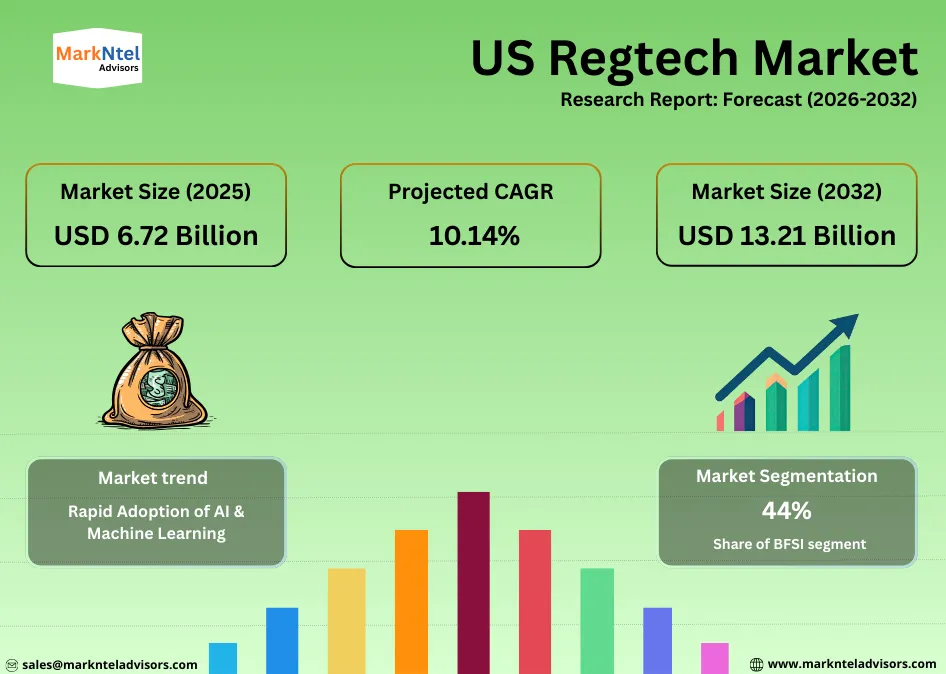
- Market size was valued at around USD6.72 billion in 2025 and is projected to reach USD13.21 billion by 2032. The estimated CAGR from 2026 to 2032 is around 10.14%, indicating strong growth.
- The West region is dominating the US Regtech Market with a substantial market share in 2025.
- By Component, the services segment represented a significant share of about 52% in the US Regtech Market in 2025.
- By Enterprise Size, the large enterprise segment represented a significant share of about 54% in the US Regtech Market in 2025.
- By End-User, the BFSI industry holds the largest market share of about 44% of the US Regtech Market in 2025.
- Leading Regtech companies in the US are Alloy, Regology, Oversight Systems, Trunomi, TransparINT, Tradle, Rsam, RegSmart, OneTrust, RegEd, Forter, Jumio, Boston, Hummingbird, Continuity, and Others.
Market Insights & Analysis: US Regtech Market (2026-32):
The US Regtech Market size was valued at around USD6.72 billion in 2025 and is projected to reach USD13.21 billion by 2032. Along with this, the market is estimated to grow at a CAGR of around 10.14% during the forecast period, i.e., 2026-32.
The U.S. RegTech Market is increasingly shaped by the scale and regulatory intensity of its end-use industries, like the BFSI, Healthcare, IT & Telecom, etc. The BFSI sector remains the dominant adopter due to the size of the U.S. banking system and the volume of regulated activity it generates. For instance, the Federal Deposit Insurance Corporation reported over 4,100 FDIC-insured commercial banks operating in the U.S. in 2024, each subject to continuous AML, consumer-protection, and cybersecurity supervision, driving sustained demand for automated compliance platforms.
Similarly, FinTech firms are emerging as fast-growing RegTech users as regulators expand oversight of non-bank financial institutions. The Consumer Financial Protection Bureau confirmed that it now supervises thousands of non-bank entities, including payment apps, digital lenders, and BNPL providers, pushing these firms to adopt bank-grade compliance, monitoring, and reporting technologies.
Beyond finance, Telecom & IT companies face growing regulatory exposure tied to data protection and cybersecurity. According to the Federal Trade Commission, data security and privacy violations consistently rank among the most frequent enforcement actions, encouraging large technology operators to deploy automated governance, risk, and audit-tracking solutions.
Likewise, Energy & Utilities are adopting RegTech as cybersecurity oversight tightens. The U.S. Department of Energy has expanded mandatory cyber-incident reporting for critical infrastructure operators, increasing reliance on compliance automation and incident-response documentation tools.
In Healthcare, regulatory pressure is also intensifying. The U.S. Department of Health and Human Services reported over 130 million healthcare records exposed in data breaches during recent years, accelerating the adoption of compliance and risk-management platforms across hospitals and insurers.
Finally, government agencies themselves are becoming RegTech users as they modernize supervision, reporting, and enforcement systems. Together, these sector-level pressures show that U.S. RegTech growth is no longer finance-only but driven by economy-wide regulatory digitalization, reinforcing a strong and durable market outlook.
US Regtech Market Recent Developments:
- 2024: Alloy introduced AI-driven compliance tools, including perpetual KYC 2024. This development enhanced real-time customer identity verification and automated risk checks, helping US financial firms improve compliance efficiency and reduce fraud risks.
- 2025: OneTrust launched Data Use Governance to automate data policy enforcement for AI-ready data. Later in 2025, it introduced AI Agents to simplify governance, risk, and privacy compliance for U.S. organizations.
US Regtech Market Scope:
| Category | Segments |
|---|---|
| By Product Type | Risk & Compliance Management, Regulatory Reporting, AML & Fraud Management, Identity Management/KYC, Regulatory Intelligence, Transaction Monitoring, Others (Data Privacy, ESG Reporting |
| By Component | Solution, Services |
| By Deployment Model | Cloud-based, On-premises |
| By Enterprise Size | Large Enterprises, SMEs |
| By Technology | Artificial Intelligence & Machine Learning, Cloud Computing & APIs, Big Data & Analytics, Blockchain & Distributed Ledger |
| By End User | BFSI, FinTech, Telecom & IT, Energy & Utilities, Healthcare, Government), and others |
US Regtech Market Driver:
Rising Regulatory Complexities & Strict Enforcement
Rising regulatory complexity and strict enforcement continue to be the primary drivers of the U.S. RegTech market, as compliance obligations expand in volume, depth, and reporting intensity. For reference, as per the U.S. Treasury, FinCEN received over 4.6 million Suspicious Activity Reports (SARs) in 2023, reflecting the scale and reporting burden placed on banks. Processing, reviewing, and filing these reports manually is increasingly impractical, driving adoption of RegTech platforms that automate monitoring and reporting workflows.
Additionally, U.S. regulators are raising expectations around documentation and evidence. Banking supervisors now require institutions to demonstrate the ongoing effectiveness of controls, not just policy existence, during examinations. This has increased demand for RegTech tools that provide real-time dashboards, audit trails, and regulatory-ready evidence. Consequently, hundreds of regtech firms are headquartered in the US, driving the market growth.
US Regtech Market Trend:
Rapid Adoption of AI & Machine Learning
The U.S. RegTech market is witnessing rapid adoption of artificial intelligence (AI) and machine learning (ML) as compliance obligations grow more complex and data-intensive. Financial institutions now process millions of transactions daily, making traditional rule-based compliance systems insufficient. As a result, AI-driven RegTech tools are increasingly used to analyze large datasets in real time, identify abnormal patterns, and dynamically update customer risk profiles.
This shift is clearly visible among U.S.-based RegTech innovators. For instance, Arva AI, founded in San Francisco, raised USD3 million in seed funding in 2025 to develop AI-powered AML and KYB solutions. Its platform uses machine learning to automate document verification and risk assessment, reflecting growing investor confidence in AI-centric compliance models.
Similarly, established platforms are embedding AI more deeply into governance workflows. OneTrust introduced AI-driven agents and automated governance tools in 2025 to support breach response, data-use governance, and compliance reporting. These tools help U.S. organizations interpret regulatory requirements faster and reduce manual intervention.
US Regtech Market Challenges:
Cybersecurity and Regulatory Data Breach Exposure
Cybersecurity is a critical challenge in the U.S. RegTech market because RegTech platforms manage highly sensitive financial, identity, and compliance data for regulated institutions. A breach at the RegTech layer can quickly escalate into a regulatory and legal issue for both vendors and their clients.
Additionally, cyber threat levels further amplify this challenge. The Federal Bureau of Investigation reported over 859,000 cybercrime complaints in 2024, with losses of approximately USD16.6 billion, highlighting the growing exposure of cloud-based compliance platforms.
Moreover, regulatory enforcement reinforces the stakes. The Equifax data breach settlement, totaling USD575–700 million, illustrates the scale of financial and reputational damage linked to inadequate data protection. In addition, U.S. banking supervisors require strict third-party risk management, meaning a RegTech breach can directly affect a bank’s regulatory standing. Consequently, U.S. RegTech firms must prioritize advanced security controls, increasing costs and slowing innovation.
US Regtech Market (2026-32) Segmentation Analysis:
The US Regtech Market Report and Forecast 2026-2032 offers a detailed analysis of the market based on the following segments:
Based on Component:
-
- Solution
- Services
In the U.S. Regulatory Technology (RegTech) Market, services dominate, holding around 52% market share because organizations across industries face continuously changing rules that require expert interpretation, tailored implementation, and ongoing oversight rather than one-time software purchases. For instance, U.S. consumers lost more than USD10 billion to fraud in 2023, and companies responding to that environment increasingly rely on managed monitoring and advisory services to adapt their systems and respond to incidents in real time rather than just buying point-software products.
Similarly, enforcement activity by the HHS Office for Civil Rights has produced multiple six-figure HIPAA settlements (like a USD950,000 resolution in 2024), which pushes healthcare and life-science firms to invest in continuous compliance support and expert remediation services alongside technology. These factors are contributing to the dominance of the services segment in this market.
Based on the End-User:
- BFSI
- FinTech
- Telecom & IT
- Energy & Utilities
- Healthcare
- Government
The BFSI segment dominates the U.S. RegTech market with a market share of about 44% because financial institutions face some of the most complex and high-stakes regulatory compliance demands compared with other industries. For instance, U.S. banking and financial firms must comply with thousands of overlapping federal, state, and securities rules, and regulators like the Financial Industry Regulatory Authority (FINRA) oversee over 600,000 registered securities representatives and nearly 3,400 brokerage firms in the U.S., showing how broad and regulated this space is.
These compliance pressures drive BFSI firms to invest heavily in automated compliance, reporting, and risk monitoring technologies to avoid costly penalties and operational disruption. Moreover, as fraud, money laundering, and financial crime risks grow more sophisticated, RegTech solutions are increasingly essential in BFSI for anti-money-laundering (AML), Know-Your-Customer (KYC), and real-time transaction monitoring functions, tasks that financial regulators in the U.S. require financial firms to perform diligently.
Because these requirements are expensive and continually evolving, BFSI organizations are the largest adopters of RegTech tools compared with non-financial sectors. Their compliance budgets and regulatory scrutiny levels are much higher, so they contribute disproportionately to RegTech spending and innovation in the United States relative to other industries.
US Regtech Market (2026-32): Regional Projection
The West region of the United States, led overwhelmingly by California, represents the core innovation and adoption hub of the US Regtech Market. This leadership is driven by the region’s dense concentration of fintech startups, AI engineering talent, and proximity to complex state-level regulatory enforcement. For instance, California-headquartered firms accounted for around 31% of all U.S. RegTech deals in 2024, completing more than 90 RegTech transactions, the highest share among all U.S. states, underscoring its role as the primary launchpad for compliance-driven technologies.
Additionally, regulatory engagement actively reinforces this ecosystem. The California Department of Financial Protection and Innovation operates an Office of Financial Technology Innovation, which provides regulatory guidance and innovation support to fintech and RegTech firms. For reference, this office was created to enable responsible testing of compliance technologies while maintaining strict consumer-protection oversight, directly influencing how RegTech products are designed and deployed.
Likewise, federal-level infrastructure strengthens regional adoption. The Federal Reserve Bank of San Francisco regularly convenes banks, supervisors, and technology providers through fintech and compliance forums, accelerating real-world validation of RegTech tools in areas such as AML monitoring, identity verification, and reporting automation.
Furthermore, California’s early enforcement of the California Consumer Privacy Act (CCPA) since 2020 has compelled enterprises to adopt automated data-governance, risk, and monitoring solutions earlier than other U.S. regions. Together, sustained deal leadership, regulatory, industry collaboration, and privacy-driven compliance pressure firmly position the West as the dominant RegTech region in the United States.
Gain a Competitive Edge with Our US Regtech Market Report:
- US Regtech Market Report by MarkNtel Advisors provides a detailed & thorough analysis of market size & share, growth rate, competitive landscape, and key players. This comprehensive analysis helps businesses gain a holistic understanding of the market dynamics & make informed decisions.
- This report also highlights current market trends & future projections, allowing businesses to identify emerging opportunities & potential challenges. By understanding market forecasts, companies can align their strategies & stay ahead of the competition.
- US Regtech Market Report aids in assessing & mitigating risks associated with entering or operating in the market. By understanding market dynamics, regulatory frameworks, and potential challenges, businesses can develop strategies to minimize risks & optimize their operations.
*Reports Delivery Format - Market research studies from MarkNtel Advisors are offered in PDF, Excel and PowerPoint formats. Within 24 hours of the payment being successfully received, the report will be sent to your email address.
Frequently Asked Questions
- Market Segmentation
- Introduction
- Product Definition
- Research Process
- Assumptions
- Executive Summary
- US Regtech Market Regulations, Policies & Standards
- Federal AML & Financial-Crime Regulations
- Bank Secrecy Act (BSA)
- USA PATRIOT Act
- AML Act of 2020
- FinCEN AML rules (SAR, CTR, CDD)
- Banking Supervision & Inter-Agency Guidelines
- FFIEC BSA/AML Examination Manual
- Office of the Comptroller of the Currency (OCC) guidance
- Federal Reserve supervisory expectations
- FDIC compliance requirements
- Securities & Capital-Markets Regulations
- SEC compliance and reporting rules
- FINRA AML and market-conduct standards
- CFTC reporting and surveillance requirements
- Reg SCI and record-retention mandates
- Consumer-Protection & Data-Privacy Frameworks
- Consumer Financial Protection Bureau (CFPB) rules
- Gramm-Leach-Bliley Act (GLBA)
- California Consumer Privacy Act (CCPA/CPRA)
- State-level privacy and data-security laws
- Sanctions & Trade-Control Regimes
- OFAC sanctions compliance
- SDN list screening requirements
- Export-control obligations (BIS)
- Corporate Transparency & Beneficial-Ownership Rules
- Corporate Transparency Act (CTA)
- FinCEN Beneficial Ownership Information (BOI) reporting
- Legal-entity identification requirements
- Cybersecurity & Information-Security Standards
- NIST Cybersecurity Framework (CSF)
- ISO/IEC 27001 standards
- SOC 1 / SOC 2 controls
- PCI-DSS (where applicable)
- Third-Party & Vendor Risk Management
- Regulatory outsourcing guidelines
- Vendor due diligence requirements
- Continuous monitoring expectations
- Regulatory Reporting & Data Standards
- XBRL and structured reporting formats
- Record-keeping and audit-trail mandates
- Data-quality and validation standards
- Digital Assets & Crypto-Related Regulations
- FinCEN crypto AML guidance
- Travel Rule applicability to virtual assets
- OFAC enforcement for crypto transactions
- State-Specific & Sector-Specific Regulations
- State banking and financial regulators
- Insurance compliance frameworks
- Healthcare and gaming regulatory overlays
- Industry Standards & Best-Practice Frameworks
- SIFMA guidelines
- FS-ISAC information-sharing standards
- Industry-led compliance benchmarks
- Model Risk, AI Governance & Ethics
- Model Risk Management (SR 11-7) principles
- AI explainability and auditability requirements
- Bias, fairness, and validation standards
- Federal AML & Financial-Crime Regulations
- US Regtech Market Trends & Developments
- US Regtech Market Dynamics
- Growth Drivers
- Challenges
- US Regtech Market Hotspots & Opportunities
- US Regtech Market Outlook, 2022-2032F
- Market Size & Analysis
- By Revenue (USD Million)
- Market Share & Analysis
- By Product Type- (USD Million)
- Risk & Compliance Management
- Regulatory Reporting
- AML & Fraud Management
- Identity Management/KYC
- Regulatory Intelligence
- Transaction Monitoring
- Others (Data Privacy, ESG Reporting)
- By Component- (USD Million)
- Solution
- Services
- By Deployment Model- (USD Million)
- Cloud-based
- On-premises
- By Enterprise Size- (USD Million)
- Large Enterprises
- SMEs
- By Technology- (USD Million)
- Artificial Intelligence & Machine Learning
- Cloud Computing & APIs
- Big Data & Analytics
- Blockchain & Distributed Ledger
- By End User- (USD Million)
- BFSI
- FinTech
- Telecom & IT
- Energy & Utilities
- Healthcare
- Government
- By Region
- Northeast
- South
- West
- Midwest
- By Competitors
- Competition Characteristics
- Market Share & Analysis
- By Product Type- (USD Million)
- Market Size & Analysis
- US Risk & Compliance Management Regtech Market Outlook, 2022-2032F
- Market Size & Analysis
- By Revenue (USD Million)
- Market Share & Analysis
- By Product Type- (USD Million)
- By Component- (USD Million)
- By Deployment Model- (USD Million)
- By Enterprise Size- (USD Million)
- By Technology- (USD Million)
- By End-User- (USD Million)
- Market Size & Analysis
- US Regulatory Reporting Regtech Market Outlook, 2022-2032F
- Market Size & Analysis
- By Revenue (USD Million)
- Market Share & Analysis
- By Product Type- (USD Million)
- By Component- (USD Million)
- By Deployment Model- (USD Million)
- By Enterprise Size- (USD Million)
- By Technology- (USD Million)
- By End-User- (USD Million)
- Market Size & Analysis
- AML & Fraud Management Regtech Market Outlook, 2022-2032F
- Market Size & Analysis
- By Revenue (USD Million)
- Market Share & Analysis
- By Product Type- (USD Million)
- By Component- (USD Million)
- By Deployment Model- (USD Million)
- By Enterprise Size- (USD Million)
- By Technology- (USD Million)
- By End-User- (USD Million)
- Market Size & Analysis
- US Identity Management/KYC Regtech Market Outlook, 2022-2032F
- Market Size & Analysis
- By Revenue (USD Million)
- Market Share & Analysis
- By Product Type- (USD Million)
- By Component- (USD Million)
- By Deployment Model- (USD Million)
- By Enterprise Size- (USD Million)
- By Technology- (USD Million)
- By End-User- (USD Million)
- Market Size & Analysis
- US Regulatory Intelligence Regtech Market Outlook, 2022-2032F
- Market Size & Analysis
- By Revenue (USD Million)
- Market Share & Analysis
- By Product Type- (USD Million)
- By Component- (USD Million)
- By Deployment Model- (USD Million)
- By Enterprise Size- (USD Million)
- By Technology- (USD Million)
- By End-User- (USD Million)
- Market Size & Analysis
- US Transaction Monitoring Regtech Market Outlook, 2022-2032F
- Market Size & Analysis
- By Revenue (USD Million)
- Market Share & Analysis
- By Product Type- (USD Million)
- By Component- (USD Million)
- By Deployment Model- (USD Million)
- By Enterprise Size- (USD Million)
- By Technology- (USD Million)
- By End-User- (USD Million)
- Market Size & Analysis
- US Regtech Market Key Strategic Imperatives for Growth & Success
- Competitive Outlook
- Company Profiles
- Alloy
- Business Description
- Product Portfolio
- Strategic Alliances or Partnerships
- Recent Developments
- Financial Details
- Others
- Regology
- Business Description
- Product Portfolio
- Strategic Alliances or Partnerships
- Recent Developments
- Financial Details
- Others
- Oversight Systems
- Business Description
- Product Portfolio
- Strategic Alliances or Partnerships
- Recent Developments
- Financial Details
- Others
- Trunomi
- Business Description
- Product Portfolio
- Strategic Alliances or Partnerships
- Recent Developments
- Financial Details
- Others
- TransparINT
- Business Description
- Product Portfolio
- Strategic Alliances or Partnerships
- Recent Developments
- Financial Details
- Others
- Tradle
- Business Description
- Product Portfolio
- Strategic Alliances or Partnerships
- Recent Developments
- Financial Details
- Others
- Rsam
- Business Description
- Product Portfolio
- Strategic Alliances or Partnerships
- Recent Developments
- Financial Details
- Others
- RegSmart
- Business Description
- Product Portfolio
- Strategic Alliances or Partnerships
- Recent Developments
- Financial Details
- Others
- OneTrust
- Business Description
- Product Portfolio
- Strategic Alliances or Partnerships
- Recent Developments
- Financial Details
- Others
- RegEd
- Business Description
- Product Portfolio
- Strategic Alliances or Partnerships
- Recent Developments
- Financial Details
- Others
- Forter
- Business Description
- Product Portfolio
- Strategic Alliances or Partnerships
- Recent Developments
- Financial Details
- Others
- Jumio
- Business Description
- Product Portfolio
- Strategic Alliances or Partnerships
- Recent Developments
- Financial Details
- Others
- Boston
- Business Description
- Product Portfolio
- Strategic Alliances or Partnerships
- Recent Developments
- Financial Details
- Others
- Hummingbird
- Business Description
- Product Portfolio
- Strategic Alliances or Partnerships
- Recent Developments
- Financial Details
- Others
- Continuity
- Business Description
- Product Portfolio
- Strategic Alliances or Partnerships
- Recent Developments
- Financial Details
- Others
- Others
- Alloy
- Company Profiles
- Disclaimer
MarkNtel Advisors follows a robust and iterative research methodology designed to ensure maximum accuracy and minimize deviation in market estimates and forecasts. Our approach combines both bottom-up and top-down techniques to effectively segment and quantify various aspects of the market. A consistent feature across all our research reports is data triangulation, which examines the market from three distinct perspectives to validate findings. Key components of our research process include:
1. Scope & Research Design At the outset, MarkNtel Advisors define the research objectives and formulate pertinent questions. This phase involves determining the type of research—qualitative or quantitative—and designing a methodology that outlines data collection methods, target demographics, and analytical tools. They also establish timelines and budgets to ensure the research aligns with client goals.
2. Sample Selection and Data Collection In this stage, the firm identifies the target audience and determines the appropriate sample size to ensure representativeness. They employ various sampling methods, such as random or stratified sampling, based on the research objectives. Data collection is carried out using tools like surveys, interviews, and observations, ensuring the gathered data is reliable and relevant.
3. Data Analysis and Validation Once data is collected, MarkNtel Advisors undertake a rigorous analysis process. This includes cleaning the data to remove inconsistencies, employing statistical software for quantitative analysis, and thematic analysis for qualitative data. Validation steps are taken to ensure the accuracy and reliability of the findings, minimizing biases and errors.

4. Data Forecast and FinalizationThe final phase involves forecasting future market trends based on the analyzed data. MarkNtel Advisors utilize predictive modeling and time series analysis to anticipate market behaviors. The insights are then compiled into comprehensive reports, featuring visual aids like charts and graphs, and include strategic recommendations to inform client decision-making
We offer flexible licensing options to cater to varying organizational needs. Choose the pricing pack that best suits your requirements:
Buy Now Inquire Before Buying
 Request Customization
 Talk to our Consultant







