

Qatar Greenhouse Market Research Report: Growth Drivers & Forecast (2026-2032)
By Greenhouse Structure Type (Free-Standing Greenhouse, Gutter-Connected Greenhouse), By Production Model (Hydroponic Greenhouses, Soil-Based Greenhouses, Vertical Farming Systems, ... Organic Greenhouses), By Material (Plastic (Polyethylene, Polycarbonate, Polymethyl Methacrylate (PMMA)), Glass (Horticulture, Others)), By Technology (Climate-Controlled Greenhouses, Automated / Smart Greenhouses), By Energy Source (Conventional Energy-Powered, Solar-Powered), By Crop Type (Fruits & Vegetables, Flowers & Ornamentals, Nursery Crops, Others), By End User (Commercial Growers, Government & Institutional Farms, Research & Educational Institutes, Household / Small-Scale Growers, Others), and others Read more
- Environment
- Feb 2026
- Pages 125
- Report Format: PDF, Excel, PPT
Qatar Greenhouse Market
Projected 9% CAGR from 2026 to 2032
Study Period
2026-2032
Market Size (2026)
USD 89 Million
Market Size (2032)
USD 137 Million
Base Year
2025
Projected CAGR
9%
Leading Segments
By End User: Commercial Growers
Qatar Greenhouse Market Report Key Takeaways:
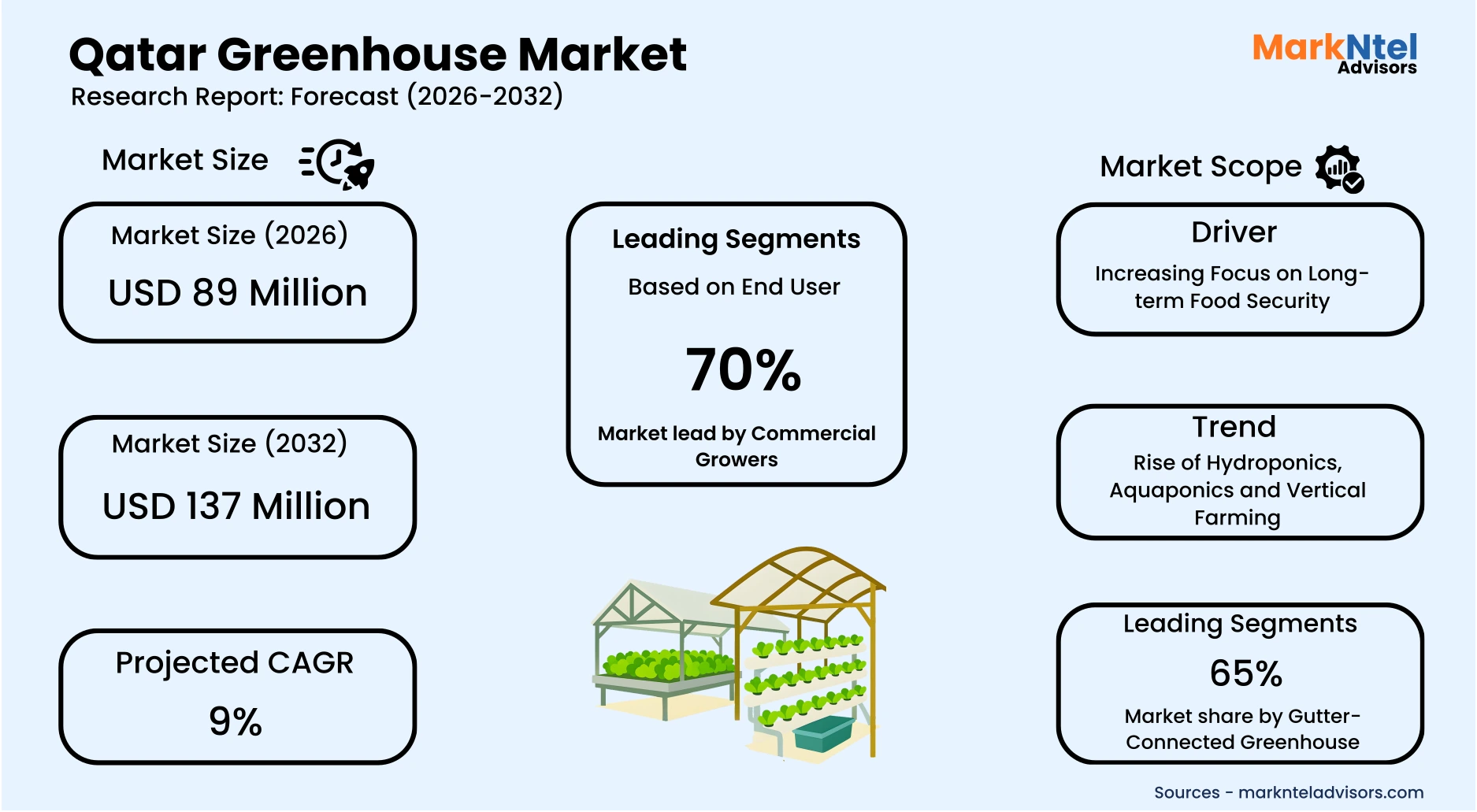
- Market size is estimated at USD 89 million in 2026 and is projected to reach USD 137 million by 2032. The estimated CAGR from 2026 to 2032 is around 9%, indicating strong growth.
- By greenhouse structure type, the gutter-connected greenhouse segment represented a significant share of about 65% in the Qatar Greenhouse Market in 2026.
- By end user, the commercial growers segment presented a significant share of about 70% in the Qatar Greenhouse Market in 2026.
- Leading greenhouse companies in the Qatar Market are Hassad Food Company Q.P.S.C., Baladna Q.P.S.C., Agrico Agricultural Development Company W.L.L., Qatarat Agricultural Development Company, Zulal Oasis, Al Sulaiteen Agricultural & Industrial Complex, Safwa Agricultural Farm, Qatar Greenhouses Company W.L.L., Pergola Contracting & Greenhouses W.L.L., Horizon Doha Trading & Contracting W.L.L., Al Dafna Greenhouse W.L.L., Naas Trading & Contracting Co. W.L.L., Elite Agro LLC, and Others.
Market Insights & Analysis: Qatar Greenhouse Market (2026-32):
The Qatar Greenhouse Market size is estimated at USD 89 million in 2026 and is projected to reach USD 137 million by 2032. Along with this, the market is estimated to grow at a CAGR of around 9% during the forecast period, i.e., 2026-32.
The Qatar Greenhouse Market is projected to expand steadily, driven by strong national food security initiatives, import substitution efforts, and the increasing adoption of hydroponics, aquaponics, and vertical farming technologies across the country.
The country’s arid climate and limited arable land have positioned greenhouse farming as a strategic solution for ensuring consistent domestic food production. As a result, national policies are increasingly focused on expanding advanced agricultural infrastructure and improving local supply resilience.
A key growth catalyst is Qatar’s objective to achieve 55% self-sufficiency in vegetables by 2030, reflecting a broader strategy to reduce reliance on imports and strengthen national food resilience. The roadmap also targets 30% self-sufficiency in red meat and 80% in fish, while maintaining 100% self-sufficiency in dairy and fresh poultry. These ambitions build on the expansion of the country’s agricultural base, with more than 950 productive farms now operating nationwide and organic farming land doubling in recent years .
Meanwhile, in 2024, Mahaseel Company facilitated the sale of over 26 million kilograms of locally grown vegetables, demonstrating the growing contribution of domestic production to national supply.
Government support remains central to greenhouse market expansion. The Ministry of Municipality continues to provide greenhouse structures, hydroponic systems, irrigation technologies, fertilizers, and seeds to local farmers. Access to agricultural machinery has also been expanded through specialized service centers, with a plan to support 441 farms during the 2024–2025 agricultural season. These initiatives are designed to accelerate technology adoption, improve farm productivity, and strengthen domestic supply chains.
Technological advancement is further shaping the market outlook. The growing adoption of hydroponics, aquaponics, and vertical farming is enabling efficient production in desert conditions. The Hydroponic Trial and Demonstration Center, developed by Agrico, QAFCO, and Yara International, spans 3,750 m² and has successfully demonstrated high-yield production of tomatoes and cucumbers using precision irrigation and nutrient management. This initiative confirms the scalability of advanced greenhouse systems in Qatar’s climate.
Looking beyond 2025, the National Food Security Strategy 2030 outlines 17 initiatives focused on strengthening sustainable food systems, climate resilience, and agricultural innovation. At the same time, renewable energy expansion will improve the long-term economics of greenhouse operations.
Meanwhile, Qatar plans to increase solar power capacity to 4,000 MW by 2030, with solar energy expected to generate around 30% of total electricity production, supporting energy-intensive sectors such as controlled-environment agriculture and desalination .
Strong policy support, technological innovation, and renewable energy expansion will drive sustained greenhouse adoption, positioning Qatar as a regional leader in climate-resilient and resource-efficient agriculture.
Qatar Greenhouse Market Recent Developments:
- 2025: The 12th Qatar International Agricultural Exhibition (AgriteQ) 2025 opened in Doha with 300 exhibitors from 29 countries, highlighting global agricultural innovations and technologies. Held across 40,000 m², the event promotes cooperation and showcases solutions to food security and climate challenges, coinciding with the launch of the National Food Security Strategy 2030 and reinforcing Qatar’s commitment to boosting local agricultural production and greenhouse farming.
Qatar Greenhouse Market Scope:
| Category | Segments |
|---|---|
| By Greenhouse Structure Type | (Free-Standing Greenhouse, Gutter-Connected Greenhouse), |
| By Production Model | (Hydroponic Greenhouses, Soil-Based Greenhouses, Vertical Farming Systems, Organic Greenhouses), |
| By Material | (Plastic (Polyethylene, Polycarbonate, Polymethyl Methacrylate (PMMA)), Glass (Horticulture, Others)), |
| By Technology | (Climate-Controlled Greenhouses, Automated / Smart Greenhouses), |
| By Energy Source | (Conventional Energy-Powered, Solar-Powered), |
| By Crop Type | (Fruits & Vegetables, Flowers & Ornamentals, Nursery Crops, Others), |
| By End User | (Commercial Growers, Government & Institutional Farms, Research & Educational Institutes, Household / Small-Scale Growers, Others), |
Qatar Greenhouse Market Driver:
Increasing Focus on Long-term Food Security
Qatar’s greenhouse market is fundamentally driven by the country’s long-term food security strategy, which prioritizes reducing reliance on food imports by boosting local agricultural production. Following regional supply disruptions and rising climate risks, the government has accelerated domestic food production through modern protected agriculture systems such as hydroponics and climate-controlled greenhouses. The country has actively promoted advanced farming solutions capable of producing vegetables despite extreme heat, limited arable land, and water scarcity.
Government agricultural marketing programs demonstrate how food security policy is translating into real production growth. In 2024, Qatar sold over 37,000 tonnes of locally grown vegetables, reflecting major progress in domestic output expansion. These sales were supported by 150 local farms, while Mahaseel for Marketing and Agricultural Services procured 24,000 tonnes of vegetables from 199 farms to strengthen local supply chains.
Water efficiency is another strategic pillar. For example, Qatar encourages farmers to adopt modern irrigation systems, with 124 farms installing advanced irrigation in 2024 after 276 farms adopted it in 2023, improving productivity and resource efficiency simultaneously .
These initiatives collectively aim to build resilient domestic food production capacity while reducing import dependence. Greenhouses play a central role by enabling year-round crop production in harsh climatic conditions. Collectively, Government-backed import substitution and food security policies are strongly accelerating greenhouse adoption and local vegetable production growth in Qatar.
Qatar Greenhouse Market Trend:
Rise of Hydroponics, Aquaponics and Vertical Farming
Qatar’s extreme desert climate and limited arable land have accelerated the shift toward hydroponics, aquaponics, and vertical farming as core greenhouse technologies. Research highlights hydroponics as a key adaptation strategy enabling higher food output with limited water resources, making it particularly suited for Qatar’s arid environment.
In 2025, Flow Farms, one of the country’s largest hydroponic vertical farms, demonstrated how advanced controlled-environment agriculture is moving from pilot projects to commercial production. The facility grows leafy greens in a fully controlled indoor environment and uses only 5% of the water required by traditional farming, while eliminating pesticide use and enabling year-round harvesting. This proves the scalability of hydroponic and vertical greenhouse systems in Qatar’s harsh climate.
The government and research institutions are also pushing technology adoption. Qatar is evaluating Korean greenhouse cooling technologies equipped with advanced sensors to monitor soil and air temperature. The system is expected to extend the growing season far beyond the typical 4–5 months, supporting year-round crop production.
Looking beyond 2025, smart farming research initiatives aim to improve energy and resource efficiency in greenhouse farming through data-driven planning and optimized water and nutrient use. These investments will accelerate the adoption of hydroponic and vertical greenhouse systems.
Rapid commercialization, research partnerships, and water-efficient farming technologies will make hydroponics and vertical farming a defining trend shaping the expansion of Qatar’s greenhouse market.
Qatar Greenhouse Market Opportunity:
Renewable Energy Integration in Greenhouses
Renewable energy integration represents one of the most promising opportunities for Qatar’s greenhouse sector. Controlled-environment agriculture requires large amounts of electricity for cooling, lighting, desalination, and irrigation, making energy costs a major operational factor. Integrating renewable power can significantly improve long-term cost efficiency and sustainability.
Qatar is increasingly investing in environmentally sustainable agriculture and expanding organic farming practices. By the end of 2024, the country recorded a 100% increase in organic farming production, supported by modern technologies and technical training programs.
The sustainability drive also includes strengthening environmentally friendly farming systems. The agricultural sector now includes 950 active organic farms, with the area dedicated to organic agriculture doubling by 2024 .
Renewable energy integration aligns with Qatar’s broader climate and sustainability ambitions. Greenhouses powered by solar energy can reduce dependence on fossil-fuel-based electricity, improve energy security, and lower operating costs. Solar-powered cooling, desalination, and irrigation systems are particularly suited to Qatar’s high solar radiation levels.
Combining renewable energy with smart greenhouse technology creates a long-term pathway toward low-carbon agriculture and sustainable food production. This integration can also help attract private investment and innovation in agri-energy solutions. Overall, renewable-powered greenhouses offer strong potential to cut costs, enhance sustainability, and attract new investment in Qatar’s agriculture sector.
Qatar Greenhouse Market Challenge:
High Capital and Operating Costs Impeding Market Growth
Despite strong government support, high capital and operating costs remain a major barrier to large-scale greenhouse expansion in Qatar. Climate-controlled greenhouse systems require heavy upfront investment in cooling technologies, automated irrigation, advanced monitoring systems, and desalinated water infrastructure. In a country with extreme summer temperatures, maintaining optimal growing conditions significantly increases electricity demand, raising ongoing operational expenses.
Water scarcity further intensifies cost pressures. Qatar relies heavily on desalination and recycled water to support agriculture, making irrigation infrastructure expensive and energy-intensive. The government aims to reduce water consumption per ton of crops by 40% by 2030, highlighting the scale of resource use and the need for advanced irrigation and hydroponic technologies that increase capital requirements .
To address limited freshwater availability, the country is working toward 100% use of treated sewage effluent (TSE) for fodder irrigation, requiring additional infrastructure investment and technology adoption.
These high infrastructure and technology costs can limit participation from small and medium-scale farms and slow private investment in greenhouse projects. Overall, high energy, water, and infrastructure costs continue to constrain greenhouse adoption, slowing market expansion despite strong government support.
Qatar Greenhouse Market (2026-32) Segmentation Analysis:
The Qatar Greenhouse Market study of MarkNtel Advisors evaluates & highlights the major trends and influencing factors in each segment. It includes predictions for the period 2026–32 at the country level. Based on the analysis, the market has been further classified as;
Based on Greenhouse Structure Type:
- Free-Standing Greenhouse
- Gutter-Connected Greenhouse
The gutter-connected greenhouse segment dominates the Qatar Greenhouse market, accounting for approximately 65% of market size, due to their strong alignment with large-scale, technology-driven agricultural development.
These structures link multiple greenhouse bays through a shared gutter system, enabling extensive cultivation areas that optimize land utilization an essential advantage in a country with limited arable land and a strong focus on maximizing domestic food production.
Their dominance is primarily supported by superior environmental control capabilities. Qatar’s extreme temperatures and intense solar radiation require advanced cooling, ventilation, and shading solutions. Gutter-connected designs allow centralized climate-control and irrigation systems, ensuring uniform temperature and humidity management across large growing areas while lowering operational costs per square meter compared with standalone structures.
The model also supports economies of scale, which is critical for commercial greenhouse operators and government-backed agricultural initiatives. Integrated automation, hydroponic irrigation, fertigation, and smart monitoring systems can be deployed more efficiently across connected structures, improving crop yield consistency, resource efficiency, and overall productivity.
Furthermore, gutter-connected greenhouses offer strong scalability. Additional bays can be integrated seamlessly, allowing farms to expand production capacity without major infrastructure redesign. This scalability, combined with efficiency and cost advantages, continues to reinforce their leadership in Qatar’s controlled-environment agriculture sector.
Based on End User:
- Commercial Growers
- Government & Institutional Farms
- Research & Educational Institutes
- Household / Small-Scale Growers
- Others
The commercial growers segment dominates the Qatar Greenhouse Market, accounting for about 70% share of total market size, supported by their ability to deploy capital-intensive, technology-driven farming systems at scale.
Large agribusinesses and private greenhouse operators possess the financial resources and technical expertise required to implement advanced climate-controlled facilities, hydroponic and aquaponic systems, and automated irrigation and fertigation solutions. These capabilities enable consistent year-round production, higher yields per square meter, and better resource optimization compared with smaller growers.
The segment’s leadership is further reinforced by Qatar’s national food security initiatives, which prioritize the expansion of domestic agricultural capacity and encourage private-sector investment in controlled-environment agriculture.
Commercial producers typically maintain established supply agreements with modern retail chains, foodservice operators, and hospitality providers, ensuring predictable demand and stable revenue streams. Their scale also allows them to absorb the high energy and water requirements associated with greenhouse operations in arid climatic conditions.
Moreover, commercial greenhouse operators are at the forefront of adopting precision agriculture technologies, data-driven cultivation practices, and advanced crop varieties suited to protected farming. This continuous innovation strengthens productivity and supply reliability while supporting the country’s import-substitution goals. Consequently, the commercial growers segment is expected to remain the primary engine of growth in Qatar’s greenhouse market over the coming years.
Gain a Competitive Edge with Our Qatar Greenhouse Market Report:
- Qatar Greenhouse Market Report by MarkNtel Advisors provides a detailed & thorough analysis of market size & share, growth rate, competitive landscape, and key players. This comprehensive analysis helps businesses gain a holistic understanding of the market dynamics & make informed decisions.
- This report also highlights current market trends & future projections, allowing businesses to identify emerging opportunities & potential challenges. By understanding market forecasts, companies can align their strategies & stay ahead of the competition.
- Qatar Greenhouse Market Report aids in assessing & mitigating risks associated with entering or operating in the market. By understanding market dynamics, regulatory frameworks, and potential challenges, businesses can develop strategies to minimize risks & optimize their operations.
*Reports Delivery Format - Market research studies from MarkNtel Advisors are offered in PDF, Excel and PowerPoint formats. Within 24 hours of the payment being successfully received, the report will be sent to your email address.
Frequently Asked Questions
- Market Segmentation
- Introduction
- Product Definition
- Research Process
- Assumptions
- Executive Summary
- Qatar Greenhouse Market Policies, Regulations, and Product Standards
- Qatar Greenhouse Market Trends & Developments
- Qatar Greenhouse Market Dynamics
- Growth Factors
- Challenges
- Qatar Greenhouse Market Hotspot & Opportunities
- Qatar Greenhouse Market Outlook, 2022-2032F
- Market Size & Outlook
- By Revenues (USD Million)
- Market Share & Outlook
- By Greenhouse Structure Type- Market Size & Forecast 2022-2032, USD Million
- Free-Standing Greenhouse
- Gutter-Connected Greenhouse
- By Production Model- Market Size & Forecast 2022-2032, USD Million
- Hydroponic Greenhouses
- Soil-Based Greenhouses
- Vertical Farming Systems
- Organic Greenhouses
- By Material- Market Size & Forecast 2022-2032, USD Million
- Plastic
- Polyethylene
- Polycarbonate
- Polymethyl Methacrylate (PMMA)
- Glass
- Horticulture
- Others
- Plastic
- By Technology- Market Size & Forecast 2022-2032, USD Million
- Climate-Controlled Greenhouses
- Automated / Smart Greenhouses
- By Energy Source- Market Size & Forecast 2022-2032, USD Million
- Conventional Energy-Powered
- Solar-Powered
- By Crop Type- Market Size & Forecast 2022-2032, USD Million
- Fruits & Vegetables
- Flowers & Ornamentals
- Nursery Crops
- Others
- By End User- Market Size & Forecast 2022-2032, USD Million
- Commercial Growers
- Government & Institutional Farms
- Research & Educational Institutes
- Household / Small-Scale Growers
- Others
- By Region - Market Size & Forecast 2022-2032, USD Million
- Doha
- Al Khor
- Al Raiyyan
- Al Dawwah
- Al Wakrah
- Others
- By Company
- Competition Characteristics
- Market Share & Analysis
- By Greenhouse Structure Type- Market Size & Forecast 2022-2032, USD Million
- Market Size & Outlook
- Qatar Free-Standing Greenhouse Market Outlook, 2022-2032
- Market Size & Outlook
- By Revenues (USD Million)
- Market Share & Outlook
- By Production Model- Market Size & Forecast 2022-2032, USD Million
- By Material- Market Size & Forecast 2022-2032, USD Million
- By Technology- Market Size & Forecast 2022-2032, USD Million
- By Energy Source- Market Size & Forecast 2022-2032, USD Million
- By Crop Type- Market Size & Forecast 2022-2032, USD Million
- By End User- Market Size & Forecast 2022-2032, USD Million
- By Region - Market Size & Forecast 2022-2032, USD Million
- Market Size & Outlook
- Qatar Gutter-Connected Greenhouse Market Outlook, 2022-2032
- Market Size & Outlook
- By Revenues (USD Million)
- Market Share & Outlook
- By Production Model- Market Size & Forecast 2022-2032, USD Million
- By Material- Market Size & Forecast 2022-2032, USD Million
- By Technology- Market Size & Forecast 2022-2032, USD Million
- By Energy Source- Market Size & Forecast 2022-2032, USD Million
- By Crop Type- Market Size & Forecast 2022-2032, USD Million
- By End User- Market Size & Forecast 2022-2032, USD Million
- By Region - Market Size & Forecast 2022-2032, USD Million
- Market Size & Outlook
- Qatar Greenhouse Market Key Strategic Imperatives for Success & Growth
- Competitive Outlook
- Company Profiles
- Hassad Food Company Q.P.S.C.
- Business Description
- Product Portfolio
- Collaborations & Alliances
- Recent Developments
- Financial Details
- Others
- Baladna Q.P.S.C.
- Business Description
- Product Portfolio
- Collaborations & Alliances
- Recent Developments
- Financial Details
- Others
- Agrico Agricultural Development Company W.L.L.
- Business Description
- Product Portfolio
- Collaborations & Alliances
- Recent Developments
- Financial Details
- Others
- Qatarat Agricultural Development Company
- Business Description
- Product Portfolio
- Collaborations & Alliances
- Recent Developments
- Financial Details
- Others
- Zulal Oasis
- Business Description
- Product Portfolio
- Collaborations & Alliances
- Recent Developments
- Financial Details
- Others
- Al Sulaiteen Agricultural & Industrial Complex
- Business Description
- Product Portfolio
- Collaborations & Alliances
- Recent Developments
- Financial Details
- Others
- Safwa Agricultural Farm
- Business Description
- Product Portfolio
- Collaborations & Alliances
- Recent Developments
- Financial Details
- Others
- Qatar Greenhouses Company W.L.L.
- Business Description
- Product Portfolio
- Collaborations & Alliances
- Recent Developments
- Financial Details
- Others
- Pergola Contracting & Greenhouses W.L.L.
- Business Description
- Product Portfolio
- Collaborations & Alliances
- Recent Developments
- Financial Details
- Others
- Horizon Doha Trading & Contracting W.L.L.
- Business Description
- Product Portfolio
- Collaborations & Alliances
- Recent Developments
- Financial Details
- Others
- Al Dafna Greenhouse W.L.L.
- Business Description
- Product Portfolio
- Collaborations & Alliances
- Recent Developments
- Financial Details
- Others
- Naas Trading & Contracting Co. W.L.L.
- Business Description
- Product Portfolio
- Collaborations & Alliances
- Recent Developments
- Financial Details
- Others
- Elite Agro LLC
- Business Description
- Product Portfolio
- Collaborations & Alliances
- Recent Developments
- Financial Details
- Others
- Hassad Food Company Q.P.S.C.
- Company Profiles
- Disclaimer
MarkNtel Advisors follows a robust and iterative research methodology designed to ensure maximum accuracy and minimize deviation in market estimates and forecasts. Our approach combines both bottom-up and top-down techniques to effectively segment and quantify various aspects of the market. A consistent feature across all our research reports is data triangulation, which examines the market from three distinct perspectives to validate findings. Key components of our research process include:
1. Scope & Research Design At the outset, MarkNtel Advisors define the research objectives and formulate pertinent questions. This phase involves determining the type of research—qualitative or quantitative—and designing a methodology that outlines data collection methods, target demographics, and analytical tools. They also establish timelines and budgets to ensure the research aligns with client goals.
2. Sample Selection and Data Collection In this stage, the firm identifies the target audience and determines the appropriate sample size to ensure representativeness. They employ various sampling methods, such as random or stratified sampling, based on the research objectives. Data collection is carried out using tools like surveys, interviews, and observations, ensuring the gathered data is reliable and relevant.
3. Data Analysis and Validation Once data is collected, MarkNtel Advisors undertake a rigorous analysis process. This includes cleaning the data to remove inconsistencies, employing statistical software for quantitative analysis, and thematic analysis for qualitative data. Validation steps are taken to ensure the accuracy and reliability of the findings, minimizing biases and errors.

4. Data Forecast and FinalizationThe final phase involves forecasting future market trends based on the analyzed data. MarkNtel Advisors utilize predictive modeling and time series analysis to anticipate market behaviors. The insights are then compiled into comprehensive reports, featuring visual aids like charts and graphs, and include strategic recommendations to inform client decision-making
We offer flexible licensing options to cater to varying organizational needs. Choose the pricing pack that best suits your requirements:
Buy Now Inquire Before Buying
 Request Customization
 Talk to our Consultant







