

Poland Water and Wastewater Pump Market Research Report: Forecast (2026-2032)
Poland Water and Wastewater Pump Market - By Pump Type: (Centrifugal Pump, (Overhung Pump (Vertical Inline, Horizontal End Suction), Split Case Pump (Single/Two Stage, Multistage), ... Vertical Pump (Turbine (Solid handling, Nonsolid handling), Axial, Mixed Flow), Submersible Pump (Solid Handling, Non-solid Handling)), Positive Displacement Pump (Diaphragm Pump, Piston Pump, Gear Pump, Lobe Pump, Progressive Cavity Pump, Screw Pump, Vane Pump, Peristaltic Pump) By End User: Municipal water and wastewater, and Industrial water and wastewater Application: Water and Wastewater), and others Read more
- Environment
- Feb 2026
- Pages 135
- Report Format: PDF, Excel, PPT
Poland Water and Wastewater Pump Market
Projected 3.09% CAGR from 2026 to 2032
Study Period
2026-2032
Market Size (2026)
USD 90 Million
Market Size (2032)
USD 113 Million
Base Year
2025
Projected CAGR
3.09%
Leading Segments
By End User: Municipal Water & Wastewater
Poland Water and Waste Water Pump Market Report Key Takeaways:
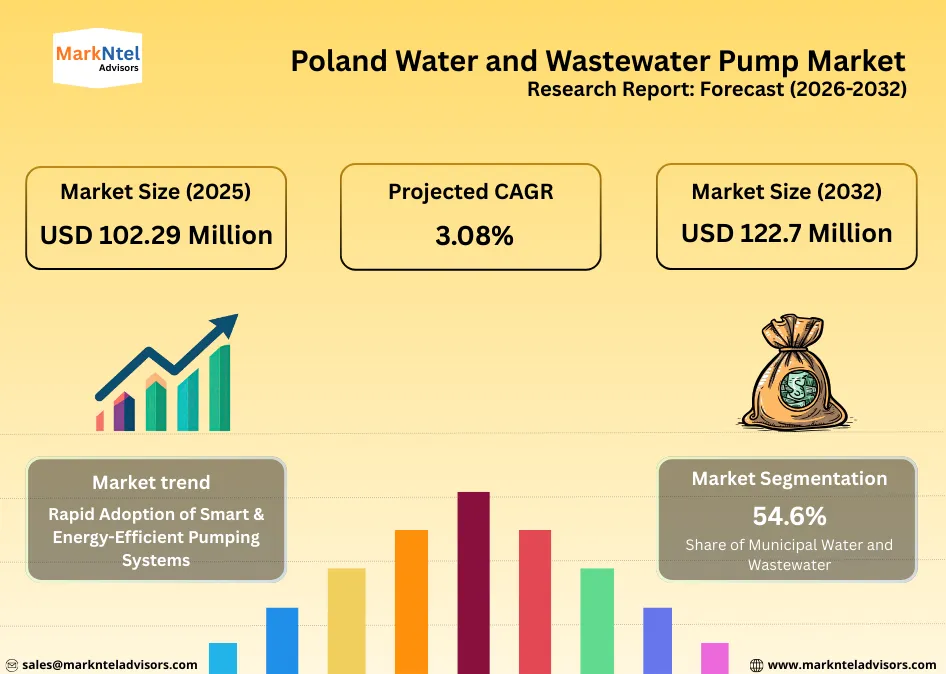
- Poland Water and Wastewater Pump Market size was valued at around USD 88 million in 2025 and is projected to grow from USD 90 million in 2026 to USD 113 million by 2032, exhibiting a CAGR of 3.09% during 2026-2032.
- Centrifugal pumps lead the Poland water and wastewater pump market in 2025, primarily due to their high efficiency in handling large volumes of low-viscosity fluids at moderate pressures, making them ideal for water supply, treatment, and drainage applications.
- In 2025, the municipal water & wastewater segment captured 54.6% of the Poland water and wastewater pump market. Meanwhile, the industrial water and wastewater segment is poised to be the fastest-growing end-user category, with a projected 2.76% CAGR during 2026-32.
- Leading companies in the Poland water and wastewater industry are ITT, IDEX, Dover, Flowserve, Sulzer AG, KSB, Xylem, Grundfos, Ebara, SPX Flow, and others.
- The demand is expected to be primarily driven by replacement units. However, new demand is likely to experience a slowdown due to rising energy costs, which are adversely affecting end-user expansion plans.
Market Insights & Analysis: Poland Water and Wastewater Pump Market (2026-32):
The Poland Water and Wastewater Pump Market size was valued at around USD 88 million in 2025 and is projected to grow from USD 90 million in 2026 to USD 113 million by 2032, exhibiting a CAGR of 3.09% during 2026-2032.
Poland’s water and wastewater pump market is increasingly shaped by robust infrastructure investments and tightening regulatory frameworks, which are redefining industry demand dynamics. Programs such as the FEnIKS program, the National Recovery Plan (KPO), and the National Fund for Environmental Protection and Water Management (NFOŚiGW) are projected to mobilize nearly USD 7.6 billion (PLN 30 billion) from the EU’s 2021–2027 budget to modernize aging water networks, expand wastewater treatment capacity, and upgrade critical pumping infrastructure. Consequently, large-scale municipal projects are directly driving procurement of high-capacity, energy-efficient, and technologically advanced pump systems. Moreover, strengthened EU regulations, particularly the revised Urban Wastewater Treatment Directive (UWWTD) and enhanced water quality standards, are compelling utilities to adopt smart monitoring solutions, improve operational efficiency, and ensure higher levels of environmental compliance.
In parallel, Poland faces structural water resource constraints, with renewable freshwater availability at only around 1,600 m³ per capita annually, highlighting growing water stress. Furthermore, the average household water consumption of around 150 liters per person per day underscores the importance of efficient distribution systems and leakage reduction. Against this backdrop of rising scarcity and climate variability, utilities are increasingly investing in water reuse, resource recovery, and digitalized pumping technologies to optimize utilization, minimize losses, and align with evolving EU and national sustainability mandates.
Poland Water and Wastewater Pump Industry Recent Developments:
- 2024: The government allocated over USD 19.5 million (PLN 78 million) toward the development and modernization of water supply and sewage management systems in rural areas of the Opole Voivodeship. The funding focuses on improving wastewater treatment coverage and upgrading aging infrastructure, directly supporting increased demand for water and wastewater pumps across small municipalities and village-level projects.
Poland Water and Wastewater Pump Market Scope:
| Category | Segments |
|---|---|
| By Pump Type | (Centrifugal Pump, (Overhung Pump (Vertical Inline, Horizontal End Suction), Split Case Pump (Single/Two Stage, Multistage), Vertical Pump (Turbine (Solid handling, Nonsolid handling), Axial, Mixed Flow), Submersible Pump (Solid Handling, Non-solid Handling)), Positive Displacement Pump (Diaphragm Pump, Piston Pump, Gear Pump, Lobe Pump, Progressive Cavity Pump, Screw Pump, Vane Pump, Peristaltic Pump) |
| By End User | Residential, Commercial & Retail, Hospitality, Healthcare, Government & Transport, Others |
Poland Water and Wastewater Pump Market Driver:
Accelerated Modernization of Aging Municipal Water Infrastructure
Poland’s municipal water and wastewater infrastructure is entering an intensive modernization phase, largely due to the aging condition of pipeline networks, pumping stations, and treatment facilities established during the large-scale urban expansion between the 1960s and 1980s. A substantial portion of installed pumping systems has now surpassed their designed operational lifespan, leading to rising leakage levels, frequent mechanical failures, and elevated energy consumption. As a result, utilities are increasingly shifting focus from temporary repairs toward systematic equipment replacement and performance upgrades.
Across major metropolitan areas as well as mid-sized municipalities, authorities are prioritizing pump modernization projects to minimize non-revenue water losses, enhance system reliability, and improve operational efficiency. Furthermore, Poland’s regulatory alignment with the environmental and efficiency frameworks of the European Union continues to compel utilities to upgrade wastewater treatment and conveyance systems to meet more stringent effluent and sustainability standards.
May 2025, Poland: Łukasiewicz Research Network partnered with Polish Waters to accelerate digital transformation across national water management infrastructure, supporting smarter and more efficient pumping operations.
These modernization initiatives are directly driving demand for high-capacity centrifugal pumps, submersible sewage pumps, and robust sludge-handling systems. Unlike greenfield infrastructure development, replacement-driven investments ensure recurring procurement cycles, creating a stable, long-term growth foundation for pump manufacturers and system integrators across Poland.
Poland Water and Wastewater Pump Market Challenge:
High Capital Costs and Budget Constraints of Municipal Utilities
A key challenge restricting faster adoption of advanced water and wastewater pumping technologies in Poland is the substantial gap between available financial resources and required investment levels for infrastructure upgrades. Many municipal utilities face constrained budgets, which makes investing in high-efficiency pumps, digital monitoring systems, and smart control technologies particularly difficult.
While Poland’s water infrastructure sector generates significant economic value, with around USD 7.6 billion (PLN 30 billion) allocated under the European Union 2021–2027 cohesion budget for water and sewage investments, including modernization projects. This funding still targets a broad set of water-related priorities, not exclusively pumping upgrades, and often must be divided across many municipalities and projects.
In practice, smaller municipalities must co-finance projects with their own budgets, which many local authorities struggle to meet. In past rural water infrastructure programs, Poland allocated around USD 11.3 billion (PLN 45 billion) for water and sewage infrastructure development between 2003 and 2017, yet even with these funds, only about 65 % of planned sewage infrastructure requirements were projected to be met by 2021, leaving a significant shortfall in investment coverage.
These funding limitations often lead to prolonged project cycles, deferred technology upgrades, and a continued reliance on conventional, lower-cost pump systems that carry higher operating and maintenance expenses over time. Until budgetary mechanisms are restructured to prioritize lifecycle cost savings and provide greater capital access, financial constraints will remain one of the most significant barriers to scaling advanced pumping solutions across Poland’s water and wastewater utilities.
Poland Water and Wastewater Pump Market Trend:
Rapid Adoption of Smart & Energy-Efficient Pumping Systems
The water and wastewater pump market in Poland is increasingly being shaped by the transition toward smart, digitally enabled, and energy-efficient pumping infrastructure. Utilities and industrial operators are moving away from conventional fixed-speed pump systems and adopting variable frequency drive (VFD)-integrated solutions that dynamically adjust flow and pressure levels based on real-time operational demand. This shift is improving system flexibility, reducing hydraulic stress, and significantly lowering energy consumption across pumping networks.
Simultaneously, the deployment of IoT-enabled monitoring platforms is transforming asset management practices within water utilities. Sensors embedded in pump systems now continuously track key performance indicators such as vibration, temperature, pressure, and flow rates, enabling predictive maintenance strategies. This proactive approach minimizes unplanned downtime, extends equipment life cycles, and reduces maintenance expenditures, an especially critical advantage in wastewater treatment facilities where operational failures can trigger regulatory and environmental risks.
Energy efficiency remains a central driver of this trend, as pumping operations account for a substantial portion of electricity usage within municipal water systems. High-efficiency motors, optimized hydraulic designs, and automated control architectures are increasingly prioritized to curb rising energy costs and meet sustainability targets aligned with broader regulatory frameworks of the European Union.
Collectively, the convergence of digitalization and efficiency optimization is accelerating the penetration of advanced pump technologies across municipal and industrial segments, gradually redefining performance standards within Poland’s water and wastewater pumping ecosystem.
Poland Water and Wastewater Pump Market (2026-32): Segmentation Analysis
The Poland Water and Wastewater Pump Market study of MarkNtel Advisors evaluates & highlights the major trends and influencing factors in each segment. It includes predictions for the period 2026–2032 at the country level. Based on the analysis, the market has been further classified as:
Based on Pump Type:
- Centrifugal Pumps
- Overhung Pumps
- Vertical Inline
- Horizontal End Suction
- Split Case Pumps
- Single/Two Stage
- Multistage
- Vertical Pumps
- Turbine
- Overhung Pumps
- Solid Handling
- Non-Solid Handling
-
- Axial
- Mixed Flow
- Submersible Pumps
- Solid Handling
- Non-solid Handling
-
- Positive Displacement Pumps
- Diaphragm Pumps
- Piston Pumps
- Gear Pumps
- Lobe Pumps
- Progressive Cavity Pumps
- Screw Pumps
- Vane Pumps
- Peristaltic Pumps
- Others
Based on pump type, centrifugal pumps dominate the Poland water and wastewater pump market in 2025, accounting for the largest share due to their operational efficiency in moving high volumes of low-viscosity fluids under moderate pressure conditions. These pumps are extensively deployed across municipal water supply networks, wastewater treatment facilities, and flood control systems, where continuous flow reliability is critical. Additionally, ongoing infrastructure modernization programs, increasing investments in urban sewage treatment, and the integration of energy-efficient pump technologies such as variable frequency drives further support the strong adoption of centrifugal pumps.
Looking forward, centrifugal pumps are projected to retain their market leadership through the forecast period, driven by expanding municipal projects and replacement demand. Furthermore, submersible centrifugal pumps are expected to witness accelerated growth, supported by rising sewer network expansion and decentralized wastewater treatment initiatives across Poland.
Based on End User:
- Municipal Water and Wastewater
- Industrial Water and Wastewater
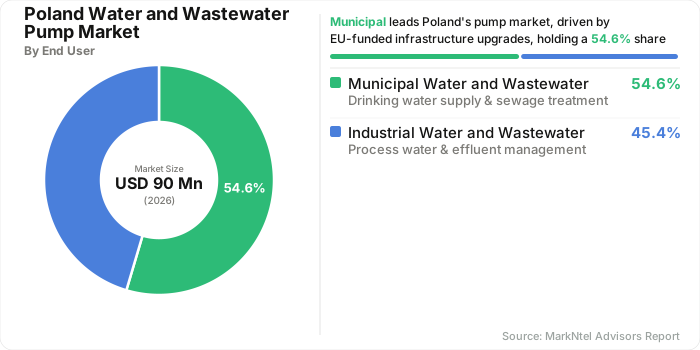
Based on end user, the municipal water and wastewater segment held the dominant position in the Poland water and wastewater pump market in 2025, accounting for nearly 54.6% of the total demand. This leadership is primarily supported by continuous investments in urban water supply systems, large-scale wastewater treatment plant upgrades, and government initiatives focused on improving sanitation infrastructure and reducing water losses. Additionally, growing urbanization and rising per capita water consumption have increased the operational load on municipal utilities, thereby driving sustained demand for high-capacity and energy-efficient pumping systems.
However, the industrial water and wastewater segment, while holding a comparatively smaller share, is projected to witness the fastest growth during 2026–2032, with an estimated CAGR of 2.76%. This growth trajectory is driven by expanding industrial production, increasing implementation of water recycling systems, and stricter environmental compliance requirements for industrial effluent management. Over the forecast period, industrial demand is expected to strengthen; however, municipal applications will continue to dominate the overall market structure.
Gain a Competitive Edge with Our Poland Water and Wastewater Pump Market Report:
- Poland Water and Wastewater Pump Market Report by MarkNtel Advisors provides a detailed & thorough analysis of market size & share, growth rate, competitive landscape, and key players. This comprehensive analysis helps businesses gain a holistic understanding of the market dynamics & make informed decisions.
- This report also highlights current market trends & future projections, allowing businesses to identify emerging opportunities & potential challenges. By understanding market forecasts, companies can align their strategies & stay ahead of the competition.
- Poland Water and Wastewater Pump Market Report aids in assessing & mitigating risks associated with entering or operating in the market. By understanding market dynamics, regulatory frameworks, and potential challenges, businesses can develop strategies to minimize risks & optimize their operations.
Frequently Asked Questions
- Market Segmentation
- Introduction
- Market Definition
- Research Process
- Assumptions
- Executive Summary
- Poland Water and Waste Water Pump Market Trends & Insights
- Poland Water and Waste Water Pump Market Regulations & Policies
- Poland Water and Waste Water Pump Market Dynamics
- Growth Drivers
- Challenges
- Poland Water and Waste Water Pump Market PORTER’s Five Forces Analysis
- Poland Water and Waste Water Pump Market Hotspots & Opportunities
- Poland Water and Waste Water Pump Market Outlook, 2022-2032
- Market Size & Analysis
- By Revenues (USD Million)
- Market Segmentation & Analysis
- By Type of Pumps
- Centrifugal Pumps- Market Size & Forecast 2022-2032, USD Million
- Overhung Pumps- Market Size & Forecast 2022-2032, USD Million
- Vertical Inline- Market Size & Forecast 2022-2032, USD Million
- Horizontal End Suction- Market Size & Forecast 2022-2032, USD Million
- Split Case Pumps- Market Size & Forecast 2022-2032, USD Million
- Single/Two Stage- Market Size & Forecast 2022-2032, USD Million
- Multistage- Market Size & Forecast 2022-2032, USD Million
- Vertical Pumps- Market Size & Forecast 2022-2032, USD Million
- Turbine- Market Size & Forecast 2022-2032, USD Million
- Solid handling- Market Size & Forecast 2022-2032, USD Million
- Nonsolid handling- Market Size & Forecast 2022-2032, USD Million
- Axial- Market Size & Forecast 2022-2032, USD Million
- Mixed Flow- Market Size & Forecast 2022-2032, USD Million
- Turbine- Market Size & Forecast 2022-2032, USD Million
- Submersible Pumps- Market Size & Forecast 2022-2032, USD Million
- Solid Handling- Market Size & Forecast 2022-2032, USD Million
- Non-solid Handling- Market Size & Forecast 2022-2032, USD Million
- Overhung Pumps- Market Size & Forecast 2022-2032, USD Million
- Positive Displacement Pumps- Market Size & Forecast 2022-2032, USD Million
- Diaphragm Pumps- Market Size & Forecast 2022-2032, USD Million
- Piston Pumps- Market Size & Forecast 2022-2032, USD Million
- Gear Pumps- Market Size & Forecast 2022-2032, USD Million
- Lobe Pumps- Market Size & Forecast 2022-2032, USD Million
- Progressive Cavity Pumps- Market Size & Forecast 2022-2032, USD Million
- Screw Pumps- Market Size & Forecast 2022-2032, USD Million
- Vane Pumps- Market Size & Forecast 2022-2032, USD Million
- Peristaltic Pumps- Market Size & Forecast 2022-2032, USD Million
- Centrifugal Pumps- Market Size & Forecast 2022-2032, USD Million
- By End User
- Industrial Water & Wastewater- Market Size & Forecast 2022-2032, USD Million
- Centrifugal Pumps- Market Size & Forecast 2022-2032, USD Million
- Overhung Pumps- Market Size & Forecast 2022-2032, USD Million
- Vertical Inline- Market Size & Forecast 2022-2032, USD Million
- Horizontal End Suction- Market Size & Forecast 2022-2032, USD Million
- Split Case Pumps- Market Size & Forecast 2022-2032, USD Million
- Single/Two Stage- Market Size & Forecast 2022-2032, USD Million
- Multistage- Market Size & Forecast 2022-2032, USD Million
- Vertical Pumps- Market Size & Forecast 2022-2032, USD Million
- Turbine- Market Size & Forecast 2022-2032, USD Million
- Solid handling- Market Size & Forecast 2022-2032, USD Million
- Nonsolid handling- Market Size & Forecast 2022-2032, USD Million
- Axial- Market Size & Forecast 2022-2032, USD Million
- Mixed Flow- Market Size & Forecast 2022-2032, USD Million
- Turbine- Market Size & Forecast 2022-2032, USD Million
- Submersible Pumps- Market Size & Forecast 2022-2032, USD Million
- Solid Handling- Market Size & Forecast 2022-2032, USD Million
- Non-solid Handling- Market Size & Forecast 2022-2032, USD Million
- Overhung Pumps- Market Size & Forecast 2022-2032, USD Million
- Positive Displacement Pumps- Market Size & Forecast 2022-2032, USD Million
- Diaphragm Pumps- Market Size & Forecast 2022-2032, USD Million
- Piston Pumps- Market Size & Forecast 2022-2032, USD Million
- Gear Pumps- Market Size & Forecast 2022-2032, USD Million
- Lobe Pumps- Market Size & Forecast 2022-2032, USD Million
- Progressive Cavity Pumps- Market Size & Forecast 2022-2032, USD Million
- Screw Pumps- Market Size & Forecast 2022-2032, USD Million
- Vane Pumps- Market Size & Forecast 2022-2032, USD Million
- Peristaltic Pumps- Market Size & Forecast 2022-2032, USD Million
- Centrifugal Pumps- Market Size & Forecast 2022-2032, USD Million
- Municipal Water & Wastewater- Market Size & Forecast 2022-2032, USD Million
- Centrifugal Pumps- Market Size & Forecast 2022-2032, USD Million
- Overhung Pumps- Market Size & Forecast 2022-2032, USD Million
- Vertical Inline- Market Size & Forecast 2022-2032, USD Million
- Horizontal End Suction- Market Size & Forecast 2022-2032, USD Million
- Split Case Pumps- Market Size & Forecast 2022-2032, USD Million
- Single/Two Stage- Market Size & Forecast 2022-2032, USD Million
- Multistage- Market Size & Forecast 2022-2032, USD Million
- Vertical Pumps- Market Size & Forecast 2022-2032, USD Million
- Turbine- Market Size & Forecast 2022-2032, USD Million
- Solid handling- Market Size & Forecast 2022-2032, USD Million
- Nonsolid handling- Market Size & Forecast 2022-2032, USD Million
- Axial- Market Size & Forecast 2022-2032, USD Million
- Mixed Flow- Market Size & Forecast 2022-2032, USD Million
- Turbine- Market Size & Forecast 2022-2032, USD Million
- Submersible Pumps- Market Size & Forecast 2022-2032, USD Million
- Solid Handling- Market Size & Forecast 2022-2032, USD Million
- Non-solid Handling- Market Size & Forecast 2022-2032, USD Million
- Overhung Pumps- Market Size & Forecast 2022-2032, USD Million
- Positive Displacement Pumps- Market Size & Forecast 2022-2032, USD Million
- Diaphragm Pumps- Market Size & Forecast 2022-2032, USD Million
- Piston Pumps- Market Size & Forecast 2022-2032, USD Million
- Gear Pumps- Market Size & Forecast 2022-2032, USD Million
- Lobe Pumps- Market Size & Forecast 2022-2032, USD Million
- Progressive Cavity Pumps- Market Size & Forecast 2022-2032, USD Million
- Screw Pumps- Market Size & Forecast 2022-2032, USD Million
- Vane Pumps- Market Size & Forecast 2022-2032, USD Million
- Peristaltic Pumps- Market Size & Forecast 2022-2032, USD Million
- Centrifugal Pumps- Market Size & Forecast 2022-2032, USD Million
- Industrial Water & Wastewater- Market Size & Forecast 2022-2032, USD Million
- By Type of Pumps
- By Application
- Water- Market Size & Forecast 2022-2032, USD Million
- Waste Water- Market Size & Forecast 2022-2032, USD Million
- By Company
- Competition Characteristics
- Market Share of Leading Companies
- Market Size & Analysis
- Poland Centrifugal Water and Waste Water Pump Market Outlook, 2022–2032
- Market Size & Outlook
- By Revenue (USD Million)
- Market Segmentation and Analysis
- By Type of Pumps- Market Size & Forecast 2022–2032, USD Million
- By End Users- Market Size & Forecast 2022-2032, USD Million
- Market Size & Outlook
- Poland Positive Displacement Water and Waste Water Pump Market Outlook, 2022–2032
- Market Size & Outlook
- By Revenue (USD Million)
- By Segmentation and Analysis
- By Type of Pumps- Market Size & Forecast 2022–2032, USD Million
- By End Users- Market Size & Forecast 2022-2032, USD Million
- Market Size & Outlook
- Poland Water and Waste Water Pump Market Key Strategic Imperatives for Growth & Success
- Competition Outlook
- Company Profiles
- ITT
- Business Description
- Product Segments
- Strategic Alliances or Partnerships
- Recent Developments
- Financial Details
- Others
- IDEX
- Business Description
- Product Segments
- Strategic Alliances or Partnerships
- Recent Developments
- Financial Details
- Others
- Dover
- Business Description
- Product Segments
- Strategic Alliances or Partnerships
- Recent Developments
- Financial Details
- Others
- Flowserver
- Business Description
- Product Segments
- Strategic Alliances or Partnerships
- Recent Developments
- Financial Details
- Others
- Sulzer AG
- Business Description
- Product Segments
- Strategic Alliances or Partnerships
- Recent Developments
- Financial Details
- Others
- KSB SE & Co. KGaA
- Business Description
- Product Segments
- Strategic Alliances or Partnerships
- Recent Developments
- Financial Details
- Others
- Grandfos
- Business Description
- Product Segments
- Strategic Alliances or Partnerships
- Recent Developments
- Financial Details
- Others
- Ebara
- Business Description
- Product Segments
- Strategic Alliances or Partnerships
- Recent Developments
- Financial Details
- Others
- SPX Flow
- Business Description
- Product Segments
- Strategic Alliances or Partnerships
- Recent Developments
- Financial Details
- Others
- Other
- Business Description
- Product Segments
- Strategic Alliances or Partnerships
- Recent Developments
- Financial Details
- Others
- ITT
- Company Profiles
- Disclaimer
MarkNtel Advisors follows a robust and iterative research methodology designed to ensure maximum accuracy and minimize deviation in market estimates and forecasts. Our approach combines both bottom-up and top-down techniques to effectively segment and quantify various aspects of the market. A consistent feature across all our research reports is data triangulation, which examines the market from three distinct perspectives to validate findings. Key components of our research process include:
1. Scope & Research Design At the outset, MarkNtel Advisors define the research objectives and formulate pertinent questions. This phase involves determining the type of research—qualitative or quantitative—and designing a methodology that outlines data collection methods, target demographics, and analytical tools. They also establish timelines and budgets to ensure the research aligns with client goals.
2. Sample Selection and Data Collection In this stage, the firm identifies the target audience and determines the appropriate sample size to ensure representativeness. They employ various sampling methods, such as random or stratified sampling, based on the research objectives. Data collection is carried out using tools like surveys, interviews, and observations, ensuring the gathered data is reliable and relevant.
3. Data Analysis and Validation Once data is collected, MarkNtel Advisors undertake a rigorous analysis process. This includes cleaning the data to remove inconsistencies, employing statistical software for quantitative analysis, and thematic analysis for qualitative data. Validation steps are taken to ensure the accuracy and reliability of the findings, minimizing biases and errors.

4. Data Forecast and FinalizationThe final phase involves forecasting future market trends based on the analyzed data. MarkNtel Advisors utilize predictive modeling and time series analysis to anticipate market behaviors. The insights are then compiled into comprehensive reports, featuring visual aids like charts and graphs, and include strategic recommendations to inform client decision-making
We offer flexible licensing options to cater to varying organizational needs. Choose the pricing pack that best suits your requirements:
Buy Now Inquire Before Buying
 Request Customization
 Talk to our Consultant







