North America Plant Genomics Market Research Report: Forecast (2026–2032)
North America Plant Genomics Market - By Product Type (Molecular Engineering Systems, Genetic Engineering Systems, Genome Editing Platforms, Supporting Consumables & Reagents, Bioi ... nformatics Software Solutions, Others), By Technology (DNA/RNA Sequencing, Genotyping, Marker, Gene Expression Analysis, GMO Trait Purity Testing, Others), By Trait (Yield Improvement, Disease Resistance, Herbicide Tolerance, Drought Resistance), By Application (Cereals and Grains, Oilseeds and Pulses, Turf Grasses & Golf Courses, Fruits and Vegetables, Others), By End User (Research Institutions and Universities, Seed Companies, Biotechnology Firms, Government and Public Agencies, Others), and others Read more
- Healthcare
- Nov 2025
- Pages 165
- Report Format: PDF, Excel, PPT
North America Plant Genomics Market
Projected 6.71% CAGR from 2026 to 2032
Study Period
2026-2032
Market Size (2025)
USD 4.43 Billion
Market Size (2032)
USD 6.98 Billion
Base Year
2025
Projected CAGR
6.71%
Leading Segments
By Product Type: Genome Editing Platforms
North America Plant Genomics Market Size: Forecast (2026-2032)
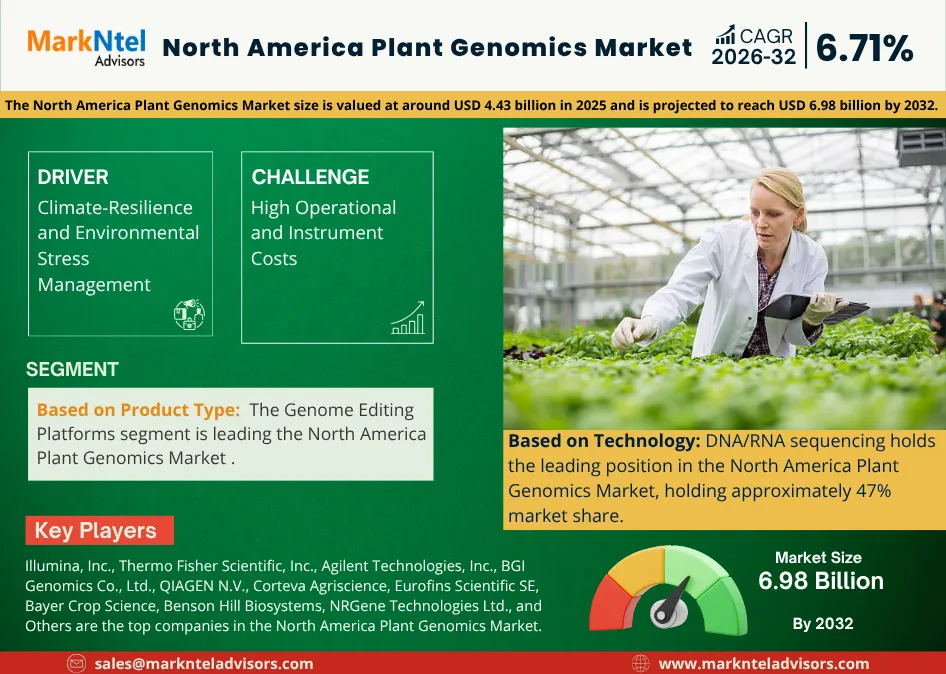
The North America Plant Genomics Market size is valued at around USD 4.43 billion in 2025 and is projected to reach USD 6.98 billion by 2032. Along with this, the market is estimated to grow at a CAGR of around 6.71% during the forecast period, i.e., 2026-32.
North America Plant Genomics Market Outlook:
Advancing genomic technologies, rising agricultural R&D investments, and gene-editing innovations are reshaping the North American plant genomics industry. The region continues to lead in global sequencing capacity and crop trait research, supported by strong public and private collaboration. For instance, the U.S. Department of Agriculture (USDA) and Department of Energy (DOE) jointly committed over USD12.6 million in 2024 to accelerate genomic research on climate-resilient and bioenergy crops, strengthening the continent’s biotechnology base. Additionally, the National Science Foundation’s (NSF) Plant Genome Research Program continues to fund large-scale sequencing projects that expand public genomic databases for crops such as maize and soybeans.
Moreover, major agriscience companies are integrating genomics into next-generation breeding pipelines. For reference, Corteva Agriscience partnered with PacBio to develop high-throughput sequencing workflows for plants, pests, and microbes, enhancing precision trait mapping. Likewise, Bayer Crop Science and BASF are investing in CRISPR-based and AI-driven breeding programs to deliver high-yield, stress-tolerant crop varieties across the U.S. and Canada.
Similarly, advancements in sequencing platforms, automation, and computational biology are reducing costs and increasing the accessibility of genomic tools to mid-size seed developers and universities. Combined with supportive policy initiatives and sustainable agriculture targets, these developments are steering the region toward faster, data-driven breeding cycles and improved crop resilience. Overall, North America’s Plant Genomics Market is entering a high-growth phase, driven by technological maturity, institutional funding, and commercialization of genomics-enabled agriculture.
North America Plant Genomics Market Recent Developments:
- September 2024: Corteva partnered with Pairwise to accelerate gene-editing technologies for climate-resilient crops. This collaboration underscores the shift from pure genomics to trait-engineering, boosting plant-genomics demand and breeding-pipeline investments in North America.
- Early 2025: Benson Hill advanced its CRISPR-based trait platform for food crops, unveiling a pipeline of improved varieties. Genomics underpins its platform, and this activity signals that start-ups are leveraging genomics to enter trait development, which enlarges the North America plant-genomics service ecosystem.
North America Plant Genomics Market Scope:
| Category | Segments |
|---|---|
| By Product Type | Molecular Engineering Systems, Genetic Engineering Systems, Genome Editing Platforms, Supporting Consumables & Reagents, Bioinformatics Software Solutions, Others), |
| By Technology | DNA/RNA Sequencing, Genotyping, Marker, Gene Expression Analysis, GMO Trait Purity Testing, Others), |
| By Trait | Yield Improvement, Disease Resistance, Herbicide Tolerance, Drought Resistance), By Application (Cereals and Grains, Oilseeds and Pulses, Turf Grasses & Golf Courses, Fruits and Vegetables, Others), |
| By End User | Research Institutions and Universities, Seed Companies, Biotechnology Firms, Government and Public Agencies, Others), and others |
North America Plant Genomics Market Drivers:
Climate-Resilience and Environmental Stress Management
Climate change is bringing more droughts, heat waves, and pest problems across North America, pushing farmers to look for stronger crops. For instance, in 2023, crop and rangeland losses exceeded USD21.94 billion, with over USD16.59 billion caused by drought, heat, and wildfires. Consequently, plant genomics is helping scientists create crop varieties that can survive these harsh conditions. For instance, the U.S. Department of Agriculture’s National Institute of Food and Agriculture (NIFA) runs “Plant Breeding, Genetics & Genomics” programs to develop heat- and drought-tolerant crops using advanced gene tools. In research supported by U.S. universities, editing a single stress-related gene improved soybean drought survival by about 57%, showing how genomics can boost resilience.
Similarly, NIFA’s “Future Proofing Plants” initiative supports studies that help crops cope with irregular rainfall and new pests. These programs are pushing seed companies and labs to invest more in sequencing and trait-discovery technologies, making genomics a key driver for sustainable, climate-resilient farming in North America.
Strong R&D Funding and Supportive Public Policy
Growing federal and institutional investment is a key driver of North America’s Plant Genomics Market. The National Science Foundation (NSF) continues to strengthen genomic infrastructure through its Plant Genome Research Program, which allocated about USD30 million in 2024 to genome-mapping and gene-editing research for key crops like maize and soybean. Likewise, the U.S. Department of Agriculture’s (USDA) National Institute of Food and Agriculture (NIFA) invested USD8.6 million in 2024 under its Plant Breeding for Agricultural Production program to enhance genomic breeding pipelines for drought- and pest-resistant crops.
Moreover, Canada also launched a national genomics strategy with USD130 million in federal funding over seven years from 2024-25 to boost genomics, including agricultural genomics, contributing to the market growth. These initiatives, paired with NSF–USDA joint calls such as Advancing Plant Transformation, create a policy environment that accelerates sequencing, trait-discovery, and bioinformatics innovation, strengthening North America’s leadership in next-generation plant genomics and sustainable crop science.
North America Plant Genomics Market Trends:
Advanced Long-Read DNA Sequencing
A major trend in North America’s Plant Genomics Industry is the fast adoption of advanced long-read DNA sequencing. This technology reads much longer pieces of DNA at once, giving a clearer and more complete picture of plant genomes than older short-read methods. For instance, U.S. researchers found that long-read sequencing captured about 55% of gene regions in crops at low coverage, compared to only 17% using older tools.
Similarly, a Nature study (US) showed that genome quality improved nearly 30 times when long-read systems were used. This helps scientists study complex crops like wheat, maize, and soybean more accurately. With clearer genetic maps, plant breeders can now discover drought-, pest-, and heat-resistant traits faster. As a result, North American labs and seed companies are increasingly using long-read sequencing to make farming more productive and climate-resilient.
Rising Adoption of High-Throughput Sequencing (HTS) in Crop Genomics
High-throughput sequencing (HTS) is transforming plant genomics across North America by allowing scientists to analyze thousands of genes faster and at lower cost. The U.S. Department of Energy’s Joint Genome Institute (JGI) sequenced over 658 trillion DNA bases in FY 2022, showing the huge scale of genomic data now produced for food and bioenergy crops. Moreover, sequencing costs have dropped by nearly 90% in the past decade, making the technology widely accessible to research institutes and seed companies, transforming the market growth.
Furthermore, major players are driving this progress, including Illumina, Inc., which offers its NovaSeq X systems, generating up to 52 billion reads per run for large-scale crop genome projects. Similarly, PacBio provides long-read sequencing to decode complex plant genomes like maize and wheat. Additionally, BGI Americas supports crop resequencing and variant mapping for U.S. and Canadian seed firms. Together, these technologies are helping breeders identify drought-, pest-, and nutrient-resistant genes in weeks instead of months.
North America Plant Genomics Market Challenges:
High Operational and Instrument Costs
A major challenge in North America’s plant genomics industry is the high cost of sequencing instruments and operations. Advanced high-throughput systems, such as Illumina’s NovaSeq X and PacBio Revio, are priced at around USD1 million each, which limits their purchase to large research institutes and government-funded programs. In addition to equipment, the expenses for reagents, skilled personnel, machine calibration, and laboratory upkeep further increase operational budgets. Every sequencing run can generate 2–3 terabytes of genomic data per crop species, and complete plant genome projects can exceed 50 TB, requiring powerful data servers and specialized software for analysis.
These financial and technical demands make it challenging for smaller genomics labs, universities, and seed-breeding firms to adopt next-generation sequencing platforms, slowing the broader deployment of plant genomics across North America’s agricultural research landscape.
North America Plant Genomics Market (2026-32) Segmentation Analysis:
The North America Plant Genomics Market Report and Forecast 2026-2032 offers a detailed analysis of the market based on the following segments:
Based on Product Type
- Molecular Engineering Systems
- Genetic Engineering Systems
- Genome Editing Platforms
- Supporting Consumables & Reagents
- Bioinformatics Software Solutions
- Others
As of 2025, the Genome Editing Platforms segment is leading the North America Plant Genomics Market by product type, accounting for more than 45% of the market share. This dominance is mainly due to the rapid adoption of advanced genetic tools such as CRISPR-Cas9, TALENs, and ZFNs, which enable precise and efficient gene modification in crops. These technologies are widely used in the U.S. and Canada for developing high-yield, pest-resistant, and climate-resilient crop varieties.
The growing investment in biotechnology research, strong support from government programs, and increasing partnerships between research institutions and agritech companies have further accelerated the use of genome editing tools. Additionally, falling sequencing costs and improved bioinformatics integration have made these platforms more accessible, reinforcing their leadership position in the North America Market.
Based on Technology
- DNA/RNA Sequencing
- Genotyping
- Marker
- Gene Expression Analysis
- GMO Trait Purity Testing
- Others
DNA/RNA sequencing holds the leading position in the North America Plant Genomics Market, holding approximately 47% market share. This is due to its vital role in understanding plant genetics and improving crop traits. This technology helps identify genes responsible for yield, disease resistance, and stress tolerance, making it essential for modern plant breeding programs. Since 2020, advancements in next-generation sequencing (NGS) have made DNA analysis faster, more accurate, and cost-effective, allowing researchers and agritech companies to study plant genomes on a large scale.
In the U.S. and Canada, strong research infrastructure and government funding have further supported the adoption of sequencing technologies in agricultural research. Companies are using DNA sequencing to develop improved crop varieties that meet sustainability and productivity goals. The growing integration of sequencing with bioinformatics tools also enables better data analysis and precision breeding, reinforcing its dominance as the foundation of plant genomics in North America.
Leading Players of the North America Plant Genomics Market:
- Illumina, Inc. (US)
Illumina, Inc. is a global leader in genomic sequencing technologies and a key player in the North American Plant Genomics Market. The company’s advanced sequencing platforms and bioinformatics tools enable precise genetic analysis for plant breeding, crop improvement, and trait discovery. Illumina’s strong R&D capabilities and collaborations with agricultural research institutions support innovation in genome mapping and molecular marker development, reinforcing its leadership in agricultural biotechnology across the region.
- Thermo Fisher Scientific, Inc.
Thermo Fisher Scientific plays a pivotal role in advancing plant genomics through its extensive portfolio of molecular biology instruments, reagents, and analytical solutions. The company’s next-generation sequencing (NGS) platforms, PCR systems, and genetic analysis tools are widely used for plant trait identification, genotyping, and crop resilience studies. With a strong presence across North America, Thermo Fisher supports the agricultural genomics ecosystem through technical expertise, innovation partnerships, and precision research solutions.
- Agilent Technologies, Inc.
Agilent Technologies contributes significantly to the North American plant genomics landscape by providing robust genomic analysis tools, microarray technologies, and bioinformatics solutions. The company’s offerings facilitate accurate gene expression profiling and molecular characterization, helping researchers identify key genetic traits in plants. Agilent’s focus on innovation, coupled with its extensive laboratory solutions and service network, enables efficient genomic research and crop productivity improvement.
BGI Genomics Co., Ltd., QIAGEN N.V., Corteva Agriscience, Eurofins Scientific SE, Bayer Crop Science, Benson Hill Biosystems, NRGene Technologies Ltd., and Others are the key players in the North America Plant Genomics Market.
North America Plant Genomics (2026-32): Regional Projection
The United States holds a leading position in North America’s Plant Genomics Market due to its strong research ecosystem, government funding, and advanced sequencing infrastructure. For instance, on average, the U.S. Department of Energy’s Joint Genome Institute (JGI) alone generates over 200 terabases of DNA data each year, making it one of the largest contributors to global plant-genome sequencing. Additionally, the U.S. institutions such as the National Science Foundation (NSF) and the U.S. Department of Agriculture (USDA) collectively invest millions of dollars annually in plant-genomics and crop-breeding programs.
These sustained investments, along with leadership from companies like Illumina, Corteva, and Bayer Crop Science’s U.S. operations, have positioned the United States as the central hub for innovation, technology development, and large-scale genomic research in North American agriculture.
Gain a Competitive Edge with Our North America Plant Genomics Market Report
- North America Plant Genomics Market Report by MarkNtel Advisors provides a detailed & thorough analysis of market size & share, growth rate, competitive landscape, and key players. This comprehensive analysis helps businesses gain a holistic understanding of the market dynamics & make informed decisions.
- This report also highlights current market trends & future projections, allowing businesses to identify emerging opportunities & potential challenges. By understanding market forecasts, companies can align their strategies & stay ahead of the competition.
- North America Plant Genomics Market Report aids in assessing & mitigating risks associated with entering or operating in the market. By understanding market dynamics, regulatory frameworks, and potential challenges, businesses can develop strategies to minimize risks & optimize their operations.
*Reports Delivery Format - Market research studies from MarkNtel Advisors are offered in PDF, Excel and PowerPoint formats. Within 24 hours of the payment being successfully received, the report will be sent to your email address.
Frequently Asked Questions
- Market Segmentation
- Research Methodology
- Product Definition
- Research Process
- Assumptions
- Executive Summary
- North America Plant Genomics Market Trends & Development
- North America Plant Genomics Market Industry Dynamics
- Drivers
- Challenges
- Trends
- Opportunities
- North America Plant Genomics Market Hotspot & Opportunities
- North America Plant Genomics Market Value Chain Analysis
- North America Plant Genomics Market Policies, Regulations, Product Standards
- North America Plant Genomics Market Pricing Analysis
- North America Plant Genomics Market Strategic Insights
- North America Plant Genomics Market Outlook, 2020- 2032F
- Market Size & Analysis
- By Revenues (USD Million)
- Market Share & Analysis
- By Product Type
- Molecular Engineering Systems- Market Size & Forecast 2020-2032F, USD Million
- Genetic Engineering Systems - Market Size & Forecast 2020-2032F, USD Million
- Genome Editing Platforms - Market Size & Forecast 2020-2032F, USD Million
- Supporting Consumables & Reagents - Market Size & Forecast 2020-2032F, USD Million
- Bioinformatics Software Solutions- Market Size & Forecast 2020-2032F, USD Million
- Others- Market Size & Forecast 2020-2032F, USD Million
- By Technology
- DNA/RNA Sequencing- Market Size & Forecast 2020-2032F, USD Million
- Genotyping- Market Size & Forecast 2020-2032F, USD Million
- Marker-Assisted Selection (MAS)- Market Size & Forecast 2020- 2032F, USD Million
- Gene Expression Analysis- Market Size & Forecast 2020- 2032F, USD Million
- GMO Trait Purity Testing- Market Size & Forecast 2020- 2032F, USD Million
- Others- Market Size & Forecast 2020-2032F, USD Million
- By Trait
- Yield Improvement- Market Size & Forecast 2020-2032F, USD Million
- Disease Resistance- Market Size & Forecast 2020-2032F, USD Million
- Herbicide Tolerance- Market Size & Forecast 2020-2032F, USD Million
- Drought Resistance- Market Size & Forecast 2020-2032F, USD Million
- By Application
- Cereals and Grains - Market Size & Forecast 2020-2032F, USD Million
- Oilseeds and Pulses- Market Size & Forecast 2020-2032F, USD Million
- Turf Grasses & Golf Courses- Market Size & Forecast 2020-2032F, USD Million
- Fruits and Vegetables- Market Size & Forecast 2020-2032F, USD Million
- Others- Market Size & Forecast 2020-2032F, USD Million
- By End User
- Research Institutions and Universities- Market Size & Forecast 2020-2032F, USD Million
- Seed Companies- Market Size & Forecast 2020-2032F, USD Million
- Biotechnology Firms- Market Size & Forecast 2020-2032F, USD Million
- Government and Public Agencies- Market Size & Forecast 2020-2032F, USD Million
- Others- Market Size & Forecast 2020-2032F, USD Million
- By Region
- United States
- Mexico
- Canada
- By Company
- Competition Characteristics
- Company Share & Analysis
- By Product Type
- Market Size & Analysis
- United States Plant Genomics Market Outlook, 2020- 2032F
- Market Size & Analysis
- By Revenue (USD Million)
- Market Share & Analysis
- By Product Type - Market Size & Forecast 2020-2032F, USD Million
- By Technology - Market Size & Forecast 2020-2032F, USD Million
- By Trait - Market Size & Forecast 2020-2032F, USD Million
- By Application- Market Size & Forecast 2020-2032F, USD Million
- By End-User- Market Size & Forecast 2020-2032F, USD Million
- Market Size & Analysis
- Mexico Plant Genomics Market Outlook, 2020- 2032F
- Market Size & Analysis
- By Revenue (USD Million)
- Market Share & Analysis
- By Product Type - Market Size & Forecast 2020-2032F, USD Million
- By Technology - Market Size & Forecast 2020-2032F, USD Million
- By Trait - Market Size & Forecast 2020-2032F, USD Million
- By Application- Market Size & Forecast 2020-2032F, USD Million
- By End-User- Market Size & Forecast 2020-2032F, USD Million
- Market Size & Analysis
- Canada Plant Genomics Market Outlook, 2020- 2032F
- Market Size & Analysis
- By Revenue (USD Million)
- Market Share & Analysis
- By Product Type - Market Size & Forecast 2020-2032F, USD Million
- By Technology - Market Size & Forecast 2020-2032F, USD Million
- By Trait - Market Size & Forecast 2020-2032F, USD Million
- By Application- Market Size & Forecast 2020-2032F, USD Million
- By End-User- Market Size & Forecast 2020-2032F, USD Million
- Market Size & Analysis
- North America Plant Genomics Market Key Strategic Imperatives for Growth & Success
- Competitive Outlook
- Company Profiles
- Illumina, Inc.
- Business Description
- Type Portfolio
- Strategic Alliances or Partnerships
- Recent Developments
- Financial Details
- Others
- Thermo Fisher Scientific, Inc.
- Business Description
- Type Portfolio
- Strategic Alliances or Partnerships
- Recent Developments
- Financial Details
- Others
- Agilent Technologies, Inc.
- Business Description
- Type Portfolio
- Strategic Alliances or Partnerships
- Recent Developments
- Financial Details
- Others
- BGI Genomics Co., Ltd.
- Business Description
- Type Portfolio
- Strategic Alliances or Partnerships
- Recent Developments
- Financial Details
- Others
- QIAGEN N.V.
- Business Description
- Type Portfolio
- Strategic Alliances or Partnerships
- Recent Developments
- Financial Details
- Others
- Corteva Agriscience
- Business Description
- Type Portfolio
- Strategic Alliances or Partnerships
- Recent Developments
- Financial Details
- Others
- Eurofins Scientific SE
- Business Description
- Type Portfolio
- Strategic Alliances or Partnerships
- Recent Developments
- Financial Details
- Others
- Bayer Crop Science
- Business Description
- Type Portfolio
- Strategic Alliances or Partnerships
- Recent Developments
- Financial Details
- Others
- Benson Hill Biosystems
- Business Description
- Type Portfolio
- Strategic Alliances or Partnerships
- Recent Developments
- Financial Details
- Others
- NRGene Technologies Ltd.
- Business Description
- Type Portfolio
- Strategic Alliances or Partnerships
- Recent Developments
- Financial Details
- Others
- Others
- Illumina, Inc.
- Company Profiles
- Disclaimer
MarkNtel Advisors follows a robust and iterative research methodology designed to ensure maximum accuracy and minimize deviation in market estimates and forecasts. Our approach combines both bottom-up and top-down techniques to effectively segment and quantify various aspects of the market. A consistent feature across all our research reports is data triangulation, which examines the market from three distinct perspectives to validate findings. Key components of our research process include:
1. Scope & Research Design At the outset, MarkNtel Advisors define the research objectives and formulate pertinent questions. This phase involves determining the type of research—qualitative or quantitative—and designing a methodology that outlines data collection methods, target demographics, and analytical tools. They also establish timelines and budgets to ensure the research aligns with client goals.
2. Sample Selection and Data Collection In this stage, the firm identifies the target audience and determines the appropriate sample size to ensure representativeness. They employ various sampling methods, such as random or stratified sampling, based on the research objectives. Data collection is carried out using tools like surveys, interviews, and observations, ensuring the gathered data is reliable and relevant.
3. Data Analysis and Validation Once data is collected, MarkNtel Advisors undertake a rigorous analysis process. This includes cleaning the data to remove inconsistencies, employing statistical software for quantitative analysis, and thematic analysis for qualitative data. Validation steps are taken to ensure the accuracy and reliability of the findings, minimizing biases and errors.

4. Data Forecast and FinalizationThe final phase involves forecasting future market trends based on the analyzed data. MarkNtel Advisors utilize predictive modeling and time series analysis to anticipate market behaviors. The insights are then compiled into comprehensive reports, featuring visual aids like charts and graphs, and include strategic recommendations to inform client decision-making
We offer flexible licensing options to cater to varying organizational needs. Choose the pricing pack that best suits your requirements:
Buy Now Inquire Before Buying
 Request Customization
 Talk to our Consultant