

Philippines Ice Cream Market Research Report: Trends, Forecast & Opportunities (2026-2032)
By Type (Impulse Ice Cream, Unpackaged Ice Cream, Take-Home Ice Cream), By Flavor (Chocolate, Mango, Vanilla, Strawberry, Butterscotch, Others), By Format (Cup, Stick, Cone, Brick) ... , By Composition (Dairy Ice Cream, Plant-based Ice Cream), By Positioning (Mass Market Ice Cream, Artisanal Ice Cream), By Trade Type (HoReCa, Invidual Consumers), By Sales Channel (Grocery Retailers, Hypermarkets/Supermarkets, Brand Owned Outlets, Ice Cream Carts, Online, Convenience Stores, Others), and others Read more
- Food & Beverages
- Mar 2026
- Pages 125
- Report Format: PDF, Excel, PPT
Philippines Ice Cream Market
Projected 6.17% CAGR from 2026 to 2032
Study Period
2026-2032
Market Size (2026)
USD 0.45 Billion
Market Size (2032)
USD 0.65 Billion
Base Year
2025
Projected CAGR
6.17%
Leading Segments
By Type: Take-Home Ice Cream
Philippines Ice Cream Market Report Key Takeaways:
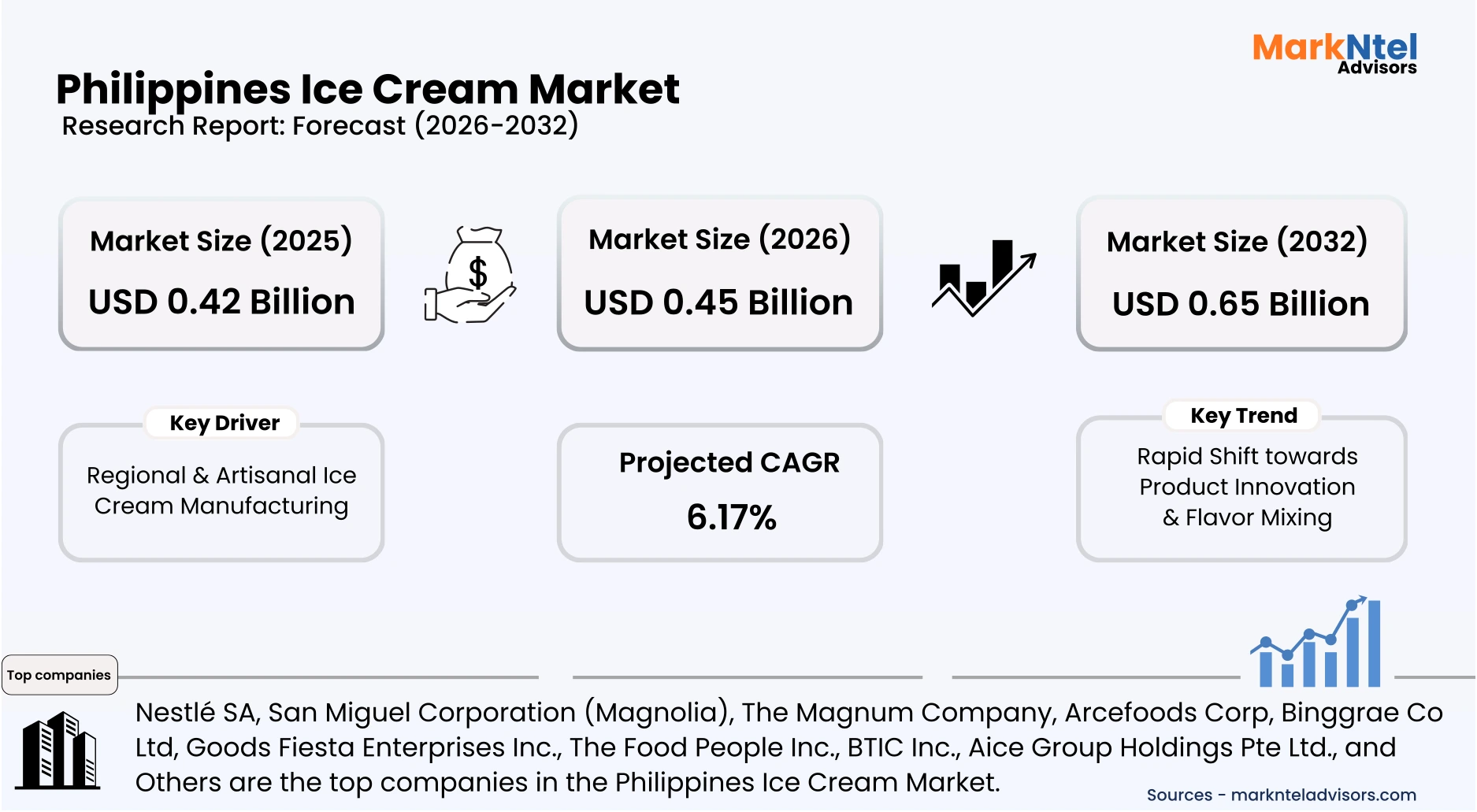
- Market size was valued at around USD 0.42 billion in 2025 and is projected to grow from USD 0.45 billion in 2026 to USD 0.65 billion by 2032, exhibiting a CAGR of 6.17% during the forecast period.
- By Type, the Take-Home Ice Cream segment represented a significant share of about 46% in the Philippines Ice Cream Market in 2026.
- By Sales Channel, the Hypermarkets & Supermarkets segment presented a significant share of about 48% in the Philippines Ice Cream Market in 2026.
- Leading Ice Cream Companies in the Philippines Market are Nestlé SA, San Miguel Corporation (Magnolia), The Magnum Company, Arcefoods Corp., Binggrae Co Ltd, Goods Fiesta Enterprises Inc., The Food People Inc., BTIC Inc., Aice Group Holdings Pte Ltd., and others.
Market Insights & Analysis: Philippines Ice Cream Market (2026-32):
The Philippines Ice Cream Market size was valued at approximately USD 0.42 billion in 2025 and is projected to grow from 0.45 billion in 2026 to USD 0.65 billion by 2032. Along with this, the market is estimated to grow at a CAGR of around 6.17% during the forecast period, i.e., 2026-32.
Growth momentum in the Philippines Ice Cream Market is closely linked to strengthening macroeconomic consumption patterns and climatic fundamentals. According to the Philippine Statistics Authority, household final consumption expenditure expanded by more than 5% in real terms in 2025, indicating resilient discretionary spending despite inflationary pressures. Since food and non-alcoholic beverages account for nearly 38% of total household spending, incremental income gains directly translate into higher packaged dessert purchases. This consumption resilience is further amplified by structural climate conditions, as annual average temperatures above 26°C, with 2024 heat index levels in parts of Luzon exceeding 42°C during El Niño months, stimulating ice cream demand.
This demand-side expansion is being efficiently supported by parallel improvements in retail and manufacturing infrastructure. According to the Philippine Board of Investments under DTI, approved investment pledges reached about USD 27.4 billion in 2024 , covering manufacturing, including food processing, strengthening domestic processing, and cold-chain capabilities. In alignment, the Board of Investments continues to grant fiscal incentives for logistics and food-processing projects under national industrial programs, lowering capital barriers for expansion. As supermarket and hypermarket networks expand across Metro Manila, CALABARZON, and Central Luzon, freezer capacity and shelf visibility increase, directly converting higher household purchasing power into retail volume growth.
Consequently, leading manufacturers are synchronizing distribution expansion with product innovation to maximize growth conversion. San Miguel Corporation (Magnolia) expanded provincial freezer deployment in 2024 to improve penetration beyond core urban clusters, directly leveraging retail infrastructure upgrades. Moreover, Nestlé SA and Aice Group Holdings simultaneously broadened flavor portfolios and value-tier offerings to address both premium and price-sensitive segments. As rising urbanization, infrastructure investments, stable dairy imports, and sustained consumer expenditure reinforce one another, the ecosystem collectively underpins the continued market growth.
Philippines Ice Cream Market Recent Developments:
- 2026 : Spanish frozen dessert brand Yolé opened its third store in the Philippines at SM North EDSA, expanding its presence with zero-added-sugar frozen yogurt and ice cream offerings for health-conscious Filipino consumers.
Philippines Ice Cream Market Scope:
| Category | Segments |
|---|---|
| By Type | (Impulse Ice Cream, Unpackaged Ice Cream, Take-Home Ice Cream), |
| By Flavor | (Chocolate, Mango, Vanilla, Strawberry, Butterscotch, Others), |
| By Format | (Cup, Stick, Cone, Brick), |
| By Composition | (Dairy Ice Cream, Plant-based Ice Cream), |
| By Positioning | (Mass Market Ice Cream, Artisanal Ice Cream), |
| By Trade Type | (HoReCa, Invidual Consumers), |
| By Sales Channel | (Grocery Retailers, Hypermarkets/Supermarkets, Brand Owned Outlets, Ice Cream Carts, Online, Convenience Stores, Others), |
Philippines Ice Cream Market Driver:
Regional & Artisanal Ice Cream Manufacturing
The growing presence of artisanal and small-batch ice-cream producers is becoming an important driver in the Philippines Ice-Cream Market. These producers focus on handcrafted methods, premium ingredients, and Filipino-inspired flavors that attract urban and middle-income consumers seeking unique dessert experiences. For instance, local brands such as Carmen’s Best and Merry Moo are small ventures offering fresh milk-based ice cream and creative flavors like sea salt caramel, etc. Their growth reflects rising demand for premium, locally made products.
Similarly, many micro and home-based producers supported under MSME programs of the Department of Trade and Industry operate in provincial cities, increasing the Ice Cream Market in the Philippines. Together, artisanal brands and small producers increase flavor diversity, encourage local ingredient sourcing, and support regional distribution, strengthening innovation and expanding the overall Philippines ice-cream market.
Philippines Ice Cream Market Trend:
Rapid Shift towards Product Innovation & Flavor Mixing
Product innovation in the Philippines ice-cream market is increasingly built around linking traditional Filipino desserts with modern, premium formats, creating a clear narrative of heritage-driven differentiation. For instance, in January 2026, Carmen’s Best introduced Ube Halaya and Tiramisu variants, directly transforming well-known Filipino and European desserts into artisanal ice-cream formats , reinforcing how brands are elevating familiar tastes into premium offerings. Additionally, ube (purple yam), a staple flavor in halo-halo and fiesta desserts , continues to anchor innovation, demonstrating how culturally rooted ingredients are repurposed into high-value dairy products.
Similarly, leading manufacturers such as Selecta and Magnolia have introduced layered flavors combining mango, cheese, and caramel swirls to cater to Filipino sweet-salty preferences. Likewise, seasonal limited editions, plant-based lines, and pint-sized premium packaging formats further illustrate how brands are connecting local flavor identity with evolving urban consumption patterns. Such innovations are actively transforming the market growth.
Philippines Ice Cream Market Opportunity:
Rising Expansion of Cold-Chain Infrastructure
Cold-chain infrastructure in the Philippines is expanding steadily, which directly boosts distribution and quality retention for frozen foods like ice cream. The country’s cold storage capacity has risen from around 500,000 tons in the early 2020s to nearly 600,000 tons in 2024 , reflecting growing investment and operational scale. Also, government plans aim to grow capacity by 15% annually, adding roughly 50,000 metric tons spaces each year under the national Cold Chain Industry Roadmap.
Additionally, public investment also supports this trend. For instance, the Department of Agriculture allocated USD50 million in 2025 to build about 99 new cold storage facilities targeting perishable goods, which will enhance refrigerated logistics across regions. These capacity gains improve regional last-mile delivery, reduce spoilage of ice cream and dairy products, and enable year-round distribution to secondary cities and rural markets, increasing retail reach for brands and supporting market growth and premium flavor experimentation.
Philippines Ice Cream Market Challenge:
Dairy Import Dependence and Energy Costs Constrain
Dairy input dependence creates a structural supply risk that directly pressures ice-cream margins. For instance, as per the USDA, the Philippines imports about 99% of its dairy requirements, leaving manufacturers exposed to global price swings and volatility. Additionally, dairy imports surged roughly 25% in the first nine months of 2024 , driven by strong skim milk powder demand, heightening exposure to shipping and commodity shocks. This import profile means local output cannot buffer global disruptions.
Moreover, energy and refrigeration costs further restrain market growth across the value chain. Smaller processors face greater hardship in funding energy-efficient retrofits and backup generation. The combined effect tightens margins and raises service-risk for provincial distribution. Therefore, increasing price and lead-time volatility for processors.
Philippines Ice Cream Market (2026-32) Segmentation Analysis:
The Philippines Ice Cream Market study of MarkNtel Advisors evaluates & highlights the major trends and influencing factors in each segment. It includes predictions for the period 2026–32 at the country level. Based on the analysis, the market has been further classified as;
Based on Type:
- Impulse Ice Cream
- Single Portion Dairy Ice Cream
- Single Portion Water Ice Cream
- Unpackaged Ice Cream
- Take-Home Ice Cream
- Bulk Dairy Ice Cream
- Ice Cream Desserts
Take-home ice cream continues to dominate the Philippines Market with a market share of about 46% due to strong household-centered consumption patterns. Rising food-at-home expenditure encourages families to purchase bulk dairy and dessert packs during regular grocery trips. Supermarket freezer expansion across major urban clusters has further improved accessibility and product visibility, ensuring consistent repeat buying cycles rather than one-time impulse purchases.
Additionally, family-oriented multipacks align well with middle-income spending capacity, offering better value per serving compared to single sticks or cones. In response, manufacturers strategically invest in larger SKUs and rectangular family tubs to strengthen cost-per-serving value perception and maximize volume turnover. In addition, provincial distribution upgrades in 2024 enhanced product penetration beyond Metro Manila, allowing take-home formats to reach emerging city clusters and secondary markets.
Moreover, take-home ice-cream desserts also gain traction during festive seasons, birthdays, and family gatherings, reinforcing bulk purchases. Premium tub innovations, including layered flavors and limited editions, further increase revenue contribution within the segment. Retail bundling strategies and promotional pricing enhance shelf turnover efficiency.
Based on Sales Channel:
- Hypermarkets/Supermarkets
- Brand Owned Outlets
- Ice Cream Carts
- Online
- Convenience Stores
- Others
Hypermarkets and supermarkets dominate ice-cream sales in the Philippines with a market share of about 48% because they combine large retail footprints, freezer capacity, and national distribution networks, creating structural advantages over smaller retail formats. For instance, the United States Department of Agriculture reports that modern retail channels handle the majority of packaged food distribution, with supermarkets and hypermarkets playing a central role in frozen and dairy categories.
Additionally, major retail operators provide nationwide scale. SM Supermarket and SM Hypermarket operate dozens of outlets across Luzon, Visayas, and Mindanao, supported by many Savemore branches, strengthening neighborhood grocery penetration . Similarly, Robinsons Supermarket runs more than 150 stores, while Puregold operates 400+ stores nationwide , significantly expanding freezer shelf access for branded and private-label ice cream.
Because these chains manage centralized procurement, promotional campaigns, and cold-chain logistics, they ensure consistent supply and competitive pricing. Together, national store density, freezer allocation, and strong dairy retail turnover firmly establish hypermarkets and supermarkets as the dominant sales channel for ice cream in the Philippines.
Gain a Competitive Edge with Our Philippines Ice Cream Market Report:
- Philippines Ice Cream Market Report by MarkNtel Advisors provides a detailed & thorough analysis of market size & share, growth rate, competitive landscape, and key players. This comprehensive analysis helps businesses gain a holistic understanding of the market dynamics & make informed decisions.
- This report also highlights current market trends & future projections, allowing businesses to identify emerging opportunities & potential challenges. By understanding market forecasts, companies can align their strategies & stay ahead of the competition.
- Philippines Ice Cream Market Report aids in assessing & mitigating risks associated with entering or operating in the market. By understanding market dynamics, regulatory frameworks, and potential challenges, businesses can develop strategies to minimize risks & optimize their operations.
*Reports Delivery Format - Market research studies from MarkNtel Advisors are offered in PDF, Excel and PowerPoint formats. Within 24 hours of the payment being successfully received, the report will be sent to your email address.
Frequently Asked Questions
- Market Segmentation
- Introduction
- Product Definition
- Research Process
- Assumptions
- Executive Summary
- Philippines Ice Cream Market Policies, Regulations, Product Standards
- Philippines Ice Cream Market Supply Chain Analysis
- Philippines Ice Cream Market Pricing Analysis
- SKU Wise Price Points
- Average Increase/Decrease in Price Per ML
- Philippines Ice Cream Market Trends & Developments
- Philippines Ice Cream Market Dynamics
- Growth Drivers
- Challenges
- Philippines Ice Cream Market Hotspot & Opportunities
- Philippines Ice Cream Market Outlook, 2022-2032F
- Market Size & Analysis
- By Revenues (USD Million)
- By Volume (Million Liters)
- Market Segmentation & Analysis
- By Type
- Impulse Ice Cream- Market Size & Forecast 2022-2032, Million Liters & USD Million
- Single Portion Dairy Ice Cream- Market Size & Forecast 2022-2032, Million Liters & USD Million
- Single Portion Water Ice Cream- Market Size & Forecast 2022-2032, Million Liters & USD Million
- Unpackaged Ice Cream- Market Size & Forecast 2022-2032, Million Liters & USD Million
- Take-Home Ice Cream- Market Size & Forecast 2022-2032, Million Liters & USD Million
- Bulk Dairy Ice Cream- Market Size & Forecast 2022-2032, Million Liters & USD Million
- Ice Cream Desserts- Market Size & Forecast 2022-2032, Million Liters & USD Million
- Impulse Ice Cream- Market Size & Forecast 2022-2032, Million Liters & USD Million
- By Flavor
- Chocolate- Market Size & Forecast 2022-2032, Million Liters & USD Million
- Mango- Market Size & Forecast 2022-2032, Million Liters & USD Million
- Vanilla- Market Size & Forecast 2022-2032, Million Liters & USD Million
- Strawberry- Market Size & Forecast 2022-2032, Million Liters & USD Million
- Butterscotch- Market Size & Forecast 2022-2032, Million Liters & USD Million
- Others- Market Size & Forecast 2022-2032, Million Liters & USD Million
- By Format
- Cup- Market Size & Forecast 2022-2032, Million Liters & USD Million
- Stick- Market Size & Forecast 2022-2032, Million Liters & USD Million
- Cone- Market Size & Forecast 2022-2032, Million Liters & USD Million
- Brick- Market Size & Forecast 2022-2032, Million Liters & USD Million
- Others (Sandwich, Tub, etc.) - Market Size & Forecast 2022-2032, Million Liters & USD Million
- By Composition
- Dairy Ice Cream- Market Size & Forecast 2022-2032, Million Liters & USD Million
- Plant-based Ice Cream- Market Size & Forecast 2022-2032, Million Liters & USD Million
- By Positioning
- Mass Market Ice Cream- Market Size & Forecast 2022-2032, Million Liters & USD Million
- Artisanal Ice Cream- Market Size & Forecast 2022-2032, Million Liters & USD Million
- By Trade Type
- HoReCa - Market Size & Forecast 2022-2032, Million Liters & USD Million
- Invidual Consumers - Market Size & Forecast 2022-2032, Million Liters & USD Million
- By Sales Channel
- Grocery Retailers- Market Size & Forecast 2022-2032, Million Liters & USD Million
- Hypermarkets/Supermarkets- Market Size & Forecast 2022-2032, Million Liters & USD Million
- Brand Owned Outlets- Market Size & Forecast 2022-2032, Million Liters & USD Million
- Ice Cream Carts- Market Size & Forecast 2022-2032, Million Liters & USD Million
- Online- Market Size & Forecast 2022-2032, Million Liters & USD Million
- Convenience Stores- Market Size & Forecast 2022-2032, Million Liters & USD Million
- Others- Market Size & Forecast 2022-2032, Million Liters & USD Million
- By Region
- Luzon
- Visays
- Mindanao
- By Competitors
- Company Revenue Shares
- Competitor Characteristics
- By Type
- Market Size & Analysis
- Philippines Impulse Ice Cream Market Outlook, 2022-2032F
- Market Size & Analysis
- By Revenues (USD Million)
- By Volume (Million Liters)
- Market Segmentation & Analysis
- By Flavor- Market Size & Forecast 2022-2032, Million Liters & USD Million
- By Format- Market Size & Forecast 2022-2032, Million Liters & USD Million
- By Composition- Market Size & Forecast 2022-2032, Million Liters & USD Million
- By Positioning- Market Size & Forecast 2022-2032, Million Liters & USD Million
- By Trade Type- Market Size & Forecast 2022-2032, Million Liters & USD Million
- By Sales Channel- Market Size & Forecast 2022-2032, Million Liters & USD Million
- Market Size & Analysis
- Philippines Unpackaged Ice Cream Market Outlook, 2022-2032F
- Market Size & Analysis
- By Revenues (USD Million)
- By Volume (Million Liters)
- Market Segmentation & Analysis
- By Flavor- Market Size & Forecast 2022-2032, Million Liters & USD Million
- By Format- Market Size & Forecast 2022-2032, Million Liters & USD Million
- By Composition- Market Size & Forecast 2022-2032, Million Liters & USD Million
- By Positioning- Market Size & Forecast 2022-2032, Million Liters & USD Million
- By Trade Type- Market Size & Forecast 2022-2032, Million Liters & USD Million
- By Sales Channel- Market Size & Forecast 2022-2032, Million Liters & USD Million
- Market Size & Analysis
- Philippines Take-Home Ice Cream Market Outlook, 2022-2032F
- Market Size & Analysis
- By Revenues (USD Million)
- By Volume (Million Liters)
- Market Segmentation & Analysis
- By Flavor- Market Size & Forecast 2022-2032, Million Liters & USD Million
- By Format- Market Size & Forecast 2022-2032, Million Liters & USD Million
- By Composition- Market Size & Forecast 2022-2032, Million Liters & USD Million
- By Positioning- Market Size & Forecast 2022-2032, Million Liters & USD Million
- By Trade Type- Market Size & Forecast 2022-2032, Million Liters & USD Million
- By Sales Channel- Market Size & Forecast 2022-2032, Million Liters & USD Million
- Market Size & Analysis
- Philippines Ice Cream Market Key Strategic Imperatives for Success & Growth
- Competition Outlook
- Company Profiles
- Nestlé
- Business Description
- Type Portfolio
- Strategic Alliances or Partnerships
- Recent Developments
- Financial Details
- Others
- San Miguel Corp / Magnolia
- Business Description
- Type Portfolio
- Strategic Alliances or Partnerships
- Recent Developments
- Financial Details
- Others
- The Magnum Company
- Business Description
- Type Portfolio
- Strategic Alliances or Partnerships
- Recent Developments
- Financial Details
- Others
- Arcefoods Corp
- Business Description
- Type Portfolio
- Strategic Alliances or Partnerships
- Recent Developments
- Financial Details
- Others
- Binggrae Co Ltd
- Business Description
- Type Portfolio
- Strategic Alliances or Partnerships
- Recent Developments
- Financial Details
- Others
- Goods Fiesta Enterprises Inc
- Business Description
- Type Portfolio
- Strategic Alliances or Partnerships
- Recent Developments
- Financial Details
- Others
- Food People Inc, The
- Business Description
- Type Portfolio
- Strategic Alliances or Partnerships
- Recent Developments
- Financial Details
- Others
- BTIC Inc
- Business Description
- Type Portfolio
- Strategic Alliances or Partnerships
- Recent Developments
- Financial Details
- Others
- Aice Group Holdings Pte Ltd.
- Business Description
- Type Portfolio
- Strategic Alliances or Partnerships
- Recent Developments
- Financial Details
- Others
- Others
- Nestlé
- Company Profiles
- Disclaimer
MarkNtel Advisors follows a robust and iterative research methodology designed to ensure maximum accuracy and minimize deviation in market estimates and forecasts. Our approach combines both bottom-up and top-down techniques to effectively segment and quantify various aspects of the market. A consistent feature across all our research reports is data triangulation, which examines the market from three distinct perspectives to validate findings. Key components of our research process include:
1. Scope & Research Design At the outset, MarkNtel Advisors define the research objectives and formulate pertinent questions. This phase involves determining the type of research—qualitative or quantitative—and designing a methodology that outlines data collection methods, target demographics, and analytical tools. They also establish timelines and budgets to ensure the research aligns with client goals.
2. Sample Selection and Data Collection In this stage, the firm identifies the target audience and determines the appropriate sample size to ensure representativeness. They employ various sampling methods, such as random or stratified sampling, based on the research objectives. Data collection is carried out using tools like surveys, interviews, and observations, ensuring the gathered data is reliable and relevant.
3. Data Analysis and Validation Once data is collected, MarkNtel Advisors undertake a rigorous analysis process. This includes cleaning the data to remove inconsistencies, employing statistical software for quantitative analysis, and thematic analysis for qualitative data. Validation steps are taken to ensure the accuracy and reliability of the findings, minimizing biases and errors.

4. Data Forecast and FinalizationThe final phase involves forecasting future market trends based on the analyzed data. MarkNtel Advisors utilize predictive modeling and time series analysis to anticipate market behaviors. The insights are then compiled into comprehensive reports, featuring visual aids like charts and graphs, and include strategic recommendations to inform client decision-making
We offer flexible licensing options to cater to varying organizational needs. Choose the pricing pack that best suits your requirements:
Buy Now Inquire Before Buying
 Request Customization
 Talk to our Consultant







