

Philippines Diagnostic Labs Market Research Report: Size, Share, Trends & Forecast (2026-2032)
By Test Type (Pathology, Radiology & Imaging), By Pathology Test Type (Clinical Chemistry, Hematology, Immunology & Serology, Microbiology, Histopathology & Cytopathology, Molecula ... r Diagnostics, Genetic Testing), By Radiology Type (X-Ray, Ultrasound, CT Scan, MRI, Mammography, PET-CT, Nuclear Imaging, Others), By Service Delivery Mode (Walk-in Testing, Home Sample Collection, Mobile Diagnostic Units), By Disease Type (Infectious Diseases, Oncology, Diabetes & Endocrinology, Cardiology, Neurology, Nephrology, Gastroenterology, Gynecology & Obstetrics, Respiratory Disorders, Orthopedics, Others), By End-User (Hospitals, Physician Clinics, Independent Diagnostic Centers, Corporate & Preventive Health Programs, Government & Public Healthcare Institutions), and others Read more
- Healthcare
- Feb 2026
- Pages 140
- Report Format: PDF, Excel, PPT
Philippines Diagnostic Labs Market
Projected 7.21% CAGR from 2026 to 2032
Study Period
2026-2032
Market Size (2025)
USD 957 million
Market Size (2032)
USD 1557.97 million
Base Year
2025
Projected CAGR
7.21%
Leading Segments
By End-User: Hospitals
Philippines Diagnostic Labs Market Report Key Takeaways:
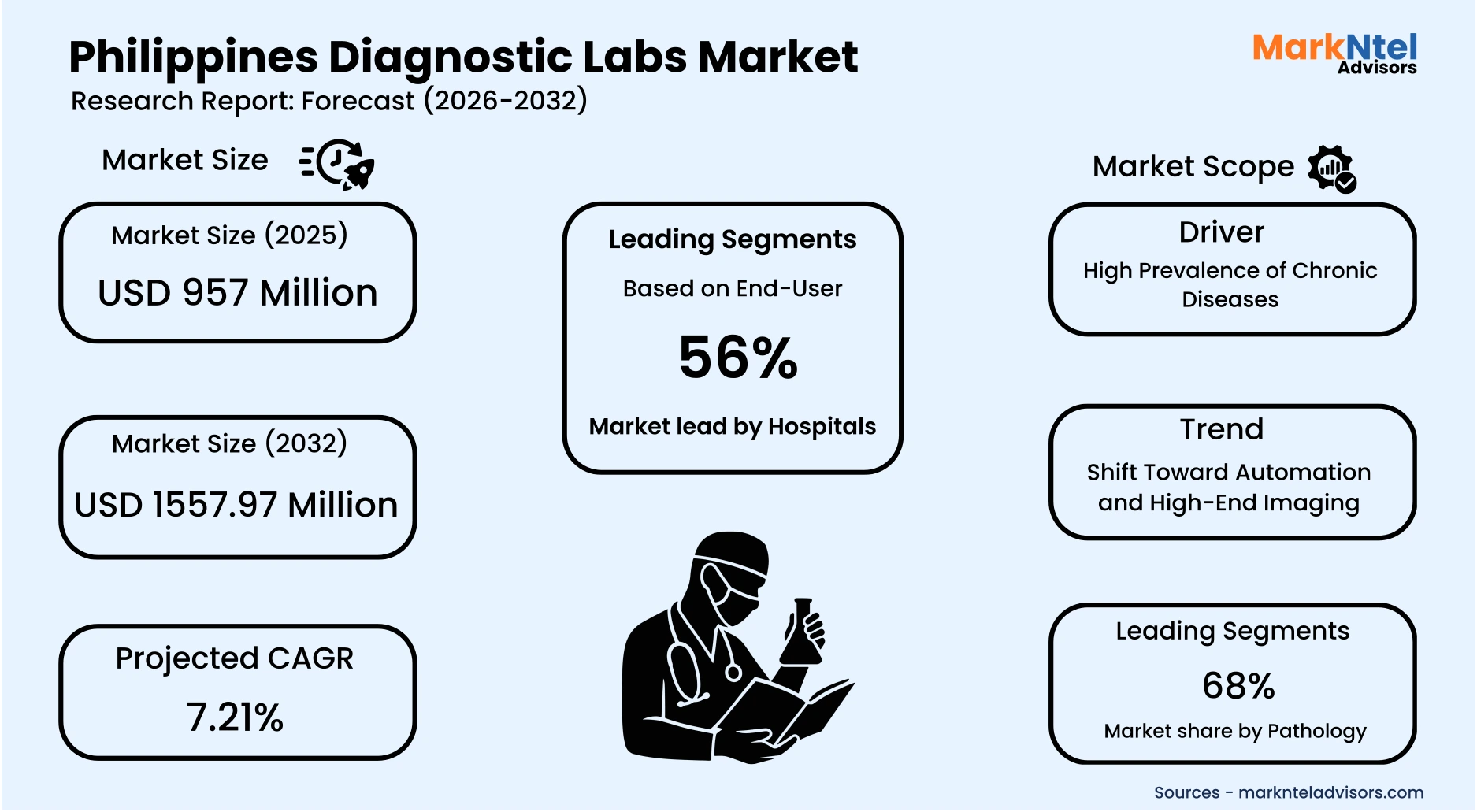
- Market size was valued at around USD957 million in 2025 and is projected to reach USD1,557.97 million by 2032. The estimated CAGR from 2026 to 2032 is around 7.21%, indicating strong growth.
- By Test Type, the Pathology Test represented a significant share of about 68% in the Philippines Diagnostic Labs Market in 2025.
- By End-User, the Hospitals seized a significant share of about 56% in the Philippines Diagnostic Labs Market in 2025.
- Leading market players are Hi Precision Diagnostics, LCM Diagnostics, Medi Linx Laboratory Inc., BioPATH Clinical Diagnostics, Inc., PMP Diagnostic Center, Inc., iScan Diagnostic Center, Singapore Diagnostics, Accuteqs Diagnostics Laboratory, ASHREY Diagnostic Center, and Others.
Market Insights & Analysis: Philippines Diagnostic Labs Market (2026-32):
The Philippines Diagnostic Labs Market size was valued at around USD957 million in 2025 and is projected to reach USD1,557.97 million by 2032. Along with this, the market is estimated to grow at a CAGR of around 7.21% during the forecast period, i.e., 2026-32.
The market is structurally anchored in the Philippines’ hospital-centric healthcare delivery model, where diagnostic services are deeply embedded within inpatient, emergency, and surgical workflows. For instance, according to the Department of Health, the country had over 1,400 licensed hospitals in 2024, with more than 60% privately operated, structurally concentrating diagnostic volumes within hospital settings and sustaining continuous demand for both in-house and outsourced laboratory services. Additionally, tertiary hospitals in Metro Manila are expanding laboratory automation to manage rising patient admissions and procedure volumes, further locking diagnostics into routine clinical pathways.
This hospital-driven demand is reinforced by disease prevalence dynamics. For reference, the World Health Organization reports that non-communicable diseases account for nearly 80% of total deaths in the Philippines , led by cardiovascular disorders, diabetes, and cancers, conditions that require repeated pathology and imaging tests across diagnosis, treatment, and follow-up stages. Similarly, DOH cancer registry data indicating over 153,000 new cancer cases annually directly anchor demand for histopathology, cytology, and advanced imaging, underscoring the non-substitutable nature of diagnostics in chronic disease management .
Additionally, on the supply and infrastructure side, this clinical demand is translating into measurable investment activity. For instance, the Department of Health (DOH) and the Department of Budget and Management (DBM), the government’s Health Facilities Enhancement Program (HFEP) received approximately USD504 Million in 2024 alone to upgrade public hospitals, covering laboratory equipment, imaging systems, and health information technology across multiple regions, including Central Luzon, CALABARZON, and Central Visayas.
Additionally, private diagnostic chains are responding by expanding branch networks and establishing centralized reference laboratories, improving turnaround times while capturing higher regional test volumes.
Moreover, the growth is therefore sustained by the convergence of technology adoption and service diversification. For reference, laboratories are increasingly deploying automated analyzers, LIS-integrated workflows, and advanced imaging modalities such as PET-CT and 128-slice CT scanners, enabling higher throughput and expanded test menus. Likewise, the rapid growth of preventive health programs and corporate screening contracts is broadening the testing base beyond acute hospital care, creating recurring outpatient demand and supporting long-term market expansion.
Philippines Diagnostic Labs Market Recent Developments:
- 2025 : Hi-Precision lists expanded ambulatory cardiology and imaging packages, including 24-hour ambulatory BP monitoring, treadmill/stress testing, improved imaging across multiple Metro Manila branches, signaling service-line upgrades.
| Category | Segments |
|---|---|
| By Test Type | (Pathology, Radiology & Imaging), |
| By Pathology Test Type | (Clinical Chemistry, Hematology, Immunology & Serology, Microbiology, Histopathology & Cytopathology, Molecular Diagnostics, Genetic Testing), |
| By Radiology Type | (X-Ray, Ultrasound, CT Scan, MRI, Mammography, PET-CT, Nuclear Imaging, Others), |
| By Service Delivery Mode | (Walk-in Testing, Home Sample Collection, Mobile Diagnostic Units), |
| By Disease Type | (Infectious Diseases, Oncology, Diabetes & Endocrinology, Cardiology, Neurology, Nephrology, Gastroenterology, Gynecology & Obstetrics, Respiratory Disorders, Orthopedics, Others), |
| By End-User | (Hospitals, Physician Clinics, Independent Diagnostic Centers, Corporate & Preventive Health Programs, Government & Public Healthcare Institutions), |
Philippines Diagnostic Labs Market Driver:
High Prevalence of Chronic Diseases
The persistently high prevalence of chronic diseases in the Philippines is a fundamental driver of the diagnostic labs market because these conditions require continuous testing across diagnosis, treatment, and long-term monitoring. For instance, diabetes prevalence remains substantial. According to the International Diabetes Federation, around 4.7 million adults in the Philippines in 2024 live with diabetes , creating sustained demand for routine blood glucose testing, HbA1c monitoring, renal panels, and complication screening. As diabetes progresses, patients require increasingly frequent laboratory follow-ups, directly expanding pathology test volumes.
This chronic testing burden is compounded by cardiovascular disease prevalence. For reference, the World Heart Federation reports approximately 225,939 cardiovascular-related deaths in 2021, reflecting widespread exposure to lipid disorders, hypertension, and metabolic risk factors. These conditions necessitate repeated lipid profiling, cardiac biomarkers, imaging studies, and ongoing laboratory surveillance, embedding diagnostics into routine care pathways. These are contributing to the market growth.
Philippines Diagnostic Labs Market Trend:
Shift Toward Automation and High-End Imaging
The shift toward automation and high-end imaging in the Philippines diagnostic labs market is being driven by the combined pressure of rising hospital workloads, government modernization programs, and private-sector capacity expansion. For instance, the Department of Health has increasingly specified fully automated chemistry and hematology analyzers in public hospital procurement documents, reflecting a policy-level push to reduce manual processing and improve turnaround times in government facilities. This direction is mirrored at the hospital level, where tertiary institutions in Metro Manila and CALABARZON have upgraded laboratory workflows to handle higher inpatient and surgical volumes.
As hospitals modernize, diagnostic providers are aligning their infrastructure accordingly. For instance, Hi-Precision Diagnostics has implemented ISO-aligned laboratory systems and automation across multiple branches, enabling standardized testing and higher daily sample throughput. Similarly, Medi Linx Laboratory’s centralized lab management partnerships with hospitals such as Riverside Medical Center demonstrate how automation supports large-scale, outsourced testing models .
Moreover, imaging capacity is shifting toward advanced modalities. For instance, iScan Diagnostic Center has expanded PET-CT, 1.5T MRI, and high-slice CT installations, directly responding to oncology and neurology referral growth. Together, these developments show a connected transition from manual, fragmented diagnostics toward automated, high-resolution, and digitally integrated diagnostic delivery nationwide.
Philippines Diagnostic Labs Market Opportunity:
Rising Healthcare Infrastructure Offering Lucrative Growth Opportunities
Significant investments in healthcare infrastructure are driving the modernization of diagnostic services in the Philippines. According to the Department of Budget and Management (DBM), the national government allocated around USD5.3 billion for the health sector in 2025 , representing one of the largest budgetary shares in recent years. This budget supports facility upgrades, medical equipment procurement, expanded testing capabilities, and capacity building across public hospitals nationwide.
Regional governments are also investing in healthcare facilities. For example, Central Luzon and CALABARZON have earmarked provincial funds for equipment and facility upgrades at general hospitals, while Davao Region authorities have pursued local partnerships to improve tertiary care and imaging capacity, as reflected in regional health infrastructure planning documents.
Additionally, government procurement notices show ongoing public tenders for advanced laboratory systems, including automated analyzers and integrated information systems, indicating sustained public commitment to diagnostic modernization across regions.
Philippines Diagnostic Labs Market Challenge:
Infrastructure Gaps and Skilled Workforce Constraints Limiting Diagnostic Scale
The market faces structural challenges related to uneven infrastructure distribution and workforce availability. For instance, advanced diagnostic capabilities such as molecular testing, PET-CT, and high-slice CT scanners remain heavily concentrated in Metro Manila and select urban centers, while many public hospitals in Mindanao, Eastern Visayas, and rural Luzon continue to rely on basic laboratory setups. This imbalance restricts timely access to complex diagnostics and increases referral dependence on urban facilities.
Additionally, the shortages of licensed medical technologists, pathologists, and radiologic technologists, particularly outside major cities. As test volumes rise due to higher disease prevalence and hospital admissions, limited staffing capacity constrains laboratory throughput, and delays result in turnaround times, directly affecting clinical decision timelines.
Moreover, capital intensity also acts as a barrier to expansion. High-end diagnostic equipment such as MRI, PET-CT, and fully automated laboratory lines requires multi-million-USD investments, in addition to ongoing maintenance and calibration costs. Consequently, smaller independent diagnostic centers and provincial hospitals struggle to scale or modernize without public funding or private partnerships. Together, infrastructure concentration, workforce shortages, and high capital requirements continue to moderate the pace at which diagnostic services can expand evenly across the Philippines.
Philippines Diagnostic Labs Market (2026-32) Segmentation Analysis:
The Philippines Diagnostic Labs Market study of MarkNtel Advisors evaluates & highlights the major trends and influencing factors in each segment. It includes predictions for the period 2026–32 at the country level. Based on the analysis, the market has been further classified as;
Based on Test Type:
- Pathology
- Radiology & Imaging
Pathology tests dominate the Philippines diagnostic labs market with a market share of about 68% because they are foundational to nearly all clinical decision-making across hospitals, clinics, and preventive care programs. For instance, pathology testing underpins diagnosis, treatment monitoring, and disease surveillance for the country’s most prevalent health conditions. According to the World Health Organization, non-communicable diseases account for the majority of deaths in the Philippines, with diabetes, cardiovascular diseases, and cancers requiring repeated laboratory monitoring rather than one-time testing.
Cancer care further anchors pathology’s dominance. According to the World Health Organization (IARC–GLOBOCAN), the Philippines records many new cancer cases annually, all of which require histopathology for definitive diagnosis, followed by immunohistochemistry and molecular testing to guide treatment decisions. Unlike imaging, pathology tests are repeated across screening, diagnosis, staging, therapy monitoring, and follow-up.
Together, the chronic, recurrent, and mandatory nature of pathology testing across disease pathways structurally positions pathology as the largest and most indispensable test category in the Philippines diagnostic labs market.
Based on End-User:
- Hospitals
- Physician Clinics
- Independent Diagnostic Centers
- Corporate & Preventive Health Programs
- Government & Public Healthcare Institutions
Hospitals dominate this market with a market share of about 56% because diagnostic demand, funding flows, and regulatory control are structurally concentrated within hospital settings. This structural requirement ensures that most high-volume and high-complexity tests, such as clinical chemistry, hematology, microbiology, and histopathology, are generated within hospitals rather than standalone labs.
Additionally, PhilHealth reimbursement mechanisms strongly reinforce hospital dominance. For reference, hospitals accounted for around 83% of total PhilHealth benefit payments in 2023, meaning diagnostic tests linked to reimbursable admissions and procedures are overwhelmingly routed through hospital laboratories. This financial concentration incentivizes hospitals to continuously expand diagnostic capacity, automation, and test menus.
Likewise, public hospitals experience persistently high bed occupancy and outpatient congestion, as documented by government health infrastructure reports, which directly translates into sustained diagnostic test volumes across emergency, inpatient, and specialty departments. Consequently, hospitals command greater procurement power for analyzers, reagents, and imaging systems, allowing them to outperform independent diagnostic centers. Together, regulatory mandates, reimbursement concentration, and patient-flow intensity firmly anchor hospitals as the dominant force in the Philippines diagnostic laboratory market.
Gain a Competitive Edge with Our Philippines Diagnostic Labs Market Report:
- Philippines Diagnostic Labs Market Report by MarkNtel Advisors provides a detailed & thorough analysis of market size & share, growth rate, competitive landscape, and key players. This comprehensive analysis helps businesses gain a holistic understanding of the market dynamics & make informed decisions.
- This report also highlights current market trends & future projections, allowing businesses to identify emerging opportunities & potential challenges. By understanding market forecasts, companies can align their strategies & stay ahead of the competition.
- Philippines Diagnostic Labs Market Report aids in assessing & mitigating risks associated with entering or operating in the market. By understanding market dynamics, regulatory frameworks, and potential challenges, businesses can develop strategies to minimize risks & optimize their operations.
*Reports Delivery Format - Market research studies from MarkNtel Advisors are offered in PDF, Excel and PowerPoint formats. Within 24 hours of the payment being successfully received, the report will be sent to your email address.
Frequently Asked Questions
- Market Segmentation
- Introduction
- Product Definition
- Research Process
- Assumptions
- Executive Summary
- Philippines Diagnostic Labs Market Policies, Regulations, and Product Standards
- Philippines Diagnostic Labs Market Trends & Developments
- Philippines Diagnostic Labs Market Dynamics
- Growth Factors
- Challenges
- Philippines Diagnostic Labs Market Hotspot & Opportunities
- Philippines Diagnostic Labs Market Outlook, 2022-2032F
- Market Size & Outlook
- By Revenues (USD Million)
- Market Share & Outlook
- By Test Type- Market Size & Forecast 2022-2032, USD Million
- Pathology
- Radiology & Imaging
- By Pathology Test Type- Market Size & Forecast 2022-2032, USD Million
- Clinical Chemistry
- Hematology
- Immunology & Serology
- Microbiology
- Histopathology & Cytopathology
- Molecular Diagnostics
- Genetic Testing
- By Radiology Type- Market Size & Forecast 2022-2032, USD Million
- X-Ray
- Ultrasound
- CT Scan
- MRI
- Mammography
- PET-CT
- Nuclear Imaging
- Others
- By Service Delivery Mode- Market Size & Forecast 2022-2032, USD Million
- Walk-in Testing
- Home Sample Collection
- Mobile Diagnostic Units
- By Disease Type - Market Size & Forecast 2022-2032, USD Million
- Infectious Diseases
- Oncology
- Diabetes & Endocrinology
- Cardiology
- Neurology
- Nephrology
- Gastroenterology
- Gynecology & Obstetrics
- Respiratory Disorders
- Orthopedics
- Others
- By End-User- Market Size & Forecast 2022-2032, USD Million
- Hospitals
- Physician Clinics
- Independent Diagnostic Centers
- Corporate & Preventive Health Programs
- Government & Public Healthcare Institutions
- By Region- Market Size & Forecast 2022-2032, USD Million
- Metro Manila
- CALABARZON
- Central Luzon
- Central Visayas
- Davao
- By Company
- Competition Characteristics
- Market Share & Analysis
- By Test Type- Market Size & Forecast 2022-2032, USD Million
- Market Size & Outlook
- Philippines Pathology Labs Market Outlook, 2022-2032
- Market Size & Outlook
- By Revenues (USD Million)
- Market Share & Outlook
- By Pathology Test Type- Market Size & Forecast 2022-2032, USD Million
- By Radiology Type- Market Size & Forecast 2022-2032, USD Million
- By Service Delivery Mode- Market Size & Forecast 2022-2032, USD Million
- By Disease Type - Market Size & Forecast 2022-2032, USD Million
- By End-User- Market Size & Forecast 2022-2032, USD Million
- By Region- Market Size & Forecast 2022-2032, USD Million
- Market Size & Outlook
- Philippines Radiology & Imaging Labs Market Outlook, 2022-2032
- Market Size & Outlook
- By Revenues (USD Million)
- Market Share & Outlook
- By Pathology Test Type- Market Size & Forecast 2022-2032, USD Million
- By Radiology Type- Market Size & Forecast 2022-2032, USD Million
- By Service Delivery Mode- Market Size & Forecast 2022-2032, USD Million
- By Disease Type - Market Size & Forecast 2022-2032, USD Million
- By End-User- Market Size & Forecast 2022-2032, USD Million
- By Region- Market Size & Forecast 2022-2032, USD Million
- Market Size & Outlook
- Philippines Diagnostic Labs Market Key Strategic Imperatives for Success & Growth
- Competitive Outlook
- Company Profiles
- Hi Precision Diagnostics
- Business Description
- Product Portfolio
- Collaborations & Alliances
- Recent Developments
- Financial Details
- Others
- LCM Diagnostics
- Business Description
- Product Portfolio
- Collaborations & Alliances
- Recent Developments
- Financial Details
- Others
- Medi Linx Laboratory Inc.
- Business Description
- Product Portfolio
- Collaborations & Alliances
- Recent Developments
- Financial Details
- Others
- BioPATH Clinical Diagnostics, Inc.
- Business Description
- Product Portfolio
- Collaborations & Alliances
- Recent Developments
- Financial Details
- Others
- PMP Diagnostic Center, Inc.
- Business Description
- Product Portfolio
- Collaborations & Alliances
- Recent Developments
- Financial Details
- Others
- iScan Diagnostic Center
- Business Description
- Product Portfolio
- Collaborations & Alliances
- Recent Developments
- Financial Details
- Others
- Singapore Diagnostics
- Business Description
- Product Portfolio
- Collaborations & Alliances
- Recent Developments
- Financial Details
- Others
- Accuteqs Diagnostics Laboratory
- Business Description
- Product Portfolio
- Collaborations & Alliances
- Recent Developments
- Financial Details
- Others
- ASHREY Diagnostic Center
- Business Description
- Product Portfolio
- Collaborations & Alliances
- Recent Developments
- Financial Details
- Others
- Hi Precision Diagnostics
- Company Profiles
- Disclaimer
MarkNtel Advisors follows a robust and iterative research methodology designed to ensure maximum accuracy and minimize deviation in market estimates and forecasts. Our approach combines both bottom-up and top-down techniques to effectively segment and quantify various aspects of the market. A consistent feature across all our research reports is data triangulation, which examines the market from three distinct perspectives to validate findings. Key components of our research process include:
1. Scope & Research Design At the outset, MarkNtel Advisors define the research objectives and formulate pertinent questions. This phase involves determining the type of research—qualitative or quantitative—and designing a methodology that outlines data collection methods, target demographics, and analytical tools. They also establish timelines and budgets to ensure the research aligns with client goals.
2. Sample Selection and Data Collection In this stage, the firm identifies the target audience and determines the appropriate sample size to ensure representativeness. They employ various sampling methods, such as random or stratified sampling, based on the research objectives. Data collection is carried out using tools like surveys, interviews, and observations, ensuring the gathered data is reliable and relevant.
3. Data Analysis and Validation Once data is collected, MarkNtel Advisors undertake a rigorous analysis process. This includes cleaning the data to remove inconsistencies, employing statistical software for quantitative analysis, and thematic analysis for qualitative data. Validation steps are taken to ensure the accuracy and reliability of the findings, minimizing biases and errors.

4. Data Forecast and FinalizationThe final phase involves forecasting future market trends based on the analyzed data. MarkNtel Advisors utilize predictive modeling and time series analysis to anticipate market behaviors. The insights are then compiled into comprehensive reports, featuring visual aids like charts and graphs, and include strategic recommendations to inform client decision-making
We offer flexible licensing options to cater to varying organizational needs. Choose the pricing pack that best suits your requirements:
Buy Now Inquire Before Buying
 Request Customization
 Talk to our Consultant







