

Philippines Agribusiness Market Research Report: Trends, Forecast & Opportunities (2026-2032)
By Product (Grains and Cereals, Dairy, Oilseeds, Livestock, Others), By Application (Crop Production, Livestock Production, Aquaculture, Agroforestry), By Farming Type (Conventiona ... l Farming, Organic Farming, Precision Farming, Contract Farming, Vertical & Controlled Environment Farming), By Farm Size (Small-Scale Farms, Medium-Scale Farms, Large-Scale Farms), By End User (Food & Beverage Industry, Textile Industry (Cotton, Jute), Biofuel Industry, Pharmaceutical Industry, Animal Husbandry & Dairy Industry), and others Read more
- Environment
- Mar 2026
- Pages 145
- Report Format: PDF, Excel, PPT
Philippines Agribusiness Market
Projected 2.57% CAGR from 2026 to 2032
Study Period
2026-2032
Market Size (2026)
USD 71.03 Billion
Market Size (2032)
USD 82.69 Billion
Base Year
2025
Projected CAGR
2.57%
Leading Segments
By Product: Grains and Cereals
Philippines Agribusiness Market Report Key Takeaways:
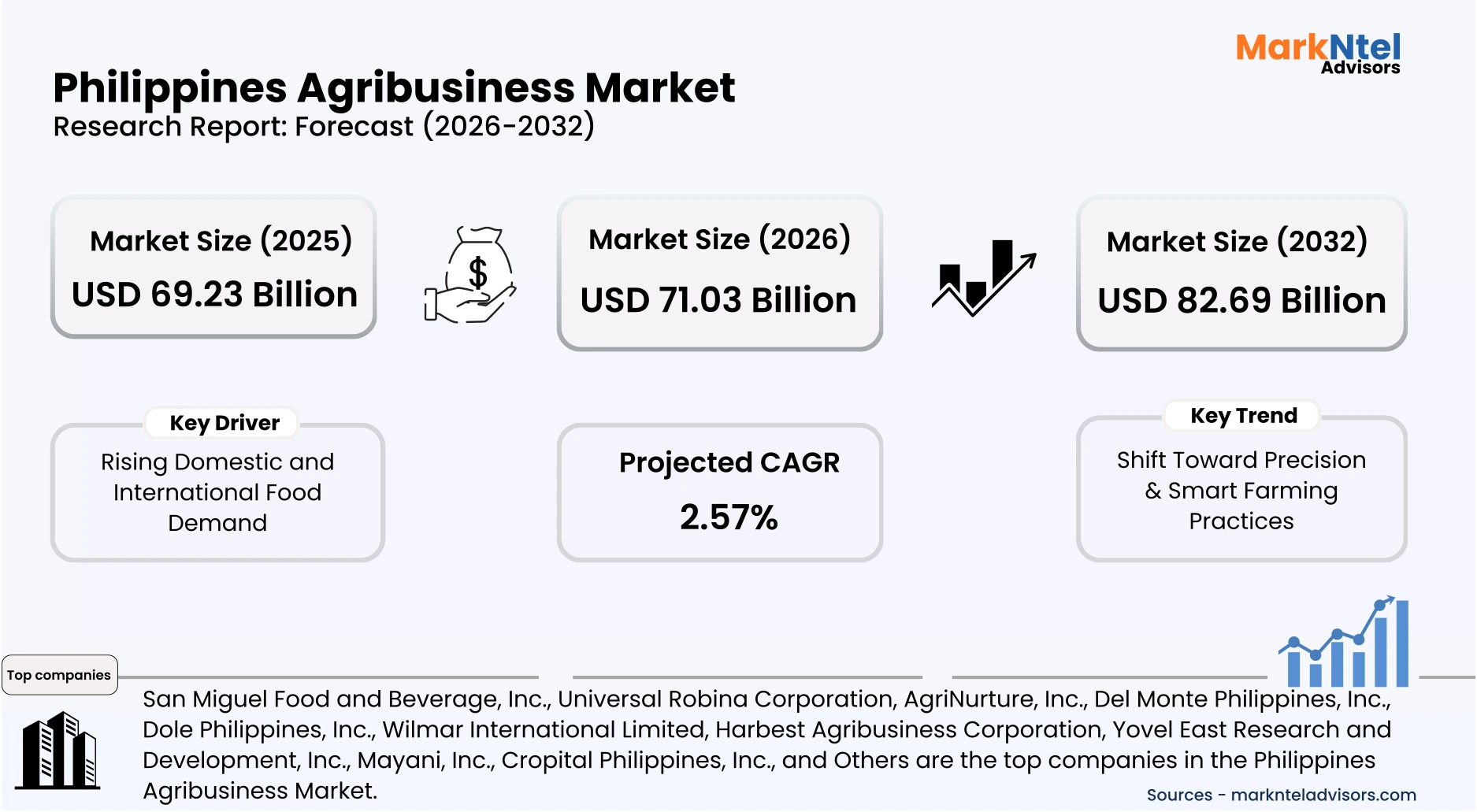
- The Philippines Agribusiness Market size was valued at USD 69.23 billion in 2025 and is projected to grow from USD 71.03 billion in 2026 to USD 82.69 billion by 2032, exhibiting a CAGR of 2.57% during the forecast period.
- By product, the grains and cereals segment represented a significant share of about 32% in the Philippines Agribusiness Market in 2026.
- By end user, the food & beverage industry seized a significant share of about 68% in the Philippines Agribusiness Market in 2026.
- Leading agribusiness companies in the Philippines are San Miguel Food and Beverage, Inc., Universal Robina Corporation, AgriNurture, Inc., Del Monte Philippines, Inc., Dole Philippines, Inc., Wilmar International Limited, Harbest Agribusiness Corporation, Yovel East Research and Development, Inc., Mayani, Inc., Cropital Philippines, Inc., and Others.
Market Insights & Analysis: Philippines Agribusiness Market (2026-32):
The Philippines Agribusiness Market size was valued at USD 69.23 billion in 2025 and is projected to grow from USD 71.03 billion in 2026 to USD 82.69 billion by 2032. Along with this, the market is estimated to grow at a CAGR of around 2.57% during the forecast period, i.e., 2026-32.
The Philippines Agribusiness Market is projected to expand steadily, driven by rising domestic and international food demand, alongside increasing adoption of precision and smart farming technologies, which are enhancing productivity, efficiency, and overall value chain development.
One of the most significant growth drivers is the country’s structurally high food demand. The Philippine Statistics Authority estimates annual rice consumption at 122.7 kg per capita, among the highest in Asia, reflecting a consistently strong baseline demand for staple food products . This is further reinforced by data from the United States Department of Agriculture, which reported rice consumption rising from 16 million metric tons in 2023 to 17.3 million metric tons in 2024, with projections reaching 17.7 million metric tons by 2025–2026.
Urbanization is also playing a critical role in shaping demand patterns. With 54.4% of the population living in urban areas as of 2023, there is increasing consumption of processed, packaged, and high-value food products.
Regionally, areas such as the Visayas are witnessing rising consumption alongside production growth, with Central Visayas recording 5.4% agricultural growth in 2024, highlighting strengthening regional demand dynamics.
International demand is further supporting market expansion. The Philippines continues to be a major exporter of agricultural commodities, with banana exports rising to approximately 3 million metric tons in 2025, up from 2.33 million metric tons in 2024.
At the same time, the country is expected to remain the world’s largest rice importer, with import requirements reaching up to 5.5 million metric tons in 2025–2026, underscoring a persistent gap between domestic production and consumption.
Technological transformation is also emerging as a defining trend. The shift toward precision and smart farming is accelerating, supported by collaborations such as the 2025 partnership between the International Rice Research Institute and XAG, which focuses on deploying drones and digital tools for crop monitoring and input optimization.
Additionally, long-term strategies such as the Philippine Rice Industry Roadmap (2025–2035) and the IRRI 2025–2030 strategy emphasize innovation, climate resilience, and productivity enhancement, reinforcing future growth potential .
Government support remains a key enabler of growth. For instance, public spending on agriculture, including infrastructure and irrigation, accounts for approximately 2.1% of GDP, demonstrating a long-term commitment to food security . Policy initiatives such as the extension of the Rice Competitiveness Enhancement Fund until 2031 are further strengthening domestic production capacity and mechanization.
The Philippines agribusiness market is positioned for sustained growth, driven by strong consumption fundamentals and rising global demand. With continued policy support and technological adoption, the sector is expected to witness enhanced productivity, improved supply chains, and long-term market expansion.
Philippines Agribusiness Market Recent Developments:
- 2025: The Philippines launched a satellite-based crop insurance and agro-advisory program in partnership with institutions, including the International Rice Research Institute and government agencies. The initiative leverages satellite data and weather insights to improve risk management, enhance climate resilience, and support more efficient decision-making for rice farmers.
- 2025: The International Rice Research Institute, in collaboration with the Department of Agriculture–Bureau of Plant Industry and PhilRice, strengthened efforts to scale climate-smart pest management in rice. The initiative integrates pest control with climate adaptation strategies to reduce crop losses, improve farmer incomes, and enhance resilience against climate risks.
Philippines Agribusiness Market Scope:
| Category | Segments |
|---|---|
| By Product | (Grains and Cereals, Dairy, Oilseeds, Livestock, Others), |
| By Application | (Crop Production, Livestock Production, Aquaculture, Agroforestry), |
| By Farming Type | (Conventional Farming, Organic Farming, Precision Farming, Contract Farming, Vertical & Controlled Environment Farming), |
| By Farm Size | (Small-Scale Farms, Medium-Scale Farms, Large-Scale Farms), |
| By End User | (Food & Beverage Industry, Textile Industry (Cotton, Jute), Biofuel Industry, Pharmaceutical Industry, Animal Husbandry & Dairy Industry), |
Philippines Agribusiness Market Driver:
Rising Domestic and International Food Demand
Rising domestic and international food demand is a key driver shaping the Philippines agribusiness market, supported by population growth, urban consumption, and expanding export activity.
The country’s population reached 114.9 million in 2023 and is projected to exceed 124 million by 2033, indicating sustained growth in food consumption across staple and processed categories. Additionally, the population was estimated at over 112.7 million in 2024, growing at an annual rate of 0.8%, reinforcing long-term demand fundamentals.
Urban economic concentration is further intensifying consumption patterns. The National Capital Region (NCR), the country’s primary consumption hub, recorded a GDP of approximately USD 143.7 billion in 2024, contributing over 31% of the national GDP. This reflects strong purchasing power and rising demand for high-value, processed, and imported food products, which in turn stimulates upstream agricultural production and supply chains.
International demand is also playing an increasingly important role. Agricultural exports reached approximately USD 884.77 million in December 2025, driven by strong global demand for tropical fruits and ongoing government efforts to expand access to international markets . This export momentum complements domestic demand, creating a dual growth engine for the agribusiness sector.
Strong population growth, urban consumption, and rising export demand are collectively driving sustained food demand in the Philippines. This dual demand dynamic will continue to boost production, attract investment, and accelerate overall agribusiness market growth.
Philippines Agribusiness Market Trend:
Shift Toward Precision & Smart Farming Practices
The Philippines agribusiness sector is witnessing a significant shift toward precision and smart farming, driven by the need to enhance productivity, reduce costs, and address structural inefficiencies in agricultural operations. Government-backed initiatives and institutional collaborations are accelerating the adoption of advanced technologies across the value chain.
A notable development occurred in 2024, when the International Rice Research Institute, in collaboration with the Philippine Rice Research Institute under the Department of Agriculture, launched the “Drones4Rice Project.” This initiative focuses on standardizing drone-based applications for seeding, fertilization, and pesticide spraying. By enabling real-time crop monitoring and precise input application, the project significantly improves farm efficiency while lowering operational costs.
The growing adoption of such technologies is also addressing cost pressures within the sector. Labor expenses account for nearly one-third of total rice production costs, making automation and drone-based solutions critical for improving cost efficiency and yield outcomes .
Beyond drones, the integration of smart farming tools, including sensors, satellite imaging, and automated irrigation systems, is enabling data-driven decision-making. These technologies enhance resource utilization, optimize water and fertilizer use, and improve overall farm productivity.
The increasing adoption of precision and smart farming technologies is transforming agricultural practices in the Philippines. This trend will continue to boost productivity, reduce costs, and drive sustainable growth in the agribusiness market.
Philippines Agribusiness Market Opportunity:
Agro-Processing and Value Chain Integration Showing Bright Market Outlook
The Philippines agribusiness market offers a compelling opportunity in agro-processing and value chain integration, primarily driven by structural inefficiencies in post-harvest handling and distribution.
A significant portion of agricultural output is lost before reaching end markets, limiting value realization for farmers and processors. According to the World Bank, total losses across the country’s agri-food value chain range between 30% and 60%, with post-harvest losses estimated at 9%–37% for cereals and up to 42% for perishable commodities . These inefficiencies highlight a critical need for improved storage, processing, and logistics infrastructure.
Gaps in market linkage further reinforce this opportunity. Facilities such as the Nueva Vizcaya Agricultural Terminal have reported instances of oversupply and wastage due to inadequate processing capacity and weak farm-to-market connectivity. This reflects broader inefficiencies between production zones and consumption centers, constraining profitability and supply chain efficiency.
Further, the government approved a USD 174 million modernization initiative in 2024 to expand rice drying, milling, and storage capacity to 180,000 tonnes . This investment aims to strengthen downstream processing capabilities, reduce losses, and stabilize supply through improved buffer stock systems.
Agro-processing and integrated value chains can significantly reduce losses and enhance value capture across the agricultural sector. As infrastructure investments accelerate, this opportunity will drive higher efficiency, improved farmer incomes, and sustained agribusiness market growth.
Philippines Agribusiness Market Challenge:
Climate Vulnerability and Extreme Weather Risks Hindering Market Expansion
The Philippines agribusiness market is significantly constrained by frequent and intensifying climate-related disruptions, which undermine agricultural productivity and supply chain stability.
The country’s high exposure to typhoons makes it particularly vulnerable, with climate shocks acting as major supply-side risks. According to the International Monetary Fund, a single Category-5 typhoon can result in agricultural losses equivalent to 0.1% of national GDP, highlighting the scale of economic impact on the sector.
Recent weather events further demonstrate this challenge. In 2025, multiple typhoons led to the loss of nearly 110,000 metric tons of agricultural output and affected over 47,700 hectares of farmland, disrupting production of rice, corn, and high-value crops.
Similarly, in 2024, tropical cyclone Yinxing alone caused approximately USD 195.8 million in crop damage, reflecting the growing severity and frequency of extreme weather events. Repeated storms within short intervals also damage infrastructure, delay planting and harvesting cycles, and increase overall production costs.
Climate-related disruptions create persistent supply instability and financial losses across the agribusiness value chain. Without adequate resilience measures, this challenge will continue to limit productivity, increase risks, and hinder long-term market growth.
Philippines Agribusiness Market (2026-32) Segmentation Analysis:
The Philippines Agribusiness Market study of MarkNtel Advisors evaluates & highlights the major trends and influencing factors in each segment. It includes predictions for the period 2026–32 at the country level. Based on the analysis, the market has been further classified as;
Based on Product:
- Grains and Cereals
- Dairy
- Oilseeds
- Livestock
- Others
The grains and cereals segment dominates the Philippines Agribusiness market, accounting for approximately 32% of the total market size, primarily driven by its central role in national food security and dietary consumption patterns.
Rice, in particular, remains the dominant staple, consumed extensively across all income groups, ensuring stable and recurring demand throughout the year. This structural dependence on staple grains positions the segment as the backbone of the country’s agricultural output.
The segment’s dominance is further strengthened by sustained government support aimed at improving domestic production capacity. Public investments in irrigation infrastructure, high-yield seed distribution, mechanization, and post-harvest facilities are largely concentrated on rice and corn, reflecting their strategic importance.
In addition, grains and cereals serve as critical inputs across multiple downstream industries. Corn, for instance, is a key component in animal feed, supporting the growth of the livestock and poultry sectors and reinforcing inter-sectoral demand linkages within the agribusiness ecosystem.
Technological advancements, including the adoption of precision farming tools and farm mechanization, are increasingly being implemented in grain cultivation, enhancing productivity, optimizing input use, and improving cost efficiency.
Collectively, the combination of strong consumption fundamentals, policy prioritization, and cross-industry demand integration firmly establishes grains and cereals as the dominant segment in the Philippines agribusiness market.
Based on End User:
- Food & Beverage Industry
- Textile Industry (Cotton, Jute)
- Biofuel Industry
- Pharmaceutical Industry
- Animal Husbandry & Dairy Industry
The food & beverage industry dominates the Philippines Agribusiness market, accounting for about 68% of total market value, underpinned by its direct linkage to national food consumption and supply chains.
The sector consistently absorbs a substantial portion of agricultural output, including grains, fruits, vegetables, sugar, and livestock products, due to the country’s strong reliance on staple and processed food.
Sustained population growth and accelerating urbanization have led to a structural shift in consumption patterns, with increasing demand for packaged, convenience, and value-added food products. This transition has intensified the need for reliable, high-volume agricultural inputs, reinforcing the sector’s dominant position. Moreover, rising disposable incomes and changing lifestyles are driving diversification in diets, further expanding the consumption base for processed and premium food categories.
The rapid expansion of food processing industries, organized retail, and food service establishments, including quick-service restaurants and institutional catering, has strengthened backward linkages with the agricultural sector. These developments require consistent raw material supply, quality standardization, and efficient logistics, all of which elevate the role of agribusiness.
Additionally, export-oriented food processing, particularly in segments such as tropical fruits and coconut-derived products, contributes to sustained demand from international markets. Overall, the food & beverage industry’s scale, supply chain integration, and demand intensity firmly establish it as the leading end-user segment in the Philippines agribusiness market.
Gain a Competitive Edge with Our Philippines Agribusiness Market Report:
- Philippines Agribusiness Market Report by MarkNtel Advisors provides a detailed & thorough analysis of market size & share, growth rate, competitive landscape, and key players. This comprehensive analysis helps businesses gain a holistic understanding of the market dynamics & make informed decisions.
- This report also highlights current market trends & future projections, allowing businesses to identify emerging opportunities & potential challenges. By understanding market forecasts, companies can align their strategies & stay ahead of the competition.
- Philippines Agribusiness Market Report aids in assessing & mitigating risks associated with entering or operating in the market. By understanding market dynamics, regulatory frameworks, and potential challenges, businesses can develop strategies to minimize risks & optimize their operations.
*Reports Delivery Format - Market research studies from MarkNtel Advisors are offered in PDF, Excel and PowerPoint formats. Within 24 hours of the payment being successfully received, the report will be sent to your email address.
Frequently Asked Questions
- Market Segmentation
- Introduction
- Product Definition
- Research Process
- Assumptions
- Executive Summary
- Philippines Agribusiness Market Policies, Regulations, and Product Standards
- Philippines Agribusiness Market Trends & Developments
- Philippines Agribusiness Market Dynamics
- Growth Factors
- Challenges
- Philippines Agribusiness Market Hotspot & Opportunities
- Philippines Agribusiness Market Outlook, 2022-2032F
- Market Size & Outlook
- By Revenues (USD Million)
- Market Share & Outlook
- By Product- Market Size & Forecast 2022-2032, USD Million
- Grains and Cereals
- Dairy
- Oilseeds
- Livestock
- Others
- By Application- Market Size & Forecast 2022-2032, USD Million
- Crop Production
- Livestock Production
- Aquaculture
- Agroforestry
- By Farming Type- Market Size & Forecast 2022-2032, USD Million
- Conventional Farming
- Organic Farming
- Precision Farming
- Contract Farming
- Vertical & Controlled Environment Farming
- By Farm Size- Market Size & Forecast 2022-2032, USD Million
- Small-Scale Farms
- Medium-Scale Farms
- Large-Scale Farms
- By End User- Market Size & Forecast 2022-2032, USD Million
- Food & Beverage Industry
- Textile Industry (Cotton, Jute)
- Biofuel Industry
- Pharmaceutical Industry
- Animal Husbandry & Dairy Industry
- By Region- Market Size & Forecast 2022-2032, USD Million
- National Capital Region (NCR)
- Luzon
- Visayas
- Mindanao
- By Company
- Competition Characteristics
- Market Share & Analysis
- By Product- Market Size & Forecast 2022-2032, USD Million
- Market Size & Outlook
- Philippines Grains and Cereals Market Outlook, 2022-2032
- Market Size & Outlook
- By Revenues (USD Million)
- Market Share & Outlook
- By Application- Market Size & Forecast 2022-2032, USD Million
- By Farming Type- Market Size & Forecast 2022-2032, USD Million
- By Farm Size- Market Size & Forecast 2022-2032, USD Million
- By End User- Market Size & Forecast 2022-2032, USD Million
- By Region- Market Size & Forecast 2022-2032, USD Million
- Market Size & Outlook
- Philippines Dairy Market Outlook, 2022-2032
- Market Size & Outlook
- By Revenues (USD Million)
- Market Share & Outlook
- By Application- Market Size & Forecast 2022-2032, USD Million
- By Farming Type- Market Size & Forecast 2022-2032, USD Million
- By Farm Size- Market Size & Forecast 2022-2032, USD Million
- By End User- Market Size & Forecast 2022-2032, USD Million
- By Region- Market Size & Forecast 2022-2032, USD Million
- Market Size & Outlook
- Philippines Oilseeds Market Outlook, 2022-2032
- Market Size & Outlook
- By Revenues (USD Million)
- Market Share & Outlook
- By Application- Market Size & Forecast 2022-2032, USD Million
- By Farming Type- Market Size & Forecast 2022-2032, USD Million
- By Farm Size- Market Size & Forecast 2022-2032, USD Million
- By End User- Market Size & Forecast 2022-2032, USD Million
- By Region- Market Size & Forecast 2022-2032, USD Million
- Market Size & Outlook
- Philippines Livestock Market Outlook, 2022-2032
- Market Size & Outlook
- By Revenues (USD Million)
- Market Share & Outlook
- By Application- Market Size & Forecast 2022-2032, USD Million
- By Farming Type- Market Size & Forecast 2022-2032, USD Million
- By Farm Size- Market Size & Forecast 2022-2032, USD Million
- By End User- Market Size & Forecast 2022-2032, USD Million
- By Region- Market Size & Forecast 2022-2032, USD Million
- Market Size & Outlook
- Philippines Agribusiness Market Key Strategic Imperatives for Success & Growth
- Competitive Outlook
- Company Profiles
- San Miguel Food and Beverage, Inc.
- Business Description
- Product Portfolio
- Collaborations & Alliances
- Recent Developments
- Financial Details
- Others
- Universal Robina Corporation
- Business Description
- Product Portfolio
- Collaborations & Alliances
- Recent Developments
- Financial Details
- Others
- AgriNurture, Inc.
- Business Description
- Product Portfolio
- Collaborations & Alliances
- Recent Developments
- Financial Details
- Others
- Del Monte Philippines, Inc.
- Business Description
- Product Portfolio
- Collaborations & Alliances
- Recent Developments
- Financial Details
- Others
- Dole Philippines, Inc.
- Business Description
- Product Portfolio
- Collaborations & Alliances
- Recent Developments
- Financial Details
- Others
- Wilmar International Limited
- Business Description
- Product Portfolio
- Collaborations & Alliances
- Recent Developments
- Financial Details
- Others
- Harbest Agribusiness Corporation
- Business Description
- Product Portfolio
- Collaborations & Alliances
- Recent Developments
- Financial Details
- Others
- Yovel East Research and Development, Inc.
- Business Description
- Product Portfolio
- Collaborations & Alliances
- Recent Developments
- Financial Details
- Others
- Mayani, Inc.
- Business Description
- Product Portfolio
- Collaborations & Alliances
- Recent Developments
- Financial Details
- Others
- Cropital Philippines, Inc.
- Business Description
- Product Portfolio
- Collaborations & Alliances
- Recent Developments
- Financial Details
- Others
- San Miguel Food and Beverage, Inc.
- Company Profiles
- Disclaimer
MarkNtel Advisors follows a robust and iterative research methodology designed to ensure maximum accuracy and minimize deviation in market estimates and forecasts. Our approach combines both bottom-up and top-down techniques to effectively segment and quantify various aspects of the market. A consistent feature across all our research reports is data triangulation, which examines the market from three distinct perspectives to validate findings. Key components of our research process include:
1. Scope & Research Design At the outset, MarkNtel Advisors define the research objectives and formulate pertinent questions. This phase involves determining the type of research—qualitative or quantitative—and designing a methodology that outlines data collection methods, target demographics, and analytical tools. They also establish timelines and budgets to ensure the research aligns with client goals.
2. Sample Selection and Data Collection In this stage, the firm identifies the target audience and determines the appropriate sample size to ensure representativeness. They employ various sampling methods, such as random or stratified sampling, based on the research objectives. Data collection is carried out using tools like surveys, interviews, and observations, ensuring the gathered data is reliable and relevant.
3. Data Analysis and Validation Once data is collected, MarkNtel Advisors undertake a rigorous analysis process. This includes cleaning the data to remove inconsistencies, employing statistical software for quantitative analysis, and thematic analysis for qualitative data. Validation steps are taken to ensure the accuracy and reliability of the findings, minimizing biases and errors.

4. Data Forecast and FinalizationThe final phase involves forecasting future market trends based on the analyzed data. MarkNtel Advisors utilize predictive modeling and time series analysis to anticipate market behaviors. The insights are then compiled into comprehensive reports, featuring visual aids like charts and graphs, and include strategic recommendations to inform client decision-making
We offer flexible licensing options to cater to varying organizational needs. Choose the pricing pack that best suits your requirements:
Buy Now Inquire Before Buying
 Request Customization
 Talk to our Consultant







