Global Online Language Learning Market Research Report: Size, Share, Trends & Forecast (2026,2032)
By Learning Mode (Self-Learning Apps, Tutoring / Live Learning, Blended Learning), By Language Type (English, Spanish, French, German, Japanese, Arabic, Others), By Platform Type ( ... Mobile Applications, Web-Based Platforms, Desktop Software, Virtual Classroom Platforms), By Age Group (Below 18 years, 18 – 20 years, 21 – 30 years, 31 – 40 years, Above 40 years), By Learning Purpose (Academic Learning, Professional / Career Development, Migration & Exam Preparation, Travel & Cultural Interest, Personal Development), By Delivery Format (AI-Powered Learning, Gamified Learning, AR / VR Language Learning, Speech Recognition & NLP-based Platforms), By Pricing Model (Freemium Model, Subscription-Based, Pay-Per-Course, Enterprise Licensing), By Learning Level (Beginner, Intermediate, Advanced), By End User (Individual Learners, Educational Institutions, Corporate / Enterprise Learners), and others Read more
- ICT & Electronics
- Feb 2026
- Pages 215
- Report Format: PDF, Excel, PPT
Global Online Language Learning Market
Projected 15.29% CAGR from 2026,2032 to
Study Period
2026,2032
Market Size (2026)
USD 28.34 Billion
Market Size (2032)
USD 66.54 Billion
Largest Region
Asia-Pacific
Projected CAGR
15.29%
Leading Segments
By Learning Mode: Self-Learning Apps
Global Online Language Learning Market Report Key Takeaways:
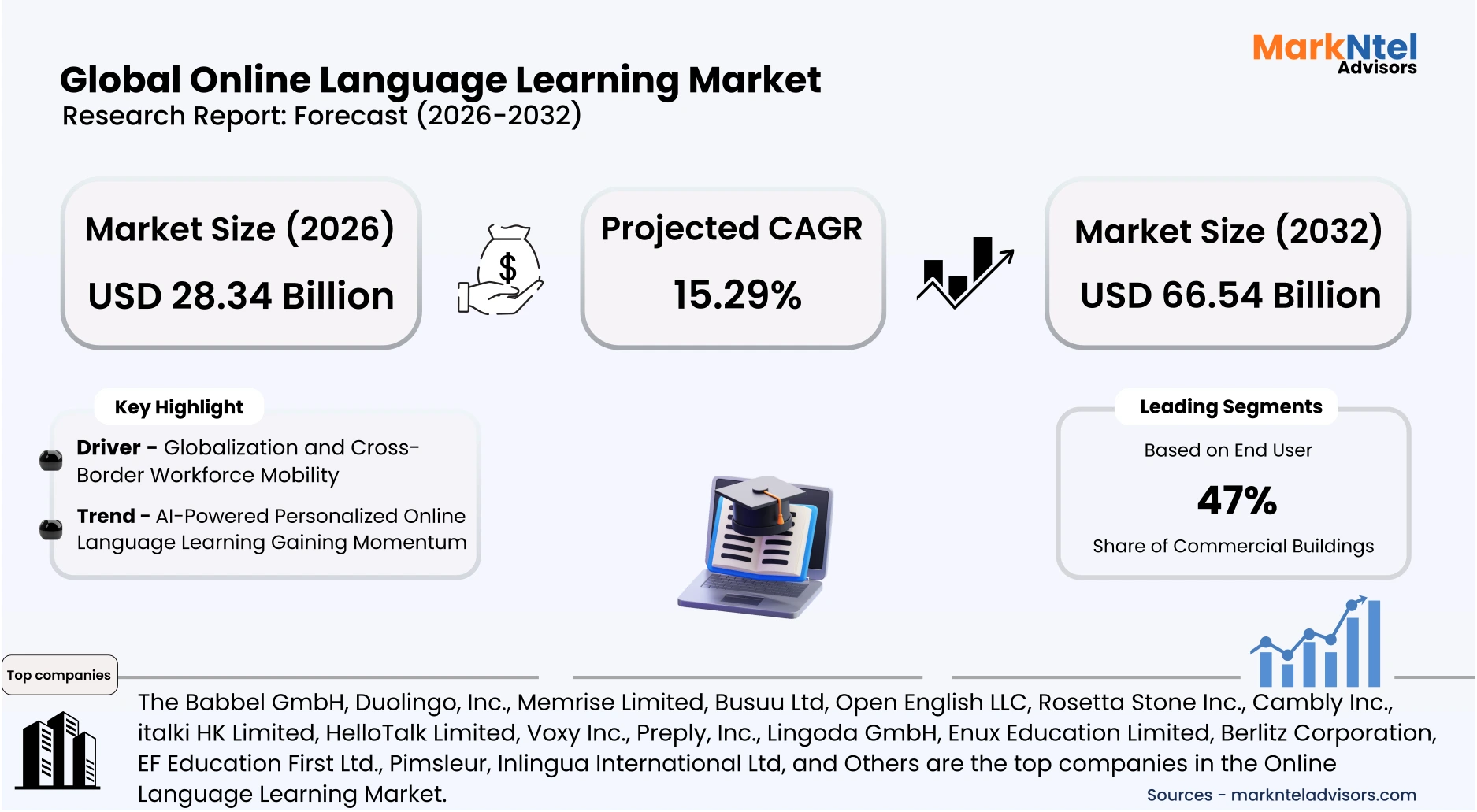
- The Global Online Language Learning market size was valued at USD 24.58 billion in 2025 and is projected to grow from USD 28.34 billion in 2026 to USD 66.54 billion by 2032, exhibiting a CAGR of 15.29% during the forecast period.
- Asia-Pacific holds the largest market share of about 45% in the Global Online Language Learning Market in 2026.
- By learning mode, the self-learning apps segment represented a significant share of about 58% in the Global Online Language Learning Market in 2026.
- By language type, the English segment presented a significant share of about 55% in the Global Online Language Learning Market in 2026.
- By end user, the individual learners segment presented a significant share of about 48% in the Global Online Language Learning Market in 2026.
- Leading online language learning companies in the global market are Babbel GmbH, Duolingo, Inc., Memrise Limited, Busuu Ltd, Open English LLC, Rosetta Stone Inc., Cambly Inc., italki HK Limited, HelloTalk Limited, Voxy Inc., Preply, Inc., Lingoda GmbH, Enux Education Limited, Berlitz Corporation, EF Education First Ltd., Pimsleur, Inlingua International Ltd., and Others.
Market Insights & Analysis: Global Online Language Learning Market (2026-32):
The Global Online Language Learning Market size was valued at approximately USD 24.58 billion in 2025 and is projected to grow from USD 28.34 billion in 2026 to USD 66.54 billion by 2032. Along with this, the market is estimated to grow at a CAGR of around 15.29% during the forecast period, i.e., 2026-32.
The Global Online Language Learning Market is projected to expand steadily, driven by rising cross-border workforce mobility and the rapid adoption of AI-powered personalized learning technologies that enhance accessibility, engagement, and global communication skills demand.
Global migration has reached unprecedented levels. In 2024, the world recorded 304 million international migrants, highlighting the scale of global workforce mobility and labor integration. Major economic hubs attract the largest migrant populations, with the United States hosting 17% of global migrants, followed by Germany (6%), Saudi Arabia (5%), the United Kingdom (4%), and France (3%). These migration patterns make language proficiency essential for employment and workplace integration.
Student mobility is also accelerating, with around 7 million internationally mobile students in 2024–2025, led by the U.S., Canada, the U.K., France, and Australia. These learners require language skills for admissions, academic success, and career opportunities, strengthening demand for digital language platforms.
Labor market dynamics further reinforce the trend. Approximately 168 million migrant workers represent 5% of the global labor force, while immigrants account for 20% of the U.S. workforce and 30% of Canada’s workforce, particularly in healthcare, construction, and technology .
North America remains the largest migrant destination. According to the United Nations, the U.S. hosted 52.4 million migrants in 2024, while Canada hosted 8.8 million migrants . Immigration flows also remain historically high. The OECD reported 6.5 million permanent migrants entered OECD countries in 2023, with the U.S. granting 1.2 million new permanent residencies. In Canada, migrant employment reached 83.3% in 2024, highlighting strong workforce integration and the need for workplace language proficiency .
Technology innovation is also transforming the market. For example, in 2025, Babbel launched Babbel Speak, an AI-powered, voice-led feature that simulates real-life conversations and delivers personalized speaking feedback. This shift toward AI-driven, immersive learning reflects the industry’s move toward adaptive, real-time tutoring that improves engagement and outcomes . Notably, English remains the dominant learning priority, with the English segment accounting for approximately 55% of the global online language learning market in 2025.
Future immigration policies will further accelerate demand. The Canada Immigration Levels Plan (2024–2026) targets 500,000 permanent residents annually by 2025–2026, with 60% focused on economic migrants, signaling long-term workforce mobility and language training needs .
Rising migration, global student mobility, and workforce globalization will continue expanding the need for language proficiency worldwide. Combined with AI-powered innovation, these forces will strongly accelerate the long-term growth of the global online language learning market.
Global Online Language Learning Market Recent Developments:
- 2025: Duolingo rolls out 28 new language courses in Indian languages designed for Indian users. Learners can now study global languages such as Spanish, French, German, Korean, and Japanese using Hindi, Bengali, Tamil, and Telugu as base languages. The rollout, powered by generative AI, aims to make global language learning accessible to non-metro audiences and significantly scale content development.
- 2025: The Indo-Japan Chamber of Commerce and Industry announced plans to launch a Japanese language course in Chennai from mid-December, aimed at strengthening India-Japan business and cultural ties. The initiative will support skill development and employment opportunities for students and professionals seeking careers with Japanese companies.
Global Online Language Learning Market Scope:
| Category | Segments |
|---|---|
| By Learning Mode | (Self-Learning Apps, Tutoring / Live Learning, Blended Learning), |
| By Language Type | (English, Spanish, French, German, Japanese, Arabic, Others), |
| By Platform Type | (Mobile Applications, Web-Based Platforms, Desktop Software, Virtual Classroom Platforms), |
| By Age Group | (Below 18 years, 18 – 20 years, 21 – 30 years, 31 – 40 years, Above 40 years), |
| By Learning Purpose | (Academic Learning, Professional / Career Development, Migration & Exam Preparation, Travel & Cultural Interest, Personal Development), |
| By Delivery Format | (AI-Powered Learning, Gamified Learning, AR / VR Language Learning, Speech Recognition & NLP-based Platforms), |
| By Pricing Model | (Freemium Model, Subscription-Based, Pay-Per-Course, Enterprise Licensing), |
| By Learning Level | (Beginner, Intermediate, Advanced), |
| By End User | (Individual Learners, Educational Institutions, Corporate / Enterprise Learners), |
Global Online Language Learning Market Driver:
Globalization and Cross-Border Workforce Mobility
Rising international migration and cross-border workforce mobility are key drivers accelerating the growth of the global online language learning market. According to the United Nations, Latin America remains one of the world’s largest migration origin regions, with 71% of migrants from the region residing outside their home region, among the highest diaspora shares globally .
Labor market integration trends further reinforce this need. Data from the Organisation for Economic Co-operation and Development indicates that South American migrants in the United States achieved a 74.2% employment rate in 2024, highlighting the strong link between language proficiency and workforce participation.
Furthermore, Europe continues to be the largest hub for intra-regional migration, with 74% of European migrants living in another European country in 2024, intensifying the need for cross-border communication and multilingual skills.
Major destination economies are witnessing record inflows. The United Kingdom received approximately 750,000 migrants in 2023, Germany welcomed nearly 700,000 migrants, and Spain recorded a 12% rise in immigration, collectively expanding the addressable market for language upskilling. I
Meanwhile, in the Middle East, Saudi Arabia hosted 13.7 million migrants and the UAE 8.2 million, further strengthening demand for English and workplace communication training. Additionally, 64% of migrants from Sub-Saharan Africa move within the region, reinforcing regional multilingual education requirements.
Sustained global migration and labor mobility are structurally increasing the need for scalable, accessible language learning solutions, positioning online platforms as essential enablers of workforce integration and global talent mobility.
Global Online Language Learning Market Trend:
AI-Powered Personalized Online Language Learning Gaining Momentum
Artificial intelligence is becoming a foundational pillar of online language education, enabling scalable personalization, real-time feedback, and immersive conversational practice. The integration of generative AI, speech recognition, and adaptive learning algorithms is shifting the industry from static content delivery to intelligent, tutor-like digital ecosystems that improve learner engagement and outcomes.
A notable development is the introduction of Duolingo Max by Duolingo, powered by GPT-4. This premium tier incorporates an AI tutor capable of simulating real-world conversations and delivering contextual explanations tailored to individual learner mistakes. By enabling learners to practice practical dialogue and receive immediate feedback, the feature represents a major transition toward immersive, adaptive learning models that closely replicate human tutoring while improving retention and completion rates.
In parallel, Rosetta Stone has advanced AI-driven proficiency evaluation through patented assessments that measure speaking and writing skills across multiple languages. The platform generates standardized scores aligned with CEFR, ACTFL, and TOEFL benchmarks and is utilized by global institutions, including the World Bank and leading universities, to support multilingual talent identification and workforce training . These capabilities enhance recruitment efficiency and strengthen the role of digital language certification in professional environments.
AI-enabled tutoring and automated proficiency assessment are redefining digital language learning as a personalized, career-aligned solution. Continued innovation in AI is expected to accelerate adoption, enhance learner outcomes, and sustain long-term market expansion.
Global Online Language Learning Market Opportunity:
Growth of Corporate and Institutional Subscriptions
The expansion of corporate and institutional subscriptions represents a major opportunity for the global online language learning market, as organizations increasingly recognize language proficiency as a strategic workforce skill. According to research by EF Corporate Learning, multilingual capabilities help companies expand internationally, improve cross-border collaboration, and attract global talent, pushing organizations to invest in structured language training programs for employees.
Pearson’s global employer research highlights the scale of this opportunity. Around 90% of employees want employer-provided language training, yet only one-third of organizations currently offer it, revealing a significant unmet demand. Additionally, 85% of employees agree English will remain the dominant language of international business, and 72% say their jobs would be easier with better English skills. Companies providing language training also report stronger employee satisfaction and retention, demonstrating measurable business value from corporate subscriptions.
Government-supported workforce globalization and digital upskilling initiatives are expected to further expand institutional demand beyond 2025. As companies adopt skills-first hiring models and cross-border digital collaboration increases, enterprises, universities, and public institutions are likely to scale enterprise-wide subscriptions for online language platforms to improve productivity and competitiveness.
Rising corporate recognition of language skills as a productivity and retention driver is unlocking large institutional subscription opportunities. As unmet demand converges with global workforce digitalization, enterprise adoption will significantly accelerate long-term market growth.
Global Online Language Learning Market Challenge:
Low Completion and Engagement Rates
Low learner completion and sustained engagement remain structural constraints for the global online language learning ecosystem. Research published by MDPI shows that Massive Open Online Courses (MOOCs) consistently report completion rates below 10%, underscoring the difficulty of maintaining long-term motivation in self-paced digital learning environments. Competing professional responsibilities, time constraints, and reduced accountability in asynchronous courses often interrupt learning continuity, particularly for adult and working learners.
Digital infrastructure gaps further exacerbate this challenge, particularly in emerging economies. According to UNESCO, over 30% of students in Sub-Saharan Africa and rural South Asia still experience significant connectivity limitations that restrict regular participation in online education.
The organization also reports that approximately half of the world’s students lack access to a home computer, and 43% do not have internet access . These constraints directly affect the use of live tutoring, AI conversation tools, and interactive practice modules—core features required for effective language acquisition.
Persistent engagement challenges and global digital inequality reduce course completion and learning effectiveness, limiting subscription retention and revenue growth. Without improvements in access and learner motivation, these structural barriers could slow the market’s long-term expansion.
Global Online Language Learning Market (2026-32) Segmentation Analysis:
The Global Online Language Learning Market study of MarkNtel Advisors evaluates & highlights the major trends and influencing factors in each segment. It includes predictions for the period 2026–32 at the global level. Based on the analysis, the market has been further classified as;
Based on Learning Mode:
- Self-Learning Apps
- Tutoring / Live Learning
- Blended Learning
The self-learning apps segment dominates the Global Online Language Learning market, accounting for approximately 58% market share, due to their unmatched scalability, accessibility, and cost efficiency.
These platforms provide fully on-demand learning experiences, allowing users to access lessons anytime and from any location, eliminating scheduling constraints associated with live tutoring or classroom-based instruction. This flexibility strongly appeals to working professionals, students, and migrant learners who must balance language acquisition with academic or professional responsibilities.
Affordability further strengthens the dominance of this segment. Self-learning apps commonly operate on freemium or low-cost subscription models, significantly reducing the financial barrier to entry compared with instructor-led programs. Because digital content can be distributed globally with minimal incremental cost, providers can reach large user bases while maintaining competitive pricing, accelerating adoption across both developed and emerging economies.
Continuous technological advancements also reinforce the segment’s leadership. Artificial intelligence, speech recognition, and adaptive learning algorithms enable platforms to tailor lesson pathways to individual proficiency levels, learning speeds, and behavioral patterns. Gamification features such as progress tracking, streaks, and reward systems improve user engagement and long-term retention.
Additionally, mobile-first design and micro-learning formats align with evolving consumer preferences for short, flexible learning sessions. Collectively, these advantages position self-learning applications as the most scalable and widely adopted learning mode, ensuring their sustained dominance in the years ahead.
Based on End User:
- Individual Learners
- Educational Institutions
- Corporate / Enterprise Learners
The individual learners segment dominates the Global Online Language Learning market, accounting for about 48% of total market share, primarily driven by the growing demand for flexible, self-directed, and cost-efficient language education.
Digital platforms allow learners to access courses at any time and from any location, making them highly suitable for working professionals, students, job seekers, migrants, and lifelong learners managing multiple commitments. The convenience of mobile applications, micro-learning modules, and subscription-based pricing has significantly reduced barriers to entry and expanded the global learner base.
Rising international mobility and remote employment trends further reinforce this dominance. Individuals increasingly pursue language skills independently to enhance career prospects, qualify for overseas opportunities, and participate in cross-border digital work.
Similarly, students preparing for international education often begin language training individually before enrolling in formal academic programs. The growth of freelance and gig-economy employment has also encouraged individuals to invest in multilingual capabilities to increase global earning potential.
Technological advancements have strengthened the appeal of self-learning solutions. AI-driven personalization, speech recognition, gamification, and real-time feedback have improved learner engagement and outcomes, enabling individuals to achieve measurable progress without institutional support.
Collectively, the combination of accessibility, affordability, technological innovation, and career-driven motivations firmly establishes individual learners as the leading end-user segment in the global online language learning market.
Global Online Language Learning Market (2026-32): Regional Projection
Asia-Pacific dominates the Global Online Language Learning Market with an estimated 45% share, supported by its strong role in international education mobility, workforce globalization, and rapid digital adoption.
The region represents the world’s largest source of internationally mobile students and migrants, creating sustained demand for English and multilingual communication skills required for overseas education, employment, and cross-border collaboration.
According to the OECD, students from China and India accounted for 17% and 14% of all international students in OECD countries in 2023, underlining the region’s dominant contribution to global student mobility and the growing need for digital language preparation tools .
Inbound student policies across the Asia Pacific and partner destinations further reinforce this momentum. For example, Japan welcomed approximately 167,000 new international students in 2024, representing a 20% increase, while Denmark, South Korea, and Sweden recorded student inflow growth of 14–19%. These trends highlight the expansion of cross-border education ecosystems that rely heavily on flexible, online language learning platforms for admission readiness and academic integration.
The region’s large youth population, expanding internet penetration, and rising participation in global technology, outsourcing, and service sectors further accelerate the adoption of digital language learning solutions. Collectively, these structural and demographic advantages position the Asia Pacific as the most influential regional contributor to market growth.
Gain a Competitive Edge with Our Global Online Language Learning Market Report:
- Global Online Language Learning Market Report by MarkNtel Advisors provides a detailed & thorough analysis of market size & share, growth rate, competitive landscape, and key players. This comprehensive analysis helps businesses gain a holistic understanding of the market dynamics & make informed decisions.
- This report also highlights current market trends & future projections, allowing businesses to identify emerging opportunities & potential challenges. By understanding market forecasts, companies can align their strategies & stay ahead of the competition.
- Global Online Language Learning Market Report aids in assessing & mitigating risks associated with entering or operating in the market. By understanding market dynamics, regulatory frameworks, and potential challenges, businesses can develop strategies to minimize risks & optimize their operations.
*Reports Delivery Format - Market research studies from MarkNtel Advisors are offered in PDF, Excel and PowerPoint formats. Within 24 hours of the payment being successfully received, the report will be sent to your email address.
Frequently Asked Questions
- Market Segmentation
- Introduction
- Product Definition
- Research Process
- Assumptions
- Executive Summary
- Global Online Language Learning Market Policies, Regulations, and Product Standards
- Global Online Language Learning Market Trends & Developments
- Global Online Language Learning Market Dynamics
- Growth Drivers
- Challenges
- Global Online Language Learning Market Hotspot & Opportunities
- Global Online Language Learning Market Outlook, 2022-2032
- Market Size & Outlook
- By Revenues (USD Million)
- Market Share & Outlook
- By Learning Mode – Market Size & Forecast 2022-2032, USD Million
- Self-Learning Apps
- Tutoring / Live Learning
- Blended Learning
- By Language Type – Market Size & Forecast 2022-2032, USD Million
- English
- Spanish
- French
- German
- Japanese
- Arabic
- Others
- By Platform Type – Market Size & Forecast 2022-2032, USD Million
- Mobile Applications
- Web-Based Platforms
- Desktop Software
- Virtual Classroom Platforms
- By Age Group – Market Size & Forecast 2022-2032, USD Million
- Below 18 years
- 18 – 20 years
- 21 – 30 years
- 31 – 40 years
- Above 40 years
- By Learning Purpose – Market Size & Forecast 2022-2032, USD Million
- Academic Learning
- Professional / Career Development
- Migration & Exam Preparation
- Travel & Cultural Interest
- Personal Development
- By Delivery Format – Market Size & Forecast 2022-2032, USD Million
- AI-Powered Learning
- Gamified Learning
- AR / VR Language Learning
- Speech Recognition & NLP-based Platforms
- By Pricing Model – Market Size & Forecast 2022-2032, USD Million
- Freemium Model
- Subscription-Based
- Pay-Per-Course
- Enterprise Licensing
- By Learning Level – Market Size & Forecast 2022-2032, USD Million
- Beginner
- Intermediate
- Advanced
- By End User – Market Size & Forecast 2022-2032, USD Million
- Individual Learners
- Educational Institutions
- Corporate / Enterprise Learners
- By Region
- North America
- South America
- Europe
- Middle East & Africa
- Asia-Pacific
- By Company
- Competition Characteristics
- Market Share & Analysis
- By Learning Mode – Market Size & Forecast 2022-2032, USD Million
- Market Size & Outlook
- North America Online Language Learning Market Outlook, 2021-2032F
- Market Size & Analysis
- By Revenue (USD Million)
- Market Share & Analysis
- By Learning Mode – Market Size & Forecast 2022-2032, USD Million
- By Language Type – Market Size & Forecast 2022-2032, USD Million
- By Platform Type – Market Size & Forecast 2022-2032, USD Million
- By Age Group – Market Size & Forecast 2022-2032, USD Million
- By Learning Purpose – Market Size & Forecast 2022-2032, USD Million
- By Delivery Format – Market Size & Forecast 2022-2032, USD Million
- By Pricing Model – Market Size & Forecast 2022-2032, USD Million
- By Learning Level – Market Size & Forecast 2022-2032, USD Million
- By End User – Market Size & Forecast 2022-2032, USD Million
- By Country
- The US
- Canada
- Mexico
- The US Online Language Learning Market Outlook, 2021-2032F
- Market Size & Analysis
- By Revenue (USD Million)
- Market Share & Analysis
- By Learning Mode – Market Size & Forecast 2022-2032, USD Million
- By Language Type – Market Size & Forecast 2022-2032, USD Million
- By Platform Type – Market Size & Forecast 2022-2032, USD Million
- By Age Group – Market Size & Forecast 2022-2032, USD Million
- By Learning Purpose – Market Size & Forecast 2022-2032, USD Million
- By Delivery Format – Market Size & Forecast 2022-2032, USD Million
- By Pricing Model – Market Size & Forecast 2022-2032, USD Million
- By Learning Level – Market Size & Forecast 2022-2032, USD Million
- By End User – Market Size & Forecast 2022-2032, USD Million
- Market Size & Analysis
- Canada Online Language Learning Market Outlook, 2021-2032F
- Market Size & Analysis
- By Revenue (USD Million)
- Market Share & Analysis
- By Learning Mode – Market Size & Forecast 2022-2032, USD Million
- By Language Type – Market Size & Forecast 2022-2032, USD Million
- By Platform Type – Market Size & Forecast 2022-2032, USD Million
- By Age Group – Market Size & Forecast 2022-2032, USD Million
- By Learning Purpose – Market Size & Forecast 2022-2032, USD Million
- By Delivery Format – Market Size & Forecast 2022-2032, USD Million
- By Pricing Model – Market Size & Forecast 2022-2032, USD Million
- By Learning Level – Market Size & Forecast 2022-2032, USD Million
- By End User – Market Size & Forecast 2022-2032, USD Million
- Market Size & Analysis
- Mexico Online Language Learning Market Outlook, 2021-2032F
- Market Size & Analysis
- By Revenue (USD Million)
- Market Share & Analysis
- By Learning Mode – Market Size & Forecast 2022-2032, USD Million
- By Language Type – Market Size & Forecast 2022-2032, USD Million
- By Platform Type – Market Size & Forecast 2022-2032, USD Million
- By Age Group – Market Size & Forecast 2022-2032, USD Million
- By Learning Purpose – Market Size & Forecast 2022-2032, USD Million
- By Delivery Format – Market Size & Forecast 2022-2032, USD Million
- By Pricing Model – Market Size & Forecast 2022-2032, USD Million
- By Learning Level – Market Size & Forecast 2022-2032, USD Million
- By End User – Market Size & Forecast 2022-2032, USD Million
- Market Size & Analysis
- Market Size & Analysis
- South America Online Language Learning Market Outlook, 2021-2032F
- Market Size & Analysis
- By Revenue (USD Million)
- Market Share & Analysis
- By Learning Mode – Market Size & Forecast 2022-2032, USD Million
- By Language Type – Market Size & Forecast 2022-2032, USD Million
- By Platform Type – Market Size & Forecast 2022-2032, USD Million
- By Age Group – Market Size & Forecast 2022-2032, USD Million
- By Learning Purpose – Market Size & Forecast 2022-2032, USD Million
- By Delivery Format – Market Size & Forecast 2022-2032, USD Million
- By Pricing Model – Market Size & Forecast 2022-2032, USD Million
- By Learning Level – Market Size & Forecast 2022-2032, USD Million
- By End User – Market Size & Forecast 2022-2032, USD Million
- By Country
- Brazil
- Argentina
- Rest of South America
- Brazil Online Language Learning Market Outlook, 2021-2032F
- Market Size & Analysis
- By Revenue (USD Million)
- Market Share & Analysis
- By Learning Mode – Market Size & Forecast 2022-2032, USD Million
- By Language Type – Market Size & Forecast 2022-2032, USD Million
- By Platform Type – Market Size & Forecast 2022-2032, USD Million
- By Age Group – Market Size & Forecast 2022-2032, USD Million
- By Learning Purpose – Market Size & Forecast 2022-2032, USD Million
- By Delivery Format – Market Size & Forecast 2022-2032, USD Million
- By Pricing Model – Market Size & Forecast 2022-2032, USD Million
- By Learning Level – Market Size & Forecast 2022-2032, USD Million
- By End User – Market Size & Forecast 2022-2032, USD Million
- Market Size & Analysis
- Argentina Online Language Learning Market Outlook, 2021-2032F
- Market Size & Analysis
- By Revenue (USD Million)
- Market Share & Analysis
- By Learning Mode – Market Size & Forecast 2022-2032, USD Million
- By Language Type – Market Size & Forecast 2022-2032, USD Million
- By Platform Type – Market Size & Forecast 2022-2032, USD Million
- By Age Group – Market Size & Forecast 2022-2032, USD Million
- By Learning Purpose – Market Size & Forecast 2022-2032, USD Million
- By Delivery Format – Market Size & Forecast 2022-2032, USD Million
- By Pricing Model – Market Size & Forecast 2022-2032, USD Million
- By Learning Level – Market Size & Forecast 2022-2032, USD Million
- By End User – Market Size & Forecast 2022-2032, USD Million
- Market Size & Analysis
- Market Size & Analysis
- Europe Online Language Learning Market Outlook, 2021-2032F
- Market Size & Analysis
- By Revenue (USD Million)
- Market Share & Analysis
- By Learning Mode – Market Size & Forecast 2022-2032, USD Million
- By Language Type – Market Size & Forecast 2022-2032, USD Million
- By Platform Type – Market Size & Forecast 2022-2032, USD Million
- By Age Group – Market Size & Forecast 2022-2032, USD Million
- By Learning Purpose – Market Size & Forecast 2022-2032, USD Million
- By Delivery Format – Market Size & Forecast 2022-2032, USD Million
- By Pricing Model – Market Size & Forecast 2022-2032, USD Million
- By Learning Level – Market Size & Forecast 2022-2032, USD Million
- By End User – Market Size & Forecast 2022-2032, USD Million
- By Country
- The UK
- Germany
- France
- Italy
- Spain
- Rest of Europe
- The UK Online Language Learning Market Outlook, 2021-2032F
- Market Size & Analysis
- By Revenue (USD Million)
- Market Share & Analysis
- By Learning Mode – Market Size & Forecast 2022-2032, USD Million
- By Language Type – Market Size & Forecast 2022-2032, USD Million
- By Platform Type – Market Size & Forecast 2022-2032, USD Million
- By Age Group – Market Size & Forecast 2022-2032, USD Million
- By Learning Purpose – Market Size & Forecast 2022-2032, USD Million
- By Delivery Format – Market Size & Forecast 2022-2032, USD Million
- By Pricing Model – Market Size & Forecast 2022-2032, USD Million
- By Learning Level – Market Size & Forecast 2022-2032, USD Million
- By End User – Market Size & Forecast 2022-2032, USD Million
- Market Size & Analysis
- Germany Online Language Learning Market Outlook, 2021-2032F
- Market Size & Analysis
- By Revenue (USD Million)
- Market Share & Analysis
- By Learning Mode – Market Size & Forecast 2022-2032, USD Million
- By Language Type – Market Size & Forecast 2022-2032, USD Million
- By Platform Type – Market Size & Forecast 2022-2032, USD Million
- By Age Group – Market Size & Forecast 2022-2032, USD Million
- By Learning Purpose – Market Size & Forecast 2022-2032, USD Million
- By Delivery Format – Market Size & Forecast 2022-2032, USD Million
- By Pricing Model – Market Size & Forecast 2022-2032, USD Million
- By Learning Level – Market Size & Forecast 2022-2032, USD Million
- By End User – Market Size & Forecast 2022-2032, USD Million
- Market Size & Analysis
- France Online Language Learning Market Outlook, 2021-2032F
- Market Size & Analysis
- By Revenue (USD Million)
- Market Share & Analysis
- By Learning Mode – Market Size & Forecast 2022-2032, USD Million
- By Language Type – Market Size & Forecast 2022-2032, USD Million
- By Platform Type – Market Size & Forecast 2022-2032, USD Million
- By Age Group – Market Size & Forecast 2022-2032, USD Million
- By Learning Purpose – Market Size & Forecast 2022-2032, USD Million
- By Delivery Format – Market Size & Forecast 2022-2032, USD Million
- By Pricing Model – Market Size & Forecast 2022-2032, USD Million
- By Learning Level – Market Size & Forecast 2022-2032, USD Million
- By End User – Market Size & Forecast 2022-2032, USD Million
- Market Size & Analysis
- Italy Online Language Learning Market Outlook, 2021-2032F
- Market Size & Analysis
- By Revenue (USD Million)
- Market Share & Analysis
- By Learning Mode – Market Size & Forecast 2022-2032, USD Million
- By Language Type – Market Size & Forecast 2022-2032, USD Million
- By Platform Type – Market Size & Forecast 2022-2032, USD Million
- By Age Group – Market Size & Forecast 2022-2032, USD Million
- By Learning Purpose – Market Size & Forecast 2022-2032, USD Million
- By Delivery Format – Market Size & Forecast 2022-2032, USD Million
- By Pricing Model – Market Size & Forecast 2022-2032, USD Million
- By Learning Level – Market Size & Forecast 2022-2032, USD Million
- By End User – Market Size & Forecast 2022-2032, USD Million
- Market Size & Analysis
- Spain Online Language Learning Market Outlook, 2021-2032F
- Market Size & Analysis
- By Revenue (USD Million)
- Market Share & Analysis
- By Learning Mode – Market Size & Forecast 2022-2032, USD Million
- By Language Type – Market Size & Forecast 2022-2032, USD Million
- By Platform Type – Market Size & Forecast 2022-2032, USD Million
- By Age Group – Market Size & Forecast 2022-2032, USD Million
- By Learning Purpose – Market Size & Forecast 2022-2032, USD Million
- By Delivery Format – Market Size & Forecast 2022-2032, USD Million
- By Pricing Model – Market Size & Forecast 2022-2032, USD Million
- By Learning Level – Market Size & Forecast 2022-2032, USD Million
- By End User – Market Size & Forecast 2022-2032, USD Million
- Market Size & Analysis
- Market Size & Analysis
- The Middle East & Africa Online Language Learning Market Outlook, 2021-2032F
- Market Size & Analysis
- By Revenue (USD Million)
- Market Share & Analysis
- By Learning Mode – Market Size & Forecast 2022-2032, USD Million
- By Language Type – Market Size & Forecast 2022-2032, USD Million
- By Platform Type – Market Size & Forecast 2022-2032, USD Million
- By Age Group – Market Size & Forecast 2022-2032, USD Million
- By Learning Purpose – Market Size & Forecast 2022-2032, USD Million
- By Delivery Format – Market Size & Forecast 2022-2032, USD Million
- By Pricing Model – Market Size & Forecast 2022-2032, USD Million
- By Learning Level – Market Size & Forecast 2022-2032, USD Million
- By End User – Market Size & Forecast 2022-2032, USD Million
- By Country
- Saudi Arabia
- The UAE
- South Africa
- Egypt
- Rest of the Middle East and Africa
- Saudi Arabia Online Language Learning Market Outlook, 2021-2032F
- Market Size & Analysis
- By Revenue (USD Million)
- Market Share & Analysis
- By Learning Mode – Market Size & Forecast 2022-2032, USD Million
- By Language Type – Market Size & Forecast 2022-2032, USD Million
- By Platform Type – Market Size & Forecast 2022-2032, USD Million
- By Age Group – Market Size & Forecast 2022-2032, USD Million
- By Learning Purpose – Market Size & Forecast 2022-2032, USD Million
- By Delivery Format – Market Size & Forecast 2022-2032, USD Million
- By Pricing Model – Market Size & Forecast 2022-2032, USD Million
- By Learning Level – Market Size & Forecast 2022-2032, USD Million
- By End User – Market Size & Forecast 2022-2032, USD Million
- Market Size & Analysis
- The UAE Online Language Learning Market Outlook, 2021-2032F
- Market Size & Analysis
- By Revenue (USD Million)
- Market Share & Analysis
- By Learning Mode – Market Size & Forecast 2022-2032, USD Million
- By Language Type – Market Size & Forecast 2022-2032, USD Million
- By Platform Type – Market Size & Forecast 2022-2032, USD Million
- By Age Group – Market Size & Forecast 2022-2032, USD Million
- By Learning Purpose – Market Size & Forecast 2022-2032, USD Million
- By Delivery Format – Market Size & Forecast 2022-2032, USD Million
- By Pricing Model – Market Size & Forecast 2022-2032, USD Million
- By Learning Level – Market Size & Forecast 2022-2032, USD Million
- By End User – Market Size & Forecast 2022-2032, USD Million
- By End-User– Market Size & Forecast 2022-2032, USD Million
- Market Size & Analysis
- South Africa Online Language Learning Market Outlook, 2021-2032F
- Market Size & Analysis
- By Revenue (USD Million)
- Market Share & Analysis
- By Learning Mode – Market Size & Forecast 2022-2032, USD Million
- By Language Type – Market Size & Forecast 2022-2032, USD Million
- By Platform Type – Market Size & Forecast 2022-2032, USD Million
- By Age Group – Market Size & Forecast 2022-2032, USD Million
- By Learning Purpose – Market Size & Forecast 2022-2032, USD Million
- By Delivery Format – Market Size & Forecast 2022-2032, USD Million
- By Pricing Model – Market Size & Forecast 2022-2032, USD Million
- By Learning Level – Market Size & Forecast 2022-2032, USD Million
- By End User – Market Size & Forecast 2022-2032, USD Million
- Market Size & Analysis
- Egypt Online Language Learning Market Outlook, 2021-2032F
- Market Size & Analysis
- By Revenue (USD Million)
- Market Share & Analysis
- By Learning Mode – Market Size & Forecast 2022-2032, USD Million
- By Language Type – Market Size & Forecast 2022-2032, USD Million
- By Platform Type – Market Size & Forecast 2022-2032, USD Million
- By Age Group – Market Size & Forecast 2022-2032, USD Million
- By Learning Purpose – Market Size & Forecast 2022-2032, USD Million
- By Delivery Format – Market Size & Forecast 2022-2032, USD Million
- By Pricing Model – Market Size & Forecast 2022-2032, USD Million
- By Learning Level – Market Size & Forecast 2022-2032, USD Million
- By End User – Market Size & Forecast 2022-2032, USD Million
- Market Size & Analysis
- Market Size & Analysis
- Asia-Pacific Online Language Learning Market Outlook, 2021-2032F
- Market Size & Analysis
- By Revenue (USD Million)
- Market Share & Analysis
- By Learning Mode – Market Size & Forecast 2022-2032, USD Million
- By Language Type – Market Size & Forecast 2022-2032, USD Million
- By Platform Type – Market Size & Forecast 2022-2032, USD Million
- By Age Group – Market Size & Forecast 2022-2032, USD Million
- By Learning Purpose – Market Size & Forecast 2022-2032, USD Million
- By Delivery Format – Market Size & Forecast 2022-2032, USD Million
- By Pricing Model – Market Size & Forecast 2022-2032, USD Million
- By Learning Level – Market Size & Forecast 2022-2032, USD Million
- By End User – Market Size & Forecast 2022-2032, USD Million
- By Country
- China
- Japan
- India
- South Korea
- Australia
- Rest of Asia-Pacific
- China Online Language Learning Market Outlook, 2021-2032F
- Market Size & Analysis
- By Revenue (USD Million)
- Market Share & Analysis
- By Learning Mode – Market Size & Forecast 2022-2032, USD Million
- By Language Type – Market Size & Forecast 2022-2032, USD Million
- By Platform Type – Market Size & Forecast 2022-2032, USD Million
- By Age Group – Market Size & Forecast 2022-2032, USD Million
- By Learning Purpose – Market Size & Forecast 2022-2032, USD Million
- By Delivery Format – Market Size & Forecast 2022-2032, USD Million
- By Pricing Model – Market Size & Forecast 2022-2032, USD Million
- By Learning Level – Market Size & Forecast 2022-2032, USD Million
- By End User – Market Size & Forecast 2022-2032, USD Million
- Market Size & Analysis
- Japan Online Language Learning Market Outlook, 2021-2032F
- Market Size & Analysis
- By Revenue (USD Million)
- Market Share & Analysis
- By Learning Mode – Market Size & Forecast 2022-2032, USD Million
- By Language Type – Market Size & Forecast 2022-2032, USD Million
- By Platform Type – Market Size & Forecast 2022-2032, USD Million
- By Age Group – Market Size & Forecast 2022-2032, USD Million
- By Learning Purpose – Market Size & Forecast 2022-2032, USD Million
- By Delivery Format – Market Size & Forecast 2022-2032, USD Million
- By Pricing Model – Market Size & Forecast 2022-2032, USD Million
- By Learning Level – Market Size & Forecast 2022-2032, USD Million
- By End User – Market Size & Forecast 2022-2032, USD Million
- Market Size & Analysis
- India Online Language Learning Market Outlook, 2021-2032F
- Market Size & Analysis
- By Revenue (USD Million)
- Market Share & Analysis
- By Learning Mode – Market Size & Forecast 2022-2032, USD Million
- By Language Type – Market Size & Forecast 2022-2032, USD Million
- By Platform Type – Market Size & Forecast 2022-2032, USD Million
- By Age Group – Market Size & Forecast 2022-2032, USD Million
- By Learning Purpose – Market Size & Forecast 2022-2032, USD Million
- By Delivery Format – Market Size & Forecast 2022-2032, USD Million
- By Pricing Model – Market Size & Forecast 2022-2032, USD Million
- By Learning Level – Market Size & Forecast 2022-2032, USD Million
- By End User – Market Size & Forecast 2022-2032, USD Million
- Market Size & Analysis
- South Korea Online Language Learning Market Outlook, 2021-2032F
- Market Size & Analysis
- By Revenue (USD Million)
- Market Share & Analysis
- By Learning Mode – Market Size & Forecast 2022-2032, USD Million
- By Language Type – Market Size & Forecast 2022-2032, USD Million
- By Platform Type – Market Size & Forecast 2022-2032, USD Million
- By Age Group – Market Size & Forecast 2022-2032, USD Million
- By Learning Purpose – Market Size & Forecast 2022-2032, USD Million
- By Delivery Format – Market Size & Forecast 2022-2032, USD Million
- By Pricing Model – Market Size & Forecast 2022-2032, USD Million
- By Learning Level – Market Size & Forecast 2022-2032, USD Million
- By End User – Market Size & Forecast 2022-2032, USD Million
- Market Size & Analysis
- Australia Online Language Learning Market Outlook, 2021-2032F
- Market Size & Analysis
- By Revenue (USD Million)
- Market Share & Analysis
- By Learning Mode – Market Size & Forecast 2022-2032, USD Million
- By Language Type – Market Size & Forecast 2022-2032, USD Million
- By Platform Type – Market Size & Forecast 2022-2032, USD Million
- By Age Group – Market Size & Forecast 2022-2032, USD Million
- By Learning Purpose – Market Size & Forecast 2022-2032, USD Million
- By Delivery Format – Market Size & Forecast 2022-2032, USD Million
- By Pricing Model – Market Size & Forecast 2022-2032, USD Million
- By Learning Level – Market Size & Forecast 2022-2032, USD Million
- By End User – Market Size & Forecast 2022-2032, USD Million
- Market Size & Analysis
- Market Size & Analysis
- Global Online Language Learning Market Key Strategic Imperatives for Success & Growth
- Competition Outlook
- Company Profiles
- Babbel GmbH
- Business Description
- Product Portfolio
- Strategic Alliances or Partnerships
- Recent Developments
- Financial Details
- Others
- Duolingo, Inc.
- Business Description
- Product Portfolio
- Strategic Alliances or Partnerships
- Recent Developments
- Financial Details
- Others
- Memrise Limited
- Business Description
- Product Portfolio
- Strategic Alliances or Partnerships
- Recent Developments
- Financial Details
- Others
- Busuu Ltd
- Business Description
- Product Portfolio
- Strategic Alliances or Partnerships
- Recent Developments
- Financial Details
- Others
- Open English LLC
- Business Description
- Product Portfolio
- Strategic Alliances or Partnerships
- Recent Developments
- Financial Details
- Others
- Rosetta Stone Inc.
- Business Description
- Product Portfolio
- Strategic Alliances or Partnerships
- Recent Developments
- Financial Details
- Others
- Cambly Inc.
- Business Description
- Product Portfolio
- Strategic Alliances or Partnerships
- Recent Developments
- Financial Details
- Others
- italki HK Limited
- Business Description
- Product Portfolio
- Strategic Alliances or Partnerships
- Recent Developments
- Financial Details
- Others
- HelloTalk Limited
- Business Description
- Product Portfolio
- Strategic Alliances or Partnerships
- Recent Developments
- Financial Details
- Others
- Voxy Inc.
- Business Description
- Product Portfolio
- Strategic Alliances or Partnerships
- Recent Developments
- Financial Details
- Others
- Preply, Inc.
- Business Description
- Product Portfolio
- Strategic Alliances or Partnerships
- Recent Developments
- Financial Details
- Others
- Lingoda GmbH
- Business Description
- Product Portfolio
- Strategic Alliances or Partnerships
- Recent Developments
- Financial Details
- Others
- Enux Education Limited
- Business Description
- Product Portfolio
- Strategic Alliances or Partnerships
- Recent Developments
- Financial Details
- Others
- Berlitz Corporation
- Business Description
- Product Portfolio
- Strategic Alliances or Partnerships
- Recent Developments
- Financial Details
- Others
- EF Education First Ltd.
- Business Description
- Product Portfolio
- Strategic Alliances or Partnerships
- Recent Developments
- Financial Details
- Others
- Pimsleur
- Business Description
- Product Portfolio
- Strategic Alliances or Partnerships
- Recent Developments
- Financial Details
- Others
- Inlingua International Ltd.
- Business Description
- Product Portfolio
- Strategic Alliances or Partnerships
- Recent Developments
- Financial Details
- Others
- Others
- Babbel GmbH
- Company Profiles
- Disclaimer
MarkNtel Advisors follows a robust and iterative research methodology designed to ensure maximum accuracy and minimize deviation in market estimates and forecasts. Our approach combines both bottom-up and top-down techniques to effectively segment and quantify various aspects of the market. A consistent feature across all our research reports is data triangulation, which examines the market from three distinct perspectives to validate findings. Key components of our research process include:
1. Scope & Research Design At the outset, MarkNtel Advisors define the research objectives and formulate pertinent questions. This phase involves determining the type of research—qualitative or quantitative—and designing a methodology that outlines data collection methods, target demographics, and analytical tools. They also establish timelines and budgets to ensure the research aligns with client goals.
2. Sample Selection and Data Collection In this stage, the firm identifies the target audience and determines the appropriate sample size to ensure representativeness. They employ various sampling methods, such as random or stratified sampling, based on the research objectives. Data collection is carried out using tools like surveys, interviews, and observations, ensuring the gathered data is reliable and relevant.
3. Data Analysis and Validation Once data is collected, MarkNtel Advisors undertake a rigorous analysis process. This includes cleaning the data to remove inconsistencies, employing statistical software for quantitative analysis, and thematic analysis for qualitative data. Validation steps are taken to ensure the accuracy and reliability of the findings, minimizing biases and errors.

4. Data Forecast and FinalizationThe final phase involves forecasting future market trends based on the analyzed data. MarkNtel Advisors utilize predictive modeling and time series analysis to anticipate market behaviors. The insights are then compiled into comprehensive reports, featuring visual aids like charts and graphs, and include strategic recommendations to inform client decision-making
We offer flexible licensing options to cater to varying organizational needs. Choose the pricing pack that best suits your requirements:
Buy Now Inquire Before Buying
 Request Customization
 Talk to our Consultant