

Nigeria Water and Wastewater Pump Market Research Report: Forecast (2026-2032)
Nigeria Water and Wastewater Pump Market - By Pump Type: Centrifugal Pump, (Overhung Pump (Vertical Inline, Horizontal End Suction), Split Case Pump (Single/Two Stage, Multistage), ... Vertical Pump (Turbine (Solid handling, Nonsolid handling), Axial, Mixed Flow), Submersible Pump (Solid Handling, Non-solid Handling)), Positive Displacement Pump (Diaphragm Pump, Piston Pump, Gear Pump, Lobe Pump, Progressive Cavity Pump, Screw Pump, Vane Pump, Peristaltic Pump) By End User: Municipal water and wastewater, and Industrial water and wastewater Application: Water and Wastewater ), and others Read more
- Environment
- Apr 2026
- Pages 136
- Report Format: PDF, Excel, PPT
Nigeria Water and Wastewater Pump Market
Projected 4.4% CAGR from 2026 to 2032
Study Period
2026-2032
Market Size (2026)
USD 30 Million
Market Size (2032)
USD 39 Million
Base Year
2025
Projected CAGR
4.4%
Leading Segments
By End User: Municipal water & wastewater
Nigeria Water and Wastewater Pump Market Report Key Takeaways:
- Nigeria Water and Wastewater Pump Market size was valued at around USD 32 million in 2025 and is projected to grow from USD 30 million in 2026 to USD 39 million by 2032, exhibiting a CAGR of 4.4% during 2026-2032.
- Centrifugal pumps lead the Nigeria water and wastewater pump market in 2025, owing to their reliability for continuous high-flow operations, low lifecycle costs, and easy maintenance in resource-limited settings.
- In 2025, the municipal water & wastewater segment captured 56.85% of the Nigeria water and wastewater pump industry. Meanwhile, the industrial water and wastewater segment is poised to be the fastest-growing end-user category, with a projected 3.73% CAGR during 2026-32.
- Leading companies in the Nigeria water and wastewater pump industry are ITT, IDEX, Dover, Flowserve, Sulzer AG, KSB, Xylem, Grundfos, Ebara, SPX Flow, and others.
- The escalation of the Iran–Israel conflict has led to a reduction in capital expenditure (capex) across GCC countries, as end users adopt a more cautious investment approach amid heightened geopolitical uncertainty. Additionally, the financing of large-scale construction projects in Saudi Arabia is expected to face long-term repercussions, driven by rising costs, supply chain disruptions, and increased investor risk aversion.
Market Insights & Analysis: Nigeria Water and Wastewater Pump Market (2026-32):
The Nigeria Water and Wastewater Pump Market size was valued at around USD 32 million in 2025 and is projected to grow from USD 30 million in 2026 to USD 39 million by 2032, exhibiting a CAGR of 4.4% during 2026-2032.
The Nigeria water and wastewater pump market is being strongly shaped by rising government spending and large-scale infrastructure projects aimed at improving national water access and sanitation coverage in Nigeria. In recent years, the Federal Ministry of Water Resources has consistently received substantial capital allocations, with over USD211.6 million in 2024 and significant proposed funding for dams, urban water schemes, and solar-powered supply projects in 2025.
Moreover, the commissioning of major projects such as the Greater Abuja Water Supply Network expansion in 2025 has accelerated demand for high-capacity intake, transmission, and distribution pumps. Additionally, multilateral funding programs supported by international development agencies are driving water treatment plant construction, rural supply schemes, and sanitation upgrades across multiple states.
Furthermore, emerging PPP initiatives in urban centers, particularly in Lagos, are stimulating the rehabilitation of aging infrastructure. Collectively, these investments are creating sustained procurement cycles for centrifugal, submersible, and wastewater pumps, strengthening long-term market growth momentum.
Nigeria Water and Wastewater Pump Industry Recent Developments:
- Feb 2026: The Lagos State Water Corporation commenced an eight-month rehabilitation of the Iju and Adiyan water treatment plants, focusing on the replacement and upgrade of critical pump systems, with major pump OEMs engaged for delivery. This signals robust demand for advanced pumping equipment in Nigeria’s water infrastructure segment.
- 2025: Ebonyi State government received high-tech centrifugal pumps from Bombas Ideal (Spain) as part of efforts to rehabilitate low-lift pumping stations serving Abakaliki and Izzi via the Onuebeonyi River. This development underscores growing investment in water infrastructure and supports demand for advanced pumping solutions in Nigeria’s water market.
- 2025: Government of Katsina State launched a USD 22.9 billion initiative to expand water access in underserved communities through the Zobe Phase 1B water project, an investment in municipal water infrastructure that may drive demand for pumping systems as part of network expansion.
Nigeria Water and Wastewater Pump Market Driver:
Rapid Urbanization Driving Market Growth
Nigeria continues to urbanize swiftly, with many metropolitan regions experiencing sustained demographic growth. While exact current urban growth percentages vary by data source, projections have estimated urban population growth around 2.8%–3% annually, with some urban areas expanding even faster in certain years. This has led to cities outpacing the capacity of existing water infrastructure networks.
Despite this growth, access to piped and reliably treated urban water remains constrained. World Bank data shows that about 94% of Nigeria’s urban population had access to at least basic drinking water services in 2024, indicating higher nominal coverage. However, this figure includes improved sources such as boreholes or protected wells, not necessarily piped or reliably supplied water.
In reality, on-the-ground assessments and city reports highlight that a large portion of urban residents still rely heavily on boreholes, wells, hauled water, or private vendors, with many lacking a dependable municipal supply. As noted in Lagos and other major centers, an overwhelming majority of residents do not have regular access to public piped water infrastructure.
This duality, relatively high access to basic improved sources yet limited functional municipal supply, signifies persistent infrastructure gaps. These gaps drive strong demand for water and wastewater pumps (borehole pumps, booster systems, sewage lift stations, and stormwater solutions) as governments, private developers, and households compensate for unreliable central networks.
Nigeria Water and Wastewater Pump Market Trend:
Shift Toward Decentralized & Private Water Systems
A major trend shaping Nigeria’s water and wastewater pump market is the growing shift toward decentralized infrastructure driven by private sector engagement and alternative financing models. As centralized utilities face operational limitations, private developers, industries, and institutions are increasingly investing in self-contained water supply and wastewater systems supported by submersible pumps, booster units, and treatment-linked pumping equipment.
Large housing estates, industrial parks, hospitals, hotels, and universities are integrating packaged treatment plants to reduce dependence on unreliable main grids and expand service coverage with more control over quality and uptime. Additionally, mobile sewage and modular effluent treatment units equipped with high-efficiency pumps are becoming popular solutions in peri-urban and rapidly expanding residential zones.
Moreover, emerging public-private partnerships (PPPs) and collaborative investment efforts are strengthening market pull for pump technologies. For instance:
- Lagos Water Corporation PPP pilot engagement (2025): Lagos State Government actively advanced a pilot PPP model for water service delivery that seeks private capital and expertise to enhance potable water infrastructure.
- Greater Abuja Water Supply Network expansion (2025): The Federal Capital Territory commissioned a major water supply expansion project involving a partnership with foreign support to scale potable water capacity, signaling increased collaborative infrastructure scaling that drives ancillary pump demand.
These initiatives reflect broader momentum toward combined financing and private participation in water supply systems, accelerating market penetration beyond utilities and creating demand for advanced, energy-efficient, and adaptable pump solutions.
Nigeria Water and Wastewater Pump Market Challenge:
Unreliable Power Supply & High Operating Costs
One of the most critical challenges restraining Nigeria water and wastewater pump market is power instability. Frequent outages, voltage fluctuations, and limited grid coverage significantly disrupt continuous pump operations, especially for municipal utilities and industrial facilities.
Consequently, most pump systems rely heavily on diesel generators, sharply increasing operational expenditure. Rising fuel prices further strain budgets, making large-scale pumping projects financially difficult to sustain.
Additionally, inconsistent power quality contributes to premature motor failures, higher maintenance requirements, and shortened pump lifecycles, discouraging investments in advanced high-capacity systems.
Moreover, smaller municipalities and rural schemes often delay pump replacements due to energy cost concerns, slowing infrastructure modernization.
Until power reliability improves or energy-efficient solar-hybrid pumping systems scale rapidly, operational cost pressure would continue to act as a significant constraint on market expansion.
Nigeria Water and Wastewater Pump Market (2026-32): Segmentation Analysis
The Nigeria Water and Wastewater Pump Market study of MarkNtel Advisors evaluates & highlights the major trends and influencing factors in each segment. It includes predictions for the period 2026–2032 at the country level. Based on the analysis, the market has been further classified as:
Based on Pump Type:
- Centrifugal Pump
- Overhung Pump
- Vertical Inline
- Horizontal End Suction
- Split Case Pump
- Single/Two Stage
- Multistage
- Vertical Pump
- Turbine
- Solid Handling
- Non-Solid Handling
- Axial
- Mixed Flow
- Turbine
- Submersible Pump
- Solid Handling
- Non-solid Handling
- Overhung Pump
- Positive Displacement Pump
- Diaphragm Pump
- Piston Pump
- Gear Pump
- Lobe Pump
- Progressive Cavity Pump
- Screw Pump
- Vane Pump
- Peristaltic Pump
In 2025, centrifugal pumps held a dominant position in Nigeria’s water and wastewater pump market, primarily due to their efficiency in handling large volumes of water across municipal supply networks, wastewater treatment plants, and flood control systems. Their robust construction, ability to support continuous operations, and relatively low maintenance requirements make them highly suitable for Nigeria’s resource-constrained utility environments. Moreover, centrifugal pumps offer cost-effective lifecycle performance, which is critical for government-led infrastructure projects operating under tight budgets.
Additionally, their versatility in applications such as raw water intake, distribution boosting, sludge transfer, and stormwater management further strengthens their widespread adoption. The availability of local servicing capabilities and spare parts also contributes to operational reliability.
As a result, centrifugal pumps continue to serve as the backbone of Nigeria’s water infrastructure, maintaining their market leadership across both urban and large-scale public sector projects.
Based on End User:
- Municipal water and wastewater
- Industrial water and wastewater
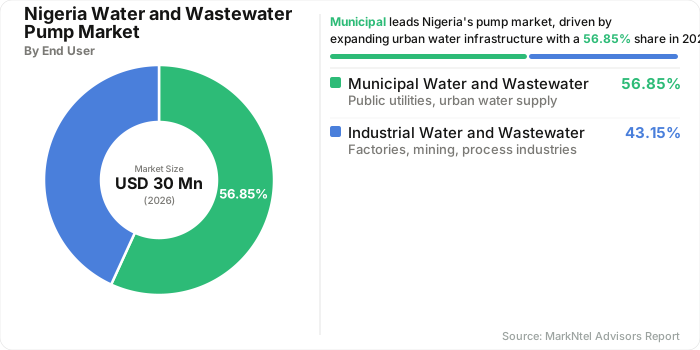
In 2025, the municipal water and wastewater segment emerged as the leading end user, accounting for 56.85% of the market share. This dominance is primarily driven by rapid urban population growth, widening gaps in centralized water infrastructure, and sustained government investments in water treatment plants, distribution networks, sewage systems, and flood management projects. Additionally, the ongoing rehabilitation of aging municipal facilities and expansion of urban water coverage continue to generate strong demand for high-capacity intake pumps, booster systems, and wastewater handling equipment.
Meanwhile, the industrial water and wastewater segment is projected to be the fastest-growing category, registering a CAGR of 3.73% during 2026–2032. This growth is supported by expanding manufacturing activities, rising industrial water consumption, stricter effluent discharge regulations, and increased adoption of on-site treatment and recycling systems.
Gain a Competitive Edge with Our Nigeria Water and Wastewater Pump Market Report:
- Nigeria Water and Wastewater Pump Market Report by MarkNtel Advisors provides a detailed & thorough analysis of market size & share, growth rate, competitive landscape, and key players. This comprehensive analysis helps businesses gain a holistic understanding of the market dynamics & make informed decisions.
- This report also highlights current market trends & future projections, allowing businesses to identify emerging opportunities & potential challenges. By understanding market forecasts, companies can align their strategies & stay ahead of the competition.
- Nigeria Water and Wastewater Pump Market Report aids in assessing & mitigating risks associated with entering or operating in the market. By understanding market dynamics, regulatory frameworks, and potential challenges, businesses can develop strategies to minimize risks & optimize their operations.
*Reports Delivery Format - Market research studies from MarkNtel Advisors are offered in PDF, Excel and PowerPoint formats. Within 24 hours of the payment being successfully received, the report will be sent to your email address.
Frequently Asked Questions
- Market Segmentation
- Introduction
- Product Definition
- Research Process
- Assumptions
- Executive Summary
- Nigeria Water and Wastewater Pump Market Policies, Regulations, and Product Standards
- Nigeria Water and Wastewater Pump Market Trends & Developments
- Nigeria Water and Wastewater Pump Market Dynamics
- Growth Factors
- Challenges
- Nigeria Water and Wastewater Pump Market Hotspot & Opportunities
- Nigeria Water and Wastewater Pump Market Outlook, 2022-2032F
- Market Size & Outlook
- By Revenues (USD Million)
- Market Share & Outlook
- By Pump Type- Market Size & Forecast 2022-2032, USD Million
- Centrifugal Pump
- Overhung Pump
- Vertical Inline
- Horizontal End Suction
- Split Case Pump
- Single/Two Stage
- Multistage
- Vertical Pump
- Turbine
- Solid handling
- Nonsolid handling
- Axial
- Mixed Flow
- Turbine
- Submersible Pump
- Solid Handling
- Non-solid Handling
- Overhung Pump
- Positive Displacement Pump
- Diaphragm Pump
- Piston Pump
- Gear Pump
- Lobe Pump
- Progressive Cavity Pump
- Screw Pump
- Vane Pump
- Peristaltic Pump
- Centrifugal Pump
- By End User- Market Size & Forecast 2022-2032, USD Million
- Municipal water and wastewater
- Industrial water and wastewater
- By Application- Market Size & Forecast 2022-2032, USD Million
- Water
- Wastewater
- By Company
- Competition Characteristics
- Market Share & Analysis
- By Pump Type- Market Size & Forecast 2022-2032, USD Million
- Market Size & Outlook
- Nigeria Centrifugal Pump Market Outlook, 2022-2032
- Market Size & Outlook
- By Revenues (USD Million)
- Market Share & Outlook
- By End User- Market Size & Forecast 2022-2032, USD Million
- By Application- Market Size & Forecast 2022-2032, USD Million
- Market Size & Outlook
- Nigeria Positive Displacement Pump Market Outlook, 2022-2032
- Market Size & Outlook
- By Revenues (USD Million)
- Market Share & Outlook
- By End User- Market Size & Forecast 2022-2032, USD Million
- By Application- Market Size & Forecast 2022-2032, USD Million
- Market Size & Outlook
- Nigeria Water and Wastewater Pump Market Key Strategic Imperatives for Success & Growth
- Competitive Outlook
- Company Profiles
- ITT
- Business Description
- Product Portfolio
- Collaborations & Alliances
- Recent Developments
- Financial Details
- Others
- IDEX
- Business Description
- Product Portfolio
- Collaborations & Alliances
- Recent Developments
- Financial Details
- Others
- Dover
- Business Description
- Product Portfolio
- Collaborations & Alliances
- Recent Developments
- Financial Details
- Others
- Flowserve
- Business Description
- Product Portfolio
- Collaborations & Alliances
- Recent Developments
- Financial Details
- Others
- Sulzer AG
- Business Description
- Product Portfolio
- Collaborations & Alliances
- Recent Developments
- Financial Details
- Others
- KSB
- Business Description
- Product Portfolio
- Collaborations & Alliances
- Recent Developments
- Financial Details
- Others
- Xylem
- Business Description
- Product Portfolio
- Collaborations & Alliances
- Recent Developments
- Financial Details
- Others
- Grundfos
- Business Description
- Product Portfolio
- Collaborations & Alliances
- Recent Developments
- Financial Details
- Others
- Ebara
- Business Description
- Product Portfolio
- Collaborations & Alliances
- Recent Developments
- Financial Details
- Others
- SPX Flow
- Business Description
- Product Portfolio
- Collaborations & Alliances
- Recent Developments
- Financial Details
- Others
- Others
- Business Description
- Product Portfolio
- Collaborations & Alliances
- Recent Developments
- Financial Details
- Others
- ITT
- Company Profiles
- Disclaimer
MarkNtel Advisors follows a robust and iterative research methodology designed to ensure maximum accuracy and minimize deviation in market estimates and forecasts. Our approach combines both bottom-up and top-down techniques to effectively segment and quantify various aspects of the market. A consistent feature across all our research reports is data triangulation, which examines the market from three distinct perspectives to validate findings. Key components of our research process include:
1. Scope & Research Design At the outset, MarkNtel Advisors define the research objectives and formulate pertinent questions. This phase involves determining the type of research—qualitative or quantitative—and designing a methodology that outlines data collection methods, target demographics, and analytical tools. They also establish timelines and budgets to ensure the research aligns with client goals.
2. Sample Selection and Data Collection In this stage, the firm identifies the target audience and determines the appropriate sample size to ensure representativeness. They employ various sampling methods, such as random or stratified sampling, based on the research objectives. Data collection is carried out using tools like surveys, interviews, and observations, ensuring the gathered data is reliable and relevant.
3. Data Analysis and Validation Once data is collected, MarkNtel Advisors undertake a rigorous analysis process. This includes cleaning the data to remove inconsistencies, employing statistical software for quantitative analysis, and thematic analysis for qualitative data. Validation steps are taken to ensure the accuracy and reliability of the findings, minimizing biases and errors.

4. Data Forecast and FinalizationThe final phase involves forecasting future market trends based on the analyzed data. MarkNtel Advisors utilize predictive modeling and time series analysis to anticipate market behaviors. The insights are then compiled into comprehensive reports, featuring visual aids like charts and graphs, and include strategic recommendations to inform client decision-making
We offer flexible licensing options to cater to varying organizational needs. Choose the pricing pack that best suits your requirements:
Buy Now Inquire Before Buying
 Request Customization
 Talk to our Consultant







