

Morocco HVAC Market Research Report: Forecast (2026-2032)
By Product Type (Room Air Conditioners (Window AC (Upto 1 Ton, 1 Ton to 2 Ton, Above 2 Ton), Split AC (Upto 1 Ton, 1 Ton to 1.5 Ton, Above 1.6 to 2 Ton, Above 2 Ton)), VRF Systems, ... Chillers (Air cooled chillers, Water cooled chillers, Others), Packaged Air Conditioners (Upto 5 Tons, 6 to 10 Tons, 11 to 20 Tons, Above 20 Tons), Cassette Air Conditioners (Upto 2 Tons, 2.1 to 4 Tons, 4.1 to 5 Tons, Above 5 Tons), Ducted Split Systems (Upto 5 Tons, 6 to 10 Tons, 11 to 20 Tons, Above 20 Tons), Boilers, Heat Pump, Others (Air Handling Units (AHU) / Fan Coil Units (FCU), etc.)), By Refrigerant Type- (R32, R410A, R134a, R290, R1234ze / R1234yf, Others), By Sales Channel- (Direct Sales, Authorized Dealers & Distributors, Multi Brand Stores, Online), By End User- (Residential, Offices, Retail & Malls, Hotels & Hospitality, Hospitals & Healthcare, Educational Institutions, Manufacturing, Pharmaceuticals, Food & Beverage, Data Centers, Others) Read more
- Environment
- Aug 2026
- Pages 145
- Report Format: PDF, Excel, PPT
Morocco HVAC Market
Projected 4.29% CAGR from 2026 to 2032
Study Period
2026-2032
Market Size (2026)
USD 398 Million
Market Size (2032)
USD 512 Million
Base Year
2025
Projected CAGR
4.29%
Leading Segments
By Product Type: Room Air Conditioners
Morocco HVAC Market Key Takeaways
- The Morocco HVAC market was valued at USD 376 million in 2025 and is projected to grow from USD 398 million in 2026 to USD 512 million by 2032.
- The industry is projected to witness steady growth at a CAGR of 29% during the forecast period, i.e., 2026–2032.
- By product type, room air conditioners dominate the market, accounting for 8% of the total market share in 2026.
- By end user, the residential segment holds the largest share at approximately 4% in 2026.
- The market is moderately fragmented, with the top five companies collectively accounting for 58% of the total market share in 2026.
Morocco HVAC Market Size and Outlook
The HVAC market size in the Morocco was valued at USD 376 million in 2025 and is projected to grow from USD 398 million in 2026 to USD 512 million by 2032. Along with this, the market is estimated to grow at a CAGR of around 4.29% during the forecast period, i.e., 2026-32, supported by sustained expansion in the construction sector, increasing investments in commercial and industrial infrastructure, rapid urbanization, and the rising adoption of energy-efficient climate control solutions. In addition, growing awareness of indoor air quality, coupled with the increasing preference for sustainable building designs, is encouraging the deployment of advanced heating, ventilation, and air conditioning systems across residential, commercial, healthcare, hospitality, and institutional facilities.
Morocco's expanding construction pipeline continues to create substantial demand for HVAC systems as climate control has become an essential component of modern infrastructure projects. According to the Haut-Commissariat au Plan (HCP), the country's construction sector recorded higher activity during the first quarter of 2025, with the capacity utilization rate reaching 72%, reflecting sustained momentum across civil engineering and specialized construction activities. This continued expansion is expected to drive the installation of air conditioning, ventilation, and commercial cooling systems across newly developed residential complexes, office buildings, hotels, hospitals, educational institutions, and mixed-use developments. Furthermore, increasing emphasis on energy-efficient buildings and the modernization of commercial infrastructure is accelerating the adoption of inverter-based, smart, and environmentally sustainable HVAC solutions, supporting the long-term growth of the Morocco HVAC industry.
Morocco HVAC Market Key Indicators
- According to Morocco's High Commission for Planning (HCP), the construction and public works sector grew by 5.0% in 2024, while Morocco's overall GDP expanded by 3.8%. Rising construction activity directly increases the installation of HVAC systems across residential, commercial, institutional, and mixed-use developments, thereby supporting the adoption of HCAC systems.
- Morocco welcomed a record 17.4 million international tourists in 2024, representing a 20% year-on-year increase, while tourism revenues reached MAD 112 billion. The country is targeting 26 million tourists by 2030, accelerating investments in hotels, resorts, airports, and hospitality infrastructure, all of which require extensive HVAC installations.
- Morocco's industrial sector recorded significant expansion in 2024, with industrial production increasing by 12%, industrial turnover reaching MAD 898 billion, and industrial investment rising by 30%. Expansion of automotive, aerospace, electrical equipment, and manufacturing facilities increases demand for industrial ventilation, process cooling, and climate-control systems, thereby supporting market growth.
- According to HCP, Morocco's manufacturing sector expanded by 3.3%, while the overall secondary sector grew by 4.2% in 2024. Manufacturing plants require ventilation, clean-air systems, chilled water systems, and industrial air-conditioning to maintain production efficiency, thereby driving HVAC demand.
- Morocco's electricity, gas, water, sanitation, and waste management sector grew by 2.6% in 2024, reflecting increasing energy demand and infrastructure expansion. Rising electricity consumption and greater cooling requirements encourage adoption of energy-efficient HVAC technologies across residential and commercial buildings.
- According to the World Bank, Morocco's gross fixed capital formation expanded by approximately 16.8% in 2025, supported by strong investments in infrastructure, commercial buildings, logistics, and industrial facilities. Such capital investments directly increase demand for HVAC equipment during new construction and renovation projects.
- Morocco continues strengthening its automotive manufacturing ecosystem, with a new EV battery gigafactory initially producing 10 GWh annually, planned to scale up to 100 GWh, while creating over 600 direct jobs in the first phase. Expansion of automotive and battery manufacturing facilities increases demand for industrial HVAC systems, clean-room ventilation, and precision climate control.
Morocco HVAC Market Scope
| Category | Segments |
|---|---|
| By Product Type | Room Air Conditioners (Window AC (Upto 1 Ton, 1 Ton to 2 Ton, Above 2 Ton), Split AC (Upto 1 Ton, 1 Ton to 1.5 Ton, Above 1.6 to 2 Ton, Above 2 Ton)), VRF Systems, Chillers (Air cooled chillers, Water cooled chillers, Others), Packaged Air Conditioners (Upto 5 Tons, 6 to 10 Tons, 11 to 20 Tons, Above 20 Tons), Cassette Air Conditioners (Upto 2 Tons, 2.1 to 4 Tons, 4.1 to 5 Tons, Above 5 Tons), Ducted Split Systems (Upto 5 Tons, 6 to 10 Tons, 11 to 20 Tons, Above 20 Tons), Boilers, Heat Pump, Others (Air Handling Units (AHU) / Fan Coil Units (FCU), etc. |
| By Refrigerant Type | R32, R410A, R134a, R290, R1234ze / R1234yf, Others |
| By Sales Channel | Direct Sales, Authorized Dealers & Distributors, Multi Brand Stores, Online |
| By End User | Residential, Offices, Retail & Malls, Hotels & Hospitality, Hospitals & Healthcare, Educational Institutions, Manufacturing, Pharmaceuticals, Food & Beverage, Data Centers, Others |
Morocco HVAC Market Growth Drivers
Expanding Infrastructure and Commercial Construction Activities Driving HVAC Demand
Morocco's expanding infrastructure pipeline and commercial construction activities are emerging as key growth drivers for the HVAC industry. Continued investments in transportation networks, public infrastructure, mixed-use developments, healthcare facilities, educational institutions, and commercial real estate are increasing the demand for modern climate control systems across newly constructed and renovated buildings. As developers increasingly prioritize occupant comfort, operational efficiency, and sustainable building practices, HVAC systems are becoming an integral component of building design.
Preparations for the 2030 FIFA World Cup are further accelerating construction activity across the country. The Moroccan government has allocated approximately USD 1.02 billion for the construction and modernization of major stadiums in Casablanca, Rabat, Tangier, Marrakech, Agadir, and Fez, alongside investments in airport expansion and transport infrastructure to accommodate the anticipated increase in visitors. These large-scale projects are expected to generate sustained demand for heating, ventilation, and air conditioning equipment across sports venues, hospitality facilities, commercial buildings, and public infrastructure, supporting market growth throughout the forecast period.
Recent Trends
Energy Efficiency Regulations Accelerating the Adoption of High-Efficiency HVAC Systems
Improving energy efficiency has become a defining trend in Morocco's HVAC market as regulatory developments increasingly influence equipment selection across residential and commercial buildings. End users are gradually shifting towards air conditioning systems that offer lower electricity consumption, improved operational performance, and compliance with evolving national energy efficiency requirements. This transition is encouraging greater adoption of high-efficiency cooling technologies while supporting Morocco's broader decarbonization objectives.
Morocco further reinforced this transition by introducing Decree No. 1529.24, which came into force in March 2025, updating the country's Minimum Energy Performance Standards (MEPS) and mandatory energy labeling requirements for air conditioners. The regulation establishes higher efficiency benchmarks for air conditioning equipment marketed within the country, accelerating the adoption of inverter-based systems, R32 refrigerant technologies, and smart energy-efficient HVAC solutions. As regulatory compliance increasingly becomes a purchasing criterion for distributors, developers, and end users, demand is expected to progressively shift toward advanced, high-efficiency HVAC systems throughout the forecast period.
Morocco HVAC Market Opportunities and Challenges
Growing Water Scarcity Creating Opportunities for Water-Efficient HVAC Technologies
Morocco's persistent water scarcity is increasingly influencing cooling infrastructure decisions across commercial and industrial facilities, where conventional water-cooled HVAC systems face rising operational constraints. The country's prolonged drought conditions and declining freshwater availability are shifting attention towards technologies capable of reducing water consumption without compromising cooling performance. This evolving resource landscape is reinforcing the importance of water-efficient HVAC solutions, particularly in water-intensive sectors such as manufacturing, hospitality, healthcare, and large commercial developments.
The strategic importance of this transition is reflected in Morocco's accelerated investments under the 2020–2027 National Drinking Water Supply and Irrigation Program (PNAEPI), which allocates approximately USD 15.4 billion to strengthen national water security through desalination, wastewater reuse, dam infrastructure, and improved water resource management. These initiatives underscore the government's recognition of long-term water scarcity as a structural challenge rather than a temporary climatic event. Consequently, demand is expected to strengthen for HVAC technologies that minimize water consumption, including air-cooled chillers, closed-loop cooling systems, hybrid cooling solutions, and intelligent building management platforms.
The increasing emphasis on water-efficient building operations is anticipated to create significant opportunities for manufacturers offering sustainable cooling technologies throughout the forecast period.
Segmentation Insights
Room Air Conditioners Lead Morocco's HVAC Product Landscape
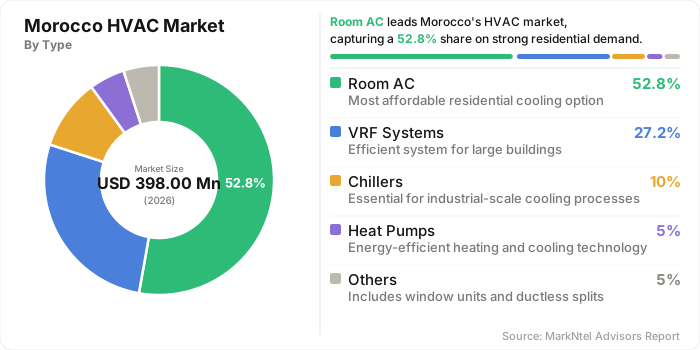
The room air conditioners (RAC) segment holds the largest share of the Morocco HVAC industry in 2026, accounting for approximately 52.8% of the overall market, making it the dominant product category. Morocco's expanding urban population, increasing residential construction, and rising household preference for affordable space cooling continue to position room air conditioners as the primary revenue contributor within the HVAC industry. Split air conditioners account for the majority of installations owing to their superior energy efficiency, quieter operation, and suitability for apartments and independent housing, while window air conditioners maintain demand in budget-conscious residential applications and selected commercial establishments. Beyond the residential sector, room air conditioners are extensively deployed across small offices, retail outlets, restaurants, educational institutions, and healthcare clinics where decentralized cooling solutions remain the preferred choice.
The segment's leadership is also supported by the broad availability of room air conditioners across multiple price points, making them the most accessible HVAC solution for households and small commercial establishments. International manufacturers continue to expand their residential product portfolios through inverter-based split systems, compact designs, and smart-enabled models that cater to evolving consumer preferences for improved comfort and convenience. In addition, the relatively lower installation complexity and maintenance requirements of room air conditioners, compared with centralized HVAC systems such as VRF units and chillers, encourage wider adoption across both new housing developments and existing buildings.
- Room Air Conditioners
- VRF Systems
- Chillers
- Packaged Air Conditioners
- Cassette Air Conditioners
- Ducted Split Systems
- Boilers
- Heat Pump
- Others
High-Efficiency HVAC Systems Accelerate the Adoption of R32 Refrigerant
The R32 segment holds the largest share of the Morocco HVAC market by refrigerant type in 2026, accounting for approximately 46.7% of the overall market. The segment's leadership is primarily driven by the growing adoption of room air conditioners and light commercial HVAC systems, where R32 has become the preferred refrigerant due to its superior cooling efficiency and lower environmental impact compared to conventional refrigerants.
As residential and commercial customers increasingly prioritize energy-efficient cooling solutions with lower operating costs, manufacturers are expanding their portfolios of R32-compatible products across split air conditioners, cassette units, packaged systems, and other light commercial applications. The refrigerant's favorable thermodynamic properties also enable manufacturers to develop compact, high-performance HVAC systems that align with evolving customer expectations for efficient cooling.
The segment's dominance is further supported by the growing availability of R32-based HVAC equipment from both global and regional manufacturers operating in Morocco. As the market witnesses increasing product launches featuring inverter technology and environmentally preferable refrigerants, distributors and contractors are strengthening their technical capabilities to support the installation and servicing of R32-compatible systems.
Furthermore, the continued replacement of aging air-conditioning equipment with next-generation cooling solutions is expected to increase the installed base of R32 systems, reinforcing the refrigerant's leading position throughout the forecast period.
- R32
- R410A
- R134a
- R290
- R1234ze / R1234yf
- Others
Morocco HVAC Market Competitive Analysis
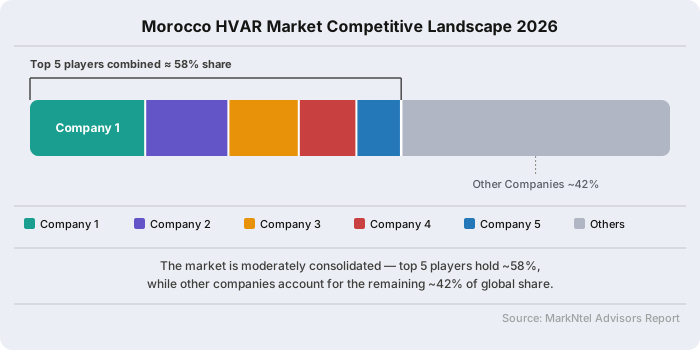
The Morocco HVAC market remains moderately consolidated, with the top five companies accounting for approximately 58% of the total market in 2026. The leading companies comprise Daikin Industries, LG Electronics, Samsung Electronics, Carrier Global, and Midea Group.
Top Companies in the Morocco HVAC Market
- Daikin Industries
- LG Electronics
- Samsung Electronics
- Carrier Global
- Midea Group
- Trane Technologies
- Johnson Controls
- Airwell Group
- Gree Electric Appliances
- Hisense HVAC
- Others
Morocco HVAC Industry News and Recent Developments
May 2024: Daikin Partners with OFPPT to Strengthen Morocco's HVAC-R Workforce
Daikin Middle East & Africa signed a Memorandum of Understanding (MoU) with Morocco's Office of Vocational Training and Employment Promotion (OFPPT) to strengthen vocational education in the HVAC-R sector. The partnership focuses on modernizing refrigeration and thermal engineering curricula, providing technical training for instructors, and creating internship opportunities through Daikin's partner network to develop a skilled workforce capable of supporting Morocco's growing demand for advanced HVAC systems.
Impact Analysis: The partnership is expected to strengthen Morocco's HVAC service ecosystem by improving the availability of qualified technicians for system installation, commissioning, and maintenance. A more skilled workforce is also likely to support wider adoption of advanced HVAC technologies while enhancing after-sales service quality and long-term industry development.
May 2025: H.Stars Showcases Commercial and Industrial HVAC Solutions at Refrigair Expo Casablanca
H.Stars Group participated in Refrigair Expo 2025 in Casablanca, where it showcased its portfolio of commercial and industrial HVAC equipment, including water-cooled chillers, air-cooled chillers, heat recovery systems, air handling units, and heat pumps. During the exhibition, the company held discussions with a Casablanca-based HVAC distributor regarding potential cooperation to expand the availability of its products in Morocco and the wider North African market. While no formal distribution agreement was announced, the engagement highlights growing international interest in Morocco's HVAC sector.
Impact Analysis: The development reflects Morocco's increasing attractiveness as a regional market for international HVAC equipment suppliers seeking local distribution partnerships. Continued participation by overseas manufacturers is expected to broaden equipment availability in the applied HVAC segment, strengthen competition within commercial and industrial cooling solutions, and encourage distributors to expand their technical capabilities and product offerings.
Frequently Asked Questions
- Market Segmentation
- Introduction
- Product Definition
- Research Process
- Assumptions
- Executive Summary
- Morocco HVAC Market Regulations, Policies, & Product Standards
- Morocco HVAC Market Imports, Exports Statistics
- Morocco HVAC Market Trends & Developments
- Morocco HVAC Market Dynamics
- Drivers
- Challenges
- Morocco HVAC Market Hotspots & Opportunities
- Morocco HVAC Market Outlook, 2022-2032
- Market Size & Analysis
- By Revenues (USD Million)
- Market Share & Analysis
- By Product Type- (USD Million & Thousand Units)
- Room Air Conditioners
- Window AC
- Upto 1 Ton
- 1 Ton to 2 Ton
- Above 2 Ton
- Split AC
- Upto 1 Ton
- 1 Ton to 1.5 Ton
- Above 1.6 to 2 Ton
- Above 2 Ton
- Window AC
- VRF Systems
- Chillers
- Air cooled chillers
- Water cooled chillers
- Others
- Packaged Air Conditioners
- Upto 5 Tons
- 6 to 10 Tons
- 11 to 20 Tons
- Above 20 Tons
- Cassette Air Conditioners
- Upto 2 Tons
- 2.1 to 4 Tons
- 4.1 to 5 Tons
- Above 5 Tons
- Ducted Split Systems
- Upto 5 Tons
- 6 to 10 Tons
- 11 to 20 Tons
- Above 20 Tons
- Boilers
- Heat Pump
- Others (Air Handling Units (AHU) / Fan Coil Units (FCU), etc.)
- Room Air Conditioners
- By Refrigerant Type- (USD Million)
- R32
- R410A
- R134a
- R290
- R1234ze / R1234yf
- Others
- By Sales Channel- (USD Million)
- Direct Sales
- Authorized Dealers & Distributors
- Multi Brand Stores
- Online
- By End User- (USD Million)
- Residential
- Offices
- Retail & Malls
- Hotels & Hospitality
- Hospitals & Healthcare
- Educational Institutions
- Manufacturing
- Pharmaceuticals
- Food & Beverage
- Data Centers
- Others
- By Company
- Competition Characteristics
- Market Share & Analysis
- By Product Type- (USD Million & Thousand Units)
- Market Size & Analysis
- Morocco Room Air Conditioners Market Outlook, 2022-2032
- Market Size & Analysis
- Market Share & Analysis
- Product Type- (USD Million)
- By Refrigerant Type- (USD Million)
- By Sales Channel- (USD Million)
- By End User- (USD Million)
- Morocco VRF Systems Market Outlook, 2022-2032
- Market Size & Analysis
- Market Revenues (USD Million)
- Market Share & Analysis
- By Refrigerant Type- (USD Million)
- By Sales Channel- (USD Million)
- By End User- (USD Million)
- Market Size & Analysis
- Morocco Chillers Market Outlook, 2022-2032
- Market Size & Analysis
- Market Revenues (USD Million)
- Market Share & Analysis
- Product Type- (USD Million)
- By Refrigerant Type- (USD Million)
- By Sales Channel- (USD Million)
- By End User- (USD Million)
- Market Size & Analysis
- Morocco Packaged Air Conditioners Market Outlook, 2022-2032
- Market Size & Analysis
- By Revenue (USD Million)
- Market Share & Analysis
- Product Type- (USD Million)
- By Refrigerant Type- (USD Million)
- By Sales Channel- (USD Million)
- By End User- (USD Million)
- Market Size & Analysis
- Morocco Cassette Air Conditioners Market Outlook, 2022-2032
- Market Size & Analysis
- Market Revenues (USD Million)
- Market Share & Analysis
- Product Type- (USD Million)
- By Refrigerant Type- (USD Million)
- By Sales Channel- (USD Million)
- By End User- (USD Million)
- Market Size & Analysis
- Morocco Ducted Split Systems Market Outlook, 2022-2032
- Market Size & Analysis
- Market Revenues (USD Million)
- Market Share & Analysis
- Product Type- (USD Million)
- By Refrigerant Type- (USD Million)
- By Sales Channel- (USD Million)
- By End User- (USD Million)
- Market Size & Analysis
- Morocco Boiler Market Outlook, 2022-2032
- Market Size & Analysis
- Market Revenues (USD Million)
- Market Share & Analysis
- By Refrigerant Type- (USD Million)
- By Sales Channel- (USD Million)
- By End User- (USD Million)
- Market Size & Analysis
- Morocco Heat Pump Market Outlook, 2022-2032
- Market Size & Analysis
- Market Revenues (USD Million)
- Market Share & Analysis
- By Refrigerant Type- (USD Million)
- By Sales Channel- (USD Million)
- By End User- (USD Million)
- Market Size & Analysis
- Morocco HVAC Market Key Strategic Imperatives for Success & Growth
- Competitive Outlook
- Company Profile
- Daikin Industries
- Business Description
- Product Portfolio
- Collaborations & Alliances
- Recent Developments
- Financial Details
- Others
- LG Electronics
- Business Description
- Product Portfolio
- Collaborations & Alliances
- Recent Developments
- Financial Details
- Others
- Samsung Electronics
- Business Description
- Product Portfolio
- Collaborations & Alliances
- Recent Developments
- Financial Details
- Others
- Carrier Global
- Business Description
- Product Portfolio
- Collaborations & Alliances
- Recent Developments
- Financial Details
- Others
- Midea Group
- Business Description
- Product Portfolio
- Collaborations & Alliances
- Recent Developments
- Financial Details
- Others
- Trane Technologies
- Business Description
- Product Portfolio
- Collaborations & Alliances
- Recent Developments
- Financial Details
- Others
- Johnson Controls
- Business Description
- Product Portfolio
- Collaborations & Alliances
- Recent Developments
- Financial Details
- Others
- Airwell Group
- Business Description
- Product Portfolio
- Collaborations & Alliances
- Recent Developments
- Financial Details
- Others
- Others
- Daikin Industries
- Company Profile
- Disclaimer
MarkNtel Advisors follows a robust and iterative research methodology designed to ensure maximum accuracy and minimize deviation in market estimates and forecasts. Our approach combines both bottom-up and top-down techniques to effectively segment and quantify various aspects of the market. A consistent feature across all our research reports is data triangulation, which examines the market from three distinct perspectives to validate findings. Key components of our research process include:
1. Scope & Research Design At the outset, MarkNtel Advisors define the research objectives and formulate pertinent questions. This phase involves determining the type of research—qualitative or quantitative—and designing a methodology that outlines data collection methods, target demographics, and analytical tools. They also establish timelines and budgets to ensure the research aligns with client goals.
2. Sample Selection and Data Collection In this stage, the firm identifies the target audience and determines the appropriate sample size to ensure representativeness. They employ various sampling methods, such as random or stratified sampling, based on the research objectives. Data collection is carried out using tools like surveys, interviews, and observations, ensuring the gathered data is reliable and relevant.
3. Data Analysis and Validation Once data is collected, MarkNtel Advisors undertake a rigorous analysis process. This includes cleaning the data to remove inconsistencies, employing statistical software for quantitative analysis, and thematic analysis for qualitative data. Validation steps are taken to ensure the accuracy and reliability of the findings, minimizing biases and errors.

4. Data Forecast and FinalizationThe final phase involves forecasting future market trends based on the analyzed data. MarkNtel Advisors utilize predictive modeling and time series analysis to anticipate market behaviors. The insights are then compiled into comprehensive reports, featuring visual aids like charts and graphs, and include strategic recommendations to inform client decision-making
We offer flexible licensing options to cater to varying organizational needs. Choose the pricing pack that best suits your requirements:
Buy Now Inquire Before Buying
 Request Customization
 Talk to our Consultant







