

Mexico Electric Two-Wheeler Market Research Report: Size, Share, Trends & Forecast (2026-2032)
By Type (Electric Motorcycles, Electric Scooters), By Battery Type (Nickel Metal Hybride Batteries, Sealed Lead Acid Batteries, Lithium-Ion Batteries), By Drive Type (Hub Drive Mot ... or, Mid Drive Motor), By Voltage (<48V, 48-60V, 61-72V, 73-96V, >96V), By Peak Power (<3 kW, 3–6 kW, 7–10 kW, >10 kW), By Battery Technology (Removable, Non-Removable), By Motor Placement (Hub Type, Chassis Mounted), and others Read more
- Automotive
- Feb 2026
- Pages 160
- Report Format: PDF, Excel, PPT
Mexico Electric Two-Wheeler Market
Projected 12.54% CAGR from 2026 to 2032
Study Period
2026-2032
Market Size (2026)
USD 0.32 Billion
Market Size (2032)
USD 0.65 Billion
Base Year
2025
Projected CAGR
12.54%
Leading Segments
By Type: Electric scooters
Mexico Electric Two-Wheeler Market Report Key Takeaways:
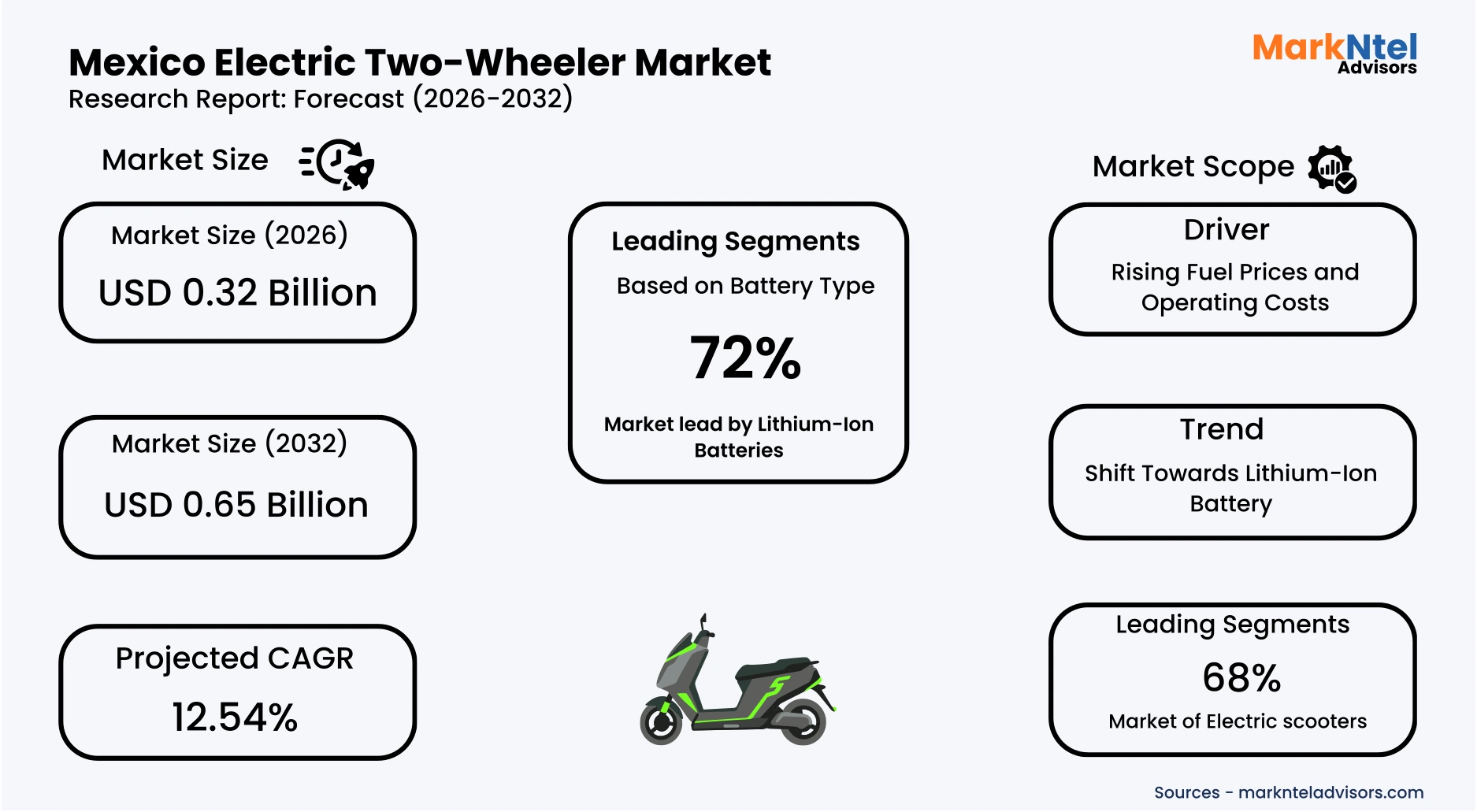
- The Mexico Electric Two-Wheeler market size was valued at USD 0.28 billion in 2025 and is projected to grow from USD 0.32 billion in 2026 to USD 0.65 billion by 2032, exhibiting a CAGR of 12.54% during the forecast period.
- By type, the electric scooters segment represented a significant share of about 68% in the Mexico Electric Two-Wheeler Market in 2026.
- By battery type, the Lithium-Ion batteries segment presented a significant share of about 72% in the Mexico Electric Two-Wheeler Market in 2026.
- Leading electric two-wheeler companies in the Mexico Market are BMW AG, GOVECS AG, Hero Electric Vehicles Pvt. Ltd., Mahindra GenZe, Terra Motors Corporation, Vmoto Limited, Zero Motorcycles Inc., NIU Technologies, Yadea Group, Italika, and Others.
Market Insights & Analysis: Mexico Electric Two-Wheeler Market (2026-32):
The Mexico Electric Two-Wheeler Market size was valued at approximately USD 0.28 billion in 2025 and is projected to grow from USD 0.32 billion in 2026 to USD 0.65 billion by 2032. Along with this, the market is estimated to grow at a CAGR of around 12.54% during the forecast period, i.e., 2026-32.
The Mexico electric two-wheeler market is positioned for steady growth, primarily supported by rising fuel prices and the cost advantages associated with electric mobility compared with conventional gasoline vehicles. Consumers are increasingly shifting toward affordable commuting options as fuel expenses fluctuate, while electric scooters and motorcycles offer lower maintenance requirements and reduced running costs per kilometer. These economic benefits are particularly attractive for urban commuters and last-mile delivery users, making cost efficiency one of the strongest adoption drivers across Mexico.
Government initiatives are also strengthening the long-term outlook of the sector. In 2025, the Mexican government launched the Olinia electric mobility initiative, allocating approximately USD 1.25 million to develop domestic electric vehicles through public-private partnerships. The program aims to promote local innovation, manufacturing capabilities, and clean transportation technologies, indirectly supporting the two-wheeler electrification ecosystem .
Financial accessibility is emerging as another major growth catalyst. BBVA Mexico allocated around USD 31 million per month toward financing electric and hybrid vehicles, representing a 47% year-over-year increase. Expanding green financing programs reduces upfront purchase barriers for consumers and small businesses, enabling wider adoption of electric mobility solutions, including two-wheelers that typically depend on affordable financing options for market penetration .
Technological advancements, particularly the expansion of lithium-ion battery adoption, are further accelerating market development. Declining battery costs, improved energy density, and longer operational life are enhancing vehicle performance and ownership value. Industrial investments are reinforcing this technological transition. For instance, Seojin Mobility is investing approximately USD 160 million in Nuevo León to manufacture electric mobility components, including motors for EV platforms. Such investments strengthen the domestic EV supply ecosystem and create positive spillover effects for light electric vehicles, including electric scooters and motorcycles .
Overall, the combination of economic savings, supportive government initiatives, accessible financing, and expanding industrial investment is creating a favorable environment for electric two-wheeler adoption. As Mexico continues to build its domestic EV ecosystem and improve affordability, consumer acceptance is expected to accelerate.
Mexico Electric Two-Wheeler Market Recent Developments:
- 2025: Yadea introduced new electric two-wheelers powered by advanced sodium-ion battery technology, offering faster charging and improved cold-weather performance. The innovation supports affordability and durability for emerging markets, including Latin America expansion strategies such as Mexico.
- 2025: Fly-E Group opened a new store in Mexico City to expand sales of electric motorcycles, scooters, and e-bikes, alongside a regional partnership to strengthen distribution. The move reflects rising demand for affordable urban mobility solutions across Latin America, including Mexico .
Mexico Electric Two-Wheeler Market Scope:
| Category | Segments |
|---|---|
| By Type | (Electric Motorcycles, Electric Scooters), |
| By Battery Type | (Nickel Metal Hybride Batteries, Sealed Lead Acid Batteries, Lithium-Ion Batteries), |
| By Drive Type | (Hub Drive Motor, Mid Drive Motor), |
| By Voltage | (<48V, 48-60V, 61-72V, 73-96V, >96V), |
| By Peak Power | (<3 kW, 3–6 kW, 7–10 kW, >10 kW), |
| By Battery Technology | (Removable, Non-Removable), |
| By Motor Placement | (Hub Type, Chassis Mounted), |
Mexico Electric Two-Wheeler Market Driver:
Rising Fuel Prices and Operating Costs
The steady increase in gasoline prices and vehicle operating costs in Mexico is a major factor accelerating demand for electric two-wheelers. In early 2025, the national average gasoline price reached about USD 1.16/L with premium fuel around USD 1.23/L, primarily driven by fuel taxes and global crude price volatility, according to government-linked data. Fuel taxes alone contribute significantly to retail prices, with excise duties forming a large portion of the final cost paid by consumers.
High fuel costs directly increase daily commuting expenses, especially for delivery riders and urban commuters who rely on motorcycles. Mexico also experienced periods without fuel subsidies during 2025, meaning consumers paid the full tax rate, further raising operating costs. Government data showed fuel tax revenue reaching USD 12 billion in the first half of 2025, reflecting sustained fuel price pressure .
Electric two-wheelers offer significantly lower running costs because electricity prices per kilometer are substantially lower than gasoline. This cost advantage becomes more attractive when fuel prices remain volatile or high.
Furthermore, Mexico’s broader energy and mobility transition plans, including investments in domestic refining, energy infrastructure, and cleaner transportation policies, are expected to reshape fuel economics and encourage the adoption of electric mobility solutions. Rising logistics and last-mile delivery demand will further increase the need for cost-efficient electric two-wheelers in urban areas.
Rising fuel prices increase the financial burden of gasoline motorcycles, making electric alternatives economically attractive. As fuel costs remain uncertain and mobility demand grows, this driver will strongly accelerate electric two-wheeler adoption in Mexico.
Mexico Electric Two-Wheeler Market Trend:
Shift Towards Lithium-Ion Battery
Lithium-ion battery is emerging as a major trend in Mexico’s electric two-wheeler market, primarily driven by rapid cost reductions, technological improvements, and growing domestic manufacturing investments. According to the International Energy Agency (IEA), lithium-ion battery prices declined from about USD 1,400 per kWh in 2010 to below USD 140 per kWh in 2023, reflecting a nearly 90% reduction driven by economies of scale and innovation. Lower battery costs directly improve the affordability and range performance of electric scooters and motorcycles, accelerating adoption in price-sensitive markets such as Mexico .
Recent global data also indicates that average battery costs dropped to nearly USD 213 per kWh in 2024, representing a 58% decline from 2019 levels. This cost trajectory is encouraging manufacturers to integrate higher-capacity lithium batteries into lightweight mobility vehicles, improving performance and lifecycle economics .
For example, according to the company announcement, BMW is investing about USD 800 million in its Mexico operations, including a high-voltage battery assembly facility to support next-generation EV production starting later this decade.
Additionally, in 2025, Hyundai Mobis inaugurated a battery plant expansion in Nuevo León with a USD 28.6 million investment, reinforcing Mexico’s role in North America’s electromobility manufacturing network .
Mexico Electric Two-Wheeler Market Opportunity:
Expanding Local Manufacturing & Assembly Capabilities
The expansion of domestic manufacturing and assembly capabilities presents a major opportunity for the Mexico electric two-wheeler market, supported by rising foreign investment and nearshoring trends. Mexico has increasingly positioned itself as a regional EV production hub due to its trade agreements, skilled labor, and proximity to the United States. For example, Chinese electric two-wheeler manufacturer Yadea announced plans to invest approximately USD 80 million to establish an assembly plant in Mexico, intended to serve both domestic demand and export markets across the Americas . This investment highlights growing confidence in Mexico as a strategic production base for electric mobility.
Domestic manufacturers are also strengthening local production capacity. Mexican motorcycle brand Italika operates large assembly facilities in Toluca with an annual capacity exceeding hundreds of thousands of units, demonstrating the country’s capability to scale two-wheeler manufacturing efficiently. Expansion of such facilities improves supply chain localization, reduces import dependency, and lowers vehicle costs, making electric models more affordable for consumers.
Furthermore, Mexico’s broader automotive investment boom, including EV-related manufacturing projects and government incentives for export-oriented production, creates spillover benefits for smaller electric mobility segments, including scooters and motorcycles. Localized production also supports job creation, technology transfer, and component ecosystem development, which can accelerate adoption rates nationwide.
Overall, increasing domestic assembly investments reduces costs and strengthens supply chains, positioning Mexico as a regional production hub and significantly accelerating electric two-wheeler market growth in the coming years.
Mexico Electric Two-Wheeler Market Challenge:
Limited Charging Infrastructure Impeding Market Growth
Limited charging infrastructure remains a major barrier to the growth of the Mexico electric two-wheeler market, primarily due to uneven deployment and restricted public accessibility. Although Mexico’s EV ecosystem is expanding, charging availability still lags behind adoption needs. For instance, Mexico had only 1,189 charging stations with 2,193 connectors by 2022, with several units either privately operated or not fully functional, highlighting early-stage infrastructure maturity .
More recent data indicate improvement but continued structural gaps. By 2025, the country had approximately 51,000 charging connectors, yet only around 3,665 were public, meaning most infrastructure was installed in private residences, corporate fleets, or restricted facilities. This limits accessibility for two-wheeler users who rely heavily on public or shared charging networks, particularly in urban commuting environments.
The challenge is further intensified by regional disparities, as charging stations remain concentrated in major metropolitan areas such as Mexico City and northern industrial corridors, leaving smaller cities underserved. According to insights published by Mexico Business News, infrastructure expansion requires stronger policy incentives, grid upgrades, and private-sector collaboration. Until nationwide public charging density improves, consumer confidence and large-scale adoption of electric two-wheelers in Mexico are likely to remain constrained despite favorable long-term demand potential.
Mexico Electric Two-Wheeler Market (2026-32) Segmentation Analysis:
The Mexico Electric Two-Wheeler Market study of MarkNtel Advisors evaluates & highlights the major trends and influencing factors in each segment. It includes predictions for the period 2026–32 at the country level. Based on the analysis, the market has been further classified as;
Based on Type:
-
- Electric Motorcycles
- Electric Scooters
Electric scooters dominate the Mexico electric two-wheeler market, accounting for approximately 68% share, primarily due to their affordability, convenience, and suitability for short-distance urban travel. In major Mexican cities, rising fuel prices, traffic congestion, and growing demand for last-mile delivery solutions have significantly increased scooter adoption among commuters and gig-economy workers. Scooters typically have lower purchase costs compared to electric motorcycles, making them accessible to middle-income consumers and small businesses.
Additionally, their lightweight design, ease of charging, and lower maintenance requirements further strengthen consumer preference. Government sustainability initiatives and urban mobility programs encouraging cleaner transportation options also support scooter demand growth. Fleet operators, including food delivery and courier companies, are increasingly deploying electric scooters because of their cost efficiency and operational flexibility. Moreover, improvements in battery technology, including removable battery options, have enhanced usability in dense urban environments where home charging infrastructure may be limited, reinforcing the segment’s leadership position.
Based on Battery Type:
- Nickel Metal Hybride Batteries
- Sealed Lead Acid Batteries
- Lithium-Ion Batteries
Lithium-ion batteries hold the largest share in the Mexico electric two-wheeler market, representing about 72%, mainly due to their superior performance, longer lifespan, and declining costs compared to traditional battery chemistries. These batteries offer higher energy density, enabling longer travel ranges and faster charging times, which are critical factors for both personal and commercial users. As consumer expectations shift toward reliable and efficient mobility solutions, manufacturers increasingly prefer lithium-ion technology to enhance vehicle performance and competitiveness. The growing presence of international electric vehicle brands in Mexico has also accelerated lithium-ion adoption, as most modern electric scooters and motorcycles are designed around this battery type.
Furthermore, advancements in battery management systems and improved safety features have increased consumer confidence. Government incentives promoting clean transportation and the gradual expansion of charging infrastructure are further encouraging lithium-ion battery deployment, helping this segment maintain its dominant market position across urban and semi-urban regions.
Mexico Electric Two-Wheeler Market (2026-32): Regional Projection
The electric two-wheeler market in Mexico is dominated by major urban regions, particularly Mexico City, Monterrey, and Guadalajara. These metropolitan areas lead adoption due to higher population density, increasing traffic congestion, stronger purchasing power, and better access to charging infrastructure than smaller cities. Government initiatives promoting sustainable mobility and air-quality improvement are concentrated in urban centers, accelerating electric vehicle acceptance. For example, Mexico City has implemented environmental policies encouraging cleaner transportation, while Monterrey and Guadalajara benefit from strong industrial ecosystems and logistics activity that support electric fleet deployment.
In addition, the presence of dealerships, financing options, and after-sales networks is higher in these regions, improving consumer confidence. Growing last-mile delivery demand from e-commerce and food delivery platforms further stimulates electric scooter and motorcycle usage in urban zones. As a result, these metropolitan clusters account for the largest share of Mexico’s electric two-wheeler demand overall currently.
Gain a Competitive Edge with Our Mexico Electric Two-Wheeler Market Report:
- Mexico Electric Two-Wheeler Market Report by MarkNtel Advisors provides a detailed & thorough analysis of market size & share, growth rate, competitive landscape, and key players. This comprehensive analysis helps businesses gain a holistic understanding of the market dynamics & make informed decisions.
- This report also highlights current market trends & future projections, allowing businesses to identify emerging opportunities & potential challenges. By understanding market forecasts, companies can align their strategies & stay ahead of the competition.
- Mexico Electric Two-Wheeler Market Report aids in assessing & mitigating risks associated with entering or operating in the market. By understanding market dynamics, regulatory frameworks, and potential challenges, businesses can develop strategies to minimize risks & optimize their operations.
*Reports Delivery Format - Market research studies from MarkNtel Advisors are offered in PDF, Excel and PowerPoint formats. Within 24 hours of the payment being successfully received, the report will be sent to your email address.
Frequently Asked Questions
- Market Segmentation
- Introduction
- Product Definition
- Research Process
- Assumptions
- Executive Summary
- Mexico Electric Two-Wheeler Market Policies, Regulations, and Product Standards
- Mexico Electric Two-Wheeler Market Trends & Developments
- Mexico Electric Two-Wheeler Market Dynamics
- Growth Factors
- Challenges
- Mexico Electric Two-Wheeler Market Hotspot & Opportunities
- Mexico Electric Two-Wheeler Market Outlook, 2022-2032F
- Market Size & Outlook
- By Revenues (USD Million)
- Market Share & Outlook
- By Type- Market Size & Forecast 2022-2032, USD Million
- Electric Motorcycles
- Electric Scooters
- By Battery Type- Market Size & Forecast 2022-2032, USD Million
- Nickel Metal Hybride Batteries
- Sealed Lead Acid Batteries
- Lithium-Ion Batteries
- By Drive Type- Market Size & Forecast 2022-2032, USD Million
- Hub Drive Motor
- Mid Drive Motor
- By Voltage- Market Size & Forecast 2022-2032, USD Million
- <48V
- 48-60V
- 61-72V
- 73-96V
- >96V
- By Peak Power- Market Size & Forecast 2022-2032, USD Million
- <3 kW
- 3–6 kW
- 7–10 kW
- >10 kW
- By Battery Technology- Market Size & Forecast 2022-2032, USD Million
- Removable
- Non-Removable
- By Motor Placement- Market Size & Forecast 2022-2032, USD Million
- Hub Type
- Chassis Mounted
- By Region- Market Size & Forecast 2022-2032, USD Million
- Northeast
- Midwest
- South
- West
- By Company
- Competition Characteristics
- Market Share & Analysis
- By Type- Market Size & Forecast 2022-2032, USD Million
- Market Size & Outlook
- Mexico Electric Motorcycles Market Outlook, 2022-2032
- Market Size & Outlook
- By Revenues (USD Million)
- Market Share & Outlook
- By Battery Type- Market Size & Forecast 2022-2032, USD Million
- By Drive Type- Market Size & Forecast 2022-2032, USD Million
- By Voltage- Market Size & Forecast 2022-2032, USD Million
- By Peak Power- Market Size & Forecast 2022-2032, USD Million
- By Battery Technology- Market Size & Forecast 2022-2032, USD Million
- By Motor Placement- Market Size & Forecast 2022-2032, USD Million
- By Region- Market Size & Forecast 2022-2032, USD Million
- Market Size & Outlook
- Mexico Electric Scooters Market Outlook, 2022-2032
- Market Size & Outlook
- By Revenues (USD Million)
- Market Share & Outlook
- By Battery Type- Market Size & Forecast 2022-2032, USD Million
- By Drive Type- Market Size & Forecast 2022-2032, USD Million
- By Voltage- Market Size & Forecast 2022-2032, USD Million
- By Peak Power- Market Size & Forecast 2022-2032, USD Million
- By Battery Technology- Market Size & Forecast 2022-2032, USD Million
- By Motor Placement- Market Size & Forecast 2022-2032, USD Million
- By Region- Market Size & Forecast 2022-2032, USD Million
- Market Size & Outlook
- Mexico Electric Two-Wheeler Market Key Strategic Imperatives for Success & Growth
- Competitive Outlook
- Company Profiles
- BMW AG
- Business Description
- Product Portfolio
- Collaborations & Alliances
- Recent Developments
- Financial Details
- Others
- GOVECS AG
- Business Description
- Product Portfolio
- Collaborations & Alliances
- Recent Developments
- Financial Details
- Others
- Hero Electric Vehicles Pvt. Ltd.
- Business Description
- Product Portfolio
- Collaborations & Alliances
- Recent Developments
- Financial Details
- Others
- Mahindra GenZe
- Business Description
- Product Portfolio
- Collaborations & Alliances
- Recent Developments
- Financial Details
- Others
- Terra Motors Corporation
- Business Description
- Product Portfolio
- Collaborations & Alliances
- Recent Developments
- Financial Details
- Others
- Vmoto Limited
- Business Description
- Product Portfolio
- Collaborations & Alliances
- Recent Developments
- Financial Details
- Others
- Zero Motorcycles Inc.
- Business Description
- Product Portfolio
- Collaborations & Alliances
- Recent Developments
- Financial Details
- Others
- NIU Technologies
- Business Description
- Product Portfolio
- Collaborations & Alliances
- Recent Developments
- Financial Details
- Others
- Yadea Group
- Business Description
- Product Portfolio
- Collaborations & Alliances
- Recent Developments
- Financial Details
- Others
- Italika
- Business Description
- Product Portfolio
- Collaborations & Alliances
- Recent Developments
- Financial Details
- Others
- BMW AG
- Company Profiles
- Disclaimer
MarkNtel Advisors follows a robust and iterative research methodology designed to ensure maximum accuracy and minimize deviation in market estimates and forecasts. Our approach combines both bottom-up and top-down techniques to effectively segment and quantify various aspects of the market. A consistent feature across all our research reports is data triangulation, which examines the market from three distinct perspectives to validate findings. Key components of our research process include:
1. Scope & Research Design At the outset, MarkNtel Advisors define the research objectives and formulate pertinent questions. This phase involves determining the type of research—qualitative or quantitative—and designing a methodology that outlines data collection methods, target demographics, and analytical tools. They also establish timelines and budgets to ensure the research aligns with client goals.
2. Sample Selection and Data Collection In this stage, the firm identifies the target audience and determines the appropriate sample size to ensure representativeness. They employ various sampling methods, such as random or stratified sampling, based on the research objectives. Data collection is carried out using tools like surveys, interviews, and observations, ensuring the gathered data is reliable and relevant.
3. Data Analysis and Validation Once data is collected, MarkNtel Advisors undertake a rigorous analysis process. This includes cleaning the data to remove inconsistencies, employing statistical software for quantitative analysis, and thematic analysis for qualitative data. Validation steps are taken to ensure the accuracy and reliability of the findings, minimizing biases and errors.

4. Data Forecast and FinalizationThe final phase involves forecasting future market trends based on the analyzed data. MarkNtel Advisors utilize predictive modeling and time series analysis to anticipate market behaviors. The insights are then compiled into comprehensive reports, featuring visual aids like charts and graphs, and include strategic recommendations to inform client decision-making
We offer flexible licensing options to cater to varying organizational needs. Choose the pricing pack that best suits your requirements:
Buy Now Inquire Before Buying
 Request Customization
 Talk to our Consultant







