

India Medical Robots Market Research Report: Forecast (2026-2032)
By Product type (Surgical Robots, Rehabilitation and prosthetics, Disinfection robots, Logistics and Delivery robots, Diagnostic and Telepresence robots), By Component (Hardware (R ... obotic Arms, Controllers, Sensors, Cameras & Imaging Systems, Displays & Consoles), Software (AI & Analytics, Navigation Software, Surgical Planning Software), Services (Installation, Maintenance, Training)), By Technology (AI-Based Robotics, Computer Vision-Based Robotics, Haptic Technology-Based Robotics, Image-Guided Robotics, Cloud-Connected Robotics), By Application (Laparoscopy, Orthopedics, Neurology, Cardiology, Pharmacy Automation, Others), By End users (Hospitals and Clinics, Ambulatory Surgery Centers (ASCs), Rehabilitation Centers, Research and Academic Institutions, Others), By Mobility (Fixed, Mobile Robots), By Level of Automation (Manual-Assisted, Semi-Autonomous, Autonomous), and others Read more
- Healthcare
- Jun 2026
- Pages 138
- Report Format: PDF, Excel, PPT
India Medical Robots Market
Projected 17.04% CAGR from 2026 to 2032
Study Period
2026-2032
Market Size (2026)
USD 142 Million
Market Size (2032)
USD 365 Million
Base Year
2025
Projected CAGR
17.04%
Leading Segments
By Product Type: Surgical Robots
India Medical Robots Market Key Takeaways
- The India Medical Robots market was valued at USD 129 million in 2025, reached USD 142 million in 2026, and is projected to grow to USD 365 million by 2032.
- The industry is projected to witness steady growth at a steady CAGR of 17.04% during the forecast period, i.e., 2026-32.
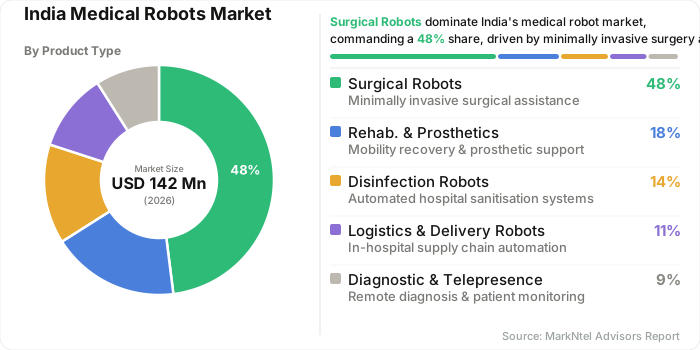
- Surgical robots dominated the market by product type, accounting for approximately 48% of total revenue in 2026.
- By mobility, fixed robotic systems held the largest market share of approximately 75% in 2026.
- South India emerged as the leading regional market, capturing approximately 40% of total revenue in 2026.
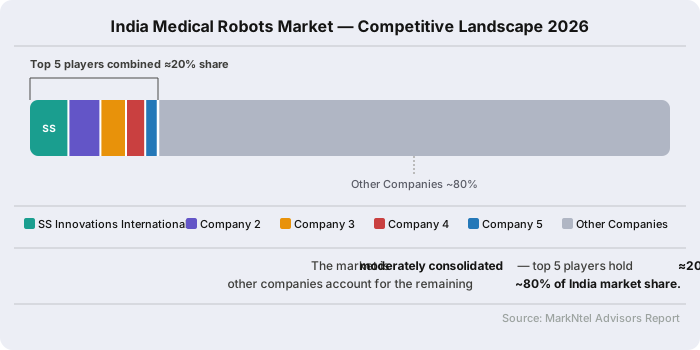
- The market is moderately consolidated, with the top five players collectively accounting for around 20% of total market revenue, reflecting competition from both global leaders and domestic innovators.
India Medical Robots Market Size and Outlook
The India Medical Robots Market is valued at USD 129 million in 2025, to USD 142 million in 2026 and is projected to reach USD 365 million by 2032, expanding at a CAGR of 17.04% during the forecast period. i.e., 2026-32.
This growth is underpinned by converging structural forces underpin this growth: a rapidly escalating burden of non-communicable diseases, accelerating investment in hospital infrastructure, and the commercial entry of cost-effective robotic-assisted surgery systems that are expanding procedural access beyond metropolitan centers. According to the World Health Organization, nearly 63% of all deaths in India are attributable to non-communicable diseases, including cardiovascular disease, cancer, and diabetes, creating sustained clinical demand for precision surgical interventions where robotic platforms deliver measurably superior patient outcomes.
Tertiary and specialty hospitals, the primary institutional end-users of minimally invasive surgery robots and rehabilitation systems, are receiving unprecedented public investment. The Government of India approved USD3.46 billion in allocations to states and union territories under the Pradhan Mantri Ayushman Bharat Health Infrastructure Mission (PM-ABHIM) for 2021–22 to 2025–26, as part of a total scheme outlay of ₹64,180 crore directed at strengthening primary, secondary, and tertiary care capacity.
Additionally, the Union Budget 2025–26 raised the total healthcare allocation by approximately 11% to USD 10.46 billion, with PM-ABHIM alone receiving USD 0.44 billion, a 40% increase over the prior year, directly expanding the hospital networks where AI-powered medical robots and surgical navigation systems are deployed.
The Ayushman Bharat Pradhan Mantri Jan Arogya Yojana (AB-PMJAY) had empaneled over 15,733 private hospitals as of December 2025, with the Ayushman Vay Vandana initiative extending coverage to all senior citizens aged 70 and above, a demographic disproportionately reliant on complex surgical procedures. This hospital network expansion, combined with digital healthcare transformation priorities embedded in the Ayushman Bharat Digital Mission, is accelerating procurement decisions for robotic diagnostic, surgical, and patient-care systems across both public and private hospital chains. Collectively, these demand-side, policy, and supply-side forces position this sector for sustained expansion through 2032.
India Medical Robots Market Key Indicators
- The Indian Council of Medical Research (ICMR), in data presented to the Lok Sabha in August 2025, reported 1,533,055 estimated new cancer cases in India for 2024, a patient volume that demands precision oncology interventions, directly accelerating adoption of robotic-assisted minimally invasive surgery systems in surgical oncology across tertiary hospitals.
- The International Diabetes Federation (IDF) Diabetes Atlas 11th Edition (2025) estimated 89.8 million adults in India were living with diabetes in 2024, the second-largest national burden globally, creating sustained demand for robotic diagnostics, automated pharmacy dispensing robots, and remote patient monitoring systems that reduce the clinical load of chronic disease management.
- India accounted for 2 million total orthopedic procedures in 2024, the third-highest national volume globally, driven by rising osteoarthritis, joint degeneration, and trauma cases; this procedure volume underpins growing procurement of India orthopedic surgery robotics platforms such as robotic knee arthroplasty and spinal navigation systems in private hospitals across Tier 1 cities.
- India's Ministry of Health and Family Welfare's Health Dynamics of India report, cited in Parliament in 2024, recorded a shortfall of 17,551 specialists, including surgeons, physicians, and pediatricians, across rural Community Health Centres; this chronic shortage of skilled robotic surgeons and specialist capacity accelerates procurement of surgical robotic systems as a force-multiplying solution in under-resourced facilities.
India Medical Robots Market Scope
| Category | Segments |
|---|---|
| By Product type | Surgical Robots, Rehabilitation and prosthetics, Disinfection robots, Logistics and Delivery robots, Diagnostic and Telepresence robots |
| By Component | Hardware (Robotic Arms, Controllers, Sensors, Cameras & Imaging Systems, Displays & Consoles), Software (AI & Analytics, Navigation Software, Surgical Planning Software), Services (Installation, Maintenance, Training |
| By Technology | AI-Based Robotics, Computer Vision-Based Robotics, Haptic Technology-Based Robotics, Image-Guided Robotics, Cloud-Connected Robotics |
| By Application | Laparoscopy, Orthopedics, Neurology, Cardiology, Pharmacy Automation, Others |
| By End users | Hospitals and Clinics, Ambulatory Surgery Centers (ASCs), Rehabilitation Centers, Research and Academic Institutions, Others |
| By Mobility | Fixed, Mobile Robots |
| By Level of Automation | Manual-Assisted, Semi-Autonomous, Autonomous |
India Medical Robots Industry Growth Drivers
Rising Demand for Minimally Invasive Surgery Driving Robotic System Procurement in Indian Hospitals
The growing adoption of robotic surgery in India is structurally anchored in the sustained patient and clinician shift toward minimally invasive surgical procedures, which require the precision, articulation, and three-dimensional visualization that only robotic platforms deliver. Conventional laparoscopic instruments cannot replicate the range of motion or depth perception needed for complex procedures in urology, oncology, and gynecology, making surgical robots the functionally necessary technology, not an optional upgrade. According to the Federation of Indian Chambers of Commerce and Industry (FICCI), patient preference for minimally invasive surgery grew by over 40% across urban hospitals in the five years through 2024, creating consistent procurement pressure on hospital management to install robotic systems to retain surgical volume and patient satisfaction.
This preference translated into measurable procedural output; for example, India recorded over 10,000 robotic surgeries in 2024 alone, spanning urology, oncology, cardiology, and gynecology across hospitals including Apollo, Fortis, Kokila Ben, and AIIMS, demonstrating that multi-specialty robotic adoption is now an institutional standard in leading tertiary facilities, not an experimental capability.
As procedure volumes rise and patient awareness deepens, hospitals that lack robotic capability face measurable competitive disadvantage in attracting both domestic and internationally referred surgical cases, sustaining capital expenditure on robotic systems as a structural market demand through the forecast period.
Recent Trends
Accelerating Adoption of AI-Guided Robotic Platforms Expanding Surgical Access Beyond Metro Hospitals in India
India's medical robotics sector is undergoing a sustained shift from passive robot-assistance toward AI-guided platforms embedding real-time decision-support, patient-specific 3D surgical planning, and precision instrument control directly into the operating workflow. In September 2025, AIIMS Delhi became the first government medical college in India to install Intuitive Surgical's da Vinci system under a formal MoU, making it the only institution nationwide housing two dedicated robotic training platforms: the da Vinci and Medtronic's Hugo, confirming AI-capable robotic systems are entering India's public tertiary infrastructure.
Moreover, in 2026, Shukra Pharmaceuticals signed an MoU with Borns Medical Robotics to commercialize the AI-driven Veer Surgical Robot across India, supported by a USD 62.8 million manufacturing facility at YEIDA's Medical Device Park, Greater Noida, with hospital deployment targeted from Q2 2026. As AI capabilities advance from planning tools into autonomous intraoperative tissue recognition, the range of procedures viable for robotic delivery will expand significantly, cementing AI-guided medical robots as the defining surgical technology standard through 2032.
India Medical Robots Industry Opportunities and Challenges
High Cost of Imported Surgical Robotic Systems Driving Domestic Manufacturing and Affordable Innovation in India
The prohibitive cost of robotic surgery systems in India remains the single most significant constraint on market-wide adoption, particularly for non-metropolitan hospitals that represent the majority of India's installed healthcare capacity. Internationally manufactured platforms such as Intuitive Surgical's da Vinci system are priced between USD 1.47 million and USD 2.09 million per unit in India, a capital threshold that smaller multi-Speciality hospitals, government institutions, and Tier 2 city facilities cannot absorb within standard procurement budgets.
The same cost pressure, however, is generating a commercially significant domestic manufacturing opportunity that is now translating into real investment commitments. The Government of India's Production Linked Incentive (PLI) Scheme for Medical Devices, with a total outlay of USD358 million and a 5% incentive on incremental sales through FY2026–27, is creating direct financial headroom for indigenous robotic manufacturers to price competitively against imported systems.
Additionally, SS Innovations, the early mover capturing this opening, dispatched over 103 SSi Mantra systems in 2025 alone, the first Indian medtech startup to achieve this deployment scale in a single year, and declared Tier 2 and Tier 3 city penetration its primary mandate for 2026. As affordable domestic platforms scale into non-metro hospitals, the cost-driven constraint will convert into the primary engine of volume expansion through 2032.
Segmentation Insights
Surgical Robots Lead as the Dominant Product Type in India's Medical Robots Market
Surgical robots account for approximately 48% of India's medical robots market, driven by their direct application in high-volume clinical specialties where precision, 3D visualization, and articulated instrument control are procedurally non-negotiable. Hospitals in India performed nearly 50,000 robotic procedures in 2025, of which 45,000 were conducted using da Vinci systems alone, per data from the Clinical Robotic Surgery Association, confirming that surgical robots are not an emerging capability but an institutionally embedded clinical standard across leading tertiary networks.
The procedural breadth of surgical platforms spanning urology, oncology, cardiac surgery, gynecology, and general surgery gives them an application versatility that no other robot category can match, cementing their revenue dominance. Among the fastest-growing sub-segments, rehabilitation and prosthetics are gaining traction as India's aging population drives demand for post-surgical recovery systems and mobility assistance devices.
Additionally, other factors like AIIMS Raipur launching its first robotic surgery and rehabilitation program in September 2025, focused specifically on urology and gynecology, signal that public institutions are now embedding both surgical and rehabilitative robotic capabilities as complementary investments .
As procedure volumes expand across Tier 2 cities and diagnostic and telepresence robots gain hospital procurement budgets, the product-type landscape will diversify progressively through 2032. By the product type, the market is further segmented into the following sub-categories:
- Surgical Robots
- Rehabilitation and prosthetics
- Disinfection Robots
- Logistics and Delivery Robots
- Diagnostic and Telepresence Robots
Fixed Robotic Systems Dominate India's Medical Robots Market by Mobility
Fixed robotic systems hold approximately 75% of India's medical robots market by mobility, supported by the deep infrastructure commitments of India's large tertiary hospital chains that install permanently stationed robotic surgical platforms as long-term capital assets in dedicated operating theatres. Fixed systems also benefit from integration with hospital IT infrastructure, EMR systems, and OR scheduling workflows, creating institutional switching costs that reinforce retention and repeat capital investment.
Mobile robotic systems, while currently a smaller share, represent the fastest-growing mobility sub-segment driven by India's expanding public hospital robotics mandate. For Instance, King George's Medical University (KGMU), Lucknow, deployed two indigenously developed robotic systems in May 2025 under a public-private partnership model offering the first 200 procedures free of cost, becoming the third government medical institute in Lucknow to operationalize robotic surgery alongside SGPGIMS and RMLIMS.
As government institutions across Tier 2 cities replicate this PPP (public-private partnership) deployment model and 5G connectivity, under the Digital India initiative, mobile robotic platforms will progressively expand the addressable hospital base, shift the fixed-mobile ratio, and enlarge total market volume through 2032. By mobility, the market is further segmented into the following sub-categories:
- Fixed
- Mobile Robots
India Medical Robots Industry Geographical Analysis
South India accounts for approximately 40% of India's medical robots market, anchored by the highest concentration of JCI and NABH-accredited multi-specialty hospital chains headquartered in this region, a structural advantage unique to this geography. Major Hospitals like Apollo Hospitals (Chennai), Narayana Health (Bengaluru), CARE Hospitals (Hyderabad), and Manipal Hospitals (Bengaluru) collectively operate the deepest installed base of robotic surgical systems in the country, making South India the primary hub for medical robotics applications in Indian healthcare across oncology, cardiac, urology, and orthopedic specialties.
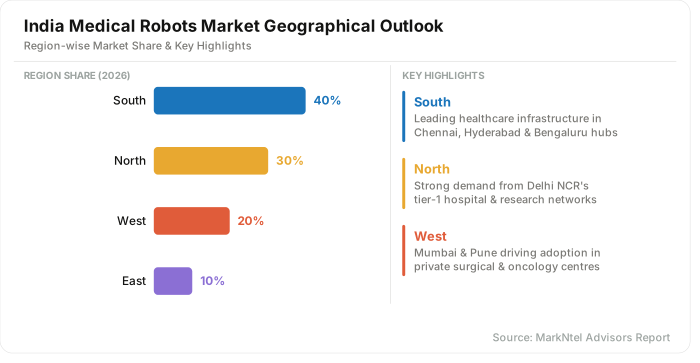
For Example, Tamil Nadu allocated USD 2.12 billion to healthcare in its 2024–25 state budget, an 8.2% increase over the prior year, directly expanding hospital procurement capacity for advanced surgical technologies. At the facility level, Narayana Health City Bengaluru completed over 100 robotic cardiac surgeries in a single month in March 2026, the highest monthly robotic cardiac volume at any Indian hospital, confirming Karnataka's position as the region's most active robotic surgery state.
Telangana's commissioning of nearly 7,000 new beds across five government super-specialty hospitals from December 2025 will generate a fresh institutional procurement wave for robotic systems across Hyderabad and beyond, sustaining the region's market leadership through 2032.
India Medical Robots Industry Competitive Landscape
The India medical robots market exhibits a moderately consolidated structure. The Robots market is led by key players such as Intuitive Surgical, SS Innovations International, Medtronic, Johnson & Johnson MedTech, and Meril Life Sciences India Private Limited, which collectively account for a significant share of the market through their advanced robotic platforms, strong hospital partnerships, and continuous investments in innovation and product development, with a combined share of 20%.
India Medical Robots Industry News and Recent Developments
2025: Meril Life Sciences Launches Mizzo Endo 4000 AI and 5G-Enabled Soft Tissue Surgical Robot Across 10 Surgical Specialties
Meril Life Sciences, headquartered in Vapi, Gujarat, launched the Mizzo Endo 4000 in September 2025, a next-generation, indigenously designed soft tissue surgical robotic system integrating AI-powered 3D anatomical mapping, haptic feedback, and 5G-enabled telesurgery in a single platform. The system is engineered to support procedures across 10 surgical specialties: general surgery, gynaecology, urology, thoracic, colorectal, bariatric, hepatobiliary, ENT, gastrointestinal, and oncology, making it one of the broadest procedure-scope robotic platforms commercially launched in India.
Impact analysis: The Mizzo Endo 4000 directly challenges imported platforms, particularly Intuitive Surgical's da Vinci, by offering a domestically manufactured, multi-specialty soft tissue robotic system at a competitive price point with integrated 5G telesurgery capabilities. Its 10-specialty procedure scope and indigenous design position it to capture demand across a broader range of Indian hospitals than orthopedic-only platforms, materially widening the addressable market and intensifying competitive pressure on established global robotic system providers operating in India.
2025: IIT Kharagpur Researchers Develop India's First AI-Powered Medical Robot ‘MedBot’ for Early Disease Prediction
In December 2025, researchers from IIT Kharagpur developed MedBot, an AI-enabled medical robot designed to autonomously monitor patient vital signs and identify early indicators of chronic diseases before symptoms appear. The robot measures blood pressure, glucose levels, oxygen saturation, heart rate, and body temperature while integrating data into electronic health records. MedBot also features robotic arms capable of performing routine patient-assistance tasks. Pilot deployments in private hospitals are planned to evaluate its clinical effectiveness.
Impact analysis: The development of MedBot highlights India's growing capabilities in indigenous healthcare robotics and AI-driven medical technologies. The innovation could improve hospital efficiency by reducing manual monitoring workloads and supporting early disease detection. It also strengthens the adoption of intelligent robotic assistants beyond surgical applications, expanding the scope of the medical robots market. Furthermore, successful commercialization could encourage additional investments in AI-powered healthcare automation solutions across India.
2026: Shukra Pharma Signs MoU with US-Based Borns Medical Robotics to Commercialize AI-Powered Surgical
Shukra Pharmaceuticals, through its subsidiary Shukra Robotics, entered into an MoU with US-based Borns Medical Robotics in January 2026. The partnership aims to introduce and commercialize next-generation AI-enabled soft-tissue surgical robotic systems across India and selected South Asian countries.
Impact analysis: The partnership is expected to accelerate the adoption of advanced surgical robotics in India by improving access to minimally invasive procedures. It strengthens technology transfer and skill development within the country's healthcare ecosystem. The collaboration may increase competition in the surgical robotics segment and encourage further investments in indigenous robotic healthcare infrastructure. Additionally, it supports the broader trend of AI integration in medical robotics and digital surgery platforms.
Frequently Asked Questions
- Market Segmentation
- Introduction
- Product Definition
- Research Process
- Assumptions
- Executive Summary
- India Medical Robots Market Policies, Regulations, and Product Standards
- India Medical Robots Market Trends & Developments
- India Medical Robots Market Dynamics
- Growth Factors
- Challenges
- India Medical Robots Market Hotspot & Opportunities
- India Medical Robots Market Outlook, 2022-2032F
- Market Size & Outlook
- By Revenues (USD Million)
- Market Share & Outlook
- By Product type- Market Size & Forecast 2022-2032, USD Million
- Surgical Robots
- Rehabilitation and prosthetics
- Disinfection robots
- Logistics and Delivery robots
- Diagnostic and Telepresence robots
- By Component- Market Size & Forecast 2022-2032, USD Million
- Hardware
- Robotic Arms
- Controllers
- Sensors
- Cameras & Imaging Systems
- Displays & Consoles
- Software
- AI & Analytics
- Navigation Software
- Surgical Planning Software
- Services
- Installation
- Maintenance
- Training
- Hardware
- By Technology- Market Size & Forecast 2022-2032, USD Million
- AI-Based Robotics
- Computer Vision-Based Robotics
- Haptic Technology-Based Robotics
- Image-Guided Robotics
- Cloud-Connected Robotics
- By Application- Market Size & Forecast 2022-2032, USD Million
- Laparoscopy
- Orthopedics
- Neurology
- Cardiology
- Pharmacy Automation
- Others
- By End users- Market Size & Forecast 2022-2032, USD Million
- Hospitals and Clinics
- Ambulatory Surgery Centers (ASCs)
- Rehabilitation Centers
- Research and Academic Institutions
- Others
- By Mobility- Market Size & Forecast 2022-2032, USD Million
- Fixed
- Mobile Robots
- By Level of Automation- Market Size & Forecast 2022-2032, USD Million
- Manual-Assisted
- Semi-Autonomous
- Autonomous
- By region- Market Size & Forecast 2022-2032, USD Million
- North
- National Capital Region (Delhi NCR)
- Uttar Pradesh
- Punjab
- Rajasthan
- South
- Karnataka
- Tamil Nadu
- Kerala
- East
- West Bengal
- Odisha
- West
- Maharashtra
- Gujarat
- Madhya Pradesh
- North
- By Company
- Competition Characteristics
- Market Share & Analysis
- By Product type- Market Size & Forecast 2022-2032, USD Million
- Market Size & Outlook
- India Fixed Medical Robots Market Outlook, 2022-2032
- Market Size & Outlook
- By Revenues (USD Million)
- Market Share & Outlook
- By Component- Market Size & Forecast 2022-2032, USD Million
- By Technology- Market Size & Forecast 2022-2032, USD Million
- By Application- Market Size & Forecast 2022-2032, USD Million
- By End users- Market Size & Forecast 2022-2032, USD Million
- By Mobility- Market Size & Forecast 2022-2032, USD Million
- By Level of Automation- Market Size & Forecast 2022-2032, USD Million
- By region- Market Size & Forecast 2022-2032, USD Million
- Market Size & Outlook
- India Mobile Medical Robots Market Outlook, 2022-2032
- Market Size & Outlook
- By Revenues (USD Million)
- Market Share & Outlook
- By Component- Market Size & Forecast 2022-2032, USD Million
- By Technology- Market Size & Forecast 2022-2032, USD Million
- By Application- Market Size & Forecast 2022-2032, USD Million
- By End users- Market Size & Forecast 2022-2032, USD Million
- By Mobility- Market Size & Forecast 2022-2032, USD Million
- By Level of Automation- Market Size & Forecast 2022-2032, USD Million
- By region- Market Size & Forecast 2022-2032, USD Million
- Market Size & Outlook
- India Medical Robots Market Key Strategic Imperatives for Success & Growth
- Competitive Outlook
- Company Profiles
- Curneu Medtech Private Limited
- Business Description
- Product Portfolio
- Collaborations & Alliances
- Recent Developments
- Financial Details
- Others
- SS Innovations International, Inc.
- Business Description
- Product Portfolio
- Collaborations & Alliances
- Recent Developments
- Financial Details
- Others
- Theranautilus Private Limited
- Business Description
- Product Portfolio
- Collaborations & Alliances
- Recent Developments
- Financial Details
- Others
- DiFACTO Robotics and Automation Private Limited
- Business Description
- Product Portfolio
- Collaborations & Alliances
- Recent Developments
- Financial Details
- Others
- Stryker India Private Limited
- Business Description
- Product Portfolio
- Collaborations & Alliances
- Recent Developments
- Financial Details
- Others
- Intuitive Surgical
- Business Description
- Product Portfolio
- Collaborations & Alliances
- Recent Developments
- Financial Details
- Others
- Medtronic
- Business Description
- Product Portfolio
- Collaborations & Alliances
- Recent Developments
- Financial Details
- Others
- Johnson & Johnson MedTech
- Business Description
- Product Portfolio
- Collaborations & Alliances
- Recent Developments
- Financial Details
- Others
- CMR Surgical
- Business Description
- Product Portfolio
- Collaborations & Alliances
- Recent Developments
- Financial Details
- Others
- Zimmer India Pvt. Ltd.
- Business Description
- Product Portfolio
- Collaborations & Alliances
- Recent Developments
- Financial Details
- Others
- Meril Life Sciences India Private Limited
- Business Description
- Product Portfolio
- Collaborations & Alliances
- Recent Developments
- Financial Details
- Others
- Curneu Medtech Private Limited
- Company Profiles
- Disclaimer
MarkNtel Advisors follows a robust and iterative research methodology designed to ensure maximum accuracy and minimize deviation in market estimates and forecasts. Our approach combines both bottom-up and top-down techniques to effectively segment and quantify various aspects of the market. A consistent feature across all our research reports is data triangulation, which examines the market from three distinct perspectives to validate findings. Key components of our research process include:
1. Scope & Research Design At the outset, MarkNtel Advisors define the research objectives and formulate pertinent questions. This phase involves determining the type of research—qualitative or quantitative—and designing a methodology that outlines data collection methods, target demographics, and analytical tools. They also establish timelines and budgets to ensure the research aligns with client goals.
2. Sample Selection and Data Collection In this stage, the firm identifies the target audience and determines the appropriate sample size to ensure representativeness. They employ various sampling methods, such as random or stratified sampling, based on the research objectives. Data collection is carried out using tools like surveys, interviews, and observations, ensuring the gathered data is reliable and relevant.
3. Data Analysis and Validation Once data is collected, MarkNtel Advisors undertake a rigorous analysis process. This includes cleaning the data to remove inconsistencies, employing statistical software for quantitative analysis, and thematic analysis for qualitative data. Validation steps are taken to ensure the accuracy and reliability of the findings, minimizing biases and errors.

4. Data Forecast and FinalizationThe final phase involves forecasting future market trends based on the analyzed data. MarkNtel Advisors utilize predictive modeling and time series analysis to anticipate market behaviors. The insights are then compiled into comprehensive reports, featuring visual aids like charts and graphs, and include strategic recommendations to inform client decision-making
We offer flexible licensing options to cater to varying organizational needs. Choose the pricing pack that best suits your requirements:
Buy Now Inquire Before Buying
 Request Customization
 Talk to our Consultant







